More Related Content


Similar to Capacitance of the cables


Capacitance of the cables
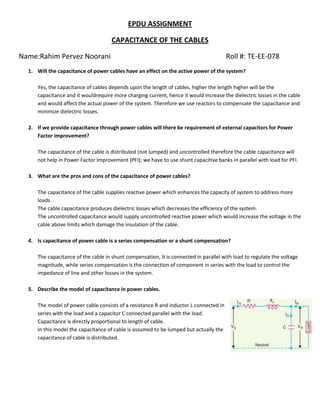
- 1. EPDU ASSIGNMENT CAPACITANCE OF THE CABLES Name:Rahim Pervez Noorani Roll #: TE-EE-078 1. Will the capacitance of power cables have an effect on the active power of the system? Yes, the capacitance of cables depends upon the length of cables, higher the length higher will be the capacitance and it wouldrequire more charging current, hence it would increase the dielectric losses in the cable and would affect the actual power of the system. Therefore we use reactors to compensate the capacitance and minimize dielectric losses. 2. If we provide capacitance through power cables will there be requirement of external capacitors for Power Factor improvement? The capacitance of the cable is distributed (not lumped) and uncontrolled therefore the cable capacitance will not help in Power Factor Improvement (PFI); we have to use shunt capacitive banks in parallel with load for PFI. 3. What are the pros and cons of the capacitance of power cables? The capacitance of the cable supplies reactive power which enhances the capacity of system to address more loads. The cable capacitance produces dielectric losses which decreases the efficiency of the system. The uncontrolled capacitance would supply uncontrolled reactive power which would increase the voltage in the cable above limits which damage the insulation of the cable. 4. Is capacitance of power cable is a series compensation or a shunt compensation? The capacitance of the cable in shunt compensation, it is connected in parallel with load to regulate the voltage magnitude, while series compensation is the connection of component in series with the load to control the impedance of line and other losses in the system. 5. Describe the model of capacitance in power cables. The model of power cable consists of a resistance R and inductor L connected in series with the load and a capacitor C connected parallel with the load. Capacitance is directly proportional to length of cable. In this model the capacitance of cable is assumed to be lumped but actually the capacitance of cable is distributed.