Electrical and Electronic
Principles
Capacitors
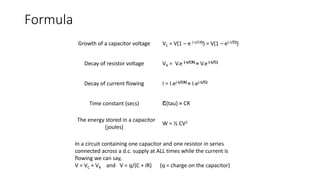
Formula
Growth of a capacitor voltage VC = V(1 – e (-t/CR)) = V(1 – e(-t/Շ))
Decay of resistor voltage VR = V.e (-t/CR) = V.e (-t/Շ)
Decay of current flowing I = I.e(-t/CR) = I.e(-t/Շ)
Time constant (secs) Շ(tau) = CR
The energy stored in a capacitor
(joules)
W = ½ CV2
Equations
The following equations may be useful in this assignment:
In a circuit containing one capacitor and one resistor in series connected across a d.c. supply at ALL times while the current is flowing we can say,
V = VC + VR and V = q/(C + iR) (q = charge on the capacitor)
In a circuit containing one capacitor and one resistor in series
connected across a d.c. supply at ALL times while the current is
flowing we can say,
V = VC + VR and V = q/(C + iR) (q = charge on the capacitor)
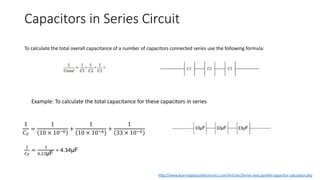
Capacitors in Series Circuit
To calculate the total overall capacitance of a number of capacitors connected series use the following formula:
Example: To calculate the total capacitance for these capacitors in series
10μF 10μF 33μF
1
𝐶 𝑇
=
1
10 × 10−6
+
1
10 × 10−6
+
1
33 × 10−6
1
𝐶 𝑇
=
1
0.23μF
= 4.34μF
http://www.learningaboutelectronics.com/Articles/Series-and-parallel-capacitor-calculator.php
Capacitors in Parallel Circuit
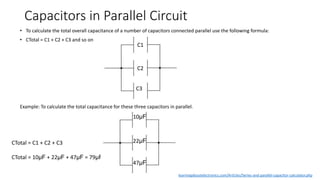
• To calculate the total overall capacitance of a number of capacitors connected parallel use the following formula:
• CTotal = C1 + C2 + C3 and so on
CTotal = C1 + C2 + C3
CTotal = 10μF + 22μF + 47μF = 79μF
C1
C2
C3
Example: To calculate the total capacitance for these three capacitors in parallel.
http://www.learningaboutelectronics.com/Articles/Series-and-parallel-capacitor-calculator.php
22μF
10μF
47μF
Capacitors in Parallel Circuit
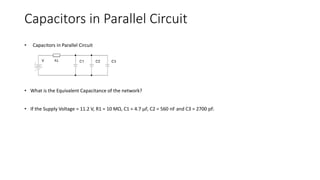
• Capacitors in Parallel Circuit
• What is the Equivalent Capacitance of the network?
• If the Supply Voltage = 11.2 V, R1 = 10 MΩ, C1 = 4.7 μF, C2 = 560 nF and C3 = 2700 pF.
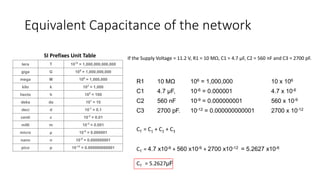
Equivalent Capacitance of the network
tera T 1012
= 1,000,000,000,000
giga G 109
= 1,000,000,000
mega M 106
= 1,000,000
kilo k 103
= 1,000
hecto h 102
= 100
deka da 101
= 10
deci d 10-1
= 0.1
centi c 10-2
= 0.01
milli m 10-3
= 0.001
micro µ 10-6
= 0.000001
nano n 10-9
= 0.000000001
pico p 10-12
= 0.000000000001
SI Prefixes Unit Table
R1 10 MΩ 106 = 1,000,000 10 x 106
C1 4.7 μF, 10-6 = 0.000001 4.7 x 10⁻⁶
C2 560 nF 10-9 = 0.000000001 560 x 10-9
C3 2700 pF. 10-12 = 0.000000000001 2700 x 10-12
If the Supply Voltage = 11.2 V, R1 = 10 MΩ, C1 = 4.7 μF, C2 = 560 nF and C3 = 2700 pF.
CT = C1 + C2 + C3
CT = 4.7 x10⁻⁶ + 560 x10-9 + 2700 x10-12 = 5.2627 x10⁻⁶
CT = 5.2627μF
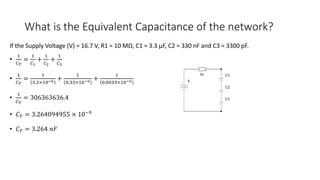
What is the Equivalent Capacitance of the network?
If the Supply Voltage (V) = 16.7 V, R1 = 10 MΩ, C1 = 3.3 μF, C2 = 330 nF and C3 = 3300 pF.
•
1
𝐶 𝑇
=
1
𝐶1
+
1
𝐶2
+
1
𝐶3
•
1
𝐶 𝑇
=
1
3.3×10⁻⁶ +
1
0.33×10⁻⁶ +
1
0.0033×10⁻⁶
•
1
𝐶 𝑇
= 306363636.4
• 𝐶 𝑇 = 3.264094955 × 10⁻⁹
• 𝐶 𝑇 = 3.264 𝑛𝐹
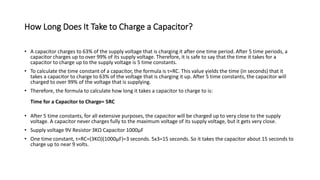
How Long Does It Take to Charge a Capacitor?
• A capacitor charges to 63% of the supply voltage that is charging it after one time period. After 5 time periods, a
capacitor charges up to over 99% of its supply voltage. Therefore, it is safe to say that the time it takes for a
capacitor to charge up to the supply voltage is 5 time constants.
• To calculate the time constant of a capacitor, the formula is τ=RC. This value yields the time (in seconds) that it
takes a capacitor to charge to 63% of the voltage that is charging it up. After 5 time constants, the capacitor will
charged to over 99% of the voltage that is supplying.
• Therefore, the formula to calculate how long it takes a capacitor to charge to is:
Time for a Capacitor to Charge= 5RC
• After 5 time constants, for all extensive purposes, the capacitor will be charged up to very close to the supply
voltage. A capacitor never charges fully to the maximum voltage of its supply voltage, but it gets very close.
• Supply voltage 9V Resistor 3KΩ Capacitor 1000µF
• One time constant, τ=RC=(3KΩ)(1000µF)=3 seconds. 5x3=15 seconds. So it takes the capacitor about 15 seconds to
charge up to near 9 volts.
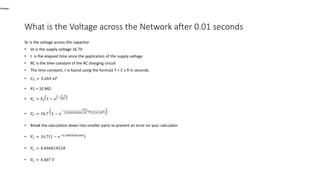
What is the Voltage across the Network after 0.01 seconds
Vc is the voltage across the capacitor
• Vs is the supply voltage 16.7V
• t is the elapsed time since the application of the supply voltage
• RC is the time constant of the RC charging circuit
• The time constant, τ is found using the formula T = C x R in seconds.
• 𝐶 𝑇 = 3.264 𝑛𝐹
• R1 = 10 MΩ
• 𝑉𝐶 = 𝑉𝑆 1 − 𝑒
−
𝑡
𝐶𝑅
• 𝑉𝐶 = 16.7 1 − 𝑒
−
0.01
0.003264094×10−6 × 10×106
• Break the calculation down into smaller parts to prevent an error on your calculator.
• 𝑉𝐶 = 16.7 1 − 𝑒−0.3063636364
• 𝑉𝐶 = 4.406814518
• 𝑉𝐶 = 4.407 𝑉
What is the Voltage accross the Network after 50 seconds?
Answer:
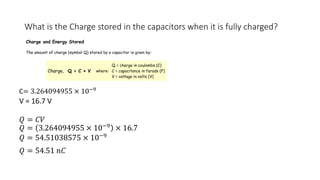
What is the Charge stored in the capacitors when it is fully charged?
C= 3.264094955 × 10⁻⁹
V = 16.7 V
𝑄 = 𝐶𝑉
𝑄 = 3.264094955 × 10−9
× 16.7
𝑄 = 54.51038575 × 10⁻⁹
𝑄 = 54.51 𝑛𝐶
Charge and Energy Stored
The amount of charge (symbol Q) stored by a capacitor is given by:
Charge, Q = C × V where:
Q = charge in coulombs (C)
C = capacitance in farads (F)
V = voltage in volts (V)
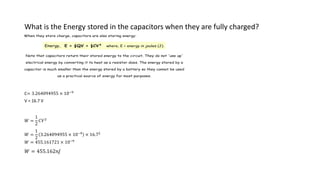
What is the Energy stored in the capacitors when they are fully charged?
C= 3.264094955 × 10⁻⁹
V = 16.7 V
𝑊 =
1
2
𝐶𝑉2
𝑊 =
1
2
3.264094955 × 10−9
× 16.72
𝑊 = 455.161721 × 10⁻⁹
𝑊 = 455.162𝑛𝐽
When they store charge, capacitors are also storing energy:
Energy, E = ½QV = ½CV² where, E = energy in joules (J).
Note that capacitors return their stored energy to the circuit. They do not 'use up'
electrical energy by converting it to heat as a resistor does. The energy stored by a
capacitor is much smaller than the energy stored by a battery so they cannot be used
as a practical source of energy for most purposes.
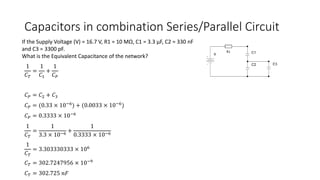
Capacitors in combination Series/Parallel Circuit
If the Supply Voltage (V) = 16.7 V, R1 = 10 MΩ, C1 = 3.3 μF, C2 = 330 nF
and C3 = 3300 pF.
What is the Equivalent Capacitance of the network?
1
𝐶 𝑇
=
1
𝐶1
+
1
𝐶 𝑃
𝐶 𝑃 = 𝐶2 + 𝐶3
𝐶 𝑃 = (0.33 × 10⁻⁶) + (0.0033 × 10⁻⁶)
𝐶 𝑃 = 0.3333 × 10⁻⁶
1
𝐶 𝑇
=
1
3.3 × 10⁻⁶
+
1
0.3333 × 10⁻⁶
1
𝐶 𝑇
= 3.303330333 × 10⁶
𝐶 𝑇 = 302.7247956 × 10⁻⁹
𝐶 𝑇 = 302.725 𝑛𝐹
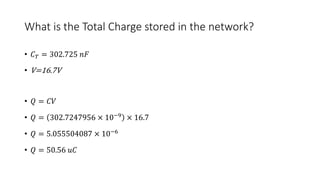
What is the Total Charge stored in the network?
• 𝐶 𝑇 = 302.725 𝑛𝐹
• V=16.7V
• 𝑄 = 𝐶𝑉
• 𝑄 = 302.7247956 × 10−9
× 16.7
• 𝑄 = 5.055504087 × 10⁻⁶
• 𝑄 = 50.56 𝑢𝐶
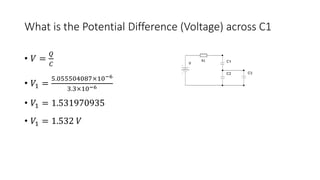
What is the Potential Difference (Voltage) across C1
• 𝑉 =
𝑄
𝐶
• 𝑉1 =
5.055504087×10⁻⁶
3.3×10⁻⁶
• 𝑉1 = 1.531970935
• 𝑉1 = 1.532 𝑉
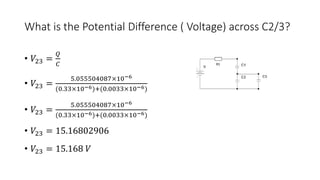
What is the Potential Difference ( Voltage) across C2/3?
• 𝑉23 =
𝑄
𝐶
• 𝑉23 =
5.055504087×10⁻⁶
(0.33×10⁻⁶)+(0.0033×10⁻⁶)
• 𝑉23 =
5.055504087×10⁻⁶
(0.33×10⁻⁶)+(0.0033×10⁻⁶)
• 𝑉23 = 15.16802906
• 𝑉23 = 15.168 𝑉
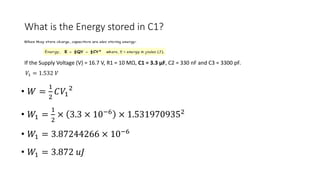
What is the Energy stored in C1?
• 𝑊 =
1
2
𝐶𝑉1
2
• 𝑊1 =
1
2
× 3.3 × 10−6 × 1.5319709352
• 𝑊1 = 3.87244266 × 10⁻⁶
• 𝑊1 = 3.872 𝑢𝐽
If the Supply Voltage (V) = 16.7 V, R1 = 10 MΩ, C1 = 3.3 μF, C2 = 330 nF and C3 = 3300 pF.
𝑉1 = 1.532 𝑉
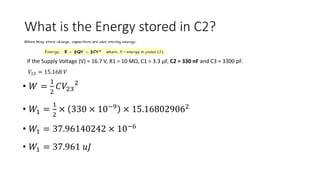
What is the Energy stored in C2?
• 𝑊 =
1
2
𝐶𝑉23
2
• 𝑊1 =
1
2
× 330 × 10−9 × 15.168029062
• 𝑊1 = 37.96140242 × 10⁻⁶
• 𝑊1 = 37.961 𝑢𝐽
If the Supply Voltage (V) = 16.7 V, R1 = 10 MΩ, C1 = 3.3 μF, C2 = 330 nF and C3 = 3300 pF.
𝑉23 = 15.168 𝑉
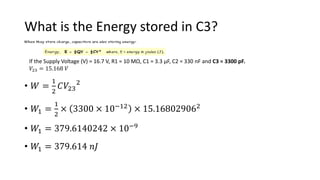
What is the Energy stored in C3?
• 𝑊 =
1
2
𝐶𝑉23
2
• 𝑊1 =
1
2
× 3300 × 10−12 × 15.168029062
• 𝑊1 = 379.6140242 × 10⁻⁹
• 𝑊1 = 379.614 𝑛𝐽
If the Supply Voltage (V) = 16.7 V, R1 = 10 MΩ, C1 = 3.3 μF, C2 = 330 nF and C3 = 3300 pF.
𝑉23 = 15.168 𝑉

Unit 6 electrical and electronic principle capacitor calculations

  • 1.
  • 2.
    Formula Growth of acapacitor voltage VC = V(1 – e (-t/CR)) = V(1 – e(-t/Շ)) Decay of resistor voltage VR = V.e (-t/CR) = V.e (-t/Շ) Decay of current flowing I = I.e(-t/CR) = I.e(-t/Շ) Time constant (secs) Շ(tau) = CR The energy stored in a capacitor (joules) W = ½ CV2 Equations The following equations may be useful in this assignment: In a circuit containing one capacitor and one resistor in series connected across a d.c. supply at ALL times while the current is flowing we can say, V = VC + VR and V = q/(C + iR) (q = charge on the capacitor) In a circuit containing one capacitor and one resistor in series connected across a d.c. supply at ALL times while the current is flowing we can say, V = VC + VR and V = q/(C + iR) (q = charge on the capacitor)
  • 3.
    Capacitors in SeriesCircuit To calculate the total overall capacitance of a number of capacitors connected series use the following formula: Example: To calculate the total capacitance for these capacitors in series 10μF 10μF 33μF 1 𝐶 𝑇 = 1 10 × 10−6 + 1 10 × 10−6 + 1 33 × 10−6 1 𝐶 𝑇 = 1 0.23μF = 4.34μF http://www.learningaboutelectronics.com/Articles/Series-and-parallel-capacitor-calculator.php
  • 4.
    Capacitors in ParallelCircuit • To calculate the total overall capacitance of a number of capacitors connected parallel use the following formula: • CTotal = C1 + C2 + C3 and so on CTotal = C1 + C2 + C3 CTotal = 10μF + 22μF + 47μF = 79μF C1 C2 C3 Example: To calculate the total capacitance for these three capacitors in parallel. http://www.learningaboutelectronics.com/Articles/Series-and-parallel-capacitor-calculator.php 22μF 10μF 47μF
  • 5.
    Capacitors in ParallelCircuit • Capacitors in Parallel Circuit • What is the Equivalent Capacitance of the network? • If the Supply Voltage = 11.2 V, R1 = 10 MΩ, C1 = 4.7 μF, C2 = 560 nF and C3 = 2700 pF.
  • 6.
    Equivalent Capacitance ofthe network tera T 1012 = 1,000,000,000,000 giga G 109 = 1,000,000,000 mega M 106 = 1,000,000 kilo k 103 = 1,000 hecto h 102 = 100 deka da 101 = 10 deci d 10-1 = 0.1 centi c 10-2 = 0.01 milli m 10-3 = 0.001 micro µ 10-6 = 0.000001 nano n 10-9 = 0.000000001 pico p 10-12 = 0.000000000001 SI Prefixes Unit Table R1 10 MΩ 106 = 1,000,000 10 x 106 C1 4.7 μF, 10-6 = 0.000001 4.7 x 10⁻⁶ C2 560 nF 10-9 = 0.000000001 560 x 10-9 C3 2700 pF. 10-12 = 0.000000000001 2700 x 10-12 If the Supply Voltage = 11.2 V, R1 = 10 MΩ, C1 = 4.7 μF, C2 = 560 nF and C3 = 2700 pF. CT = C1 + C2 + C3 CT = 4.7 x10⁻⁶ + 560 x10-9 + 2700 x10-12 = 5.2627 x10⁻⁶ CT = 5.2627μF
  • 7.
    What is theEquivalent Capacitance of the network? If the Supply Voltage (V) = 16.7 V, R1 = 10 MΩ, C1 = 3.3 μF, C2 = 330 nF and C3 = 3300 pF. • 1 𝐶 𝑇 = 1 𝐶1 + 1 𝐶2 + 1 𝐶3 • 1 𝐶 𝑇 = 1 3.3×10⁻⁶ + 1 0.33×10⁻⁶ + 1 0.0033×10⁻⁶ • 1 𝐶 𝑇 = 306363636.4 • 𝐶 𝑇 = 3.264094955 × 10⁻⁹ • 𝐶 𝑇 = 3.264 𝑛𝐹
  • 8.
    How Long DoesIt Take to Charge a Capacitor? • A capacitor charges to 63% of the supply voltage that is charging it after one time period. After 5 time periods, a capacitor charges up to over 99% of its supply voltage. Therefore, it is safe to say that the time it takes for a capacitor to charge up to the supply voltage is 5 time constants. • To calculate the time constant of a capacitor, the formula is τ=RC. This value yields the time (in seconds) that it takes a capacitor to charge to 63% of the voltage that is charging it up. After 5 time constants, the capacitor will charged to over 99% of the voltage that is supplying. • Therefore, the formula to calculate how long it takes a capacitor to charge to is: Time for a Capacitor to Charge= 5RC • After 5 time constants, for all extensive purposes, the capacitor will be charged up to very close to the supply voltage. A capacitor never charges fully to the maximum voltage of its supply voltage, but it gets very close. • Supply voltage 9V Resistor 3KΩ Capacitor 1000µF • One time constant, τ=RC=(3KΩ)(1000µF)=3 seconds. 5x3=15 seconds. So it takes the capacitor about 15 seconds to charge up to near 9 volts.
  • 9.
    What is theVoltage across the Network after 0.01 seconds Vc is the voltage across the capacitor • Vs is the supply voltage 16.7V • t is the elapsed time since the application of the supply voltage • RC is the time constant of the RC charging circuit • The time constant, τ is found using the formula T = C x R in seconds. • 𝐶 𝑇 = 3.264 𝑛𝐹 • R1 = 10 MΩ • 𝑉𝐶 = 𝑉𝑆 1 − 𝑒 − 𝑡 𝐶𝑅 • 𝑉𝐶 = 16.7 1 − 𝑒 − 0.01 0.003264094×10−6 × 10×106 • Break the calculation down into smaller parts to prevent an error on your calculator. • 𝑉𝐶 = 16.7 1 − 𝑒−0.3063636364 • 𝑉𝐶 = 4.406814518 • 𝑉𝐶 = 4.407 𝑉 What is the Voltage accross the Network after 50 seconds? Answer:
  • 10.
    What is theCharge stored in the capacitors when it is fully charged? C= 3.264094955 × 10⁻⁹ V = 16.7 V 𝑄 = 𝐶𝑉 𝑄 = 3.264094955 × 10−9 × 16.7 𝑄 = 54.51038575 × 10⁻⁹ 𝑄 = 54.51 𝑛𝐶 Charge and Energy Stored The amount of charge (symbol Q) stored by a capacitor is given by: Charge, Q = C × V where: Q = charge in coulombs (C) C = capacitance in farads (F) V = voltage in volts (V)
  • 11.
    What is theEnergy stored in the capacitors when they are fully charged? C= 3.264094955 × 10⁻⁹ V = 16.7 V 𝑊 = 1 2 𝐶𝑉2 𝑊 = 1 2 3.264094955 × 10−9 × 16.72 𝑊 = 455.161721 × 10⁻⁹ 𝑊 = 455.162𝑛𝐽 When they store charge, capacitors are also storing energy: Energy, E = ½QV = ½CV² where, E = energy in joules (J). Note that capacitors return their stored energy to the circuit. They do not 'use up' electrical energy by converting it to heat as a resistor does. The energy stored by a capacitor is much smaller than the energy stored by a battery so they cannot be used as a practical source of energy for most purposes.
  • 12.
    Capacitors in combinationSeries/Parallel Circuit If the Supply Voltage (V) = 16.7 V, R1 = 10 MΩ, C1 = 3.3 μF, C2 = 330 nF and C3 = 3300 pF. What is the Equivalent Capacitance of the network? 1 𝐶 𝑇 = 1 𝐶1 + 1 𝐶 𝑃 𝐶 𝑃 = 𝐶2 + 𝐶3 𝐶 𝑃 = (0.33 × 10⁻⁶) + (0.0033 × 10⁻⁶) 𝐶 𝑃 = 0.3333 × 10⁻⁶ 1 𝐶 𝑇 = 1 3.3 × 10⁻⁶ + 1 0.3333 × 10⁻⁶ 1 𝐶 𝑇 = 3.303330333 × 10⁶ 𝐶 𝑇 = 302.7247956 × 10⁻⁹ 𝐶 𝑇 = 302.725 𝑛𝐹
  • 13.
    What is theTotal Charge stored in the network? • 𝐶 𝑇 = 302.725 𝑛𝐹 • V=16.7V • 𝑄 = 𝐶𝑉 • 𝑄 = 302.7247956 × 10−9 × 16.7 • 𝑄 = 5.055504087 × 10⁻⁶ • 𝑄 = 50.56 𝑢𝐶
  • 14.
    What is thePotential Difference (Voltage) across C1 • 𝑉 = 𝑄 𝐶 • 𝑉1 = 5.055504087×10⁻⁶ 3.3×10⁻⁶ • 𝑉1 = 1.531970935 • 𝑉1 = 1.532 𝑉
  • 15.
    What is thePotential Difference ( Voltage) across C2/3? • 𝑉23 = 𝑄 𝐶 • 𝑉23 = 5.055504087×10⁻⁶ (0.33×10⁻⁶)+(0.0033×10⁻⁶) • 𝑉23 = 5.055504087×10⁻⁶ (0.33×10⁻⁶)+(0.0033×10⁻⁶) • 𝑉23 = 15.16802906 • 𝑉23 = 15.168 𝑉
  • 16.
    What is theEnergy stored in C1? • 𝑊 = 1 2 𝐶𝑉1 2 • 𝑊1 = 1 2 × 3.3 × 10−6 × 1.5319709352 • 𝑊1 = 3.87244266 × 10⁻⁶ • 𝑊1 = 3.872 𝑢𝐽 If the Supply Voltage (V) = 16.7 V, R1 = 10 MΩ, C1 = 3.3 μF, C2 = 330 nF and C3 = 3300 pF. 𝑉1 = 1.532 𝑉
  • 17.
    What is theEnergy stored in C2? • 𝑊 = 1 2 𝐶𝑉23 2 • 𝑊1 = 1 2 × 330 × 10−9 × 15.168029062 • 𝑊1 = 37.96140242 × 10⁻⁶ • 𝑊1 = 37.961 𝑢𝐽 If the Supply Voltage (V) = 16.7 V, R1 = 10 MΩ, C1 = 3.3 μF, C2 = 330 nF and C3 = 3300 pF. 𝑉23 = 15.168 𝑉
  • 18.
    What is theEnergy stored in C3? • 𝑊 = 1 2 𝐶𝑉23 2 • 𝑊1 = 1 2 × 3300 × 10−12 × 15.168029062 • 𝑊1 = 379.6140242 × 10⁻⁹ • 𝑊1 = 379.614 𝑛𝐽 If the Supply Voltage (V) = 16.7 V, R1 = 10 MΩ, C1 = 3.3 μF, C2 = 330 nF and C3 = 3300 pF. 𝑉23 = 15.168 𝑉