Implement Spanning Tree Protocols LAN Switching and Wireless   – Chapter 5
Objectives Explain the  role of redundancy  in a converged network Summarize  how STP works to eliminate Layer 2 loops  in a converged network  Explain how the  STP algorithm  uses three steps to converge on a loop-free topology Implement rapid per VLAN spanning tree  (rapid PVST+) in a LAN to prevent loops between redundant switches.
Explain the Role of  Redundancy  in a Converged Switched Network
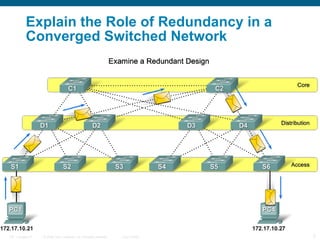
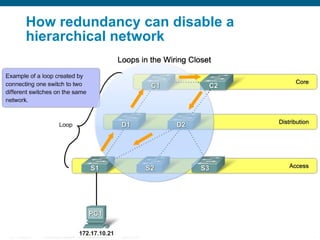
How redundancy can disable a hierarchical network
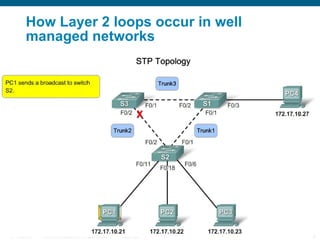
How Layer 2 loops occur in well managed networks
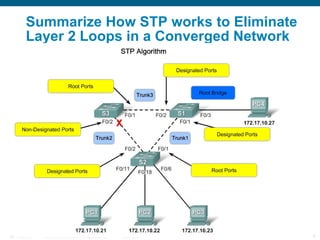
Summarize How STP works to Eliminate Layer 2 Loops in a Converged Network
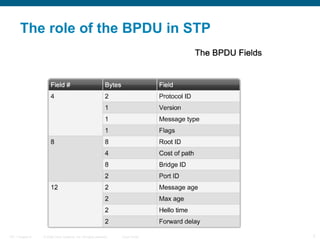
The role of the BPDU in STP
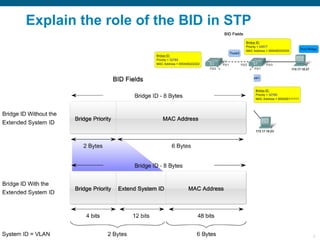
Explain the role of the BID in STP
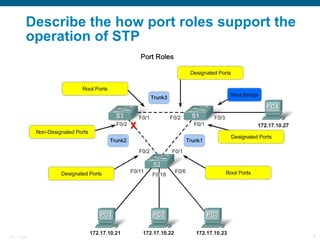
Describe the how port roles support the operation of STP
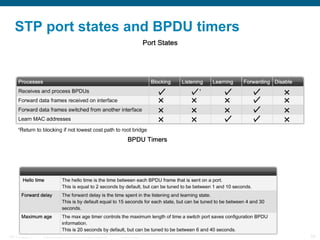
STP port states and BPDU timers
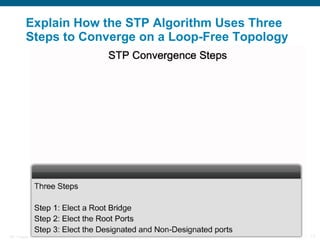
Explain How the STP Algorithm Uses Three Steps to Converge on a Loop-Free Topology
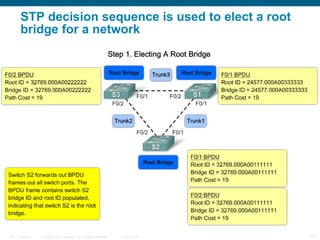
STP decision sequence is used to elect a root bridge for a network
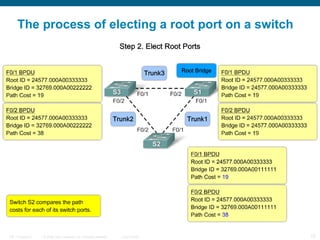
The process of electing a root port on a switch
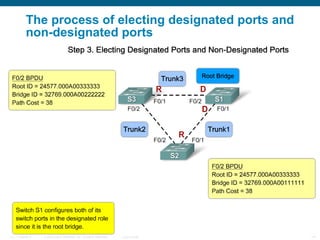
The process of electing designated ports and non-designated ports
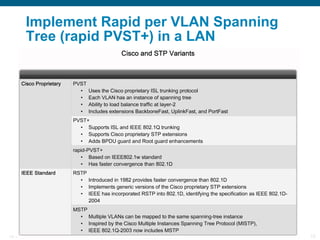
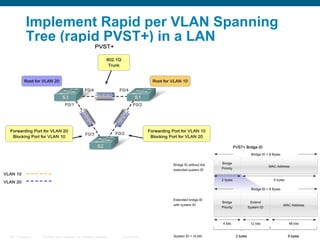
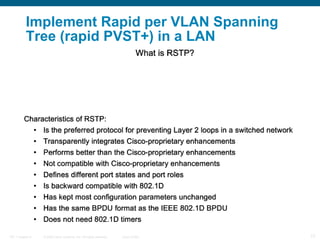
Implement Rapid per VLAN Spanning Tree (rapid PVST+) in a LAN
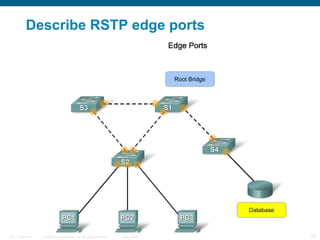
Describe RSTP edge ports
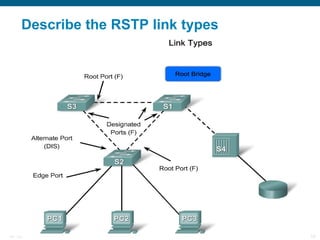
Describe the RSTP link types
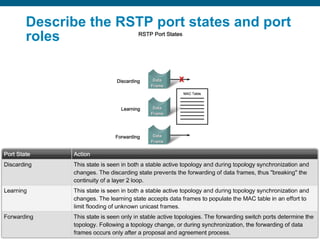
Describe the RSTP port states and port roles
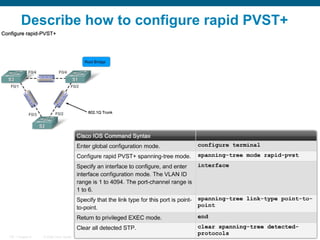
Describe how to configure rapid PVST+
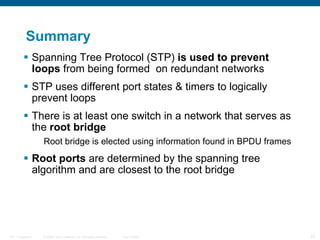
Summary Spanning Tree Protocol (STP)  is used to prevent loops  from being formed  on redundant networks STP uses different port states & timers to logically prevent loops There is at least one switch in a network that serves as the  root bridge Root bridge is elected using information found in BPDU frames Root ports  are determined by the spanning tree algorithm and are closest to the root bridge
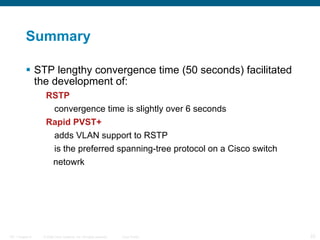
Summary STP lengthy convergence time (50 seconds) facilitated the development of: RSTP convergence time is slightly over 6 seconds Rapid PVST+ adds VLAN support to RSTP is the preferred spanning-tree protocol on a Cisco switch  netowrk

Cap5 stp

  • 1.
    Implement Spanning TreeProtocols LAN Switching and Wireless – Chapter 5
  • 2.
    Objectives Explain the role of redundancy in a converged network Summarize how STP works to eliminate Layer 2 loops in a converged network Explain how the STP algorithm uses three steps to converge on a loop-free topology Implement rapid per VLAN spanning tree (rapid PVST+) in a LAN to prevent loops between redundant switches.
  • 3.
    Explain the Roleof Redundancy in a Converged Switched Network
  • 4.
    How redundancy candisable a hierarchical network
  • 5.
    How Layer 2loops occur in well managed networks
  • 6.
    Summarize How STPworks to Eliminate Layer 2 Loops in a Converged Network
  • 7.
    The role ofthe BPDU in STP
  • 8.
    Explain the roleof the BID in STP
  • 9.
    Describe the howport roles support the operation of STP
  • 10.
    STP port statesand BPDU timers
  • 11.
    Explain How theSTP Algorithm Uses Three Steps to Converge on a Loop-Free Topology
  • 12.
    STP decision sequenceis used to elect a root bridge for a network
  • 13.
    The process ofelecting a root port on a switch
  • 14.
    The process ofelecting designated ports and non-designated ports
  • 15.
    Implement Rapid perVLAN Spanning Tree (rapid PVST+) in a LAN
  • 16.
    Implement Rapid perVLAN Spanning Tree (rapid PVST+) in a LAN
  • 17.
    Implement Rapid perVLAN Spanning Tree (rapid PVST+) in a LAN
  • 18.
  • 19.
  • 20.
    Describe the RSTPport states and port roles
  • 21.
    Describe how toconfigure rapid PVST+
  • 22.
    Summary Spanning TreeProtocol (STP) is used to prevent loops from being formed on redundant networks STP uses different port states & timers to logically prevent loops There is at least one switch in a network that serves as the root bridge Root bridge is elected using information found in BPDU frames Root ports are determined by the spanning tree algorithm and are closest to the root bridge
  • 23.
    Summary STP lengthyconvergence time (50 seconds) facilitated the development of: RSTP convergence time is slightly over 6 seconds Rapid PVST+ adds VLAN support to RSTP is the preferred spanning-tree protocol on a Cisco switch netowrk

Editor's Notes

  • #4 Graphic 5.1.1.2
  • #5 Graphics 5.1.3.1 & 5.1.3.2
  • #6 Graphic 5.2.1.1
  • #7 Graphic 5.2.1.2
  • #8 Graphic 5.2.2.1
  • #9 Graphic 5.2.3.1
  • #10 Graphic 5.2.4.1
  • #11 Graphic 5.2.5.2
  • #12 Objective for the slide: Define convergence for a switched network and summarize the 3 step process STP uses to create a loop free topology Graphic 5.3.1.1
  • #13 Graphic 5.3.2.1
  • #14 Graphic 5.3.3.1
  • #15 Graphic 5.3.4.1 – try to put in as many of the steps as you can
  • #16 Graphic 5.4.1.1
  • #17 Graphic 5.4.2.1 & 5.4.2.2
  • #18 Graphic 5.4.3.1 (characteristics)
  • #19 Graphic 5.4.4.1
  • #20 Graphic 5.4.5.1
  • #21 Graphic 5.4.6.1 try to use all 3 but if you can’t then use the description graphic
  • #22 Graphic 5.4.7.1 try to use both the configuration commands and the example configuration. If you can’t then use the example.