Switches (and bridges) needed a mechanism to prevent loops from forming, and thus Spanning Tree Protocol (STP, or IEEE 802.1D) was developed. STP is enabled by default on all VLANs on
Catalyst switches. STP-enabled switches communicate to form a topology of the entire switching network, and then shutting down (or blocking) a port if a loop exists. The blocked port can be
reactivated if another link on the switching network goes down, thus preserving fault-tolerance.
Various flavors of 802.1D STP exist, including:
Common Spanning Tree (CST) – A single STP process is
used for all VLANs.
Per-VLAN Spanning Tree (PVST) – Cisco proprietary
version of STP, which employs a separate STP process for
each VLAN.
Per-VLAN Spanning Tree Plus (PVST+) – Enhanced
version of PVST that allows CST-enabled switches and
PVST-enabled switches to interoperate. This is default on
newer Catalyst switches.
Rapid Spanning Tree Protocol (RSTP)
To further alleviate the 30 to 50 second convergence delays
with STP, enhancements were made to the original IEEE
802.1D standard. The result was 802.1w, or Rapid Spanning
Tree Protocol (RSTP).
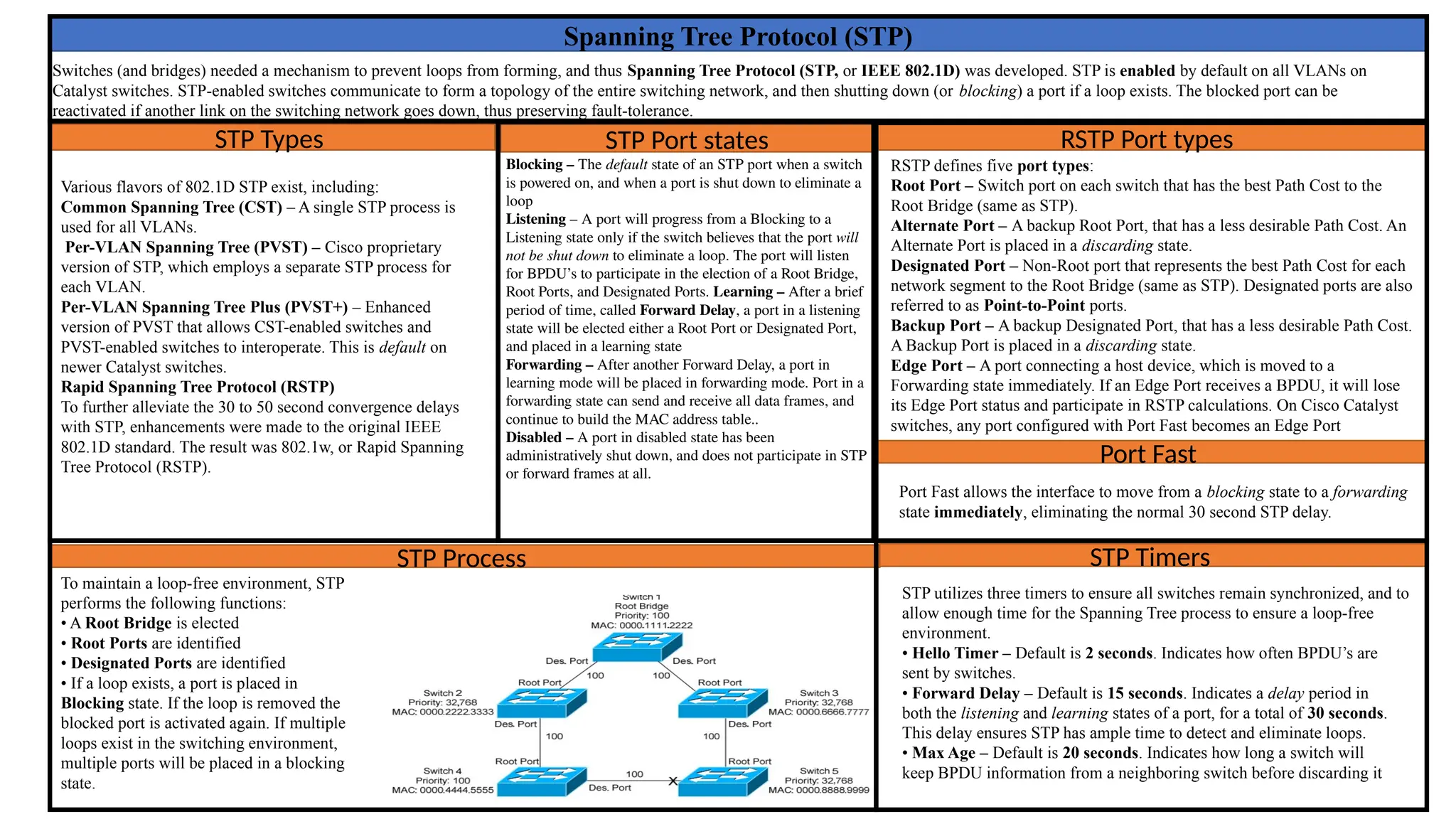
To maintain a loop-free environment, STP
performs the following functions:
• A Root Bridge is elected
• Root Ports are identified
• Designated Ports are identified
• If a loop exists, a port is placed in
Blocking state. If the loop is removed the
blocked port is activated again. If multiple
loops exist in the switching environment,
multiple ports will be placed in a blocking
state.
RSTP defines five port types:
Root Port – Switch port on each switch that has the best Path Cost to the
Root Bridge (same as STP).
Alternate Port – A backup Root Port, that has a less desirable Path Cost. An
Alternate Port is placed in a discarding state.
Designated Port – Non-Root port that represents the best Path Cost for each
network segment to the Root Bridge (same as STP). Designated ports are also
referred to as Point-to-Point ports.
Backup Port – A backup Designated Port, that has a less desirable Path Cost.
A Backup Port is placed in a discarding state.
Edge Port – A port connecting a host device, which is moved to a
Forwarding state immediately. If an Edge Port receives a BPDU, it will lose
its Edge Port status and participate in RSTP calculations. On Cisco Catalyst
switches, any port configured with Port Fast becomes an Edge Port
Blocking – The default state of an STP port when a switch
is powered on, and when a port is shut down to eliminate a
loop
Listening – A port will progress from a Blocking to a
Listening state only if the switch believes that the port will
not be shut down to eliminate a loop. The port will listen
for BPDU’s to participate in the election of a Root Bridge,
Root Ports, and Designated Ports. Learning – After a brief
period of time, called Forward Delay, a port in a listening
state will be elected either a Root Port or Designated Port,
and placed in a learning state
Forwarding – After another Forward Delay, a port in
learning mode will be placed in forwarding mode. Port in a
forwarding state can send and receive all data frames, and
continue to build the MAC address table..
Disabled – A port in disabled state has been
administratively shut down, and does not participate in STP
or forward frames at all.
STP utilizes three timers to ensure all switches remain synchronized, and to
allow enough time for the Spanning Tree process to ensure a loop-free
environment.
• Hello Timer – Default is 2 seconds. Indicates how often BPDU’s are
sent by switches.
• Forward Delay – Default is 15 seconds. Indicates a delay period in
both the listening and learning states of a port, for a total of 30 seconds.
This delay ensures STP has ample time to detect and eliminate loops.
• Max Age – Default is 20 seconds. Indicates how long a switch will
keep BPDU information from a neighboring switch before discarding it
Spanning Tree Protocol (STP)
STP Types
STP Process
STP Port states RSTP Port types
STP Timers
Port Fast
Port Fast allows the interface to move from a blocking state to a forwarding
state immediately, eliminating the normal 30 second STP delay.

STP protocols in Layer 2 cheat sheet.pptx

  • 1.
    Switches (and bridges)needed a mechanism to prevent loops from forming, and thus Spanning Tree Protocol (STP, or IEEE 802.1D) was developed. STP is enabled by default on all VLANs on Catalyst switches. STP-enabled switches communicate to form a topology of the entire switching network, and then shutting down (or blocking) a port if a loop exists. The blocked port can be reactivated if another link on the switching network goes down, thus preserving fault-tolerance. Various flavors of 802.1D STP exist, including: Common Spanning Tree (CST) – A single STP process is used for all VLANs. Per-VLAN Spanning Tree (PVST) – Cisco proprietary version of STP, which employs a separate STP process for each VLAN. Per-VLAN Spanning Tree Plus (PVST+) – Enhanced version of PVST that allows CST-enabled switches and PVST-enabled switches to interoperate. This is default on newer Catalyst switches. Rapid Spanning Tree Protocol (RSTP) To further alleviate the 30 to 50 second convergence delays with STP, enhancements were made to the original IEEE 802.1D standard. The result was 802.1w, or Rapid Spanning Tree Protocol (RSTP). To maintain a loop-free environment, STP performs the following functions: • A Root Bridge is elected • Root Ports are identified • Designated Ports are identified • If a loop exists, a port is placed in Blocking state. If the loop is removed the blocked port is activated again. If multiple loops exist in the switching environment, multiple ports will be placed in a blocking state. RSTP defines five port types: Root Port – Switch port on each switch that has the best Path Cost to the Root Bridge (same as STP). Alternate Port – A backup Root Port, that has a less desirable Path Cost. An Alternate Port is placed in a discarding state. Designated Port – Non-Root port that represents the best Path Cost for each network segment to the Root Bridge (same as STP). Designated ports are also referred to as Point-to-Point ports. Backup Port – A backup Designated Port, that has a less desirable Path Cost. A Backup Port is placed in a discarding state. Edge Port – A port connecting a host device, which is moved to a Forwarding state immediately. If an Edge Port receives a BPDU, it will lose its Edge Port status and participate in RSTP calculations. On Cisco Catalyst switches, any port configured with Port Fast becomes an Edge Port Blocking – The default state of an STP port when a switch is powered on, and when a port is shut down to eliminate a loop Listening – A port will progress from a Blocking to a Listening state only if the switch believes that the port will not be shut down to eliminate a loop. The port will listen for BPDU’s to participate in the election of a Root Bridge, Root Ports, and Designated Ports. Learning – After a brief period of time, called Forward Delay, a port in a listening state will be elected either a Root Port or Designated Port, and placed in a learning state Forwarding – After another Forward Delay, a port in learning mode will be placed in forwarding mode. Port in a forwarding state can send and receive all data frames, and continue to build the MAC address table.. Disabled – A port in disabled state has been administratively shut down, and does not participate in STP or forward frames at all. STP utilizes three timers to ensure all switches remain synchronized, and to allow enough time for the Spanning Tree process to ensure a loop-free environment. • Hello Timer – Default is 2 seconds. Indicates how often BPDU’s are sent by switches. • Forward Delay – Default is 15 seconds. Indicates a delay period in both the listening and learning states of a port, for a total of 30 seconds. This delay ensures STP has ample time to detect and eliminate loops. • Max Age – Default is 20 seconds. Indicates how long a switch will keep BPDU information from a neighboring switch before discarding it Spanning Tree Protocol (STP) STP Types STP Process STP Port states RSTP Port types STP Timers Port Fast Port Fast allows the interface to move from a blocking state to a forwarding state immediately, eliminating the normal 30 second STP delay.