GDP / Canada – May 2016
By: Paul Young, CPA, CGA
Date: August 7, 2016
Disclaimer
• This presentation is on view of the key market indicators for North
America
Paul Young - Presenter
Bio
• CPA/CGA
• 25 years of experience in Academia, Industry and Financial solutions
• Youtube Channel -
https://www.youtube.com/channel/UCAArky1bAXPSuV2NLtUnyLg
Agenda
• Key Comments/Government
• GDP
• GDP by sector
• Employment
• Key areas of the economy
• G20 Summit
• Government Policies
• Summary
Summary:
• Real gross domestic product (GDP) fell 0.6% in May, the largest monthly decline since March 2009. The decrease in May was primarily
due to lower non-conventional oil extraction, a consequence of the Fort McMurray wildfire and evacuation.
• Real gross domestic product falls in May
• Chart 1: Real gross domestic product falls in May
• The Fort McMurray wildfire was the main cause behind a 2.8% decline in the output of goods-producing industries. The mining,
quarrying, and oil and gas extraction sector fell 6.4%, as the output of the non-conventional oil extraction industry recorded a 22%
drop. Following an 8.1% decrease in April due to maintenance shutdowns at upgrader facilities, the output level in May for this
industry was the lowest since May 2011.
• Excluding the decline in the non-conventional oil extraction industry, real GDP edged down 0.1% in May. There was little evidence that
the Fort McMurray wildfire significantly affected other industries at the national level. Therefore, the difference between the overall
0.6% decline in GDP and the 0.1% decrease in GDP excluding the non-conventional oil and gas industry is an approximation of the
direct impact that the Fort McMurray wildfire had on overall growth in May.
• Chart 2 Chart 2: Non-conventional oil extraction drops sharply in May
• Non-conventional oil extraction drops sharply in May
• Chart 2: Non-conventional oil extraction drops sharply in May
• The output of service-producing industries rose 0.3% in May. Wholesale and retail trade, the public sector (education, health and
public administration combined), the arts, entertainment and recreation sector, and the finance and insurance sector were up. On the
other hand, transportation and warehousing services, and administrative services were down. The Fort McMurray wildfire and
evacuation had a minimal impact on most of the service-producing industries at the national level.
• For more information on the impact of the Fort McMurray wildfire and evacuation on current production measures of GDP, see the
note to readers.
Summary:
• In addition to the drop in non-conventional oil and gas extraction, the
mining, quarrying, and oil and gas extraction sector recorded decreases
in mining except oil and gas extraction (-0.4%) and support activities for
mining, and oil and gas extraction (-3.3%).
• The decline in mining excluding oil and gas extraction was mainly
attributable to lower output at metal ore mines (such as copper and
nickel), which offset increases in potash mining. Support activities for
mining and oil and gas extraction were down for the fourth consecutive
month, primarily due to a decrease in support activities for mining.
• In contrast, conventional oil and gas extraction rose 0.6% in May, as
most conventional crude petroleum extraction facilities are located
outside the areas affected by the wildfire.
Summary:
Manufacturing output falls
• Manufacturing output was down 2.4% in May, the largest decline since January 2009. Both non-
durable and durable goods manufacturing recorded significant decreases in May.
• Non-durable goods manufacturing fell 2.8%, mainly as a result of a 15% drop in output at petroleum
refineries. The decrease at petroleum refineries reflected a loss in availability of crude oil for
refining—due to the Fort McMurray wildfire—combined with maintenance and turnaround work at
some facilities. Chemical manufacturing (-3.9%) also posted a notable decline.
• Durable-goods manufacturing was down 2.1% in May. Declines were widespread among industry
sub-groups and occurred for a variety of reasons. Lower output from transportation equipment
manufacturers resulted partly from supply interruptions associated with the earthquake in Japan in
April, while lower foreign demand influenced the decrease in non-metallic mineral product
manufacturing.
Utilities decline
• Utilities declined 1.8% in May. Both electric power generation, transmission and distribution, and
natural gas distribution industries were down. The decrease in May offset most of the increase in
April, which was caused by colder than usual weather in Central Canada.
Summary:
The public sector rises
• The public sector (education, health and public administration combined) rose 0.3% in May, a ninth consecutive monthly increase. The
growth in May was primarily the result of gains in public administration due to the 2016 Census. Health services edged up, while
education services were unchanged.
Wholesale and retail trade grow
• Wholesale trade rose 1.0% in May, a third consecutive monthly increase, as most subsectors posted a gain. Output growth was notable
for wholesalers of food, beverage and tobacco, motor vehicles and parts, and personal and household goods. The output of
miscellaneous wholesalers and, to a lesser extent, farm product wholesalers declined.
• Retail trade grew 0.4% in May, mainly as a result of increases in output at food and beverage stores, clothing and clothing accessories
stores, and gasoline stations. Conversely, output declined at motor vehicles and parts dealers, general merchandise stores (which
include department stores), and furniture and home furnishing stores.
Construction decreases
• Construction decreased 0.7% in May, after essentially no change in April. Residential building construction fell 1.2% in May as fewer
single-family dwellings were built. After five straight months of gains, repair construction has declined for three consecutive months.
Engineering construction was also down in May, while non-residential building construction was up.
• The real estate and rental and leasing sector edged up 0.1% in May, partly as a result of higher output from lessors of real estate. The
sector's rise was tempered by a 2.4% decline in the output of real estate agents and brokers, as home resale activity dropped in most
markets, led by those in British Columbia and Ontario.
Summary:
• The finance and insurance sector increases
• The finance and insurance sector grew 0.6% in May, a third consecutive monthly gain. The output of
insurance carriers was up, reflecting an increase in claims due to the Fort McMurray wildfire.
Financial investment services and, to a lesser extent, banking services also rose.
• Other industries
• Transportation and warehousing services declined 0.2% in May. Rail transportation fell for a third
month in a row, reaching its lowest level since July 2013. The decline in rail transportation in May
was partly due to a decrease in the movements of grain and fertilizer, metals and minerals, and fuel
oils and crude petroleum products. Pipeline transportation of oil fell in May. Some pipelines were
shut down as a result of the Fort McMurray wildfire, but this lower output was partially offset by the
movement of oil out of inventory, which kept exports steady. In contrast, air transportation
rose 1.6%.
• The arts, entertainment and recreation sector grew 4.3% in May. The increase was primarily the
result of a gain in spectator sports and related industries, as higher attendance at professional
basketball and baseball sporting events in May more than offset the decline in April, which was due
to the absence of National Hockey League playoff games played in Canada.
GDP/Comments – Minister of Finance
• Canada's economy should rebound "over the course of the year" from the impact of the Fort McMurray,
Alta. wildfire, Finance Minister Bill Morneau said on Saturday on the sidelines of a G20 meeting
in Chengdu, China. The fire is estimated to have cut daily oil production by more than 1 million barrels
and the Bank of Canada estimates it will shave 1.25 percentage points off economic growth in the
second quarter. "We were approximately right in our expectations in our budget," he said of Canada's
fiscal plan introduced in March, which promised growth spurred by government spending. Speaking to
reporters by telephone, Morneau said the country's growth was also challenged by global uncertainty
following Britain's vote last month to exit the European Union, but that was offset by the strong U.S.
economy. Source – CBC
• Fact 1 – Canada economy was hit harder by unforeseen events like For Mac Fire, but those numbers were not in the
government of Canada’s original government’s growth forecast
• Fact 2 – World has been in slow growth (3.0%)
• Fact 3 – USA economy is not going like gangbusters. The growth is only 1.9% for 2016. The growth is driven by
consumer spending
• Fact 4 – There are recessions in Russia and Brazil
• Fact 5 – Commodity Prices are down 25% to 35%
• Fact 6 - Japan has instituted negative interest rates and held off an increase to their consumption tax.
• Fact 7 – Federal Budget for Canada spending has yet to reach the economy. Many cases the money is for long-term
projects that will take time to get off the ground. The impact to GDP would be only .25 to .30% point to GDP
• Fact 8 – Ontario and Alberta have introduced new carbon tax/pricing that will drive up costs by 6%-8%. Household
spending like food, accommodation and transportation will be hit the hardest.
Key Quotes
Canada’s gross domestic product contracted at the fastest pace in more than seven years in May as
wildfires curbed Alberta oil production.
The economy shrank 0.6 percent after an April expansion of 0.1 percent, Statistics Canada said
Friday in Ottawa. The median forecast in a Bloomberg survey was for a 0.5 percent contraction. The
drop was “primarily due” to the record 22 percent plunge in non-conventional oil production, the
agency said, which typically refers to the technique used in the oil sands of extracting bitumen by
mining it or injecting steam into the ground.
Analysts see the damage from the fires as contained and predict the losses will be more than
recovered in the second half.
“We would still not regard this as a bad news story,” said Doug Porter, chief economist at BMO
Capital Markets in Toronto. “The oil production losses will be fully reversed over the next few
monthly reports, and the rest of the economy is still grinding along at a pace of around 1 percent.”
Source: http://www.bloomberg.com/news/articles/2016-07-29/canada-gdp-shrinks-most-since-
2009-as-wildfires-crimp-oil-output
GDP by sector
employment
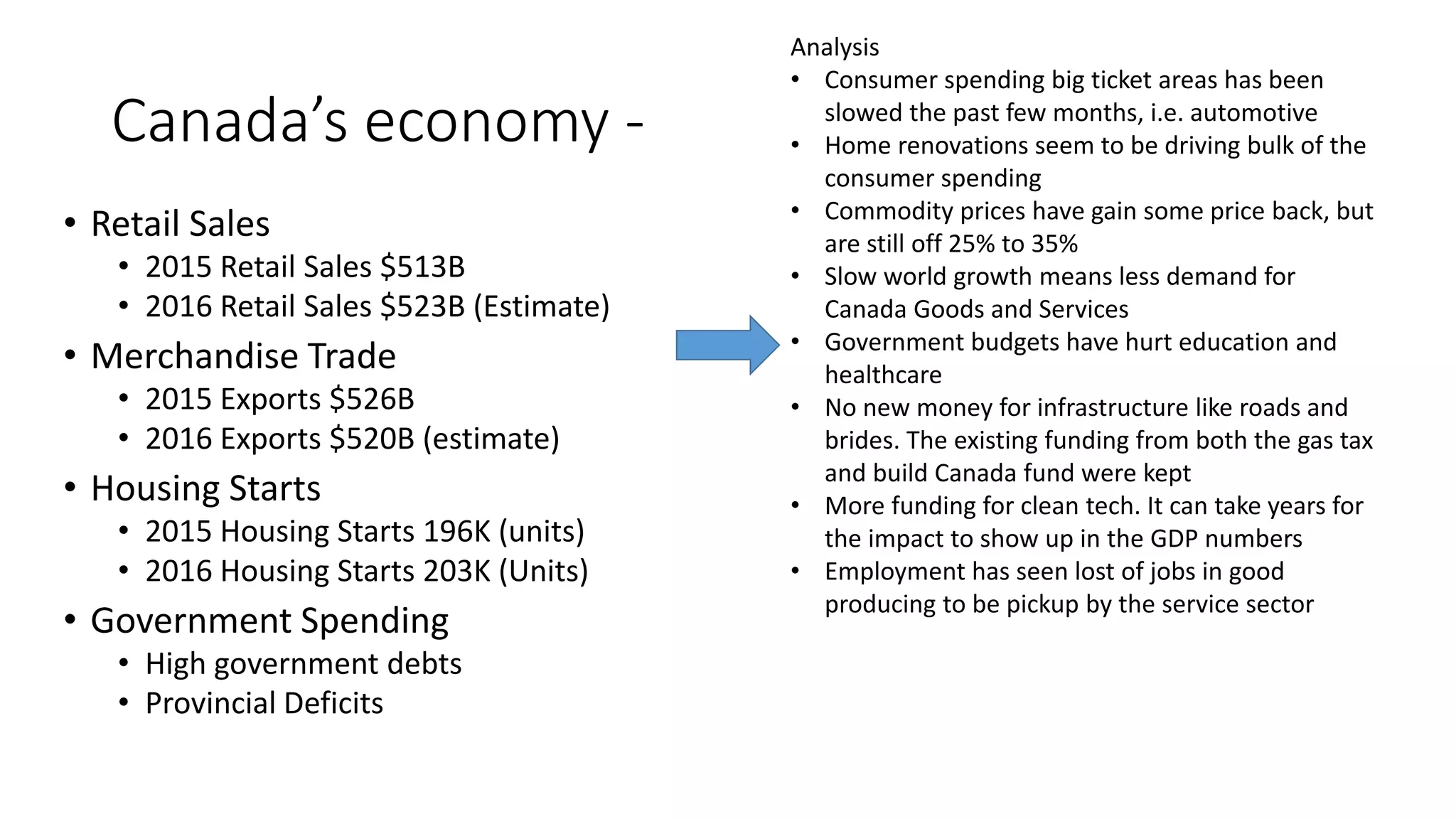
Canada’s economy -
• Retail Sales
• 2015 Retail Sales $513B
• 2016 Retail Sales $523B (Estimate)
• Merchandise Trade
• 2015 Exports $526B
• 2016 Exports $520B (estimate)
• Housing Starts
• 2015 Housing Starts 196K (units)
• 2016 Housing Starts 203K (Units)
• Government Spending
• High government debts
• Provincial Deficits
Analysis
• Consumer spending big ticket areas has been
slowed the past few months, i.e. automotive
• Home renovations seem to be driving bulk of the
consumer spending
• Commodity prices have gain some price back, but
are still off 25% to 35%
• Slow world growth means less demand for
Canada Goods and Services
• Government budgets have hurt education and
healthcare
• No new money for infrastructure like roads and
brides. The existing funding from both the gas tax
and build Canada fund were kept
• More funding for clean tech. It can take years for
the impact to show up in the GDP numbers
• Employment has seen lost of jobs in good
producing to be pickup by the service sector
G20 Meeting – July 2016
• The world's biggest economies will work to support global growth and
better share the benefits of trade, policymakers said on Sunday after a
meeting dominated by the impact of Britain's exit from Europe and fears of
rising protectionism. Source: CBC
• U.S. Treasury Secretary Jack Lew said he told a meeting of policymakers
from the Group of 20 economies that the United States's economy was
strong and its job market was healthy. The United States could look at fiscal
policy from a position of strength as the country's deficit had fallen, he told
a news conference after a two-day meeting of G20 central bankers and
finance ministers in China. Source: Reuters
• IMF warns G20 of need for broad based policies to ignite global growth
Source: IMF
Government Policies
• Interest Rates (set by various banks chairs)
• How long before rates are hiked?
• Taxation
• CPP hikes
• Carbon Tax/Pricing
• Hikes to Consumption and Provincial Sales Tax
• Spending
• Social programs
• Trade
• Expansion of Trade/FIPA Deals
• Infrastructure
• Commitment to roads and transportation
• Commitment to support exports
Summary
• Canada growth is projected at 1.3%
• Risks
• Lack of rebound in commodity prices
• Lack of streamlining regulations for pipelines, mines, etc.
• New Taxation, i.e. carbon pricing, CPP hikes, PST hikes, etc
• Consumer spending falls from 3.6 annual growth rate to 1.5% to 2.2% range
• Housing prices are 25-30% over value. Housing prices are growing at 8% clip which is faster than GDP growth
and Wage growth
• Exports do not expand into areas like China, India and/or emerging markets. 1/3 of exports is tied to
energy. Canada lacks the capacity to move oil via pipelines to export market.
• Fall of 2016 the new federal government will released its new oil and gas sector policy
• Trans Canada has filed lawsuit under NAFTA against USA government over the keystone pipeline
• Capital investment in Alberta has dropped by 25-30%.
• Manufacturing upside has been driven by three sectors: 1. Automotive 2. Food Production 3. Forestry.
• Forestry softwood lumber deal has expired . No new deal has been signed. The grace period expires October
2016
• Food Processing has grown, but could see issues as drought conditions exist in parts of Canada.
• Automotive started 2016 with bang, but has slowly fizzle out over the past few months.
• New taxation or increase to hydro rates or other policies could impact manufacturers, especially with cost
increases. The cost increases can impact manufacturers being cost competitive.

Canada GDP for May 2016

  • 1.
    GDP / Canada– May 2016 By: Paul Young, CPA, CGA Date: August 7, 2016
  • 2.
    Disclaimer • This presentationis on view of the key market indicators for North America
  • 3.
    Paul Young -Presenter Bio • CPA/CGA • 25 years of experience in Academia, Industry and Financial solutions • Youtube Channel - https://www.youtube.com/channel/UCAArky1bAXPSuV2NLtUnyLg
  • 4.
    Agenda • Key Comments/Government •GDP • GDP by sector • Employment • Key areas of the economy • G20 Summit • Government Policies • Summary
  • 5.
    Summary: • Real grossdomestic product (GDP) fell 0.6% in May, the largest monthly decline since March 2009. The decrease in May was primarily due to lower non-conventional oil extraction, a consequence of the Fort McMurray wildfire and evacuation. • Real gross domestic product falls in May • Chart 1: Real gross domestic product falls in May • The Fort McMurray wildfire was the main cause behind a 2.8% decline in the output of goods-producing industries. The mining, quarrying, and oil and gas extraction sector fell 6.4%, as the output of the non-conventional oil extraction industry recorded a 22% drop. Following an 8.1% decrease in April due to maintenance shutdowns at upgrader facilities, the output level in May for this industry was the lowest since May 2011. • Excluding the decline in the non-conventional oil extraction industry, real GDP edged down 0.1% in May. There was little evidence that the Fort McMurray wildfire significantly affected other industries at the national level. Therefore, the difference between the overall 0.6% decline in GDP and the 0.1% decrease in GDP excluding the non-conventional oil and gas industry is an approximation of the direct impact that the Fort McMurray wildfire had on overall growth in May. • Chart 2 Chart 2: Non-conventional oil extraction drops sharply in May • Non-conventional oil extraction drops sharply in May • Chart 2: Non-conventional oil extraction drops sharply in May • The output of service-producing industries rose 0.3% in May. Wholesale and retail trade, the public sector (education, health and public administration combined), the arts, entertainment and recreation sector, and the finance and insurance sector were up. On the other hand, transportation and warehousing services, and administrative services were down. The Fort McMurray wildfire and evacuation had a minimal impact on most of the service-producing industries at the national level. • For more information on the impact of the Fort McMurray wildfire and evacuation on current production measures of GDP, see the note to readers.
  • 6.
    Summary: • In additionto the drop in non-conventional oil and gas extraction, the mining, quarrying, and oil and gas extraction sector recorded decreases in mining except oil and gas extraction (-0.4%) and support activities for mining, and oil and gas extraction (-3.3%). • The decline in mining excluding oil and gas extraction was mainly attributable to lower output at metal ore mines (such as copper and nickel), which offset increases in potash mining. Support activities for mining and oil and gas extraction were down for the fourth consecutive month, primarily due to a decrease in support activities for mining. • In contrast, conventional oil and gas extraction rose 0.6% in May, as most conventional crude petroleum extraction facilities are located outside the areas affected by the wildfire.
  • 7.
    Summary: Manufacturing output falls •Manufacturing output was down 2.4% in May, the largest decline since January 2009. Both non- durable and durable goods manufacturing recorded significant decreases in May. • Non-durable goods manufacturing fell 2.8%, mainly as a result of a 15% drop in output at petroleum refineries. The decrease at petroleum refineries reflected a loss in availability of crude oil for refining—due to the Fort McMurray wildfire—combined with maintenance and turnaround work at some facilities. Chemical manufacturing (-3.9%) also posted a notable decline. • Durable-goods manufacturing was down 2.1% in May. Declines were widespread among industry sub-groups and occurred for a variety of reasons. Lower output from transportation equipment manufacturers resulted partly from supply interruptions associated with the earthquake in Japan in April, while lower foreign demand influenced the decrease in non-metallic mineral product manufacturing. Utilities decline • Utilities declined 1.8% in May. Both electric power generation, transmission and distribution, and natural gas distribution industries were down. The decrease in May offset most of the increase in April, which was caused by colder than usual weather in Central Canada.
  • 8.
    Summary: The public sectorrises • The public sector (education, health and public administration combined) rose 0.3% in May, a ninth consecutive monthly increase. The growth in May was primarily the result of gains in public administration due to the 2016 Census. Health services edged up, while education services were unchanged. Wholesale and retail trade grow • Wholesale trade rose 1.0% in May, a third consecutive monthly increase, as most subsectors posted a gain. Output growth was notable for wholesalers of food, beverage and tobacco, motor vehicles and parts, and personal and household goods. The output of miscellaneous wholesalers and, to a lesser extent, farm product wholesalers declined. • Retail trade grew 0.4% in May, mainly as a result of increases in output at food and beverage stores, clothing and clothing accessories stores, and gasoline stations. Conversely, output declined at motor vehicles and parts dealers, general merchandise stores (which include department stores), and furniture and home furnishing stores. Construction decreases • Construction decreased 0.7% in May, after essentially no change in April. Residential building construction fell 1.2% in May as fewer single-family dwellings were built. After five straight months of gains, repair construction has declined for three consecutive months. Engineering construction was also down in May, while non-residential building construction was up. • The real estate and rental and leasing sector edged up 0.1% in May, partly as a result of higher output from lessors of real estate. The sector's rise was tempered by a 2.4% decline in the output of real estate agents and brokers, as home resale activity dropped in most markets, led by those in British Columbia and Ontario.
  • 9.
    Summary: • The financeand insurance sector increases • The finance and insurance sector grew 0.6% in May, a third consecutive monthly gain. The output of insurance carriers was up, reflecting an increase in claims due to the Fort McMurray wildfire. Financial investment services and, to a lesser extent, banking services also rose. • Other industries • Transportation and warehousing services declined 0.2% in May. Rail transportation fell for a third month in a row, reaching its lowest level since July 2013. The decline in rail transportation in May was partly due to a decrease in the movements of grain and fertilizer, metals and minerals, and fuel oils and crude petroleum products. Pipeline transportation of oil fell in May. Some pipelines were shut down as a result of the Fort McMurray wildfire, but this lower output was partially offset by the movement of oil out of inventory, which kept exports steady. In contrast, air transportation rose 1.6%. • The arts, entertainment and recreation sector grew 4.3% in May. The increase was primarily the result of a gain in spectator sports and related industries, as higher attendance at professional basketball and baseball sporting events in May more than offset the decline in April, which was due to the absence of National Hockey League playoff games played in Canada.
  • 10.
    GDP/Comments – Ministerof Finance • Canada's economy should rebound "over the course of the year" from the impact of the Fort McMurray, Alta. wildfire, Finance Minister Bill Morneau said on Saturday on the sidelines of a G20 meeting in Chengdu, China. The fire is estimated to have cut daily oil production by more than 1 million barrels and the Bank of Canada estimates it will shave 1.25 percentage points off economic growth in the second quarter. "We were approximately right in our expectations in our budget," he said of Canada's fiscal plan introduced in March, which promised growth spurred by government spending. Speaking to reporters by telephone, Morneau said the country's growth was also challenged by global uncertainty following Britain's vote last month to exit the European Union, but that was offset by the strong U.S. economy. Source – CBC • Fact 1 – Canada economy was hit harder by unforeseen events like For Mac Fire, but those numbers were not in the government of Canada’s original government’s growth forecast • Fact 2 – World has been in slow growth (3.0%) • Fact 3 – USA economy is not going like gangbusters. The growth is only 1.9% for 2016. The growth is driven by consumer spending • Fact 4 – There are recessions in Russia and Brazil • Fact 5 – Commodity Prices are down 25% to 35% • Fact 6 - Japan has instituted negative interest rates and held off an increase to their consumption tax. • Fact 7 – Federal Budget for Canada spending has yet to reach the economy. Many cases the money is for long-term projects that will take time to get off the ground. The impact to GDP would be only .25 to .30% point to GDP • Fact 8 – Ontario and Alberta have introduced new carbon tax/pricing that will drive up costs by 6%-8%. Household spending like food, accommodation and transportation will be hit the hardest.
  • 11.
    Key Quotes Canada’s grossdomestic product contracted at the fastest pace in more than seven years in May as wildfires curbed Alberta oil production. The economy shrank 0.6 percent after an April expansion of 0.1 percent, Statistics Canada said Friday in Ottawa. The median forecast in a Bloomberg survey was for a 0.5 percent contraction. The drop was “primarily due” to the record 22 percent plunge in non-conventional oil production, the agency said, which typically refers to the technique used in the oil sands of extracting bitumen by mining it or injecting steam into the ground. Analysts see the damage from the fires as contained and predict the losses will be more than recovered in the second half. “We would still not regard this as a bad news story,” said Doug Porter, chief economist at BMO Capital Markets in Toronto. “The oil production losses will be fully reversed over the next few monthly reports, and the rest of the economy is still grinding along at a pace of around 1 percent.” Source: http://www.bloomberg.com/news/articles/2016-07-29/canada-gdp-shrinks-most-since- 2009-as-wildfires-crimp-oil-output
  • 12.
  • 13.
  • 14.
    Canada’s economy - •Retail Sales • 2015 Retail Sales $513B • 2016 Retail Sales $523B (Estimate) • Merchandise Trade • 2015 Exports $526B • 2016 Exports $520B (estimate) • Housing Starts • 2015 Housing Starts 196K (units) • 2016 Housing Starts 203K (Units) • Government Spending • High government debts • Provincial Deficits Analysis • Consumer spending big ticket areas has been slowed the past few months, i.e. automotive • Home renovations seem to be driving bulk of the consumer spending • Commodity prices have gain some price back, but are still off 25% to 35% • Slow world growth means less demand for Canada Goods and Services • Government budgets have hurt education and healthcare • No new money for infrastructure like roads and brides. The existing funding from both the gas tax and build Canada fund were kept • More funding for clean tech. It can take years for the impact to show up in the GDP numbers • Employment has seen lost of jobs in good producing to be pickup by the service sector
  • 15.
    G20 Meeting –July 2016 • The world's biggest economies will work to support global growth and better share the benefits of trade, policymakers said on Sunday after a meeting dominated by the impact of Britain's exit from Europe and fears of rising protectionism. Source: CBC • U.S. Treasury Secretary Jack Lew said he told a meeting of policymakers from the Group of 20 economies that the United States's economy was strong and its job market was healthy. The United States could look at fiscal policy from a position of strength as the country's deficit had fallen, he told a news conference after a two-day meeting of G20 central bankers and finance ministers in China. Source: Reuters • IMF warns G20 of need for broad based policies to ignite global growth Source: IMF
  • 16.
    Government Policies • InterestRates (set by various banks chairs) • How long before rates are hiked? • Taxation • CPP hikes • Carbon Tax/Pricing • Hikes to Consumption and Provincial Sales Tax • Spending • Social programs • Trade • Expansion of Trade/FIPA Deals • Infrastructure • Commitment to roads and transportation • Commitment to support exports
  • 17.
    Summary • Canada growthis projected at 1.3% • Risks • Lack of rebound in commodity prices • Lack of streamlining regulations for pipelines, mines, etc. • New Taxation, i.e. carbon pricing, CPP hikes, PST hikes, etc • Consumer spending falls from 3.6 annual growth rate to 1.5% to 2.2% range • Housing prices are 25-30% over value. Housing prices are growing at 8% clip which is faster than GDP growth and Wage growth • Exports do not expand into areas like China, India and/or emerging markets. 1/3 of exports is tied to energy. Canada lacks the capacity to move oil via pipelines to export market. • Fall of 2016 the new federal government will released its new oil and gas sector policy • Trans Canada has filed lawsuit under NAFTA against USA government over the keystone pipeline • Capital investment in Alberta has dropped by 25-30%. • Manufacturing upside has been driven by three sectors: 1. Automotive 2. Food Production 3. Forestry. • Forestry softwood lumber deal has expired . No new deal has been signed. The grace period expires October 2016 • Food Processing has grown, but could see issues as drought conditions exist in parts of Canada. • Automotive started 2016 with bang, but has slowly fizzle out over the past few months. • New taxation or increase to hydro rates or other policies could impact manufacturers, especially with cost increases. The cost increases can impact manufacturers being cost competitive.

Editor's Notes

  • #6 1. http://www.statcan.gc.ca/daily-quotidien/160729/dq160729a-eng.htm?HPA=1
  • #7 1. http://www.statcan.gc.ca/daily-quotidien/160729/dq160729a-eng.htm?HPA=1
  • #8 1. http://www.statcan.gc.ca/daily-quotidien/160729/dq160729a-eng.htm?HPA=1
  • #9 1. http://www.statcan.gc.ca/daily-quotidien/160729/dq160729a-eng.htm?HPA=1
  • #10 1. http://www.statcan.gc.ca/daily-quotidien/160729/dq160729a-eng.htm?HPA=1
  • #11 http://www.cbc.ca/news/world/g20-china-brexit-1.3692308 http://www.gbm.scotiabank.com/English/bns_econ/forecast.pdf https://www.ivyinvestments.com/perspectives/2016-economic-and-market-outlook-us-bright-spot-slow-growth-world http://www.cityam.com/245368/japan-has-axed-its-gdp-growth-forecast-2016
  • #13 Stats Canada http://www.statcan.gc.ca/daily-quotidien/160729/dq160729a-eng.pdf
  • #14 1. Stats Canada
  • #15 http://www.statcan.gc.ca/daily-quotidien/160722/dq160722b-eng.pdf http://www.statcan.gc.ca/tables-tableaux/sum-som/l01/cst01/trad15a-eng.htm https://www.edc.ca/EN/Knowledge-Centre/Economic-Analysis-and-Research/Documents/export-performance-monitor.pdf
  • #16 1. http://www.cbc.ca/news/business/g20-chengdu-finance-growth-1.3692911