
Aphrodisiacs in the Diet
HEIDI CHODOROWICZ
HLTH 421
MARCH 21, 2013
Outline


   Introduction
   History
   Biomechanics
   Supported by research
   Not supported by research
   Summary
   Discussion
Introduction


   Aphrodisiacs: substances which are used to improve
    sexual arousal, performance, or satisfaction, and/or to
    treat sexual dysfunction
   Sexual dysfunction:
       Premature, retrograded, retarded or inhibited ejaculation,
       Erectile Dysfunction (ED), Arousal difficulties
       Compulsive Sexual Behaviour, Orgasmic Disorder, or failure of
        Detumescence
History

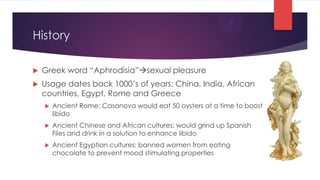
   Greek word “Aphrodisia”sexual pleasure
   Usage dates back 1000’s of years: China, India, African
    countries, Egypt, Rome and Greece
       Ancient Rome: Casanova would eat 50 oysters at a time to boost
        libido
       Ancient Chinese and African cultures: would grind up Spanish
        Flies and drink in a solution to enhance libido
       Ancient Egyptian cultures: banned women from eating
        chocolate to prevent mood stimulating properties
Biomechanics

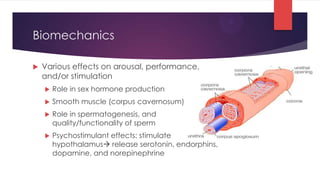
   Various effects on arousal, performance,
    and/or stimulation
       Role in sex hormone production
       Smooth muscle (corpus cavernosum)
       Role in spermatogenesis, and
        quality/functionality of sperm
       Psychostimulant effects: stimulate
        hypothalamus release serotonin, endorphins,
        dopamine, and norepinephrine
1.   Oysters
                  2.   Chocolate
                  3.   Saffron
Scientific        4.   Horney Goat Weed
Evidence          5.   Red Ginseng
supports the      6.   Yohimbine
following foods   7.   Carnitine
                  8.   Maca Root
                  9.   Muria puama
Oysters


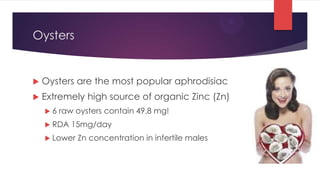
   Oysters are the most popular aphrodisiac
   Extremely high source of organic Zinc (Zn)
    6   raw oysters contain 49.8 mg!
     RDA   15mg/day
     Lower   Zn concentration in infertile males
Zinc on semen quality

   RCT: cattle with Zn supplementation vs placebo
    revealed significant improvements in semen
    quality:
       1.   Higher semen volume
       2.   Higher sperm concentration per ejaculate (also
            seen in men, rams, bucks, and rabbits)
       3.   Improved sperm motility and functionality
       4.   Higher concentration of testosterone
Biological roles of Zinc

1. Increased semen volume
     Prostate secretes Zn into semen, therefore, more Zn  greater
      secretory activity
2. Increased sperm concentration
     Zn part of DNA/RNA polymerases role in mitotic and meiotic
      cell division, and synthesis of DNA and RNA
     Zn metalloenzymes: Sorbitol dehydrogenase and lactate
      dehydrogenase  key in spermatogenesis
Biological Roles of Zinc

3. Improved Sperm motility:
      Zn controls ATP utilization by regulating phospholipid reserves and
       oxygen uptake for sperm flagella

4. Improved sperm and functionality/livability:
      Zn acts as an antioxidant; inhibits phospholipase
      Protects sperm from free radical damage and lipid peroxidation

5. Increased testosterone:
      Zn stimulates Leydig cells  synthesis and secretion
      Zn activates adenylyl cyclase system synthesis
      Maintenance of seminiferous tubules secretion
Chocolate

   Increases mood, sexual desire and sexual pleasure
   Bioactive constituent - Phenolic flavenols:
    Phenylethylamine, catechin, epicatachin, and
    procyanidis
       Stimulates hypothalamus; inducing pleasure with serotonin
        and endorphins
       Upregulates Nitric Oxide (NO); role in engorging corpus
        callosum
       Mimics dopamine and adrenaline: Raises blood pressure,
        increase heart rate, and heightened sensations
Chocolate

   Bioactive Constituent - Unsaturated N-Acetylcholamines
    in chocolate:
       Activate cannabinoid receptors increased penile sensitivity and
        feelings of euphoria

1. 2006 retrospective cohort study; those who regularly
    consumed chocolate vs those who did not:
       Higher sexual desire scores
       No difference in sexual arousal, satisfaction, distress, or
        depression
Saffron


    Research has shown aphrodisiac effects of saffron
1.   RCT with 20 ED males given 200mg/day x 10 days:
        Improved erectile function, sexual desire, intercourse
         satisfaction, and overall satisfaction
2.   RCT placebo: women with SSRI-induced sexual
     dysfunction on 30 mg saffron/day x 4 wks:
        Improved total sexual function, arousal, lubrication, and pain
        No improvements in desire, satisfaction, or orgasm
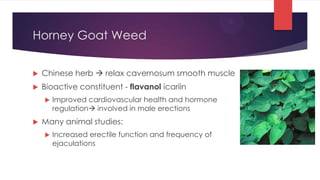
Horney Goat Weed


   Chinese herb  relax cavernosum smooth muscle
   Bioactive constituent - flavanol icariin
       Improved cardiovascular health and hormone
        regulation involved in male erections
   Many animal studies:
       Increased erectile function and frequency of
        ejaculations
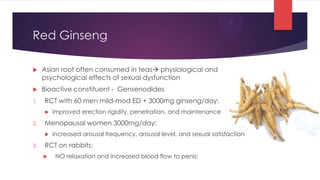
Red Ginseng

    Asian root often consumed in teas physiological and
     psychological effects of sexual dysfunction
    Bioactive constituent - Gensenodides
1.   RCT with 60 men mild-mod ED + 3000mg ginseng/day:
        improved erection rigidity, penetration, and maintenance
2.   Menopausal women 3000mg/day:
        increased arousal frequency, arousal level, and sexual satisfaction
3.   RCT on rabbits:
         NO relaxation and increased blood flow to penis:
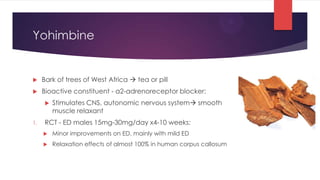
Yohimbine


    Bark of trees of West Africa  tea or pill
    Bioactive constituent - a2-adrenoreceptor blocker:
         Stimulates CNS, autonomic nervous system smooth
          muscle relaxant
1.    RCT - ED males 15mg-30mg/day x4-10 weeks:
         Minor improvements on ED, mainly with mild ED
         Relaxation effects of almost 100% in human corpus callosum
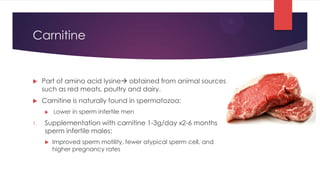
Carnitine


    Part of amino acid lysine obtained from animal sources
     such as red meats, poultry and dairy.
    Carnitine is naturally found in spermatozoa:
        Lower in sperm infertile men

1.   Supplementation with carnitine 1-3g/day x2-6 months
     sperm infertile males:
        Improved sperm motility, fewer atypical sperm cell, and
         higher pregnancy rates
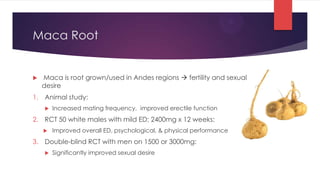
Maca Root


   Maca is root grown/used in Andes regions  fertility and sexual
    desire
1. Animal study:
       Increased mating frequency, improved erectile function
2. RCT 50 white males with mild ED; 2400mg x 12 weeks:
       Improved overall ED, psychological, & physical performance
3. Double-blind RCT with men on 1500 or 3000mg:
       Significantly improved sexual desire
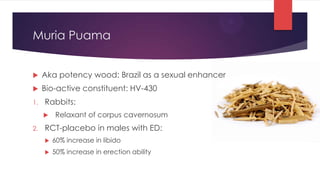
Muria Puama


    Aka potency wood: Brazil as a sexual enhancer
    Bio-active constituent: HV-430
1.   Rabbits:
        Relaxant of corpus cavernosum
2.   RCT-placebo in males with ED:
        60% increase in libido
        50% increase in erection ability
1. Supplements:
                       Vitamin C, Vitamin E, Co-enzyme Q10,
Not                
                       Lycopene
Supported       2. Phallic symbols or resemblance to
                   genitals
by Scientific
                3. Spanish Fly:
Evidence              More toxic than beneficial  severe
                       urinary tract infections
                4. Nutmeg:
                      Only two animal studies:
                           increased mounting behaviour of male
                            rats onto female rats
•   Despite popularity over
              millennia, aphrodisiacs
              seldom researched
          •   Always consult physician for
              sexual dysfunction
              Treatment
Summary   •   Some evidence exists, but
              take with grain of salt
          •   No single nutrient will act as
              a miraculous cure, do your
              research!
Discussion

Aphrodisiacs in the diet

  • 1.
    Aphrodisiacs in theDiet HEIDI CHODOROWICZ HLTH 421 MARCH 21, 2013
  • 2.
    Outline  Introduction  History  Biomechanics  Supported by research  Not supported by research  Summary  Discussion
  • 3.
    Introduction  Aphrodisiacs: substances which are used to improve sexual arousal, performance, or satisfaction, and/or to treat sexual dysfunction  Sexual dysfunction:  Premature, retrograded, retarded or inhibited ejaculation,  Erectile Dysfunction (ED), Arousal difficulties  Compulsive Sexual Behaviour, Orgasmic Disorder, or failure of Detumescence
  • 4.
    History  Greek word “Aphrodisia”sexual pleasure  Usage dates back 1000’s of years: China, India, African countries, Egypt, Rome and Greece  Ancient Rome: Casanova would eat 50 oysters at a time to boost libido  Ancient Chinese and African cultures: would grind up Spanish Flies and drink in a solution to enhance libido  Ancient Egyptian cultures: banned women from eating chocolate to prevent mood stimulating properties
  • 5.
    Biomechanics  Various effects on arousal, performance, and/or stimulation  Role in sex hormone production  Smooth muscle (corpus cavernosum)  Role in spermatogenesis, and quality/functionality of sperm  Psychostimulant effects: stimulate hypothalamus release serotonin, endorphins, dopamine, and norepinephrine
  • 6.
    1. Oysters 2. Chocolate 3. Saffron Scientific 4. Horney Goat Weed Evidence 5. Red Ginseng supports the 6. Yohimbine following foods 7. Carnitine 8. Maca Root 9. Muria puama
  • 7.
    Oysters  Oysters are the most popular aphrodisiac  Extremely high source of organic Zinc (Zn) 6 raw oysters contain 49.8 mg!  RDA 15mg/day  Lower Zn concentration in infertile males
  • 8.
    Zinc on semenquality  RCT: cattle with Zn supplementation vs placebo revealed significant improvements in semen quality: 1. Higher semen volume 2. Higher sperm concentration per ejaculate (also seen in men, rams, bucks, and rabbits) 3. Improved sperm motility and functionality 4. Higher concentration of testosterone
  • 9.
    Biological roles ofZinc 1. Increased semen volume  Prostate secretes Zn into semen, therefore, more Zn  greater secretory activity 2. Increased sperm concentration  Zn part of DNA/RNA polymerases role in mitotic and meiotic cell division, and synthesis of DNA and RNA  Zn metalloenzymes: Sorbitol dehydrogenase and lactate dehydrogenase  key in spermatogenesis
  • 10.
    Biological Roles ofZinc 3. Improved Sperm motility:  Zn controls ATP utilization by regulating phospholipid reserves and oxygen uptake for sperm flagella 4. Improved sperm and functionality/livability:  Zn acts as an antioxidant; inhibits phospholipase  Protects sperm from free radical damage and lipid peroxidation 5. Increased testosterone:  Zn stimulates Leydig cells  synthesis and secretion  Zn activates adenylyl cyclase system synthesis  Maintenance of seminiferous tubules secretion
  • 11.
    Chocolate  Increases mood, sexual desire and sexual pleasure  Bioactive constituent - Phenolic flavenols: Phenylethylamine, catechin, epicatachin, and procyanidis  Stimulates hypothalamus; inducing pleasure with serotonin and endorphins  Upregulates Nitric Oxide (NO); role in engorging corpus callosum  Mimics dopamine and adrenaline: Raises blood pressure, increase heart rate, and heightened sensations
  • 12.
    Chocolate  Bioactive Constituent - Unsaturated N-Acetylcholamines in chocolate:  Activate cannabinoid receptors increased penile sensitivity and feelings of euphoria 1. 2006 retrospective cohort study; those who regularly consumed chocolate vs those who did not:  Higher sexual desire scores  No difference in sexual arousal, satisfaction, distress, or depression
  • 13.
    Saffron  Research has shown aphrodisiac effects of saffron 1. RCT with 20 ED males given 200mg/day x 10 days:  Improved erectile function, sexual desire, intercourse satisfaction, and overall satisfaction 2. RCT placebo: women with SSRI-induced sexual dysfunction on 30 mg saffron/day x 4 wks:  Improved total sexual function, arousal, lubrication, and pain  No improvements in desire, satisfaction, or orgasm
  • 14.
    Horney Goat Weed  Chinese herb  relax cavernosum smooth muscle  Bioactive constituent - flavanol icariin  Improved cardiovascular health and hormone regulation involved in male erections  Many animal studies:  Increased erectile function and frequency of ejaculations
  • 15.
    Red Ginseng  Asian root often consumed in teas physiological and psychological effects of sexual dysfunction  Bioactive constituent - Gensenodides 1. RCT with 60 men mild-mod ED + 3000mg ginseng/day:  improved erection rigidity, penetration, and maintenance 2. Menopausal women 3000mg/day:  increased arousal frequency, arousal level, and sexual satisfaction 3. RCT on rabbits:  NO relaxation and increased blood flow to penis:
  • 16.
    Yohimbine  Bark of trees of West Africa  tea or pill  Bioactive constituent - a2-adrenoreceptor blocker:  Stimulates CNS, autonomic nervous system smooth muscle relaxant 1. RCT - ED males 15mg-30mg/day x4-10 weeks:  Minor improvements on ED, mainly with mild ED  Relaxation effects of almost 100% in human corpus callosum
  • 17.
    Carnitine  Part of amino acid lysine obtained from animal sources such as red meats, poultry and dairy.  Carnitine is naturally found in spermatozoa:  Lower in sperm infertile men 1. Supplementation with carnitine 1-3g/day x2-6 months sperm infertile males:  Improved sperm motility, fewer atypical sperm cell, and higher pregnancy rates
  • 18.
    Maca Root  Maca is root grown/used in Andes regions  fertility and sexual desire 1. Animal study:  Increased mating frequency, improved erectile function 2. RCT 50 white males with mild ED; 2400mg x 12 weeks:  Improved overall ED, psychological, & physical performance 3. Double-blind RCT with men on 1500 or 3000mg:  Significantly improved sexual desire
  • 19.
    Muria Puama  Aka potency wood: Brazil as a sexual enhancer  Bio-active constituent: HV-430 1. Rabbits:  Relaxant of corpus cavernosum 2. RCT-placebo in males with ED:  60% increase in libido  50% increase in erection ability
  • 20.
    1. Supplements: Vitamin C, Vitamin E, Co-enzyme Q10, Not  Lycopene Supported 2. Phallic symbols or resemblance to genitals by Scientific 3. Spanish Fly: Evidence  More toxic than beneficial  severe urinary tract infections 4. Nutmeg:  Only two animal studies:  increased mounting behaviour of male rats onto female rats
  • 21.
    Despite popularity over millennia, aphrodisiacs seldom researched • Always consult physician for sexual dysfunction Treatment Summary • Some evidence exists, but take with grain of salt • No single nutrient will act as a miraculous cure, do your research!
  • 22.

Editor's Notes

  • #4 Substances including food, micronutirents, herbal supplements, or food constituents consumed for the purpose of improving sexual arousal, performance, satisfaction, or for the treatment of sexual dysfunction
  • #5 Historically consumed to enhance successful procreation/obtaian sexually fulfillinf relationships
  • #6 For example, zinc is secreted with each male ejaculation, therefore replenishing with high zinc sources such as oysters contribute to good sexual helathB vEach source responsible for different mechanisms that contribute to sexual arousal, performance, and/or stimulationRole in sex hormone production  Zinc, possibly B vitaminsSmooth muscle relaxants (ie corpus callosum leading to erection)  Zinc and Horney Goat WeedRole in spermatogenesis, and quality/functionality of sperm: ZincPsychostimulant effects: stimulate hypothalamus, can release serotonin, endorphins, dopamine, and norepinephrine  Chocolateitamins involved in testosterone production
  • #8 (2nd highest = 8.9mg in 3 oz of shank beef)Lack of research on oysters, but lots on znStudies show that infertile males have lower Zinc in their semen, therefore, increasing Zinc may be an effective aphrodisiac
  • #10 Prostate secretes 35-40% of semen volume
  • #12 Dopamine and adrenaline: autonomic nervous system
  • #13 Cocoa and chocolate have been reported to exert several effects on human sexuality, acting mainly as an effective aphrodisiac, increasing sexual desire and improving sexual pleasurephenylethylamine, which has been reported to stimulate the hypothalamus, inducing pleasurable sensations as well as affecting the levels of two neurotransmitters – 5-hydroxytrytamine (serotonin) and endorphins in the brain – hence enhancing mood lifting and sexual drive.Participants in Group 1 had significantly higher total (P = 0.002) and desire domain (P = 0.01) FSFI scores than participants in Group 2. No differences between the two groups were observed concerning sexual arousal and satisfaction, sexual distress and depression
  • #14 This was a randomized double-blind placebo-controlled study. Thirty-eight women with major depression who were stabilized on fluoxetine 40 mg/day for a minimum of 6 weeks and had experienced subjective feeling of sexual dysfunction entered the study. The patients were randomly assigned to saffron (30 mg/daily) or placebo for 4 weeks. Measurement was performed at baseline, week 2, and week 4 using the Female Sexual Function Index (FSFI). Side effects were systematically recorded.At the end of the fourth week, patients in the saffron group had experienced significantly more improvement in total FSFI (p<0.001), arousal (p = 0.028), lubrication (p = 0.035), and pain (p = 0.016) domains of FSFI but not in desire (p = 0.196), satisfaction (p = 0.206), and orgasm (p = 0.354) domains. Frequency of side effects was similar between the two groups.
  • #17 Is a alpha2-adrenoreceptor blocker that has been shown in vivo to have effects in the CNS, autonomic nervous system, and penile tissue and vascular smooth muscleRCT confirm ability to treat ED 15mg-30mg.day x4-10 weeks: minor improvements on ED, mainly with mild EDBut yohimbine has been shown to have relaxation effects of almost 100% in human corpus callosum, therefore certainly potential as effective aphrodisiac
  • #19 Maca:Lepidiummeyenii (Maca) is a cultivated root belonging to the brassica familyused in the Andean region for its supposed aphrodisiac properties. We carriedout a double-blind clinical trial on 50 Caucasian men affected by mild erectiledysfunction (ED), randomised to treatment with Maca dry extract, 2400 mg,or placebo. The treatment effect on ED and subjective well-being was testedadministrating before and after 12 weeks the International Index of ErectileFunction (IIEF-5) and the Satisfaction Profile (SAT-P). After 12 weeks of treatment, both Maca- and placebo-treated patients experienced a significantincrease in IIEF-5 score (P < 0.05 for both). However, patients taking Macaexperienced a more significant increase than those taking placebo (1.6 ± 1.1versus 0.5 ± 0.6, P < 0.001). Both Maca- and placebo-treated subjects experienced a significant improvement in psychological performance-related SAT-Pscore, but the Maca group higher than that of placebo group (+9 ± 6 versus+6 ± 5, P < 0.05). However, only Maca-treated patients experienced a signifi-cant improvement in physical and social performance-related SAT-P scorecompared with the baseline (+7 ± 6 and +7 ± 6, both P < 0.05). In conclusion, our data support a small but significant effect of Maca supplementationon subjective perception of general and sexual well-being in adult patients withmild ED.