Prevalence of Sexual Dysfunction in Women using Intrauterine
Hormone-Releasing Systems: preliminary results
Janssens D1, Enzlin P2,3, Poppe W3, Eelen Chr4, Weyers S5, Amy J-J6
1 Department of Gynaecology; Turnhout; 2 Institute of Family and Sexuality Studies, Katholieke Universiteit Leuven, Leuven;
3Department of Gynaecology, University Hospitals Gasthuisberg, Leuven; 4Department of Gynaecology, Antwerp;
5University Hospital, UZ Ghent, Ghent; and 6 Academisch Ziekenhuis –Vrije Universiteit Brussel; Brussels; Belgium.
Flemish General Gynaecology Working Party – Flemish Society of Obstetrics and Gynaecology (VVOG)
INTRODUCTION
Contraceptive choice is largely affected by the satisfaction with different used methods. The level of satisfaction with a specific method will be influenced by the woman’s
personal experience with that method and its impact on quality of life and sexual functioning. Although it is known that hormonal contraceptive methods can lower the level
of bioavailable testosterone - and hence decrease sexual desire - the relation between contraceptives and sexual functioning has not been intensively studied. Therefore, this
study was designed to compare the influence of intrauterine hormone-releasing systems (HIUS - levonorgestrel) versus Cu-IUD on sexual functioning.
OBJECTIVES
This study was designed : (1) to assess different aspects of sexual functioning, including the prevalence of sexual dysfunction in women using an HIUS; (2) to compare this
prevalence with that in women using a copper-releasing intrauterine device (Cu-IUD); and (3) to identify the relation between psychological variables and sexual functioning
in women resorting to intrauterine contraception.
RESEARCH DESIGN AND METHODS
In this multi centre study, all participating gynaecologists consecutively invited 845 women consulting for a routine gynecological check-up to participate in the study.
Women could be included if they were (1) at least 18 years old; (2) in a stable heterosexual relation for at least 1 year; and (3) using an HIUS of Cu-IUD for at least 6 months.
Participants received a number of questionnaires to fill out at home, and were asked to return these within 4 weeks by mail. The questionnaires covered depression (BDI),
well-being (WHO-5), quality of the marital relation (DAS), and sexual functioning (QSF, SSFS).
• The Beck Depression Inventory (BDI) measures self-reported symptoms of depression. Higher scores mean the existence of more depressive symptomatology.
• The Dyadic Adjustment Scale (DAS) measures the quality of marital relation. Higher scores mean higher marital satisfaction.
• The Short Sexual Functioning Scale (SSFS) is a self-constructed questionnaire measuring the presence and severity of sexual dysfunction (increased libido, decreased
libido, vaginal dryness, problems with orgasm) including the burden imposed by the dysfunction on the women, her partner and the relation.
• The Questionnaire on Female Sexual Functioning (QSF) is a self-constructed questionnaire measuring the impact of IUD-use on sexual functioning by comparing the
current sexual experiences with the highest satisfaction ever; and including Visual Analogue Scales on the impact of IUHS or Cu-IUD on several aspects of sexual
functioning (frequency, desire, arousal, orgasm, general influence of IUD on sexual functioning).
Also data pertaining to (1) demographic characteristics (age, civil status, education, occupation, chronic disease); (2) IUHS or Cu-IUD-use (age at placement first IUD,
number of children, reason for IUD-use, changes in menstrual cycle, satisfaction, recommendations to other women; (3) menstrual cycle (age at menarche, presence and
severity of premenstrual emotional changes).
SAMPLE CHARACTERISTICS
In total, 402 patients (RR= 48%) sent back the questionnaire: of these, 23 (6%) refused to participate and returned a blank questionnaire; 354 women were using an HIUS
(88%) and 48 were using a Cu-IUD (12%). The mean age of this sample was 40.8  8.3 years old (range: 19-63) with no significant difference between both groups. Women
using a Cu-IUD were significantly older (35.5 vs 29.5 years old; p=<.001), and used the IUD significantly longer (88.7 vs 41.8 months; p <.001). Both groups did not differ
with regard to psychological variables as depressive symptoms (3.9 vs 4.7; p=.52), well-being (17.7 vs 16.8; p=.17), and quality of the partner relation (108 vs 107; p=.74).
RESULTS
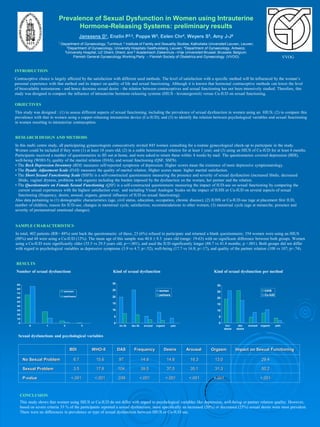
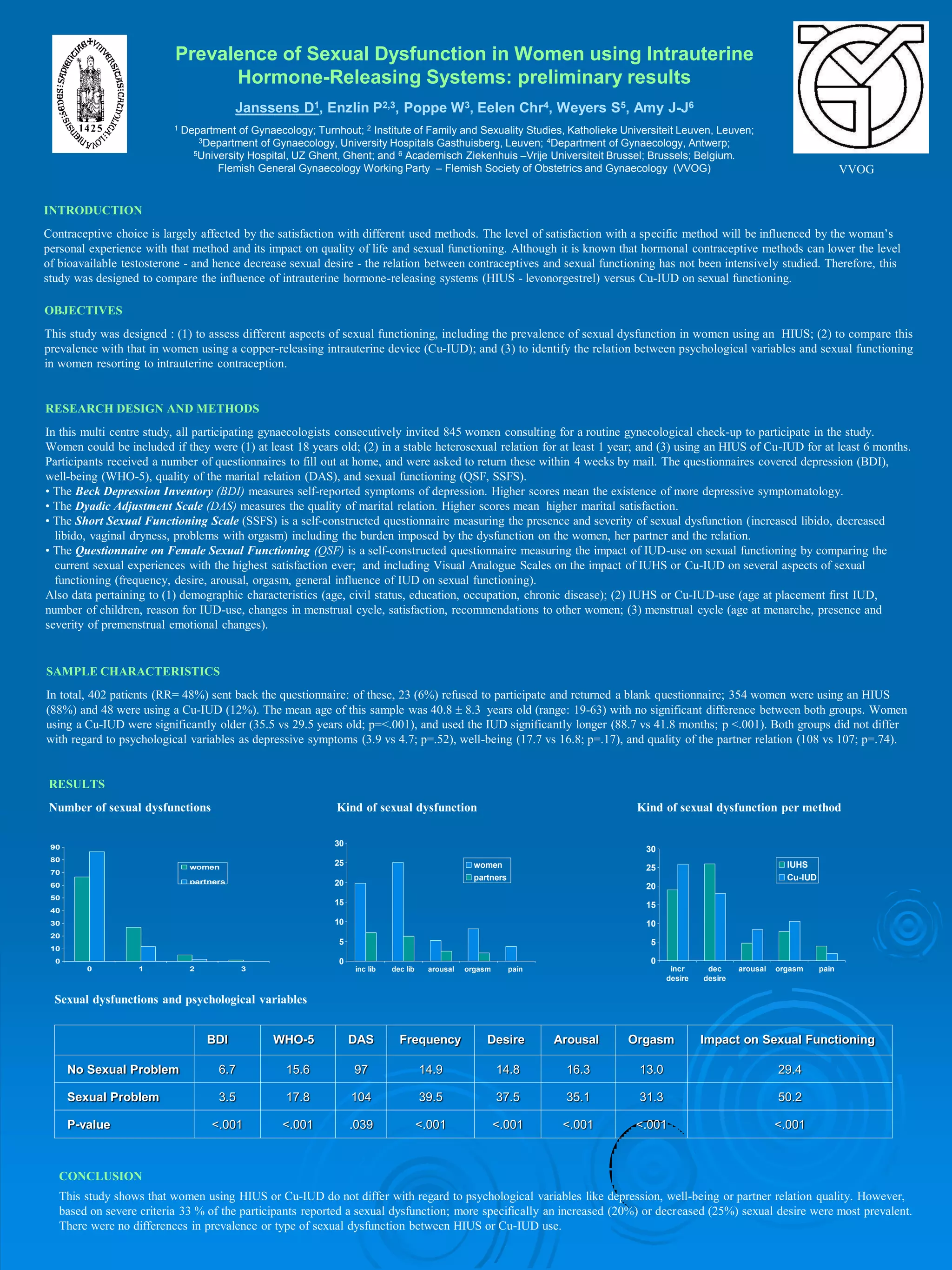
Number of sexual dysfunctions Kind of sexual dysfunction Kind of sexual dysfunction per method
CONCLUSION
This study shows that women using HIUS or Cu-IUD do not differ with regard to psychological variables like depression, well-being or partner relation quality. However,
based on severe criteria 33 % of the participants reported a sexual dysfunction; more specifically an increased (20%) or decreased (25%) sexual desire were most prevalent.
There were no differences in prevalence or type of sexual dysfunction between HIUS or Cu-IUD use.
VVOG
0
10
20
30
40
50
60
70
80
90
0 1 2 3
women
partners
0
5
10
15
20
25
30
inc lib dec lib arousal orgasm pain
women
partners
0
5
10
15
20
25
30
incr
desire
dec
desire
arousal orgasm pain
IUHS
Cu-IUD
Sexual dysfunctions and psychological variables
BDI WHO-5 DAS Frequency Desire Arousal Orgasm Impact on Sexual Functioning
No Sexual Problem 6.7 15.6 97 14.9 14.8 16.3 13.0 29.4
Sexual Problem 3.5 17.8 104 39.5 37.5 35.1 31.3 50.2
P-value <.001 <.001 .039 <.001 <.001 <.001 <.001 <.001

poster helsinki vespiras - kleur - final

  • 1.
    Prevalence of SexualDysfunction in Women using Intrauterine Hormone-Releasing Systems: preliminary results Janssens D1, Enzlin P2,3, Poppe W3, Eelen Chr4, Weyers S5, Amy J-J6 1 Department of Gynaecology; Turnhout; 2 Institute of Family and Sexuality Studies, Katholieke Universiteit Leuven, Leuven; 3Department of Gynaecology, University Hospitals Gasthuisberg, Leuven; 4Department of Gynaecology, Antwerp; 5University Hospital, UZ Ghent, Ghent; and 6 Academisch Ziekenhuis –Vrije Universiteit Brussel; Brussels; Belgium. Flemish General Gynaecology Working Party – Flemish Society of Obstetrics and Gynaecology (VVOG) INTRODUCTION Contraceptive choice is largely affected by the satisfaction with different used methods. The level of satisfaction with a specific method will be influenced by the woman’s personal experience with that method and its impact on quality of life and sexual functioning. Although it is known that hormonal contraceptive methods can lower the level of bioavailable testosterone - and hence decrease sexual desire - the relation between contraceptives and sexual functioning has not been intensively studied. Therefore, this study was designed to compare the influence of intrauterine hormone-releasing systems (HIUS - levonorgestrel) versus Cu-IUD on sexual functioning. OBJECTIVES This study was designed : (1) to assess different aspects of sexual functioning, including the prevalence of sexual dysfunction in women using an HIUS; (2) to compare this prevalence with that in women using a copper-releasing intrauterine device (Cu-IUD); and (3) to identify the relation between psychological variables and sexual functioning in women resorting to intrauterine contraception. RESEARCH DESIGN AND METHODS In this multi centre study, all participating gynaecologists consecutively invited 845 women consulting for a routine gynecological check-up to participate in the study. Women could be included if they were (1) at least 18 years old; (2) in a stable heterosexual relation for at least 1 year; and (3) using an HIUS of Cu-IUD for at least 6 months. Participants received a number of questionnaires to fill out at home, and were asked to return these within 4 weeks by mail. The questionnaires covered depression (BDI), well-being (WHO-5), quality of the marital relation (DAS), and sexual functioning (QSF, SSFS). • The Beck Depression Inventory (BDI) measures self-reported symptoms of depression. Higher scores mean the existence of more depressive symptomatology. • The Dyadic Adjustment Scale (DAS) measures the quality of marital relation. Higher scores mean higher marital satisfaction. • The Short Sexual Functioning Scale (SSFS) is a self-constructed questionnaire measuring the presence and severity of sexual dysfunction (increased libido, decreased libido, vaginal dryness, problems with orgasm) including the burden imposed by the dysfunction on the women, her partner and the relation. • The Questionnaire on Female Sexual Functioning (QSF) is a self-constructed questionnaire measuring the impact of IUD-use on sexual functioning by comparing the current sexual experiences with the highest satisfaction ever; and including Visual Analogue Scales on the impact of IUHS or Cu-IUD on several aspects of sexual functioning (frequency, desire, arousal, orgasm, general influence of IUD on sexual functioning). Also data pertaining to (1) demographic characteristics (age, civil status, education, occupation, chronic disease); (2) IUHS or Cu-IUD-use (age at placement first IUD, number of children, reason for IUD-use, changes in menstrual cycle, satisfaction, recommendations to other women; (3) menstrual cycle (age at menarche, presence and severity of premenstrual emotional changes). SAMPLE CHARACTERISTICS In total, 402 patients (RR= 48%) sent back the questionnaire: of these, 23 (6%) refused to participate and returned a blank questionnaire; 354 women were using an HIUS (88%) and 48 were using a Cu-IUD (12%). The mean age of this sample was 40.8  8.3 years old (range: 19-63) with no significant difference between both groups. Women using a Cu-IUD were significantly older (35.5 vs 29.5 years old; p=<.001), and used the IUD significantly longer (88.7 vs 41.8 months; p <.001). Both groups did not differ with regard to psychological variables as depressive symptoms (3.9 vs 4.7; p=.52), well-being (17.7 vs 16.8; p=.17), and quality of the partner relation (108 vs 107; p=.74). RESULTS Number of sexual dysfunctions Kind of sexual dysfunction Kind of sexual dysfunction per method CONCLUSION This study shows that women using HIUS or Cu-IUD do not differ with regard to psychological variables like depression, well-being or partner relation quality. However, based on severe criteria 33 % of the participants reported a sexual dysfunction; more specifically an increased (20%) or decreased (25%) sexual desire were most prevalent. There were no differences in prevalence or type of sexual dysfunction between HIUS or Cu-IUD use. VVOG 0 10 20 30 40 50 60 70 80 90 0 1 2 3 women partners 0 5 10 15 20 25 30 inc lib dec lib arousal orgasm pain women partners 0 5 10 15 20 25 30 incr desire dec desire arousal orgasm pain IUHS Cu-IUD Sexual dysfunctions and psychological variables BDI WHO-5 DAS Frequency Desire Arousal Orgasm Impact on Sexual Functioning No Sexual Problem 6.7 15.6 97 14.9 14.8 16.3 13.0 29.4 Sexual Problem 3.5 17.8 104 39.5 37.5 35.1 31.3 50.2 P-value <.001 <.001 .039 <.001 <.001 <.001 <.001 <.001