may 9.2016
John Fernandez, Dir. of MIT Environmental Solutions Initiative
AccessMyCommute
• John Attanucci, Lecturer & Manager MIT Transit Research Program
• Corey Tucker, 3rd year, Master of Sci. in Transport. and Technology &
Policy
MIT Roof Study
• Taya Dixon, Senior Planner, Capital Renewal
• Isaac LaJoie, 4th year, Mechanical Engineering
2100 Resiliency Planning
• Mike Wilson, Urban Studies and Planning
• Jacqueline Kuo, 4th year, Mechanical Engineering
campus as a living
laboratory
Accessmycommute
Corey Tucker
John Attanucci
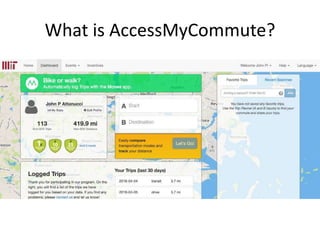
What is AccessMyCommute?
Benefits of AccessMyCommute
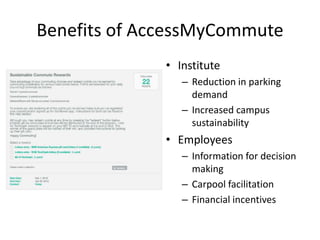
• Institute
– Reduction in parking
demand
– Increased campus
sustainability
• Employees
– Information for decision
making
– Carpool facilitation
– Financial incentives
Challenges/Research Advances
• Platform integration (Combining a mobile app with secure,
interactive employee dashboard on established site)
– RideAmigos – Unity
– ATLAS
– Moves
• Data (Can we collect and present reliable dashboard data
seamlessly with minimal user assistance?)
– Availability
– Reliability
– Processing
• User reception/experience (Can we get eyes repeatedly on the
dashboard; can we measure & change commuting behavior?)
– Email messaging
– Use of Moves
| MIT Sustainability Connect 2016: Campus as a Living Lab
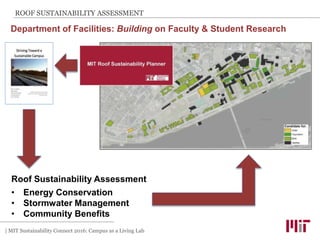
Department of Facilities: Building on Faculty & Student Research
ROOF SUSTAINABILITY ASSESSMENT
Roof Sustainability Assessment
• Energy Conservation
• Stormwater Management
• Community Benefits
| MIT Sustainability Connect 2016: Campus as a Living Lab
Student Investigation: What is MIT’s solar potential?
 MIT should be a leader in
sustainability and clean
energy
 Used MIT developed tool
(Mapdwell) to generate data
and designs
 Worked with Office of
Sustainability
 Presented findings to
administration
ROOF SUSTAINABILITY ASSESSMENT
Student Inquiry
Administration
Office of Sustainability
Impact &
Development
Facilities
ADAPTING MIT TO CLIMATE
CHANGE
11.123 | BIG PLANS
INSTRUCTORS: LINDA SHI AND MIKE WILSON
STUDENT: JACQUELINE KUO
CAMBRIDGE CLIMATE VULNERABILITY ASSESSMENT
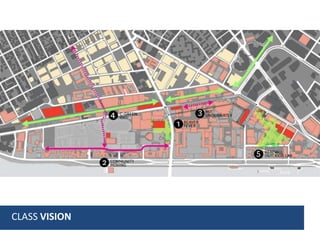
CLASS VISION
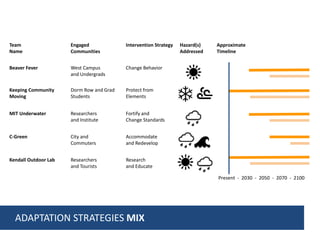
Team
Name
Engaged
Communities
Intervention Strategy Hazard(s)
Addressed
Approximate
Timeline
Beaver Fever West Campus
and Undergrads
Change Behavior
Keeping Community
Moving
Dorm Row and Grad
Students
Protect from
Elements
MIT Underwater Researchers
and Institute
Fortify and
Change Standards
C-Green City and
Commuters
Accommodate
and Redevelop
Kendall Outdoor Lab Researchers
and Tourists
Research
and Educate
ADAPTATION STRATEGIES MIX
Present - 2030 - 2050 - 2070 - 2100
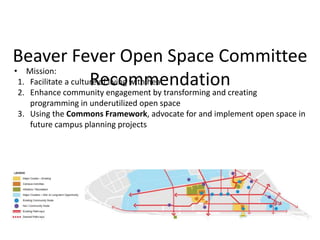
Beaver Fever Open Space Committee
Recommendation
• Mission:
1. Facilitate a culture of living with heat
2. Enhance community engagement by transforming and creating
programming in underutilized open space
3. Using the Commons Framework, advocate for and implement open space in
future campus planning projects
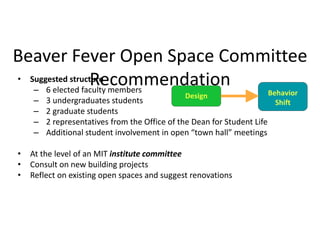
• Suggested structure
– 6 elected faculty members
– 3 undergraduates students
– 2 graduate students
– 2 representatives from the Office of the Dean for Student Life
– Additional student involvement in open “town hall” meetings
• At the level of an MIT institute committee
• Consult on new building projects
• Reflect on existing open spaces and suggest renovations
Design Behavior
Shift
Beaver Fever Open Space Committee
Recommendation
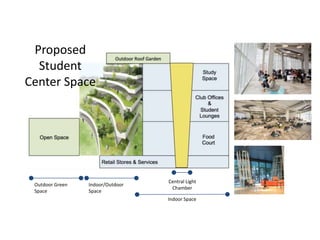
Outdoor Green
Space
Indoor/Outdoor
Space
Indoor Space
Central Light
Chamber
Proposed
Student
Center Space
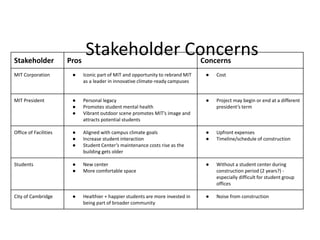
Stakeholder Pros Concerns
MIT Corporation ● Iconic part of MIT and opportunity to rebrand MIT
as a leader in innovative climate-ready campuses
● Cost
MIT President ● Personal legacy
● Promotes student mental health
● Vibrant outdoor scene promotes MIT’s image and
attracts potential students
● Project may begin or end at a different
president’s term
Office of Facilities ● Aligned with campus climate goals
● Increase student interaction
● Student Center’s maintenance costs rise as the
building gets older
● Upfront expenses
● Timeline/schedule of construction
Students ● New center
● More comfortable space
● Without a student center during
construction period (2 years?) -
especially difficult for student group
offices
City of Cambridge ● Healthier + happier students are more invested in
being part of broader community
● Noise from construction
Stakeholder Concerns
may 9.2016
campus as a living
laboratory
discussion & questions

Campus as a living laboratory

  • 1.
    may 9.2016 John Fernandez,Dir. of MIT Environmental Solutions Initiative AccessMyCommute • John Attanucci, Lecturer & Manager MIT Transit Research Program • Corey Tucker, 3rd year, Master of Sci. in Transport. and Technology & Policy MIT Roof Study • Taya Dixon, Senior Planner, Capital Renewal • Isaac LaJoie, 4th year, Mechanical Engineering 2100 Resiliency Planning • Mike Wilson, Urban Studies and Planning • Jacqueline Kuo, 4th year, Mechanical Engineering campus as a living laboratory
  • 2.
  • 3.
  • 4.
    Benefits of AccessMyCommute •Institute – Reduction in parking demand – Increased campus sustainability • Employees – Information for decision making – Carpool facilitation – Financial incentives
  • 5.
    Challenges/Research Advances • Platformintegration (Combining a mobile app with secure, interactive employee dashboard on established site) – RideAmigos – Unity – ATLAS – Moves • Data (Can we collect and present reliable dashboard data seamlessly with minimal user assistance?) – Availability – Reliability – Processing • User reception/experience (Can we get eyes repeatedly on the dashboard; can we measure & change commuting behavior?) – Email messaging – Use of Moves
  • 7.
    | MIT SustainabilityConnect 2016: Campus as a Living Lab Department of Facilities: Building on Faculty & Student Research ROOF SUSTAINABILITY ASSESSMENT Roof Sustainability Assessment • Energy Conservation • Stormwater Management • Community Benefits
  • 8.
    | MIT SustainabilityConnect 2016: Campus as a Living Lab Student Investigation: What is MIT’s solar potential?  MIT should be a leader in sustainability and clean energy  Used MIT developed tool (Mapdwell) to generate data and designs  Worked with Office of Sustainability  Presented findings to administration ROOF SUSTAINABILITY ASSESSMENT Student Inquiry Administration Office of Sustainability Impact & Development Facilities
  • 10.
    ADAPTING MIT TOCLIMATE CHANGE 11.123 | BIG PLANS INSTRUCTORS: LINDA SHI AND MIKE WILSON STUDENT: JACQUELINE KUO
  • 11.
  • 12.
  • 13.
  • 14.
    Team Name Engaged Communities Intervention Strategy Hazard(s) Addressed Approximate Timeline BeaverFever West Campus and Undergrads Change Behavior Keeping Community Moving Dorm Row and Grad Students Protect from Elements MIT Underwater Researchers and Institute Fortify and Change Standards C-Green City and Commuters Accommodate and Redevelop Kendall Outdoor Lab Researchers and Tourists Research and Educate ADAPTATION STRATEGIES MIX Present - 2030 - 2050 - 2070 - 2100
  • 15.
    Beaver Fever OpenSpace Committee Recommendation • Mission: 1. Facilitate a culture of living with heat 2. Enhance community engagement by transforming and creating programming in underutilized open space 3. Using the Commons Framework, advocate for and implement open space in future campus planning projects
  • 16.
    • Suggested structure –6 elected faculty members – 3 undergraduates students – 2 graduate students – 2 representatives from the Office of the Dean for Student Life – Additional student involvement in open “town hall” meetings • At the level of an MIT institute committee • Consult on new building projects • Reflect on existing open spaces and suggest renovations Design Behavior Shift Beaver Fever Open Space Committee Recommendation
  • 17.
    Outdoor Green Space Indoor/Outdoor Space Indoor Space CentralLight Chamber Proposed Student Center Space
  • 18.
    Stakeholder Pros Concerns MITCorporation ● Iconic part of MIT and opportunity to rebrand MIT as a leader in innovative climate-ready campuses ● Cost MIT President ● Personal legacy ● Promotes student mental health ● Vibrant outdoor scene promotes MIT’s image and attracts potential students ● Project may begin or end at a different president’s term Office of Facilities ● Aligned with campus climate goals ● Increase student interaction ● Student Center’s maintenance costs rise as the building gets older ● Upfront expenses ● Timeline/schedule of construction Students ● New center ● More comfortable space ● Without a student center during construction period (2 years?) - especially difficult for student group offices City of Cambridge ● Healthier + happier students are more invested in being part of broader community ● Noise from construction Stakeholder Concerns
  • 19.
    may 9.2016 campus asa living laboratory discussion & questions

Editor's Notes

  • #4 Tool for all MIT employees offering real time trip planning information, tracking of commuting habits (modes, distance, dates), carpool facilitation and financial incentives.
  • #6 Integrating three platforms in the RideAmigos Unity, ATLAS and Moves platforms presented significant challenges with access coming from within ATLAS, and automated account creation is both Unity and Moves Data challenges included availability for all MIT employees. Data was not immediately, automatically available for parkers in ungated lots and some transit users. This was rectified by adding self-reporting at a later time. Reliability from the various data sources (MBTA, parking and transportation, and Moves), safeguards are in place to ensure that should data be missed week to week, it will be caught and added during the next push. Processing…although quality control measures were taken, expansion to over 8,000 MIT users led to some data processing complications. Email messaging was effective, but not reliable as some employees report receiving emails promptly while others did not receive information in a timely manner. Incorporation of Moves proved more difficult than expected, and additional instructions had to be added.
  • #16 Creating informal gathering spaces and encouraging spontaneous interactions among students, faculty, and staff, as well as members of the community and visitors to campus. Commons Framework - preferred locations for campus community spaces Study on Community and Student Activity Space on MIT Campus -Created by MIT Planning Office
  • #17 Size and composition based off of http://studentlife.mit.edu/sites/default/files/CSL%20roster%202015-16.pdf http://web.mit.edu/ir/surveys/pdf/2013_SQL_Survey_Open_Comments_DRAFT_2013July.pdf MIT may be planning to renovate the student center anyway (maybe some MIT surveys in the past say that students want more open space, I will have to check...) Endowed committee independent/discretionary to students- decide how funds are spent Eg. Harvard 5 options- harvard college endowment, financial aid, lecture fund...etc SUGGESTED strucuture, doesn’t really have to be it What kind of power that entails- institute committee? MIT’s governance structure is supported by a strong system of committees and councils. Institute-wide committees and councils that have been established by the governing body of the Faculty and by the President.
  • #19 http://web.mit.edu/corporation/about.html http://orgchart.mit.edu/corporation-and-institutional-officers The renovation will also bring student center up to modern building codes Utilizing current sustainability standards while ensuring historic preservation. MAYBE Installation of life safety systems, sprinkler protection, heat and air conditioning, refurbished windows, security, and network upgrades. Israel Ruiz-The Executive Vice President and Treasurer is the chief steward of over $17.7 billion of MIT's financial assets and $3.1 billion in operating revenues (2015), and is responsible for administering the Institute's $5 billion capital plan through 2030. Areas of responsibility also include human resources, information systems, facilities, and operations. MITIMCo “Time horizon measured in decades, if not centruries, MIT can endure inevtible short-term market fluctuations and wait patiently forthe long-term realization of value” PArtnership with MIT Deshpande Center