IEA DSM Task 24:
Behaviour Change in
DSM
Phases I and II
Dr Sea Rotmann
Operating Agent Task 24
Energy Cultures conference, Wellington
July 7, 2016
For more information, visit www.ieadsm.org
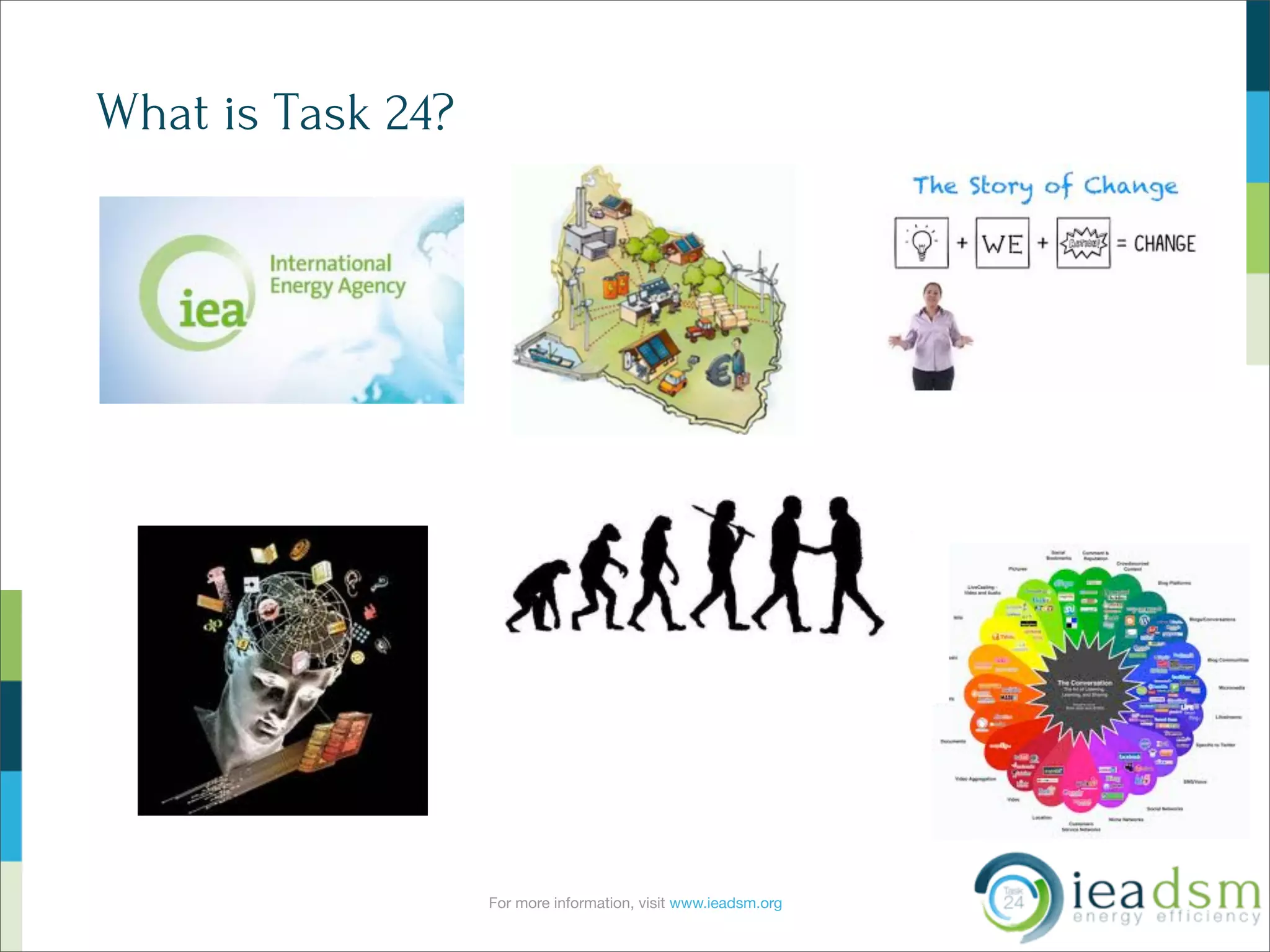
What is Task 24?
For more information, visit www.ieadsm.org
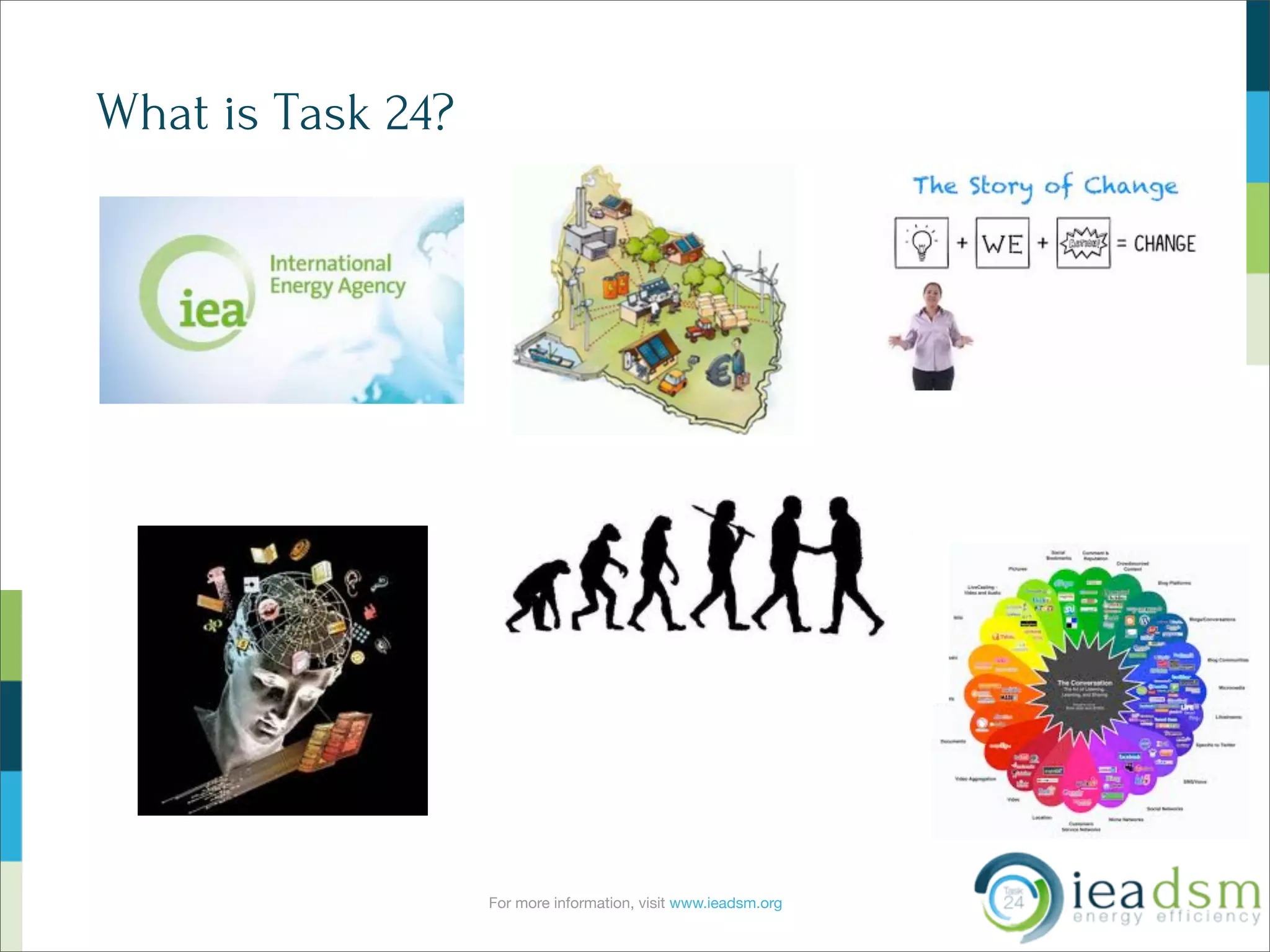
What is Task 24?
For more information, visit www.ieadsm.org
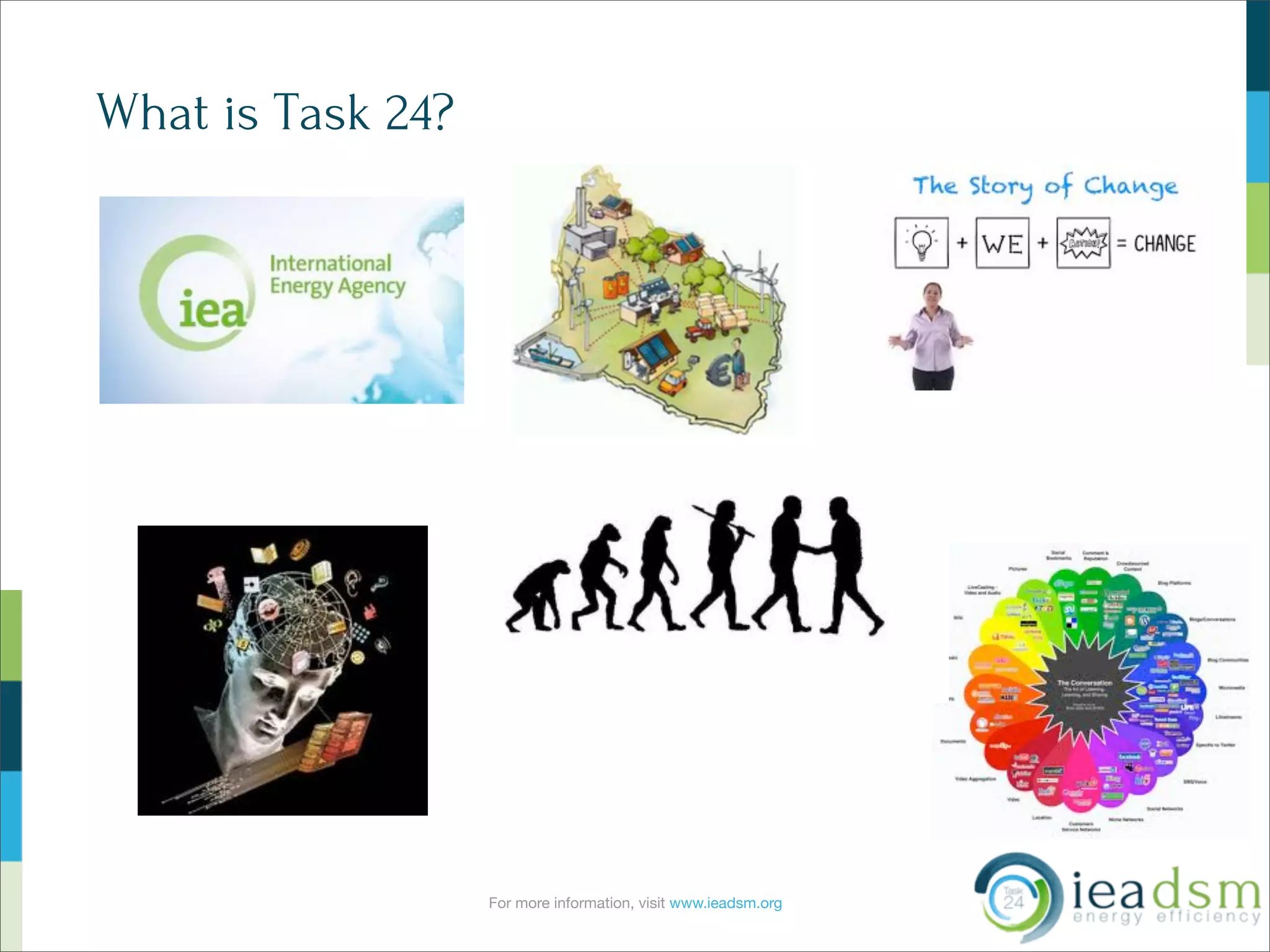
What is Task 24?
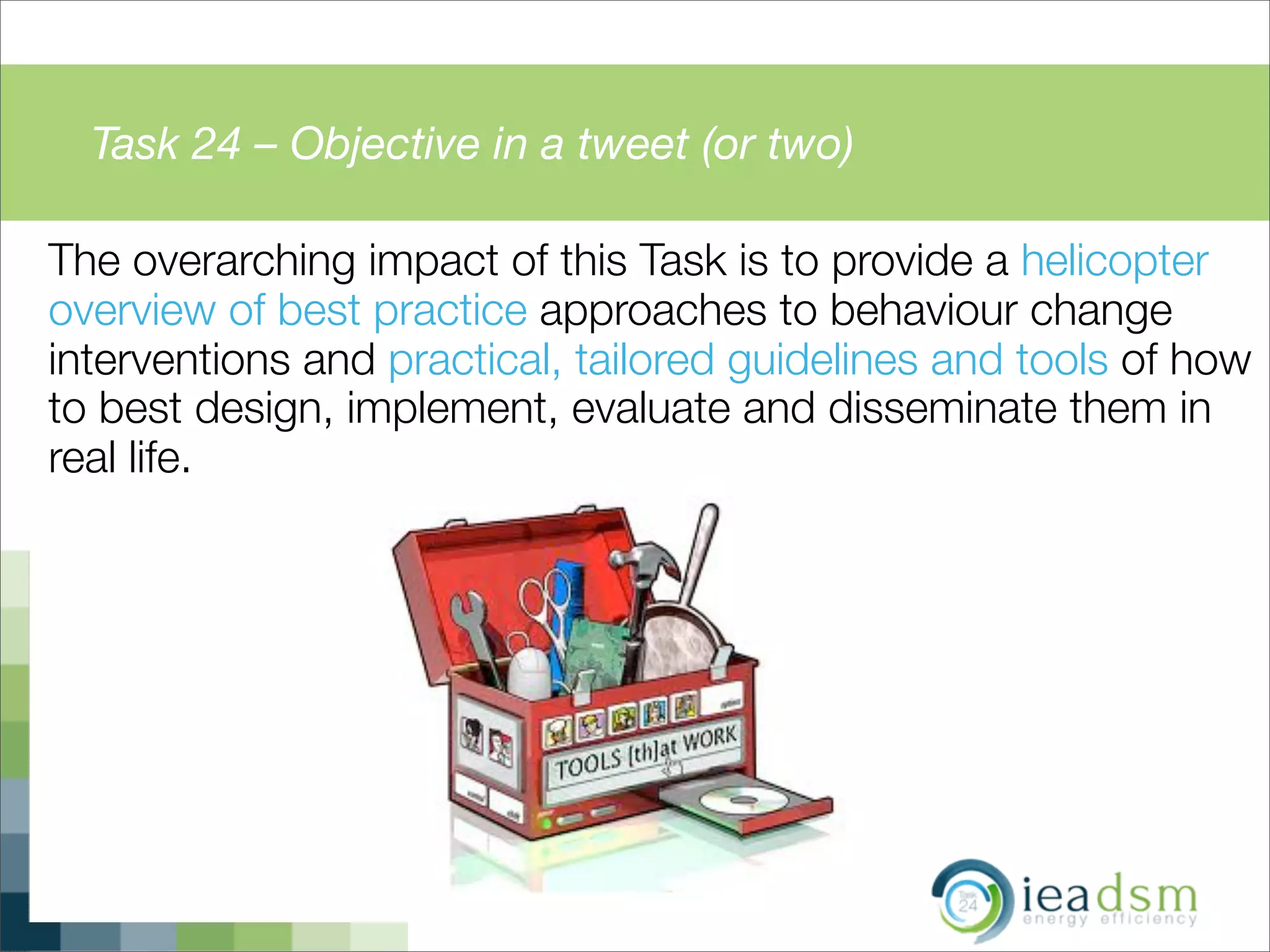
Task 24 – Objective in a tweet (or two)
The overarching impact of this Task is to provide a helicopter
overview of best practice approaches to behaviour change
interventions and practical, tailored guidelines and tools of how
to best design, implement, evaluate and disseminate them in
real life.
IEA DSM Task 24
Phase I
Closing the Loop – Behaviour Change in DSM: From Theory to
Practice
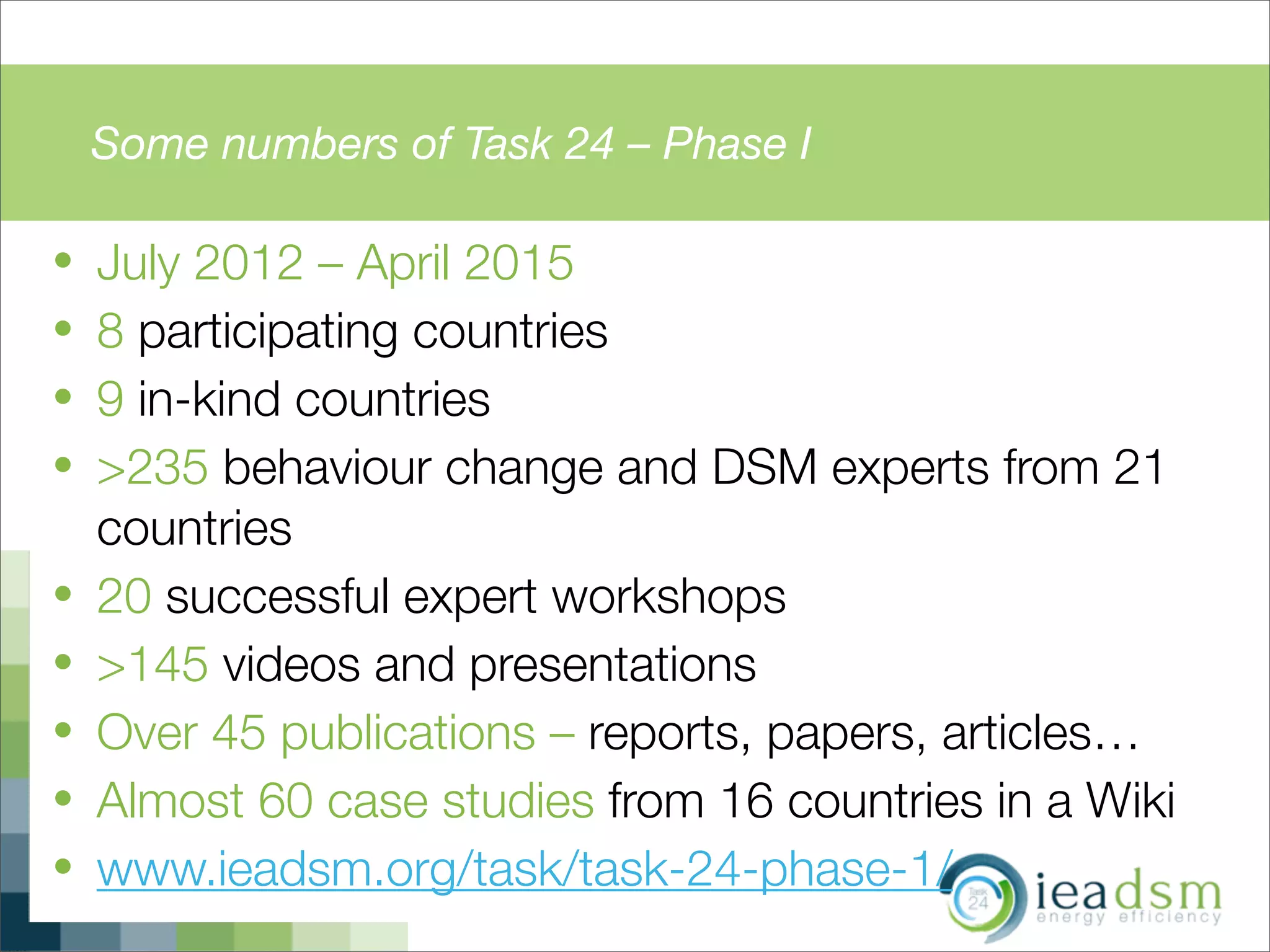
Some numbers of Task 24 – Phase I
• July 2012 – April 2015
• 8 participating countries
• 9 in-kind countries
• >235 behaviour change and DSM experts from 21
countries
• 20 successful expert workshops
• >145 videos and presentations
• Over 45 publications – reports, papers, articles…
• Almost 60 case studies from 16 countries in a Wiki
• www.ieadsm.org/task/task-24-phase-1/
For more information, visit www.ieadsm.org
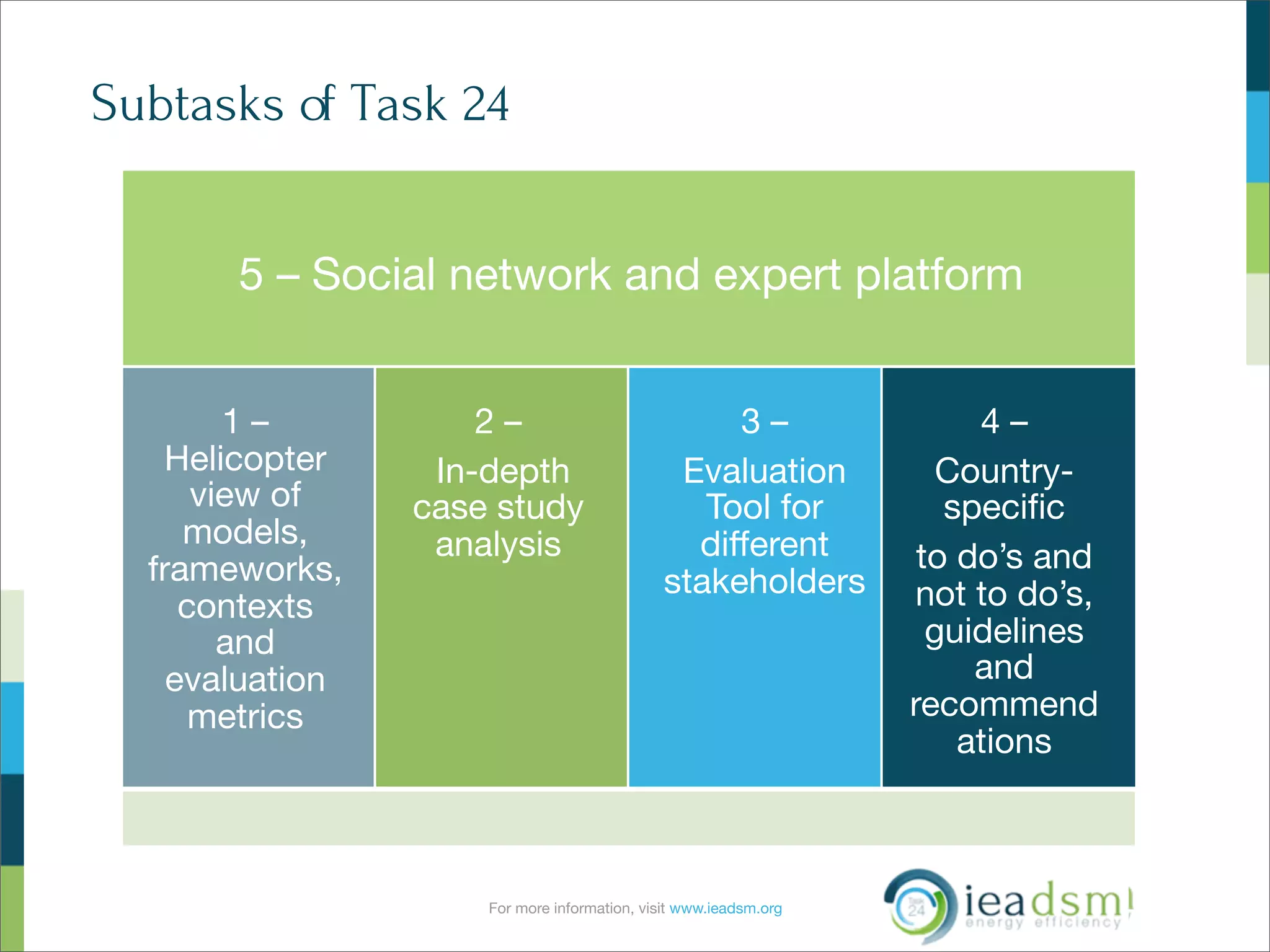
Subtasks of Task 24
5 – Social network and expert platform
1 –
Helicopter
view of
models,
frameworks,
contexts
and
evaluation
metrics
2 –
In-depth
case study
analysis
3 –
Evaluation
Tool for
different
stakeholders
4 –
Country-
specific
to do’s and
not to do’s,
guidelines
and
recommend
ations
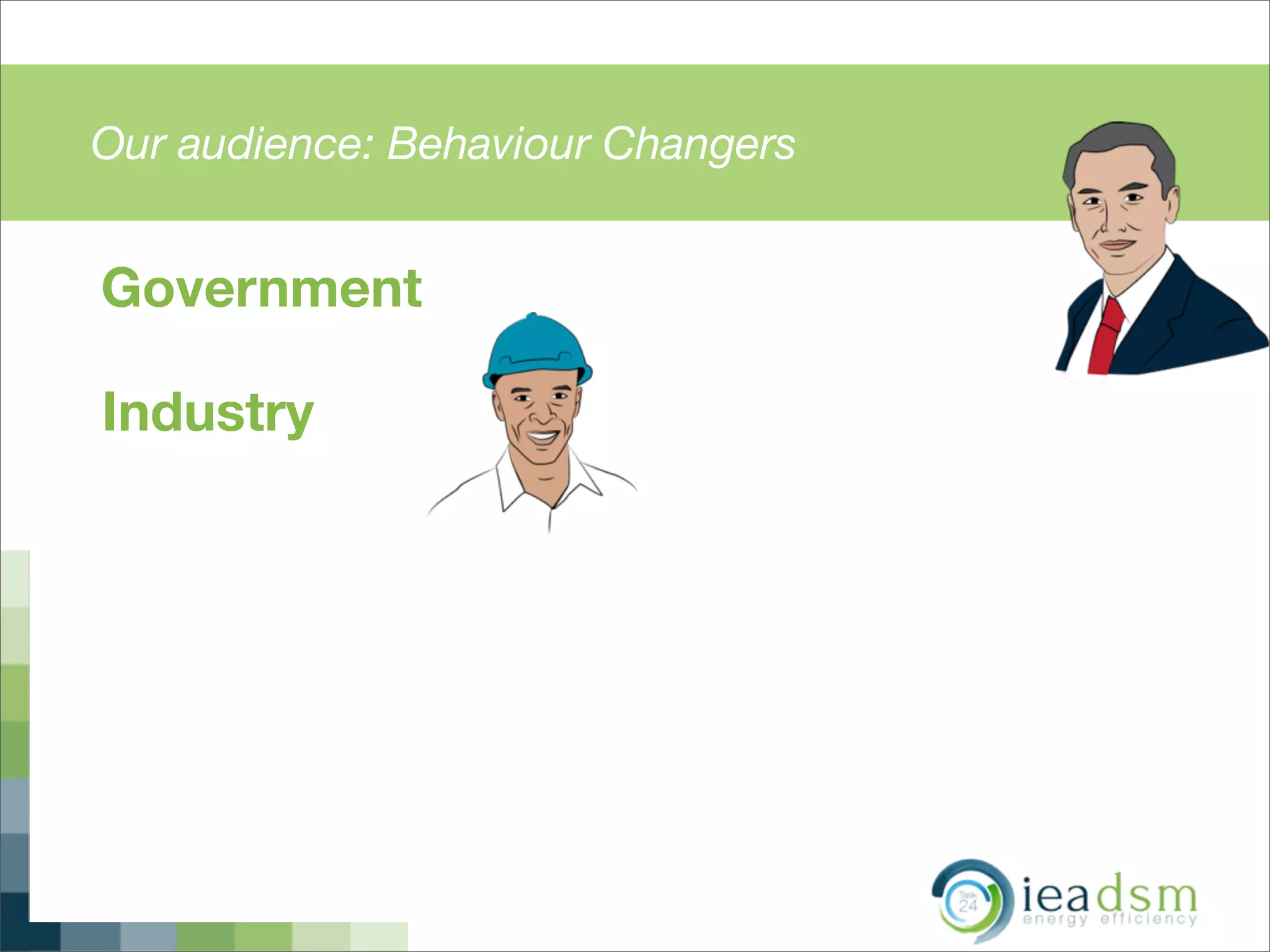
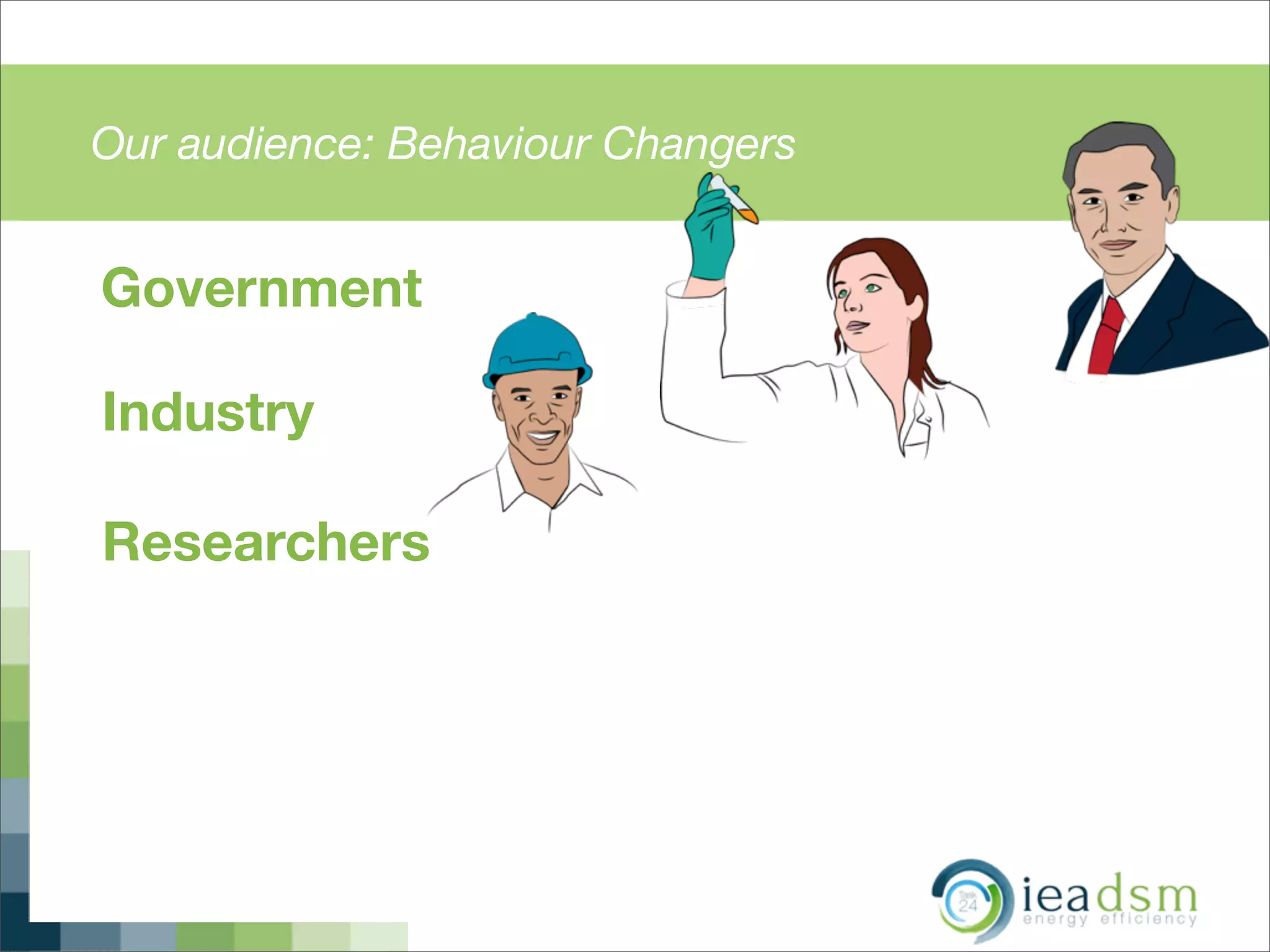
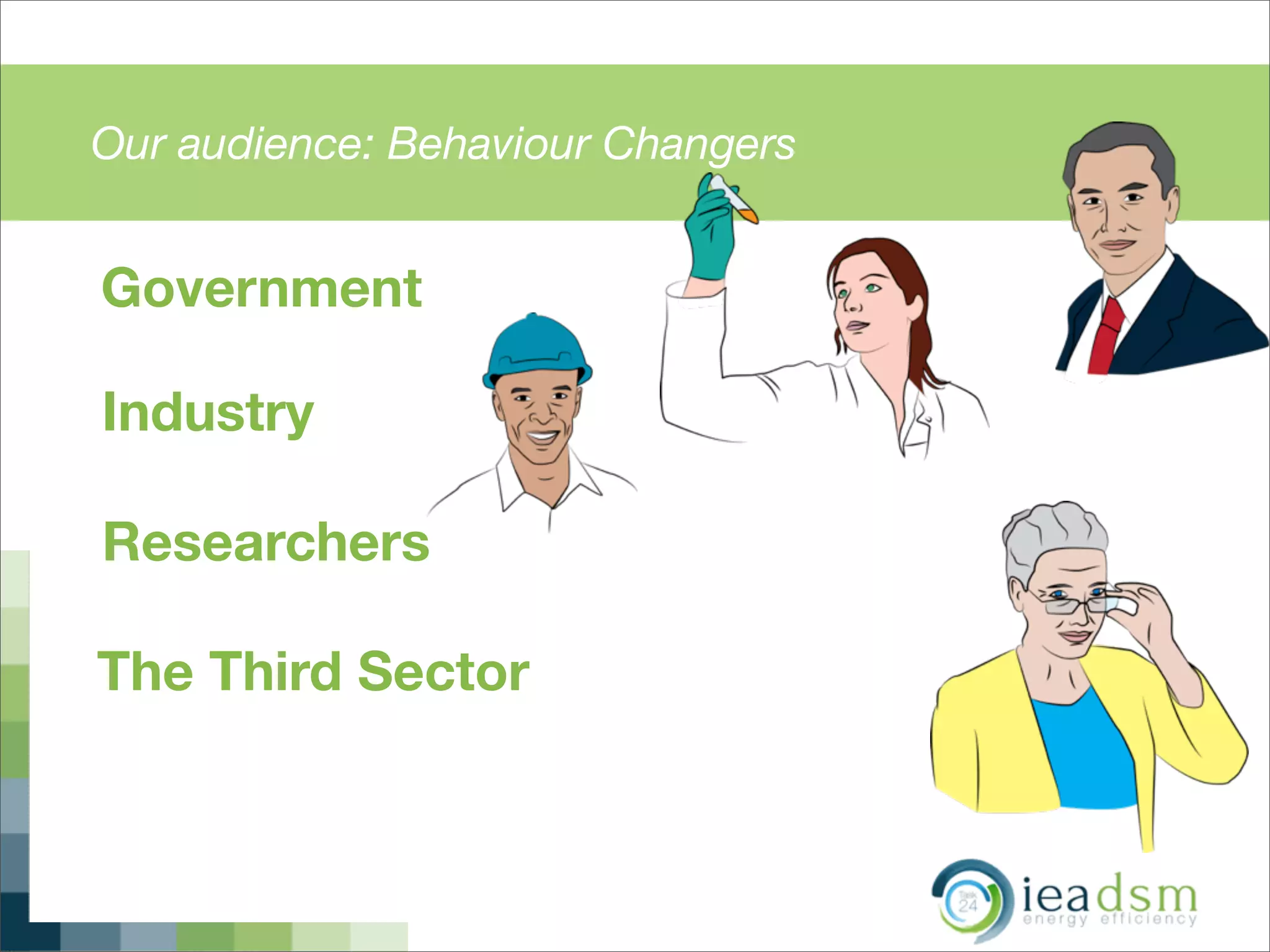
Our audience: Behaviour Changers
Government
Our audience: Behaviour Changers
Government
Industry
Our audience: Behaviour Changers
Government
Industry
Researchers
Our audience: Behaviour Changers
Government
Industry
Researchers
The Third Sector
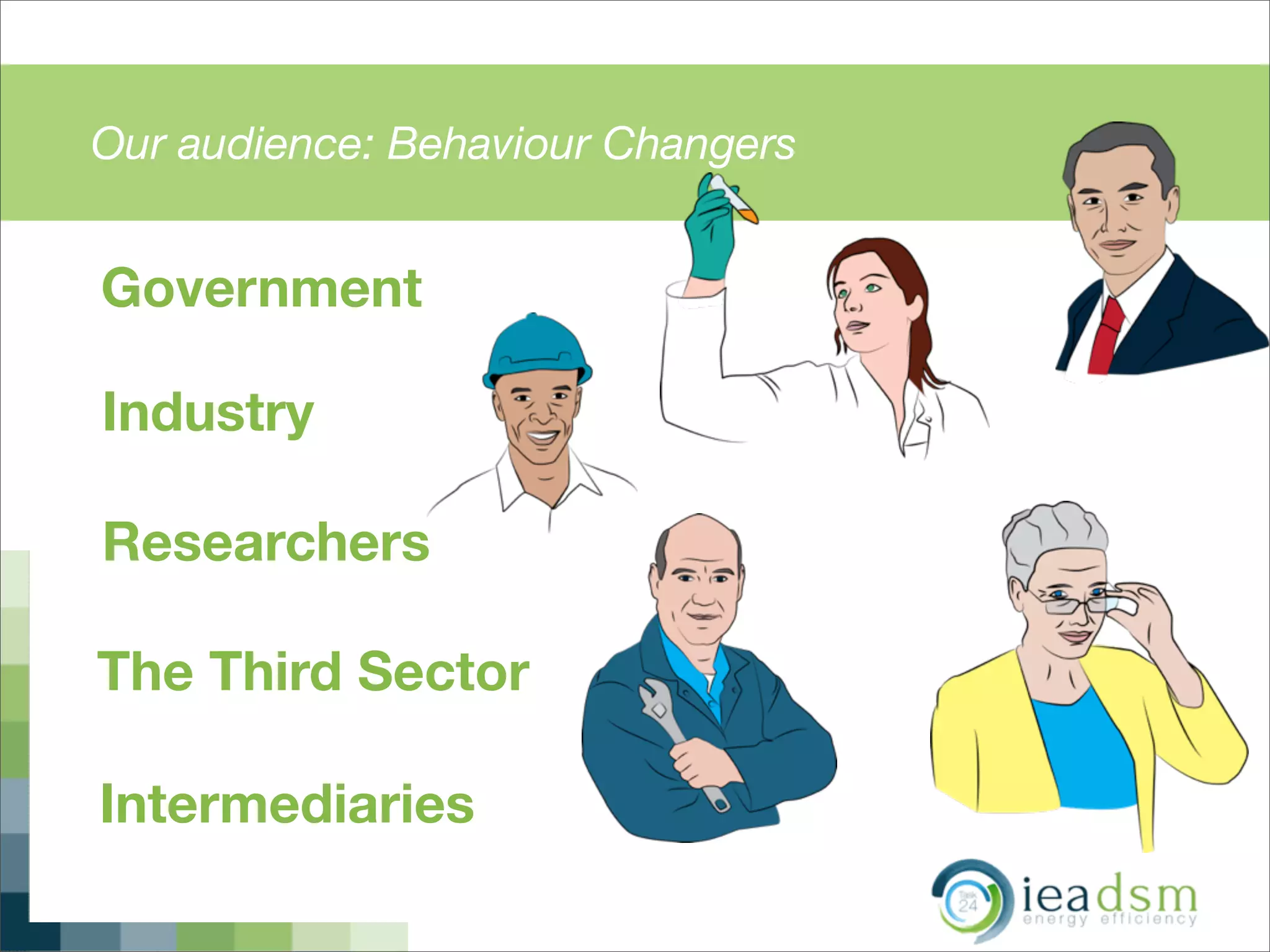
Our audience: Behaviour Changers
Government
Industry
Researchers
The Third Sector
Intermediaries
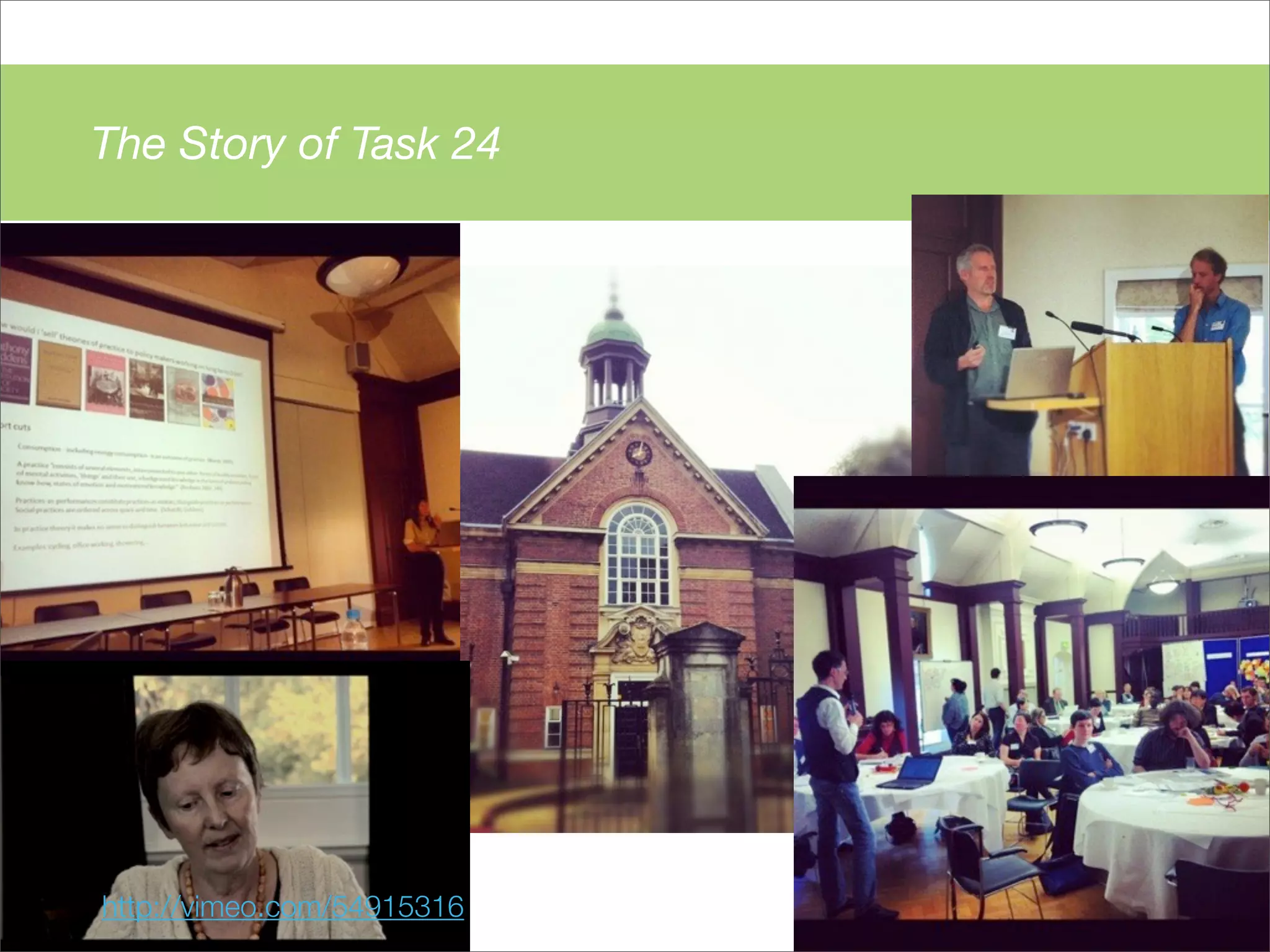
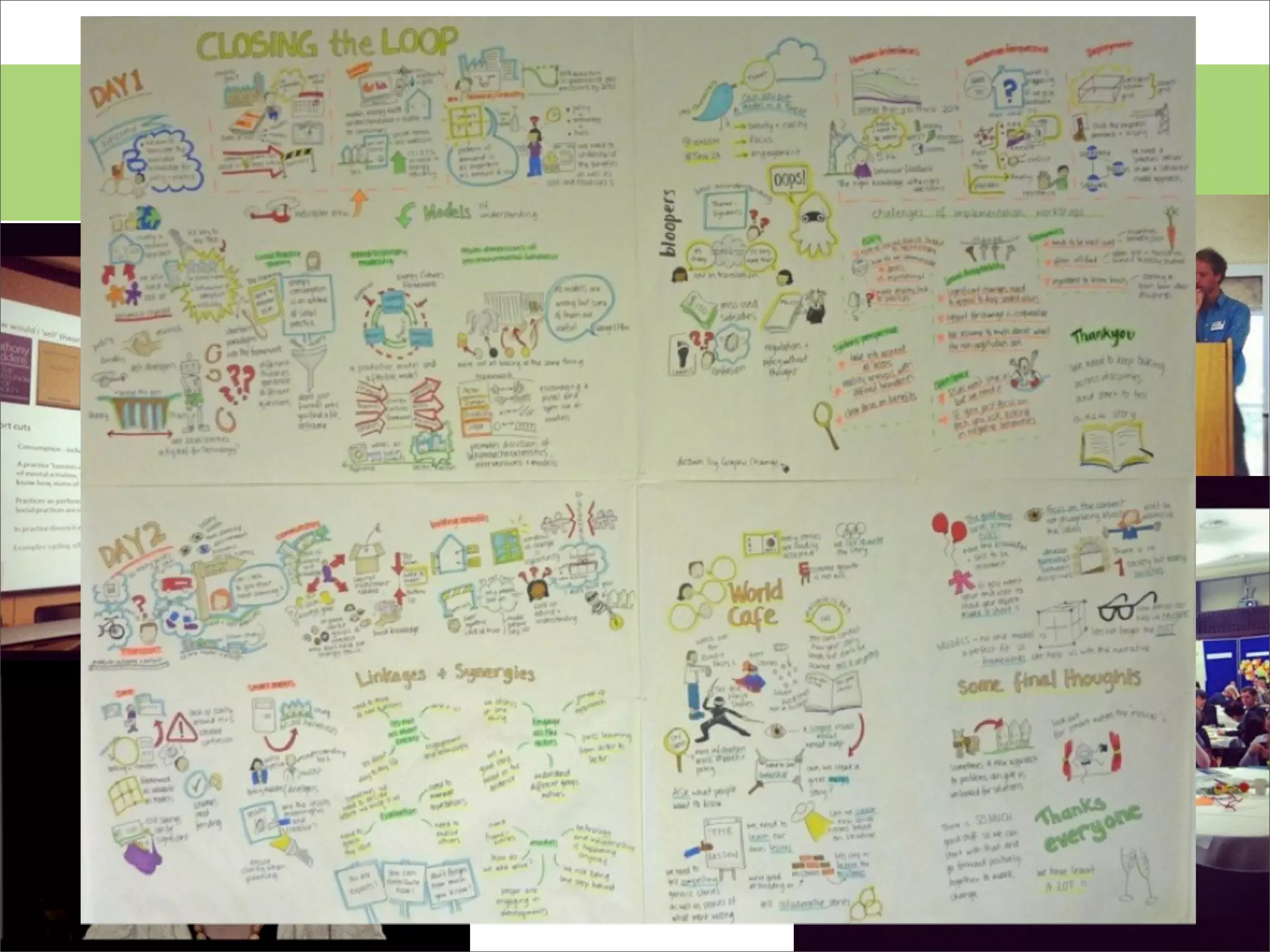
The Story of Task 24
http://vimeo.com/54915316
The Story of Task 24
http://vimeo.com/54915316
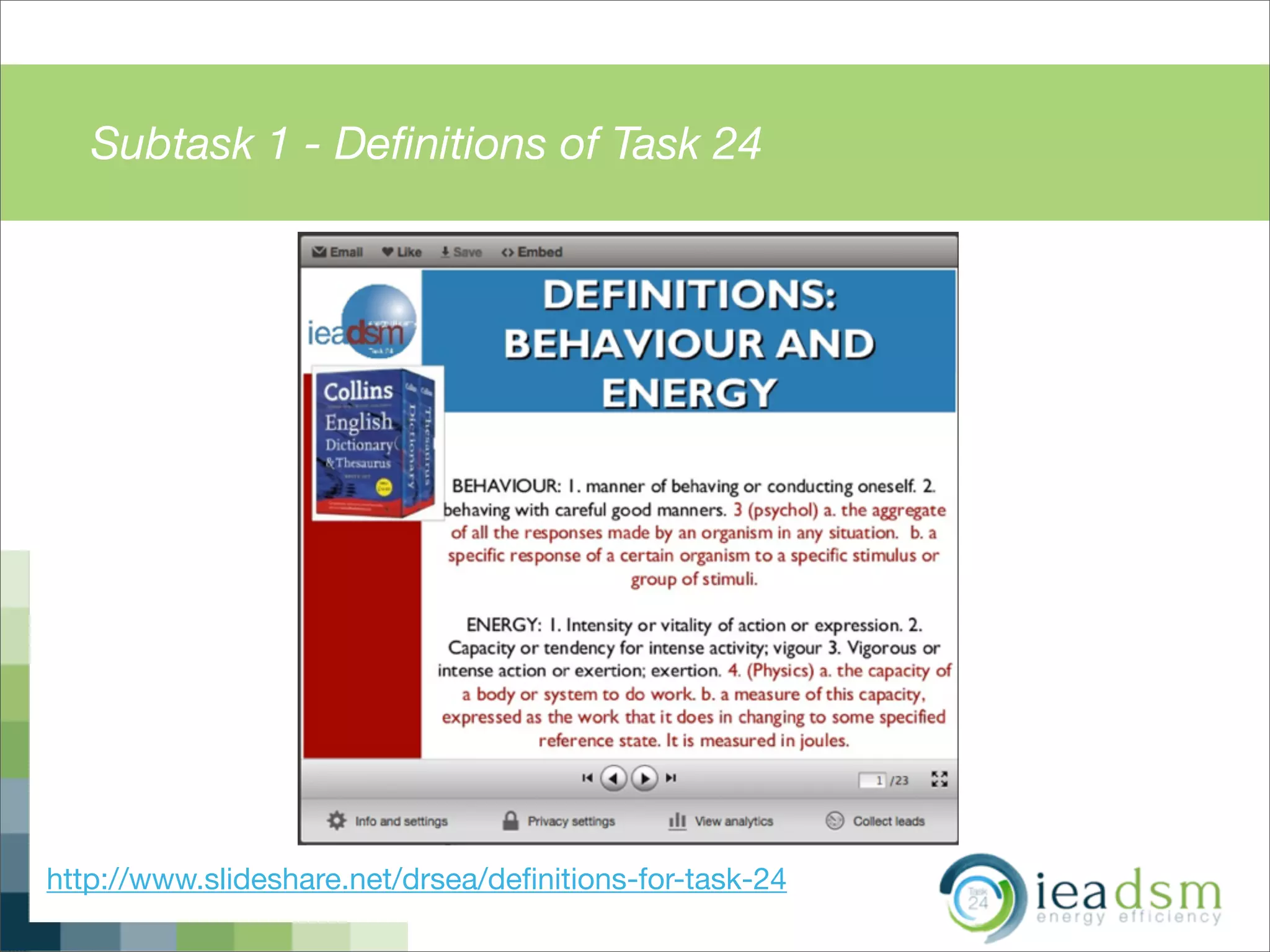
Subtask 1 - Definitions of Task 24
http://www.slideshare.net/drsea/definitions-for-task-24
What is behaviour (in Task 24)?
Energy behaviour refers to all human actions that affect the way that fuels
(electricity, gas, petroleum, coal, etc) are used to achieve desired services,
including the acquisition or disposal of energy-related technologies and
materials, the ways in which these are used, and the mental processes that
relate to these actions.
Behaviour Change in the context of this Task thus refers to any changes in
said human actions which were directly or indirectly influenced by a variety of
interventions (e.g. legislation, regulation, incentives, subsidies, information
campaigns, peer pressure etc.) aimed at fulfilling specific behaviour change
outcomes. These outcomes can include any changes in energy efficiency,
total energy consumption, energy technology uptake or demand
management but should be identified and specified by the Behaviour
Changer designing the intervention for the purpose of outcome evaluation.
What is behaviour (in Task 24)?
Energy behaviour refers to all human actions that affect the way that fuels
(electricity, gas, petroleum, coal, etc) are used to achieve desired services,
including the acquisition or disposal of energy-related technologies and
materials, the ways in which these are used, and the mental processes that
relate to these actions.
Behaviour Change in the context of this Task thus refers to any changes in
said human actions which were directly or indirectly influenced by a variety of
interventions (e.g. legislation, regulation, incentives, subsidies, information
campaigns, peer pressure etc.) aimed at fulfilling specific behaviour change
outcomes. These outcomes can include any changes in energy efficiency,
total energy consumption, energy technology uptake or demand
management but should be identified and specified by the Behaviour
Changer designing the intervention for the purpose of outcome evaluation.
BEHAVIOUR IS
EVERYTHING!
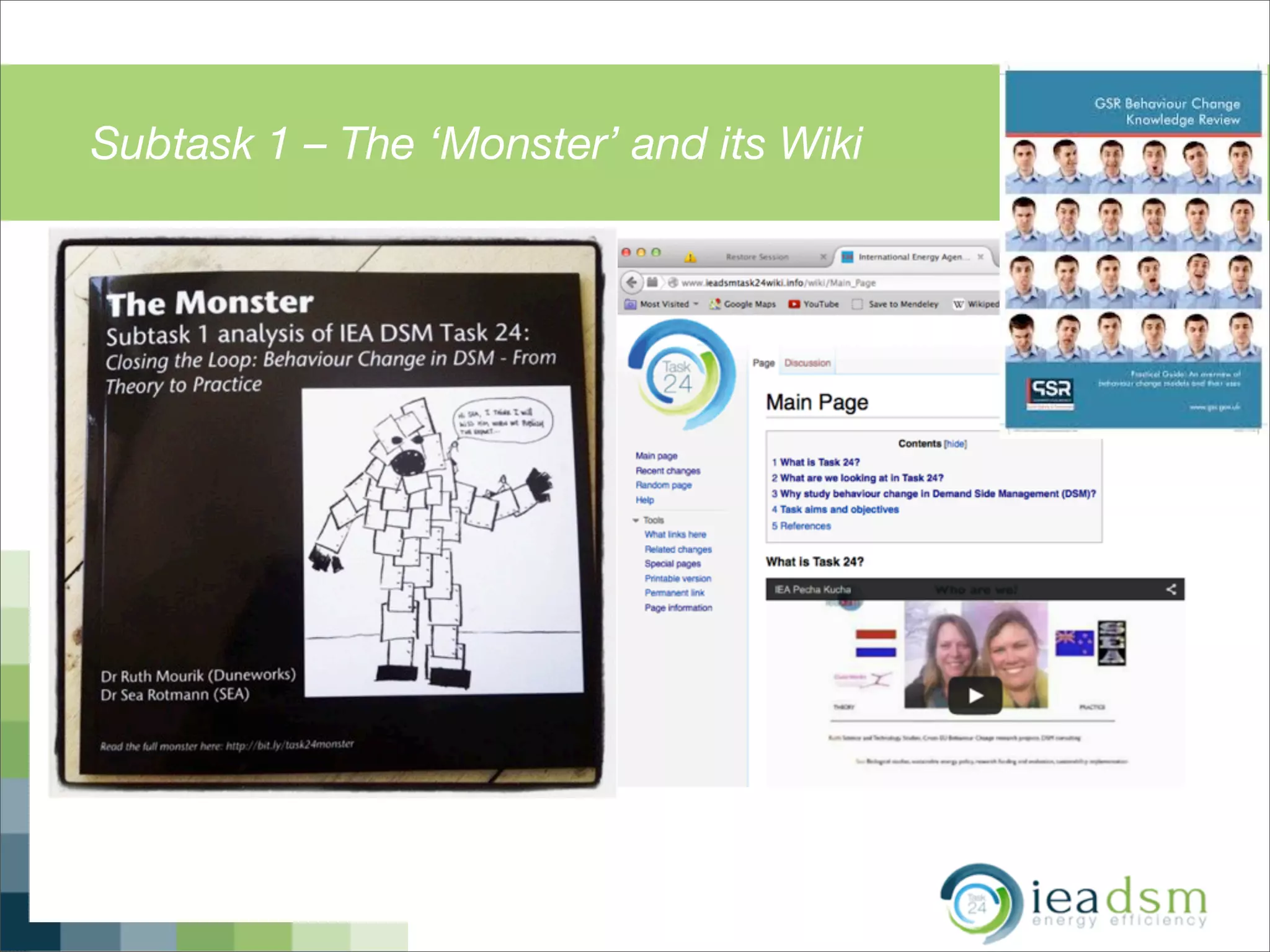
Subtask 1 – The ‘Monster’ and its Wiki
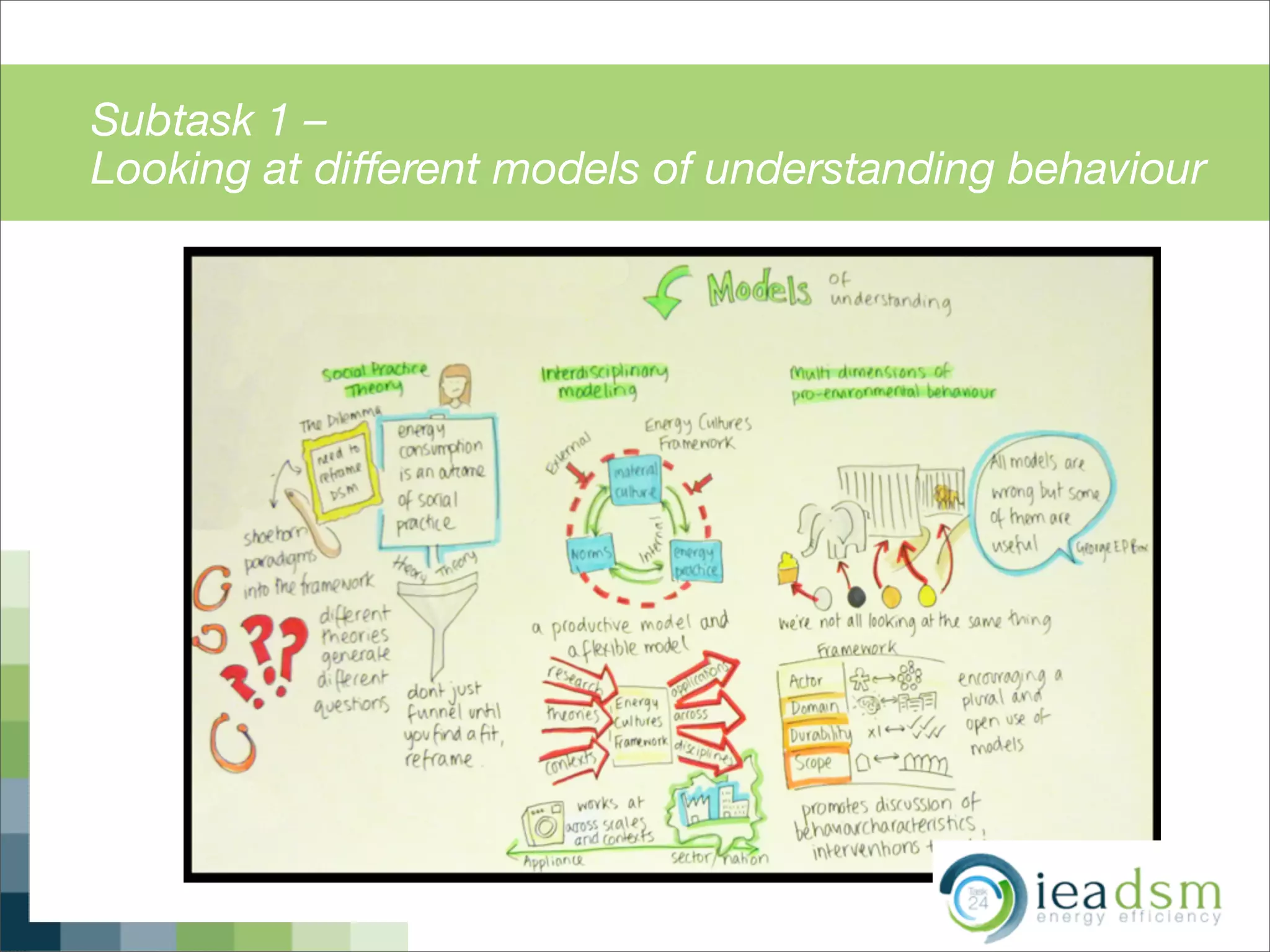
Subtask 1 –
Looking at different models of understanding behaviour
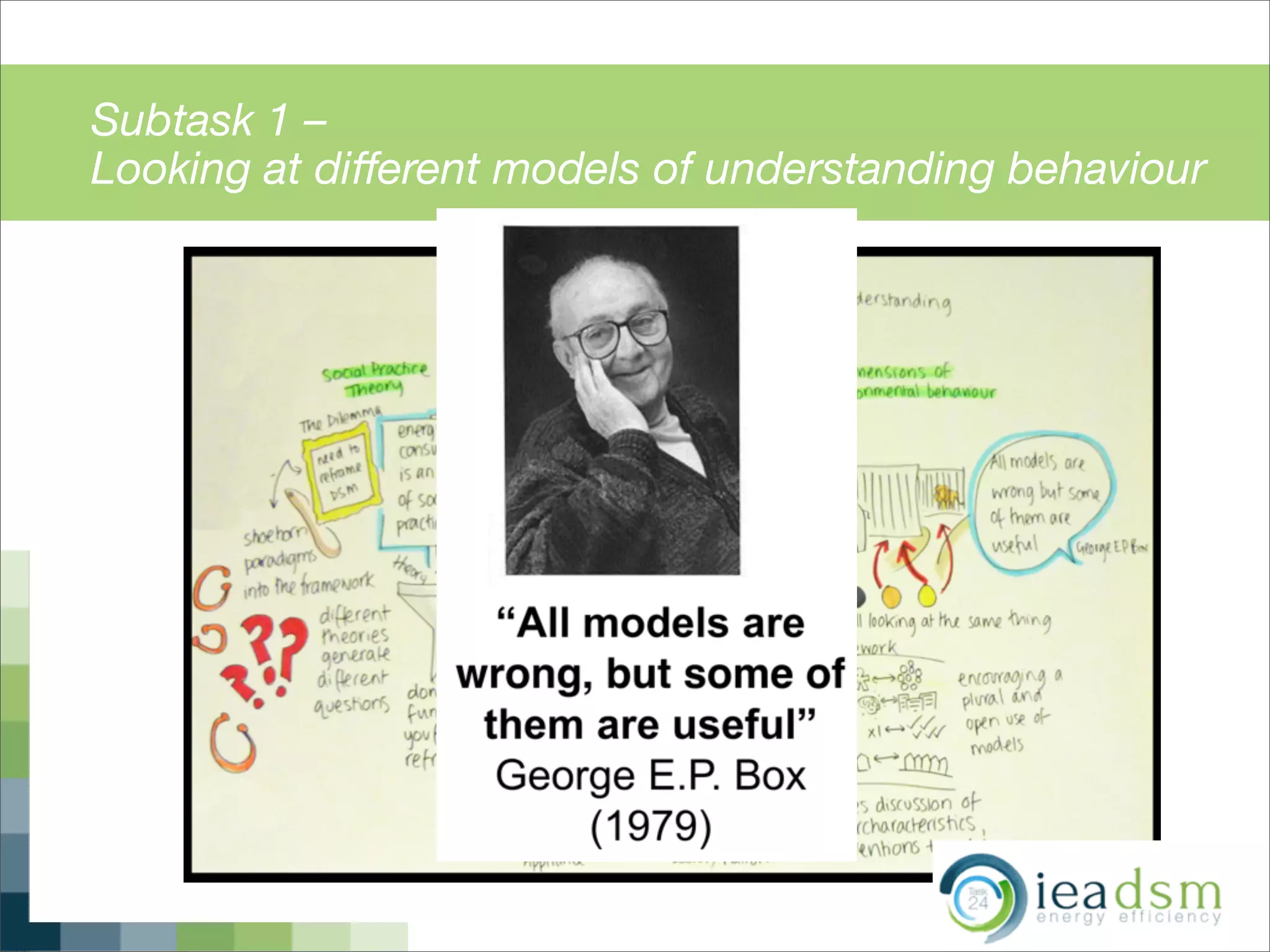
Subtask 1 –
Looking at different models of understanding behaviour
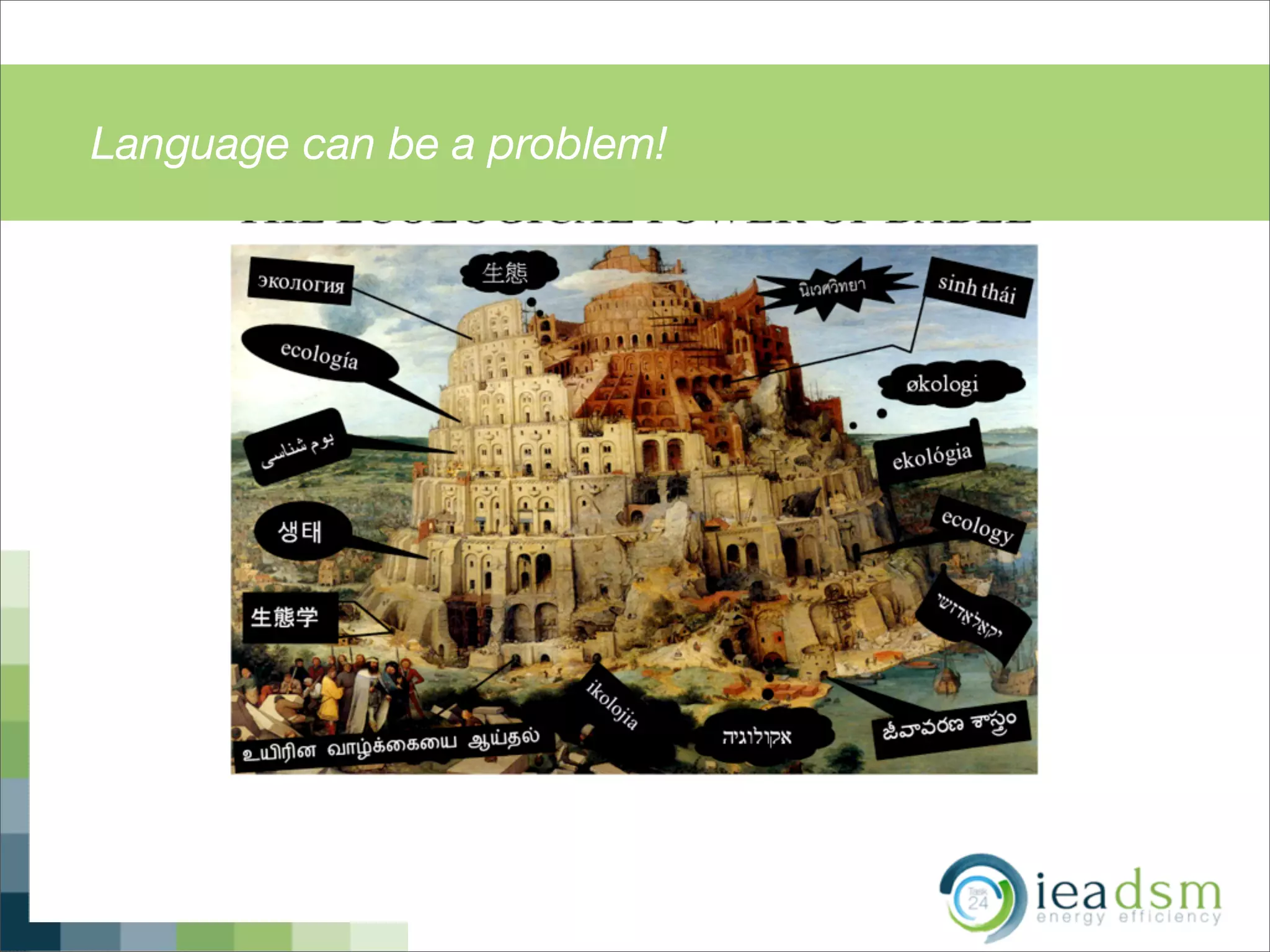
Language can be a problem!
For more information, visit www.ieadsm.org
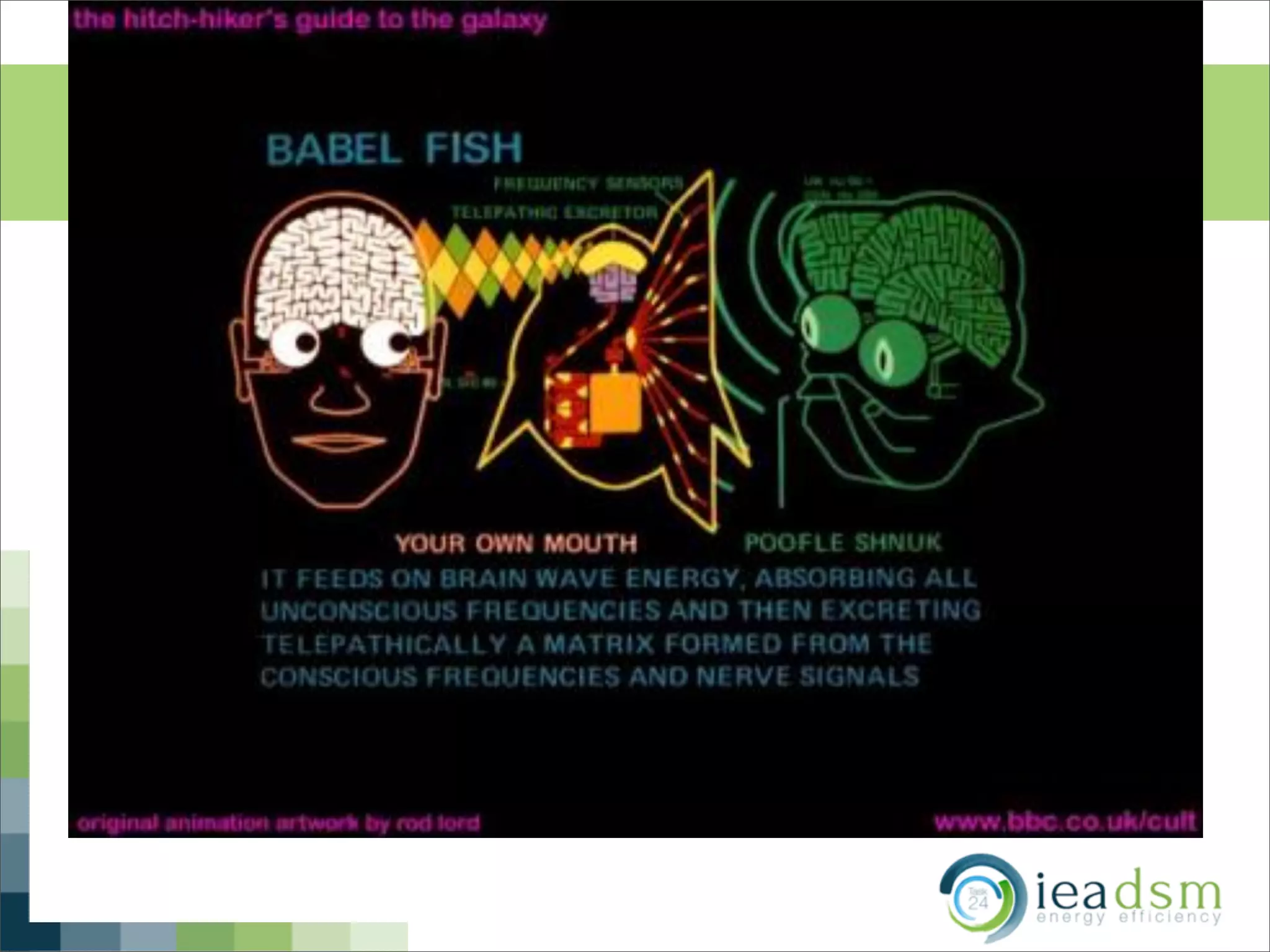
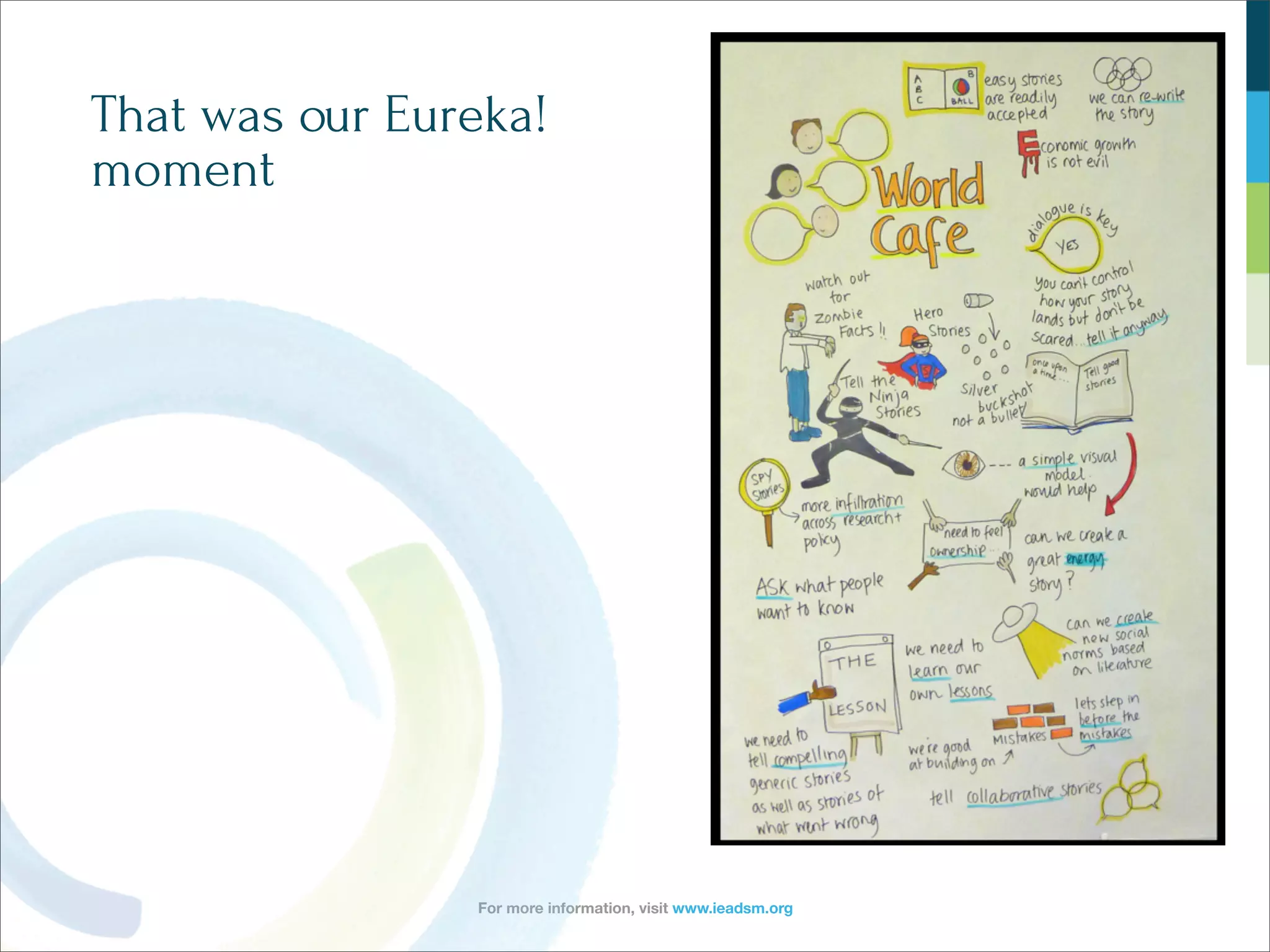
That was our Eureka!
moment
For more information, visit www.ieadsm.org
What is storytelling?
‘Storytelling’ is the construction of a
desirable future based on a narrative of
past events, with a plot that expresses
some causal relationship
To read more: Rotmann et al (2015). Once Upon a
Time… How to tell an energy efficiency story that ‘sticks’.
ECEEE Summer study proceedings
And ERSS Special Edition on Storytelling & Narratives
For more information, visit www.ieadsm.org
Stories are:
• Universal
• Help us process information
• Providing multiple perspectives
• Subjective, not one truth
• Aid recall
• Shape identity
• Make connections
For more information, visit www.ieadsm.org
The art and scientific methodology of storytelling
Narratives = social science tool aimed at providing way to
explore how big events (policies) impact on small scale
(individuals)
Allow for quick, practical and useful understanding of
complexity of interconnected factors in behaviour research
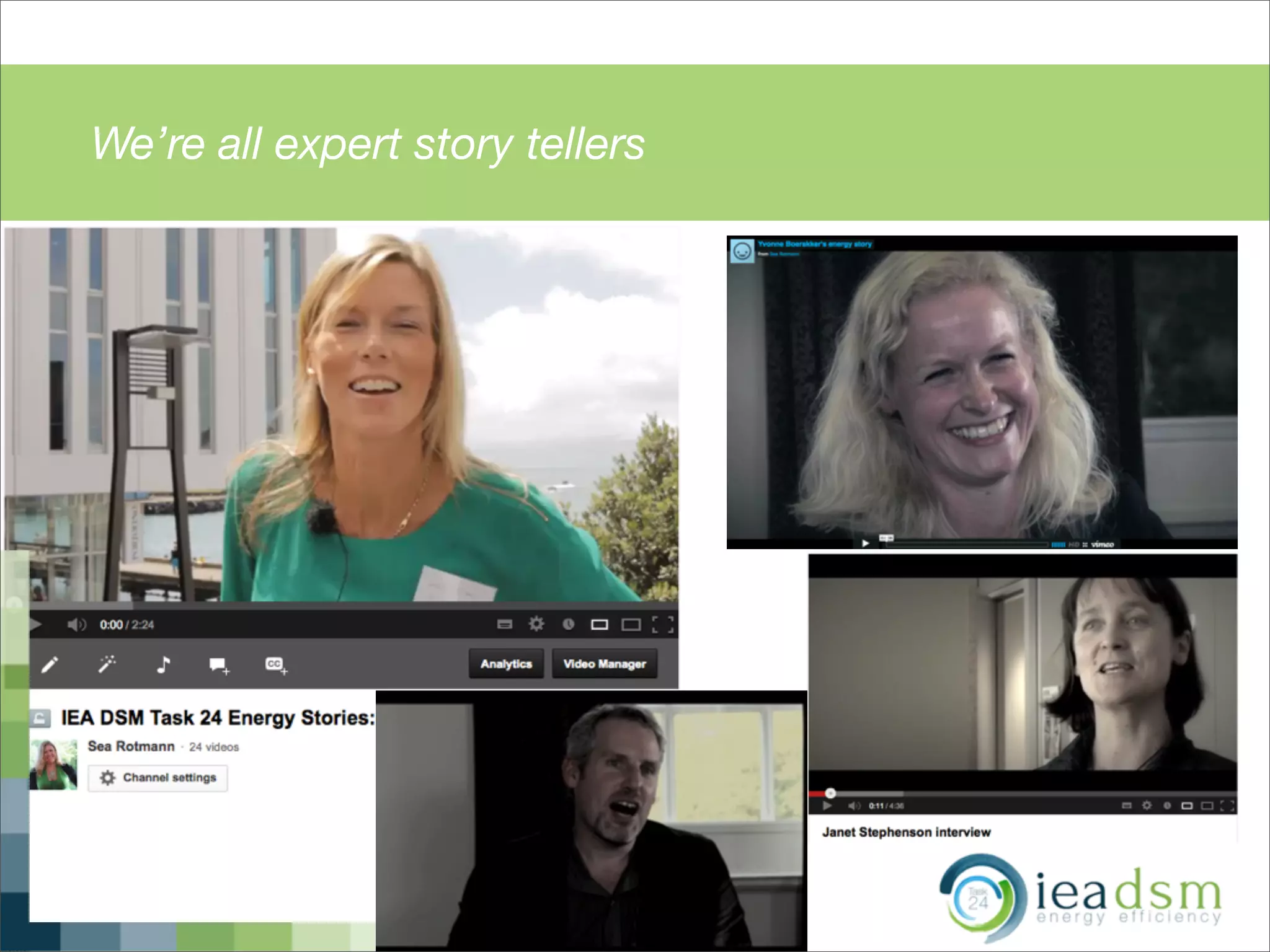
We all turn everything into a narrative in order to remember it
We’re all expert story tellers
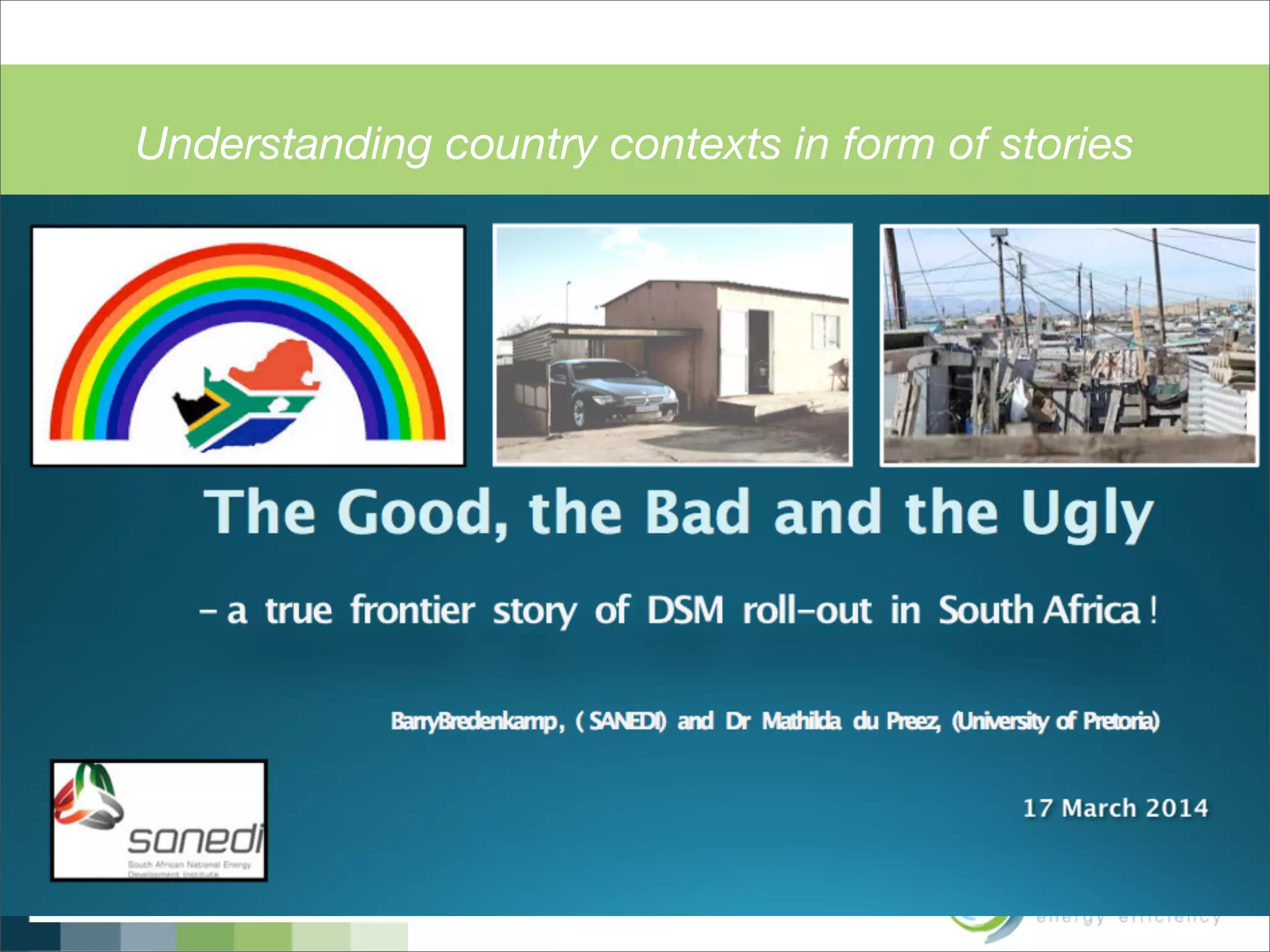
Understanding country contexts in form of stories
For more information, visit www.ieadsm.org
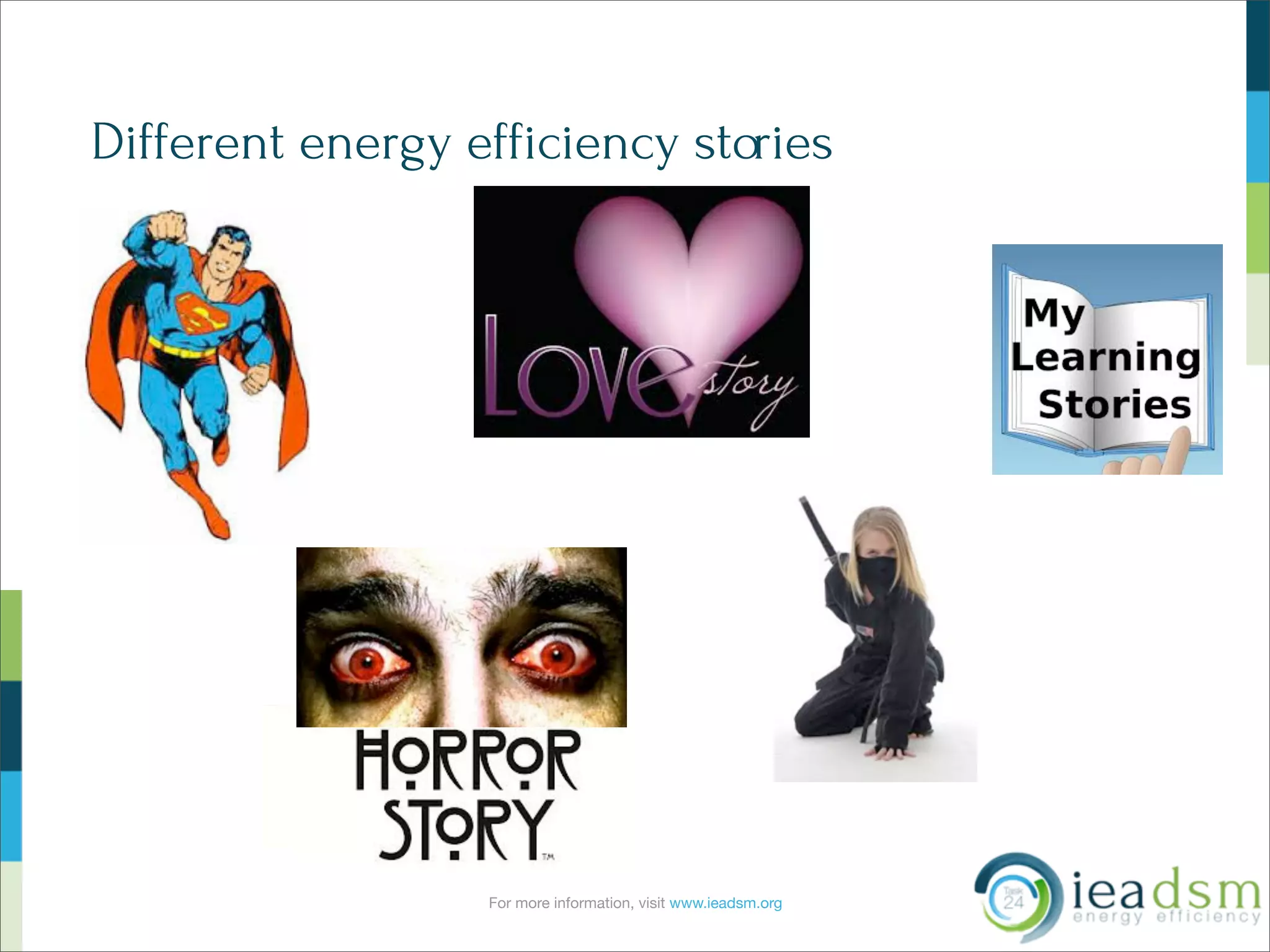
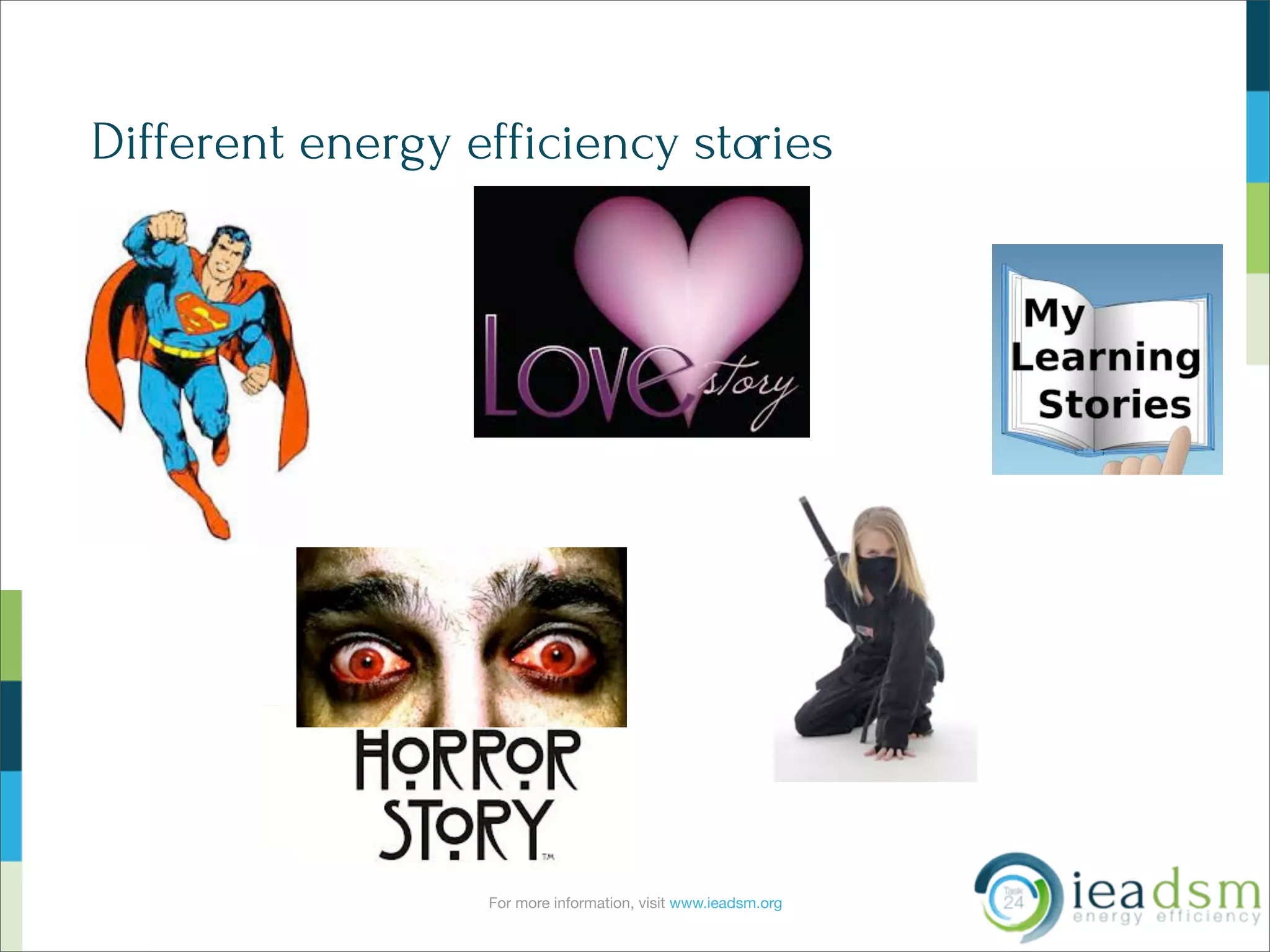
Different energy efficiency stories
For more information, visit www.ieadsm.org
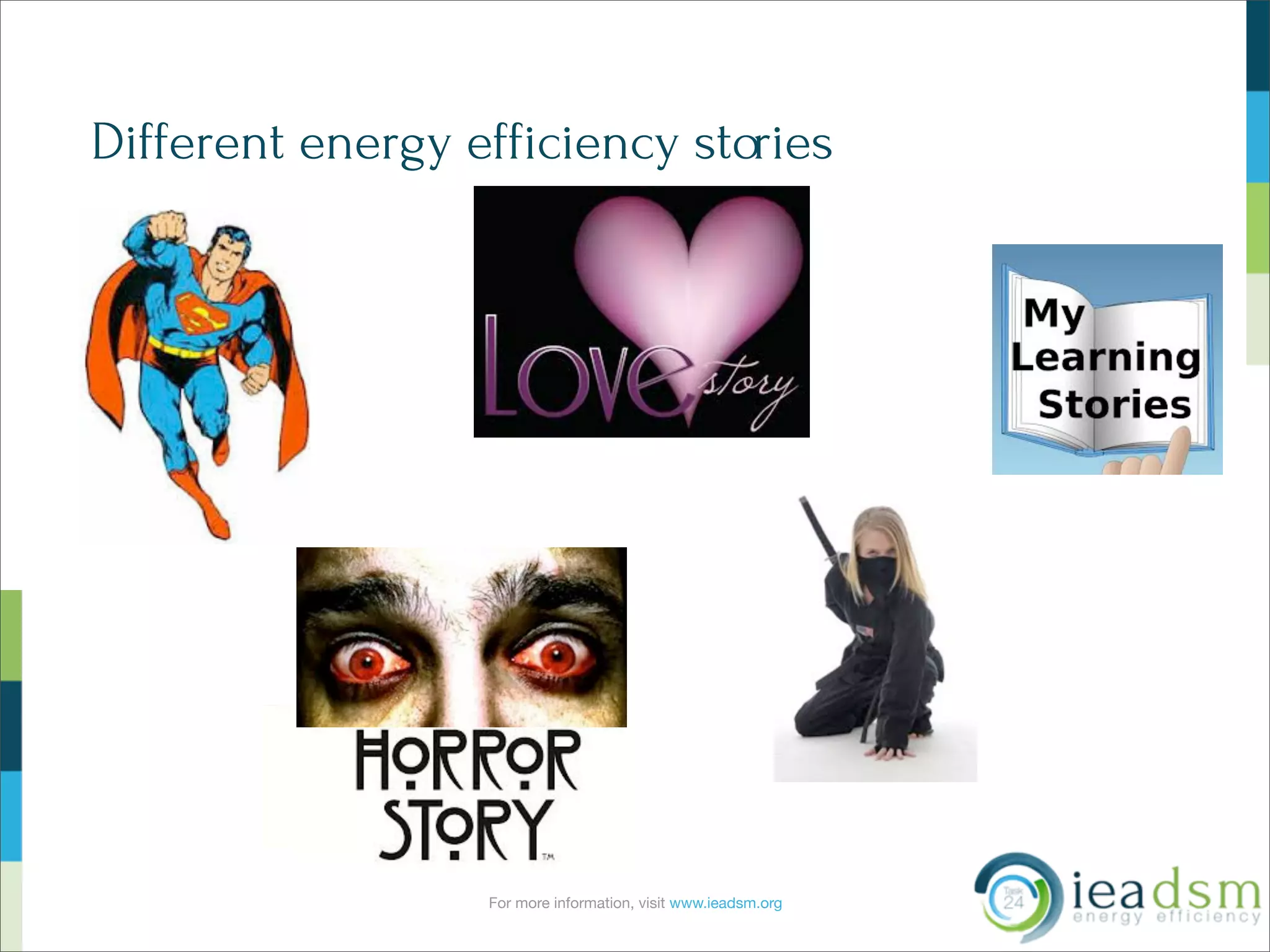
Different energy efficiency stories
For more information, visit www.ieadsm.org
Different energy efficiency stories
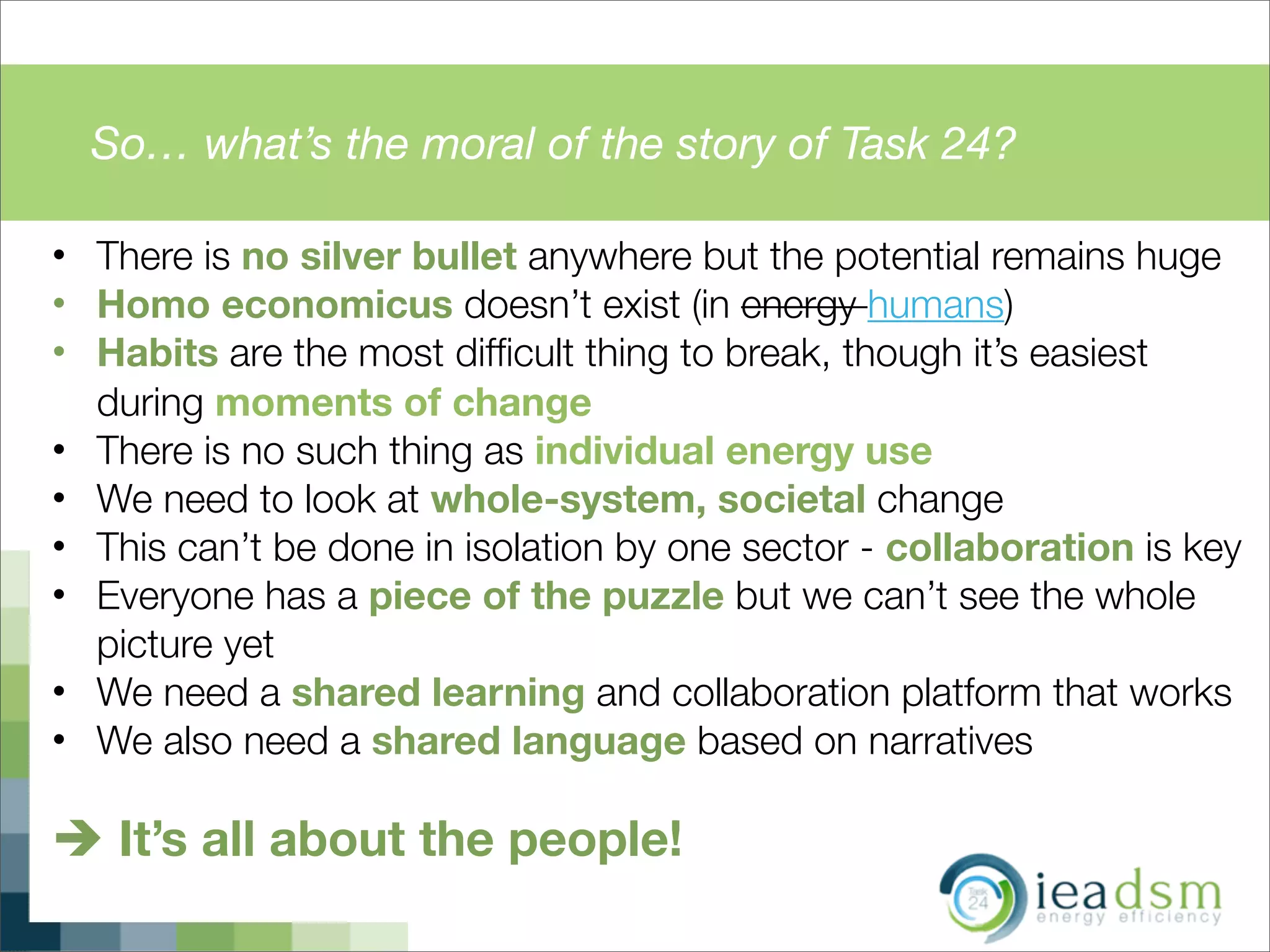
So… what’s the moral of the story of Task 24?
• There is no silver bullet anywhere but the potential remains huge
• Homo economicus doesn’t exist (in energy humans)
• Habits are the most difficult thing to break, though it’s easiest
during moments of change
• There is no such thing as individual energy use
• We need to look at whole-system, societal change
• This can’t be done in isolation by one sector - collaboration is key
• Everyone has a piece of the puzzle but we can’t see the whole
picture yet
• We need a shared learning and collaboration platform that works
• We also need a shared language based on narratives
è It’s all about the people!
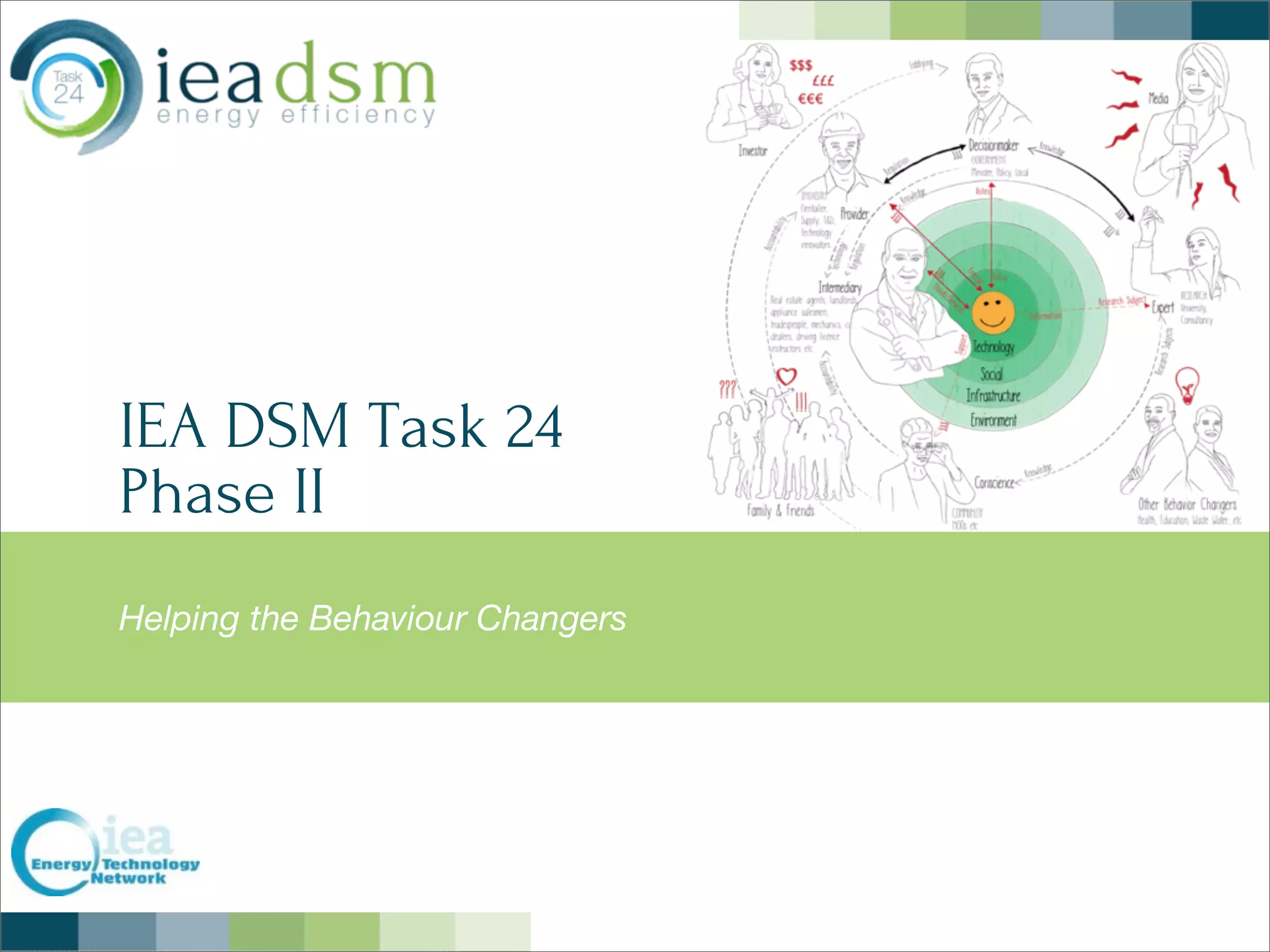
IEA DSM Task 24
Phase II
Helping the Behaviour Changers
For more information, visit www.ieadsm.org
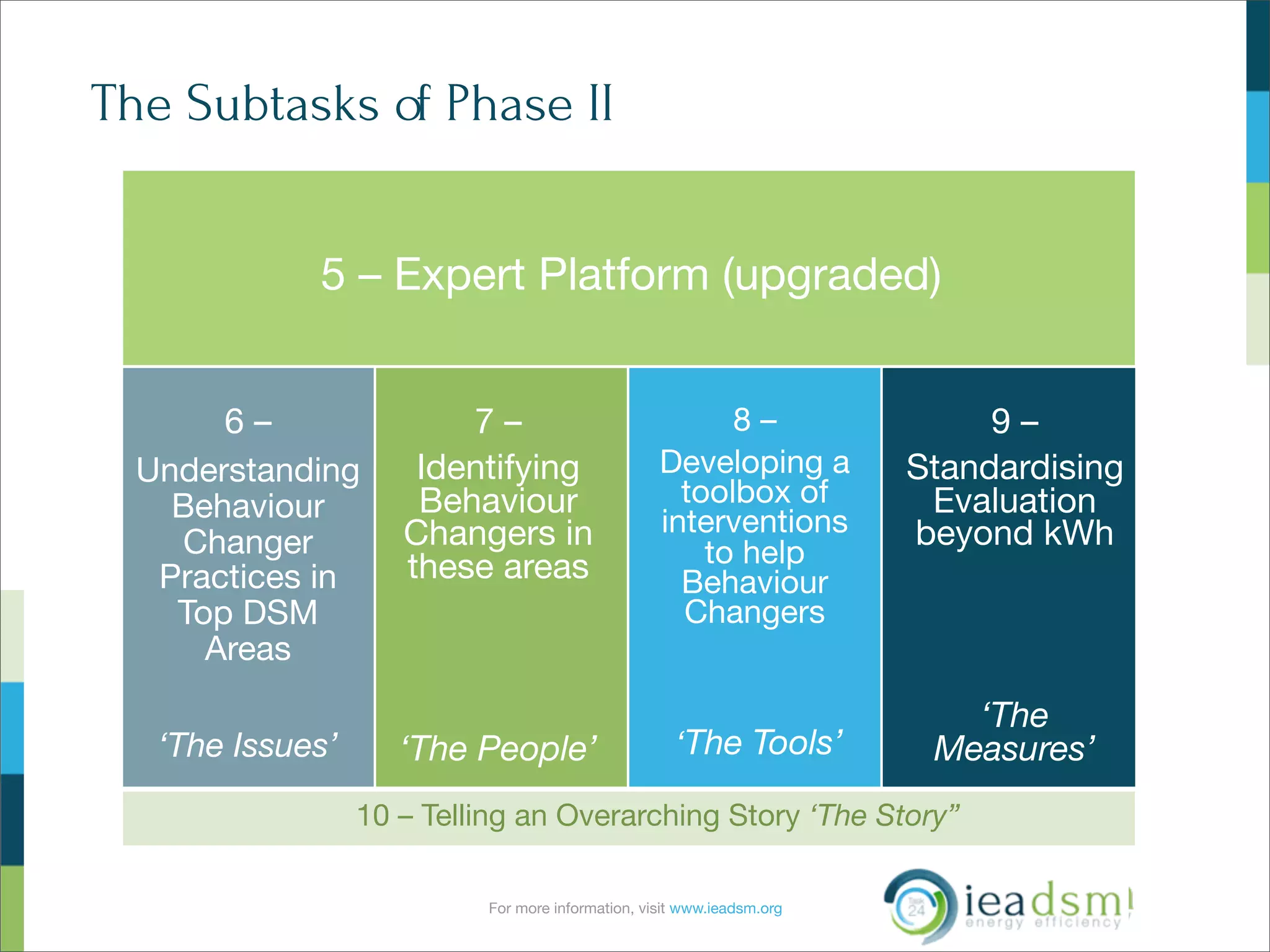
The Subtasks of Phase II
5 – Expert Platform (upgraded)
6 –
Understanding
Behaviour
Changer
Practices in
Top DSM
Areas
‘The Issues’
7 –
Identifying
Behaviour
Changers in
these areas
‘The People’
8 –
Developing a
toolbox of
interventions
to help
Behaviour
Changers
‘The Tools’
9 –
Standardising
Evaluation
beyond kWh
‘The
Measures’
10 – Telling an Overarching Story ‘The Story”
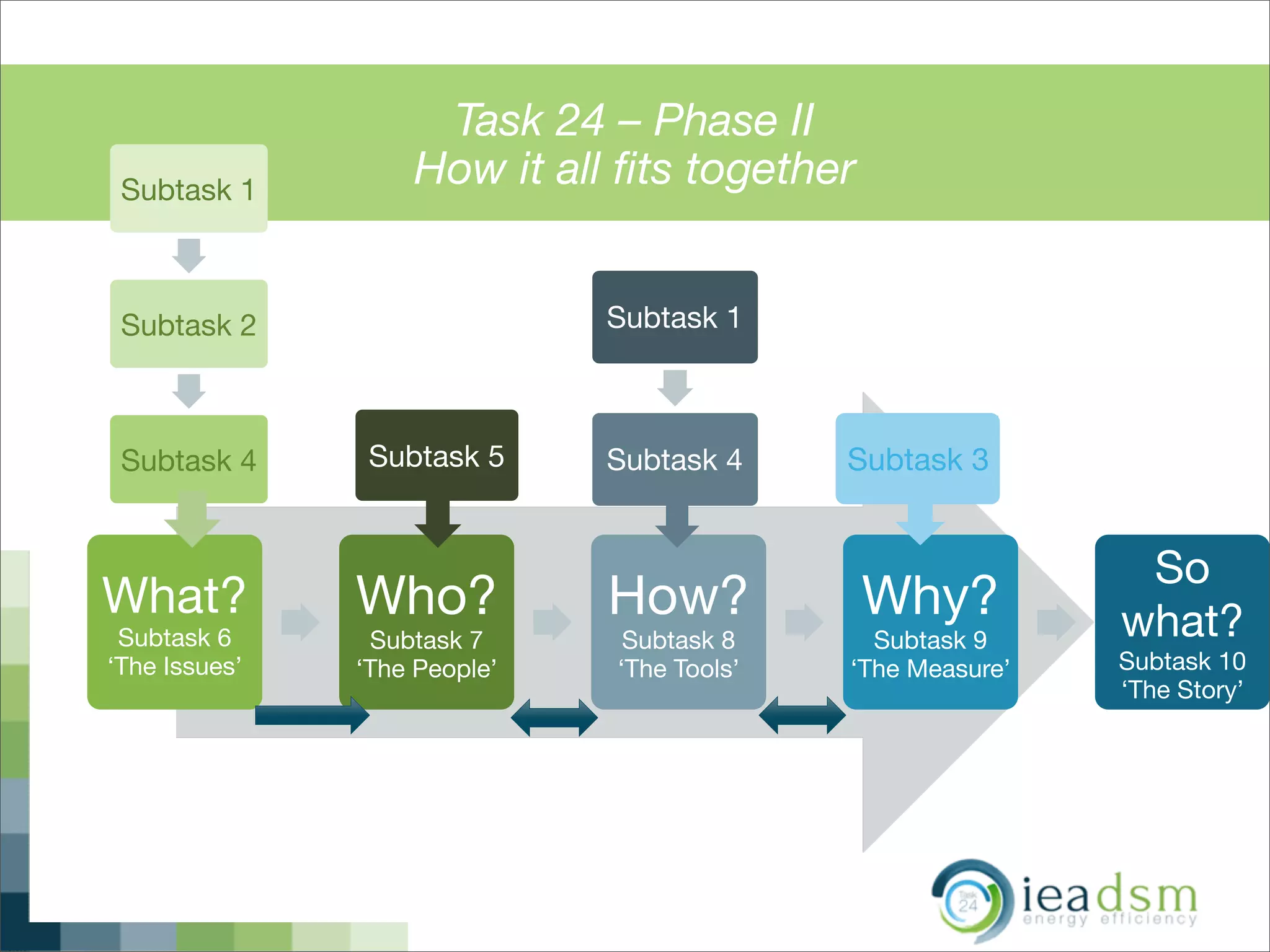
Task 24 – Phase II
How it all fits together
What?
Subtask 6
‘The Issues’
Who?
Subtask 7
‘The People’
How?
Subtask 8
‘The Tools’
Why?
Subtask 9
‘The Measure’
So
what?
Subtask 10
‘The Story’
Subtask 1
Subtask 2
Subtask 4 Subtask 5
Subtask 1
Subtask 4 Subtask 3
For more information, visit www.ieadsm.org
Task 24 Phase II
The Energy System
How does it look like
now?
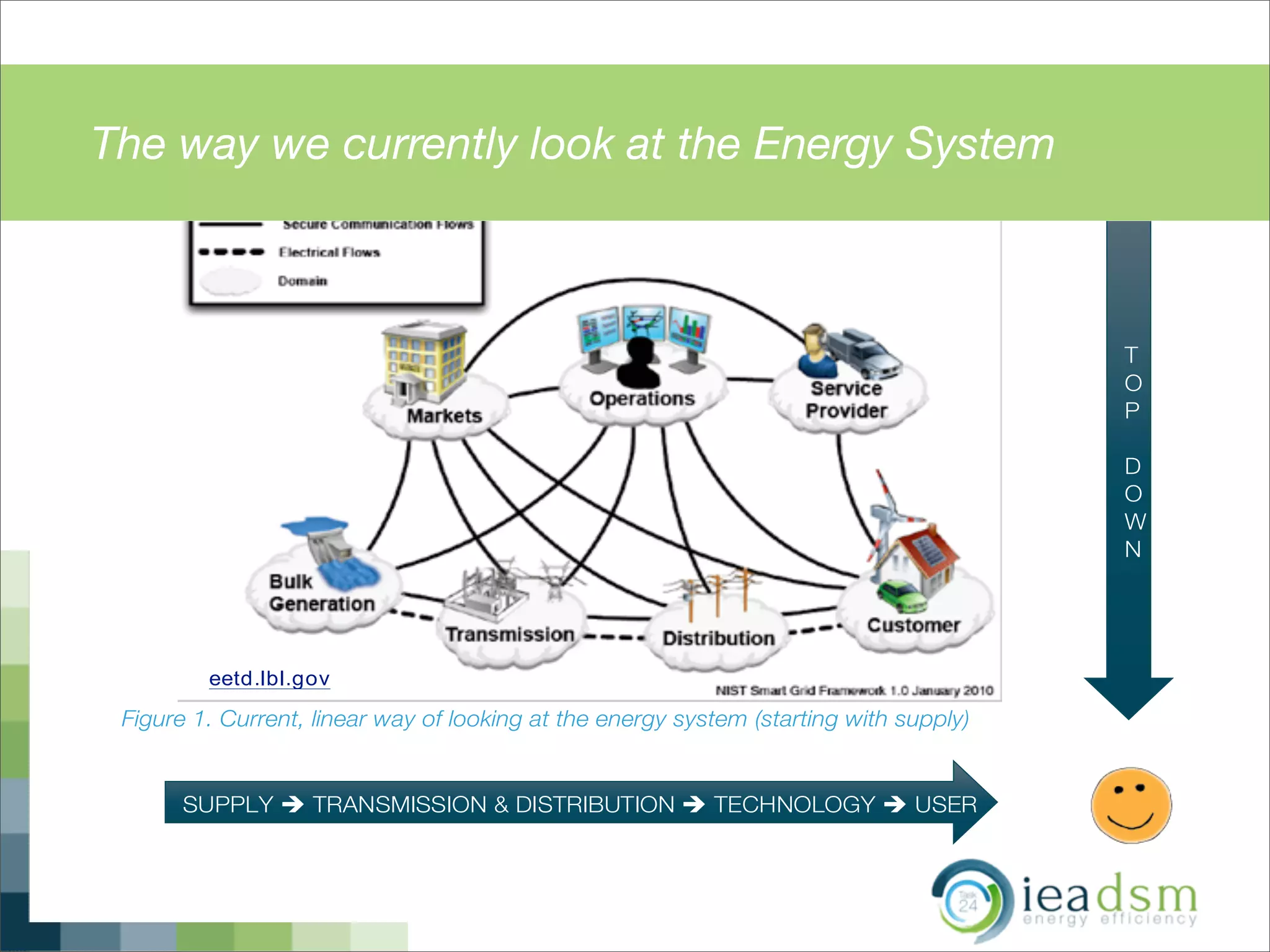
The way we currently look at the Energy System
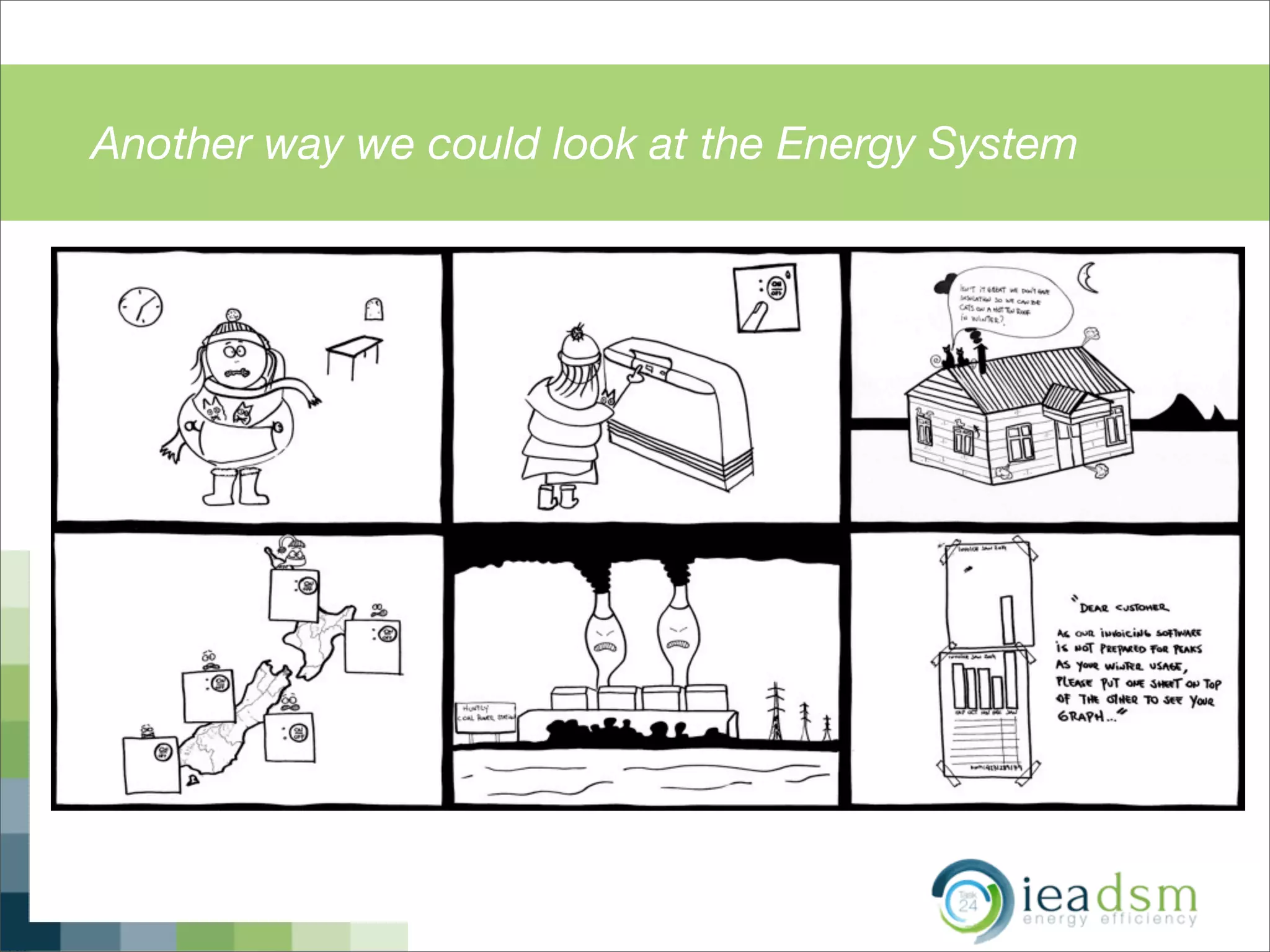
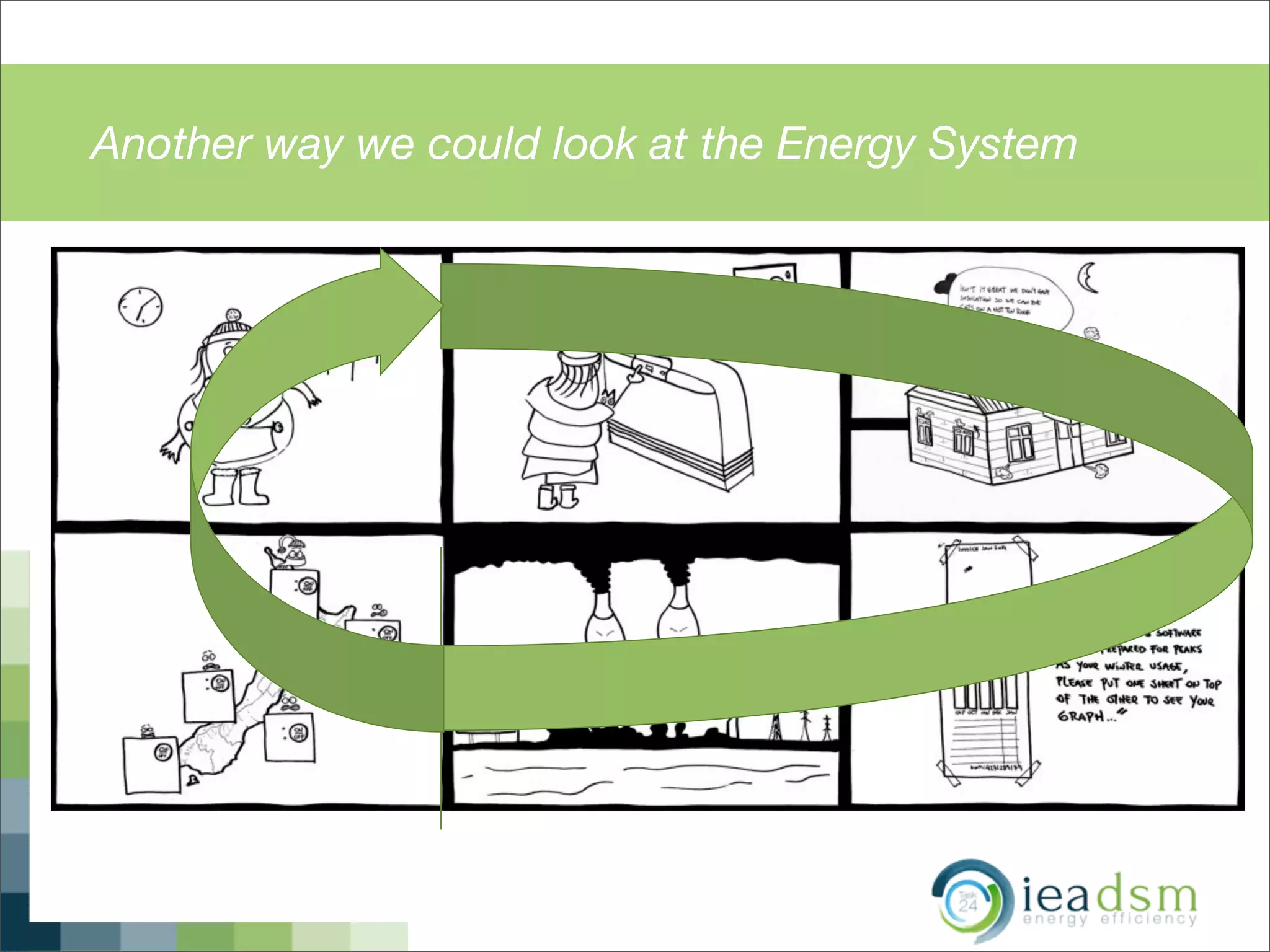
whole-system view which puts human needs, behaviours and (ir)rationalities at the center of
interventions geared at system change. Instead, if we look at the Energy System through the
human lens (Figure 2), we can see that it isn’t necessarily this top-down/left-right linear
realtionship starting with supply and ending with the end user, but rather a circular relationship
which actually starts with the end user need for an energy service (click here for a short video
presentation explaining this in more detail).
Figure 1. Current, linear way of looking at the energy system (starting with supply)
eetd.lbl.gov
T
O
P
D
O
W
N
SUPPLY ! TRANSMISSION & DISTRIBUTION ! TECHNOLOGY ! USER
Another way we could look at the Energy System
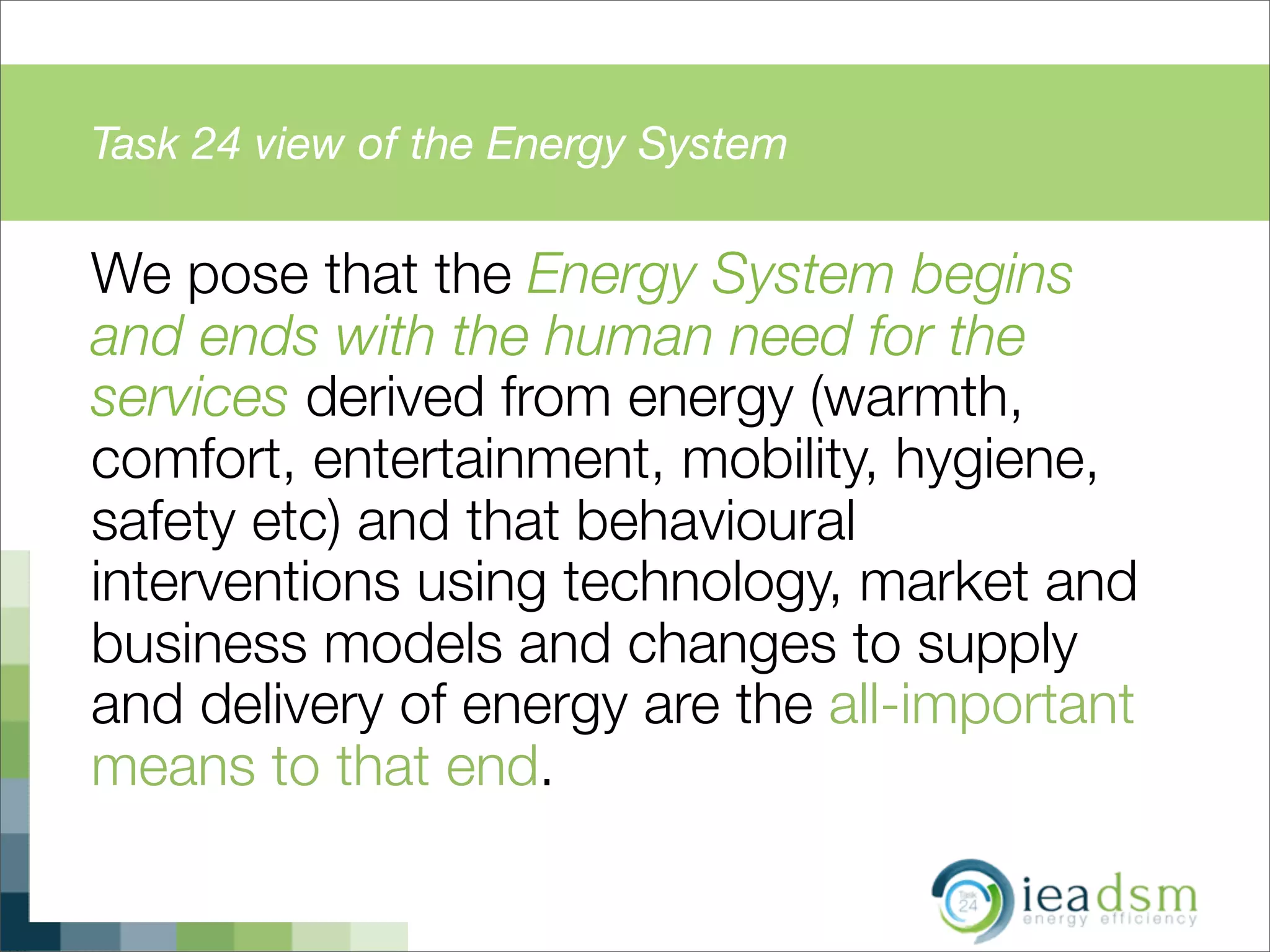
Task 24 view of the Energy System
We pose that the Energy System begins
and ends with the human need for the
services derived from energy (warmth,
comfort, entertainment, mobility, hygiene,
safety etc) and that behavioural
interventions using technology, market and
business models and changes to supply
and delivery of energy are the all-important
means to that end.
For more information, visit www.ieadsm.org
Task 24 Phase II
The Collective Impact Approach
Methodoloy of the
Behaviour Changer
Framework
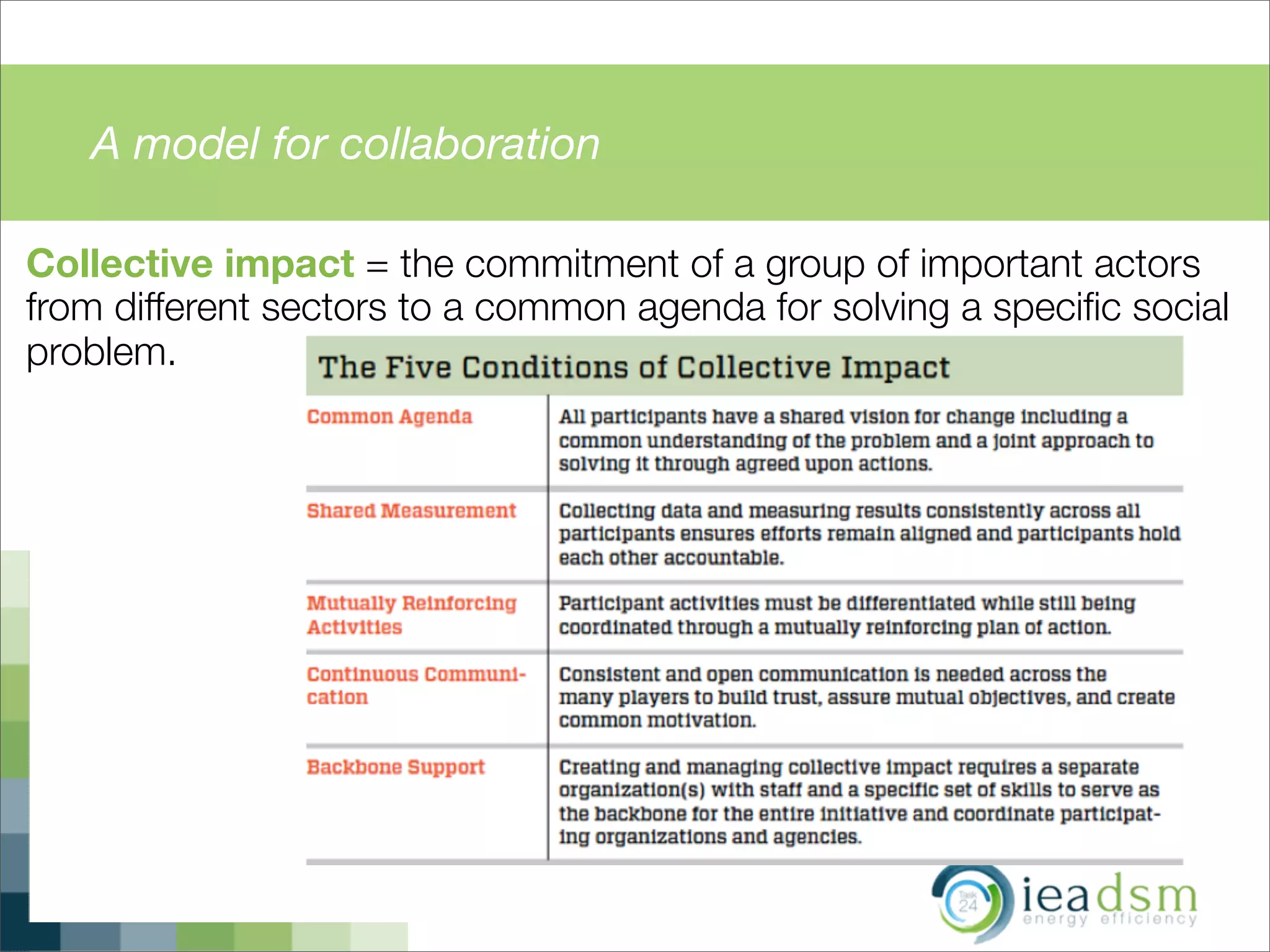
A model for collaboration
Collective impact = the commitment of a group of important actors
from different sectors to a common agenda for solving a specific social
problem.
For more information, visit www.ieadsm.org
Task 24 Phase II
Subtask 6 – Understanding the
Behaviour Changers’ Practices and
Priorities “The Issues”
Deciding on the issues
to focus on for Canada
What are the Top DSM Issues here?
Top DSM Issues:
• Is there a national list of DSM issues?
• What are the biggest behavioural potentials?
• What DSM policies and programmes are already
tackling these issues and how?
• What are their approximate contribution to the
country’s load management (economic, technical,
political and societal potentials)?
• What are the risks and multiple benefits of each?
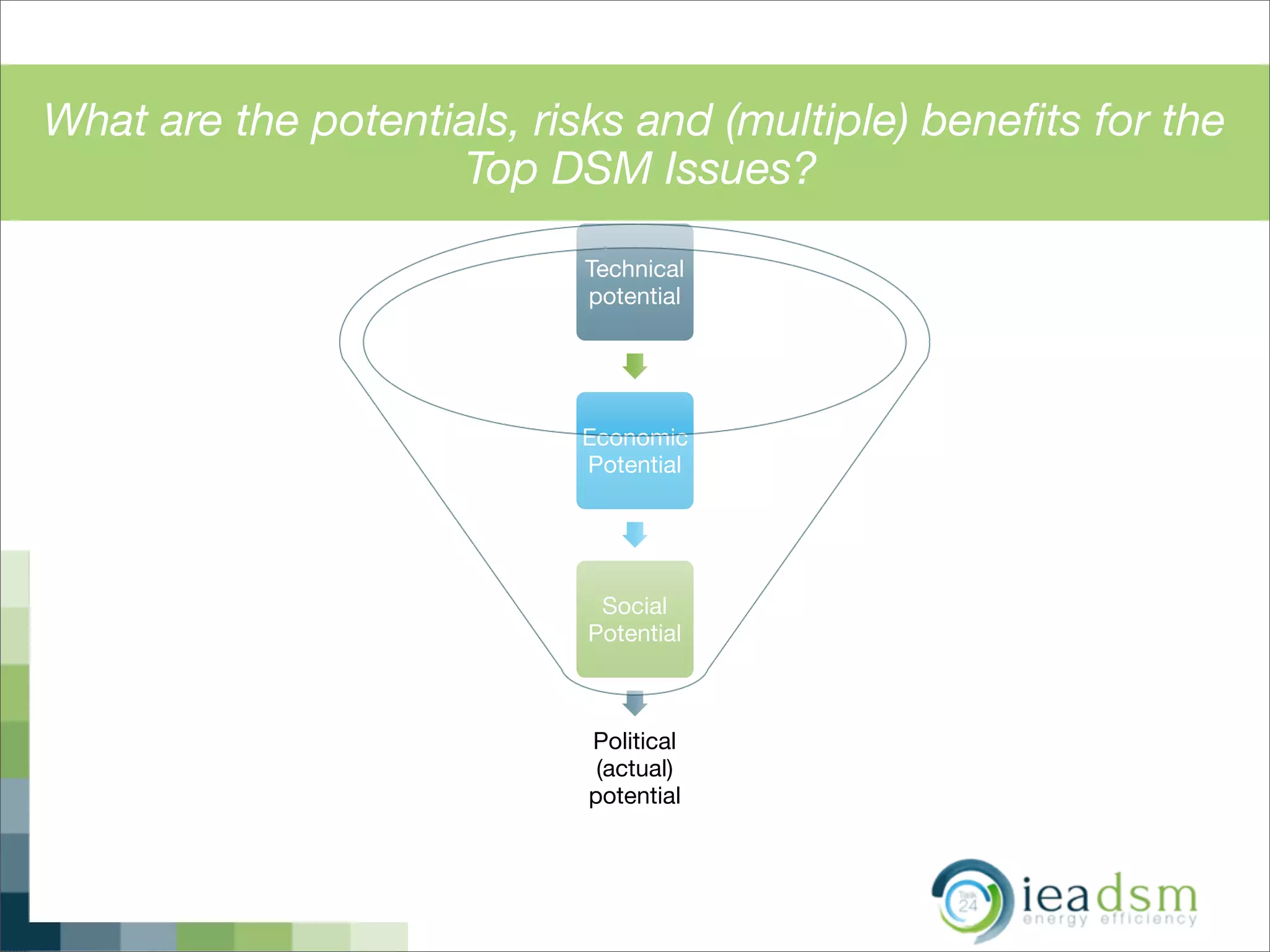
What are the potentials, risks and (multiple) benefits for the
Top DSM Issues?
Technical
potential
Economic
Potential
Social
Potential
Political
(actual)
potential
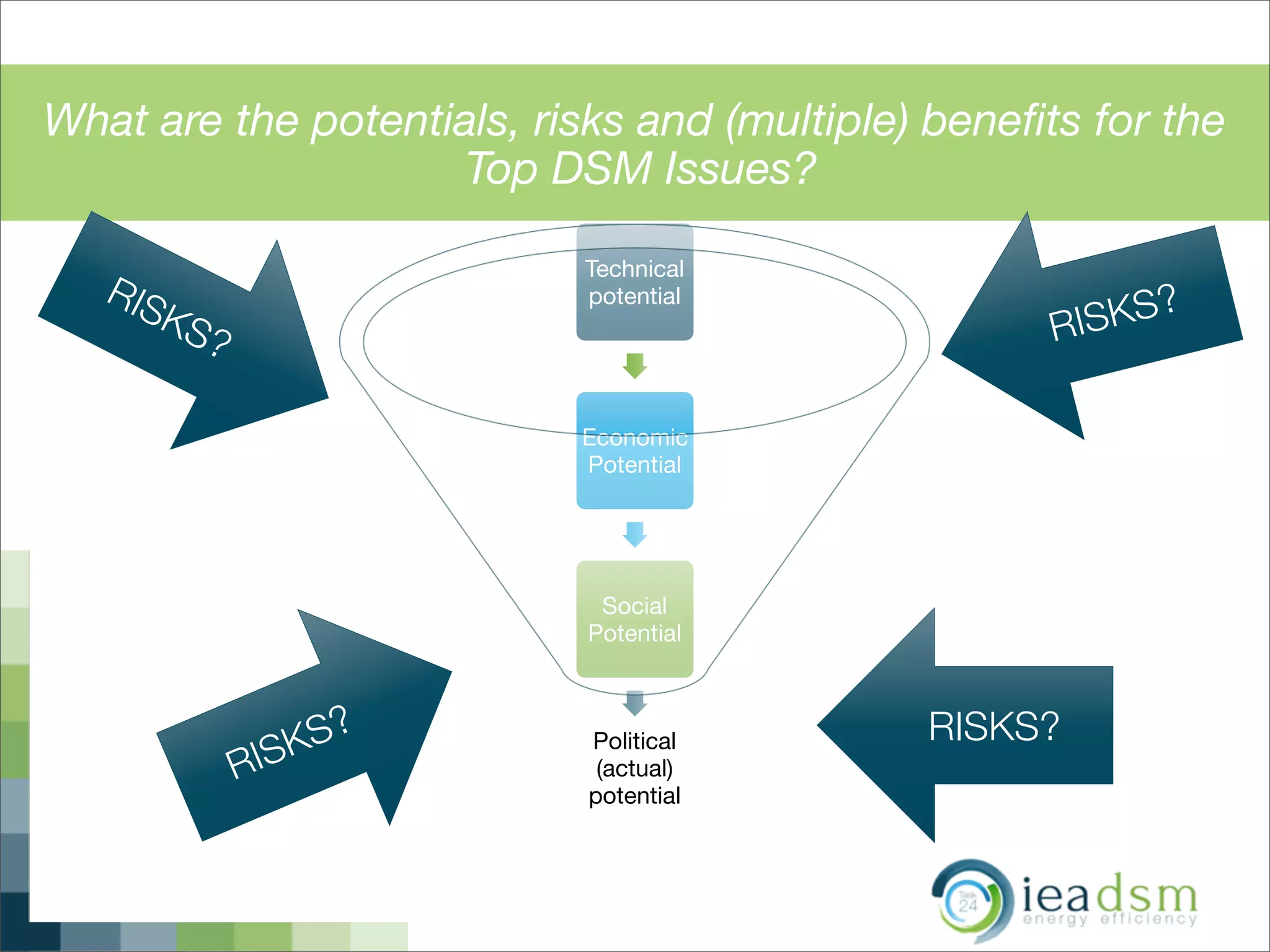
What are the potentials, risks and (multiple) benefits for the
Top DSM Issues?
Technical
potential
Economic
Potential
Social
Potential
Political
(actual)
potential
RISKS?
RISKS?
RISKS?
RISKS?
Multiple
Benefits?
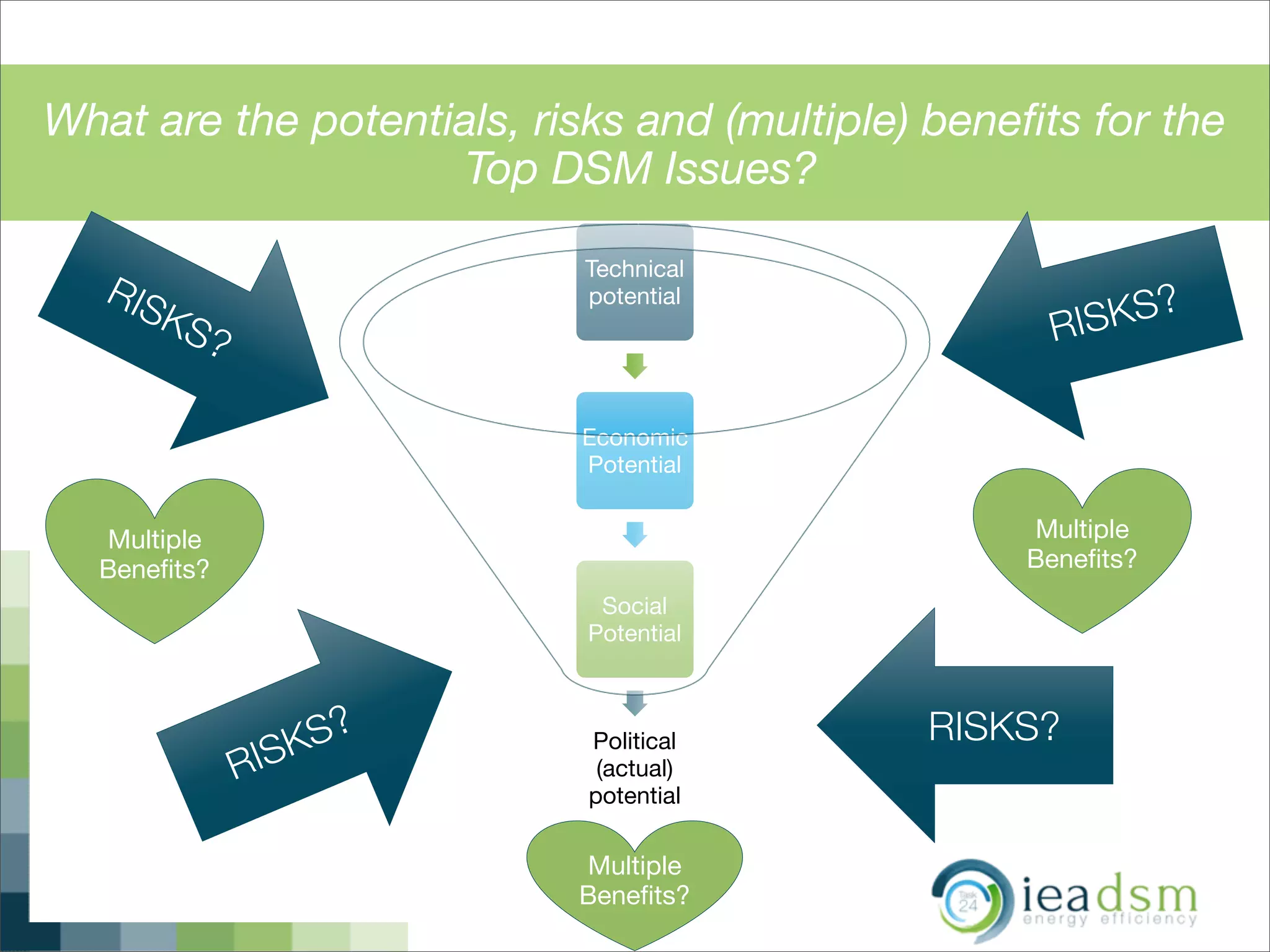
What are the potentials, risks and (multiple) benefits for the
Top DSM Issues?
Technical
potential
Economic
Potential
Social
Potential
Political
(actual)
potential
RISKS?
RISKS?
RISKS?
RISKS?
Multiple
Benefits?
Multiple
Benefits?
Who is the End User whose behaviour we are trying to
change?t the energy system (starting with supply)
STRIBUTION ! TECHNOLOGY ! USER
Who is the End User whose behaviour we are trying to
change?
Tenants? In single homes or apartment buildings?
Home owners? (single or apartment)
Office workers in a large commercial building?
Retail workers in smaller retail buildings?
Landlords? Private or large-scale? Social housing? Commercial?
Building Management Operators? Office or e.g. hospitals?
Smart meter/feedback/EE technology installers or developers?
Drivers? Truck or private vehicle? Behaviour or Mode Switching?
Freight companies? Behaviour or technology switching?
SMEs? Which sector? CEOs or energy managers/CFOs?
Who else could it be?
t the energy system (starting with supply)
STRIBUTION ! TECHNOLOGY ! USER
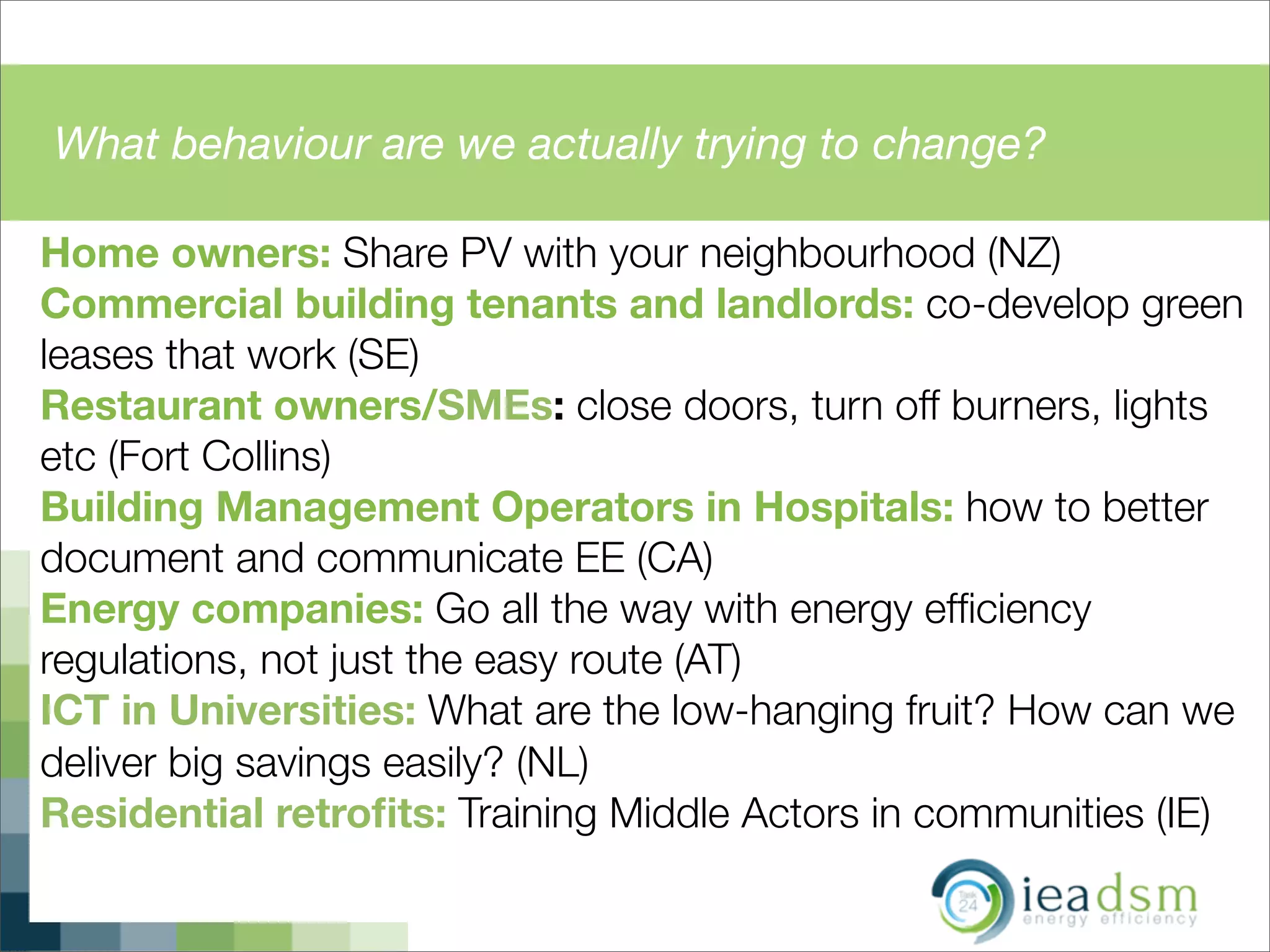
What behaviour are we actually trying to change?
Home owners: Share PV with your neighbourhood (NZ)
Commercial building tenants and landlords: co-develop green
leases that work (SE)
Restaurant owners/SMEs: close doors, turn off burners, lights
etc (Fort Collins)
Building Management Operators in Hospitals: how to better
document and communicate EE (CA)
Energy companies: Go all the way with energy efficiency
regulations, not just the easy route (AT)
ICT in Universities: What are the low-hanging fruit? How can we
deliver big savings easily? (NL)
Residential retrofits: Training Middle Actors in communities (IE)
For more information, visit www.ieadsm.org
Task 24 Phase II
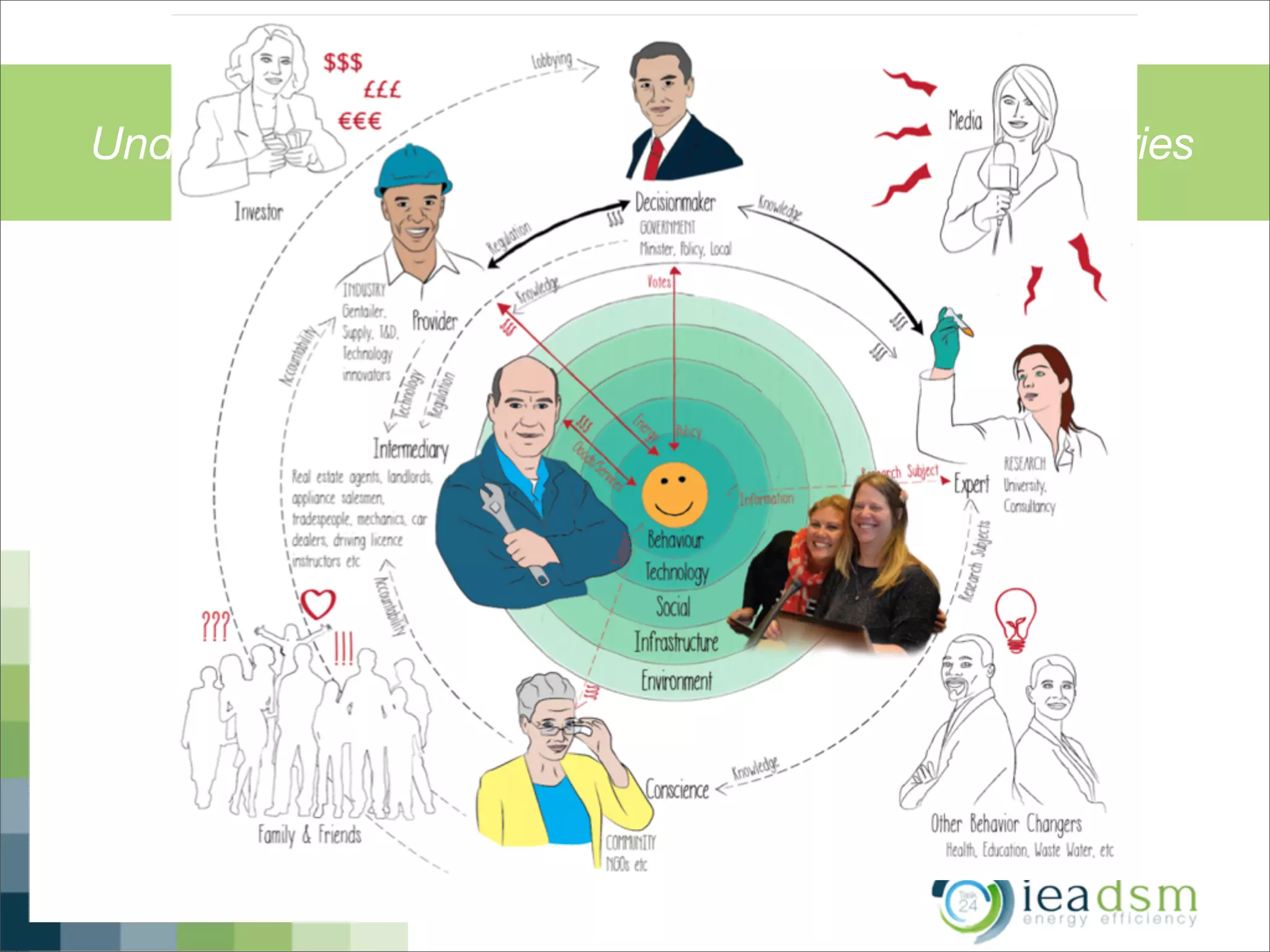
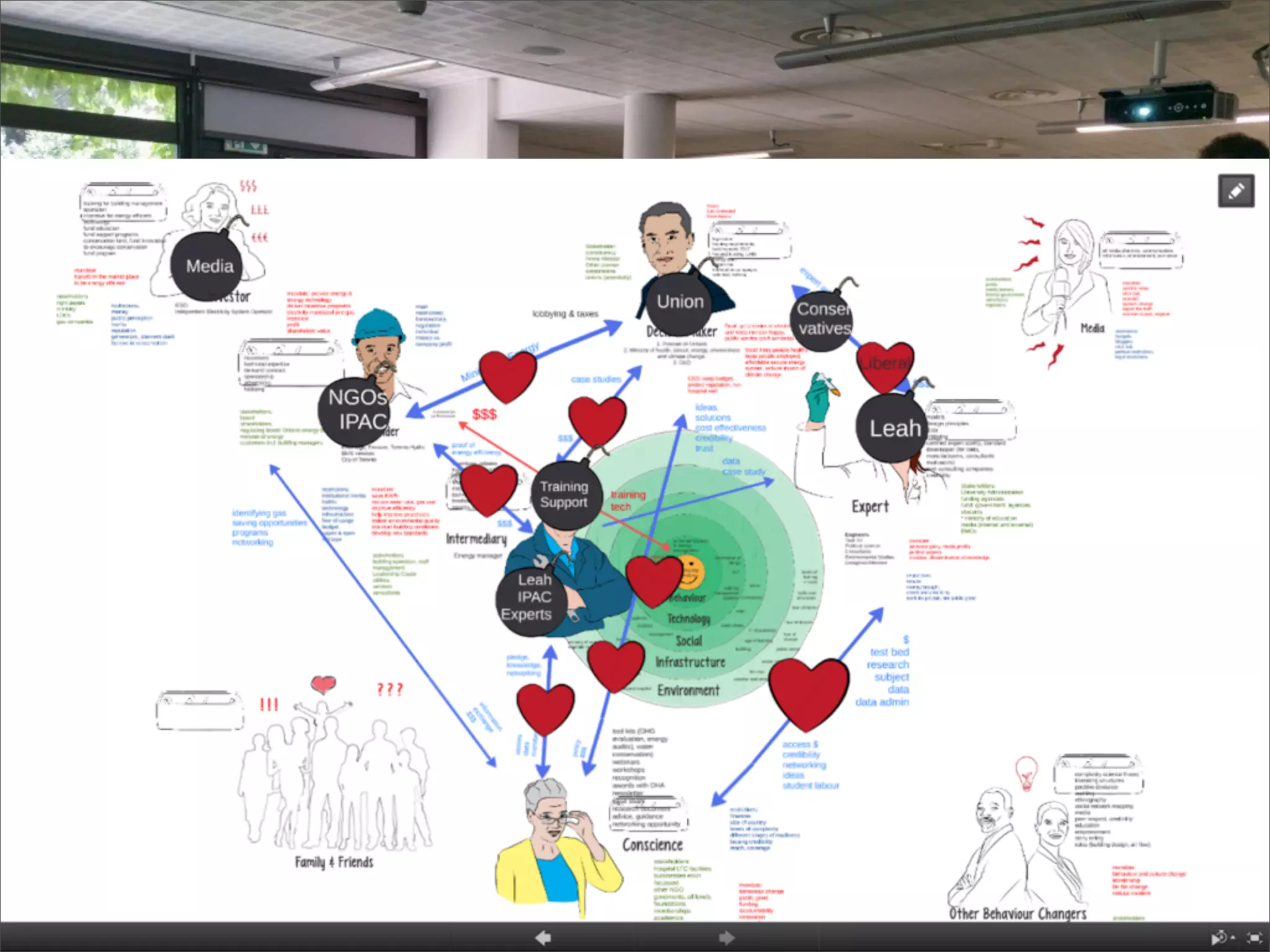
Subtask 7 - The Behaviour Changer
Framework “The People”
A new way of visualising
the energy system
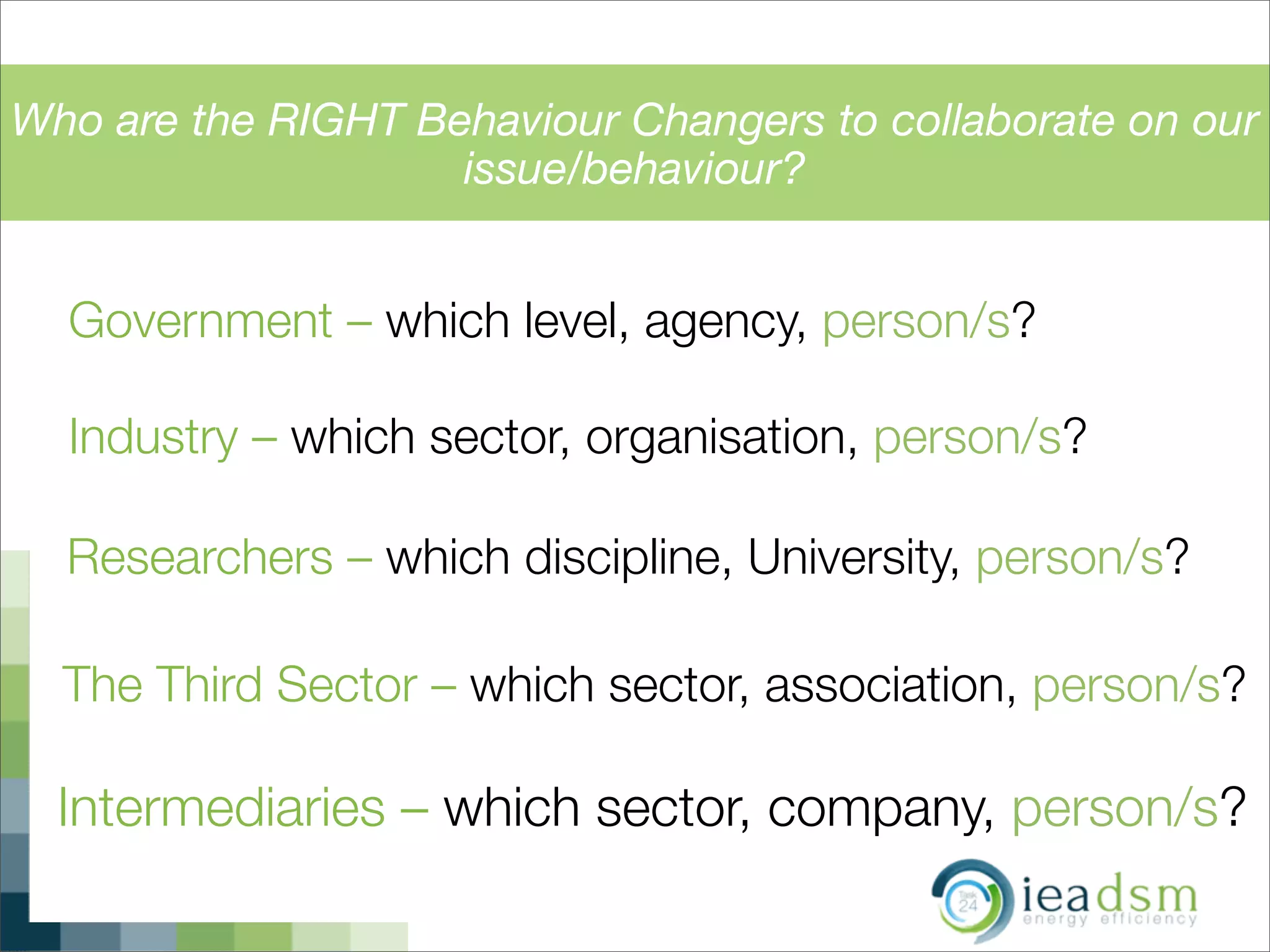
Who are the RIGHT Behaviour Changers to collaborate on our
issue/behaviour?
Government – which level, agency, person/s?
Industry – which sector, organisation, person/s?
Researchers – which discipline, University, person/s?
The Third Sector – which sector, association, person/s?
Intermediaries – which sector, company, person/s?
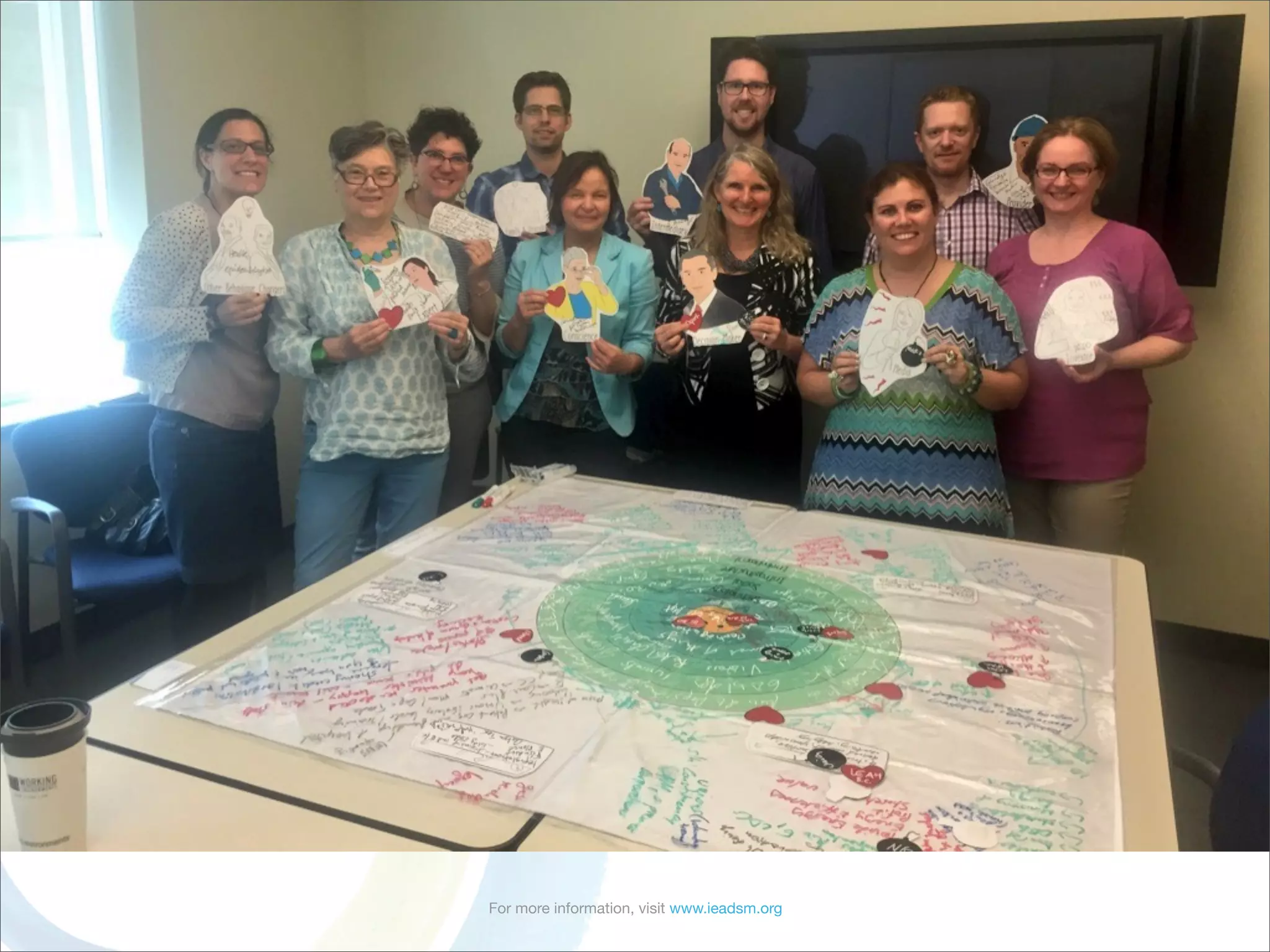
Understanding the Behaviour Changers’ unique stories
For more information, visit www.ieadsm.org
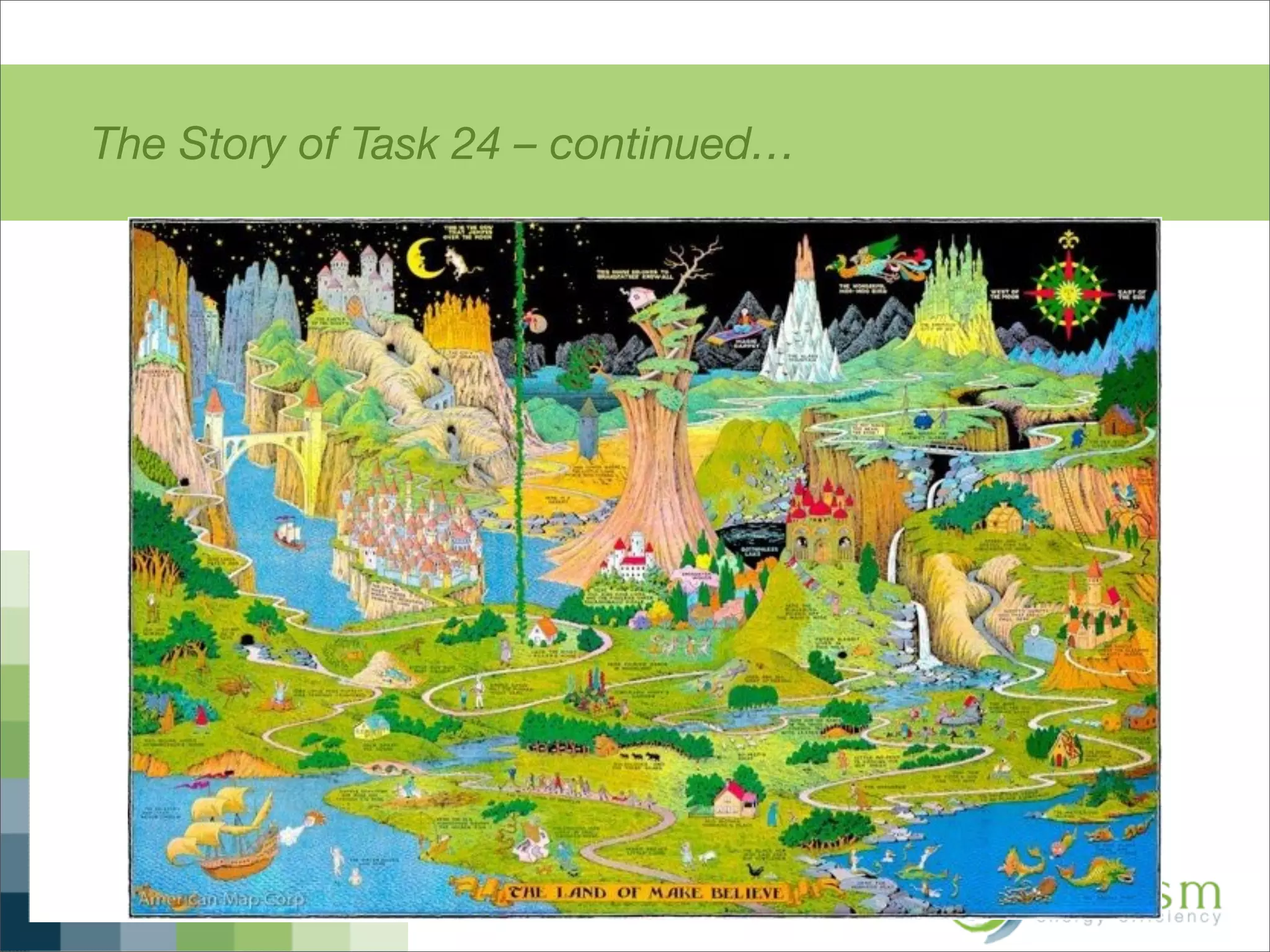
The Story of Task 24 – continued…
If there is ONE THING to take home from this:
IT’S ALL ABOUT
THE PEOPLE!
For more information, visit www.ieadsm.org
Thank you very much for your attention!
Any comments or questions?
drsea@orcon.net.nz

Sea Rotmann “Helping the Behaviour Changers – or how to create systemic change. “

  • 1.
    IEA DSM Task24: Behaviour Change in DSM Phases I and II Dr Sea Rotmann Operating Agent Task 24 Energy Cultures conference, Wellington July 7, 2016
  • 2.
    For more information,visit www.ieadsm.org What is Task 24?
  • 3.
    For more information,visit www.ieadsm.org What is Task 24?
  • 4.
    For more information,visit www.ieadsm.org What is Task 24?
  • 5.
    Task 24 –Objective in a tweet (or two) The overarching impact of this Task is to provide a helicopter overview of best practice approaches to behaviour change interventions and practical, tailored guidelines and tools of how to best design, implement, evaluate and disseminate them in real life.
  • 6.
    IEA DSM Task24 Phase I Closing the Loop – Behaviour Change in DSM: From Theory to Practice
  • 7.
    Some numbers ofTask 24 – Phase I • July 2012 – April 2015 • 8 participating countries • 9 in-kind countries • >235 behaviour change and DSM experts from 21 countries • 20 successful expert workshops • >145 videos and presentations • Over 45 publications – reports, papers, articles… • Almost 60 case studies from 16 countries in a Wiki • www.ieadsm.org/task/task-24-phase-1/
  • 8.
    For more information,visit www.ieadsm.org Subtasks of Task 24 5 – Social network and expert platform 1 – Helicopter view of models, frameworks, contexts and evaluation metrics 2 – In-depth case study analysis 3 – Evaluation Tool for different stakeholders 4 – Country- specific to do’s and not to do’s, guidelines and recommend ations
  • 9.
  • 10.
    Our audience: BehaviourChangers Government
  • 11.
    Our audience: BehaviourChangers Government Industry
  • 12.
    Our audience: BehaviourChangers Government Industry Researchers
  • 13.
    Our audience: BehaviourChangers Government Industry Researchers The Third Sector
  • 14.
    Our audience: BehaviourChangers Government Industry Researchers The Third Sector Intermediaries
  • 15.
    The Story ofTask 24 http://vimeo.com/54915316
  • 16.
    The Story ofTask 24 http://vimeo.com/54915316
  • 17.
    Subtask 1 -Definitions of Task 24 http://www.slideshare.net/drsea/definitions-for-task-24
  • 18.
    What is behaviour(in Task 24)? Energy behaviour refers to all human actions that affect the way that fuels (electricity, gas, petroleum, coal, etc) are used to achieve desired services, including the acquisition or disposal of energy-related technologies and materials, the ways in which these are used, and the mental processes that relate to these actions. Behaviour Change in the context of this Task thus refers to any changes in said human actions which were directly or indirectly influenced by a variety of interventions (e.g. legislation, regulation, incentives, subsidies, information campaigns, peer pressure etc.) aimed at fulfilling specific behaviour change outcomes. These outcomes can include any changes in energy efficiency, total energy consumption, energy technology uptake or demand management but should be identified and specified by the Behaviour Changer designing the intervention for the purpose of outcome evaluation.
  • 19.
    What is behaviour(in Task 24)? Energy behaviour refers to all human actions that affect the way that fuels (electricity, gas, petroleum, coal, etc) are used to achieve desired services, including the acquisition or disposal of energy-related technologies and materials, the ways in which these are used, and the mental processes that relate to these actions. Behaviour Change in the context of this Task thus refers to any changes in said human actions which were directly or indirectly influenced by a variety of interventions (e.g. legislation, regulation, incentives, subsidies, information campaigns, peer pressure etc.) aimed at fulfilling specific behaviour change outcomes. These outcomes can include any changes in energy efficiency, total energy consumption, energy technology uptake or demand management but should be identified and specified by the Behaviour Changer designing the intervention for the purpose of outcome evaluation. BEHAVIOUR IS EVERYTHING!
  • 20.
    Subtask 1 –The ‘Monster’ and its Wiki
  • 21.
    Subtask 1 – Lookingat different models of understanding behaviour
  • 22.
    Subtask 1 – Lookingat different models of understanding behaviour
  • 23.
    Language can bea problem!
  • 24.
    Language can bea problem!
  • 25.
    For more information,visit www.ieadsm.org That was our Eureka! moment
  • 26.
    For more information,visit www.ieadsm.org What is storytelling? ‘Storytelling’ is the construction of a desirable future based on a narrative of past events, with a plot that expresses some causal relationship To read more: Rotmann et al (2015). Once Upon a Time… How to tell an energy efficiency story that ‘sticks’. ECEEE Summer study proceedings And ERSS Special Edition on Storytelling & Narratives
  • 27.
    For more information,visit www.ieadsm.org Stories are: • Universal • Help us process information • Providing multiple perspectives • Subjective, not one truth • Aid recall • Shape identity • Make connections
  • 28.
    For more information,visit www.ieadsm.org The art and scientific methodology of storytelling Narratives = social science tool aimed at providing way to explore how big events (policies) impact on small scale (individuals) Allow for quick, practical and useful understanding of complexity of interconnected factors in behaviour research We all turn everything into a narrative in order to remember it
  • 29.
    We’re all expertstory tellers
  • 30.
  • 31.
    For more information,visit www.ieadsm.org Different energy efficiency stories
  • 32.
    For more information,visit www.ieadsm.org Different energy efficiency stories
  • 33.
    For more information,visit www.ieadsm.org Different energy efficiency stories
  • 34.
    So… what’s themoral of the story of Task 24? • There is no silver bullet anywhere but the potential remains huge • Homo economicus doesn’t exist (in energy humans) • Habits are the most difficult thing to break, though it’s easiest during moments of change • There is no such thing as individual energy use • We need to look at whole-system, societal change • This can’t be done in isolation by one sector - collaboration is key • Everyone has a piece of the puzzle but we can’t see the whole picture yet • We need a shared learning and collaboration platform that works • We also need a shared language based on narratives è It’s all about the people!
  • 35.
    IEA DSM Task24 Phase II Helping the Behaviour Changers
  • 36.
    For more information,visit www.ieadsm.org The Subtasks of Phase II 5 – Expert Platform (upgraded) 6 – Understanding Behaviour Changer Practices in Top DSM Areas ‘The Issues’ 7 – Identifying Behaviour Changers in these areas ‘The People’ 8 – Developing a toolbox of interventions to help Behaviour Changers ‘The Tools’ 9 – Standardising Evaluation beyond kWh ‘The Measures’ 10 – Telling an Overarching Story ‘The Story”
  • 37.
    Task 24 –Phase II How it all fits together What? Subtask 6 ‘The Issues’ Who? Subtask 7 ‘The People’ How? Subtask 8 ‘The Tools’ Why? Subtask 9 ‘The Measure’ So what? Subtask 10 ‘The Story’ Subtask 1 Subtask 2 Subtask 4 Subtask 5 Subtask 1 Subtask 4 Subtask 3
  • 38.
    For more information,visit www.ieadsm.org Task 24 Phase II The Energy System How does it look like now?
  • 39.
    The way wecurrently look at the Energy System whole-system view which puts human needs, behaviours and (ir)rationalities at the center of interventions geared at system change. Instead, if we look at the Energy System through the human lens (Figure 2), we can see that it isn’t necessarily this top-down/left-right linear realtionship starting with supply and ending with the end user, but rather a circular relationship which actually starts with the end user need for an energy service (click here for a short video presentation explaining this in more detail). Figure 1. Current, linear way of looking at the energy system (starting with supply) eetd.lbl.gov T O P D O W N SUPPLY ! TRANSMISSION & DISTRIBUTION ! TECHNOLOGY ! USER
  • 40.
    Another way wecould look at the Energy System
  • 41.
    Another way wecould look at the Energy System
  • 42.
    Task 24 viewof the Energy System We pose that the Energy System begins and ends with the human need for the services derived from energy (warmth, comfort, entertainment, mobility, hygiene, safety etc) and that behavioural interventions using technology, market and business models and changes to supply and delivery of energy are the all-important means to that end.
  • 43.
    For more information,visit www.ieadsm.org Task 24 Phase II The Collective Impact Approach Methodoloy of the Behaviour Changer Framework
  • 44.
    A model forcollaboration Collective impact = the commitment of a group of important actors from different sectors to a common agenda for solving a specific social problem.
  • 45.
    For more information,visit www.ieadsm.org Task 24 Phase II Subtask 6 – Understanding the Behaviour Changers’ Practices and Priorities “The Issues” Deciding on the issues to focus on for Canada
  • 46.
    What are theTop DSM Issues here? Top DSM Issues: • Is there a national list of DSM issues? • What are the biggest behavioural potentials? • What DSM policies and programmes are already tackling these issues and how? • What are their approximate contribution to the country’s load management (economic, technical, political and societal potentials)? • What are the risks and multiple benefits of each?
  • 47.
    What are thepotentials, risks and (multiple) benefits for the Top DSM Issues? Technical potential Economic Potential Social Potential Political (actual) potential
  • 48.
    What are thepotentials, risks and (multiple) benefits for the Top DSM Issues? Technical potential Economic Potential Social Potential Political (actual) potential RISKS? RISKS? RISKS? RISKS?
  • 49.
    Multiple Benefits? What are thepotentials, risks and (multiple) benefits for the Top DSM Issues? Technical potential Economic Potential Social Potential Political (actual) potential RISKS? RISKS? RISKS? RISKS? Multiple Benefits? Multiple Benefits?
  • 50.
    Who is theEnd User whose behaviour we are trying to change?t the energy system (starting with supply) STRIBUTION ! TECHNOLOGY ! USER
  • 51.
    Who is theEnd User whose behaviour we are trying to change? Tenants? In single homes or apartment buildings? Home owners? (single or apartment) Office workers in a large commercial building? Retail workers in smaller retail buildings? Landlords? Private or large-scale? Social housing? Commercial? Building Management Operators? Office or e.g. hospitals? Smart meter/feedback/EE technology installers or developers? Drivers? Truck or private vehicle? Behaviour or Mode Switching? Freight companies? Behaviour or technology switching? SMEs? Which sector? CEOs or energy managers/CFOs? Who else could it be? t the energy system (starting with supply) STRIBUTION ! TECHNOLOGY ! USER
  • 52.
    What behaviour arewe actually trying to change?
  • 53.
    What behaviour arewe actually trying to change? Home owners: Share PV with your neighbourhood (NZ) Commercial building tenants and landlords: co-develop green leases that work (SE) Restaurant owners/SMEs: close doors, turn off burners, lights etc (Fort Collins) Building Management Operators in Hospitals: how to better document and communicate EE (CA) Energy companies: Go all the way with energy efficiency regulations, not just the easy route (AT) ICT in Universities: What are the low-hanging fruit? How can we deliver big savings easily? (NL) Residential retrofits: Training Middle Actors in communities (IE)
  • 54.
    For more information,visit www.ieadsm.org Task 24 Phase II Subtask 7 - The Behaviour Changer Framework “The People” A new way of visualising the energy system
  • 55.
    Who are theRIGHT Behaviour Changers to collaborate on our issue/behaviour? Government – which level, agency, person/s? Industry – which sector, organisation, person/s? Researchers – which discipline, University, person/s? The Third Sector – which sector, association, person/s? Intermediaries – which sector, company, person/s?
  • 56.
    Understanding the BehaviourChangers’ unique stories
  • 57.
    Understanding the BehaviourChangers’ unique stories
  • 58.
    For more information,visit www.ieadsm.org
  • 59.
    For more information,visit www.ieadsm.org
  • 60.
    For more information,visit www.ieadsm.org
  • 61.
    For more information,visit www.ieadsm.org
  • 62.
    The Story ofTask 24 – continued…
  • 63.
    If there isONE THING to take home from this:
  • 64.
    If there isONE THING to take home from this: IT’S ALL ABOUT THE PEOPLE!
  • 65.
    For more information,visit www.ieadsm.org Thank you very much for your attention! Any comments or questions? drsea@orcon.net.nz