Campbell High School
Summer Reading
Podcast #4-
Characterization
Characters
• For fiction novels, choose
two characters from the
text.
• In two to three
paragraphs, analyze how
these complex characters
develop throughout the
text. Be sure to provide
specific examples from
the text.
• For nonfiction books,
choose two events or
situations from the text.
• In two to three
paragraphs, analyze how
these complex events or
situations develop
throughout the text. Be
sure to provide specific
examples from the text.
Characters
How to read for character
analysis-
 Make a list, a timeline or
a cluster map for each
character
 Describe the character in
detail from the evidence
the author gives you
about the character.
 Note how the character
changes or grows over
time.
Characters
Static or Dynamic
• A static character doesn’t
change or grow over the
course of a story
• The reader understands a
dynamic character’s
thinking and motivations.
The character often changes
as a result of conflicts and
events in the story.
Flat or Round
• A flat character is one-
dimensional or even
stereotypical- the bully, the
evil step mother, the mad
scientist
• A round character is
multidimensional- the bitter
loner who begins to love
again as a result of meeting
a new person or the
popular girl who falls from
grace when people find out
how mean she actually is
Antagonist- a character who is in
conflict with another character; an
adversary
Protagonist- leading or major
character; hero or heroine; advocate
Characters
Character Brainstorm List
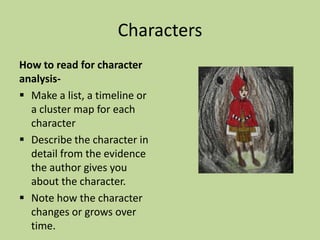
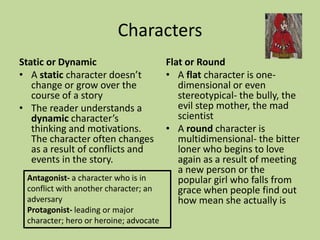
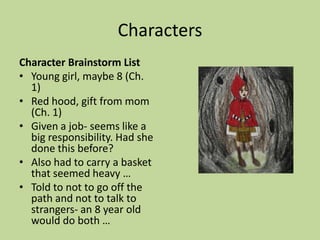
• Young girl, maybe 8 (Ch.
1)
• Red hood, gift from mom
(Ch. 1)
• Given a job- seems like a
big responsibility. Had she
done this before?
• Also had to carry a basket
that seemed heavy …
• Told to not to go off the
path and not to talk to
strangers- an 8 year old
would do both …
Characters
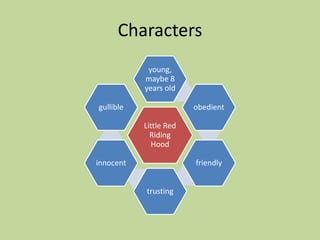
Little Red
Riding
Hood
young,
maybe 8
years old
obedient
friendly
trusting
innocent
gullible
Characters
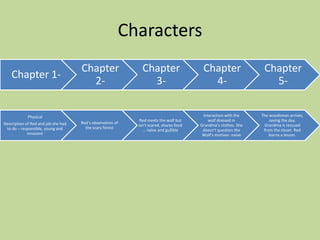
Chapter 1-
Chapter
2-
Chapter
3-
Chapter
4-
Chapter
5-
Physical
Description of Red and job she had
to do – responsible, young and
innocent
Red’s observation of
the scary forest
Red meets the wolf but
isn’t scared, shares food
… naïve and gullible
Interaction with the
wolf dressed in
Grandma’s clothes. She
doesn’t question the
Wolf’s motives- naive
The woodsman arrives,
saving the day.
Grandma is rescued
from the closet. Red
learns a lesson.
Characters
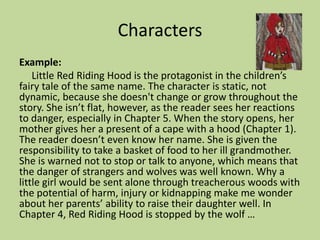
Example:
Little Red Riding Hood is the protagonist in the children’s
fairy tale of the same name. The character is static, not
dynamic, because she doesn't change or grow throughout the
story. She isn’t flat, however, as the reader sees her reactions
to danger, especially in Chapter 5. When the story opens, her
mother gives her a present of a cape with a hood (Chapter 1).
The reader doesn’t even know her name. She is given the
responsibility to take a basket of food to her ill grandmother.
She is warned not to stop or talk to anyone, which means that
the danger of strangers and wolves was well known. Why a
little girl would be sent alone through treacherous woods with
the potential of harm, injury or kidnapping make me wonder
about her parents’ ability to raise their daughter well. In
Chapter 4, Red Riding Hood is stopped by the wolf …
Characters
Example:
Little Red Riding Hood the protagonist in the children’s fairy
tale of the same name. The character is static, not dynamic,
because she doesn't change or grow throughout the story.
The reader doesn’t even know her name. She isn’t flat,
however, as the reader sees Red’s reactions to danger,
especially in Chapter 5. When the story opens, her mother
gives her a present of a cape with a hood (Chapter 1). She is
given the responsibility to take a basket of food to her ill
grandmother. She is warned not to stop or talk to anyone,
which means that the danger of strangers and wolves was
well known. Why a little girl would be sent alone through
treacherous woods with the potential of harm, injury or
kidnapping makes me wonder about her parents’ ability to
raise their daughter well. In Chapter 4, Red Riding Hood is
stopped by the wolf …
Characters
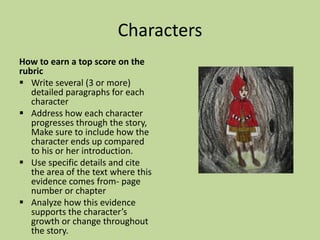
How to earn a top score on the
rubric
 Write several (3 or more)
detailed paragraphs for each
character
 Address how each character
progresses through the story,
Make sure to include how the
character ends up compared
to his or her introduction.
 Use specific details and cite
the area of the text where this
evidence comes from- page
number or chapter
 Analyze how this evidence
supports the character’s
growth or change throughout
the story.
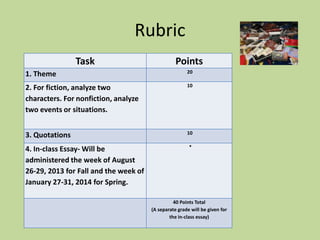
Rubric
Task Points
1. Theme 20
2. For fiction, analyze two
characters. For nonfiction, analyze
two events or situations.
10
3. Quotations 10
4. In-class Essay- Will be
administered the week of August
26-29, 2013 for Fall and the week of
January 27-31, 2014 for Spring.
*
40 Points Total
(A separate grade will be given for
the in-class essay)

Campbell high school podcast 4 characterization

  • 1.
    Campbell High School SummerReading Podcast #4- Characterization
  • 2.
    Characters • For fictionnovels, choose two characters from the text. • In two to three paragraphs, analyze how these complex characters develop throughout the text. Be sure to provide specific examples from the text. • For nonfiction books, choose two events or situations from the text. • In two to three paragraphs, analyze how these complex events or situations develop throughout the text. Be sure to provide specific examples from the text.
  • 3.
    Characters How to readfor character analysis-  Make a list, a timeline or a cluster map for each character  Describe the character in detail from the evidence the author gives you about the character.  Note how the character changes or grows over time.
  • 4.
    Characters Static or Dynamic •A static character doesn’t change or grow over the course of a story • The reader understands a dynamic character’s thinking and motivations. The character often changes as a result of conflicts and events in the story. Flat or Round • A flat character is one- dimensional or even stereotypical- the bully, the evil step mother, the mad scientist • A round character is multidimensional- the bitter loner who begins to love again as a result of meeting a new person or the popular girl who falls from grace when people find out how mean she actually is Antagonist- a character who is in conflict with another character; an adversary Protagonist- leading or major character; hero or heroine; advocate
  • 5.
    Characters Character Brainstorm List •Young girl, maybe 8 (Ch. 1) • Red hood, gift from mom (Ch. 1) • Given a job- seems like a big responsibility. Had she done this before? • Also had to carry a basket that seemed heavy … • Told to not to go off the path and not to talk to strangers- an 8 year old would do both …
  • 6.
    Characters Little Red Riding Hood young, maybe 8 yearsold obedient friendly trusting innocent gullible
  • 7.
    Characters Chapter 1- Chapter 2- Chapter 3- Chapter 4- Chapter 5- Physical Description ofRed and job she had to do – responsible, young and innocent Red’s observation of the scary forest Red meets the wolf but isn’t scared, shares food … naïve and gullible Interaction with the wolf dressed in Grandma’s clothes. She doesn’t question the Wolf’s motives- naive The woodsman arrives, saving the day. Grandma is rescued from the closet. Red learns a lesson.
  • 8.
    Characters Example: Little Red RidingHood is the protagonist in the children’s fairy tale of the same name. The character is static, not dynamic, because she doesn't change or grow throughout the story. She isn’t flat, however, as the reader sees her reactions to danger, especially in Chapter 5. When the story opens, her mother gives her a present of a cape with a hood (Chapter 1). The reader doesn’t even know her name. She is given the responsibility to take a basket of food to her ill grandmother. She is warned not to stop or talk to anyone, which means that the danger of strangers and wolves was well known. Why a little girl would be sent alone through treacherous woods with the potential of harm, injury or kidnapping make me wonder about her parents’ ability to raise their daughter well. In Chapter 4, Red Riding Hood is stopped by the wolf …
  • 9.
    Characters Example: Little Red RidingHood the protagonist in the children’s fairy tale of the same name. The character is static, not dynamic, because she doesn't change or grow throughout the story. The reader doesn’t even know her name. She isn’t flat, however, as the reader sees Red’s reactions to danger, especially in Chapter 5. When the story opens, her mother gives her a present of a cape with a hood (Chapter 1). She is given the responsibility to take a basket of food to her ill grandmother. She is warned not to stop or talk to anyone, which means that the danger of strangers and wolves was well known. Why a little girl would be sent alone through treacherous woods with the potential of harm, injury or kidnapping makes me wonder about her parents’ ability to raise their daughter well. In Chapter 4, Red Riding Hood is stopped by the wolf …
  • 10.
    Characters How to earna top score on the rubric  Write several (3 or more) detailed paragraphs for each character  Address how each character progresses through the story, Make sure to include how the character ends up compared to his or her introduction.  Use specific details and cite the area of the text where this evidence comes from- page number or chapter  Analyze how this evidence supports the character’s growth or change throughout the story.
  • 11.
    Rubric Task Points 1. Theme20 2. For fiction, analyze two characters. For nonfiction, analyze two events or situations. 10 3. Quotations 10 4. In-class Essay- Will be administered the week of August 26-29, 2013 for Fall and the week of January 27-31, 2014 for Spring. * 40 Points Total (A separate grade will be given for the in-class essay)