Name ____________________________________ Date _________________________ Block ______________ A or B


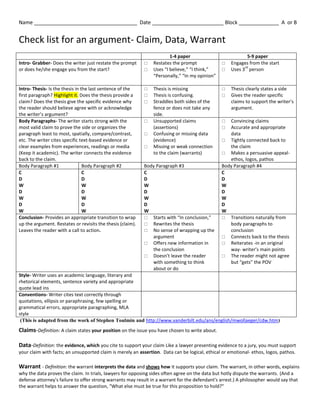
Check list for an argument- Claim, Data, Warrant
                                                                        1-4 paper                            5-9 paper
Intro- Grabber- Does the writer just restate the prompt        Restates the prompt                 Engages from the start
                                                                                                           rd
or does he/she engage you from the start?                      Uses “I believe,” “I think,”        Uses 3 person
                                                                “Personally,” “In my opinion”

Intro- Thesis- Is the thesis in the last sentence of the       Thesis is missing                   Thesis clearly states a side
first paragraph? Highlight it. Does the thesis provide a       Thesis is confusing.                Gives the reader specific
claim? Does the thesis give the specific evidence why          Straddles both sides of the          claims to support the writer’s
the reader should believe agree with or acknowledge             fence or does not take any           argument.
the writer’s argument?                                          side.
Body Paragraphs- The writer starts strong with the             Unsupported claims                Convincing claims
most valid claim to prove the side or organizes the             (assertions)                      Accurate and appropriate
paragraph least to most, spatially, compare/contrast,          Confusing or missing data          data
etc. The writer cites specific text-based evidence or           (evidence)                       Tightly connected back to
clear examples from experiences, readings or media             Missing or weak connection         the claim
(Keep it academic). The writer connects the evidence            to the claim (warrants)          Makes a persuasive appeal-
back to the claim.                                                                                 ethos, logos, pathos
Body Paragraph #1                Body Paragraph #2          Body Paragraph #3                   Body Paragraph #4
C                                C                          C                                   C
D                                D                          D                                   D
W                                W                          W                                   W
D                                D                          D                                   D
W                                W                          W                                   W
D                                D                          D                                   D
W                                W                          W                                   W
Conclusion- Provides an appropriate transition to wrap       Starts with “In conclusion,”       Transitions naturally from
up the argument. Restates or revisits the thesis (claim).    Rewrites the thesis                  body paragraphs to
Leaves the reader with a call to action.                     No sense of wrapping up the          conclusion
                                                               argument                          Connects back to the thesis
                                                             Offers new information in          Reiterates -in an original
                                                               the conclusion                      way- writer’s main points
                                                             Doesn’t leave the reader           The reader might not agree
                                                               with something to think             but “gets” the POV
                                                               about or do
Style- Writer uses an academic language, literary and
rhetorical elements, sentence variety and appropriate
quote lead ins
Conventions- Writer cites text correctly through
quotations, ellipsis or paraphrasing, few spelling or
grammatical errors, appropriate paragraphing, MLA
style
 (This is adapted from the work of Stephen Toulmin and http://www.vanderbilt.edu/ans/english/mwollaeger/cdw.htm)
Claims-Definition: A claim states your position on the issue you have chosen to write about.

Data-Definition: the evidence, which you cite to support your claim Like a lawyer presenting evidence to a jury, you must support
your claim with facts; an unsupported claim is merely an assertion. Data can be logical, ethical or emotional- ethos, logos, pathos.

Warrant - Definition: the warrant interprets the data and shows how it supports your claim. The warrant, in other words, explains
why the data proves the claim. In trials, lawyers for opposing sides often agree on the data but hotly dispute the warrants. (And a
defense attorney's failure to offer strong warrants may result in a warrant for the defendant's arrest.) A philosopher would say that
the warrant helps to answer the question, "What else must be true for this proposition to hold?"

Check list for an argument

  • 1.
    Name ____________________________________ Date_________________________ Block ______________ A or B Check list for an argument- Claim, Data, Warrant 1-4 paper 5-9 paper Intro- Grabber- Does the writer just restate the prompt  Restates the prompt  Engages from the start rd or does he/she engage you from the start?  Uses “I believe,” “I think,”  Uses 3 person “Personally,” “In my opinion” Intro- Thesis- Is the thesis in the last sentence of the  Thesis is missing  Thesis clearly states a side first paragraph? Highlight it. Does the thesis provide a  Thesis is confusing.  Gives the reader specific claim? Does the thesis give the specific evidence why  Straddles both sides of the claims to support the writer’s the reader should believe agree with or acknowledge fence or does not take any argument. the writer’s argument? side. Body Paragraphs- The writer starts strong with the  Unsupported claims  Convincing claims most valid claim to prove the side or organizes the (assertions)  Accurate and appropriate paragraph least to most, spatially, compare/contrast,  Confusing or missing data data etc. The writer cites specific text-based evidence or (evidence)  Tightly connected back to clear examples from experiences, readings or media  Missing or weak connection the claim (Keep it academic). The writer connects the evidence to the claim (warrants)  Makes a persuasive appeal- back to the claim. ethos, logos, pathos Body Paragraph #1 Body Paragraph #2 Body Paragraph #3 Body Paragraph #4 C C C C D D D D W W W W D D D D W W W W D D D D W W W W Conclusion- Provides an appropriate transition to wrap  Starts with “In conclusion,”  Transitions naturally from up the argument. Restates or revisits the thesis (claim).  Rewrites the thesis body paragraphs to Leaves the reader with a call to action.  No sense of wrapping up the conclusion argument  Connects back to the thesis  Offers new information in  Reiterates -in an original the conclusion way- writer’s main points  Doesn’t leave the reader  The reader might not agree with something to think but “gets” the POV about or do Style- Writer uses an academic language, literary and rhetorical elements, sentence variety and appropriate quote lead ins Conventions- Writer cites text correctly through quotations, ellipsis or paraphrasing, few spelling or grammatical errors, appropriate paragraphing, MLA style (This is adapted from the work of Stephen Toulmin and http://www.vanderbilt.edu/ans/english/mwollaeger/cdw.htm) Claims-Definition: A claim states your position on the issue you have chosen to write about. Data-Definition: the evidence, which you cite to support your claim Like a lawyer presenting evidence to a jury, you must support your claim with facts; an unsupported claim is merely an assertion. Data can be logical, ethical or emotional- ethos, logos, pathos. Warrant - Definition: the warrant interprets the data and shows how it supports your claim. The warrant, in other words, explains why the data proves the claim. In trials, lawyers for opposing sides often agree on the data but hotly dispute the warrants. (And a defense attorney's failure to offer strong warrants may result in a warrant for the defendant's arrest.) A philosopher would say that the warrant helps to answer the question, "What else must be true for this proposition to hold?"