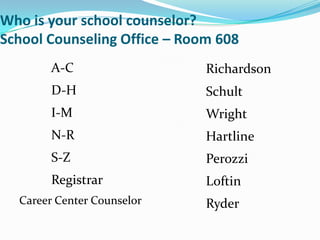
Who is your school counselor?
School Counseling Office – Room 608
        A-C                   Richardson
        D-H                   Schult
        I-M                   Wright
        N-R                   Hartline
        S-Z                   Perozzi
        Registrar             Loftin
  Career Center Counselor     Ryder
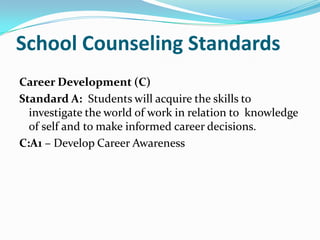
School Counseling Standards
Career Development (C)
Standard A: Students will acquire the skills to
  investigate the world of work in relation to knowledge
  of self and to make informed career decisions.
C:A1 – Develop Career Awareness
How do I put my post-secondary plan into
                action?
Let’s talk about…
 Researching and selecting colleges
 Financial Aid resources and HOPE
 Next steps
 Career & Education Exploration via GACollege411
How do I get to college?
 Make a list of potential schools
 Compare your profile to the school’s freshman profile
 Review each school’s application:
    Online application (preferred)
                                                    Know your
    Transcript                                     application
                                                    deadlines!
    Application fee
    Recommendations (if needed)
       Counselor Recommendation (or school evaluation)
       Teacher Recommendation (letter or form)
Where will my GPA and test scores take me?
Your GPA and test scores are two major factors
colleges take into consideration.

 REACH school – your core GPA and test scores are BELOW
 the college freshmen profile from last year

 TARGET school – your core GPA and test scores MATCH the
 college freshmen profile from last year

 SAFE school – your core GPA and test scores are ABOVE the
 college freshmen profile from last year
Grants & Scholarships
  – Do not have to be repaid
  – Based on specific requirements
Loans
  – Need to be repaid after college
Work-study Programs
  – Student has a job on campus
  – Money earned helps pay for college or
     expenses
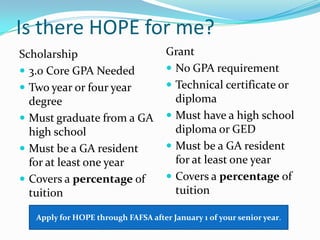
Is there HOPE for me?
Scholarship                          Grant
 3.0 Core GPA Needed                 No GPA requirement
 Two year or four year               Technical certificate or
  degree                               diploma
 Must graduate from a GA             Must have a high school
  high school                          diploma or GED
 Must be a GA resident               Must be a GA resident
  for at least one year                for at least one year
 Covers a percentage of              Covers a percentage of
  tuition                              tuition

   Apply for HOPE through FAFSA after January 1 of your senior year.
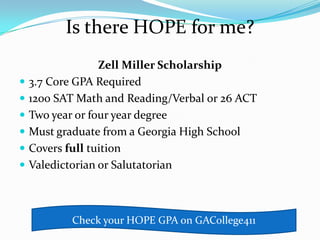
Is there HOPE for me?
                  Zell Miller Scholarship
   3.7 Core GPA Required
   1200 SAT Math and Reading/Verbal or 26 ACT
   Two year or four year degree
   Must graduate from a Georgia High School
   Covers full tuition
   Valedictorian or Salutatorian


           Check your HOPE GPA on GACollege411
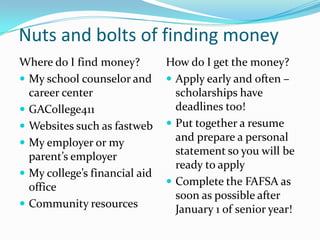
Nuts and bolts of finding money
Where do I find money?         How do I get the money?
 My school counselor and       Apply early and often –
  career center                  scholarships have
 GACollege411                   deadlines too!
 Websites such as fastweb      Put together a resume
 My employer or my
                                 and prepare a personal
  parent’s employer              statement so you will be
                                 ready to apply
 My college’s financial aid
                                Complete the FAFSA as
  office
                                 soon as possible after
 Community resources
                                 January 1 of senior year!
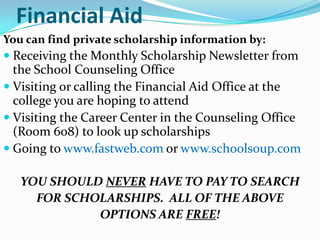
Financial Aid
You can find private scholarship information by:
 Receiving the Monthly Scholarship Newsletter from
  the School Counseling Office
 Visiting or calling the Financial Aid Office at the
  college you are hoping to attend
 Visiting the Career Center in the Counseling Office
  (Room 608) to look up scholarships
 Going to www.fastweb.com or www.schoolsoup.com

   YOU SHOULD NEVER HAVE TO PAY TO SEARCH
     FOR SCHOLARSHIPS. ALL OF THE ABOVE
             OPTIONS ARE FREE!
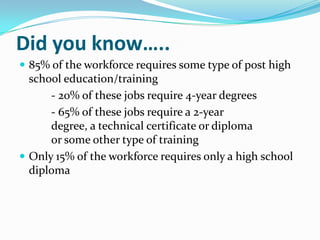
Did you know…..
 85% of the workforce requires some type of post high
  school education/training
      - 20% of these jobs require 4-year degrees
      - 65% of these jobs require a 2-year
      degree, a technical certificate or diploma
      or some other type of training
 Only 15% of the workforce requires only a high school
  diploma
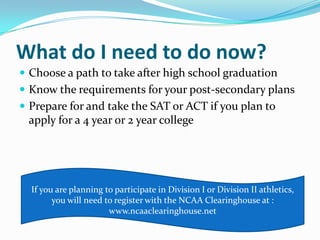
What do I need to do now?
 Choose a path to take after high school graduation
 Know the requirements for your post-secondary plans
 Prepare for and take the SAT or ACT if you plan to
 apply for a 4 year or 2 year college


  If you are planning to participate in Division I or Division II athletics,
        you will need to register with the NCAA Clearinghouse at :
                       www.ncaaclearinghouse.net
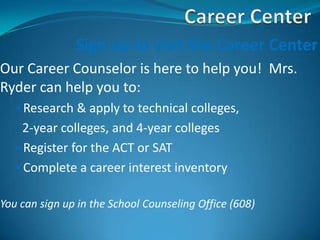
Sign up to visit the Career Center
Our Career Counselor is here to help you! Mrs.
Ryder can help you to:
   • Research & apply to technical colleges,
     2-year colleges, and 4-year colleges
   • Register for the ACT or SAT
   • Complete a career interest inventory


You can sign up in the School Counseling Office (608)
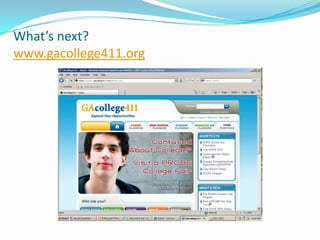
What’s next?
www.gacollege411.org

11th grade second session

  • 2.
    Who is yourschool counselor? School Counseling Office – Room 608 A-C Richardson D-H Schult I-M Wright N-R Hartline S-Z Perozzi Registrar Loftin Career Center Counselor Ryder
  • 3.
    School Counseling Standards CareerDevelopment (C) Standard A: Students will acquire the skills to investigate the world of work in relation to knowledge of self and to make informed career decisions. C:A1 – Develop Career Awareness
  • 4.
    How do Iput my post-secondary plan into action?
  • 5.
    Let’s talk about… Researching and selecting colleges  Financial Aid resources and HOPE  Next steps  Career & Education Exploration via GACollege411
  • 6.
    How do Iget to college?  Make a list of potential schools  Compare your profile to the school’s freshman profile  Review each school’s application:  Online application (preferred) Know your  Transcript application deadlines!  Application fee  Recommendations (if needed)  Counselor Recommendation (or school evaluation)  Teacher Recommendation (letter or form)
  • 7.
    Where will myGPA and test scores take me? Your GPA and test scores are two major factors colleges take into consideration.  REACH school – your core GPA and test scores are BELOW the college freshmen profile from last year  TARGET school – your core GPA and test scores MATCH the college freshmen profile from last year  SAFE school – your core GPA and test scores are ABOVE the college freshmen profile from last year
  • 8.
    Grants & Scholarships – Do not have to be repaid – Based on specific requirements Loans – Need to be repaid after college Work-study Programs – Student has a job on campus – Money earned helps pay for college or expenses
  • 9.
    Is there HOPEfor me? Scholarship Grant  3.0 Core GPA Needed  No GPA requirement  Two year or four year  Technical certificate or degree diploma  Must graduate from a GA  Must have a high school high school diploma or GED  Must be a GA resident  Must be a GA resident for at least one year for at least one year  Covers a percentage of  Covers a percentage of tuition tuition Apply for HOPE through FAFSA after January 1 of your senior year.
  • 10.
    Is there HOPEfor me? Zell Miller Scholarship  3.7 Core GPA Required  1200 SAT Math and Reading/Verbal or 26 ACT  Two year or four year degree  Must graduate from a Georgia High School  Covers full tuition  Valedictorian or Salutatorian Check your HOPE GPA on GACollege411
  • 11.
    Nuts and boltsof finding money Where do I find money? How do I get the money?  My school counselor and  Apply early and often – career center scholarships have  GACollege411 deadlines too!  Websites such as fastweb  Put together a resume  My employer or my and prepare a personal parent’s employer statement so you will be ready to apply  My college’s financial aid  Complete the FAFSA as office soon as possible after  Community resources January 1 of senior year!
  • 12.
    Financial Aid You canfind private scholarship information by:  Receiving the Monthly Scholarship Newsletter from the School Counseling Office  Visiting or calling the Financial Aid Office at the college you are hoping to attend  Visiting the Career Center in the Counseling Office (Room 608) to look up scholarships  Going to www.fastweb.com or www.schoolsoup.com YOU SHOULD NEVER HAVE TO PAY TO SEARCH FOR SCHOLARSHIPS. ALL OF THE ABOVE OPTIONS ARE FREE!
  • 13.
    Did you know….. 85% of the workforce requires some type of post high school education/training - 20% of these jobs require 4-year degrees - 65% of these jobs require a 2-year degree, a technical certificate or diploma or some other type of training  Only 15% of the workforce requires only a high school diploma
  • 14.
    What do Ineed to do now?  Choose a path to take after high school graduation  Know the requirements for your post-secondary plans  Prepare for and take the SAT or ACT if you plan to apply for a 4 year or 2 year college If you are planning to participate in Division I or Division II athletics, you will need to register with the NCAA Clearinghouse at : www.ncaaclearinghouse.net
  • 15.
    Sign up tovisit the Career Center Our Career Counselor is here to help you! Mrs. Ryder can help you to: • Research & apply to technical colleges, 2-year colleges, and 4-year colleges • Register for the ACT or SAT • Complete a career interest inventory You can sign up in the School Counseling Office (608)
  • 16.

Editor's Notes

  • #3 Please insert department information on this slide.
  • #7 Talking points:Include in your list of potential schools:reach(dream) school – student’s core GPA and test scores are below the college’s freshman profile OR the school is highly competitivetarget schools – student’s core GPA and test scores match the college’s freshman profilesafety school – student’s core GPA and test scores are above the college’s freshman profileRecommendations: The teacher recommendation should usually be from a core teacherExplain your school’s counselor recommendation policyDeadlines: These are firm. Tell kids not to wait until the last minute because servers do go down and postal workers strike.
  • #10 Talking points:Technical colleges offer two year degrees as well as certificates and diplomas Some technical certificates consist of core college courses so a student could obtain the certificate and then transfer credits to apply toward a two or four year degree.Give students a copy of the included flyer on where to check their HOPE GPA on GACollege411. Free copies can be ordered from Georgia Student Finance Commission at:https://www.gsfc.org/gheac/order_loan/index.cfm?guid=&returnurl=https%3a%2f%2fsecure.gacollege411.org%2fHome%2fEducator.aspx
  • #12 Talking points:Community resources include your high school scholarships, civic or service organizations, churches, etc.Students may begin applying for some grants and scholarships as early as their junior year. They can apply for many beginning in the summer after the junior year.In order to be eligible for any college financial aid, you must complete the FAFSA.