Introduction to Camera

By: Sergio Aguirre <sergio.a.aguirre@gmail.com>
Basics

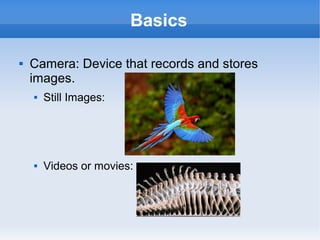
   Camera: Device that records and stores
    images.
       Still Images:


       Videos or movies:
Basics

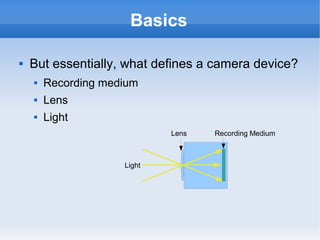
   But essentially, what defines a camera device?
       Recording medium
       Lens
       Light
                             Lens   Recording Medium


                     Light
Basics

   Now, what about a typical digital camera?
       Image sensor (CCD or CMOS)
       Lens
       Flash
       ISP: Image Signal Processor
       Image and video Encoders (To save space)
       Storage Media (SD Cards, USB drives, Etc.)
Image sensors
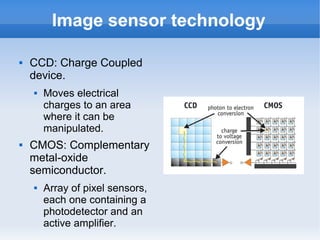
Image sensor technology

   CCD: Charge Coupled
    device.
       Moves electrical
        charges to an area
        where it can be
        manipulated.
   CMOS: Complementary
    metal-oxide
    semiconductor.
       Array of pixel sensors,
        each one containing a
        photodetector and an
        active amplifier.
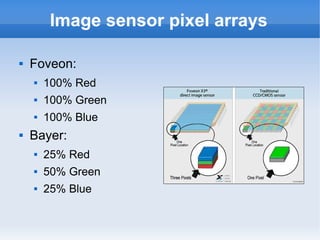
Image sensor pixel arrays

   Foveon:
       100% Red
       100% Green
       100% Blue
   Bayer:
       25% Red
       50% Green
       25% Blue
Image sensor formats
               (Most typical)
   RAW 10-bits.
       10-bit digital value obtained thru an ADC (Analog to
        Digital Converter) of the analog voltage coming
        from each pixel's associated photodetector charge-
        to-voltage converter.
   YUV 4:2:2 8-bits.
       Represent pairs of horizontally contiguous pixels. 8-
        bits per component (Y: Luminance, UV:
        Chrominance). Order is usually YUYV, or UYVY.
        Croma components (UV) are subsampled at half
        the sample rate than luma (Y).
Image sensor formats
               (Most typical)
   YUV 4:2:0 8-bits.
       Similar to 4:2:2, but the difference being that the UV
        components are also vertically subsampled by 2.
        This format contains interleaved data, which
        means, odd lines contain only Y elements, and
        even lines contain packed UYVY elements, similarly
        to 4:2:2 subsampling.
   NV12 (YUV 4:2:0 8-bits, planar)
       Exact same subsampling as above format, but the
        difference being that one array contains only Y
        components, and a second array contains packed
        UV components, 2x2 subsampled.
Image sensor core

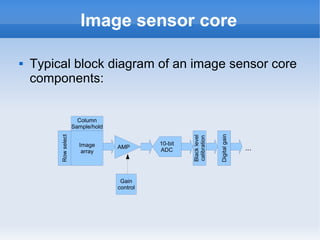
   Typical block diagram of an image sensor core
    components:


                        Column
                      Sample/hold


                                                                     Digital gain
         Row select


                                                       Black level
                                                       calibration
                        Image                 10-bit
                         array
                                    AMP
                                              ADC                                   ...


                                     Gain
                                    control
Image sensor core functions

   Analog gain: Amplifies constant voltage per-
    pixel for entire array. Done before ADC.
   Black level: Level of pixel voltage at the darkest
    (black) part of the incoming image.
   Digital gain: Adds a constant number to the
    digitally converted pixel value, after going
    through the ADC.
   Skipping: Certain pixels rows/columns are
    avoided (skipped) on sampling.
   Binning: Averaging groups of neighborhood
    pixel charges.
Image sensor interfaces

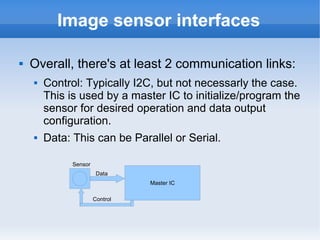
   Overall, there's at least 2 communication links:
       Control: Typically I2C, but not necessarly the case.
        This is used by a master IC to initialize/program the
        sensor for desired operation and data output
        configuration.
       Data: This can be Parallel or Serial.

              Sensor
                        Data
                                 Master IC

                       Control
Image sensor interfaces - Control

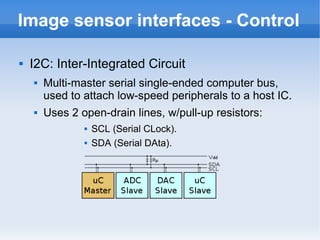
   I2C: Inter-Integrated Circuit
       Multi-master serial single-ended computer bus,
        used to attach low-speed peripherals to a host IC.
       Uses 2 open-drain lines, w/pull-up resistors:
                   SCL (Serial CLock).
                   SDA (Serial DAta).
Image sensor interfaces - I2C

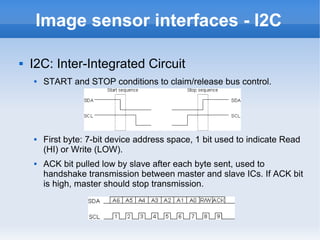
   I2C: Inter-Integrated Circuit
       START and STOP conditions to claim/release bus control.


       First byte: 7-bit device address space, 1 bit used to indicate Read
        (HI) or Write (LOW).
       ACK bit pulled low by slave after each byte sent, used to
        handshake transmission between master and slave ICs. If ACK bit
        is high, master should stop transmission.
Image sensor interfaces - Parallel

   Parallel interface (a.k.a. Digital Video Port)
       Data signals: 1 digital output pin per bit.
       Sync signals:
                         PCLK: Pixel Clock.
                         HSYNC: Horizontal Sync.
                         VSYNC: Vertical Sync.
                             Horizontal Blanking


                                                            D[9:0]


        Image data                                 Sensor
                                                            PCLK
                                                                     Master IC

                                                            HSYNC
                                                            VSYNC

         Vertical Blanking
Image sensor interfaces - CSI2

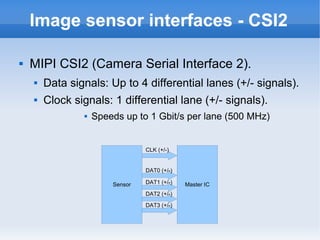
   MIPI CSI2 (Camera Serial Interface 2).
       Data signals: Up to 4 differential lanes (+/- signals).
       Clock signals: 1 differential lane (+/- signals).
                   Speeds up to 1 Gbit/s per lane (500 MHz)


                                 CLK (+/-)


                                 DAT0 (+/-)

                        Sensor   DAT1 (+/-)   Master IC
                                 DAT2 (+/-)

                                 DAT3 (+/-)
Image sensor interfaces - CSI2

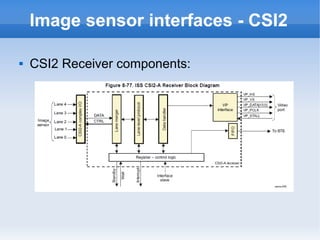
   CSI2 Receiver components:
Image sensor interfaces - CSI2

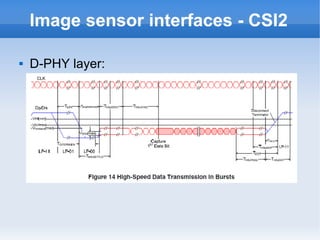
   D-PHY layer:
Image sensor interfaces - CSI2

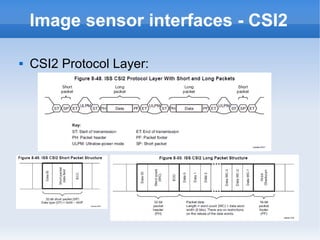
   CSI2 Protocol Layer:
Image sensor interfaces - CSI2

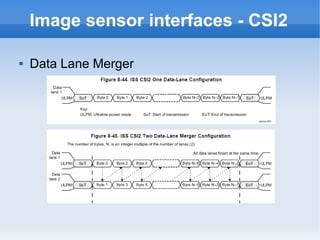
   Data Lane Merger
Lens
Lens

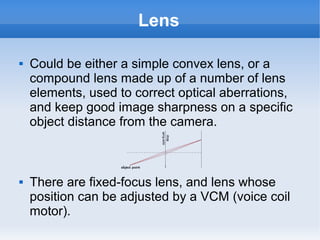
   Could be either a simple convex lens, or a
    compound lens made up of a number of lens
    elements, used to correct optical aberrations,
    and keep good image sharpness on a specific
    object distance from the camera.


   There are fixed-focus lens, and lens whose
    position can be adjusted by a VCM (voice coil
    motor).
Lens

   For moving lens, position can be either
    controlled as part of the image sensor registers,
    or as a separate I2C device in the bus.
   This is usually done as a result of the Auto
    Focus algorithm, after analyzing the captured
    images. It can also be due to manual control, if
    desired.
Flash
Flash

   Used in photography to compensate natural
    ambient light, and illuminate a dark scene.
   Syncronized with start of capture image
    command, with adjusted flashing duration, and
    intensity.
   Usually triggered with GPIOs and configured
    with I2C commands.
Thanks!
Extra slides
Image sensor interfaces - Data

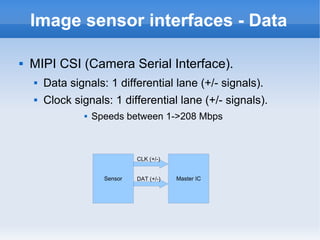
   MIPI CSI (Camera Serial Interface).
       Data signals: 1 differential lane (+/- signals).
       Clock signals: 1 differential lane (+/- signals).
                   Speeds between 1->208 Mbps


                               CLK (+/-)


                      Sensor   DAT (+/-)   Master IC
Image sensor interfaces - Data

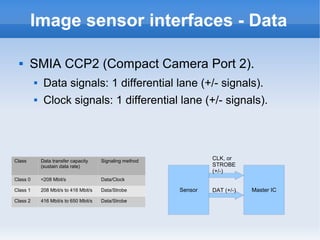
       SMIA CCP2 (Compact Camera Port 2).
              Data signals: 1 differential lane (+/- signals).
              Clock signals: 1 differential lane (+/- signals).


Class         Data transfer capacity     Signaling method            CLK, or
              (sustain data rate)                                    STROBE
                                                                     (+/-)
Class 0       <208 Mbit/s                Data/Clock

Class 1       208 Mbit/s to 416 Mbit/s   Data/Strobe        Sensor   DAT (+/-)   Master IC
Class 2       416 Mbit/s to 650 Mbit/s   Data/Strobe

Camera training by Sergio Aguirre

  • 1.
    Introduction to Camera By:Sergio Aguirre <sergio.a.aguirre@gmail.com>
  • 2.
    Basics  Camera: Device that records and stores images.  Still Images:  Videos or movies:
  • 3.
    Basics  But essentially, what defines a camera device?  Recording medium  Lens  Light Lens Recording Medium Light
  • 4.
    Basics  Now, what about a typical digital camera?  Image sensor (CCD or CMOS)  Lens  Flash  ISP: Image Signal Processor  Image and video Encoders (To save space)  Storage Media (SD Cards, USB drives, Etc.)
  • 5.
  • 6.
    Image sensor technology  CCD: Charge Coupled device.  Moves electrical charges to an area where it can be manipulated.  CMOS: Complementary metal-oxide semiconductor.  Array of pixel sensors, each one containing a photodetector and an active amplifier.
  • 7.
    Image sensor pixelarrays  Foveon:  100% Red  100% Green  100% Blue  Bayer:  25% Red  50% Green  25% Blue
  • 8.
    Image sensor formats (Most typical)  RAW 10-bits.  10-bit digital value obtained thru an ADC (Analog to Digital Converter) of the analog voltage coming from each pixel's associated photodetector charge- to-voltage converter.  YUV 4:2:2 8-bits.  Represent pairs of horizontally contiguous pixels. 8- bits per component (Y: Luminance, UV: Chrominance). Order is usually YUYV, or UYVY. Croma components (UV) are subsampled at half the sample rate than luma (Y).
  • 9.
    Image sensor formats (Most typical)  YUV 4:2:0 8-bits.  Similar to 4:2:2, but the difference being that the UV components are also vertically subsampled by 2. This format contains interleaved data, which means, odd lines contain only Y elements, and even lines contain packed UYVY elements, similarly to 4:2:2 subsampling.  NV12 (YUV 4:2:0 8-bits, planar)  Exact same subsampling as above format, but the difference being that one array contains only Y components, and a second array contains packed UV components, 2x2 subsampled.
  • 10.
    Image sensor core  Typical block diagram of an image sensor core components: Column Sample/hold Digital gain Row select Black level calibration Image 10-bit array AMP ADC ... Gain control
  • 11.
    Image sensor corefunctions  Analog gain: Amplifies constant voltage per- pixel for entire array. Done before ADC.  Black level: Level of pixel voltage at the darkest (black) part of the incoming image.  Digital gain: Adds a constant number to the digitally converted pixel value, after going through the ADC.  Skipping: Certain pixels rows/columns are avoided (skipped) on sampling.  Binning: Averaging groups of neighborhood pixel charges.
  • 12.
    Image sensor interfaces  Overall, there's at least 2 communication links:  Control: Typically I2C, but not necessarly the case. This is used by a master IC to initialize/program the sensor for desired operation and data output configuration.  Data: This can be Parallel or Serial. Sensor Data Master IC Control
  • 13.
    Image sensor interfaces- Control  I2C: Inter-Integrated Circuit  Multi-master serial single-ended computer bus, used to attach low-speed peripherals to a host IC.  Uses 2 open-drain lines, w/pull-up resistors:  SCL (Serial CLock).  SDA (Serial DAta).
  • 14.
    Image sensor interfaces- I2C  I2C: Inter-Integrated Circuit  START and STOP conditions to claim/release bus control.  First byte: 7-bit device address space, 1 bit used to indicate Read (HI) or Write (LOW).  ACK bit pulled low by slave after each byte sent, used to handshake transmission between master and slave ICs. If ACK bit is high, master should stop transmission.
  • 15.
    Image sensor interfaces- Parallel  Parallel interface (a.k.a. Digital Video Port)  Data signals: 1 digital output pin per bit.  Sync signals:  PCLK: Pixel Clock.  HSYNC: Horizontal Sync.  VSYNC: Vertical Sync. Horizontal Blanking D[9:0] Image data Sensor PCLK Master IC HSYNC VSYNC Vertical Blanking
  • 16.
    Image sensor interfaces- CSI2  MIPI CSI2 (Camera Serial Interface 2).  Data signals: Up to 4 differential lanes (+/- signals).  Clock signals: 1 differential lane (+/- signals).  Speeds up to 1 Gbit/s per lane (500 MHz) CLK (+/-) DAT0 (+/-) Sensor DAT1 (+/-) Master IC DAT2 (+/-) DAT3 (+/-)
  • 17.
    Image sensor interfaces- CSI2  CSI2 Receiver components:
  • 18.
    Image sensor interfaces- CSI2  D-PHY layer:
  • 19.
    Image sensor interfaces- CSI2  CSI2 Protocol Layer:
  • 20.
    Image sensor interfaces- CSI2  Data Lane Merger
  • 21.
  • 22.
    Lens  Could be either a simple convex lens, or a compound lens made up of a number of lens elements, used to correct optical aberrations, and keep good image sharpness on a specific object distance from the camera.  There are fixed-focus lens, and lens whose position can be adjusted by a VCM (voice coil motor).
  • 23.
    Lens  For moving lens, position can be either controlled as part of the image sensor registers, or as a separate I2C device in the bus.  This is usually done as a result of the Auto Focus algorithm, after analyzing the captured images. It can also be due to manual control, if desired.
  • 24.
  • 25.
    Flash  Used in photography to compensate natural ambient light, and illuminate a dark scene.  Syncronized with start of capture image command, with adjusted flashing duration, and intensity.  Usually triggered with GPIOs and configured with I2C commands.
  • 26.
  • 27.
  • 28.
    Image sensor interfaces- Data  MIPI CSI (Camera Serial Interface).  Data signals: 1 differential lane (+/- signals).  Clock signals: 1 differential lane (+/- signals).  Speeds between 1->208 Mbps CLK (+/-) Sensor DAT (+/-) Master IC
  • 29.
    Image sensor interfaces- Data  SMIA CCP2 (Compact Camera Port 2).  Data signals: 1 differential lane (+/- signals).  Clock signals: 1 differential lane (+/- signals). Class Data transfer capacity Signaling method CLK, or (sustain data rate) STROBE (+/-) Class 0 <208 Mbit/s Data/Clock Class 1 208 Mbit/s to 416 Mbit/s Data/Strobe Sensor DAT (+/-) Master IC Class 2 416 Mbit/s to 650 Mbit/s Data/Strobe