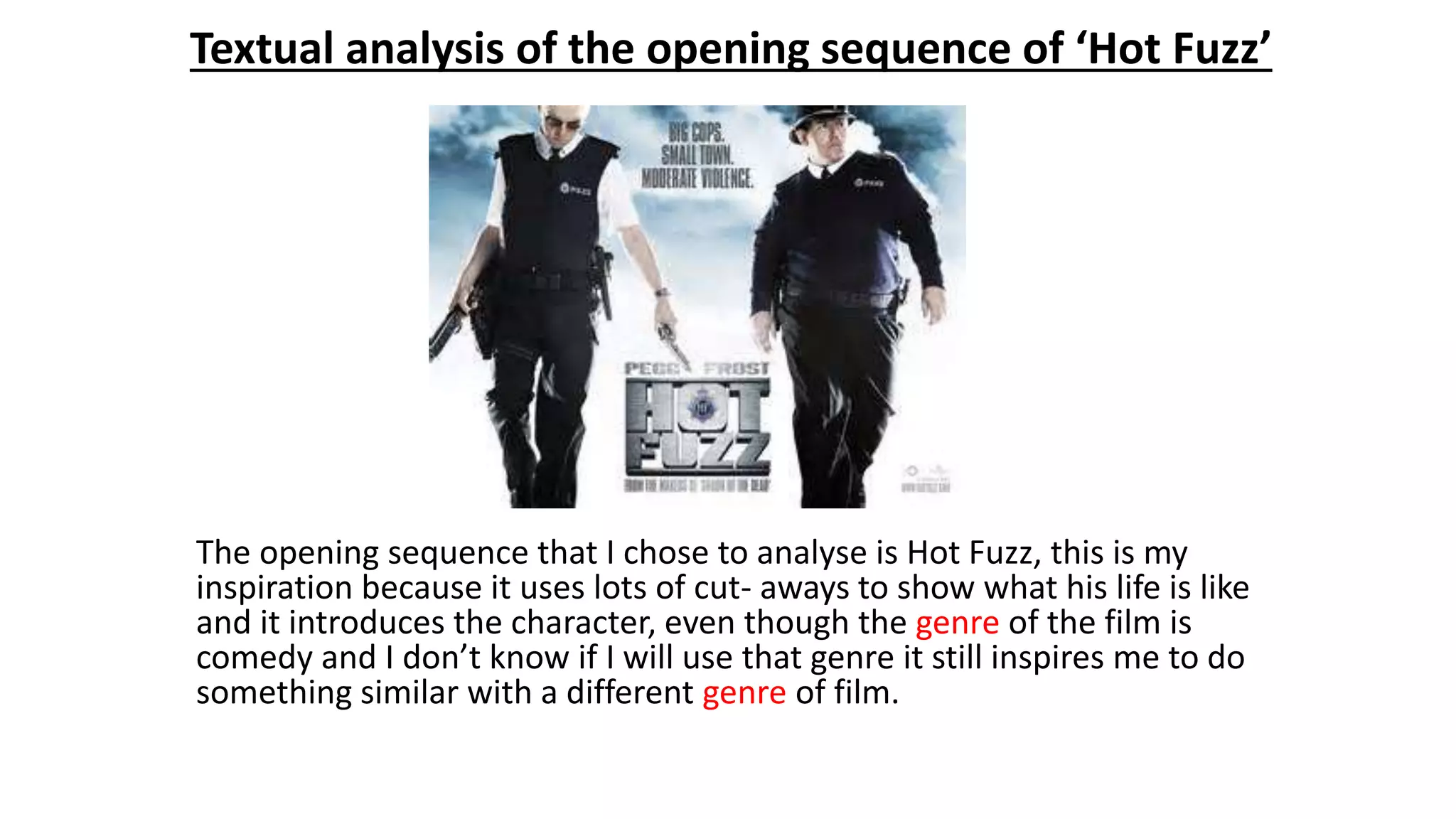
The opening sequence that I chose to analyse is Hot Fuzz, this is my
inspiration because it uses lots of cut- aways to show what his life is like
and it introduces the character, even though the genre of the film is
comedy and I don’t know if I will use that genre it still inspires me to do
something similar with a different genre of film.
Textual analysis of the opening sequence of ‘Hot Fuzz’
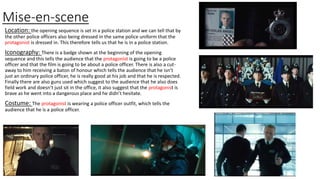
Mise-en-scene
Location: the opening sequence is set in a police station and we can tell that by
the other police officers also being dressed in the same police uniform that the
protagonist is dressed in. This therefore tells us that he is in a police station.
Iconography: There is a badge shown at the beginning of the opening
sequence and this tells the audience that the protagonist is going to be a police
officer and that the film is going to be about a police officer. There is also a cut-
away to him receiving a baton of honour which tells the audience that he isn’t
just an ordinary police officer, he is really good at his job and that he is respected.
Finally there are also guns used which suggest to the audience that he also does
field work and doesn’t just sit in the office, it also suggest that the protagonist is
brave as he went into a dangerous place and he didn’t hesitate.
Costume: The protagonist is wearing a police officer outfit, which tells the
audience that he is a police officer.
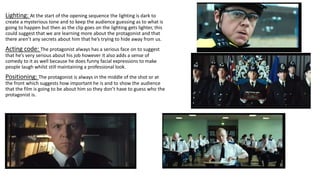
Lighting: At the start of the opening sequence the lighting is dark to
create a mysterious tone and to keep the audience guessing as to what is
going to happen but then as the clip goes on the lighting gets lighter, this
could suggest that we are learning more about the protagonist and that
there aren’t any secrets about him that he’s trying to hide away from us.
Acting code: The protagonist always has a serious face on to suggest
that he’s very serious about his job however it also adds a sense of
comedy to it as well because he does funny facial expressions to make
people laugh whilst still maintaining a professional look.
Positioning: The protagonist is always in the middle of the shot or at
the front which suggests how important he is and to show the audience
that the film is going to be about him so they don’t have to guess who the
protagonist is.
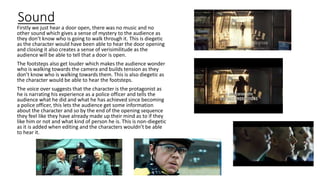
Sound
Firstly we just hear a door open, there was no music and no
other sound which gives a sense of mystery to the audience as
they don’t know who is going to walk through it. This is diegetic
as the character would have been able to hear the door opening
and closing it also creates a sense of verisimilitude as the
audience will be able to tell that a door is open.
The footsteps also get louder which makes the audience wonder
who is walking towards the camera and builds tension as they
don’t know who is walking towards them. This is also diegetic as
the character would be able to hear the footsteps.
The voice over suggests that the character is the protagonist as
he is narrating his experience as a police officer and tells the
audience what he did and what he has achieved since becoming
a police officer, this lets the audience get some information
about the character and so by the end of the opening sequence
they feel like they have already made up their mind as to if they
like him or not and what kind of person he is. This is non-diegetic
as it is added when editing and the characters wouldn’t be able
to hear it.
The fast paced music suggest that the film is going to be an action film and shows that it’s upbeat and going to be funny, it could also show
how the character is always doing something and he doesn’t have a break he’s always on the move. The music is non-diegetic as the
characters wouldn’t be able to hear it.
There is also a whooshing sound every time a cut away happens, this could be used to indicate to the audience that it is a flash back and it
will be important as it will give us more information about the character, this would be non-diegetic as the characters won’t be able to hear
it as it is just a flash back.
You can also hear car/ bicycle tires screeching, this would be diegetic as the characters would be able to hear it and it was used to make the
scene more verisimilitude as we can picture the character riding a car and a bike.
We can also hear gun shots, this gives the audience a sense that the character is brave and is well skilled as he can operate a gun.
Finally at the end we hear screaming when he got stabbed in the hand by a Santa Claus, this is to increase the verisimilitude of the scene
and tell the audience that he got hurt, it is also meant to have a sense of comedy as he got stabbed by a Santa Claus which is funny.
Editing
There are lots of cut-aways used to represent flash backs, this therefore
gives the audience more information about the character and gives
them an insight into their life.
There is also lots of fast pace editing used this is used to suggest that a
lot of things have happened to the character and that his life is fast
paced and he is always doing something and is always busy.
The voice over is also put over the clip so that the character tells the
audience about him which gives it a more personal feel and so the
audience will feel more closer to the character and believe everything
that he says as he has just told them their life story.
Camerawork
Firstly there is a long shot used when he’s walking which then goes to an
extreme close up, this is used to create a sense of mystery for the audience as
they don’t know who is walking towards the camera.
Then there is an extreme close up of his feet to tell the audience that it was him
that was walking at the beginning of the scene.
There is also a mid shot of the character to show what he looks like.
Another camera angle that is used is an extreme close up of a badge on his
shoulder to show his identification and further tell the audience that he is a
police officer.
There are also lots of close ups of the characters face to show that he’s a funny
character as most of his facial expressions are funny and are meant to make
people laugh, this therefore suggests that the film is going to be a comedy and it
gives the audience an insight of what the protagonist is really like.
The close up that is used on his exam paper show how smart and how easily he
understands things, this is also backed up by it being followed by mid shot
showing the character and other police officers beside him, this was used to
show the confusion on the other officers faces, which tells us that the
protagonist is very smart.
There were also close up of face used when he driving and riding his bike for
comedic effect.
A long shot was used when he was walking through the police headquarters to
show the audience where he is and to establish a location.
Finally there were close up of all the certificates he got which shows the
audience how good he is at his job.

Hot fuzz - textual analysis

  • 1.
    The opening sequencethat I chose to analyse is Hot Fuzz, this is my inspiration because it uses lots of cut- aways to show what his life is like and it introduces the character, even though the genre of the film is comedy and I don’t know if I will use that genre it still inspires me to do something similar with a different genre of film. Textual analysis of the opening sequence of ‘Hot Fuzz’
  • 2.
    Mise-en-scene Location: the openingsequence is set in a police station and we can tell that by the other police officers also being dressed in the same police uniform that the protagonist is dressed in. This therefore tells us that he is in a police station. Iconography: There is a badge shown at the beginning of the opening sequence and this tells the audience that the protagonist is going to be a police officer and that the film is going to be about a police officer. There is also a cut- away to him receiving a baton of honour which tells the audience that he isn’t just an ordinary police officer, he is really good at his job and that he is respected. Finally there are also guns used which suggest to the audience that he also does field work and doesn’t just sit in the office, it also suggest that the protagonist is brave as he went into a dangerous place and he didn’t hesitate. Costume: The protagonist is wearing a police officer outfit, which tells the audience that he is a police officer.
  • 3.
    Lighting: At thestart of the opening sequence the lighting is dark to create a mysterious tone and to keep the audience guessing as to what is going to happen but then as the clip goes on the lighting gets lighter, this could suggest that we are learning more about the protagonist and that there aren’t any secrets about him that he’s trying to hide away from us. Acting code: The protagonist always has a serious face on to suggest that he’s very serious about his job however it also adds a sense of comedy to it as well because he does funny facial expressions to make people laugh whilst still maintaining a professional look. Positioning: The protagonist is always in the middle of the shot or at the front which suggests how important he is and to show the audience that the film is going to be about him so they don’t have to guess who the protagonist is.
  • 4.
    Sound Firstly we justhear a door open, there was no music and no other sound which gives a sense of mystery to the audience as they don’t know who is going to walk through it. This is diegetic as the character would have been able to hear the door opening and closing it also creates a sense of verisimilitude as the audience will be able to tell that a door is open. The footsteps also get louder which makes the audience wonder who is walking towards the camera and builds tension as they don’t know who is walking towards them. This is also diegetic as the character would be able to hear the footsteps. The voice over suggests that the character is the protagonist as he is narrating his experience as a police officer and tells the audience what he did and what he has achieved since becoming a police officer, this lets the audience get some information about the character and so by the end of the opening sequence they feel like they have already made up their mind as to if they like him or not and what kind of person he is. This is non-diegetic as it is added when editing and the characters wouldn’t be able to hear it.
  • 5.
    The fast pacedmusic suggest that the film is going to be an action film and shows that it’s upbeat and going to be funny, it could also show how the character is always doing something and he doesn’t have a break he’s always on the move. The music is non-diegetic as the characters wouldn’t be able to hear it. There is also a whooshing sound every time a cut away happens, this could be used to indicate to the audience that it is a flash back and it will be important as it will give us more information about the character, this would be non-diegetic as the characters won’t be able to hear it as it is just a flash back. You can also hear car/ bicycle tires screeching, this would be diegetic as the characters would be able to hear it and it was used to make the scene more verisimilitude as we can picture the character riding a car and a bike. We can also hear gun shots, this gives the audience a sense that the character is brave and is well skilled as he can operate a gun. Finally at the end we hear screaming when he got stabbed in the hand by a Santa Claus, this is to increase the verisimilitude of the scene and tell the audience that he got hurt, it is also meant to have a sense of comedy as he got stabbed by a Santa Claus which is funny.
  • 6.
    Editing There are lotsof cut-aways used to represent flash backs, this therefore gives the audience more information about the character and gives them an insight into their life. There is also lots of fast pace editing used this is used to suggest that a lot of things have happened to the character and that his life is fast paced and he is always doing something and is always busy. The voice over is also put over the clip so that the character tells the audience about him which gives it a more personal feel and so the audience will feel more closer to the character and believe everything that he says as he has just told them their life story.
  • 7.
    Camerawork Firstly there isa long shot used when he’s walking which then goes to an extreme close up, this is used to create a sense of mystery for the audience as they don’t know who is walking towards the camera. Then there is an extreme close up of his feet to tell the audience that it was him that was walking at the beginning of the scene. There is also a mid shot of the character to show what he looks like. Another camera angle that is used is an extreme close up of a badge on his shoulder to show his identification and further tell the audience that he is a police officer. There are also lots of close ups of the characters face to show that he’s a funny character as most of his facial expressions are funny and are meant to make people laugh, this therefore suggests that the film is going to be a comedy and it gives the audience an insight of what the protagonist is really like. The close up that is used on his exam paper show how smart and how easily he understands things, this is also backed up by it being followed by mid shot showing the character and other police officers beside him, this was used to show the confusion on the other officers faces, which tells us that the protagonist is very smart. There were also close up of face used when he driving and riding his bike for comedic effect. A long shot was used when he was walking through the police headquarters to show the audience where he is and to establish a location. Finally there were close up of all the certificates he got which shows the audience how good he is at his job.