1
PROBABILITY
Probability of Simple Events
2
Probability is a measure of the likelihood of
a random phenomenon or chance behavior.
Probability describes the long-term
proportion with which a certain outcome will
occur in situations with short-term
uncertainty.
EXAMPLE
Simulate flipping a coin 100 times. Plot the
proportion of heads against the number of flips.
Repeat the simulation.
3
Probability deals with experiments that yield
random short-term results or outcomes, yet
reveal long-term predictability.
The long-term proportion with which a
certain outcome is observed is the
probability of that outcome.
4
The Law of Large Numbers
As the number of repetitions of a probability
experiment increases, the proportion with which
a certain outcome is observed gets closer to the
probability of the outcome.
5
In probability, an experiment is any
process that can be repeated in which
the results are uncertain.
A simple event is any single outcome
from a probability experiment. Each
simple event is denoted ei.
6
The sample space, S, of a
probability experiment is the
collection of all possible simple
events. In other words, the
sample space is a list of all
possible outcomes of a probability
experiment.
7
An event is any collection of
outcomes from a probability
experiment. An event may consist
of one or more simple events.
Events are denoted using capital
letters such as E.
8
EXAMPLE Identifying Events and the Sample
Space of a Probability Experiment
Consider the probability experiment of
having two children.
(a) Identify the simple events of the
probability experiment.
(b) Determine the sample space.
(c) Define the event E = “have one boy”.
9
The probability of an event,
denoted P(E), is the likelihood of
that event occurring.
10
Properties of ProbabilitiesProperties of Probabilities
1. The probability of any event E, P(E), must be
between 0 and 1 inclusive. That is,
0 < P(E) < 1.
2. If an event is impossible, the probability of the
event is 0.
3. If an event is a certainty, the probability of the
event is 1.
4. If S = {e1, e2, …, en}, then
P(e1) + P(e2) + … + P(en) = 1.
11
An unusual event is an event that has
a low probability of occurring.
12
Three methods for determining the
probability of an event:
(1) the classical method
13
Three methods for determining the
probability of an event:
(1) the classical method
(2) the empirical method
14
Three methods for determining the
probability of an event:
(1) the classical method
(2) the empirical method
(3) the subjective method
15
The classical method of computing
probabilities requires equally likely
outcomes.
An experiment is said to have equally
likely outcomes when each simple event
has the same probability of occurring.
16
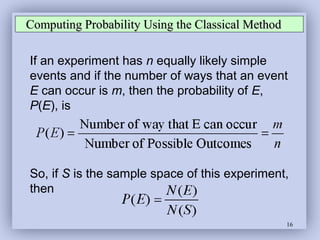
Computing Probability Using the Classical MethodComputing Probability Using the Classical Method
If an experiment has n equally likely simple
events and if the number of ways that an event
E can occur is m, then the probability of E,
P(E), is
So, if S is the sample space of this experiment,
then
17
EXAMPLE Computing Probabilities Using the
Classical Method
Suppose a “fun size” bag of M&Ms contains 9
brown candies, 6 yellow candies, 7 red
candies, 4 orange candies, 2 blue candies, and
2 green candies. Suppose that a candy is
randomly selected.
(a) What is the probability that it is brown?
(b) What is the probability that it is blue?
(c) Comment on the likelihood of the candy
being brown versus blue.

Probability

  • 1.
  • 2.
    2 Probability is ameasure of the likelihood of a random phenomenon or chance behavior. Probability describes the long-term proportion with which a certain outcome will occur in situations with short-term uncertainty. EXAMPLE Simulate flipping a coin 100 times. Plot the proportion of heads against the number of flips. Repeat the simulation.
  • 3.
    3 Probability deals withexperiments that yield random short-term results or outcomes, yet reveal long-term predictability. The long-term proportion with which a certain outcome is observed is the probability of that outcome.
  • 4.
    4 The Law ofLarge Numbers As the number of repetitions of a probability experiment increases, the proportion with which a certain outcome is observed gets closer to the probability of the outcome.
  • 5.
    5 In probability, anexperiment is any process that can be repeated in which the results are uncertain. A simple event is any single outcome from a probability experiment. Each simple event is denoted ei.
  • 6.
    6 The sample space,S, of a probability experiment is the collection of all possible simple events. In other words, the sample space is a list of all possible outcomes of a probability experiment.
  • 7.
    7 An event isany collection of outcomes from a probability experiment. An event may consist of one or more simple events. Events are denoted using capital letters such as E.
  • 8.
    8 EXAMPLE Identifying Eventsand the Sample Space of a Probability Experiment Consider the probability experiment of having two children. (a) Identify the simple events of the probability experiment. (b) Determine the sample space. (c) Define the event E = “have one boy”.
  • 9.
    9 The probability ofan event, denoted P(E), is the likelihood of that event occurring.
  • 10.
    10 Properties of ProbabilitiesPropertiesof Probabilities 1. The probability of any event E, P(E), must be between 0 and 1 inclusive. That is, 0 < P(E) < 1. 2. If an event is impossible, the probability of the event is 0. 3. If an event is a certainty, the probability of the event is 1. 4. If S = {e1, e2, …, en}, then P(e1) + P(e2) + … + P(en) = 1.
  • 11.
    11 An unusual eventis an event that has a low probability of occurring.
  • 12.
    12 Three methods fordetermining the probability of an event: (1) the classical method
  • 13.
    13 Three methods fordetermining the probability of an event: (1) the classical method (2) the empirical method
  • 14.
    14 Three methods fordetermining the probability of an event: (1) the classical method (2) the empirical method (3) the subjective method
  • 15.
    15 The classical methodof computing probabilities requires equally likely outcomes. An experiment is said to have equally likely outcomes when each simple event has the same probability of occurring.
  • 16.
    16 Computing Probability Usingthe Classical MethodComputing Probability Using the Classical Method If an experiment has n equally likely simple events and if the number of ways that an event E can occur is m, then the probability of E, P(E), is So, if S is the sample space of this experiment, then
  • 17.
    17 EXAMPLE Computing ProbabilitiesUsing the Classical Method Suppose a “fun size” bag of M&Ms contains 9 brown candies, 6 yellow candies, 7 red candies, 4 orange candies, 2 blue candies, and 2 green candies. Suppose that a candy is randomly selected. (a) What is the probability that it is brown? (b) What is the probability that it is blue? (c) Comment on the likelihood of the candy being brown versus blue.

Editor's Notes

  • #9 Answer: a) (boy, girl), (girl, girl), (boy, boy) b) (boy, girl), (girl, girl), (boy, boy) c) (boy, girl), (boy, boy)