Problem
Proposed Solution
• Using the Iso-seq method from Pacific Biosciences, we should be
able to make novel discoveries within the blueberry genome in a
relatively short amount of time, and without as much financial
investment.
• This method provides long transcriptome reads (10kb+), spanning
entire gene regions.
Characteristics of PacBio Sequencing
1. Accuracy
• Achieves >99.999% via
increasing the depth of the
sequencing.
• Lack of systematic
sequencing errors (all errors
are random)
2. Uniformity
• Lack of GC content or
sequence complexity bias
3. Originality
• No DNA amplification
• Epigenome characterization
4. Contiguity
• Sequence reads >10,000
bases
• Some reads >30 kb
Isoform Sequencing Overview
Materials & Workflow
How Does SMRT Technology Work?
Utilization of SMRT Sequencing
Improvements in SMRT Technology
• PacBio introduced the new SEQUEL system in
October 2015
• Each SMRT Cell now contains one million
ZMWs for a 7-fold increase in throughput.
• The new PacBio Sequel instrument is more
cost effective.
Works Cited
• Pacific Biosciences: http://www.pacb.com/
• A De Novo Draft Assembly of Spinach Using Pacific Biosciences Technology (PAG 2014
Workshop) @ blog.pacificbiosciences.com
• PacBio seminar at NCSU (09/24/2015) by Andy Larrea, PhD
• PacBio Webinar: Optimizing Eukaryotic De Novo Genome Assembly
Speakers: Mike Schatz (CSHL), James Gurtowski (CSHL), Sergey Koren (NBACC)
• Despite decades of traditional breeding efforts, there is still not
enough genomic data available for blueberry that would be helpful
for molecular breeding purposes.
• Previous methods for genome sequencing are not adequate to
overcome complexity of plant genomes, especially to sequence
through repetitive regions, and leave genomes incomplete or of
poor quality.
• In addition to genome sequencing, PacBio sequencing can be used
to sequence transcriptomes .
• Each transcriptome sequence that is generated by PacBio
sequencing, represents the full length of a gene.
• The full-length genes can be used for genome annotation and to
identify alternate splicing events the occur at RNA level.
(Protocol can be modified for use of barcoding method)
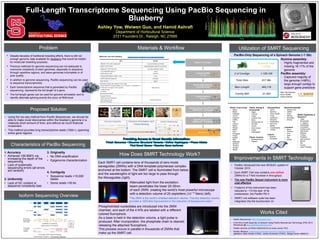
Each SMRT cell contains tens of thousands of zero-mode
waveguides (ZMWs) with a DNA template-polymerase complex
anchored at the bottom. The SMRT cell is illuminated from below,
and the wavelengths of light are too large to pass through
the Waveguides (right).
*The ZMW is the world’s smallest detection volume. This tiny detection volume
provides a 1000-fold improvement in the reduction of background noise.*
Attenuated light from the excitation
beam penetrates the lower 20-30nm
of each ZMW, creating the world’s most powerful microscope
with a detection volume of 20 zeptoliters (10−21
liters) (left).
Phospholinked nucleotides are introduced into the ZMW
chamber, and each of the 4 NTs are labeled with a different
colored fluorophore.
As a base is held in the detection volume, a light pulse is
produced. After incorporation, the phosphate chain is cleaved,
releasing the attached fluorophore.
This process occurs in parallel in thousands of ZMWs that
make up the SMRT cell.
PacBio-Only Sequencing of a Spinach Genome (~1 Gb)
Illumina assembly:
• Highly fragmented and
missing 16-17% of the
genome
PacBio assembly:
• Captured majority of
the genome (>98%),
large enough contigs to
support gene prediction
Allen Van Deynze
Kevin Stoffel
Hamid Ashrafi
• Footprint of the instrument has been
reduced to ~1/3 the size of its
predecessor, the PacBio RS II.
• SMRT Link software suite has been
integrated into the touchscreen UI.
Bacteria
1-10 Mb
Yeast
12 Mb
Arabidopsis
120 Mb
Drosophila
165 Mb
Spinach
1 Gb
Goat
2.85 Gb
Human (haploid)
3.2 Gb
Providing Access to Novel Genetic Information:
Finish Genomes • Discover Structural Variants • Define Haplotypes • Phase Alleles
Find Novel Genes • Resolve Gene Isoforms
Plants: Food Crops
• Agave
• Beans
• Cabbage
• Carrot
• Cassava
• Coffee
• Flax
• Lettuce
• Maize
• Mango
• Melon
• Pear
• Pineapple
• Potato
• Radish
• Rice
• Ryegrass
• Spinach
• Teosinte
• Tomato
• Wheat
Plants: Energy &
Ornamental
• Algae
• Cleome
• Cotton
• Loblolly Pine
• Moss
• Norway Spruce
• Oil Palm
• Orchid
• Panic Grass
• Poplar
• Switchgrass
Plants: Invasive
• Broadleaf weed
• Iceplant
Livestock
• Bison
• Chicken
• Cow
• Goat
• Pig
• Sheep
Disease/Pests
• Aphid
• Bacteria
• Citrus Psyllid
• Fungi
• Hookworm
• Mosquito
• Plasmodium
• Red Flour
Beetle
• Trypanosome
• Viruses
Insects
• Butterfly
• Honeybee
Marine/Freshwater
• Atlantic Cod
• Catfish
• Coral
• Salmon
• Sea Bass
• Shrimp
Model Organisms &
Research
• Yeast
• Neurospora
• C. elegans
• Arabidopsis
• Drosophila
• Gutless worm
• Sea Urchin
• Medaka
• Chicken
• Parakeet
• Sea Lamprey
• Mouse
• Rat
• Human
• Other Primates
PacBio Long Reads Are Already Improving These Genomes
A
G
T
C
ATCGGACTTCAA
Full-Length Transcriptome Sequencing Using PacBio Sequencing in
Blueberry
Ashley Yow, Weiwen Guo, and Hamid Ashrafi
Department of Horticultural Science
2721 Founders Dr., Raleigh, NC 27695

CALS_Stewards_of_Future_2015_Yow_IsoSeq

  • 1.
    Problem Proposed Solution • Usingthe Iso-seq method from Pacific Biosciences, we should be able to make novel discoveries within the blueberry genome in a relatively short amount of time, and without as much financial investment. • This method provides long transcriptome reads (10kb+), spanning entire gene regions. Characteristics of PacBio Sequencing 1. Accuracy • Achieves >99.999% via increasing the depth of the sequencing. • Lack of systematic sequencing errors (all errors are random) 2. Uniformity • Lack of GC content or sequence complexity bias 3. Originality • No DNA amplification • Epigenome characterization 4. Contiguity • Sequence reads >10,000 bases • Some reads >30 kb Isoform Sequencing Overview Materials & Workflow How Does SMRT Technology Work? Utilization of SMRT Sequencing Improvements in SMRT Technology • PacBio introduced the new SEQUEL system in October 2015 • Each SMRT Cell now contains one million ZMWs for a 7-fold increase in throughput. • The new PacBio Sequel instrument is more cost effective. Works Cited • Pacific Biosciences: http://www.pacb.com/ • A De Novo Draft Assembly of Spinach Using Pacific Biosciences Technology (PAG 2014 Workshop) @ blog.pacificbiosciences.com • PacBio seminar at NCSU (09/24/2015) by Andy Larrea, PhD • PacBio Webinar: Optimizing Eukaryotic De Novo Genome Assembly Speakers: Mike Schatz (CSHL), James Gurtowski (CSHL), Sergey Koren (NBACC) • Despite decades of traditional breeding efforts, there is still not enough genomic data available for blueberry that would be helpful for molecular breeding purposes. • Previous methods for genome sequencing are not adequate to overcome complexity of plant genomes, especially to sequence through repetitive regions, and leave genomes incomplete or of poor quality. • In addition to genome sequencing, PacBio sequencing can be used to sequence transcriptomes . • Each transcriptome sequence that is generated by PacBio sequencing, represents the full length of a gene. • The full-length genes can be used for genome annotation and to identify alternate splicing events the occur at RNA level. (Protocol can be modified for use of barcoding method) Each SMRT cell contains tens of thousands of zero-mode waveguides (ZMWs) with a DNA template-polymerase complex anchored at the bottom. The SMRT cell is illuminated from below, and the wavelengths of light are too large to pass through the Waveguides (right). *The ZMW is the world’s smallest detection volume. This tiny detection volume provides a 1000-fold improvement in the reduction of background noise.* Attenuated light from the excitation beam penetrates the lower 20-30nm of each ZMW, creating the world’s most powerful microscope with a detection volume of 20 zeptoliters (10−21 liters) (left). Phospholinked nucleotides are introduced into the ZMW chamber, and each of the 4 NTs are labeled with a different colored fluorophore. As a base is held in the detection volume, a light pulse is produced. After incorporation, the phosphate chain is cleaved, releasing the attached fluorophore. This process occurs in parallel in thousands of ZMWs that make up the SMRT cell. PacBio-Only Sequencing of a Spinach Genome (~1 Gb) Illumina assembly: • Highly fragmented and missing 16-17% of the genome PacBio assembly: • Captured majority of the genome (>98%), large enough contigs to support gene prediction Allen Van Deynze Kevin Stoffel Hamid Ashrafi • Footprint of the instrument has been reduced to ~1/3 the size of its predecessor, the PacBio RS II. • SMRT Link software suite has been integrated into the touchscreen UI. Bacteria 1-10 Mb Yeast 12 Mb Arabidopsis 120 Mb Drosophila 165 Mb Spinach 1 Gb Goat 2.85 Gb Human (haploid) 3.2 Gb Providing Access to Novel Genetic Information: Finish Genomes • Discover Structural Variants • Define Haplotypes • Phase Alleles Find Novel Genes • Resolve Gene Isoforms Plants: Food Crops • Agave • Beans • Cabbage • Carrot • Cassava • Coffee • Flax • Lettuce • Maize • Mango • Melon • Pear • Pineapple • Potato • Radish • Rice • Ryegrass • Spinach • Teosinte • Tomato • Wheat Plants: Energy & Ornamental • Algae • Cleome • Cotton • Loblolly Pine • Moss • Norway Spruce • Oil Palm • Orchid • Panic Grass • Poplar • Switchgrass Plants: Invasive • Broadleaf weed • Iceplant Livestock • Bison • Chicken • Cow • Goat • Pig • Sheep Disease/Pests • Aphid • Bacteria • Citrus Psyllid • Fungi • Hookworm • Mosquito • Plasmodium • Red Flour Beetle • Trypanosome • Viruses Insects • Butterfly • Honeybee Marine/Freshwater • Atlantic Cod • Catfish • Coral • Salmon • Sea Bass • Shrimp Model Organisms & Research • Yeast • Neurospora • C. elegans • Arabidopsis • Drosophila • Gutless worm • Sea Urchin • Medaka • Chicken • Parakeet • Sea Lamprey • Mouse • Rat • Human • Other Primates PacBio Long Reads Are Already Improving These Genomes A G T C ATCGGACTTCAA Full-Length Transcriptome Sequencing Using PacBio Sequencing in Blueberry Ashley Yow, Weiwen Guo, and Hamid Ashrafi Department of Horticultural Science 2721 Founders Dr., Raleigh, NC 27695