
Teacher Professional Development PortfoliosA Lifelong Personal and Professional Learning EnvironmentDr. Helen Barrettelectronicportfolios.orgTwitter: @eportfolioshashtag: #eportfolios
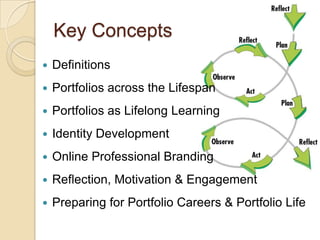
Key ConceptsDefinitionsPortfolios across the LifespanPortfolios as Lifelong LearningIdentity DevelopmentOnline Professional BrandingReflection, Motivation & EngagementPreparing for Portfolio Careers & Portfolio Life
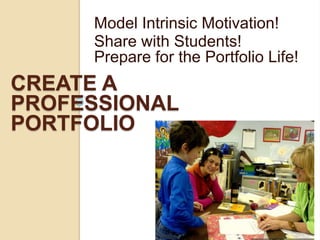
Model Intrinsic Motivation!Share with Students!Prepare for the Portfolio Life!Create a Professional Portfolio
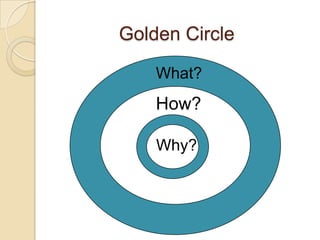
Golden Circle        What?How?Why?4
PurposeThe overarching purpose of portfolios is to create a sense of personal ownership over one’s accomplishments, because ownership engenders feelings of pride, responsibility, and dedication. (p.10)Paris, S & Ayres, L. (1994) Becoming Reflective Students and Teachers. American Psychological Association
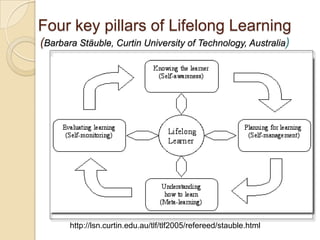
Four key pillars of Lifelong Learning(Barbara Stäuble, Curtin University of Technology, Australia)http://lsn.curtin.edu.au/tlf/tlf2005/refereed/stauble.html
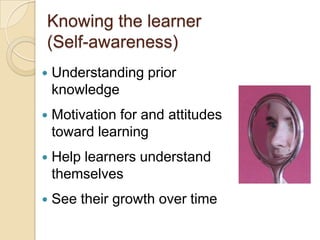
Knowing the learner (Self-awareness)Understanding prior knowledgeMotivation for and attitudes toward learningHelp learners understand themselvesSee their growth over time
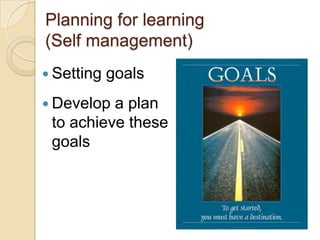
Planning for learning (Self management)Setting goalsDevelop a plan to achieve these goals
Understanding how to learn (Meta-learning)Awareness of learners to different approaches to learningDeep vs. Surface Learning, Rote vs. Meaningful LearningDifferent Learning StylesHelp learners recognize successAccommodate approaches that are not successful
Evaluating learning (Self monitoring)Systematic analysis of learners’ performanceResponsibility to construct meaningBe reflective & think criticallyLearners construct meaning, monitor learning, evaluateown outcomes
Deep Learninginvolves reflection,is developmental,is integrative,is self-directive, andis lifelongCambridge (2004)
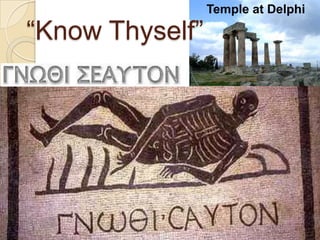
Temple at Delphi“Know Thyself”
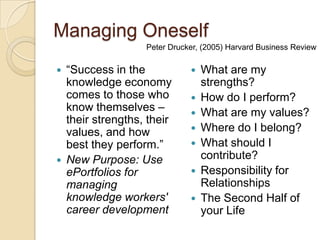
Managing OneselfPeter Drucker, (2005) Harvard Business Review“Success in the knowledge economy comes to those who know themselves – their strengths, their values, and how best they perform.”New Purpose: Use ePortfolios for managing knowledge workers' career developmentWhat are my strengths?How do I perform?What are my values?Where do I belong?What should I contribute?Responsibility for RelationshipsThe Second Half of your Life
DefinitionsWhat is an electronic portfolio?
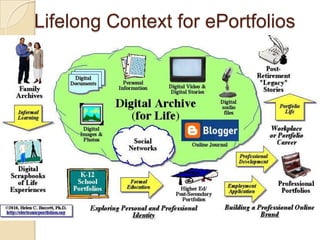
Lifelong Context for ePortfolios
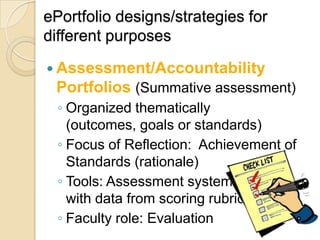
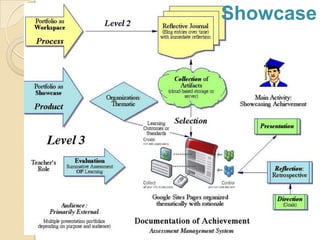
ePortfolio designs/strategies for different purposes Assessment/Accountability Portfolios (Summative assessment)Organized thematically (outcomes, goals or standards)Focus of Reflection:  Achievement of Standards (rationale)Tools: Assessment system with data from scoring rubricsFaculty role: Evaluation
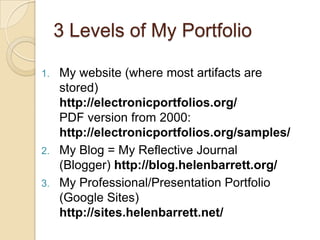
3 Levels of My PortfolioMy website (where most artifacts are stored)http://electronicportfolios.org/ PDF version from 2000: http://electronicportfolios.org/samples/My Blog = My Reflective Journal(Blogger) http://blog.helenbarrett.org/My Professional/Presentation Portfolio(Google Sites) http://sites.helenbarrett.net/
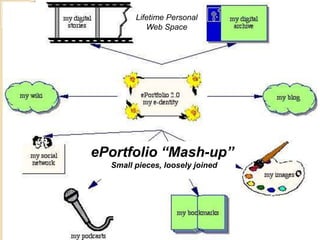
ePortfolio “Mash-up”Lifetime Personal Web SpaceePortfolio “Mash-up” Small pieces, loosely joined
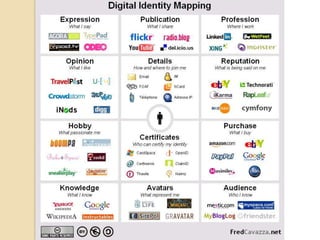
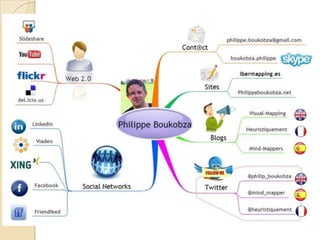
Digital Identity
The Future?Future of Personal Metadata in the cloudWorld Economic Forum: potential impact on human capital development and economic implications. (Quite big picture!)(Paul Kim, Stanford University)PrPl and PCB: a new e-portfolio environment in the cloud?
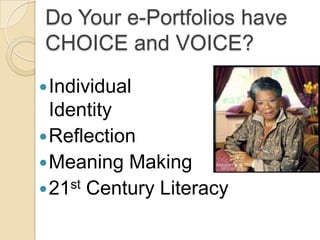
Do Your e-Portfolios have CHOICE and VOICE?Individual IdentityReflection Meaning Making21st Century Literacy
Voice6+1 Trait® DefinitionVoice is the writer coming through the words, the sense that a real person is speaking to us and cares about the message. It is the heart and soul of the writing, the magic, the wit, the feeling, the life and breath. When the writer is engaged personally with the topic, he/she imparts a personal tone and flavor to the piece that is unmistakably his/hers alone. And it is that individual something–different from the mark of all other writers–that we call Voice.http://educationnorthwest.org/resource/503#Voice
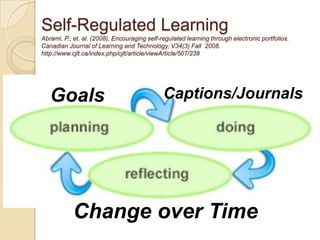
Self-Regulated LearningAbrami, P., et. al. (2008), Encouraging self-regulated learning through electronic portfolios. Canadian Journal of Learning and Technology, V34(3) Fall  2008. http://www.cjlt.ca/index.php/cjlt/article/viewArticle/507/238 GoalsCaptions/JournalsChange over Time
Creating a Professional Portfolio
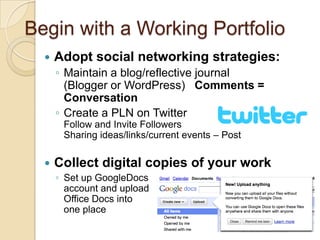
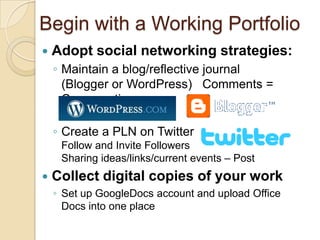
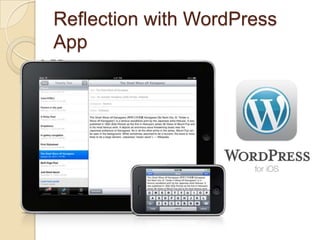
Begin with a Working PortfolioAdopt social networking strategies:Maintain a blog/reflective journal (Blogger or WordPress)   Comments = ConversationCreate a PLN on Twitter Follow and Invite FollowersSharing ideas/links/current events – Post Collect digital copies of your workSet up GoogleDocsaccount and upload Office Docs into one place
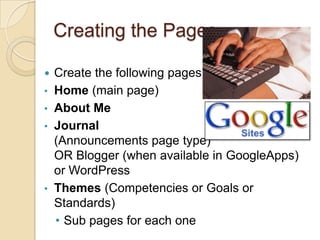
Creating the PagesCreate the following pages:Home (main page)
About Me
Journal (Announcements page type)OR Blogger (when available in GoogleApps)or WordPress
Themes (Competencies or Goals or Standards)
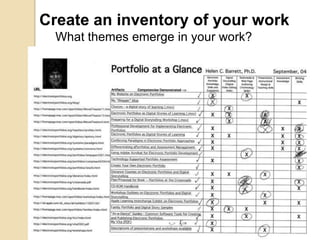
Sub pages for each oneCreate an inventory of your workWhat themes emerge in your work?
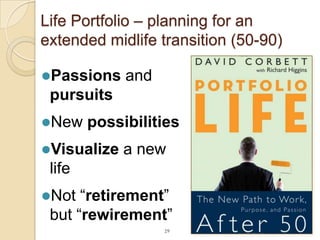
Life Portfolio – planning for an extended midlife transition (50-90)Passions and pursuits
New possibilities
Visualize a new life
Not “retirement” but “rewirement”29
30
31Portfolio Way of ThinkingPortfolios can be  timeless
What really matters in life?
Discover or rediscover passion…
Create a legacy…
Turn careers into callings, success into significance…
To make a difference…
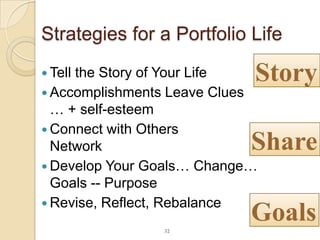
An ongoing, ageless framework for self-renewalStrategies for a Portfolio LifeStoryTell the Story of Your LifeAccomplishments Leave Clues… + self-esteemConnect with OthersNetworkDevelop Your Goals… Change… Goals -- PurposeRevise, Reflect, RebalanceShareGoals32
Tools?Expressive vs. Structured Models
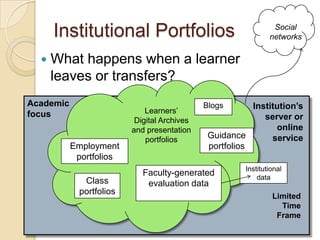
Institutional PortfoliosSocial networksWhat happens when a learner leaves or transfers?Academic focusInstitution’s server or online serviceBlogsLearners’Digital Archivesand presentation portfoliosGuidance portfoliosEmployment portfoliosInstitutional dataFaculty-generated evaluation dataClass portfoliosLimited Time Frame
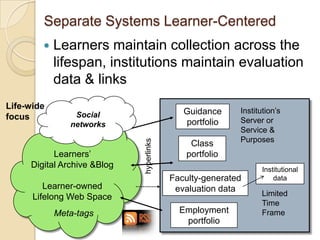
Separate Systems Learner-CenteredLearners maintain collection across the lifespan, institutions maintain evaluation data & linksLife-wide focusGuidance portfolioInstitution’s Server or Service & PurposesSocial networksClass portfoliohyperlinksLearners’ Digital Archive & BlogLearner-ownedLifelong Web SpaceInstitutional dataFaculty-generated evaluation dataLimited Time FrameEmployment portfolioMeta-tags
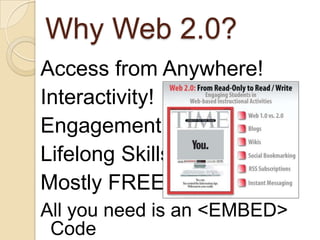
Why Web 2.0?Access from Anywhere!Interactivity!Engagement!Lifelong Skills!Mostly FREE! All you need is an <EMBED> Code
Web 2.0 is becoming the Personal Learning Environment of the “Net Generation”Learning that is… Social and Participatory
Lifelong and Life Wide
Increasingly Self-Directed
Motivating and Engaging
… and Online!Begin with a Working PortfolioAdopt social networking strategies:Maintain a blog/reflective journal (Blogger or WordPress)   Comments = ConversationCreate a PLN on Twitter Follow and Invite FollowersSharing ideas/links/current events – Post Collect digital copies of your workSet up GoogleDocs account and upload Office Docs into one place
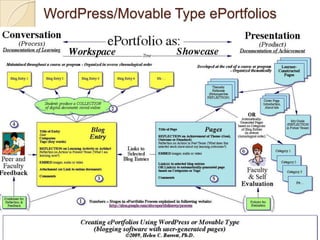
WordPress/Movable Type ePortfolios
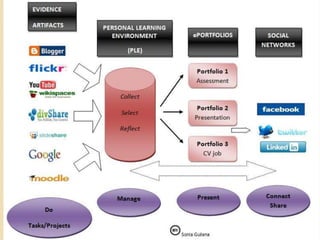
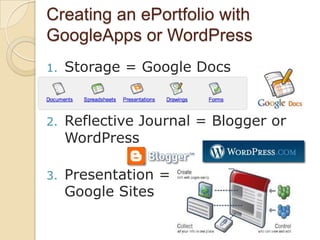
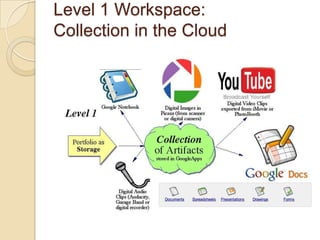
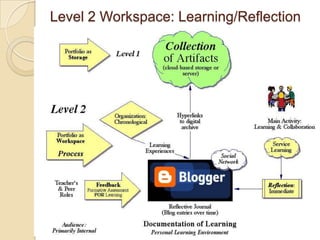
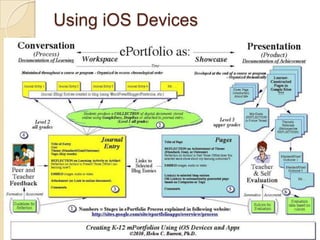
Creating an ePortfolio with GoogleApps or WordPressStorage = Google DocsReflective Journal = Blogger or WordPressPresentation =Google Sites
Level 1 Workspace: Collection in the Cloud
Level 2 Workspace: Learning/Reflection
ShowcaseLevel 3: Primary Purpose: Showcase/Accountability
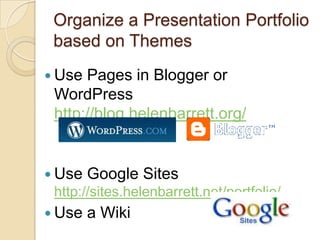
Organize a Presentation Portfolio based on ThemesUse Pages in Blogger or WordPresshttp://blog.helenbarrett.org/Use Google Siteshttp://sites.helenbarrett.net/portfolio/Use a Wiki

Calgary2Teachers

  • 1.
    Teacher Professional DevelopmentPortfoliosA Lifelong Personal and Professional Learning EnvironmentDr. Helen Barrettelectronicportfolios.orgTwitter: @eportfolioshashtag: #eportfolios
  • 2.
    Key ConceptsDefinitionsPortfolios acrossthe LifespanPortfolios as Lifelong LearningIdentity DevelopmentOnline Professional BrandingReflection, Motivation & EngagementPreparing for Portfolio Careers & Portfolio Life
  • 3.
    Model Intrinsic Motivation!Sharewith Students!Prepare for the Portfolio Life!Create a Professional Portfolio
  • 4.
    Golden Circle What?How?Why?4
  • 5.
    PurposeThe overarching purposeof portfolios is to create a sense of personal ownership over one’s accomplishments, because ownership engenders feelings of pride, responsibility, and dedication. (p.10)Paris, S & Ayres, L. (1994) Becoming Reflective Students and Teachers. American Psychological Association
  • 6.
    Four key pillarsof Lifelong Learning(Barbara Stäuble, Curtin University of Technology, Australia)http://lsn.curtin.edu.au/tlf/tlf2005/refereed/stauble.html
  • 7.
    Knowing the learner(Self-awareness)Understanding prior knowledgeMotivation for and attitudes toward learningHelp learners understand themselvesSee their growth over time
  • 8.
    Planning for learning(Self management)Setting goalsDevelop a plan to achieve these goals
  • 9.
    Understanding how tolearn (Meta-learning)Awareness of learners to different approaches to learningDeep vs. Surface Learning, Rote vs. Meaningful LearningDifferent Learning StylesHelp learners recognize successAccommodate approaches that are not successful
  • 10.
    Evaluating learning (Selfmonitoring)Systematic analysis of learners’ performanceResponsibility to construct meaningBe reflective & think criticallyLearners construct meaning, monitor learning, evaluateown outcomes
  • 11.
    Deep Learninginvolves reflection,isdevelopmental,is integrative,is self-directive, andis lifelongCambridge (2004)
  • 12.
  • 13.
    Managing OneselfPeter Drucker,(2005) Harvard Business Review“Success in the knowledge economy comes to those who know themselves – their strengths, their values, and how best they perform.”New Purpose: Use ePortfolios for managing knowledge workers' career developmentWhat are my strengths?How do I perform?What are my values?Where do I belong?What should I contribute?Responsibility for RelationshipsThe Second Half of your Life
  • 14.
    DefinitionsWhat is anelectronic portfolio?
  • 15.
  • 16.
    ePortfolio designs/strategies fordifferent purposes Assessment/Accountability Portfolios (Summative assessment)Organized thematically (outcomes, goals or standards)Focus of Reflection: Achievement of Standards (rationale)Tools: Assessment system with data from scoring rubricsFaculty role: Evaluation
  • 17.
    3 Levels ofMy PortfolioMy website (where most artifacts are stored)http://electronicportfolios.org/ PDF version from 2000: http://electronicportfolios.org/samples/My Blog = My Reflective Journal(Blogger) http://blog.helenbarrett.org/My Professional/Presentation Portfolio(Google Sites) http://sites.helenbarrett.net/
  • 18.
    ePortfolio “Mash-up”Lifetime PersonalWeb SpaceePortfolio “Mash-up” Small pieces, loosely joined
  • 20.
  • 21.
    The Future?Future ofPersonal Metadata in the cloudWorld Economic Forum: potential impact on human capital development and economic implications. (Quite big picture!)(Paul Kim, Stanford University)PrPl and PCB: a new e-portfolio environment in the cloud?
  • 22.
    Do Your e-Portfolioshave CHOICE and VOICE?Individual IdentityReflection Meaning Making21st Century Literacy
  • 23.
    Voice6+1 Trait® DefinitionVoiceis the writer coming through the words, the sense that a real person is speaking to us and cares about the message. It is the heart and soul of the writing, the magic, the wit, the feeling, the life and breath. When the writer is engaged personally with the topic, he/she imparts a personal tone and flavor to the piece that is unmistakably his/hers alone. And it is that individual something–different from the mark of all other writers–that we call Voice.http://educationnorthwest.org/resource/503#Voice
  • 24.
    Self-Regulated LearningAbrami, P.,et. al. (2008), Encouraging self-regulated learning through electronic portfolios. Canadian Journal of Learning and Technology, V34(3) Fall 2008. http://www.cjlt.ca/index.php/cjlt/article/viewArticle/507/238 GoalsCaptions/JournalsChange over Time
  • 25.
  • 26.
    Begin with aWorking PortfolioAdopt social networking strategies:Maintain a blog/reflective journal (Blogger or WordPress) Comments = ConversationCreate a PLN on Twitter Follow and Invite FollowersSharing ideas/links/current events – Post Collect digital copies of your workSet up GoogleDocsaccount and upload Office Docs into one place
  • 27.
    Creating the PagesCreatethe following pages:Home (main page)
  • 28.
  • 29.
    Journal (Announcements pagetype)OR Blogger (when available in GoogleApps)or WordPress
  • 30.
    Themes (Competencies orGoals or Standards)
  • 31.
    Sub pages foreach oneCreate an inventory of your workWhat themes emerge in your work?
  • 32.
    Life Portfolio –planning for an extended midlife transition (50-90)Passions and pursuits
  • 33.
  • 34.
  • 35.
    Not “retirement” but“rewirement”29
  • 36.
  • 37.
    31Portfolio Way ofThinkingPortfolios can be timeless
  • 38.
  • 39.
  • 40.
  • 41.
    Turn careers intocallings, success into significance…
  • 42.
    To make adifference…
  • 43.
    An ongoing, agelessframework for self-renewalStrategies for a Portfolio LifeStoryTell the Story of Your LifeAccomplishments Leave Clues… + self-esteemConnect with OthersNetworkDevelop Your Goals… Change… Goals -- PurposeRevise, Reflect, RebalanceShareGoals32
  • 44.
  • 45.
    Institutional PortfoliosSocial networksWhathappens when a learner leaves or transfers?Academic focusInstitution’s server or online serviceBlogsLearners’Digital Archivesand presentation portfoliosGuidance portfoliosEmployment portfoliosInstitutional dataFaculty-generated evaluation dataClass portfoliosLimited Time Frame
  • 46.
    Separate Systems Learner-CenteredLearnersmaintain collection across the lifespan, institutions maintain evaluation data & linksLife-wide focusGuidance portfolioInstitution’s Server or Service & PurposesSocial networksClass portfoliohyperlinksLearners’ Digital Archive & BlogLearner-ownedLifelong Web SpaceInstitutional dataFaculty-generated evaluation dataLimited Time FrameEmployment portfolioMeta-tags
  • 47.
    Why Web 2.0?Accessfrom Anywhere!Interactivity!Engagement!Lifelong Skills!Mostly FREE! All you need is an <EMBED> Code
  • 48.
    Web 2.0 isbecoming the Personal Learning Environment of the “Net Generation”Learning that is… Social and Participatory
  • 49.
  • 50.
  • 51.
  • 52.
    … and Online!Beginwith a Working PortfolioAdopt social networking strategies:Maintain a blog/reflective journal (Blogger or WordPress) Comments = ConversationCreate a PLN on Twitter Follow and Invite FollowersSharing ideas/links/current events – Post Collect digital copies of your workSet up GoogleDocs account and upload Office Docs into one place
  • 53.
  • 54.
    Creating an ePortfoliowith GoogleApps or WordPressStorage = Google DocsReflective Journal = Blogger or WordPressPresentation =Google Sites
  • 55.
    Level 1 Workspace:Collection in the Cloud
  • 56.
    Level 2 Workspace:Learning/Reflection
  • 57.
    ShowcaseLevel 3: PrimaryPurpose: Showcase/Accountability
  • 58.
    Organize a PresentationPortfolio based on ThemesUse Pages in Blogger or WordPresshttp://blog.helenbarrett.org/Use Google Siteshttp://sites.helenbarrett.net/portfolio/Use a Wiki

Editor's Notes

  • #2 Teacher Education and Professional Development Portfolios: The process of developing electronic teaching portfolios can document evidence of teacher competencies and guide long-term professional development.
  • #3 Simon Sinek, in his wonderful TED Talk, discusses How great leaders inspire action – talks about the Golden Circle. Leaders talk a lot about What and How, but really need to focus on Why.
  • #13 Who knows what this means?
  • #14 Success in the knowledge economy comes to those who know themselves – their strengths, their values, and how best they perform.
  • #16 Portfolios in Formal Education: Exploring Personal and Professional IdentityBuilding a Professional Online Brand.
  • #23 Do your e-portfolios have Voice? As Maya Angelou said, “When words are infused by the human voice, they come alive.”Do your portfolios represent individual identity, include reflection, and provide an opportunity to make meaning? ePortfolios are essential for 21st Century Literacy.
  • #24 How do portfolios and reflection fit into the learning process?BEFORE - goal-setting (reflection in the future tense), DURING - immediate reflection (in the present tense), where students write (or dictate) the reason why they chose a specific artifact to include in their collectionAFTER - retrospective (in the past tense) where students look back over a collection of work and describe what they have learned and how they have changed over a period of time (in a Level 3 portfolio)
  • #34 Common Tools vs. Proprietary systems