1
CALCIUM CHANNEL
BLOCKERS
Mrs. Sandhya Sujeetkumar Ahire
Pharmaceutical Chemistry
8/14/2020
Mrs.SSA(
Pharma'chemistry)
CCB
2
CALCIUM CHANNEL BLOCKERS
• Calcium channel blockers (CCBs) also known as
calcium antagonists. These are several medications
that disrupt the movement of calcium (Ca2
+)
through calcium channels. Calcium channel
blockers are drugs used to lower blood pressure.
• They work by slowing the movement of calcium into
the cells of the heart and blood vessel walls.
Therefore it easier for the heart to pump and
widens blood vessels.
• As a result, the heart doesn't have to work as hard,
and blood pressure lowers. they are first line
antihypertensive drugs. They are also used to treat
angina.
8/14/2020
Mrs.SSA(
Pharma'chemistry)
CCB
3
CALCIUM CHANNELS
Voltage sensitive channel: Activated when
membrane potential drops to around –40
mV or lower.
Receptor operated channel: Activated by
Adrenaline and other agonists—
independent of membrane depolarization
(NA contracts even depolarized aortic
smooth muscle by promoting influx of
Ca2+ through this channel and releasing
Ca2+ from sarcoplasmic reticulum).
Leak channel: Small amounts of Ca2+ leak
into the resting cell and are pumped out by
Ca2+ATPase. Mechanical stretch promotes
inward movement of Ca2+, through the leak
channel or through separate stretch
8/14/2020
Mrs.SSA(
Pharma'chemistry)
CCB
4
CLASSIFICATION
A. Phenyl alkylamine:
EX- Verapamil
B. Benzothiazepine:
EX-Diltiazem
C. Dihydropyridines:
EX- Nifedipine, Felodipine,
Amlodipine, Nitrendipine,
Nimodipine, Lacidipine,
Lercanidipine, Benidipine
8/14/2020
Mrs.SSA(
Pharma'chemistry)
CCB
5
CALCIUM CHANNEL BLOCKERS (CCBS)
MECHANISM OF ACTION
• Calcium is essential for muscular contraction.
• The CCBs protect the tissue by inhibiting the
entrance of Ca+2 into cardiac and smooth
muscle cells of the coronary and systemic
arterial beds.
• All CCBs are therefore arterio dilators that
cause a decrease in vascular resistance.
Cause peripheral arterial vasodilation
• Reduce myocardial contractility (-ve
inotropic action)
• Result: decreased myocardial oxygen
demand
8/14/2020
Mrs.SSA(
Pharma'chemistry)
CCB
6
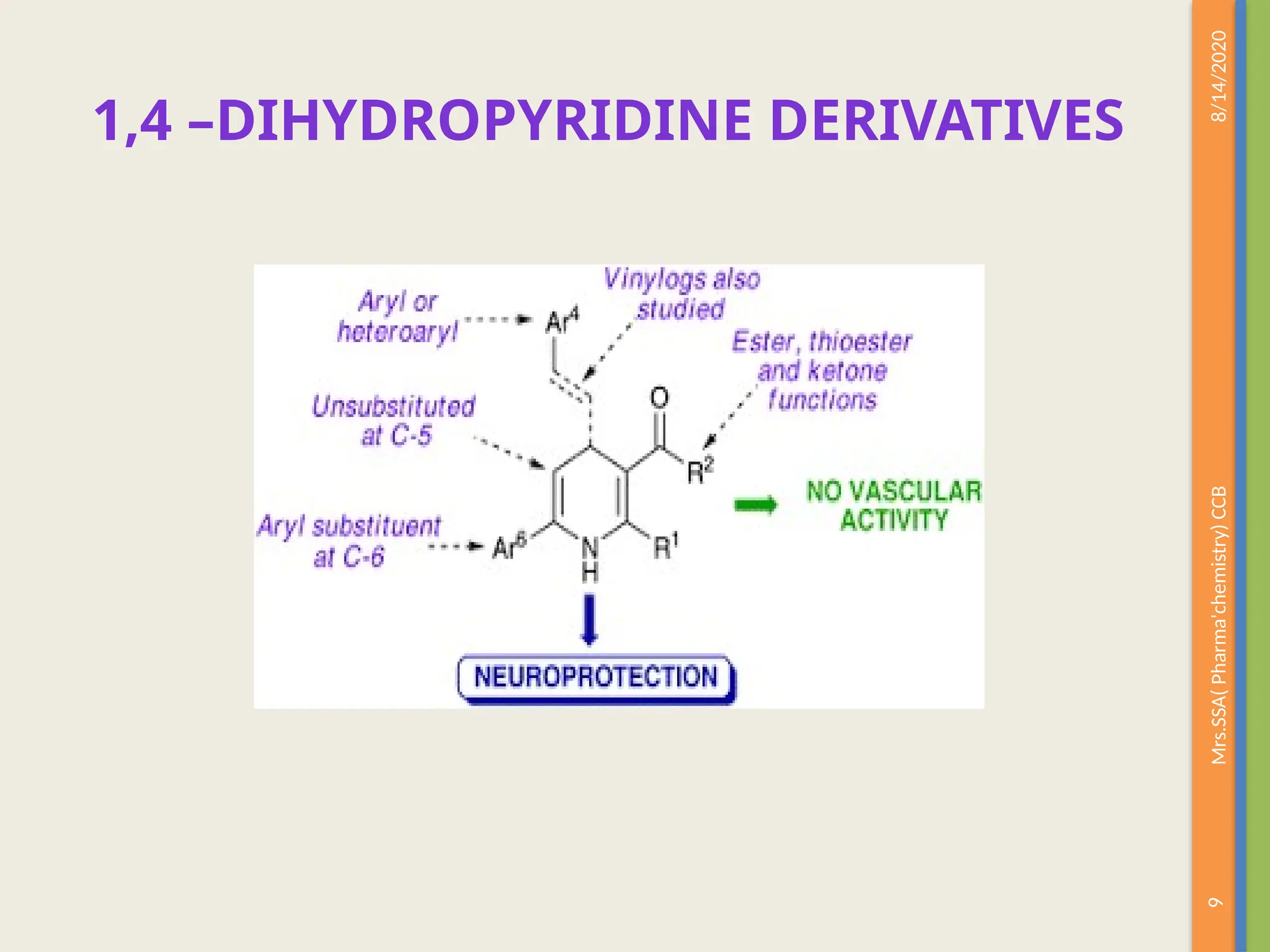
1,4 –DIHYDROPYRIDINE DERIVATIVES
8/14/2020
Mrs.SSA(
Pharma'chemistry)
CCB
7
1. 1,4 dihydro pyridine essential for activity.
2. Substitution at N or oxidation or reduction of the
ring reduces or abolishes activity.
3. A phenyl substitution at 4th
position is optimum
activity.
4. The 3rd
and 5th
position ester gr optimizies
activity.
5. Placement of electron withdrawing substitution
results in agonistic activity.
6. When the ester at c1 and c5 are non identical the
c4 becomes chiral and stereo selectivity is
observed.
7. S enantiomer are found to be effective.
8/14/2020
Mrs.SSA(
Pharma'chemistry)
CCB
8
8. R1 should be unsubstituted or carry a group
which can be readily cleared off
9. The optimal substituents at R2,R6 are lower
alkyl groups.especially methyl replacement of
R2 gr with a basic aminoethyl ether side chain
renders molecule more potent,wheras
replacement by hydrogen or an aryl causes
drop in activity.
10. In the enantiomer of chiral dihydropyridines
the s-enantiomer have proved to be more
effective.
8/14/2020
Mrs.SSA(
Pharma'chemistry)
CCB
9
11.Substituent at R4 is phenyl.In
monosubstitutied benzenoid nucleus ,ortho
substituent comp are more active than the
meta substituented compounds.para
substitution comp are inactive .electron
attracting substituent such as NO2 ,cl,CN,CF3
offer advantages over electron donating
substituent. Distribution is possible in
position ortho/meta position.
12.Alkoxy carbonyls are the optimal substituents
in positions R3 and R5. The alcohol
component of the ester gr may be the same
or different,aliphatic or araliphatic vary in
chain length,branching,degree of
8/14/2020
Mrs.SSA(
Pharma'chemistry)
CCB
10
AMLODIPINE
It is a medication used for treatment of
hypertension and coronary artery disease. It is
also used in Stable angina (where chest pain
occurs after physical and emotional stress).
MECHANISM OF ACTION:
Amlodipine relaxes peripheral and coronary
vascular smooth muscles . It produces
coronary vasodilation by inhibiting the entry
of calcium ions into the voltage gated
channels of the vascular smooth muscle and
myocardium during depolarization. It
decreases cardiac work, decrease cardiac
oxygen consumption.
8/14/2020
Mrs.SSA(
Pharma'chemistry)
CCB
11
USES
To treat hypertension and chronic stable angina
3-ethyl 5-methyl 2-[(2-aminoethoxy)methyl]-4-
(2-chlorophenyl)-6-methyl-1,4-dihydropyridine-
3,5-dicarboxylate
8/14/2020
Mrs.SSA(
Pharma'chemistry)
CCB
12
VERAPAMIL
•It is a calcium channel blockers that is used to
treat hypertension, chest pain from cardiac
ischemia and supraventricular tachycardia.
USES-
 Angina pectoris
 Arrhythmias from ischemic myocardial
syndromes and supraventricular arrhythmias.
 2-(3,4-dimethoxyphenyl)-5-{[2-(3,4-
dimethoxyphenyl)ethyl](methyl)amino}-2-(propan-2-
yl)pentanenitrile
8/14/2020
Mrs.SSA(
Pharma'chemistry)
CCB
13
MECHANISM OF ACTION:
 Verapamil inhibits entry of calcium ions into
arterial smooth muscle as well as the myocytes
and conducting tissues.
 These actions lead to reversal and preventions
of coronary artery spasm, reduction in
afterload through peripheral vasodilatation and
reduction in ventricular rate in patients with
chronic atrial flutter or fibrillation and reduction
in the occurrence of paroxysmal
supraventricular tachycardia.
 Verapamil reduces BP, relieves angina and slows
AV conduction
8/14/2020
Mrs.SSA(
Pharma'chemistry)
CCB
14
DILTIAZEM
Diltiazem, a benzothiazepine calcium-channel
blocker, is used alone or with an angiotensin-
converting enzyme inhibitor, to treat
hypertension, chronic stable angina pectoris, and
Prinzmetal's variant angina. Diltiazem is a non-
dihydropyridine (DHP)member of the calcium
channel blocker class, along with Verapamil.
USES-
 Angina pectoris
 Potent calcium channel blocker
 Lower heart rate
(2S,3S)-5-[2-(dimethylamino)ethyl]-2-(4-methoxyphenyl)-4-oxo-
2,3,4,5-tetrahydro-1,5-benzothiazepin-3-yl acetate
8/14/2020
Mrs.SSA(
Pharma'chemistry)
CCB
15
MECHANISM OF ACTIONS:
 Slow channel blocker with pharmacologic
actions similar to those of verapamil. Inhibits
calcium ion influx through slow channels
into cell of myocardial and arterial smooth
muscle (both coronary and peripheral blood
vessels).
 As a result, intracellular calcium remains at
sub threshold levels insufficient to stimulate
cell excitation and contraction.
 Slows SA and AV node conduction
(antiarrhythmic effect) without affecting
normal arterial action potential or
Interventricular conduction.
8/14/2020
Mrs.SSA(
Pharma'chemistry)
CCB
16
NIFEDIPINE
 A dihydro pyridine derivative.
 Functions mainly as an arteriolar vasodilator.
 This drug has minimal effect on cardiac
conduction or heart rate.
 Used in variant angina caused by
spontaneous coronary spasm
 Other members of this class, amlodipine,
nicardipine, and felodipine, have similar
cardiovascular characteristics except for
amlodipine, which does not affect heart rate
or cardiac output.
8/14/2020
Mrs.SSA(
Pharma'chemistry)
CCB
17
MOA-
• it is prototype DHP with rapid onset and
short duration of action.
• It involves arteriolar dilation, total
peripheral resistance decrease BP fall
USE - hypertension, angina pectoris
8/14/2020
Mrs.SSA(
Pharma'chemistry)
CCB
3,5-dimethyl 2,6-dimethyl-4-(2-
nitrophenyl)-1,4-dihydropyridine-3,5-
dicarboxylate
18
BEPRIDIL HCL
MOA
• It blocks the calcium channel and also
inhibite the sodium flow into the heart
tissue and lengthen cardiac repolarization
USES
• Tratment of stable angina
• Vasodilators
• N-benzyl-N-[3-(2-methylpropoxy)-2-(pyrrolidin-1-
yl)propyl]aniline hydrate hydrochloride
8/14/2020
Mrs.SSA(
Pharma'chemistry)
CCB
19
FELODIPINE
MOA
• It act on vascular smooth muscle cell by
stabilizing voltage gated L –type calcium
channel in their inactive conformation.
USES
• Treatment of mild to moderate essential
hypertension.
• 3-ethyl 5-methyl 4-(2,3-dichlorophenyl)-2,6-
dimethyl-1,4-dihydropyridine-3,5-
dicarboxylate.
8/14/2020
Mrs.SSA(
Pharma'chemistry)
CCB
20
NICARDIPINE
MOA
• It is a potent calcium channel blocker with
marked vasodilators action
USES
• Hypertension
• Angina pectoris
• Asthma
• Cancer
• 3-{2-[benzyl(methyl)amino]ethyl} 5-methyl 2,6-
dimethyl-4-(3-nitrophenyl)-1,4-dihydropyridine-3,5-
dicarboxylate
8/14/2020
Mrs.SSA(
Pharma'chemistry)
CCB
21
NIMODIPINE
MOA
• It acts on vascular smooth muscle cells by
stabilizing voltage gated L-type calcium
channels in their inactive conformation
USES
• haemorrahage from ruptured intracranial
aneurysm
• 3-(2-methoxyethyl) 5-propan-2-yl 2,6-dimethyl-4-(3-
nitrophenyl)-1,4-dihydropyridine-3,5-dicarboxylate.
8/14/2020
Mrs.SSA(
Pharma'chemistry)
CCB
22
THERAPEUTIC USES OF CCB
 Hypertension: Long acting CCBs are used for
the long term treatment of hypertension.
Amlodipine is the most preferred drug.
 Ischemic heart disease:
 Angina pectoris: DHPs like amlodopine
with beta-blocker are used for long term
management. Verapamil and diltiazem are
used for prophylaxis.
 Vasospastic angina - Verapamil and
amlodopine are the preffered agents.
 Unstable angina - Verapamil is used.
8/14/2020
Mrs.SSA(
Pharma'chemistry)
CCB
23
 Supraventricular arrhythmia: verapamil &
diltiazem are used due to their antiarrythmic
properties.
 Peripheral vascular disease: nifedipine,
felodipine and diltiazem are used for this
purpose. Nifedipine patches are also useful.
 Migraine prophylaxis: verapamil is useful.
 Nocturnal leg cramps: verapamil is useful.
8/14/2020
Mrs.SSA(
Pharma'chemistry)
CCB
24
ADVERSE EFFECTS
1. Verapamil causes Nausea, constipation,
bradycardia, aggravation of
2. conduction defects .
3. Ditiazem also has similar side effect profile
but slightly to lesser extent.
4. DHPs show side effects like nausea, headache,
drowsiness palpitation, hypotension, flushing
and ankle edema.
5. Difficulty in micturation & worsening of
gastroesophageal reflux is seen in elderly
patients.
8/14/2020
Mrs.SSA(
Pharma'chemistry)
CCB
8/14/2020
Mrs.SSA( Pharma'chemistry) CCB
THANK YOU FOR
YOUR
ATTENTION

.CALCIUM CHANNEL BLOCKERS. VASODILATORS,PMC 2

  • 1.
    1 CALCIUM CHANNEL BLOCKERS Mrs. SandhyaSujeetkumar Ahire Pharmaceutical Chemistry 8/14/2020 Mrs.SSA( Pharma'chemistry) CCB
  • 2.
    2 CALCIUM CHANNEL BLOCKERS •Calcium channel blockers (CCBs) also known as calcium antagonists. These are several medications that disrupt the movement of calcium (Ca2 +) through calcium channels. Calcium channel blockers are drugs used to lower blood pressure. • They work by slowing the movement of calcium into the cells of the heart and blood vessel walls. Therefore it easier for the heart to pump and widens blood vessels. • As a result, the heart doesn't have to work as hard, and blood pressure lowers. they are first line antihypertensive drugs. They are also used to treat angina. 8/14/2020 Mrs.SSA( Pharma'chemistry) CCB
  • 3.
    3 CALCIUM CHANNELS Voltage sensitivechannel: Activated when membrane potential drops to around –40 mV or lower. Receptor operated channel: Activated by Adrenaline and other agonists— independent of membrane depolarization (NA contracts even depolarized aortic smooth muscle by promoting influx of Ca2+ through this channel and releasing Ca2+ from sarcoplasmic reticulum). Leak channel: Small amounts of Ca2+ leak into the resting cell and are pumped out by Ca2+ATPase. Mechanical stretch promotes inward movement of Ca2+, through the leak channel or through separate stretch 8/14/2020 Mrs.SSA( Pharma'chemistry) CCB
  • 4.
    4 CLASSIFICATION A. Phenyl alkylamine: EX-Verapamil B. Benzothiazepine: EX-Diltiazem C. Dihydropyridines: EX- Nifedipine, Felodipine, Amlodipine, Nitrendipine, Nimodipine, Lacidipine, Lercanidipine, Benidipine 8/14/2020 Mrs.SSA( Pharma'chemistry) CCB
  • 5.
    5 CALCIUM CHANNEL BLOCKERS(CCBS) MECHANISM OF ACTION • Calcium is essential for muscular contraction. • The CCBs protect the tissue by inhibiting the entrance of Ca+2 into cardiac and smooth muscle cells of the coronary and systemic arterial beds. • All CCBs are therefore arterio dilators that cause a decrease in vascular resistance. Cause peripheral arterial vasodilation • Reduce myocardial contractility (-ve inotropic action) • Result: decreased myocardial oxygen demand 8/14/2020 Mrs.SSA( Pharma'chemistry) CCB
  • 6.
  • 7.
    7 1. 1,4 dihydropyridine essential for activity. 2. Substitution at N or oxidation or reduction of the ring reduces or abolishes activity. 3. A phenyl substitution at 4th position is optimum activity. 4. The 3rd and 5th position ester gr optimizies activity. 5. Placement of electron withdrawing substitution results in agonistic activity. 6. When the ester at c1 and c5 are non identical the c4 becomes chiral and stereo selectivity is observed. 7. S enantiomer are found to be effective. 8/14/2020 Mrs.SSA( Pharma'chemistry) CCB
  • 8.
    8 8. R1 shouldbe unsubstituted or carry a group which can be readily cleared off 9. The optimal substituents at R2,R6 are lower alkyl groups.especially methyl replacement of R2 gr with a basic aminoethyl ether side chain renders molecule more potent,wheras replacement by hydrogen or an aryl causes drop in activity. 10. In the enantiomer of chiral dihydropyridines the s-enantiomer have proved to be more effective. 8/14/2020 Mrs.SSA( Pharma'chemistry) CCB
  • 9.
    9 11.Substituent at R4is phenyl.In monosubstitutied benzenoid nucleus ,ortho substituent comp are more active than the meta substituented compounds.para substitution comp are inactive .electron attracting substituent such as NO2 ,cl,CN,CF3 offer advantages over electron donating substituent. Distribution is possible in position ortho/meta position. 12.Alkoxy carbonyls are the optimal substituents in positions R3 and R5. The alcohol component of the ester gr may be the same or different,aliphatic or araliphatic vary in chain length,branching,degree of 8/14/2020 Mrs.SSA( Pharma'chemistry) CCB
  • 10.
    10 AMLODIPINE It is amedication used for treatment of hypertension and coronary artery disease. It is also used in Stable angina (where chest pain occurs after physical and emotional stress). MECHANISM OF ACTION: Amlodipine relaxes peripheral and coronary vascular smooth muscles . It produces coronary vasodilation by inhibiting the entry of calcium ions into the voltage gated channels of the vascular smooth muscle and myocardium during depolarization. It decreases cardiac work, decrease cardiac oxygen consumption. 8/14/2020 Mrs.SSA( Pharma'chemistry) CCB
  • 11.
    11 USES To treat hypertensionand chronic stable angina 3-ethyl 5-methyl 2-[(2-aminoethoxy)methyl]-4- (2-chlorophenyl)-6-methyl-1,4-dihydropyridine- 3,5-dicarboxylate 8/14/2020 Mrs.SSA( Pharma'chemistry) CCB
  • 12.
    12 VERAPAMIL •It is acalcium channel blockers that is used to treat hypertension, chest pain from cardiac ischemia and supraventricular tachycardia. USES-  Angina pectoris  Arrhythmias from ischemic myocardial syndromes and supraventricular arrhythmias.  2-(3,4-dimethoxyphenyl)-5-{[2-(3,4- dimethoxyphenyl)ethyl](methyl)amino}-2-(propan-2- yl)pentanenitrile 8/14/2020 Mrs.SSA( Pharma'chemistry) CCB
  • 13.
    13 MECHANISM OF ACTION: Verapamil inhibits entry of calcium ions into arterial smooth muscle as well as the myocytes and conducting tissues.  These actions lead to reversal and preventions of coronary artery spasm, reduction in afterload through peripheral vasodilatation and reduction in ventricular rate in patients with chronic atrial flutter or fibrillation and reduction in the occurrence of paroxysmal supraventricular tachycardia.  Verapamil reduces BP, relieves angina and slows AV conduction 8/14/2020 Mrs.SSA( Pharma'chemistry) CCB
  • 14.
    14 DILTIAZEM Diltiazem, a benzothiazepinecalcium-channel blocker, is used alone or with an angiotensin- converting enzyme inhibitor, to treat hypertension, chronic stable angina pectoris, and Prinzmetal's variant angina. Diltiazem is a non- dihydropyridine (DHP)member of the calcium channel blocker class, along with Verapamil. USES-  Angina pectoris  Potent calcium channel blocker  Lower heart rate (2S,3S)-5-[2-(dimethylamino)ethyl]-2-(4-methoxyphenyl)-4-oxo- 2,3,4,5-tetrahydro-1,5-benzothiazepin-3-yl acetate 8/14/2020 Mrs.SSA( Pharma'chemistry) CCB
  • 15.
    15 MECHANISM OF ACTIONS: Slow channel blocker with pharmacologic actions similar to those of verapamil. Inhibits calcium ion influx through slow channels into cell of myocardial and arterial smooth muscle (both coronary and peripheral blood vessels).  As a result, intracellular calcium remains at sub threshold levels insufficient to stimulate cell excitation and contraction.  Slows SA and AV node conduction (antiarrhythmic effect) without affecting normal arterial action potential or Interventricular conduction. 8/14/2020 Mrs.SSA( Pharma'chemistry) CCB
  • 16.
    16 NIFEDIPINE  A dihydropyridine derivative.  Functions mainly as an arteriolar vasodilator.  This drug has minimal effect on cardiac conduction or heart rate.  Used in variant angina caused by spontaneous coronary spasm  Other members of this class, amlodipine, nicardipine, and felodipine, have similar cardiovascular characteristics except for amlodipine, which does not affect heart rate or cardiac output. 8/14/2020 Mrs.SSA( Pharma'chemistry) CCB
  • 17.
    17 MOA- • it isprototype DHP with rapid onset and short duration of action. • It involves arteriolar dilation, total peripheral resistance decrease BP fall USE - hypertension, angina pectoris 8/14/2020 Mrs.SSA( Pharma'chemistry) CCB 3,5-dimethyl 2,6-dimethyl-4-(2- nitrophenyl)-1,4-dihydropyridine-3,5- dicarboxylate
  • 18.
    18 BEPRIDIL HCL MOA • Itblocks the calcium channel and also inhibite the sodium flow into the heart tissue and lengthen cardiac repolarization USES • Tratment of stable angina • Vasodilators • N-benzyl-N-[3-(2-methylpropoxy)-2-(pyrrolidin-1- yl)propyl]aniline hydrate hydrochloride 8/14/2020 Mrs.SSA( Pharma'chemistry) CCB
  • 19.
    19 FELODIPINE MOA • It acton vascular smooth muscle cell by stabilizing voltage gated L –type calcium channel in their inactive conformation. USES • Treatment of mild to moderate essential hypertension. • 3-ethyl 5-methyl 4-(2,3-dichlorophenyl)-2,6- dimethyl-1,4-dihydropyridine-3,5- dicarboxylate. 8/14/2020 Mrs.SSA( Pharma'chemistry) CCB
  • 20.
    20 NICARDIPINE MOA • It isa potent calcium channel blocker with marked vasodilators action USES • Hypertension • Angina pectoris • Asthma • Cancer • 3-{2-[benzyl(methyl)amino]ethyl} 5-methyl 2,6- dimethyl-4-(3-nitrophenyl)-1,4-dihydropyridine-3,5- dicarboxylate 8/14/2020 Mrs.SSA( Pharma'chemistry) CCB
  • 21.
    21 NIMODIPINE MOA • It actson vascular smooth muscle cells by stabilizing voltage gated L-type calcium channels in their inactive conformation USES • haemorrahage from ruptured intracranial aneurysm • 3-(2-methoxyethyl) 5-propan-2-yl 2,6-dimethyl-4-(3- nitrophenyl)-1,4-dihydropyridine-3,5-dicarboxylate. 8/14/2020 Mrs.SSA( Pharma'chemistry) CCB
  • 22.
    22 THERAPEUTIC USES OFCCB  Hypertension: Long acting CCBs are used for the long term treatment of hypertension. Amlodipine is the most preferred drug.  Ischemic heart disease:  Angina pectoris: DHPs like amlodopine with beta-blocker are used for long term management. Verapamil and diltiazem are used for prophylaxis.  Vasospastic angina - Verapamil and amlodopine are the preffered agents.  Unstable angina - Verapamil is used. 8/14/2020 Mrs.SSA( Pharma'chemistry) CCB
  • 23.
    23  Supraventricular arrhythmia:verapamil & diltiazem are used due to their antiarrythmic properties.  Peripheral vascular disease: nifedipine, felodipine and diltiazem are used for this purpose. Nifedipine patches are also useful.  Migraine prophylaxis: verapamil is useful.  Nocturnal leg cramps: verapamil is useful. 8/14/2020 Mrs.SSA( Pharma'chemistry) CCB
  • 24.
    24 ADVERSE EFFECTS 1. Verapamilcauses Nausea, constipation, bradycardia, aggravation of 2. conduction defects . 3. Ditiazem also has similar side effect profile but slightly to lesser extent. 4. DHPs show side effects like nausea, headache, drowsiness palpitation, hypotension, flushing and ankle edema. 5. Difficulty in micturation & worsening of gastroesophageal reflux is seen in elderly patients. 8/14/2020 Mrs.SSA( Pharma'chemistry) CCB
  • 25.