Vitamins And Minerals In Nutrition
NF773
2018-3-14
Calcium
Supervisor : prof. sana janakat
By : Haya abumater
Calcium
• Most abundant mineral in the human body
• Total Calcium in the human body is about 1 to 1.5 kg, 99% of
which is found in bone together with phosphate.
• Small amounts are found in soft tissue & 1% in extracellular
fluid .
Chemical properties of Ca2+
• Belong to ( group IIA ) .
• The biological Activity & regulation of Ca2+ are influenced by
Concentration of ionized or free Ca2+ in solution.
• Binding of Ca2+ to the protein components of cell membrane :
- Change the fluidity of the membrane .
- Allow passage of ions .
Calcium is found in blood plasma :
• Bound to plasma proteins (albumin) (35-40%)
• As free-ionized (45-50%)
• Complex with sulfate , phosphate or citrate 10%
Sources
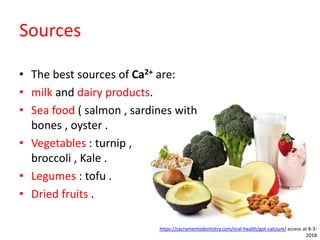
• The best sources of Ca2+ are:
• milk and dairy products.
• Sea food ( salmon , sardines with
bones , oyster .
• Vegetables : turnip ,
broccoli , Kale .
• Legumes : tofu .
• Dried fruits .
https://sacramentodentistry.com/oral-health/got-calcium/ access at 8-3-
2018
Digestion
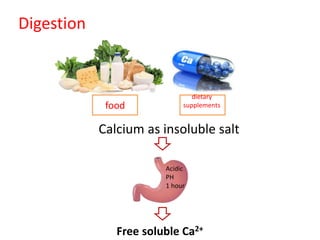
Calcium as insoluble salt
food
dietary
supplements
Acidic
PH
1 hour
Free soluble Ca2+
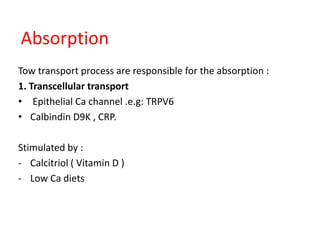
Absorption
Tow transport process are responsible for the absorption :
1. Transcellular transport
• Epithelial Ca channel .e.g: TRPV6
• Calbindin D9K , CRP.
Stimulated by :
- Calcitriol ( Vitamin D )
- Low Ca diets
2- Paracellular transport :
occurs between cells The process allows the movement
(Diffusion) of Ca .
Occurs when :
- High [ Ca ] in lumen.
- Gradient of [ Ca ] between the lumen and basoletral side .
Figure 1
Ca digestion ,absorption , transport
Gropper et al.2009
Absorption
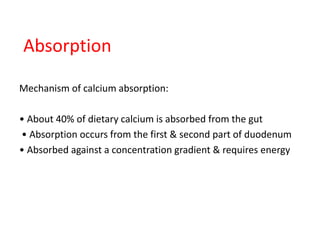
Mechanism of calcium absorption:
• About 40% of dietary calcium is absorbed from the gut
• Absorption occurs from the first & second part of duodenum
• Absorbed against a concentration gradient & requires energy
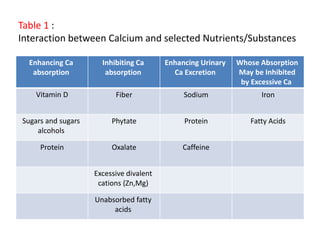
Table 1 :
Interaction between Calcium and selected Nutrients/Substances
Whose Absorption
May be Inhibited
by Excessive Ca
Enhancing Urinary
Ca Excretion
Inhibiting Ca
absorption
Enhancing Ca
absorption
IronSodiumFiberVitamin D
Fatty AcidsProteinPhytateSugars and sugars
alcohols
CaffeineOxalateProtein
Excessive divalent
cations (Zn,Mg)
Unabsorbed fatty
acids
Transport
• Calcium is Transported in the blood via :
1- bound to proteins . ( albumin & prealbumin ) 40%
2- Complex with sulfate , phosphate or citrate . 10%
3- Found free (Ionized) in blood. 50%
* the total calcium and ionized calcium measurements are available in many
laboratories
Functions of Calcium
• Formation of bone mineral .
• Regulation of enzyme activity .
• Second messenger in the cell .
• Nerve conduction
• Blood coagulation
Bone mineralization
• 99% of total body Calcium is found in bone And teeth.
• Ca2+ is found in the body as :
Calcium Phosphate compound Hydroxyapatite
( Ca10(PO4)6(OH)2)
Functions of Calcium …
Bone mineralization
Types of Bone Tissue :
• cortical bone
• trabecular bone
Trabecular and Cortical Bone (Cowin, 2001)
https://www.researchgate.net/figure/Trabecular-
and-Cortical-Bone-Cowin-2001_fig1_230822645
8-3-2017
Figure 2 : Characteristics of cortical and trabecular Bone .
Trabecular BoneCortical Bone
Spongy appearanceCompact or dense
Represents about 20% to 25% of bone in
the body .
75% to 80% of total bone in the body
Consists of an interconnected system of
protein (mostly collagen)
Consist of layers of mineralized protein
( mostly collagen )
Found in high conc. In the axial skeletonFound on the surfaces of all bones and
the shaft of long bones of the limbs and
wrist .
Calcium Binding protein in Bone
• Osteonectin ( the most aboundant noncollagenous protein in bone )
• Gla protein ( Vitamin K dependent protein )
• Osteocalcin ( biomarker of bone formation in serum)
• Protein S ( the deficiency associated with osteopenia )
3 types of bone cells :
• Osteoblast :
- called (Bone building cells)
- Produce matrix
- secret collagen and ground substance .
- become ostocytes .
• Osteocytes :
- Star shaped
- mature bone cells
• Osteoclasts :
- Phagocytic cell
-role in increasing blood [Ca2+ ]
-contain lysosomes and enzymes capable of breaking down.
• Osteoblasts cell (gray blobs forming an oval) create
new bone tissue.
https://www.sciencenewsforstudents.org/article/bo
nes-hard-scaffold-influencing-other-tissue
access at 7-3-2018
https://www.sciencephoto.com/media/301684/view
access at 7-3-2018
Osteocytes cells, instructing the other bone cells what
to do.
https://www.sciencenewsforstudents.org/article/bo
nes-hard-scaffold-influencing-other-tissue
access at 7-3-2018
http://www.anatomybox.com/tag/false-color/
access at 7-3-2018
Scanning electron micrograph of activated
osteoclast and resorption pits.
https://boneresearchsociety.org/resources/gallery/3
8/
access at 7-3-2018
Functions of Calcium …
• Second Messenger
: are molecule that relay signals from receptors on the cell surface
to target molecules inside the cell.
Ca2+ acts as a second messenger in two ways:
• it binds to an effector molecule, such as an enzyme, activating it.
• it binds to an intermediary cytosolic calcium binding protein such
as calmodulin.
Figure 3: the role of
Calcium and IP3 in
Signaling.
pathwhttps://www.youtube.com/wa
• Cytosolic Ca2+ can bind to
cellular Ca2+ binding proteins,
including Camodulin
Activate cellular Kinases and
Enzymes
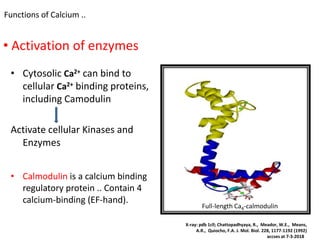
• Calmodulin is a calcium binding
regulatory protein .. Contain 4
calcium-binding (EF-hand).
Full-length Ca4-calmodulin
X-ray: pdb 1cll; Chattopadhyaya, R., Meador, W.E., Means,
A.R., Quiocho, F.A. J. Mol. Biol. 228, 1177-1192 (1992)
accses at 7-3-2018
• Activation of enzymes
Functions of Calcium ..
The EF hand
https://www.quora.com/What-is-the-
difference-between-EF-Hand-and-helix-
10/2/2018turn-helix-protein-motifs
• Found in large family of Ca2+-binding
protein , such as : calmodulin and
calbindin D .
Composed of :
• 10- to 12-amino acid alpha helices
• 12-residue calcium binding loop
region .
* most EF- hand proteins at position
12 is glutamate .
Ca2+
• Muscles
• Calcium mediates excitation & contraction of muscles
- interacts with troponin C to trigger muscle contraction
- activates ATPase, increases action of actin and myosin and
facilitates excitation-contraction coupling.
- decreases neuromuscular irritability.
- Calcium deficiency causes tetany.
Functions of Calcium…
• Nerve conduction
It is necessary for transmission of nerve impulses .
• Blood coagulation
- Calcium is known as factor IV in blood coagulation process
- Prothrombin contains γ-carboxyglutamate residues which
are chelated by Ca2+ during the thrombin formation
Functions of Calcium…
Regulation of Calcium concentrations
Extracellular
Hormones involved in Ca2+ homeostasis :
• Parathyroid hormone(PTH)
• Calcitriol
• Calcitonin
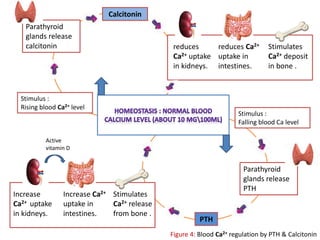
Stimulus :
Falling blood Ca level
Parathyroid
glands release
PTH
PTH
Increase
Ca2+ uptake
in kidneys.
Increase Ca2+
uptake in
.intestines
Stimulates
Ca2+ release
from bone .
Active
vitamin D
Stimulus :
Rising blood Ca2+ level
Parathyroid
glands release
calcitonin
Calcitonin
Stimulates
Ca2+ deposit
in bone .
reduces Ca2+
uptake in
.intestines
reduces
Ca2+ uptake
in kidneys.
Figure 4: Blood Ca2+ regulation by PTH & Calcitonin
Blood
Low [Ca]
Gastrointestinal
Tract
Basolate
membrane
Brush border
membrane
Calcitriol
Ca2+
Figure 5: Blood Ca2+ regulation by calcitriol in response to low blood [Ca2+ ] .
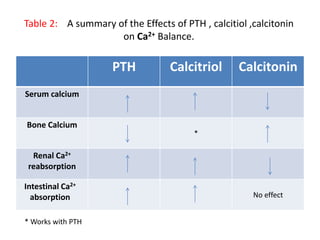
Table 2: A summary of the Effects of PTH , calcitiol ,calcitonin
on Ca2+ Balance.
CalcitoninCalcitriolPTH
Serum calcium
*
Bone Calcium
Renal Ca2+
reabsorption
No effect
Intestinal Ca2+
absorption
* Works with PTH
Regulation of Calcium concentrations
Intracellular
• Ca2+ enters cells by diffusion of channels and exerts its
actions.
• Ca2+ can be removed from the cytoplasm
in tow ways :
1- ATP-dependent pumps use Mg++ and Na++ to export Ca2+ out
of the cell, and Atpase .
2- pumped can sequester Ca2+ in organelles such as the
endoplasmic reticulum or mitochondrion.
:Figure 5
Regulation of intracellular [calcium]
Lower [Ca2+ ] By
• Buffering free Ca2+ via molecular sequestration.
• compartmentalization* of Ca2+ through uptake in to cellular
organells.
• Removal of excess Ca2+ from the cell via energy-dependent Ca2+
pumps found on Plasma membrane.
* compartmentalize meaning : to separate something into parts and
not allow those parts to mix together.
Removal of Ca2+ stimulus
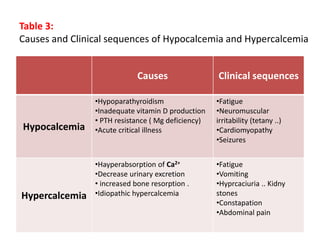
Table 3:
Causes and Clinical sequences of Hypocalcemia and Hypercalcemia
Clinical sequencesCauses
•Fatigue
•Neuromuscular
irritability (tetany ..)
•Cardiomyopathy
•Seizures
•Hypoparathyroidism
•Inadequate vitamin D production
• PTH resistance ( Mg deficiency)
•Acute critical illnessHypocalcemia
•Fatigue
•Vomiting
•Hyprcaciuria .. Kidny
stones
•Constapation
•Abdominal pain
•Hayperabsorption of Ca2+
•Decrease urinary excretion
• increased bone resorption .
•Idiopathic hypercalcemiaHypercalcemia
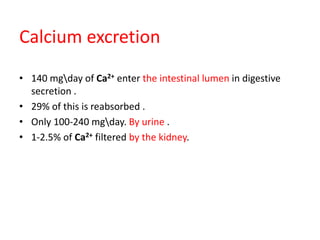
Calcium excretion
• 140 mgday of Ca2+ enter the intestinal lumen in digestive
secretion .
• 29% of this is reabsorbed .
• Only 100-240 mgday. By urine .
• 1-2.5% of Ca2+ filtered by the kidney.
Adequate intake
For men/women:
• 19-50 years : 1000 mg/day
• <50 years : 1200 mg/day
• 1500 mg/day for women not treated with estrogen ,
“ because its influences bone mineralization “
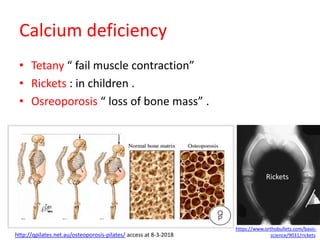
Calcium deficiency
• Tetany “ fail muscle contraction”
• Rickets : in children .
• Osreoporosis “ loss of bone mass” .
https://www.orthobullets.com/basic-
science/9031/ricketshttp://qpilates.net.au/osteoporosis-pilates/ access at 8-3-2018
Rickets
Should increased need of Ca2+ :
• High phytate diets
• Fat malabsorption
• Immobilization
• Decreased gastrointestinal transit time
• Use of thiazide diuretics (long time)
Excess Calcium Supplementation
• usually does not result in hypercalcemia, but may cause
mineral imbalances by :
Interfering with the absorption of other minerals, such as iron,
magnesium, and zinc.
Toxicity
• Upper intake : 2500 mg/day
• Hypercalcemia
• Constipation
• Kidney stones
• Deposition of ca in soft tissue
https://step1.medbullets.com/msk/112035/gout 8-3-2018
http://faressaad.com/blog/2017/06/beirut-residents-getting-much-
calcium/ access at 8-3-2018
Assessment
• Difficult to assess : same indicators of Vitamin D
status , bone disease , hormonal imbalance.
methods :
• presence of normal [albumin]
• CT scans
• DEXA : the best “ change in mass over time”
References :
1- (6th ed.) Gropper, S. A. S., Smith, J. L., & Groff, J. L. (2009). Advanced nutrition and human
metabolism.
2- Stipanuk, M. H. (2006). Biochemical, physiological, & molecular aspects of human nutrition.
St. Louis: Saunders Elsevier.

Calcium

  • 1.
    Vitamins And MineralsIn Nutrition NF773 2018-3-14 Calcium Supervisor : prof. sana janakat By : Haya abumater
  • 2.
    Calcium • Most abundantmineral in the human body • Total Calcium in the human body is about 1 to 1.5 kg, 99% of which is found in bone together with phosphate. • Small amounts are found in soft tissue & 1% in extracellular fluid .
  • 3.
    Chemical properties ofCa2+ • Belong to ( group IIA ) . • The biological Activity & regulation of Ca2+ are influenced by Concentration of ionized or free Ca2+ in solution. • Binding of Ca2+ to the protein components of cell membrane : - Change the fluidity of the membrane . - Allow passage of ions .
  • 4.
    Calcium is foundin blood plasma : • Bound to plasma proteins (albumin) (35-40%) • As free-ionized (45-50%) • Complex with sulfate , phosphate or citrate 10%
  • 5.
    Sources • The bestsources of Ca2+ are: • milk and dairy products. • Sea food ( salmon , sardines with bones , oyster . • Vegetables : turnip , broccoli , Kale . • Legumes : tofu . • Dried fruits . https://sacramentodentistry.com/oral-health/got-calcium/ access at 8-3- 2018
  • 6.
    Digestion Calcium as insolublesalt food dietary supplements Acidic PH 1 hour Free soluble Ca2+
  • 7.
    Absorption Tow transport processare responsible for the absorption : 1. Transcellular transport • Epithelial Ca channel .e.g: TRPV6 • Calbindin D9K , CRP. Stimulated by : - Calcitriol ( Vitamin D ) - Low Ca diets
  • 8.
    2- Paracellular transport: occurs between cells The process allows the movement (Diffusion) of Ca . Occurs when : - High [ Ca ] in lumen. - Gradient of [ Ca ] between the lumen and basoletral side .
  • 9.
    Figure 1 Ca digestion,absorption , transport Gropper et al.2009
  • 10.
    Absorption Mechanism of calciumabsorption: • About 40% of dietary calcium is absorbed from the gut • Absorption occurs from the first & second part of duodenum • Absorbed against a concentration gradient & requires energy
  • 11.
    Table 1 : Interactionbetween Calcium and selected Nutrients/Substances Whose Absorption May be Inhibited by Excessive Ca Enhancing Urinary Ca Excretion Inhibiting Ca absorption Enhancing Ca absorption IronSodiumFiberVitamin D Fatty AcidsProteinPhytateSugars and sugars alcohols CaffeineOxalateProtein Excessive divalent cations (Zn,Mg) Unabsorbed fatty acids
  • 12.
    Transport • Calcium isTransported in the blood via : 1- bound to proteins . ( albumin & prealbumin ) 40% 2- Complex with sulfate , phosphate or citrate . 10% 3- Found free (Ionized) in blood. 50% * the total calcium and ionized calcium measurements are available in many laboratories
  • 13.
    Functions of Calcium •Formation of bone mineral . • Regulation of enzyme activity . • Second messenger in the cell . • Nerve conduction • Blood coagulation
  • 14.
    Bone mineralization • 99%of total body Calcium is found in bone And teeth. • Ca2+ is found in the body as : Calcium Phosphate compound Hydroxyapatite ( Ca10(PO4)6(OH)2) Functions of Calcium …
  • 15.
    Bone mineralization Types ofBone Tissue : • cortical bone • trabecular bone Trabecular and Cortical Bone (Cowin, 2001) https://www.researchgate.net/figure/Trabecular- and-Cortical-Bone-Cowin-2001_fig1_230822645 8-3-2017
  • 16.
    Figure 2 :Characteristics of cortical and trabecular Bone . Trabecular BoneCortical Bone Spongy appearanceCompact or dense Represents about 20% to 25% of bone in the body . 75% to 80% of total bone in the body Consists of an interconnected system of protein (mostly collagen) Consist of layers of mineralized protein ( mostly collagen ) Found in high conc. In the axial skeletonFound on the surfaces of all bones and the shaft of long bones of the limbs and wrist .
  • 17.
    Calcium Binding proteinin Bone • Osteonectin ( the most aboundant noncollagenous protein in bone ) • Gla protein ( Vitamin K dependent protein ) • Osteocalcin ( biomarker of bone formation in serum) • Protein S ( the deficiency associated with osteopenia )
  • 18.
    3 types ofbone cells : • Osteoblast : - called (Bone building cells) - Produce matrix - secret collagen and ground substance . - become ostocytes . • Osteocytes : - Star shaped - mature bone cells • Osteoclasts : - Phagocytic cell -role in increasing blood [Ca2+ ] -contain lysosomes and enzymes capable of breaking down.
  • 19.
    • Osteoblasts cell(gray blobs forming an oval) create new bone tissue. https://www.sciencenewsforstudents.org/article/bo nes-hard-scaffold-influencing-other-tissue access at 7-3-2018 https://www.sciencephoto.com/media/301684/view access at 7-3-2018
  • 20.
    Osteocytes cells, instructingthe other bone cells what to do. https://www.sciencenewsforstudents.org/article/bo nes-hard-scaffold-influencing-other-tissue access at 7-3-2018 http://www.anatomybox.com/tag/false-color/ access at 7-3-2018
  • 21.
    Scanning electron micrographof activated osteoclast and resorption pits. https://boneresearchsociety.org/resources/gallery/3 8/ access at 7-3-2018
  • 22.
    Functions of Calcium… • Second Messenger : are molecule that relay signals from receptors on the cell surface to target molecules inside the cell. Ca2+ acts as a second messenger in two ways: • it binds to an effector molecule, such as an enzyme, activating it. • it binds to an intermediary cytosolic calcium binding protein such as calmodulin.
  • 23.
    Figure 3: therole of Calcium and IP3 in Signaling. pathwhttps://www.youtube.com/wa
  • 24.
    • Cytosolic Ca2+can bind to cellular Ca2+ binding proteins, including Camodulin Activate cellular Kinases and Enzymes • Calmodulin is a calcium binding regulatory protein .. Contain 4 calcium-binding (EF-hand). Full-length Ca4-calmodulin X-ray: pdb 1cll; Chattopadhyaya, R., Meador, W.E., Means, A.R., Quiocho, F.A. J. Mol. Biol. 228, 1177-1192 (1992) accses at 7-3-2018 • Activation of enzymes Functions of Calcium ..
  • 25.
    The EF hand https://www.quora.com/What-is-the- difference-between-EF-Hand-and-helix- 10/2/2018turn-helix-protein-motifs •Found in large family of Ca2+-binding protein , such as : calmodulin and calbindin D . Composed of : • 10- to 12-amino acid alpha helices • 12-residue calcium binding loop region . * most EF- hand proteins at position 12 is glutamate . Ca2+
  • 26.
    • Muscles • Calciummediates excitation & contraction of muscles - interacts with troponin C to trigger muscle contraction - activates ATPase, increases action of actin and myosin and facilitates excitation-contraction coupling. - decreases neuromuscular irritability. - Calcium deficiency causes tetany. Functions of Calcium…
  • 27.
    • Nerve conduction Itis necessary for transmission of nerve impulses . • Blood coagulation - Calcium is known as factor IV in blood coagulation process - Prothrombin contains γ-carboxyglutamate residues which are chelated by Ca2+ during the thrombin formation Functions of Calcium…
  • 28.
    Regulation of Calciumconcentrations Extracellular Hormones involved in Ca2+ homeostasis : • Parathyroid hormone(PTH) • Calcitriol • Calcitonin
  • 29.
    Stimulus : Falling bloodCa level Parathyroid glands release PTH PTH Increase Ca2+ uptake in kidneys. Increase Ca2+ uptake in .intestines Stimulates Ca2+ release from bone . Active vitamin D Stimulus : Rising blood Ca2+ level Parathyroid glands release calcitonin Calcitonin Stimulates Ca2+ deposit in bone . reduces Ca2+ uptake in .intestines reduces Ca2+ uptake in kidneys. Figure 4: Blood Ca2+ regulation by PTH & Calcitonin
  • 30.
    Blood Low [Ca] Gastrointestinal Tract Basolate membrane Brush border membrane Calcitriol Ca2+ Figure5: Blood Ca2+ regulation by calcitriol in response to low blood [Ca2+ ] .
  • 31.
    Table 2: Asummary of the Effects of PTH , calcitiol ,calcitonin on Ca2+ Balance. CalcitoninCalcitriolPTH Serum calcium * Bone Calcium Renal Ca2+ reabsorption No effect Intestinal Ca2+ absorption * Works with PTH
  • 32.
    Regulation of Calciumconcentrations Intracellular • Ca2+ enters cells by diffusion of channels and exerts its actions. • Ca2+ can be removed from the cytoplasm in tow ways : 1- ATP-dependent pumps use Mg++ and Na++ to export Ca2+ out of the cell, and Atpase . 2- pumped can sequester Ca2+ in organelles such as the endoplasmic reticulum or mitochondrion.
  • 33.
    :Figure 5 Regulation ofintracellular [calcium]
  • 34.
    Lower [Ca2+ ]By • Buffering free Ca2+ via molecular sequestration. • compartmentalization* of Ca2+ through uptake in to cellular organells. • Removal of excess Ca2+ from the cell via energy-dependent Ca2+ pumps found on Plasma membrane. * compartmentalize meaning : to separate something into parts and not allow those parts to mix together. Removal of Ca2+ stimulus
  • 35.
    Table 3: Causes andClinical sequences of Hypocalcemia and Hypercalcemia Clinical sequencesCauses •Fatigue •Neuromuscular irritability (tetany ..) •Cardiomyopathy •Seizures •Hypoparathyroidism •Inadequate vitamin D production • PTH resistance ( Mg deficiency) •Acute critical illnessHypocalcemia •Fatigue •Vomiting •Hyprcaciuria .. Kidny stones •Constapation •Abdominal pain •Hayperabsorption of Ca2+ •Decrease urinary excretion • increased bone resorption . •Idiopathic hypercalcemiaHypercalcemia
  • 36.
    Calcium excretion • 140mgday of Ca2+ enter the intestinal lumen in digestive secretion . • 29% of this is reabsorbed . • Only 100-240 mgday. By urine . • 1-2.5% of Ca2+ filtered by the kidney.
  • 37.
    Adequate intake For men/women: •19-50 years : 1000 mg/day • <50 years : 1200 mg/day • 1500 mg/day for women not treated with estrogen , “ because its influences bone mineralization “
  • 38.
    Calcium deficiency • Tetany“ fail muscle contraction” • Rickets : in children . • Osreoporosis “ loss of bone mass” . https://www.orthobullets.com/basic- science/9031/ricketshttp://qpilates.net.au/osteoporosis-pilates/ access at 8-3-2018 Rickets
  • 39.
    Should increased needof Ca2+ : • High phytate diets • Fat malabsorption • Immobilization • Decreased gastrointestinal transit time • Use of thiazide diuretics (long time)
  • 40.
    Excess Calcium Supplementation •usually does not result in hypercalcemia, but may cause mineral imbalances by : Interfering with the absorption of other minerals, such as iron, magnesium, and zinc.
  • 41.
    Toxicity • Upper intake: 2500 mg/day • Hypercalcemia • Constipation • Kidney stones • Deposition of ca in soft tissue https://step1.medbullets.com/msk/112035/gout 8-3-2018 http://faressaad.com/blog/2017/06/beirut-residents-getting-much- calcium/ access at 8-3-2018
  • 42.
    Assessment • Difficult toassess : same indicators of Vitamin D status , bone disease , hormonal imbalance. methods : • presence of normal [albumin] • CT scans • DEXA : the best “ change in mass over time”
  • 43.
    References : 1- (6thed.) Gropper, S. A. S., Smith, J. L., & Groff, J. L. (2009). Advanced nutrition and human metabolism. 2- Stipanuk, M. H. (2006). Biochemical, physiological, & molecular aspects of human nutrition. St. Louis: Saunders Elsevier.

Editor's Notes

  • #9 Fructose , oligosaccharides, insulin … enhance paracullular Ca absorption
  • #10 Bacteria in the colon may release Ca, that bound to some fermentable fiber as : Pectins.
  • #25 Calmodulin is part of various regulatory kinases Enzymes activated by Ca2+ include pancreatic lipase, enzymes of coagulation pathway, and rennin.
  • #43 Ct : computerized tomography DEXA : dual energy X-ray absorpitiometry