Faculty of Commerce


  Workshop: “How ideas become
  opportunities - First steps of
  creating your own business model”

Workshop Team:
Vera Haataja
Povilas Valiauga
Steffen Farny
Norris Krueger


Global Entrepreneurship Week event of FCCU and Aalto University
The HEI ICI — Project Entrepreneurship Capacity Building between Faculty of Commerce Cairo
University and Aalto University School of Business
Workshop Objective


 Introduce the ‘business model’ concept

 Demonstrate the value of ‘ideation’

 Build your first own business model – Tool: Canvas


     THIS WORKSHOP IS FOR YOU AND YOUR
           PERSONAL DEVELOPMENT
Workshop Agenda

1. What is entrepreneurship?

2. What is your idea for venture creation?

3. How can you build an executable business model?
Passion for entrepreneurship?

•   Why are you here?
•   Why are you interested in entrepreneurship?
•   What motivates you?
•   Are you already entrepreneurs or know someone who
    is?
STEP 1 - ENTREPRENEURSHIP
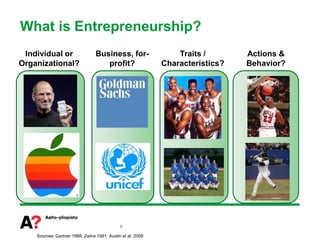
What is Entrepreneurship?
 Individual or                   Business, for-                 Traits /       Actions &
Organizational?                     profit?                 Characteristics?   Behavior?


                                             6

    Sources: Gartner 1988; Zahra 1991; Austin et al. 2006
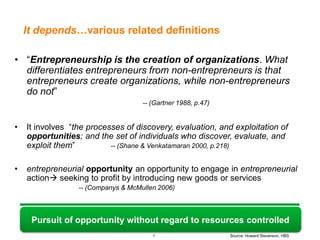
It depends…various related definitions

• “Entrepreneurship is the creation of organizations. What
  differentiates entrepreneurs from non-entrepreneurs is that
  entrepreneurs create organizations, while non-entrepreneurs
  do not”
                                     -- (Gartner 1988, p.47)


•   It involves “the processes of discovery, evaluation, and exploitation of
    opportunities; and the set of individuals who discover, evaluate, and
    exploit them”          -- (Shane & Venkatamaran 2000, p.218)


•   entrepreneurial opportunity an opportunity to engage in entrepreneurial
    action seeking to profit by introducing new goods or services
                  -- (Companys & McMullen 2006)


     Pursuit of opportunity without regard to resources controlled
                                        7                      Source: Howard Stevenson, HBS
Various types of entrepreneurship
•   Corporate entrepreneurship: “those activities that enhance a
    company's ability to innovate, take risk, and seize opportunities in its
    markets. It centers on creating new business by penetrating new
    markets, pursuing new business, or both”.         -- (Zahra 1991, 259)


•   Intrapreneurship: “entrepreneurship within existing organizations”.
    Involves new business venturing, innovativeness, self-renewal, and
    proactiveness.                        -- (Antoncic & Hisrich 2001, p. 495)


•   Social entrepreneurship: “entrepreneurial activity with an embedded
    social purpose”                                -- (Austin et al. 2006, p. 1)


•   International entrepreneurship: “the identification and exploitation of
    opportunities for international exchange”       -- Ellis (2011)


                             8
Six types of ventures…small
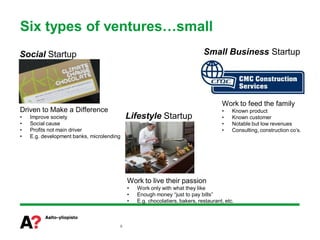
Social Startup                                                              Small Business Startup


                                                                                    Work to feed the family
Driven to Make a Difference                                                         •    Known product
•   Improve society                        Lifestyle Startup                        •    Known customer
•   Social cause                                                                    •    Notable but low revenues
•   Profits not main driver                                                         •    Consulting, construction co’s.
•   E.g. development banks, microlending


                                           Work to live their passion
                                           •   Work only with what they like
                                           •   Enough money “just to pay bills”
                                           •   E.g. chocolatiers, bakers, restaurant, etc.


                                       9
…and not so small
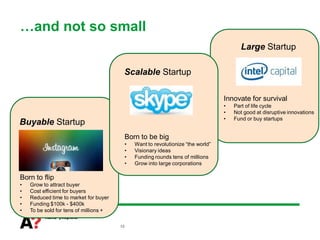
                                                                                       Large Startup

                                         Scalable Startup

                                                                                 Innovate for survival
                                                                                 •   Part of life cycle
                                                                                 •   Not good at disruptive innovations
                                                                                 •   Fund or buy startups
Buyable Startup
                                         Born to be big
                                         •   Want to revolutionize “the world”
                                         •   Visionary ideas
                                         •   Funding rounds tens of millions
                                         •   Grow into large corporations

Born to flip
•   Grow to attract buyer
•   Cost efficient for buyers
•   Reduced time to market for buyer
•   Funding $100k - $400k
•   To be sold for tens of millions +

                                        10
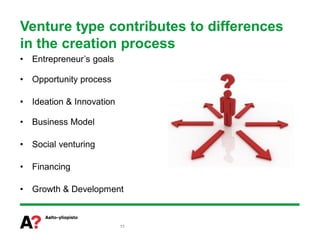
Venture type contributes to differences
in the creation process
•   Entrepreneur’s goals

•   Opportunity process

•   Ideation & Innovation

•   Business Model

•   Social venturing

•   Financing

•   Growth & Development


                            11
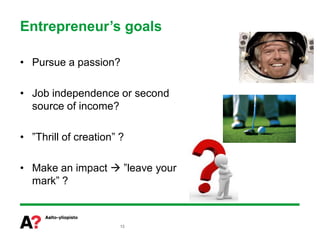
Entrepreneur’s goals

• Pursue a passion?

• Job independence or second
  source of income?

• ”Thrill of creation” ?

• Make an impact  ”leave your
  mark” ?


                       12
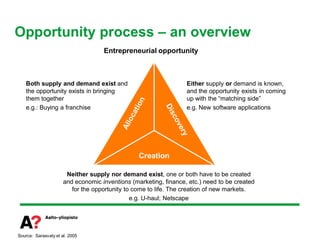
Opportunity process – an overview
                                    Entrepreneurial opportunity


   Both supply and demand exist and                               Either supply or demand is known,
   the opportunity exists in bringing                             and the opportunity exists in coming
   them together                                                  up with the “matching side”
   e.g.: Buying a franchise                                       e.g. New software applications


                                                 Creation

                       Neither supply nor demand exist, one or both have to be created
                      and economic inventions (marketing, finance, etc.) need to be created
                         for the opportunity to come to life. The creation of new markets.
                                               e.g. U-haul; Netscape


Source: Sarasvaty et al. 2005
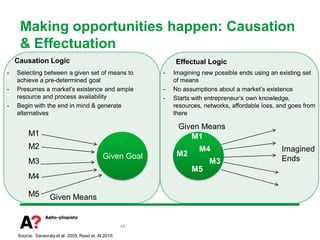
Making opportunities happen: Causation
     & Effectuation
    Causation Logic                                             Effectual Logic
-   Selecting between a given set of means to               -   Imagining new possible ends using an existing set
    achieve a pre-determined goal                               of means
-   Presumes a market’s existence and ample                 -   No assumptions about a market’s existence
    resource and process availability                       -   Starts with entrepreneur’s own knowledge,
-   Begin with the end in mind & generate                       resources, networks, affordable loss, and goes from
    alternatives                                                there

                                                                 Given Means
         M1                                                         M1
         M2                                                              M4                           Imagined
                                              Given Goal         M2
         M3                                                                 M3                        Ends
                                                                      M5
         M4

         M5         Given Means


                                                       14

    Source: Sarasvaty et al. 2005; Read et. Al 2010;
Aalto Ecosystem
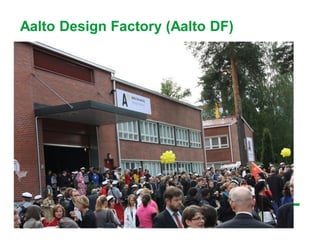
Aalto Design Factory (Aalto DF)

• What is Aalto DF?
STEP 2 - IDEATION
Ideation & Innovation varies from
 venture to venture
 Ideation: ”the first in a linear series of progressive
 activities to form a new business”


 ”Consciously engaging in an ongoing complex, cyclical,
 and recursive social process of problem solving and
 learning, which is integral to and inseparable from the
 larger cycle of innovation and new business formation”


                             18

Source: Gemmel et al. 2011
Any idea yet? – No worries!

1.   Finding a team
2.   Finding an idea
3.   Building an idea
4.   Learning to get feedback
STEP 1 - FINDING A TEAM
Match-Making PART 1

Prepare your introduction card (post-it)

1.   NAME
2.   TWO SKILLS or EXPERTISE
3.   TWO of your PASSIONS/HOBBIES/STUFF YOU LOVE
4.   A DREAM


                        5 min
Match-Making PART 2 – SPEED-MEETING

In a nutshell:
1. Sit down
2. Talk and listen for 1 minutes
3. Stand up and repeat with the next person when the whistle
blows

Suggested conversation topics:

1. Yourself:
       Educational background, work history, skills/specialties,
       ambitions
       Why am I here?
STEP 2 - FINDING AN IDEA
Ideation Topic

• Based on the features and skills of our team members,
  what sort of entrepreneurial concept can we come up
  with?
• What is the best thing that we could do together?
• What sort of idea can mix positively the
  nature/skills/passions of this group of individuals?


(Service or product, digital or concrete, for-profit or
non-profit, big or small…)
Ideation Round 1: “Quantity is Quality”

1. Individual exercise
2. 5 minutes to write down as many ideas as possible
   about the ideation topic.
3. Idea quota to aim at: 15
4. After the time is up, choose your favorite 3 ideas to
   share with the team (10min)
DECIDE ON 1 IDEA – pick the best elements
     from each idea and merge them


                5 min
STEP 3 - BUILDING ON AN IDEA
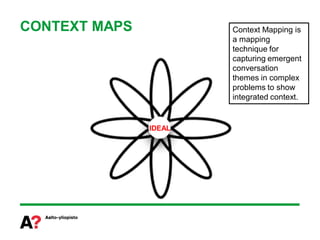
CONTEXT MAPS           Context Mapping is
                       a mapping
                       technique for
                       capturing emergent
                       conversation
                       themes in complex
                       problems to show
                       integrated context.


               IDEAL
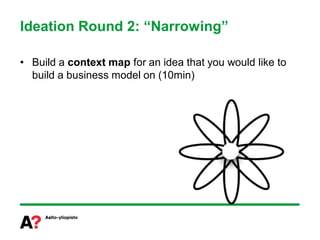
Ideation Round 2: “Narrowing”

• Build a context map for an idea that you would like to
  build a business model on (10min)
STEP 4 - LEARNING TO GET FEEDBACK


             - postponed until later -
STEP 3 – BUSINESS MODEL CREATION
What do you think is a business model?


• Video: Osterwalder
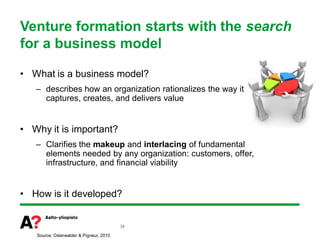
Venture formation starts with the search
for a business model

• What is a business model?
   – describes how an organization rationalizes the way it
     captures, creates, and delivers value


• Why it is important?
   – Clarifies the makeup and interlacing of fundamental
     elements needed by any organization: customers, offer,
     infrastructure, and financial viability


• How is it developed?


                                         34

   Source: Osterwalder & Pigneur, 2010
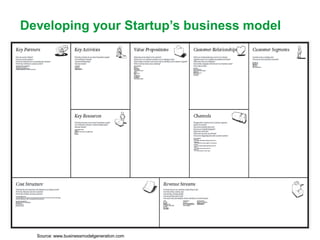
Developing your Startup’s business model


                                       35

  Source: www.businessmodelgeneration.com
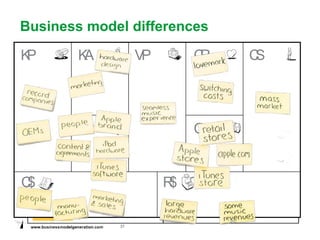
Business model differences

KP      KA        VP        CR   CS


        KR                  CH


C$                     R$

             37
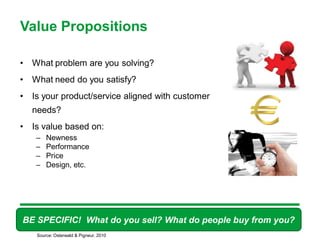
Value Propositions

•   What problem are you solving?
•   What need do you satisfy?
•   Is your product/service aligned with customer
    needs?
•   Is value based on:
     –   Newness
     –   Performance
     –   Price
     –   Design, etc.


BE SPECIFIC! What do you sell? What do people buy from you?
                                         38

     Source: Osterwald & Pigneur, 2010
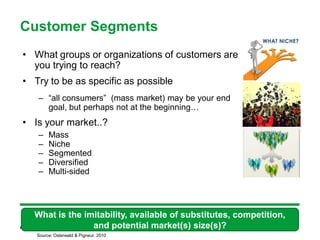
Customer Segments
• What groups or organizations of customers are
  you trying to reach?
• Try to be as specific as possible
   – “all consumers” (mass market) may be your end
     goal, but perhaps not at the beginning…
• Is your market..?
   –    Mass
   –    Niche
   –    Segmented
   –    Diversified
   –    Multi-sided


  What is the imitability, available of substitutes, competition,
                and potential market(s) size(s)?
                        39

   Source: Osterwald & Pigneur, 2010
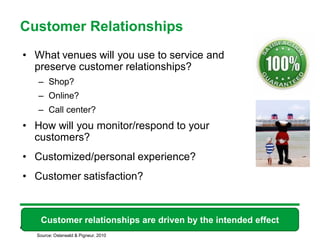
Customer Relationships
• What venues will you use to service and
  preserve customer relationships?
   – Shop?
   – Online?
   – Call center?
• How will you monitor/respond to your
  customers?
• Customized/personal experience?
• Customer satisfaction?


   Customer relationships are driven by the intended effect
                                      40

  Source: Osterwald & Pigneur, 2010
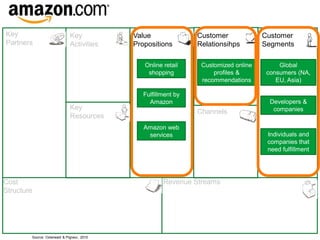
Key                           Key           Value               Customer             Customer
Partners                      Activities    Propositions        Relationsihps        Segments

                                               Online retail     Customized online        Global
                                                shopping             profiles &       consumers (NA,
                                                                 recommendations         EU, Asia)

                                               Fulfillment by
                                                 Amazon                                Developers &
                              Key                                                       companies
                                                                Channels
                              Resources
                                               Amazon web
                                                services                              Individuals and
                                                                                      companies that
                                                                                      need fulfillment


Cost                                                  Revenue Streams
Structure


        Source: Osterwald & Pigneur, 2010
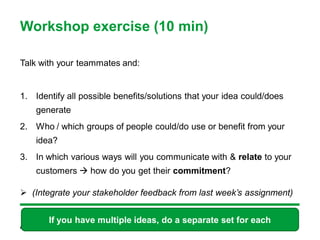
Workshop exercise (10 min)

Talk with your teammates and:


1. Identify all possible benefits/solutions that your idea could/does
    generate
2. Who / which groups of people could/do use or benefit from your
    idea?
3. In which various ways will you communicate with & relate to your
    customers  how do you get their commitment?

 (Integrate your stakeholder feedback from last week’s assignment)


       If you have multiple ideas, do a separate set for each
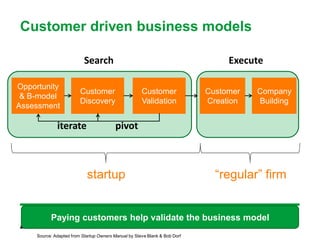
Customer driven business models

                           Search                                                Execute

Opportunity
                         Customer                     Customer              Customer   Company
 & B-model
                         Discovery                    Validation            Creation   Building
Assessment

              iterate                     pivot


                            startup                                           “regular” firm


           Paying customers help validate the business model
                                            43

     Source: Adapted from Startup Owners Manual by Steve Blank & Bob Dorf
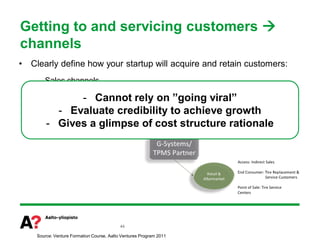
Getting to and servicing customers 
channels
•   Clearly define how your startup will acquire and retain customers:
     – Sales channels

                   - Cannot
     – Distribution channels    rely on ”going viral”
     –   Post-sales channels credibility to achieve growth
            - Evaluate
     –
         - Gives a glimpse of cost structure rationale
         Partnerships


                                            44

     Source: Venture Formation Course, Aalto Ventures Program 2011
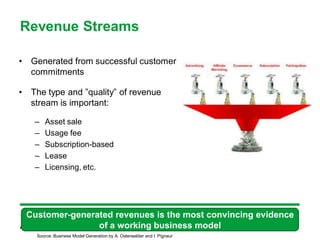
Revenue Streams

•    Generated from successful customer
     commitments

•    The type and ”quality” of revenue
     stream is important:

      –   Asset sale
      –   Usage fee
      –   Subscription-based
      –   Lease
      –   Licensing, etc.


    Customer-generated revenues is the most convincing evidence
                   of a working business model
                        45

      Source: Business Model Generation by A. Osterwalder and I. Pigneur
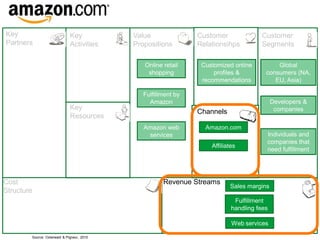
Key                           Key           Value               Customer              Customer
Partners                      Activities    Propositions        Relationsihps         Segments

                                               Online retail     Customized online          Global
                                                shopping             profiles &         consumers (NA,
                                                                 recommendations           EU, Asia)

                                               Fulfillment by
                                                 Amazon                                     Developers &
                              Key                                                            companies
                                                                Channels
                              Resources
                                               Amazon web         Amazon.com
                                                services                                Individuals and
                                                                                        companies that
                                                                    Affiliates
                                                                                        need fulfillment


Cost                                                  Revenue Streams
                                                                           Sales margins
Structure
                                                                             Fulfillment
                                                                            handling fees

                                                                            Web services

        Source: Osterwald & Pigneur, 2010
Workshop exercise (10 min)

Talk with your teammates and:

4. How does your product/service get to customers?
      a. Web sales? Shops? Distributors?

5. How do you earn revenues? Is there more than one
   way?

      a. add-on services? Customer support? After sales
servicing?

      If you have multiple ideas, do a separate set for each
                                47
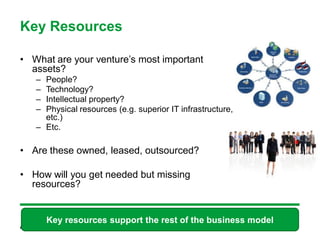
Key Resources

• What are your venture’s most important
  assets?
   – People?
   – Technology?
   – Intellectual property?
   – Physical resources (e.g. superior IT infrastructure,
     etc.)
   – Etc.

• Are these owned, leased, outsourced?

• How will you get needed but missing
  resources?


       Key resources support the rest of the business model
                          48
Key Activities

• Key activities are the most important actions your
  organization takes to:
   –   deliver value propositions
   –   Attract & retain customers
   –   earn revenues
   –   etc.

• They help identify core strengths and your venture’s
  value-add
   – Design?
   – Technology development


 Key activities link resources with the rest of the business model
                         49
Key Partners

•   Who will help you capture and deliver your value propositions?

•   Which suppliers do you need? Who are the most important?

•   Buy? Make? Lease?

•   Time to market?

•   Would any strategic partnerships help you?
    –   Joint Ventures
    –   Strategic alliances
    –   Coopetition
    –   “preferred” status / relationships


                              50
Cost Structure

•   Defines the most important costs related to the other blocks of your
    business model
•   Low cost structures are more important to some business models
    than to others
•   Despite common knowledge, it is not always about the lowest cost
     – It’s about the most efficient way to achieve your value props

•   How do you operate?
     – Cost or value driven?

     – Fixed versus variable costs?

     – Economies of scale and/or scope?


                               51
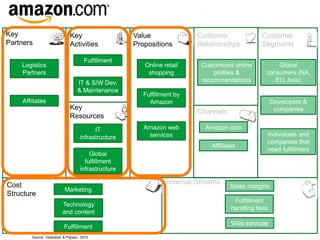
Key                           Key                    Value               Customer              Customer
Partners                      Activities             Propositions        Relationsihps         Segments

                                      Fulfillment
    Logistics                                           Online retail     Customized online          Global
    Partners                                             shopping             profiles &         consumers (NA,
                                  IT & S/W Dev.                           recommendations           EU, Asia)
                                  & Maintenance
                                                        Fulfillment by
    Affiliates                                            Amazon                                     Developers &
                              Key                                                                     companies
                                                                         Channels
                              Resources
                                          IT            Amazon web         Amazon.com
                                    infrastructure       services                                Individuals and
                                                                                                 companies that
                                                                             Affiliates
                                                                                                 need fulfillment
                                        Global
                                      fulfillment
                                    infrastructure

Cost                                                           Revenue Streams
                                                                                    Sales margins
                           Marketing
Structure
                                                                                      Fulfillment
                         Technology
                                                                                     handling fees
                         and content
                                                                                     Web services
                          Fulfillment
        Source: Osterwald & Pigneur, 2010
Workshop exercise (10 min)

Talk with your teammates and:
6. What are the most crucial resources within your team and your
   venture?
       a. Specific know-how? Geographical knowledge?
7. What are the most important activities your venture does or will
   need to do to create your value propositions?
8. Who are your most important partners?
       a. Distributors? Merchandisers?
9. What are your most substantial elements of cost?


       If you have multiple ideas, do a separate set for each
FEEDBACK/ Ideation exercise (15 minutes)
                                           single point per sticky note

Using sticky notes:
• Go around all other teams’ canvases and analyze them

   – See if you get a clear picture of what the venture does,
     who its customers/end users are, what tools they are
     using to achieve their goals

• Provide specific feedback and/or ask questions about
  each of the 9 elements

• Two types of evaluators: “Good cop / Bad cop”
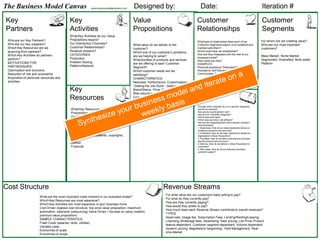
The Business Model Canvas                                    www.businessmodelgeneration.com   Designed by:                                    Date:                                                 Iteration #
Key                                          Key                                               Value                                        Customer                                                 Customer
Partners                                     Activities                                        Propositions                                 Relationsihps                                            Segments
                                             What Key Activities do our Value
 Who are our Key Partners?                   Propositions require?                                                                                                                                   For whom are we creating value?
                                                                                                                                            What type of relationship does each of our
 Who are our key suppliers?                  Our Distribution Channels?                        What value do we deliver to the              Customer Segments expect us to establish and             Who are our most important
 Which Key Resources are we                  Customer Relationships?                           customer?                                    maintain with them?                                      customers?
 acquiring from partners?                    Revenue streams?                                  Which one of our customer’s problems         Which ones have we established?
 Which Key Activities do partners            CATEGORIES                                                                                     How are they integrated with the rest of our
                                                                                               are we helping to solve?                                                                              Mass Market; Niche Market;
                                             Production                                                                                     business model?
 perform?                                                                                      What bundles of products and services                                                                 Segmented; Diversified; Multi-sided
                                                                                                                                            How costly are they?
 MOTIVATIONS FOR                             Problem Solving                                   are we offering to each Customer                                                                      Platform
                                                                                                                                            EXAMPLES
 PARTNERSHIPS:                               Platform/Network                                  Segment?                                     Personal assistance; Dedicated Personal
 Optimization and economy                                                                      Which customer needs are we                  Assistance; Self-Service; Automated Services
 Reduction of risk and uncertainty                                                             satisfying?                                  Communities; Co-creation
 Acquisition of particular resources and                                                       CHARACTERISTICS
 activities                                                                                    Newness; Performance; Customization;
                                                                                               “Getting the Job Done”; Design;
                                             Key                                               Brand/Status; Price; Cost Reduction;
                                                                                               Risk reduction; Accessibility;               Channels
                                             Resources                                         Convenience/Usability

                                                                                                                                             Through which Channels do our Customer Segments
                                              What Key Resources do our Value                                                                want to be reached?
                                                                                                                                             How are we reaching them now?
                                              Propositions require?                                                                          How are our Channels integrated?
                                              Our Distribution Channels? Customer                                                            Which ones work best?
                                              Relationships?                                                                                 Which ones are most cost-efficient?
                                                                                                                                             How are we integrating them with customer routines?
                                              Revenue Streams?                                                                               channel phases:
                                              TYPES OF RESOURCES                                                                             1. Awareness: How do we raise awareness about our
                                                                                                                                             company’s products and services?
                                              Physical                                                                                       2. Evaluation: How do we help customers evaluate our
                                              Intellectual (brand patents, copyrights,                                                       organization’s Value Proposition?
                                              data)                                                                                          3. Purchase: How do we allow customers to purchase
                                                                                                                                             specific products and services?
                                              Human                                                                                          4. Delivery: How do we deliver a Value Proposition to
                                              Financial                                                                                      customers?
                                                                                                                                             5. After sales: How do we provide post-purchase
                                                                                                                                             customer support?


Cost Structure                                                                                                     Revenue Streams
                                                                                                                     For what value are our customers really willing to pay?
                        What are the most important costs inherent in our business model?
                                                                                                                     For what do they currently pay?
                        Which Key Resources are most expensive?
                                                                                                                     How are they currently paying?
                        Which Key Activities are most expensive is your business more:
                                                                                                                     How would they prefer to pay?
                        Cost Driven (leanest cost structure, low price value proposition, maximum
                                                                                                                     How much does each Revenue Stream contribute to overall revenues?
                        automation, extensive outsourcing) Value Driven ( focused on value creation,
                                                                                                                     TYPES:
                        premium value proposition)
                                                                                                                     Asset sale; Usage fee; Subscription Fees; Lending/Renting/Leasing;
                        SAMPLE CHARACTERISTICS:
                                                                                                                     Licensing; Brokerage fees; Advertising; fixed pricing; List Price; Product
                        Fixed Costs (salaries, rents, utilities)
                                                                                                                     feature dependent; Customer segment dependent; Volume dependent;
                        Variable costs
                                                                                                                     dynamic pricing; Negotiation( bargaining); Yield Management; Real-
                        Economies of scale
                                                                                                                     time-Market
                        Economies of scope
THANKS


Global Entrepreneurship Week event of FCCU and Aalto
University
The HEI ICI — Project Entrepreneurship Capacity
Building between Faculty of Commerce Cairo University
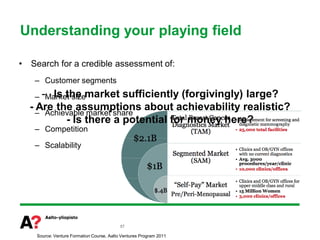
Understanding your playing field

•   Search for a credible assessment of:
     – Customer segments

     – -Market sizemarket
          Is the            sufficiently (forgivingly) large?
    - – Achievable market share about achievability realistic?
      Are the assumptions
             - Is there a potential for money here?
     – Competition

     – Scalability


                                            57

     Source: Venture Formation Course, Aalto Ventures Program 2011
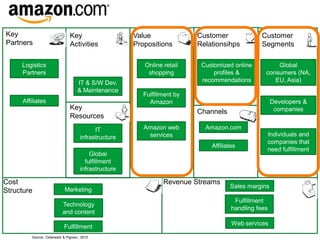
Key                            Key                    Value               Customer              Customer
Partners                       Activities             Propositions        Relationsihps         Segments

     Logistics                                           Online retail     Customized online          Global
     Partners                                             shopping             profiles &         consumers (NA,
                                   IT & S/W Dev.                           recommendations           EU, Asia)
                                   & Maintenance
                                                         Fulfillment by
     Affiliates                                            Amazon                                     Developers &
                               Key                                                                     companies
                                                                          Channels
                               Resources
                                           IT            Amazon web         Amazon.com
                                     infrastructure       services                                Individuals and
                                                                                                  companies that
                                                                              Affiliates
                                                                                                  need fulfillment
                                         Global
                                       fulfillment
                                     infrastructure

Cost                                                            Revenue Streams
                                                                                     Sales margins
Structure                   Marketing
                                                                                       Fulfillment
                          Technology
                                                                                      handling fees
                          and content
                                                                                      Web services
                           Fulfillment
         Source: Osterwald & Pigneur, 2010
59

Cairo business modeling workshop

  • 1.
    Faculty of Commerce Workshop: “How ideas become opportunities - First steps of creating your own business model” Workshop Team: Vera Haataja Povilas Valiauga Steffen Farny Norris Krueger Global Entrepreneurship Week event of FCCU and Aalto University The HEI ICI — Project Entrepreneurship Capacity Building between Faculty of Commerce Cairo University and Aalto University School of Business
  • 2.
    Workshop Objective  Introducethe ‘business model’ concept  Demonstrate the value of ‘ideation’  Build your first own business model – Tool: Canvas THIS WORKSHOP IS FOR YOU AND YOUR PERSONAL DEVELOPMENT
  • 3.
    Workshop Agenda 1. Whatis entrepreneurship? 2. What is your idea for venture creation? 3. How can you build an executable business model?
  • 4.
    Passion for entrepreneurship? • Why are you here? • Why are you interested in entrepreneurship? • What motivates you? • Are you already entrepreneurs or know someone who is?
  • 5.
    STEP 1 -ENTREPRENEURSHIP
  • 6.
    What is Entrepreneurship? Individual or Business, for- Traits / Actions & Organizational? profit? Characteristics? Behavior? 6 Sources: Gartner 1988; Zahra 1991; Austin et al. 2006
  • 7.
    It depends…various relateddefinitions • “Entrepreneurship is the creation of organizations. What differentiates entrepreneurs from non-entrepreneurs is that entrepreneurs create organizations, while non-entrepreneurs do not” -- (Gartner 1988, p.47) • It involves “the processes of discovery, evaluation, and exploitation of opportunities; and the set of individuals who discover, evaluate, and exploit them” -- (Shane & Venkatamaran 2000, p.218) • entrepreneurial opportunity an opportunity to engage in entrepreneurial action seeking to profit by introducing new goods or services -- (Companys & McMullen 2006) Pursuit of opportunity without regard to resources controlled 7 Source: Howard Stevenson, HBS
  • 8.
    Various types ofentrepreneurship • Corporate entrepreneurship: “those activities that enhance a company's ability to innovate, take risk, and seize opportunities in its markets. It centers on creating new business by penetrating new markets, pursuing new business, or both”. -- (Zahra 1991, 259) • Intrapreneurship: “entrepreneurship within existing organizations”. Involves new business venturing, innovativeness, self-renewal, and proactiveness. -- (Antoncic & Hisrich 2001, p. 495) • Social entrepreneurship: “entrepreneurial activity with an embedded social purpose” -- (Austin et al. 2006, p. 1) • International entrepreneurship: “the identification and exploitation of opportunities for international exchange” -- Ellis (2011) 8
  • 9.
    Six types ofventures…small Social Startup Small Business Startup Work to feed the family Driven to Make a Difference • Known product • Improve society Lifestyle Startup • Known customer • Social cause • Notable but low revenues • Profits not main driver • Consulting, construction co’s. • E.g. development banks, microlending Work to live their passion • Work only with what they like • Enough money “just to pay bills” • E.g. chocolatiers, bakers, restaurant, etc. 9
  • 10.
    …and not sosmall Large Startup Scalable Startup Innovate for survival • Part of life cycle • Not good at disruptive innovations • Fund or buy startups Buyable Startup Born to be big • Want to revolutionize “the world” • Visionary ideas • Funding rounds tens of millions • Grow into large corporations Born to flip • Grow to attract buyer • Cost efficient for buyers • Reduced time to market for buyer • Funding $100k - $400k • To be sold for tens of millions + 10
  • 11.
    Venture type contributesto differences in the creation process • Entrepreneur’s goals • Opportunity process • Ideation & Innovation • Business Model • Social venturing • Financing • Growth & Development 11
  • 12.
    Entrepreneur’s goals • Pursuea passion? • Job independence or second source of income? • ”Thrill of creation” ? • Make an impact  ”leave your mark” ? 12
  • 13.
    Opportunity process –an overview Entrepreneurial opportunity Both supply and demand exist and Either supply or demand is known, the opportunity exists in bringing and the opportunity exists in coming them together up with the “matching side” e.g.: Buying a franchise e.g. New software applications Creation Neither supply nor demand exist, one or both have to be created and economic inventions (marketing, finance, etc.) need to be created for the opportunity to come to life. The creation of new markets. e.g. U-haul; Netscape Source: Sarasvaty et al. 2005
  • 14.
    Making opportunities happen:Causation & Effectuation Causation Logic Effectual Logic - Selecting between a given set of means to - Imagining new possible ends using an existing set achieve a pre-determined goal of means - Presumes a market’s existence and ample - No assumptions about a market’s existence resource and process availability - Starts with entrepreneur’s own knowledge, - Begin with the end in mind & generate resources, networks, affordable loss, and goes from alternatives there Given Means M1 M1 M2 M4 Imagined Given Goal M2 M3 M3 Ends M5 M4 M5 Given Means 14 Source: Sarasvaty et al. 2005; Read et. Al 2010;
  • 15.
  • 16.
    Aalto Design Factory(Aalto DF) • What is Aalto DF?
  • 17.
    STEP 2 -IDEATION
  • 18.
    Ideation & Innovationvaries from venture to venture Ideation: ”the first in a linear series of progressive activities to form a new business” ”Consciously engaging in an ongoing complex, cyclical, and recursive social process of problem solving and learning, which is integral to and inseparable from the larger cycle of innovation and new business formation” 18 Source: Gemmel et al. 2011
  • 20.
    Any idea yet?– No worries! 1. Finding a team 2. Finding an idea 3. Building an idea 4. Learning to get feedback
  • 21.
    STEP 1 -FINDING A TEAM
  • 22.
    Match-Making PART 1 Prepareyour introduction card (post-it) 1. NAME 2. TWO SKILLS or EXPERTISE 3. TWO of your PASSIONS/HOBBIES/STUFF YOU LOVE 4. A DREAM 5 min
  • 23.
    Match-Making PART 2– SPEED-MEETING In a nutshell: 1. Sit down 2. Talk and listen for 1 minutes 3. Stand up and repeat with the next person when the whistle blows Suggested conversation topics: 1. Yourself: Educational background, work history, skills/specialties, ambitions Why am I here?
  • 24.
    STEP 2 -FINDING AN IDEA
  • 25.
    Ideation Topic • Basedon the features and skills of our team members, what sort of entrepreneurial concept can we come up with? • What is the best thing that we could do together? • What sort of idea can mix positively the nature/skills/passions of this group of individuals? (Service or product, digital or concrete, for-profit or non-profit, big or small…)
  • 26.
    Ideation Round 1:“Quantity is Quality” 1. Individual exercise 2. 5 minutes to write down as many ideas as possible about the ideation topic. 3. Idea quota to aim at: 15 4. After the time is up, choose your favorite 3 ideas to share with the team (10min)
  • 27.
    DECIDE ON 1IDEA – pick the best elements from each idea and merge them 5 min
  • 28.
    STEP 3 -BUILDING ON AN IDEA
  • 29.
    CONTEXT MAPS Context Mapping is a mapping technique for capturing emergent conversation themes in complex problems to show integrated context. IDEAL
  • 30.
    Ideation Round 2:“Narrowing” • Build a context map for an idea that you would like to build a business model on (10min)
  • 31.
    STEP 4 -LEARNING TO GET FEEDBACK - postponed until later -
  • 32.
    STEP 3 –BUSINESS MODEL CREATION
  • 33.
    What do youthink is a business model? • Video: Osterwalder
  • 34.
    Venture formation startswith the search for a business model • What is a business model? – describes how an organization rationalizes the way it captures, creates, and delivers value • Why it is important? – Clarifies the makeup and interlacing of fundamental elements needed by any organization: customers, offer, infrastructure, and financial viability • How is it developed? 34 Source: Osterwalder & Pigneur, 2010
  • 35.
    Developing your Startup’sbusiness model 35 Source: www.businessmodelgeneration.com
  • 37.
    Business model differences KP KA VP CR CS KR CH C$ R$ 37
  • 38.
    Value Propositions • What problem are you solving? • What need do you satisfy? • Is your product/service aligned with customer needs? • Is value based on: – Newness – Performance – Price – Design, etc. BE SPECIFIC! What do you sell? What do people buy from you? 38 Source: Osterwald & Pigneur, 2010
  • 39.
    Customer Segments • Whatgroups or organizations of customers are you trying to reach? • Try to be as specific as possible – “all consumers” (mass market) may be your end goal, but perhaps not at the beginning… • Is your market..? – Mass – Niche – Segmented – Diversified – Multi-sided What is the imitability, available of substitutes, competition, and potential market(s) size(s)? 39 Source: Osterwald & Pigneur, 2010
  • 40.
    Customer Relationships • Whatvenues will you use to service and preserve customer relationships? – Shop? – Online? – Call center? • How will you monitor/respond to your customers? • Customized/personal experience? • Customer satisfaction? Customer relationships are driven by the intended effect 40 Source: Osterwald & Pigneur, 2010
  • 41.
    Key Key Value Customer Customer Partners Activities Propositions Relationsihps Segments Online retail Customized online Global shopping profiles & consumers (NA, recommendations EU, Asia) Fulfillment by Amazon Developers & Key companies Channels Resources Amazon web services Individuals and companies that need fulfillment Cost Revenue Streams Structure Source: Osterwald & Pigneur, 2010
  • 42.
    Workshop exercise (10min) Talk with your teammates and: 1. Identify all possible benefits/solutions that your idea could/does generate 2. Who / which groups of people could/do use or benefit from your idea? 3. In which various ways will you communicate with & relate to your customers  how do you get their commitment?  (Integrate your stakeholder feedback from last week’s assignment) If you have multiple ideas, do a separate set for each
  • 43.
    Customer driven businessmodels Search Execute Opportunity Customer Customer Customer Company & B-model Discovery Validation Creation Building Assessment iterate pivot startup “regular” firm Paying customers help validate the business model 43 Source: Adapted from Startup Owners Manual by Steve Blank & Bob Dorf
  • 44.
    Getting to andservicing customers  channels • Clearly define how your startup will acquire and retain customers: – Sales channels - Cannot – Distribution channels rely on ”going viral” – Post-sales channels credibility to achieve growth - Evaluate – - Gives a glimpse of cost structure rationale Partnerships 44 Source: Venture Formation Course, Aalto Ventures Program 2011
  • 45.
    Revenue Streams • Generated from successful customer commitments • The type and ”quality” of revenue stream is important: – Asset sale – Usage fee – Subscription-based – Lease – Licensing, etc. Customer-generated revenues is the most convincing evidence of a working business model 45 Source: Business Model Generation by A. Osterwalder and I. Pigneur
  • 46.
    Key Key Value Customer Customer Partners Activities Propositions Relationsihps Segments Online retail Customized online Global shopping profiles & consumers (NA, recommendations EU, Asia) Fulfillment by Amazon Developers & Key companies Channels Resources Amazon web Amazon.com services Individuals and companies that Affiliates need fulfillment Cost Revenue Streams Sales margins Structure Fulfillment handling fees Web services Source: Osterwald & Pigneur, 2010
  • 47.
    Workshop exercise (10min) Talk with your teammates and: 4. How does your product/service get to customers? a. Web sales? Shops? Distributors? 5. How do you earn revenues? Is there more than one way? a. add-on services? Customer support? After sales servicing? If you have multiple ideas, do a separate set for each 47
  • 48.
    Key Resources • Whatare your venture’s most important assets? – People? – Technology? – Intellectual property? – Physical resources (e.g. superior IT infrastructure, etc.) – Etc. • Are these owned, leased, outsourced? • How will you get needed but missing resources? Key resources support the rest of the business model 48
  • 49.
    Key Activities • Keyactivities are the most important actions your organization takes to: – deliver value propositions – Attract & retain customers – earn revenues – etc. • They help identify core strengths and your venture’s value-add – Design? – Technology development Key activities link resources with the rest of the business model 49
  • 50.
    Key Partners • Who will help you capture and deliver your value propositions? • Which suppliers do you need? Who are the most important? • Buy? Make? Lease? • Time to market? • Would any strategic partnerships help you? – Joint Ventures – Strategic alliances – Coopetition – “preferred” status / relationships 50
  • 51.
    Cost Structure • Defines the most important costs related to the other blocks of your business model • Low cost structures are more important to some business models than to others • Despite common knowledge, it is not always about the lowest cost – It’s about the most efficient way to achieve your value props • How do you operate? – Cost or value driven? – Fixed versus variable costs? – Economies of scale and/or scope? 51
  • 52.
    Key Key Value Customer Customer Partners Activities Propositions Relationsihps Segments Fulfillment Logistics Online retail Customized online Global Partners shopping profiles & consumers (NA, IT & S/W Dev. recommendations EU, Asia) & Maintenance Fulfillment by Affiliates Amazon Developers & Key companies Channels Resources IT Amazon web Amazon.com infrastructure services Individuals and companies that Affiliates need fulfillment Global fulfillment infrastructure Cost Revenue Streams Sales margins Marketing Structure Fulfillment Technology handling fees and content Web services Fulfillment Source: Osterwald & Pigneur, 2010
  • 53.
    Workshop exercise (10min) Talk with your teammates and: 6. What are the most crucial resources within your team and your venture? a. Specific know-how? Geographical knowledge? 7. What are the most important activities your venture does or will need to do to create your value propositions? 8. Who are your most important partners? a. Distributors? Merchandisers? 9. What are your most substantial elements of cost? If you have multiple ideas, do a separate set for each
  • 54.
    FEEDBACK/ Ideation exercise(15 minutes) single point per sticky note Using sticky notes: • Go around all other teams’ canvases and analyze them – See if you get a clear picture of what the venture does, who its customers/end users are, what tools they are using to achieve their goals • Provide specific feedback and/or ask questions about each of the 9 elements • Two types of evaluators: “Good cop / Bad cop”
  • 55.
    The Business ModelCanvas www.businessmodelgeneration.com Designed by: Date: Iteration # Key Key Value Customer Customer Partners Activities Propositions Relationsihps Segments What Key Activities do our Value Who are our Key Partners? Propositions require? For whom are we creating value? What type of relationship does each of our Who are our key suppliers? Our Distribution Channels? What value do we deliver to the Customer Segments expect us to establish and Who are our most important Which Key Resources are we Customer Relationships? customer? maintain with them? customers? acquiring from partners? Revenue streams? Which one of our customer’s problems Which ones have we established? Which Key Activities do partners CATEGORIES How are they integrated with the rest of our are we helping to solve? Mass Market; Niche Market; Production business model? perform? What bundles of products and services Segmented; Diversified; Multi-sided How costly are they? MOTIVATIONS FOR Problem Solving are we offering to each Customer Platform EXAMPLES PARTNERSHIPS: Platform/Network Segment? Personal assistance; Dedicated Personal Optimization and economy Which customer needs are we Assistance; Self-Service; Automated Services Reduction of risk and uncertainty satisfying? Communities; Co-creation Acquisition of particular resources and CHARACTERISTICS activities Newness; Performance; Customization; “Getting the Job Done”; Design; Key Brand/Status; Price; Cost Reduction; Risk reduction; Accessibility; Channels Resources Convenience/Usability Through which Channels do our Customer Segments What Key Resources do our Value want to be reached? How are we reaching them now? Propositions require? How are our Channels integrated? Our Distribution Channels? Customer Which ones work best? Relationships? Which ones are most cost-efficient? How are we integrating them with customer routines? Revenue Streams? channel phases: TYPES OF RESOURCES 1. Awareness: How do we raise awareness about our company’s products and services? Physical 2. Evaluation: How do we help customers evaluate our Intellectual (brand patents, copyrights, organization’s Value Proposition? data) 3. Purchase: How do we allow customers to purchase specific products and services? Human 4. Delivery: How do we deliver a Value Proposition to Financial customers? 5. After sales: How do we provide post-purchase customer support? Cost Structure Revenue Streams For what value are our customers really willing to pay? What are the most important costs inherent in our business model? For what do they currently pay? Which Key Resources are most expensive? How are they currently paying? Which Key Activities are most expensive is your business more: How would they prefer to pay? Cost Driven (leanest cost structure, low price value proposition, maximum How much does each Revenue Stream contribute to overall revenues? automation, extensive outsourcing) Value Driven ( focused on value creation, TYPES: premium value proposition) Asset sale; Usage fee; Subscription Fees; Lending/Renting/Leasing; SAMPLE CHARACTERISTICS: Licensing; Brokerage fees; Advertising; fixed pricing; List Price; Product Fixed Costs (salaries, rents, utilities) feature dependent; Customer segment dependent; Volume dependent; Variable costs dynamic pricing; Negotiation( bargaining); Yield Management; Real- Economies of scale time-Market Economies of scope
  • 56.
    THANKS Global Entrepreneurship Weekevent of FCCU and Aalto University The HEI ICI — Project Entrepreneurship Capacity Building between Faculty of Commerce Cairo University
  • 57.
    Understanding your playingfield • Search for a credible assessment of: – Customer segments – -Market sizemarket Is the sufficiently (forgivingly) large? - – Achievable market share about achievability realistic? Are the assumptions - Is there a potential for money here? – Competition – Scalability 57 Source: Venture Formation Course, Aalto Ventures Program 2011
  • 58.
    Key Key Value Customer Customer Partners Activities Propositions Relationsihps Segments Logistics Online retail Customized online Global Partners shopping profiles & consumers (NA, IT & S/W Dev. recommendations EU, Asia) & Maintenance Fulfillment by Affiliates Amazon Developers & Key companies Channels Resources IT Amazon web Amazon.com infrastructure services Individuals and companies that Affiliates need fulfillment Global fulfillment infrastructure Cost Revenue Streams Sales margins Structure Marketing Fulfillment Technology handling fees and content Web services Fulfillment Source: Osterwald & Pigneur, 2010
  • 59.