Information Literacy in the Development Paradigm Shamprasad Pujar and Julie Brittain IGIDR and BLDS
Agenda What is information literacy? Why information literacy? Information literacy in the development    environment Intermediaries role in information literacy Information literacy planned by IDS    Knowledge Services Proposal to ACU-DelPHI
Question for discussion:  What do participants understand by the term ‘information literacy’?  (5 minutes in groups then report back)
What is information literacy? Has traditionally been used in Higher Education  environments to describe the skills associated with searching for,  finding, and using information (i.e. students information skills)  More recently this has tended to focus on Internet searching skills
Information Literacy: “ The ability (skills) to identify, locate, evaluate, organize and effectively create, use and communicate information from a variety of  sources to address an issue or a problem”  [Wijetunge  and Alahakoon, 2005]  “ Knowing when and why you need information, where to find it, and how to evaluate, use and communicate it in an ethical manner” (CILIP, 2007)
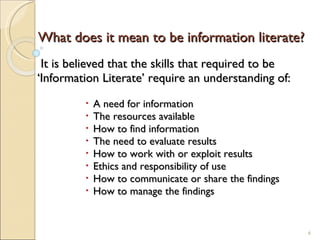
What does it mean to be information literate? It is believed that the skills that required to be  ‘Information Literate’ require an understanding of:  A need for information  The resources available  How to find information  The need to evaluate results  How to work with or exploit results  Ethics and responsibility of use  How to communicate or share the findings  How to manage the findings
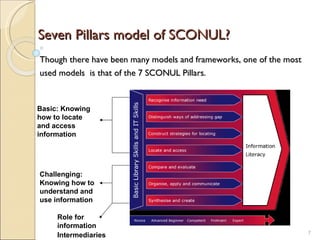
Seven Pillars model of SCONUL? Though there have been many models and frameworks, one of the most used models  is that of the 7 SCONUL Pillars.  Basic: Knowing how to locate and access information Challenging: Knowing how to understand and use information Role for information Intermediaries
Intermediaries role in increasing demand for information: Interpret, translate and if required re-package information to better suit specific community    needs i.e. make a value addition to the    information Enable researchers and policy makers to    understand specialized information Make information easier to use    Example: ELDIS, OII etc
Key problem:  Access is not enough!
The information landscape: Overabundant supply of information in different    formats Lack of skills among policy makers and researchers in    finding relevant and quality information, especially    freely available electronic information Limited use of quality research available locally and    internationally, may be due to lack of suitable    information environment Possibly leading to:  Poor quality research papers not based on most up-to-date  methods and findings Lack of evidence-based policy decisions
Basic information literacy programmes are being run    by local and international organizations (primarily for    students and researchers) Often focus on either simple search skills or on    specific databases (PERI, Research4Life) Despite very different methods, materials and even    size of course  participants success rate is variable Result is that participants continue to get irrelevant    information Information literacy in the development environment
Information Capability Emerging thinking in information literacy field is the recognition that information literacy training needs to be recognized as ‘behaviour change’ and the importance of: ‘ contextualization’ of course content i.e. embedding the course in    participants local context ‘ incentivisation’ i.e. ensuring that participants are motivated to    change their behaviour Also important is recognizing the working environment i.e. ensuring that participants have the necessary tools to change their behaviour (infrastructure and empowerment) IDS Knowledge Services staff have started to refer to this behaviour change as  ‘Information Capability’
Questions:   What is your experience of information literacy/capability initiatives? Do you run any information literacy training in your organisation? (20 min discussion and report back)
Information literacy work planned by IDS Knowledge Services An annual International/regional conference/s bringing together organisations and individuals working in the development field on information literacy initiatives Development of appropriate M&E indicators to measure success of interventions Development of an information capability training for trainers course for information staff working with  development researchers   and   practitioners
Proposal to ACU-DelPHE  Development Partnerships in Higher Education (DelPHE) programme launched its fifth call for applications in September 2009, applications deadline fall in early 2010 DelPHE  particularly encourages south-south  collaborations and also one partner can be taken from UK Funding is available for different areas, one which is of concern to us is ‘ Professional development and staff training  ‘ Planned for submission of proposal to take up the Information Literacy in the Development Environment project [IGIDR has taken a lead and is looking for other partners, especially from Africa] http://www.acu.ac.uk/key_strengths/delphe/about
Potential collaborations: ACU-DelPHE :  Scope for collaboration with other interested I-K-Mediary members organizations, especially from African region The project proposal, if approved may be effective for a period of 3 years The areas of collaborations includes professional training and development through workshops, conferences etc IDS Knowledge Services:  Scope for collaboration with other interested I-K-Mediary member organizations in relation to IDS KS planned activities
Questions/Discussion (open or closed?) Do you have any questions for us? Would you be interested in becoming involved with either of these collaborative opportunities? Do you know of other partners that we could work with in  your country?
Thanks E-mail:  [email_address]   [email_address]

Information literacy presentation

  • 1.
    Information Literacy inthe Development Paradigm Shamprasad Pujar and Julie Brittain IGIDR and BLDS
  • 2.
    Agenda What isinformation literacy? Why information literacy? Information literacy in the development environment Intermediaries role in information literacy Information literacy planned by IDS Knowledge Services Proposal to ACU-DelPHI
  • 3.
    Question for discussion: What do participants understand by the term ‘information literacy’? (5 minutes in groups then report back)
  • 4.
    What is informationliteracy? Has traditionally been used in Higher Education environments to describe the skills associated with searching for, finding, and using information (i.e. students information skills) More recently this has tended to focus on Internet searching skills
  • 5.
    Information Literacy: “The ability (skills) to identify, locate, evaluate, organize and effectively create, use and communicate information from a variety of sources to address an issue or a problem” [Wijetunge and Alahakoon, 2005] “ Knowing when and why you need information, where to find it, and how to evaluate, use and communicate it in an ethical manner” (CILIP, 2007)
  • 6.
    What does itmean to be information literate? It is believed that the skills that required to be ‘Information Literate’ require an understanding of: A need for information The resources available How to find information The need to evaluate results How to work with or exploit results Ethics and responsibility of use How to communicate or share the findings How to manage the findings
  • 7.
    Seven Pillars modelof SCONUL? Though there have been many models and frameworks, one of the most used models is that of the 7 SCONUL Pillars. Basic: Knowing how to locate and access information Challenging: Knowing how to understand and use information Role for information Intermediaries
  • 8.
    Intermediaries role inincreasing demand for information: Interpret, translate and if required re-package information to better suit specific community needs i.e. make a value addition to the information Enable researchers and policy makers to understand specialized information Make information easier to use Example: ELDIS, OII etc
  • 9.
    Key problem: Access is not enough!
  • 10.
    The information landscape:Overabundant supply of information in different formats Lack of skills among policy makers and researchers in finding relevant and quality information, especially freely available electronic information Limited use of quality research available locally and internationally, may be due to lack of suitable information environment Possibly leading to: Poor quality research papers not based on most up-to-date methods and findings Lack of evidence-based policy decisions
  • 11.
    Basic information literacyprogrammes are being run by local and international organizations (primarily for students and researchers) Often focus on either simple search skills or on specific databases (PERI, Research4Life) Despite very different methods, materials and even size of course participants success rate is variable Result is that participants continue to get irrelevant information Information literacy in the development environment
  • 12.
    Information Capability Emergingthinking in information literacy field is the recognition that information literacy training needs to be recognized as ‘behaviour change’ and the importance of: ‘ contextualization’ of course content i.e. embedding the course in participants local context ‘ incentivisation’ i.e. ensuring that participants are motivated to change their behaviour Also important is recognizing the working environment i.e. ensuring that participants have the necessary tools to change their behaviour (infrastructure and empowerment) IDS Knowledge Services staff have started to refer to this behaviour change as ‘Information Capability’
  • 13.
    Questions: What is your experience of information literacy/capability initiatives? Do you run any information literacy training in your organisation? (20 min discussion and report back)
  • 14.
    Information literacy workplanned by IDS Knowledge Services An annual International/regional conference/s bringing together organisations and individuals working in the development field on information literacy initiatives Development of appropriate M&E indicators to measure success of interventions Development of an information capability training for trainers course for information staff working with  development researchers and practitioners
  • 15.
    Proposal to ACU-DelPHE Development Partnerships in Higher Education (DelPHE) programme launched its fifth call for applications in September 2009, applications deadline fall in early 2010 DelPHE particularly encourages south-south collaborations and also one partner can be taken from UK Funding is available for different areas, one which is of concern to us is ‘ Professional development and staff training ‘ Planned for submission of proposal to take up the Information Literacy in the Development Environment project [IGIDR has taken a lead and is looking for other partners, especially from Africa] http://www.acu.ac.uk/key_strengths/delphe/about
  • 16.
    Potential collaborations: ACU-DelPHE: Scope for collaboration with other interested I-K-Mediary members organizations, especially from African region The project proposal, if approved may be effective for a period of 3 years The areas of collaborations includes professional training and development through workshops, conferences etc IDS Knowledge Services: Scope for collaboration with other interested I-K-Mediary member organizations in relation to IDS KS planned activities
  • 17.
    Questions/Discussion (open orclosed?) Do you have any questions for us? Would you be interested in becoming involved with either of these collaborative opportunities? Do you know of other partners that we could work with in your country?
  • 18.
    Thanks E-mail: [email_address] [email_address]

Editor's Notes

  • #9 In other words, intermediaries try and make information easier to use
  • #12 In other words, intermediaries try and make information easier to use
  • #14 Questions: What is your experience of information literacy/capability initiatives? Do you run any information literacy training in your organisation?
  • #15 In November 2009 BLDS piloted a course for MA students on a distance learning course (Participation, Power and Social Change) where the information literacy course was embedded into the curriculum, demonstrating the sources and also gave students an opportunity to map their research dissertation topic with mind maps and talk about other sources i.e. peers & networks