Anti-HLA Antibodies and
Outcomes after
Cord Blood Transplantation
Annalisa Ruggeri, MD
Eurocord, Hôpital Saint Louis, Paris
Background
• Delayed hematopoietic recoveryand graft failure (GF)
are critical complications of cord blood
transplantation(UCBT) and are associated with TNC or
CD34 cell dose and HLA disparities
• Other factors such as anti HLA-antibodies in the
recipient may be associated with transplant outcomes
• Anti-HLA antibodies in the recipient may be unspecific
or donor specific (DSA), directed to an antigens found
in the graft
Background
• In solid organ transplant, DSA is associated with organ
rejection and poor outcomes
• In unrelated donor recipients, Spellman et al. reported
pre-transplant anti-HLA antibodies associated to GF
and mortality. Interestingly, in this case control study,
higher frequency of DSA anti HLADP was reported
• In UCBT, DSA has also been associated with transplant
outcomes, including GF. However, authors report
different findings regarding the impact of DSA in UCBT
Takanashi, Blood 2010
•386 patients with malignant diseases
•single UCBT and MAC regimen
•89 (23%) pts had anti HLA antibody positive screening
•20 pts had DSA against the CB (15 vs. HLA class I, 5
vs. class II)
•Assays with 1000 mean fluorescent intensity (MFI)
above baseline were considered positive
Results
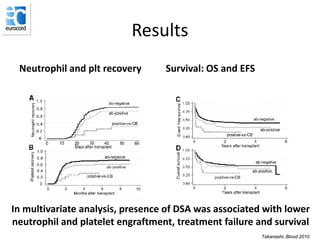
Neutrophil and plt recovery Survival: OS and EFS
Takanashi, Blood 2010
In multivariate analysis, presence of DSA was associated with lower
neutrophil and platelet engraftment, treatment failure and survival
Conclusion
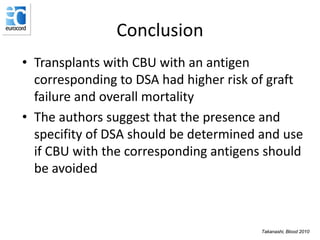
• Transplants with CBU with an antigen
corresponding to DSA had higher risk of graft
failure and overall mortality
• The authors suggest that the presence and
specifity of DSA should be determined and use
if CBU with the corresponding antigens should
be avoided
Takanashi, Blood 2010
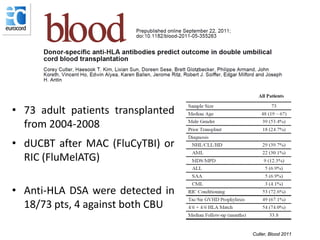
• 73 adult patients transplanted
from 2004-2008
• dUCBT after MAC (FluCyTBI) or
RIC (FluMelATG)
• Anti-HLA DSA were detected in
18/73 pts, 4 against both CBU
Cutler, Blood 2011
Methods
• Patients plasma samples were analyzed for the presence of anti-
HLA antibodies (vs. HLA-A, B, C, DR, DQ)
• Assays with 1000 mean fluorescent intensity (MFI) above baseline
were considered positive
• Anti-HLA antibody were considered for analysis if directed against
class I or II HLA specificities found in CBU
Cutler, Blood 2011
Results- Graft Failure
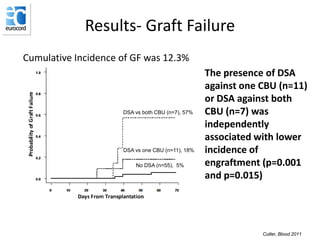
Cumulative Incidence of GF was 12.3%
DSA vs both CBU (n=7), 57%
DSA vs one CBU (n=11), 18%
No DSA (n=55), 5%
The presence of DSA
against one CBU (n=11)
or DSA against both
CBU (n=7) was
independently
associated with lower
incidence of
engraftment (p=0.001
and p=0.015)
Cutler, Blood 2011
Results- Early Mortality
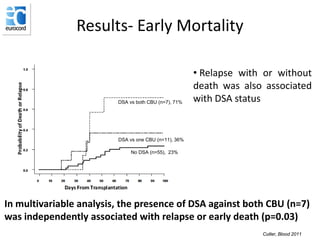
DSA vs both CBU (n=7), 71%
DSA vs one CBU (n=11), 36%
No DSA (n=55), 23%
• Relapse with or without
death was also associated
with DSA status
In multivariable analysis, the presence of DSA against both CBU (n=7)
was independently associated with relapse or early death (p=0.03)
Cutler, Blood 2011
Results- Survival
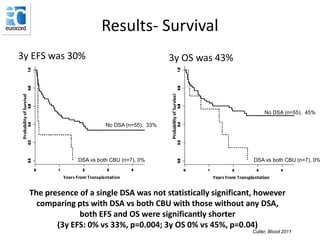
3y EFS was 30% 3y OS was 43%
The presence of a single DSA was not statistically significant, however
comparing pts with DSA vs both CBU with those without any DSA,
both EFS and OS were significantly shorter
(3y EFS: 0% vs 33%, p=0.004; 3y OS 0% vs 45%, p=0.04)
DSA vs both CBU (n=7), 0%
No DSA (n=55), 33%
DSA vs both CBU (n=7), 0%
No DSA (n=55), 45%
Cutler, Blood 2011
Conclusion
• The presence of pre-formed DSA against CBU
increases the incidence of graft failure, delays
neutrophil and platelet engraftment
• Findings demonstrate the necessity of screening of
DSA before CBU selection. The presence of DSAs
should be an important factor in the selection
algorithm
Cutler, Blood 2011
Brunstein, BBMT 2011
•297 patients received a dUCBT from 2004-2009
•126 patients had stored plasma for testing for anti-HLA ab
•Anti-HLA ab were positive in 50 of the 126 pts (41%)
•Of the 50 patients with one or more anti-HLA ab:
-12 (24%) had a DSA that targeted 1 CBU
-6 (12%) had a DSA that targeted both CBU
Assays with 500 MFI above baseline were considered
positive
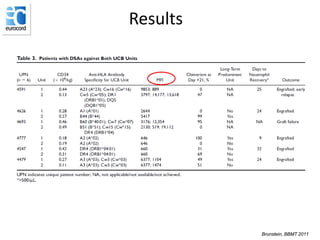
Results
• The CI of neutrophil engraftment for patients with DSA
against 1 CBU was 78%, (median 24.5 days) and was 86% in
patients with no antibody, (median 19 days), p=0.25
• Of the 12 patients with a DSA vs 1 or 2 CBU, the targeted
unit was detectable in 9 patients
• Of the 6 patients with DSA vs both CBU, 5 engrafted, with
the predominance of only 1 CBU in 4 cases, whereas in the
other 2 cases both CBU coexisted at day +21
Brunstein, BBMT 2011
Results
Brunstein, BBMT 2011
Conclusion
• Contrarily two the other two studies, Brunstein showed no
association between the presence of DSA and transplant
outcomes after double UCBT, however the threshold for DSA
positivity was different
• Homogeneous techniques are needed
Brunstein, BBMT 2011
Haematologica 2013
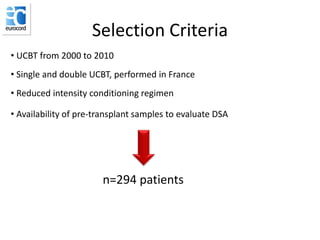
Selection Criteria
• UCBT from 2000 to 2010
• Single and double UCBT, performed in France
• Reduced intensity conditioning regimen
• Availability of pre-transplant samples to evaluate DSA
n=294 patients
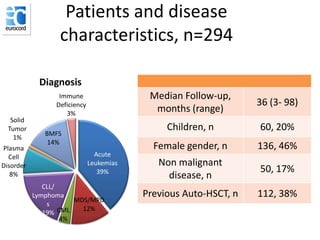
Patients and disease
characteristics, n=294
Diagnosis
Acute
Leukemias
39%
MDS/MPD
12%CML
4%
CLL/
Lymphoma
s
19%
Plasma
Cell
Disorder
8%
Solid
Tumor
1%
BMFS
14%
Immune
Deficiency
3%
Median Follow-up,
months (range)
36 (3- 98)
Children, n 60, 20%
Female gender, n 136, 46%
Non malignant
disease, n
50, 17%
Previous Auto-HSCT, n 112, 38%
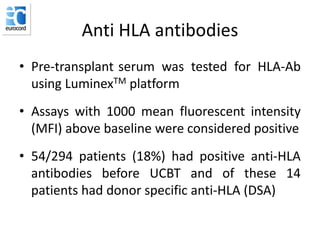
Anti HLA antibodies
• Pre-transplant serum was tested for HLA-Ab
using LuminexTM platform
• Assays with 1000 mean fluorescent intensity
(MFI) above baseline were considered positive
• 54/294 patients (18%) had positive anti-HLA
antibodies before UCBT and of these 14
patients had donor specific anti-HLA (DSA)
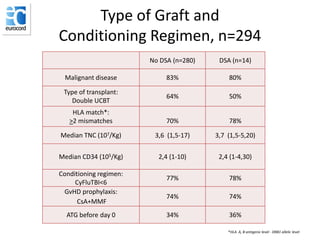
Type of Graft and
Conditioning Regimen, n=294
*HLA A, B antigenic level - DRB1 allelic level
No DSA (n=280) DSA (n=14)
Malignant disease 83% 80%
Type of transplant:
Double UCBT
64% 50%
HLA match*:
>2 mismatches 70% 78%
Median TNC (107/Kg) 3,6 (1,5-17) 3,7 (1,5-5,20)
Median CD34 (105/Kg) 2,4 (1-10) 2,4 (1-4,30)
Conditioning regimen:
CyFluTBI<6
77% 78%
GvHD prophylaxis:
CsA+MMF
74% 74%
ATG before day 0 34% 36%
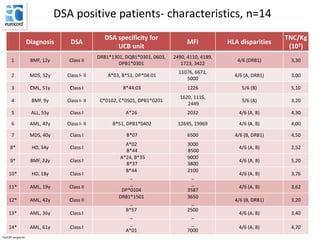
Diagnosis DSA
DSA specificity for
UCB unit
MFI HLA disparities
TNC/Kg
(107)
1 BMF, 12y Class II
DRB1*1301, DQB1*0301, 0603,
DPB1*0301
2490, 4110, 4189,
1723, 3422
4/6 (DRB1) 3,30
2 MDS, 52y Class I- II A*03, B*51, DP*04:01
11076, 6672,
5000
4/6 (A, DRB1) 3,00
3 CML, 51y Class I B*44:03 1226 5/6 (B) 5,10
4 BMF, 9y Class I- II C*0102, C*0501, DPB1*0201
1620, 1115,
2449
5/6 (A) 3,20
5 ALL, 55y Class I A*26 2032 4/6 (A, B) 4,30
6 AML, 47y Class I- II B*51, DPB1*0402 12695, 19969 4/6 (A, B) 4,00
7 MDS, 40y Class I B*07 6500 4/6 (B, DRB1) 4,50
8* HD, 34y Class I
A*02
B*44
3000
8500
4/6 (A, B) 2,52
9* BMF, 22y Class I
A*24, B*35
B*37
9000
3800
4/6 (A, B) 5,20
10* HD, 18y Class I
B*44
_
2100
_
4/6 (A, B) 3,76
11* AML, 19y Class II
_
DP*0104
_
3587
4/6 (A, B) 3,62
12* AML, 42y Class II
DRB1*1501
_
3650
_
4/6 (B, DRB1) 3,20
13* AML, 36y Class I
B*57
_
2500
_
4/6 (A, B) 3,40
14* AML, 61y Class I
_
A*01
_
7000
4/6 (A, B) 4,70
DSA positive patients- characteristics, n=14
*dUCBT recipients
0 10 20 30 40 50 60
Days
0.00.20.40.60.81.0
CumIncNeutrophilEngraftment
No DSA, n=280
DSA, n=14
Results- Neutrophil Engraftment by
DSA
No DSA: 78±3%
p=0.003
DSA: 44±8%
•The intensity of DSA measured by MFI correlates with the
occurrence of graft failure
All the 6 patients with DSA who engrafted had MFI lower
than median (3900). The median MFI among the DSA
patients who experienced graft failure was 7750 (range
2032-19969), and it was 2474 (range 1226-3650) in the DSA
patients who engrafted (P=0.004)
Results- Neutrophil Engraftment and Survival for
DSA positive patients
MFI Chimerism
Engraftment
(days)
Other
treatment
Outcome
Follow-up
(months)
1
2490, 4110, 4189,
1723, 3422
NT No 2nd UCBT Dead- Rejection 3
2
11076, 6672,
5000
NT No Auto HSCT Dead- Rejection 1
3 1226 Full Donor Day 17 Alive 13
4
1620, 1115,
2449
Full Donor Day 18 Dead- Infection 3
5 2032 Autologous No Dead- Relapse 8
6 12695, 19969 Autologous No Alive 59
7 6500 Autologous No Dead- Relapse 3
8*
3000
8500
NT No 2nd UCBT Alive 56
9*
9000
3800
NT No Dead- Relapse 2
10* 2100 Full Donor Day 15 Alive 23
11* 3587 Full Donor Day 8 Dead- Relapse 3
12* 3650 Full Donor Day 24 Dead- GvHD 5
13* 2500 Mixed Chimera Day 17 Dead- Infection 7
14* 7000 Autologous No Dead- Rejection 1
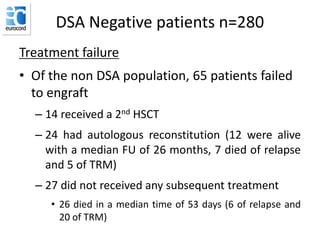
DSA Negative patients n=280
Treatment failure
• Of the non DSA population, 65 patients failed
to engraft
– 14 received a 2nd HSCT
– 24 had autologous reconstitution (12 were alive
with a median FU of 26 months, 7 died of relapse
and 5 of TRM)
– 27 did not received any subsequent treatment
• 26 died in a median time of 53 days (6 of relapse and
20 of TRM)
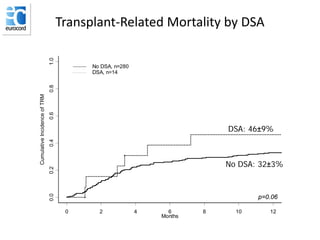
0 2 4 6 8 10 12
Months
0.00.20.40.60.81.0
CumulativeIncidenceofTRM
No DSA, n=280
DSA, n=14
Transplant-Related Mortality by DSA
p=0.06
No DSA: 32±3%
DSA: 46±9%
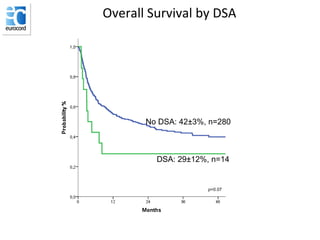
p=0.07
Overall Survival by DSA
No DSA: 42±3%, n=280
DSA: 29±12%, n=14
Conclusion
•Our findings confirm that the presence of DSA in recipients
measured by Luminex assay (>1000 MFI), is associated with
significantly higher graft failure after single or double UCBT with RIC
•In the different published studies the frequency of DSA ranges
from 0.5% in the Japanese group to 20% in the American reports
•This difference in frequency may due to Tx center policy (recipients
systematic screening) and use of leukocyte reduced cellular blood
component
•Considering feasibility, in France, the average cost for screening for
DSA identification is 250 euros
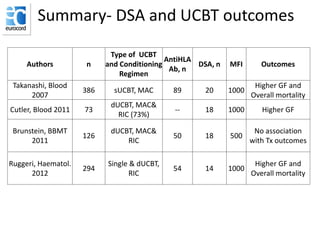
Summary- DSA and UCBT outcomes
Authors n
Type of UCBT
and Conditioning
Regimen
AntiHLA
Ab, n
DSA, n MFI Outcomes
Takanashi, Blood
2007
386 sUCBT, MAC 89 20 1000
Higher GF and
Overall mortality
Cutler, Blood 2011 73
dUCBT, MAC&
RIC (73%)
-- 18 1000 Higher GF
Brunstein, BBMT
2011
126
dUCBT, MAC&
RIC
50 18 500
No association
with Tx outcomes
Ruggeri, Haematol.
2012
294
Single & dUCBT,
RIC
54 14 1000
Higher GF and
Overall mortality
Summary
•Pre-formed DSA directed against CBU have a deleterious impact
on transplant outcomes
•Recipient screening and identification of DSA should be performed
using standardized methodology as part of donor selection
•Strategies such as plasma or B-cell depletion to minimize the
detrimental effect of DSA on transplant outcomes might be
considered. However, the benefit of long lasting immune depletion
should be carefully considered
•Avoid the selection of DSA positive-CB unit is recommended
whenever possible
•Other factors such as cell dose and HLA matching must always be
taken in consideration in the donor selection algorithm
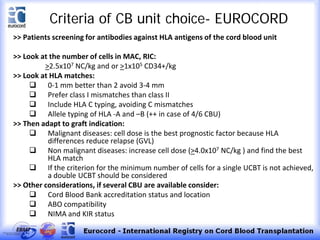
Criteria of CB unit choice- EUROCORD
>> Patients screening for antibodies against HLA antigens of the cord blood unit
>> Look at the number of cells in MAC, RIC:
>2.5x10⁷ NC/kg and or >1x10⁵ CD34+/kg
>> Look at HLA matches:
 0-1 mm better than 2 avoid 3-4 mm
 Prefer class I mismatches than class II
 Include HLA C typing, avoiding C mismatches
 Allele typing of HLA -A and –B (++ in case of 4/6 CBU)
>> Then adapt to graft indication:
 Malignant diseases: cell dose is the best prognostic factor because HLA
differences reduce relapse (GVL)
 Non malignant diseases: increase cell dose (>4.0x10⁷ NC/kg ) and find the best
HLA match
 If the criterion for the minimum number of cells for a single UCBT is not achieved,
a double UCBT should be considered
>> Other considerations, if several CBU are available consider:
 Cord Blood Bank accreditation status and location
 ABO compatibility
 NIMA and KIR status
Acknowledgments
EBMT, CIBMTR
Transplant Centers
(Data Managers, Nurses and Physicians)
Cord Blood Banks and Netcord
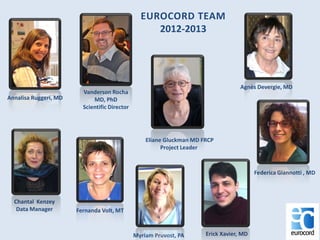
Eliane Gluckman MD FRCP
Project Leader
Vanderson Rocha
MD, PhD
Scientific Director
Annalisa Ruggeri, MD
Agnès Devergie, MD
Federica Giannotti , MD
Myriam Pruvost, PA
Fernanda Volt, MT
Chantal Kenzey
Data Manager
EUROCORD TEAM
2012-2013
Erick Xavier, MD

Anti-HLA Antibodies and Outcomes after Cord Blood Transplantation

  • 1.
    Anti-HLA Antibodies and Outcomesafter Cord Blood Transplantation Annalisa Ruggeri, MD Eurocord, Hôpital Saint Louis, Paris
  • 2.
    Background • Delayed hematopoieticrecoveryand graft failure (GF) are critical complications of cord blood transplantation(UCBT) and are associated with TNC or CD34 cell dose and HLA disparities • Other factors such as anti HLA-antibodies in the recipient may be associated with transplant outcomes • Anti-HLA antibodies in the recipient may be unspecific or donor specific (DSA), directed to an antigens found in the graft
  • 3.
    Background • In solidorgan transplant, DSA is associated with organ rejection and poor outcomes • In unrelated donor recipients, Spellman et al. reported pre-transplant anti-HLA antibodies associated to GF and mortality. Interestingly, in this case control study, higher frequency of DSA anti HLADP was reported • In UCBT, DSA has also been associated with transplant outcomes, including GF. However, authors report different findings regarding the impact of DSA in UCBT
  • 4.
    Takanashi, Blood 2010 •386patients with malignant diseases •single UCBT and MAC regimen •89 (23%) pts had anti HLA antibody positive screening •20 pts had DSA against the CB (15 vs. HLA class I, 5 vs. class II) •Assays with 1000 mean fluorescent intensity (MFI) above baseline were considered positive
  • 5.
    Results Neutrophil and pltrecovery Survival: OS and EFS Takanashi, Blood 2010 In multivariate analysis, presence of DSA was associated with lower neutrophil and platelet engraftment, treatment failure and survival
  • 6.
    Conclusion • Transplants withCBU with an antigen corresponding to DSA had higher risk of graft failure and overall mortality • The authors suggest that the presence and specifity of DSA should be determined and use if CBU with the corresponding antigens should be avoided Takanashi, Blood 2010
  • 7.
    • 73 adultpatients transplanted from 2004-2008 • dUCBT after MAC (FluCyTBI) or RIC (FluMelATG) • Anti-HLA DSA were detected in 18/73 pts, 4 against both CBU Cutler, Blood 2011
  • 8.
    Methods • Patients plasmasamples were analyzed for the presence of anti- HLA antibodies (vs. HLA-A, B, C, DR, DQ) • Assays with 1000 mean fluorescent intensity (MFI) above baseline were considered positive • Anti-HLA antibody were considered for analysis if directed against class I or II HLA specificities found in CBU Cutler, Blood 2011
  • 9.
    Results- Graft Failure CumulativeIncidence of GF was 12.3% DSA vs both CBU (n=7), 57% DSA vs one CBU (n=11), 18% No DSA (n=55), 5% The presence of DSA against one CBU (n=11) or DSA against both CBU (n=7) was independently associated with lower incidence of engraftment (p=0.001 and p=0.015) Cutler, Blood 2011
  • 10.
    Results- Early Mortality DSAvs both CBU (n=7), 71% DSA vs one CBU (n=11), 36% No DSA (n=55), 23% • Relapse with or without death was also associated with DSA status In multivariable analysis, the presence of DSA against both CBU (n=7) was independently associated with relapse or early death (p=0.03) Cutler, Blood 2011
  • 11.
    Results- Survival 3y EFSwas 30% 3y OS was 43% The presence of a single DSA was not statistically significant, however comparing pts with DSA vs both CBU with those without any DSA, both EFS and OS were significantly shorter (3y EFS: 0% vs 33%, p=0.004; 3y OS 0% vs 45%, p=0.04) DSA vs both CBU (n=7), 0% No DSA (n=55), 33% DSA vs both CBU (n=7), 0% No DSA (n=55), 45% Cutler, Blood 2011
  • 12.
    Conclusion • The presenceof pre-formed DSA against CBU increases the incidence of graft failure, delays neutrophil and platelet engraftment • Findings demonstrate the necessity of screening of DSA before CBU selection. The presence of DSAs should be an important factor in the selection algorithm Cutler, Blood 2011
  • 13.
    Brunstein, BBMT 2011 •297patients received a dUCBT from 2004-2009 •126 patients had stored plasma for testing for anti-HLA ab •Anti-HLA ab were positive in 50 of the 126 pts (41%) •Of the 50 patients with one or more anti-HLA ab: -12 (24%) had a DSA that targeted 1 CBU -6 (12%) had a DSA that targeted both CBU Assays with 500 MFI above baseline were considered positive
  • 14.
    Results • The CIof neutrophil engraftment for patients with DSA against 1 CBU was 78%, (median 24.5 days) and was 86% in patients with no antibody, (median 19 days), p=0.25 • Of the 12 patients with a DSA vs 1 or 2 CBU, the targeted unit was detectable in 9 patients • Of the 6 patients with DSA vs both CBU, 5 engrafted, with the predominance of only 1 CBU in 4 cases, whereas in the other 2 cases both CBU coexisted at day +21 Brunstein, BBMT 2011
  • 15.
  • 16.
    Conclusion • Contrarily twothe other two studies, Brunstein showed no association between the presence of DSA and transplant outcomes after double UCBT, however the threshold for DSA positivity was different • Homogeneous techniques are needed Brunstein, BBMT 2011
  • 17.
  • 18.
    Selection Criteria • UCBTfrom 2000 to 2010 • Single and double UCBT, performed in France • Reduced intensity conditioning regimen • Availability of pre-transplant samples to evaluate DSA n=294 patients
  • 19.
    Patients and disease characteristics,n=294 Diagnosis Acute Leukemias 39% MDS/MPD 12%CML 4% CLL/ Lymphoma s 19% Plasma Cell Disorder 8% Solid Tumor 1% BMFS 14% Immune Deficiency 3% Median Follow-up, months (range) 36 (3- 98) Children, n 60, 20% Female gender, n 136, 46% Non malignant disease, n 50, 17% Previous Auto-HSCT, n 112, 38%
  • 20.
    Anti HLA antibodies •Pre-transplant serum was tested for HLA-Ab using LuminexTM platform • Assays with 1000 mean fluorescent intensity (MFI) above baseline were considered positive • 54/294 patients (18%) had positive anti-HLA antibodies before UCBT and of these 14 patients had donor specific anti-HLA (DSA)
  • 21.
    Type of Graftand Conditioning Regimen, n=294 *HLA A, B antigenic level - DRB1 allelic level No DSA (n=280) DSA (n=14) Malignant disease 83% 80% Type of transplant: Double UCBT 64% 50% HLA match*: >2 mismatches 70% 78% Median TNC (107/Kg) 3,6 (1,5-17) 3,7 (1,5-5,20) Median CD34 (105/Kg) 2,4 (1-10) 2,4 (1-4,30) Conditioning regimen: CyFluTBI<6 77% 78% GvHD prophylaxis: CsA+MMF 74% 74% ATG before day 0 34% 36%
  • 22.
    Diagnosis DSA DSA specificityfor UCB unit MFI HLA disparities TNC/Kg (107) 1 BMF, 12y Class II DRB1*1301, DQB1*0301, 0603, DPB1*0301 2490, 4110, 4189, 1723, 3422 4/6 (DRB1) 3,30 2 MDS, 52y Class I- II A*03, B*51, DP*04:01 11076, 6672, 5000 4/6 (A, DRB1) 3,00 3 CML, 51y Class I B*44:03 1226 5/6 (B) 5,10 4 BMF, 9y Class I- II C*0102, C*0501, DPB1*0201 1620, 1115, 2449 5/6 (A) 3,20 5 ALL, 55y Class I A*26 2032 4/6 (A, B) 4,30 6 AML, 47y Class I- II B*51, DPB1*0402 12695, 19969 4/6 (A, B) 4,00 7 MDS, 40y Class I B*07 6500 4/6 (B, DRB1) 4,50 8* HD, 34y Class I A*02 B*44 3000 8500 4/6 (A, B) 2,52 9* BMF, 22y Class I A*24, B*35 B*37 9000 3800 4/6 (A, B) 5,20 10* HD, 18y Class I B*44 _ 2100 _ 4/6 (A, B) 3,76 11* AML, 19y Class II _ DP*0104 _ 3587 4/6 (A, B) 3,62 12* AML, 42y Class II DRB1*1501 _ 3650 _ 4/6 (B, DRB1) 3,20 13* AML, 36y Class I B*57 _ 2500 _ 4/6 (A, B) 3,40 14* AML, 61y Class I _ A*01 _ 7000 4/6 (A, B) 4,70 DSA positive patients- characteristics, n=14 *dUCBT recipients
  • 23.
    0 10 2030 40 50 60 Days 0.00.20.40.60.81.0 CumIncNeutrophilEngraftment No DSA, n=280 DSA, n=14 Results- Neutrophil Engraftment by DSA No DSA: 78±3% p=0.003 DSA: 44±8% •The intensity of DSA measured by MFI correlates with the occurrence of graft failure All the 6 patients with DSA who engrafted had MFI lower than median (3900). The median MFI among the DSA patients who experienced graft failure was 7750 (range 2032-19969), and it was 2474 (range 1226-3650) in the DSA patients who engrafted (P=0.004)
  • 24.
    Results- Neutrophil Engraftmentand Survival for DSA positive patients MFI Chimerism Engraftment (days) Other treatment Outcome Follow-up (months) 1 2490, 4110, 4189, 1723, 3422 NT No 2nd UCBT Dead- Rejection 3 2 11076, 6672, 5000 NT No Auto HSCT Dead- Rejection 1 3 1226 Full Donor Day 17 Alive 13 4 1620, 1115, 2449 Full Donor Day 18 Dead- Infection 3 5 2032 Autologous No Dead- Relapse 8 6 12695, 19969 Autologous No Alive 59 7 6500 Autologous No Dead- Relapse 3 8* 3000 8500 NT No 2nd UCBT Alive 56 9* 9000 3800 NT No Dead- Relapse 2 10* 2100 Full Donor Day 15 Alive 23 11* 3587 Full Donor Day 8 Dead- Relapse 3 12* 3650 Full Donor Day 24 Dead- GvHD 5 13* 2500 Mixed Chimera Day 17 Dead- Infection 7 14* 7000 Autologous No Dead- Rejection 1
  • 25.
    DSA Negative patientsn=280 Treatment failure • Of the non DSA population, 65 patients failed to engraft – 14 received a 2nd HSCT – 24 had autologous reconstitution (12 were alive with a median FU of 26 months, 7 died of relapse and 5 of TRM) – 27 did not received any subsequent treatment • 26 died in a median time of 53 days (6 of relapse and 20 of TRM)
  • 26.
    0 2 46 8 10 12 Months 0.00.20.40.60.81.0 CumulativeIncidenceofTRM No DSA, n=280 DSA, n=14 Transplant-Related Mortality by DSA p=0.06 No DSA: 32±3% DSA: 46±9%
  • 27.
    p=0.07 Overall Survival byDSA No DSA: 42±3%, n=280 DSA: 29±12%, n=14
  • 28.
    Conclusion •Our findings confirmthat the presence of DSA in recipients measured by Luminex assay (>1000 MFI), is associated with significantly higher graft failure after single or double UCBT with RIC •In the different published studies the frequency of DSA ranges from 0.5% in the Japanese group to 20% in the American reports •This difference in frequency may due to Tx center policy (recipients systematic screening) and use of leukocyte reduced cellular blood component •Considering feasibility, in France, the average cost for screening for DSA identification is 250 euros
  • 29.
    Summary- DSA andUCBT outcomes Authors n Type of UCBT and Conditioning Regimen AntiHLA Ab, n DSA, n MFI Outcomes Takanashi, Blood 2007 386 sUCBT, MAC 89 20 1000 Higher GF and Overall mortality Cutler, Blood 2011 73 dUCBT, MAC& RIC (73%) -- 18 1000 Higher GF Brunstein, BBMT 2011 126 dUCBT, MAC& RIC 50 18 500 No association with Tx outcomes Ruggeri, Haematol. 2012 294 Single & dUCBT, RIC 54 14 1000 Higher GF and Overall mortality
  • 30.
    Summary •Pre-formed DSA directedagainst CBU have a deleterious impact on transplant outcomes •Recipient screening and identification of DSA should be performed using standardized methodology as part of donor selection •Strategies such as plasma or B-cell depletion to minimize the detrimental effect of DSA on transplant outcomes might be considered. However, the benefit of long lasting immune depletion should be carefully considered •Avoid the selection of DSA positive-CB unit is recommended whenever possible •Other factors such as cell dose and HLA matching must always be taken in consideration in the donor selection algorithm
  • 31.
    Criteria of CBunit choice- EUROCORD >> Patients screening for antibodies against HLA antigens of the cord blood unit >> Look at the number of cells in MAC, RIC: >2.5x10⁷ NC/kg and or >1x10⁵ CD34+/kg >> Look at HLA matches:  0-1 mm better than 2 avoid 3-4 mm  Prefer class I mismatches than class II  Include HLA C typing, avoiding C mismatches  Allele typing of HLA -A and –B (++ in case of 4/6 CBU) >> Then adapt to graft indication:  Malignant diseases: cell dose is the best prognostic factor because HLA differences reduce relapse (GVL)  Non malignant diseases: increase cell dose (>4.0x10⁷ NC/kg ) and find the best HLA match  If the criterion for the minimum number of cells for a single UCBT is not achieved, a double UCBT should be considered >> Other considerations, if several CBU are available consider:  Cord Blood Bank accreditation status and location  ABO compatibility  NIMA and KIR status
  • 32.
    Acknowledgments EBMT, CIBMTR Transplant Centers (DataManagers, Nurses and Physicians) Cord Blood Banks and Netcord
  • 33.
    Eliane Gluckman MDFRCP Project Leader Vanderson Rocha MD, PhD Scientific Director Annalisa Ruggeri, MD Agnès Devergie, MD Federica Giannotti , MD Myriam Pruvost, PA Fernanda Volt, MT Chantal Kenzey Data Manager EUROCORD TEAM 2012-2013 Erick Xavier, MD