DRUG INTERACTIONS LINKED
TO TRANSPORTERS
Prarthna Yadav
26/MPH/DPSRU/2018
INDUSTRIAL PHARMACY
CONTENTS
INTRODUCTION
BASIC MECHANISM OF
TRANSPORT
MEMBRANE TRANSPORTERS
TYPES
DRUG DRUG INTERACTIONS
INTRODUCTION
 Drug transporters mediate the uptake and efflux of a broad variety of drugs and drug
metabolites
 Drug–drug interactions is induction or inhibition of drug transporters that mediate the
cellular uptake and efflux of xenobiotic
 Drug transporters of the small intestine, liver and kidney are major determinants of the
pharmacokinetic profile of drugs
 Localized in organs such as small intestine, liver, and kidney, which are critical for drug
absorption and elimination
 Inhibition or induction of drug transporters by co administered drugs can alter
pharmacokinetics and pharmacodynamics of the victim drugs
BASIC MECHANISM OF TRANSPORT
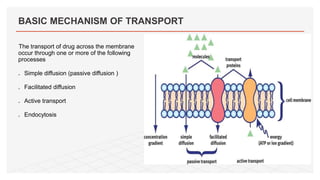
The transport of drug across the membrane
occur through one or more of the following
processes
 Simple diffusion (passive diffusion )
 Facilitated diffusion
 Active transport
 Endocytosis
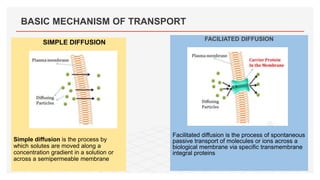
SIMPLE DIFFUSION
Simple diffusion is the process by
which solutes are moved along a
concentration gradient in a solution or
across a semipermeable membrane
BASIC MECHANISM OF TRANSPORT
FACILIATED DIFFUSION
Facilitated diffusion is the process of spontaneous
passive transport of molecules or ions across a
biological membrane via specific transmembrane
integral proteins
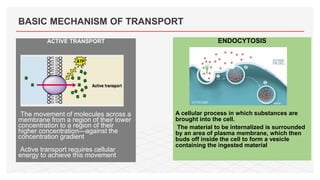
ACTIVE TRANSPORT
The movement of molecules across a
membrane from a region of their lower
concentration to a region of their
higher concentration—against the
concentration gradient
Active transport requires cellular
energy to achieve this movement
BASIC MECHANISM OF TRANSPORT
ENDOCYTOSIS
A cellular process in which substances are
brought into the cell.
The material to be internalized is surrounded
by an area of plasma membrane, which then
buds off inside the cell to form a vesicle
containing the ingested material
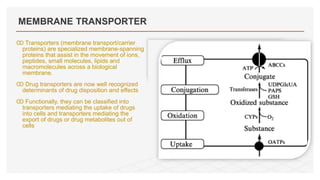
MEMBRANE TRANSPORTER
Ꙭ Transporters (membrane transport/carrier
proteins) are specialized membrane-spanning
proteins that assist in the movement of ions,
peptides, small molecules, lipids and
macromolecules across a biological
membrane.
Ꙭ Drug transporters are now well recognized
determinants of drug disposition and effects
Ꙭ Functionally, they can be classified into
transporters mediating the uptake of drugs
into cells and transporters mediating the
export of drugs or drug metabolites out of
cells
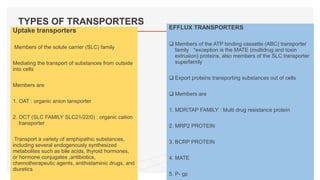
TYPES OF TRANSPORTERS
Uptake transporters
Members of the solute carrier (SLC) family
Mediating the transport of substances from outside
into cells
Members are
1. OAT : organic anion tansporter
2. OCT (SLC FAMILY SLC21/22/0) : organic cation
transporter
Transport a variety of amphipathic substances,
including several endogenously synthesized
metabolites such as bile acids, thyroid hormones,
or hormone conjugates ,antibiotics,
chemotherapeutic agents, antihistaminic drugs, and
diuretics
EFFLUX TRANSPORTERS
 Members of the ATP binding cassette (ABC) transporter
family *exception is the MATE (multidrug and toxin
extrusion) proteins, also members of the SLC transporter
superfamily
 Export proteins transporting substances out of cells
 Members are
1. MDR/TAP FAMILY : Multi drug resistance protein
2. MRP2 PROTEIN
3. BCRP PROTEIN
4. MATE
5. P- gp
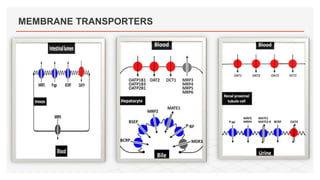
MEMBRANE TRANSPORTERS
DRUG DRUG INTERACTIONS
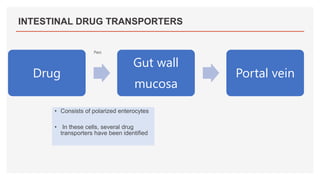
INTESTINAL DRUG TRANSPORTERS
• Consists of polarized enterocytes
• In these cells, several drug
transporters have been identified
Pass
Drug
Gut wall
mucosa
Portal vein
INTESTINAL DRUG TRANSPORTERS
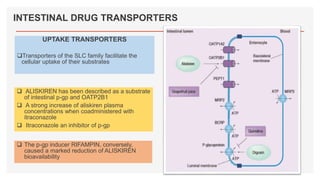
UPTAKE TRANSPORTERS
Transporters of the SLC family facilitate the
cellular uptake of their substrates
 The p-gp inducer RIFAMPIN, conversely,
caused a marked reduction of ALISKIREN
bioavailability
 ALISKIREN has been described as a substrate
of intestinal p-gp and OATP2B1
 A strong increase of aliskiren plasma
concentrations when coadministered with
itraconazole
 Itraconazole an inhibitor of p-gp
INTESTINAL DRUG TRANSPORTER
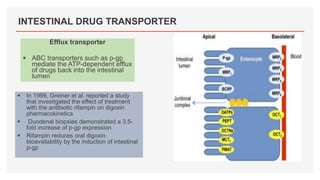
Efflux transporter
 ABC transporters such as p-gp
mediate the ATP-dependent efflux
of drugs back into the intestinal
lumen
 In 1999, Greiner et al. reported a study
that investigated the effect of treatment
with the antibiotic rifampin on digoxin
pharmacokinetics
 Duodenal biopsies demonstrated a 3.5-
fold increase of p-gp expression
 Rifampin reduces oral digoxin
bioavailability by the induction of intestinal
p-gp
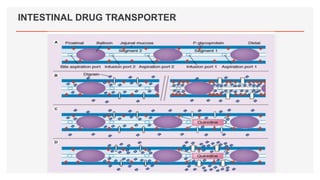
INTESTINAL DRUG TRANSPORTER
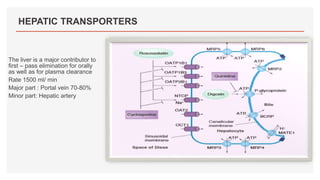
HEPATIC TRANSPORTERS
The liver is a major contributor to
first – pass elimination for orally
as well as for plasma clearance
Rate 1500 ml/ min
Major part : Portal vein 70-80%
Minor part: Hepatic artery
HEPATIC TRANSPORTERS
Uptake transporter
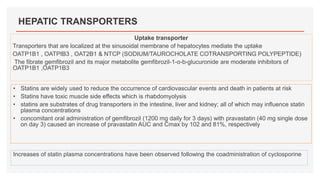
Transporters that are localized at the sinusoidal membrane of hepatocytes mediate the uptake
OATP1B1 , OATPIB3 , OAT2B1 & NTCP (SODIUM/TAUROCHOLATE COTRANSPORTING POLYPEPTIDE)
The fibrate gemfibrozil and its major metabolite gemfibrozil-1-o-b-glucuronide are moderate inhibitors of
OATP1B1 ,OATP1B3
• Statins are widely used to reduce the occurrence of cardiovascular events and death in patients at risk
• Statins have toxic muscle side effects which is rhabdomyolysis
• statins are substrates of drug transporters in the intestine, liver and kidney; all of which may influence statin
plasma concentrations
• concomitant oral administration of gemfibrozil (1200 mg daily for 3 days) with pravastatin (40 mg single dose
on day 3) caused an increase of pravastatin AUC and Cmax by 102 and 81%, respectively
Increases of statin plasma concentrations have been observed following the coadministration of cyclosporine
HEPATIC TRANSPORTERS
EFFLUX TRANSPORTER
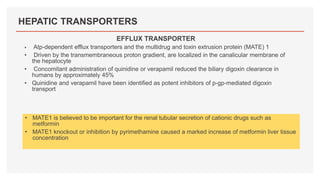
 Atp-dependent efflux transporters and the multidrug and toxin extrusion protein (MATE) 1
• Driven by the transmembraneous proton gradient, are localized in the canalicular membrane of
the hepatocyte
• Concomitant administration of quinidine or verapamil reduced the biliary digoxin clearance in
humans by approximately 45%
• Quinidine and verapamil have been identified as potent inhibitors of p-gp-mediated digoxin
transport
• MATE1 is believed to be important for the renal tubular secretion of cationic drugs such as
metformin
• MATE1 knockout or inhibition by pyrimethamine caused a marked increase of metformin liver tissue
concentration
RENAL TRANSPORTERS
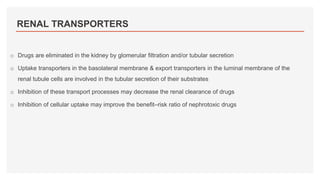
o Drugs are eliminated in the kidney by glomerular filtration and/or tubular secretion
o Uptake transporters in the basolateral membrane & export transporters in the luminal membrane of the
renal tubule cells are involved in the tubular secretion of their substrates
o Inhibition of these transport processes may decrease the renal clearance of drugs
o Inhibition of cellular uptake may improve the benefit–risk ratio of nephrotoxic drugs
RENAL TRANSPORTERS
RENAL TRANSPORTERS
UPTAKE TRANSPORTERS
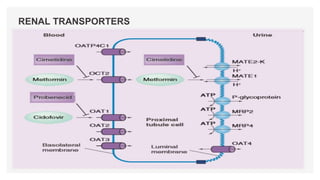
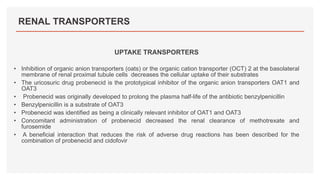
• Inhibition of organic anion transporters (oats) or the organic cation transporter (OCT) 2 at the basolateral
membrane of renal proximal tubule cells decreases the cellular uptake of their substrates
• The uricosuric drug probenecid is the prototypical inhibitor of the organic anion transporters OAT1 and
OAT3
• Probenecid was originally developed to prolong the plasma half-life of the antibiotic benzylpenicillin
• Benzylpenicillin is a substrate of OAT3
• Probenecid was identified as being a clinically relevant inhibitor of OAT1 and OAT3
• Concomitant administration of probenecid decreased the renal clearance of methotrexate and
furosemide
• A beneficial interaction that reduces the risk of adverse drug reactions has been described for the
combination of probenecid and cidofovir
RENAL TRANSPORTERS
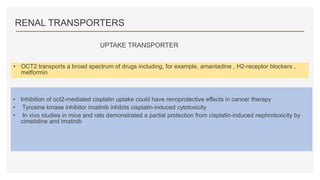
• Inhibition of oct2-mediated cisplatin uptake could have renoprotective effects in cancer therapy
• Tyrosine kinase inhibitor imatinib inhibits cisplatin-induced cytotoxicity
• In vivo studies in mice and rats demonstrated a partial protection from cisplatin-induced nephrotoxicity by
cimetidine and imatinib
• OCT2 transports a broad spectrum of drugs including, for example, amantadine , H2-receptor blockers ,
metformin
UPTAKE TRANSPORTER
RENAL TRANSPORTERS
EFFLUX TRANSPORTERS
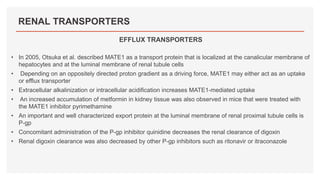
• In 2005, Otsuka et al. described MATE1 as a transport protein that is localized at the canalicular membrane of
hepatocytes and at the luminal membrane of renal tubule cells
• Depending on an oppositely directed proton gradient as a driving force, MATE1 may either act as an uptake
or efflux transporter
• Extracellular alkalinization or intracellular acidification increases MATE1-mediated uptake
• An increased accumulation of metformin in kidney tissue was also observed in mice that were treated with
the MATE1 inhibitor pyrimethamine
• An important and well characterized export protein at the luminal membrane of renal proximal tubule cells is
P-gp
• Concomitant administration of the P-gp inhibitor quinidine decreases the renal clearance of digoxin
• Renal digoxin clearance was also decreased by other P-gp inhibitors such as ritonavir or itraconazole
RENAL TRANSPORTERS
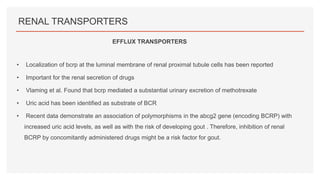
• Localization of bcrp at the luminal membrane of renal proximal tubule cells has been reported
• Important for the renal secretion of drugs
• Vlaming et al. Found that bcrp mediated a substantial urinary excretion of methotrexate
• Uric acid has been identified as substrate of BCR
• Recent data demonstrate an association of polymorphisms in the abcg2 gene (encoding BCRP) with
increased uric acid levels, as well as with the risk of developing gout . Therefore, inhibition of renal
BCRP by concomitantly administered drugs might be a risk factor for gout.
EFFLUX TRANSPORTERS
REFERENCES
• Transporters and Drug-Drug Interactions: Important Determinants of Drug
Disposition and Effectss
Jörg König, Fabian Müller, and Martin F. Fromm Institute of Experimental and
Clinical Pharmacology and Toxicology, Friedrich-Alexander-Universität
Erlangen-Nürnberg, Germany
• Transporter-mediated drug–drug interactions
Fabian Müller1 & Martin F Fromm†1 1Institute of Experimental & Clinical
Pharmacology & Toxicology, Friedrich-Alexander-Universität Erlangen-
Nürnberg, Fahrstrasse 17, 91054 Erlangen, Germany

201p

  • 1.
    DRUG INTERACTIONS LINKED TOTRANSPORTERS Prarthna Yadav 26/MPH/DPSRU/2018 INDUSTRIAL PHARMACY
  • 2.
    CONTENTS INTRODUCTION BASIC MECHANISM OF TRANSPORT MEMBRANETRANSPORTERS TYPES DRUG DRUG INTERACTIONS
  • 3.
    INTRODUCTION  Drug transportersmediate the uptake and efflux of a broad variety of drugs and drug metabolites  Drug–drug interactions is induction or inhibition of drug transporters that mediate the cellular uptake and efflux of xenobiotic  Drug transporters of the small intestine, liver and kidney are major determinants of the pharmacokinetic profile of drugs  Localized in organs such as small intestine, liver, and kidney, which are critical for drug absorption and elimination  Inhibition or induction of drug transporters by co administered drugs can alter pharmacokinetics and pharmacodynamics of the victim drugs
  • 4.
    BASIC MECHANISM OFTRANSPORT The transport of drug across the membrane occur through one or more of the following processes  Simple diffusion (passive diffusion )  Facilitated diffusion  Active transport  Endocytosis
  • 5.
    SIMPLE DIFFUSION Simple diffusionis the process by which solutes are moved along a concentration gradient in a solution or across a semipermeable membrane BASIC MECHANISM OF TRANSPORT FACILIATED DIFFUSION Facilitated diffusion is the process of spontaneous passive transport of molecules or ions across a biological membrane via specific transmembrane integral proteins
  • 6.
    ACTIVE TRANSPORT The movementof molecules across a membrane from a region of their lower concentration to a region of their higher concentration—against the concentration gradient Active transport requires cellular energy to achieve this movement BASIC MECHANISM OF TRANSPORT ENDOCYTOSIS A cellular process in which substances are brought into the cell. The material to be internalized is surrounded by an area of plasma membrane, which then buds off inside the cell to form a vesicle containing the ingested material
  • 7.
    MEMBRANE TRANSPORTER Ꙭ Transporters(membrane transport/carrier proteins) are specialized membrane-spanning proteins that assist in the movement of ions, peptides, small molecules, lipids and macromolecules across a biological membrane. Ꙭ Drug transporters are now well recognized determinants of drug disposition and effects Ꙭ Functionally, they can be classified into transporters mediating the uptake of drugs into cells and transporters mediating the export of drugs or drug metabolites out of cells
  • 8.
    TYPES OF TRANSPORTERS Uptaketransporters Members of the solute carrier (SLC) family Mediating the transport of substances from outside into cells Members are 1. OAT : organic anion tansporter 2. OCT (SLC FAMILY SLC21/22/0) : organic cation transporter Transport a variety of amphipathic substances, including several endogenously synthesized metabolites such as bile acids, thyroid hormones, or hormone conjugates ,antibiotics, chemotherapeutic agents, antihistaminic drugs, and diuretics EFFLUX TRANSPORTERS  Members of the ATP binding cassette (ABC) transporter family *exception is the MATE (multidrug and toxin extrusion) proteins, also members of the SLC transporter superfamily  Export proteins transporting substances out of cells  Members are 1. MDR/TAP FAMILY : Multi drug resistance protein 2. MRP2 PROTEIN 3. BCRP PROTEIN 4. MATE 5. P- gp
  • 9.
  • 10.
  • 11.
    INTESTINAL DRUG TRANSPORTERS •Consists of polarized enterocytes • In these cells, several drug transporters have been identified Pass Drug Gut wall mucosa Portal vein
  • 12.
    INTESTINAL DRUG TRANSPORTERS UPTAKETRANSPORTERS Transporters of the SLC family facilitate the cellular uptake of their substrates  The p-gp inducer RIFAMPIN, conversely, caused a marked reduction of ALISKIREN bioavailability  ALISKIREN has been described as a substrate of intestinal p-gp and OATP2B1  A strong increase of aliskiren plasma concentrations when coadministered with itraconazole  Itraconazole an inhibitor of p-gp
  • 13.
    INTESTINAL DRUG TRANSPORTER Effluxtransporter  ABC transporters such as p-gp mediate the ATP-dependent efflux of drugs back into the intestinal lumen  In 1999, Greiner et al. reported a study that investigated the effect of treatment with the antibiotic rifampin on digoxin pharmacokinetics  Duodenal biopsies demonstrated a 3.5- fold increase of p-gp expression  Rifampin reduces oral digoxin bioavailability by the induction of intestinal p-gp
  • 14.
  • 15.
    HEPATIC TRANSPORTERS The liveris a major contributor to first – pass elimination for orally as well as for plasma clearance Rate 1500 ml/ min Major part : Portal vein 70-80% Minor part: Hepatic artery
  • 16.
    HEPATIC TRANSPORTERS Uptake transporter Transportersthat are localized at the sinusoidal membrane of hepatocytes mediate the uptake OATP1B1 , OATPIB3 , OAT2B1 & NTCP (SODIUM/TAUROCHOLATE COTRANSPORTING POLYPEPTIDE) The fibrate gemfibrozil and its major metabolite gemfibrozil-1-o-b-glucuronide are moderate inhibitors of OATP1B1 ,OATP1B3 • Statins are widely used to reduce the occurrence of cardiovascular events and death in patients at risk • Statins have toxic muscle side effects which is rhabdomyolysis • statins are substrates of drug transporters in the intestine, liver and kidney; all of which may influence statin plasma concentrations • concomitant oral administration of gemfibrozil (1200 mg daily for 3 days) with pravastatin (40 mg single dose on day 3) caused an increase of pravastatin AUC and Cmax by 102 and 81%, respectively Increases of statin plasma concentrations have been observed following the coadministration of cyclosporine
  • 17.
    HEPATIC TRANSPORTERS EFFLUX TRANSPORTER Atp-dependent efflux transporters and the multidrug and toxin extrusion protein (MATE) 1 • Driven by the transmembraneous proton gradient, are localized in the canalicular membrane of the hepatocyte • Concomitant administration of quinidine or verapamil reduced the biliary digoxin clearance in humans by approximately 45% • Quinidine and verapamil have been identified as potent inhibitors of p-gp-mediated digoxin transport • MATE1 is believed to be important for the renal tubular secretion of cationic drugs such as metformin • MATE1 knockout or inhibition by pyrimethamine caused a marked increase of metformin liver tissue concentration
  • 18.
    RENAL TRANSPORTERS o Drugsare eliminated in the kidney by glomerular filtration and/or tubular secretion o Uptake transporters in the basolateral membrane & export transporters in the luminal membrane of the renal tubule cells are involved in the tubular secretion of their substrates o Inhibition of these transport processes may decrease the renal clearance of drugs o Inhibition of cellular uptake may improve the benefit–risk ratio of nephrotoxic drugs
  • 19.
  • 20.
    RENAL TRANSPORTERS UPTAKE TRANSPORTERS •Inhibition of organic anion transporters (oats) or the organic cation transporter (OCT) 2 at the basolateral membrane of renal proximal tubule cells decreases the cellular uptake of their substrates • The uricosuric drug probenecid is the prototypical inhibitor of the organic anion transporters OAT1 and OAT3 • Probenecid was originally developed to prolong the plasma half-life of the antibiotic benzylpenicillin • Benzylpenicillin is a substrate of OAT3 • Probenecid was identified as being a clinically relevant inhibitor of OAT1 and OAT3 • Concomitant administration of probenecid decreased the renal clearance of methotrexate and furosemide • A beneficial interaction that reduces the risk of adverse drug reactions has been described for the combination of probenecid and cidofovir
  • 21.
    RENAL TRANSPORTERS • Inhibitionof oct2-mediated cisplatin uptake could have renoprotective effects in cancer therapy • Tyrosine kinase inhibitor imatinib inhibits cisplatin-induced cytotoxicity • In vivo studies in mice and rats demonstrated a partial protection from cisplatin-induced nephrotoxicity by cimetidine and imatinib • OCT2 transports a broad spectrum of drugs including, for example, amantadine , H2-receptor blockers , metformin UPTAKE TRANSPORTER
  • 22.
    RENAL TRANSPORTERS EFFLUX TRANSPORTERS •In 2005, Otsuka et al. described MATE1 as a transport protein that is localized at the canalicular membrane of hepatocytes and at the luminal membrane of renal tubule cells • Depending on an oppositely directed proton gradient as a driving force, MATE1 may either act as an uptake or efflux transporter • Extracellular alkalinization or intracellular acidification increases MATE1-mediated uptake • An increased accumulation of metformin in kidney tissue was also observed in mice that were treated with the MATE1 inhibitor pyrimethamine • An important and well characterized export protein at the luminal membrane of renal proximal tubule cells is P-gp • Concomitant administration of the P-gp inhibitor quinidine decreases the renal clearance of digoxin • Renal digoxin clearance was also decreased by other P-gp inhibitors such as ritonavir or itraconazole
  • 23.
    RENAL TRANSPORTERS • Localizationof bcrp at the luminal membrane of renal proximal tubule cells has been reported • Important for the renal secretion of drugs • Vlaming et al. Found that bcrp mediated a substantial urinary excretion of methotrexate • Uric acid has been identified as substrate of BCR • Recent data demonstrate an association of polymorphisms in the abcg2 gene (encoding BCRP) with increased uric acid levels, as well as with the risk of developing gout . Therefore, inhibition of renal BCRP by concomitantly administered drugs might be a risk factor for gout. EFFLUX TRANSPORTERS
  • 25.
    REFERENCES • Transporters andDrug-Drug Interactions: Important Determinants of Drug Disposition and Effectss Jörg König, Fabian Müller, and Martin F. Fromm Institute of Experimental and Clinical Pharmacology and Toxicology, Friedrich-Alexander-Universität Erlangen-Nürnberg, Germany • Transporter-mediated drug–drug interactions Fabian Müller1 & Martin F Fromm†1 1Institute of Experimental & Clinical Pharmacology & Toxicology, Friedrich-Alexander-Universität Erlangen- Nürnberg, Fahrstrasse 17, 91054 Erlangen, Germany