Cache memory & Registers
By : Aiman Abbas
Cache memory
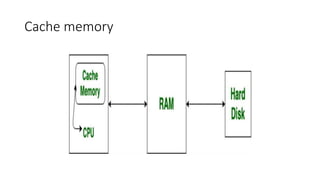
• Cache is a smaller and fast memory component in the computer
which is inserted between the CPU and the main memory. To make
this arrangement effective. The cache needs to be much faster than
main memory. This approach is more economical than the use of fast
memory devices to implement the entire main memory.
Cache memory
Register
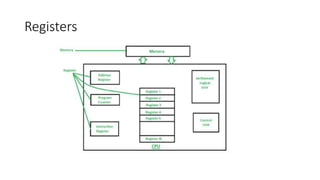
• Register are the smallest holding data elements that are built into
processor itself. These are memory locations that can be directly
accessible by processor. It holds small amount of data around 32-bits
to 64-bits and may hold an instruction, a storage address or any kind
of data such as a bit sequence or individual characters.
• For example : Accumulator register, Program counter, Instruction
register, Address register, etc.
Registers
Difference between Cache Memory and
Register :
1. Cache is a smaller and fastest memory
component in the computer.
2. Cache memory is exactly a memory unit.
3. It is used during reading and writing
processes from the disk.
4. It is a high-speed storage area for temporary
storage.
5. It copied the recently used data into.
6. It reduces the average memory access time.
7. CPU accesses memory at the faster rate than
register.
1. Registers is a small amount of fast storage
element into the processor.
2. It is located on the CPU.
3. It is used to store and retrieve information
from them.
4. It is used to store data temporarily for
processing and transfer.
5. It holds operands or instruction that CPU is
currently processing.
6. It reduces the time required to find the item
stored in memory.
7. CPU can operate on register contents at the
rate of more than one operation in one clock
cycle.

cache & register.pptx

  • 1.
    Cache memory &Registers By : Aiman Abbas
  • 2.
    Cache memory • Cacheis a smaller and fast memory component in the computer which is inserted between the CPU and the main memory. To make this arrangement effective. The cache needs to be much faster than main memory. This approach is more economical than the use of fast memory devices to implement the entire main memory.
  • 3.
  • 4.
    Register • Register arethe smallest holding data elements that are built into processor itself. These are memory locations that can be directly accessible by processor. It holds small amount of data around 32-bits to 64-bits and may hold an instruction, a storage address or any kind of data such as a bit sequence or individual characters. • For example : Accumulator register, Program counter, Instruction register, Address register, etc.
  • 5.
  • 6.
    Difference between CacheMemory and Register : 1. Cache is a smaller and fastest memory component in the computer. 2. Cache memory is exactly a memory unit. 3. It is used during reading and writing processes from the disk. 4. It is a high-speed storage area for temporary storage. 5. It copied the recently used data into. 6. It reduces the average memory access time. 7. CPU accesses memory at the faster rate than register. 1. Registers is a small amount of fast storage element into the processor. 2. It is located on the CPU. 3. It is used to store and retrieve information from them. 4. It is used to store data temporarily for processing and transfer. 5. It holds operands or instruction that CPU is currently processing. 6. It reduces the time required to find the item stored in memory. 7. CPU can operate on register contents at the rate of more than one operation in one clock cycle.