Cache on delivery
     mining memcached


    marco@sensepost.com
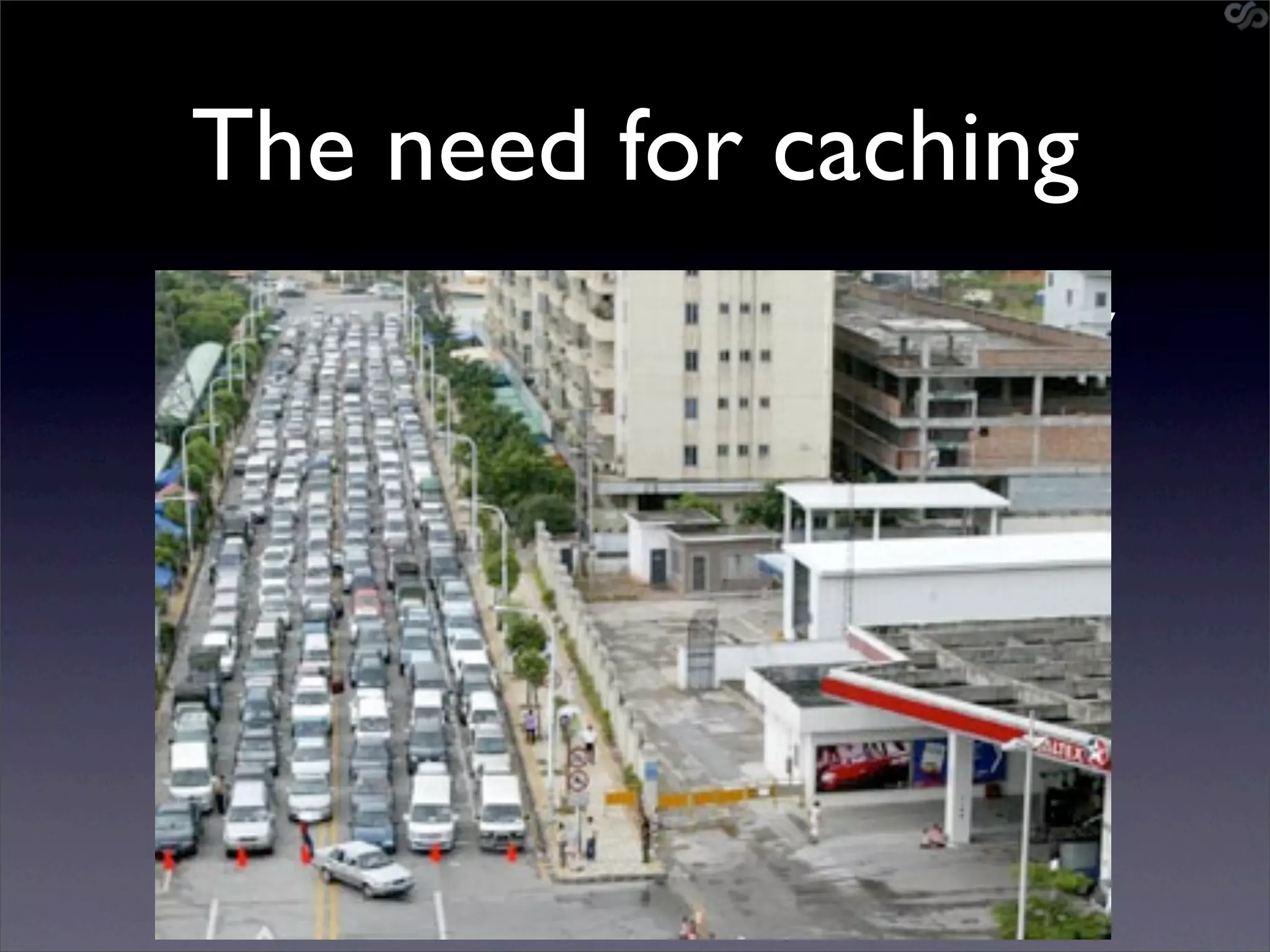
The need for caching
• Large percentage of data remains relatively
  constant
  • Wikipedia page contents
  • Youtube video links
  • FB Profile data
• Poorly designed solutions regenerate data
  on each request
• Don’t regenerate, rather regurgitate
The need for caching
• Large percentage of data remains relatively
  constant
  • Wikipedia page contents
  • Youtube video links
  • FB Profile data
• Poorly designed solutions regenerate data
  on each request
• Don’t regenerate, rather regurgitate
Memcached
• memcached.org
• Written for LJ (2003) by Brad
  Fitzpatrick
• Non-persistent network-based KV
  store
• Why do we care? Mom&pop don’t
  need the cache.
Memcached
• memcached.org
• Written for LJ (2003) by Brad
  Fitzpatrick
• Non-persistent network-based KV
  store
• Why do we care? Mom&pop don’t
  need the cache.
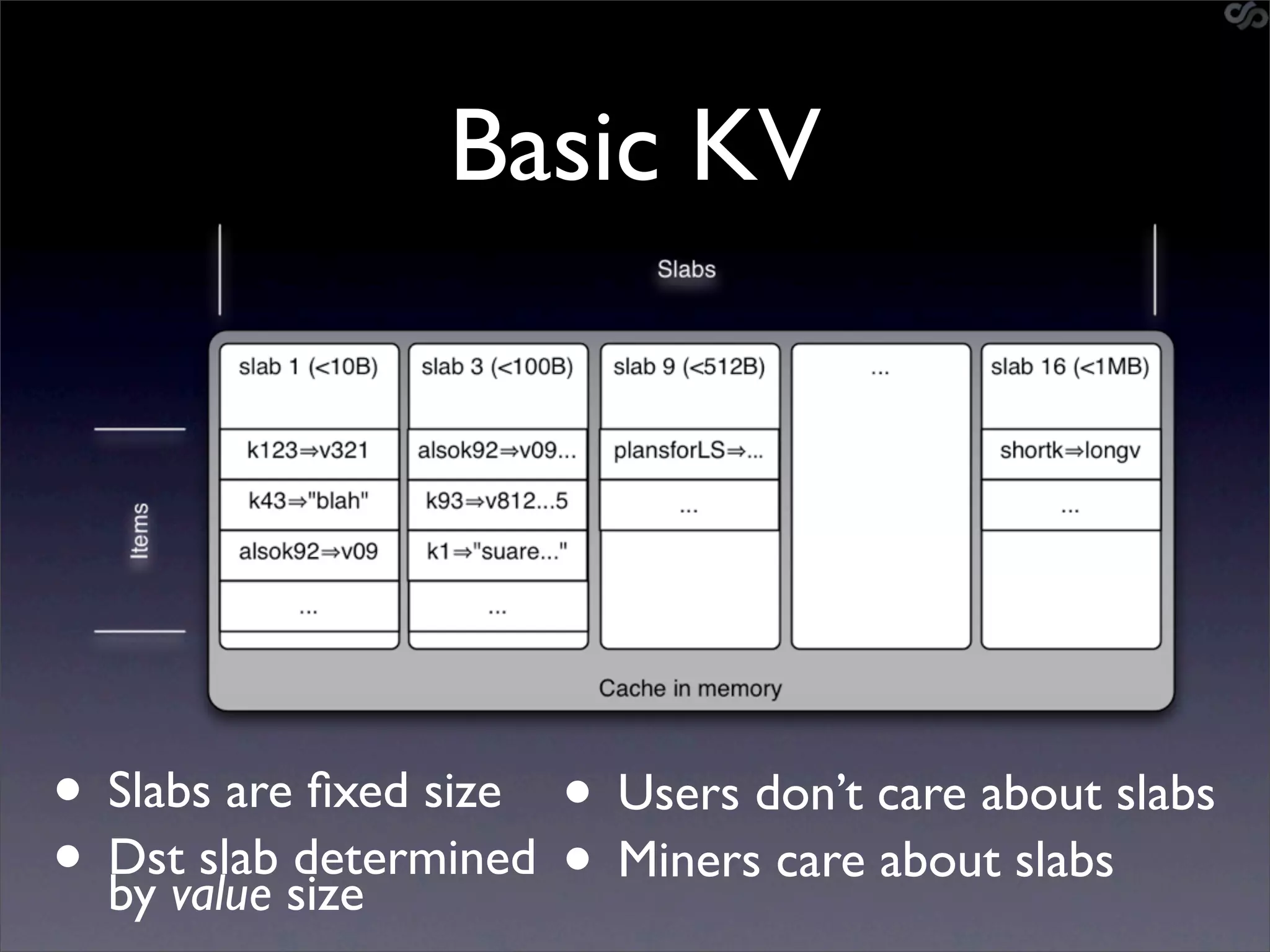
Basic KV


• Slabs are fixed size • Users don’t care about slabs
• Dstvalue size
  by
      slab determined • Miners care about slabs
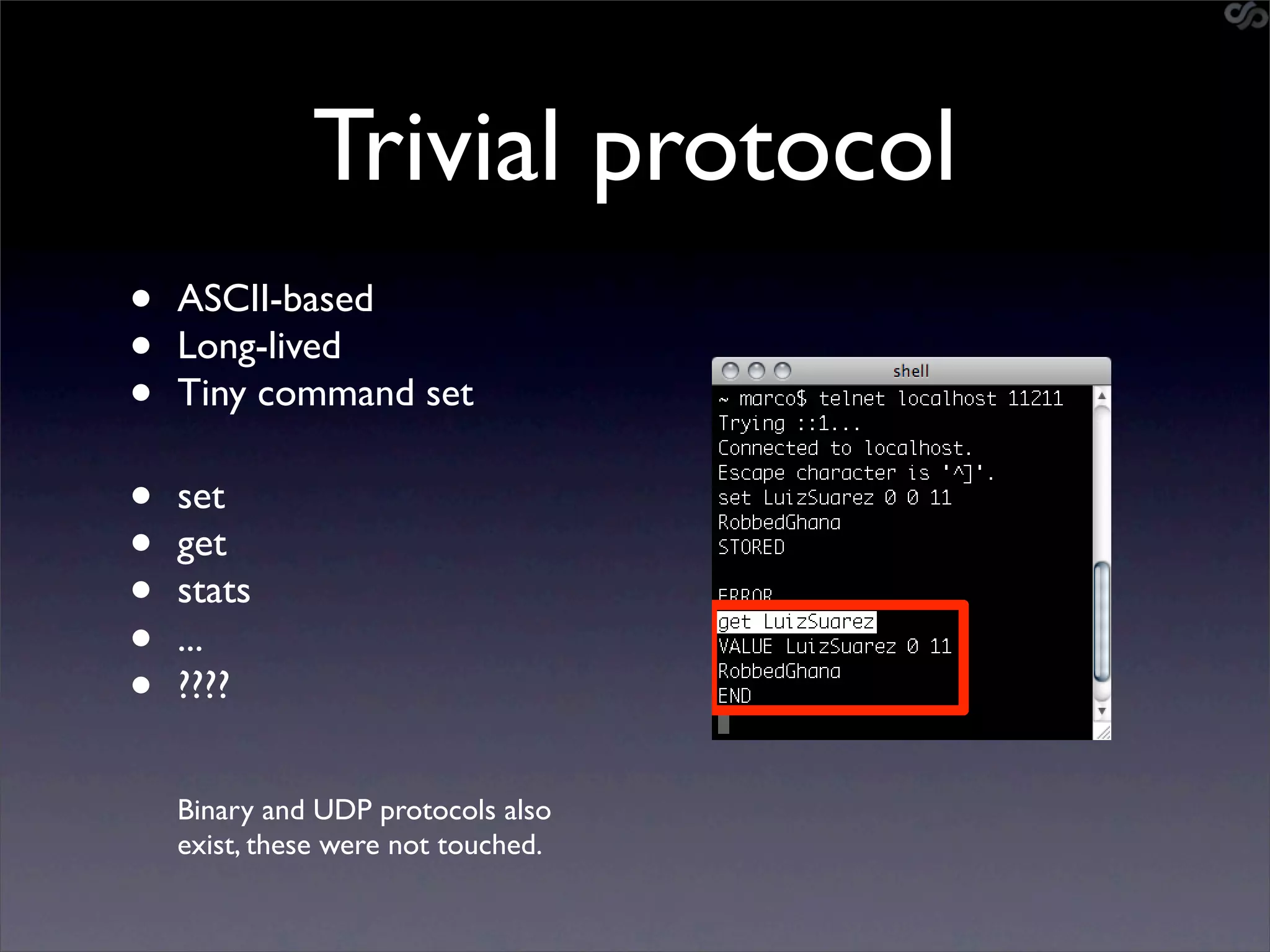
Trivial protocol
•   ASCII-based
•   Long-lived
•   Tiny command set

•   set
•   get
•   stats
•   ...
•   ????


    Binary and UDP protocols also
    exist, these were not touched.
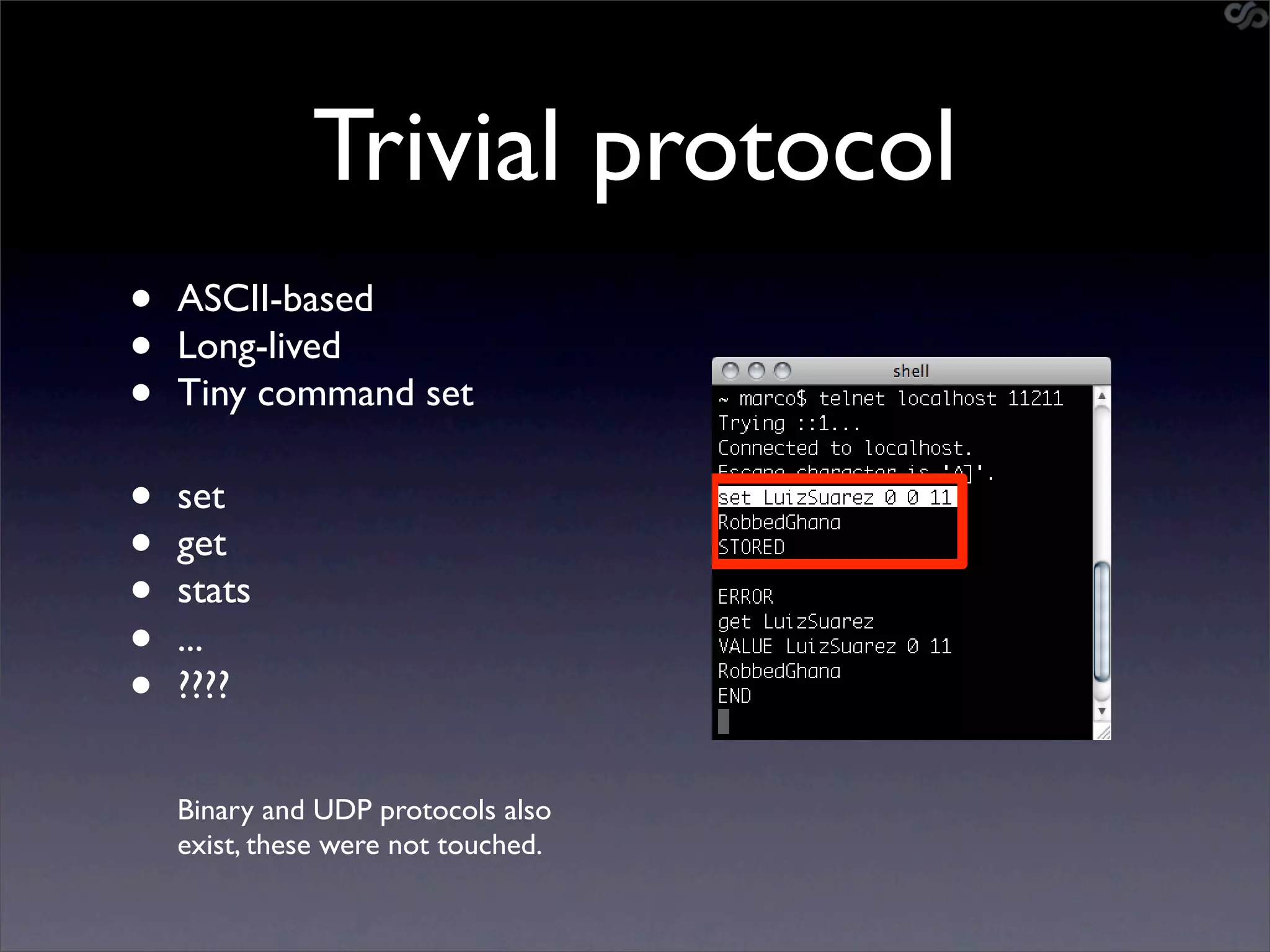
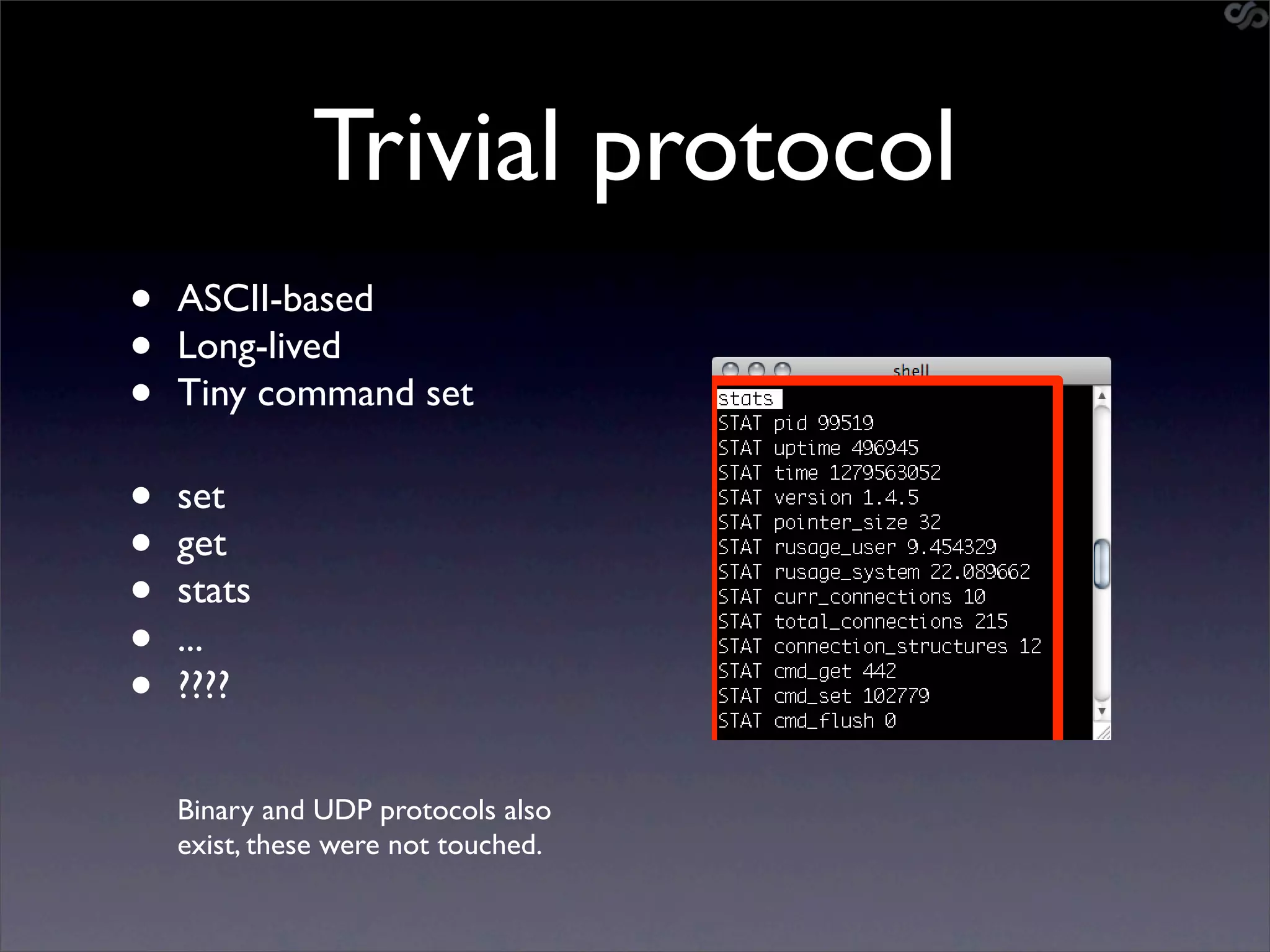
Trivial protocol
•   ASCII-based
•   Long-lived
•   Tiny command set

•   set
•   get
•   stats
•   ...
•   ????


    Binary and UDP protocols also
    exist, these were not touched.
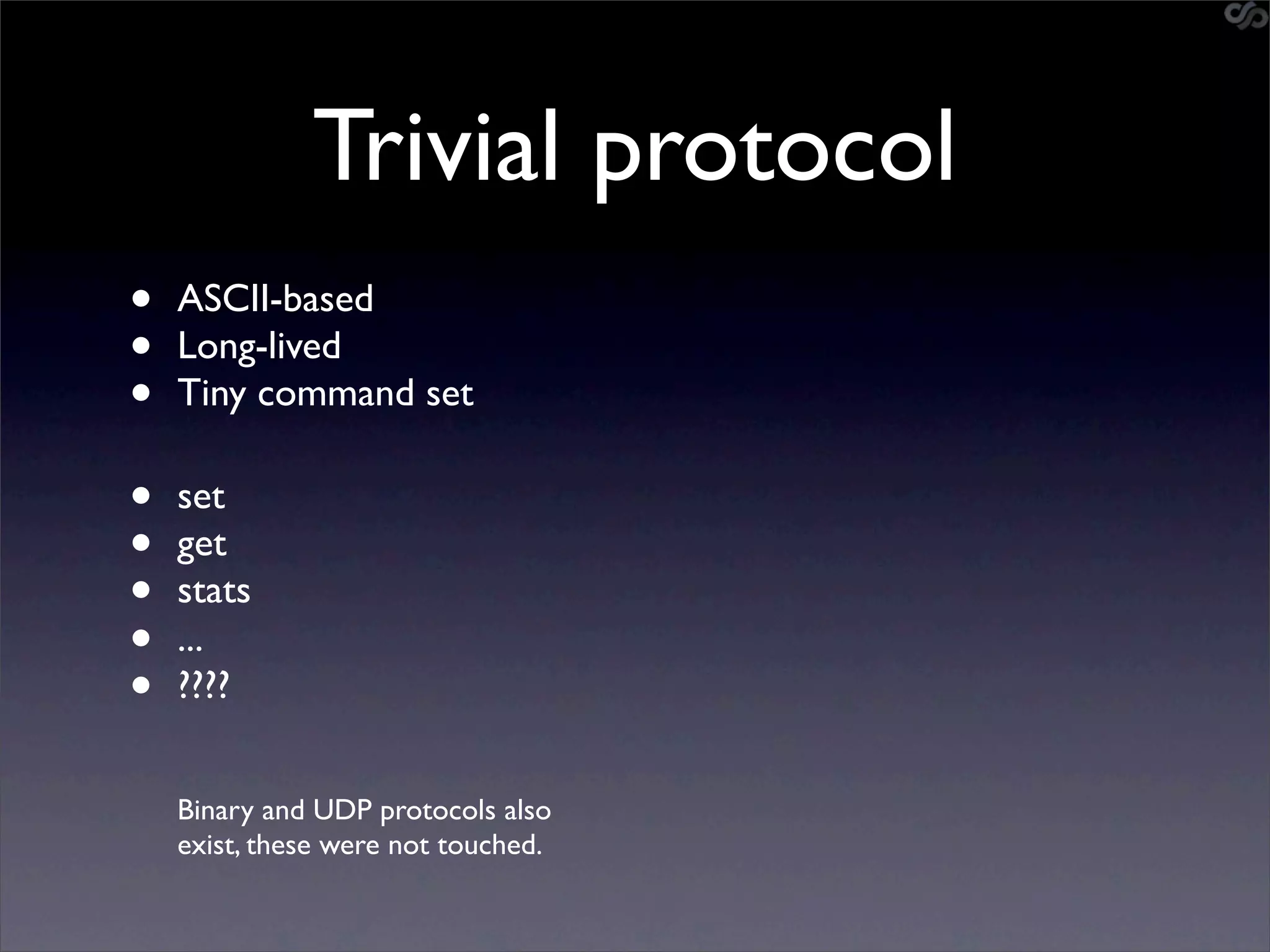
Trivial protocol
•   ASCII-based
•   Long-lived
•   Tiny command set

•   set
•   get
•   stats
•   ...
•   ????


    Binary and UDP protocols also
    exist, these were not touched.
Trivial protocol
•   ASCII-based
•   Long-lived
•   Tiny command set

•   set
•   get
•   stats
•   ...
•   ????


    Binary and UDP protocols also
    exist, these were not touched.
Trivial protocol
•   ASCII-based
•   Long-lived
•   Tiny command set

•   set
•   get
•   stats
•   ...
•   ????


    Binary and UDP protocols also
    exist, these were not touched.
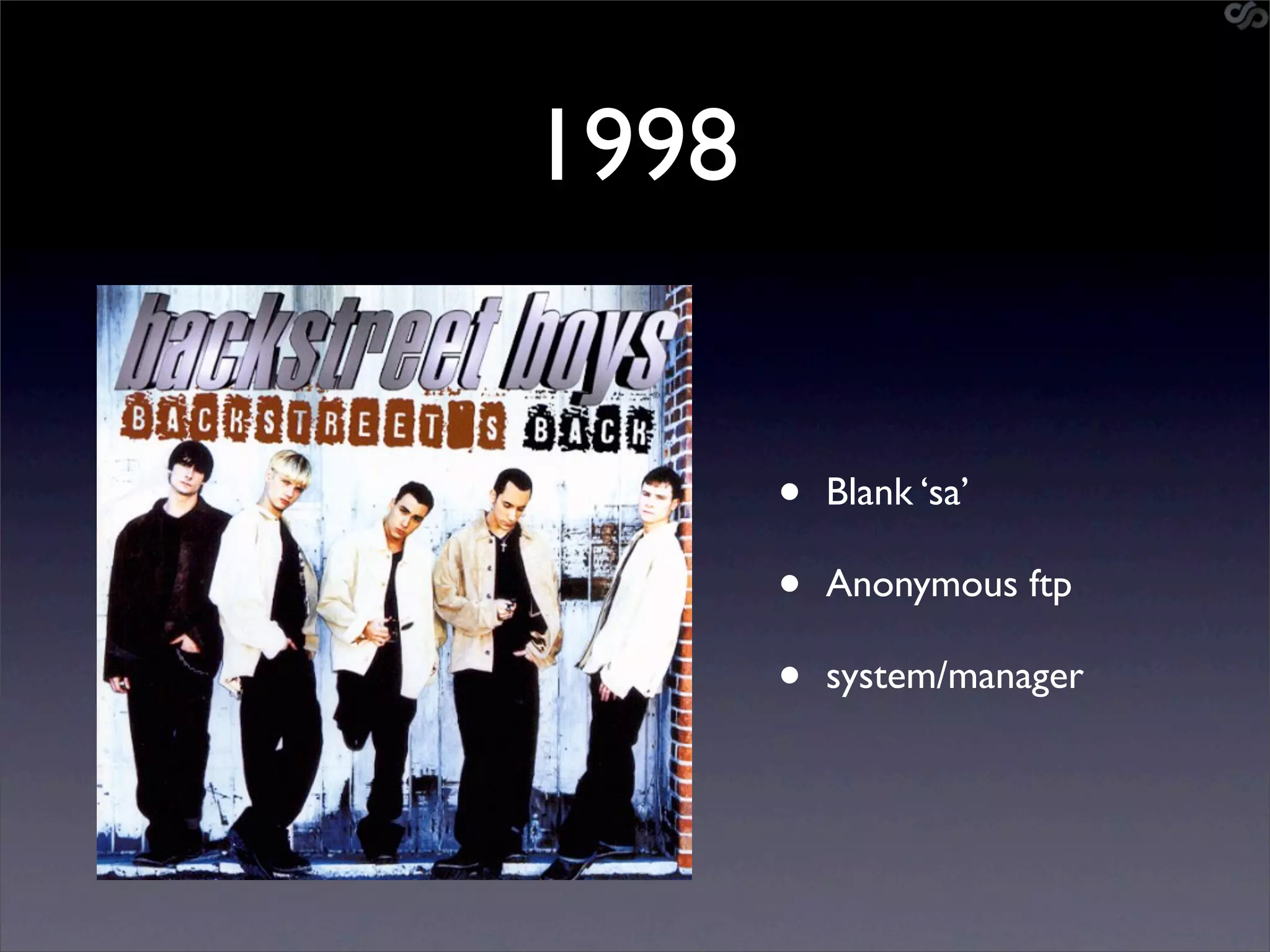
1998


       •   Blank ‘sa’

       •   Anonymous ftp

       •   system/manager
Goals

•   Connect to memcached

•   Find all slabs

•   Retrieve keynames from each slab

•   Retrieve each key
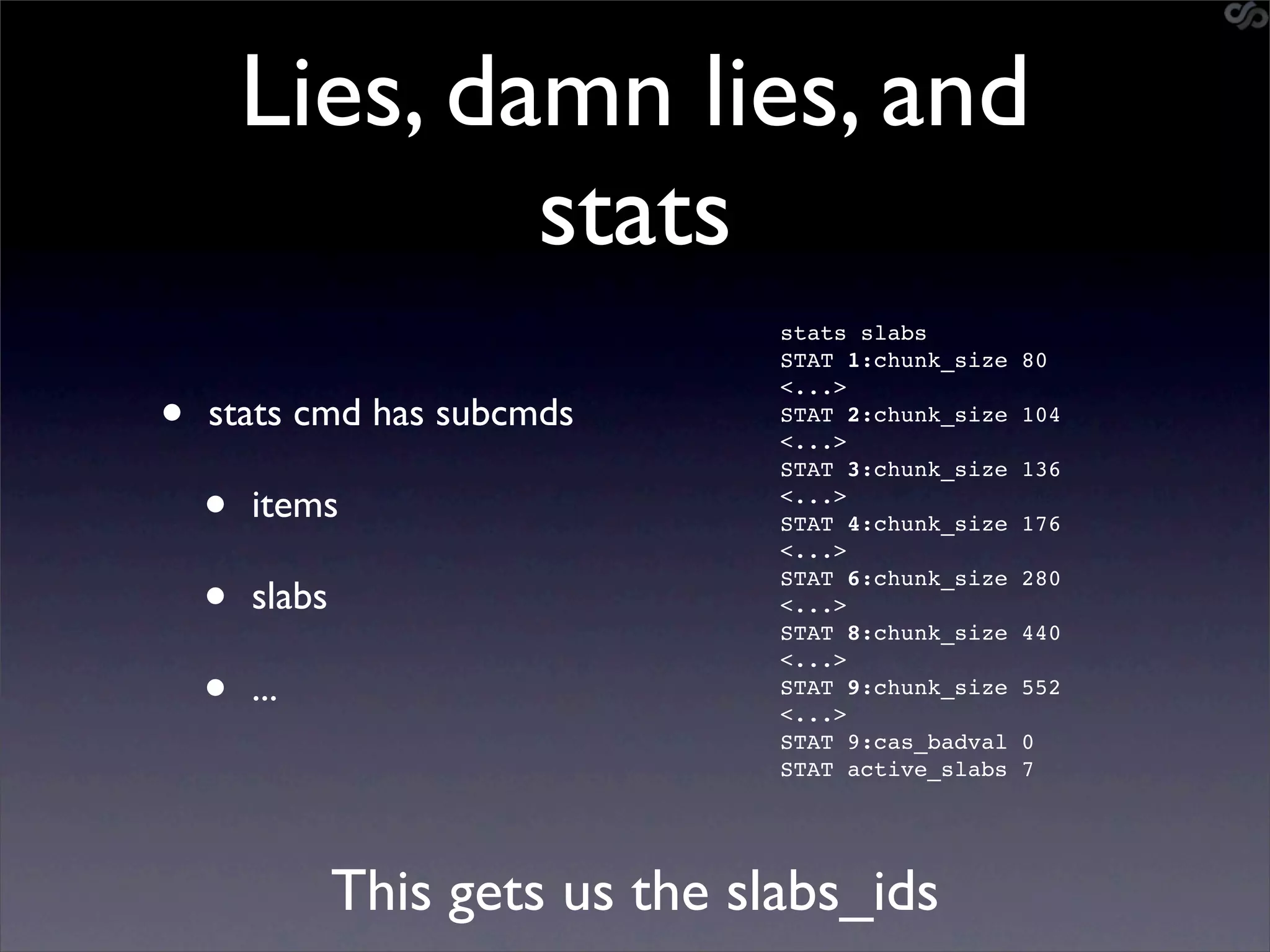
Lies, damn lies, and
                stats
                                   stats slabs
                                   STAT 1:chunk_size   80


•
                                   <...>
    stats cmd has subcmds          STAT 2:chunk_size   104
                                   <...>
                                   STAT 3:chunk_size   136

    •   items                      <...>
                                   STAT 4:chunk_size
                                   <...>
                                                       176


    •   slabs
                                   STAT 6:chunk_size
                                   <...>
                                   STAT 8:chunk_size
                                                       280

                                                       440


    •
                                   <...>
        ...                        STAT 9:chunk_size   552
                                   <...>
                                   STAT 9:cas_badval   0
                                   STAT active_slabs   7


                This gets us the slabs_ids
Retrieving key names


Rely on two
{poorly|un}
documented
features
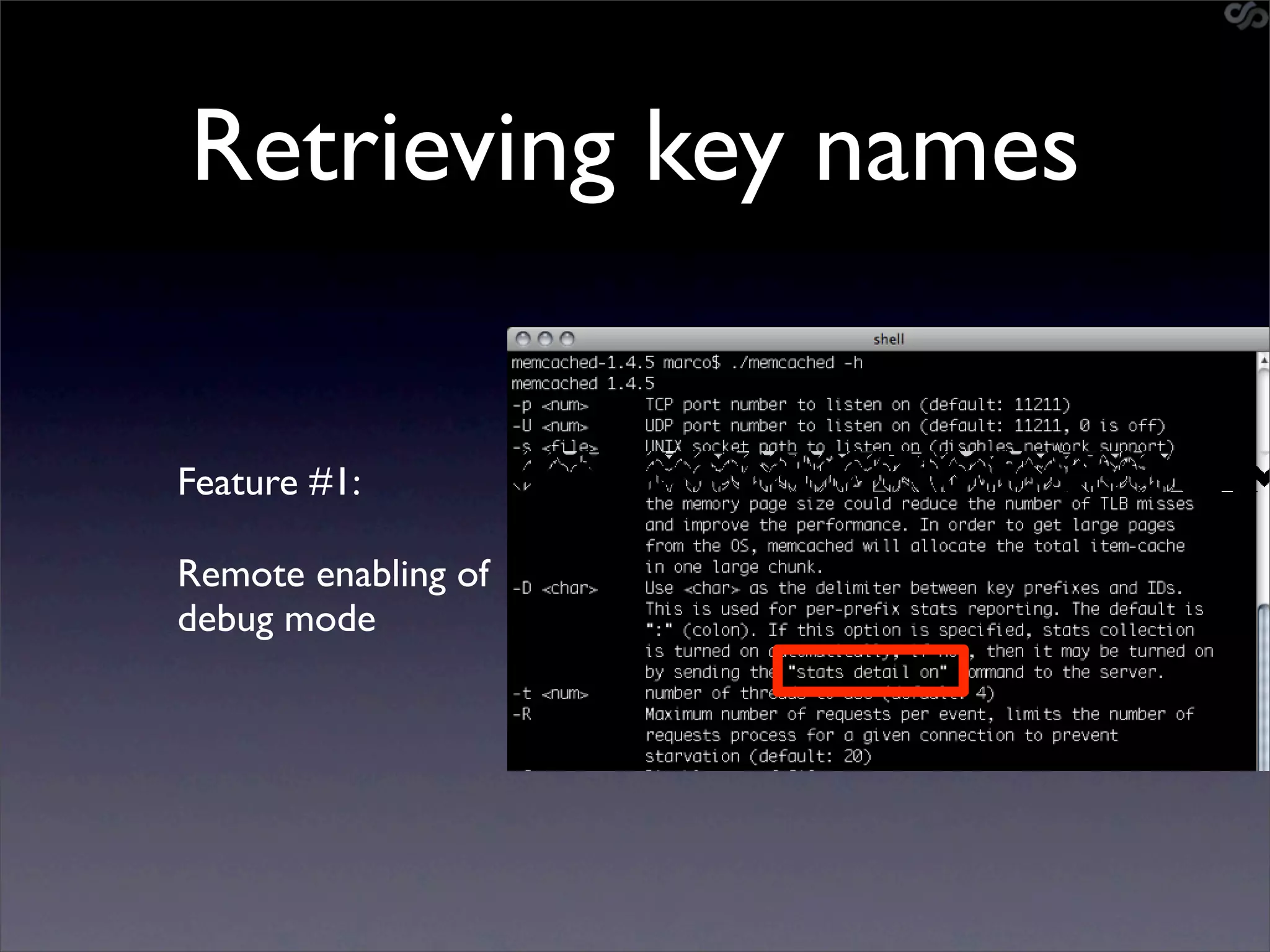
Retrieving key names


Feature #1:

Remote enabling of
debug mode
Retrieving key names


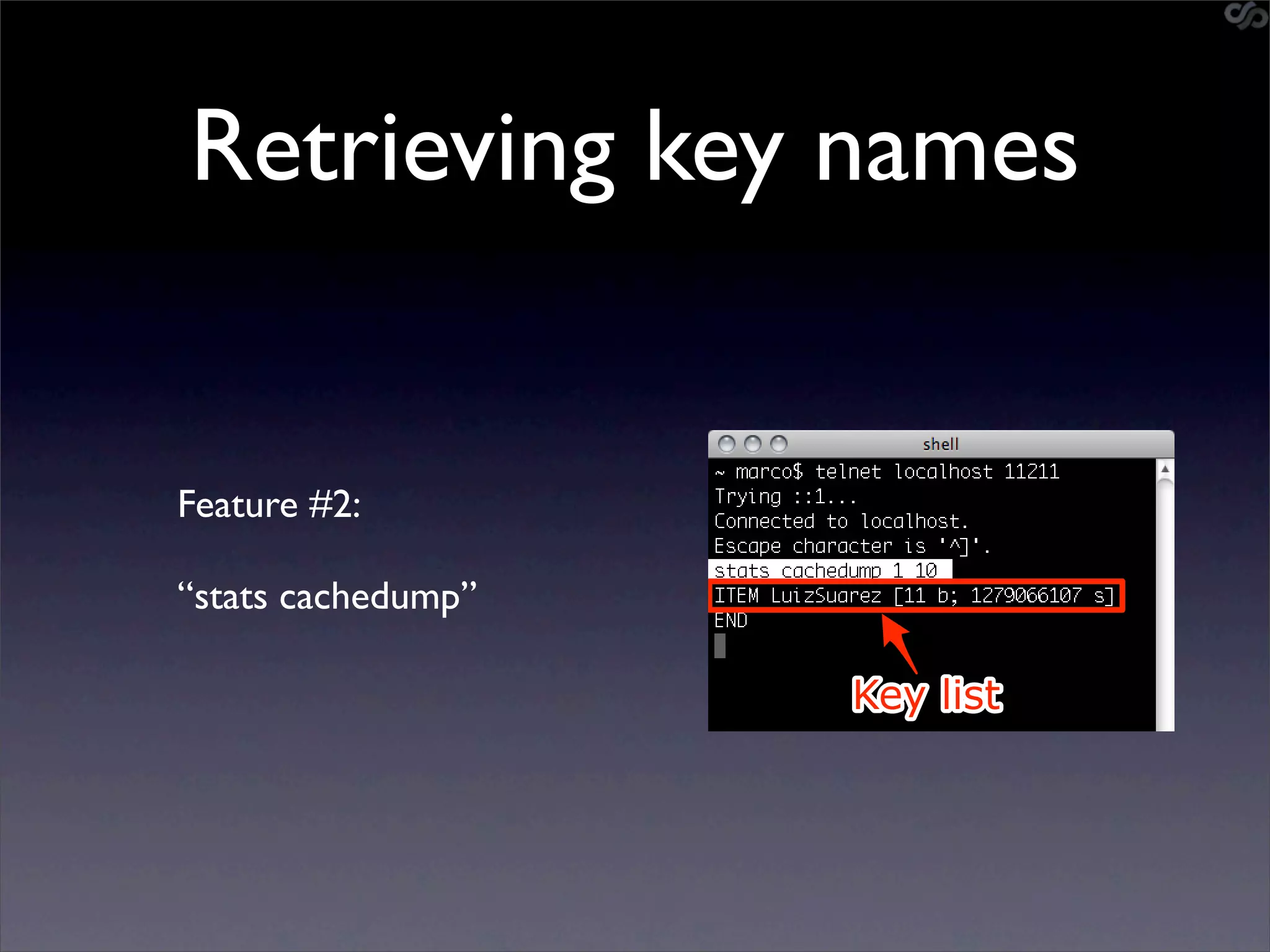
Feature #2:

“stats cachedump”
Retrieving key names


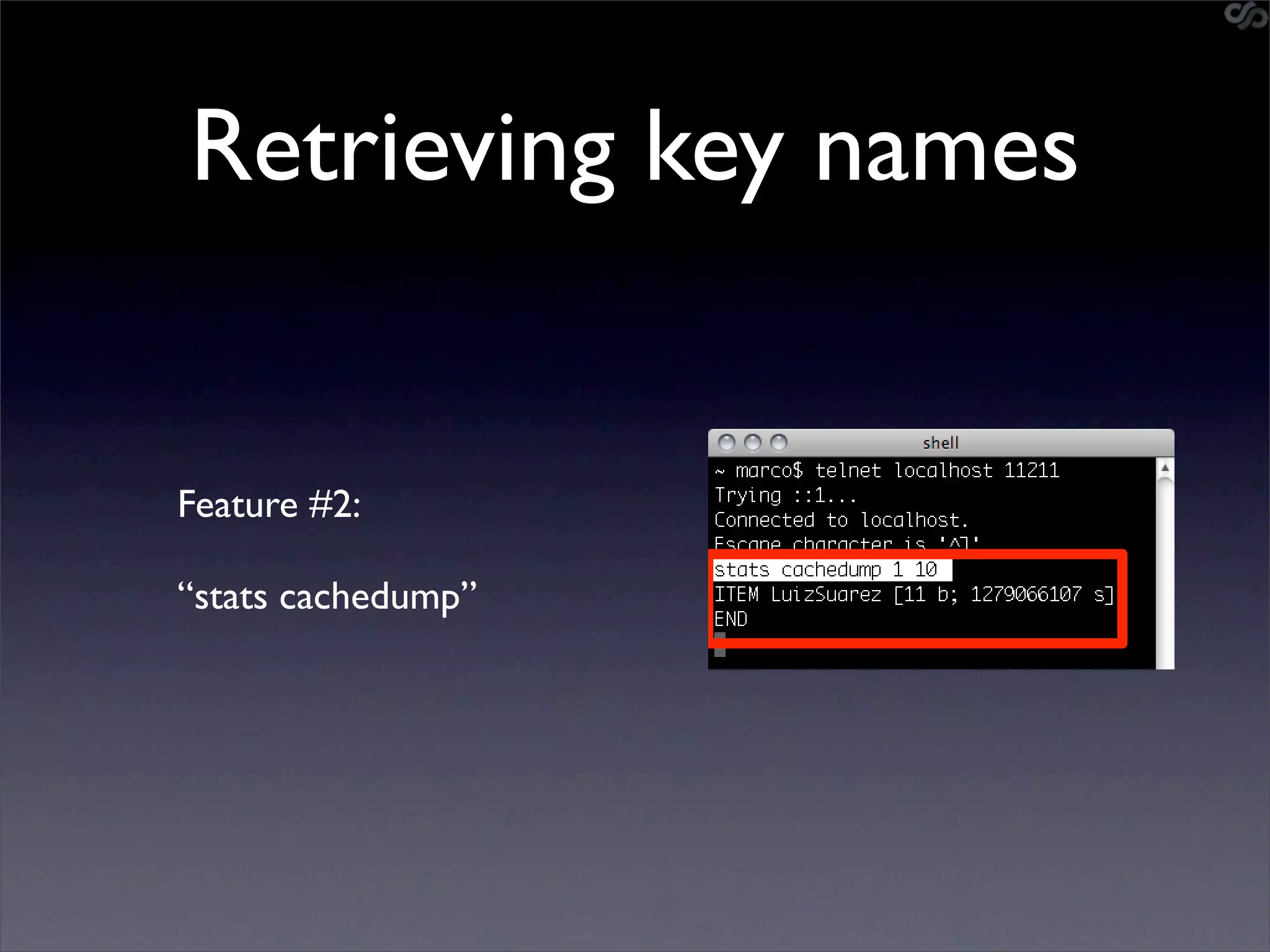
Feature #2:

“stats cachedump”
Retrieving key names


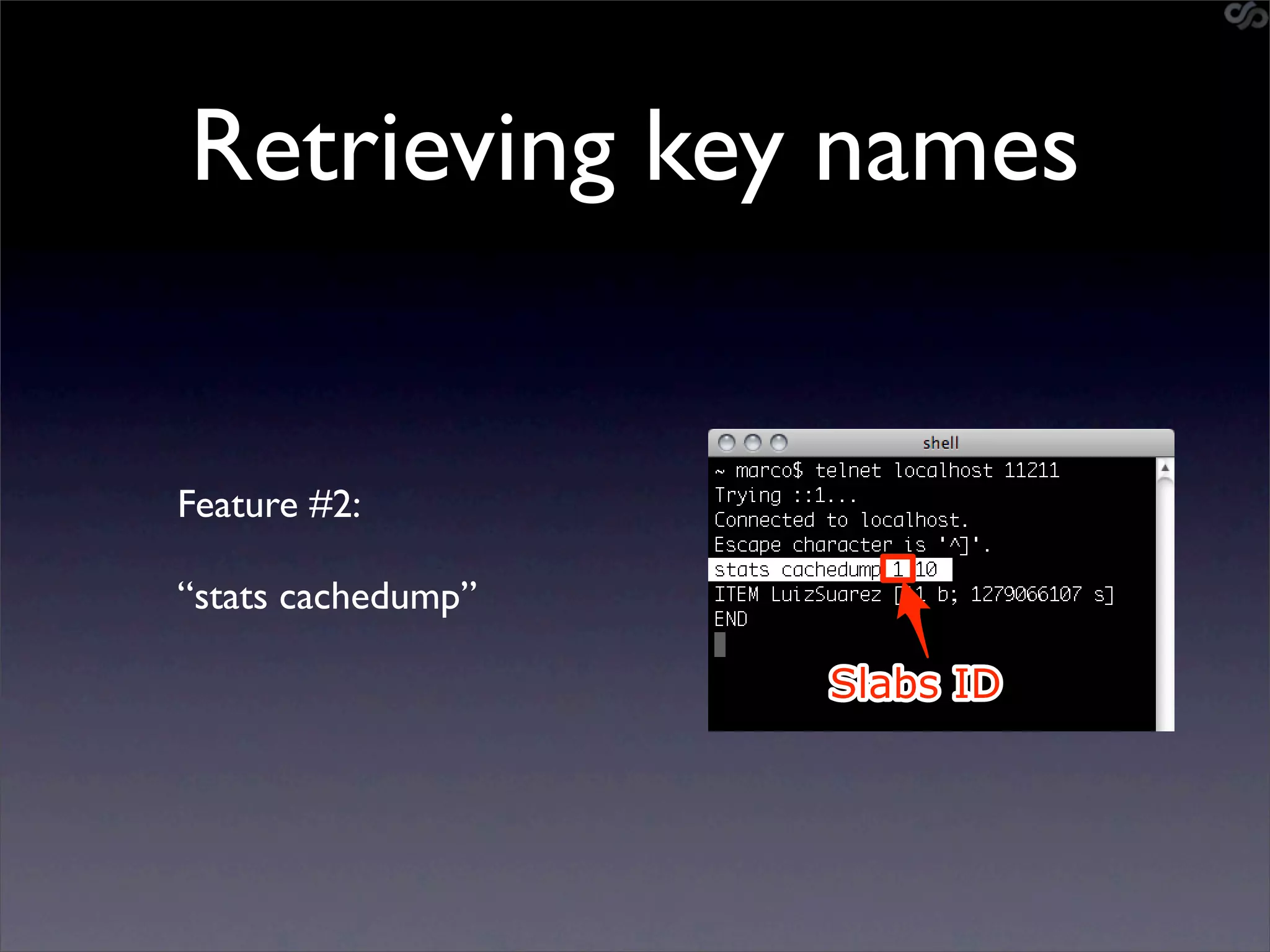
Feature #2:

“stats cachedump”

                    Slabs ID
Retrieving key names


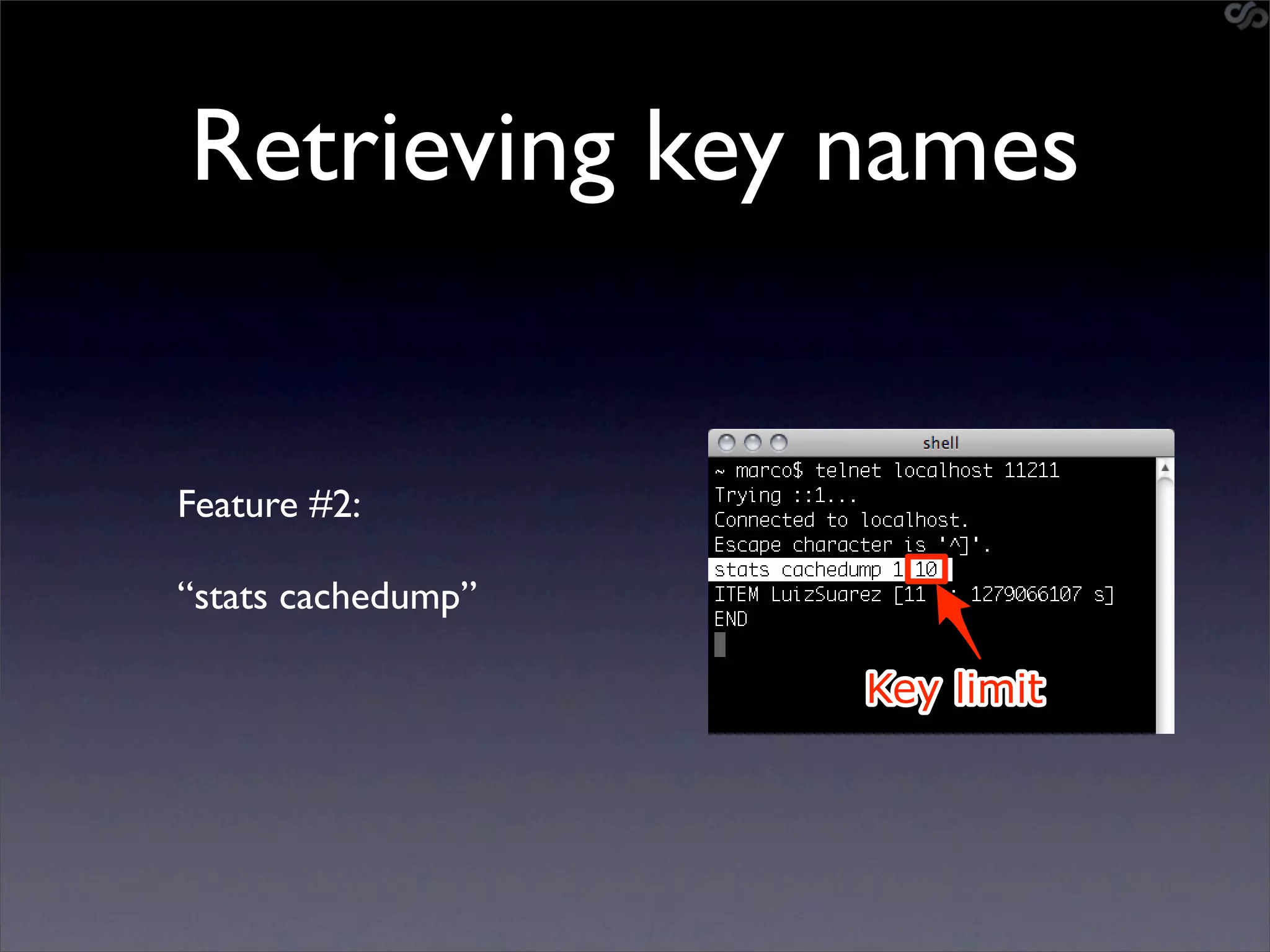
Feature #2:

“stats cachedump”

                    Key limit
Retrieving key names


Feature #2:

“stats cachedump”

                    Key list
Retrieving key names


Feature #2:

“stats cachedump”


          This gets us key names
And this gets us?
•   No need for complex hacks. Memcached serves up
    all its data for us.
•   What to do in an exposed cache?
    •   Mine
        •   SQLi is too hard for me
    •   Overwrite
        •   Client-side
        •   Server-side
Mining the cache
• go-derper.rb – memcached miner
 • Retrieves up to k keys from each slab and
    their contents, store on disk
 • Applies regexes and filters matches in a
    hits file
 • Supports easy overwriting of cache
    entries
• [demo]
Two issues
Two issues

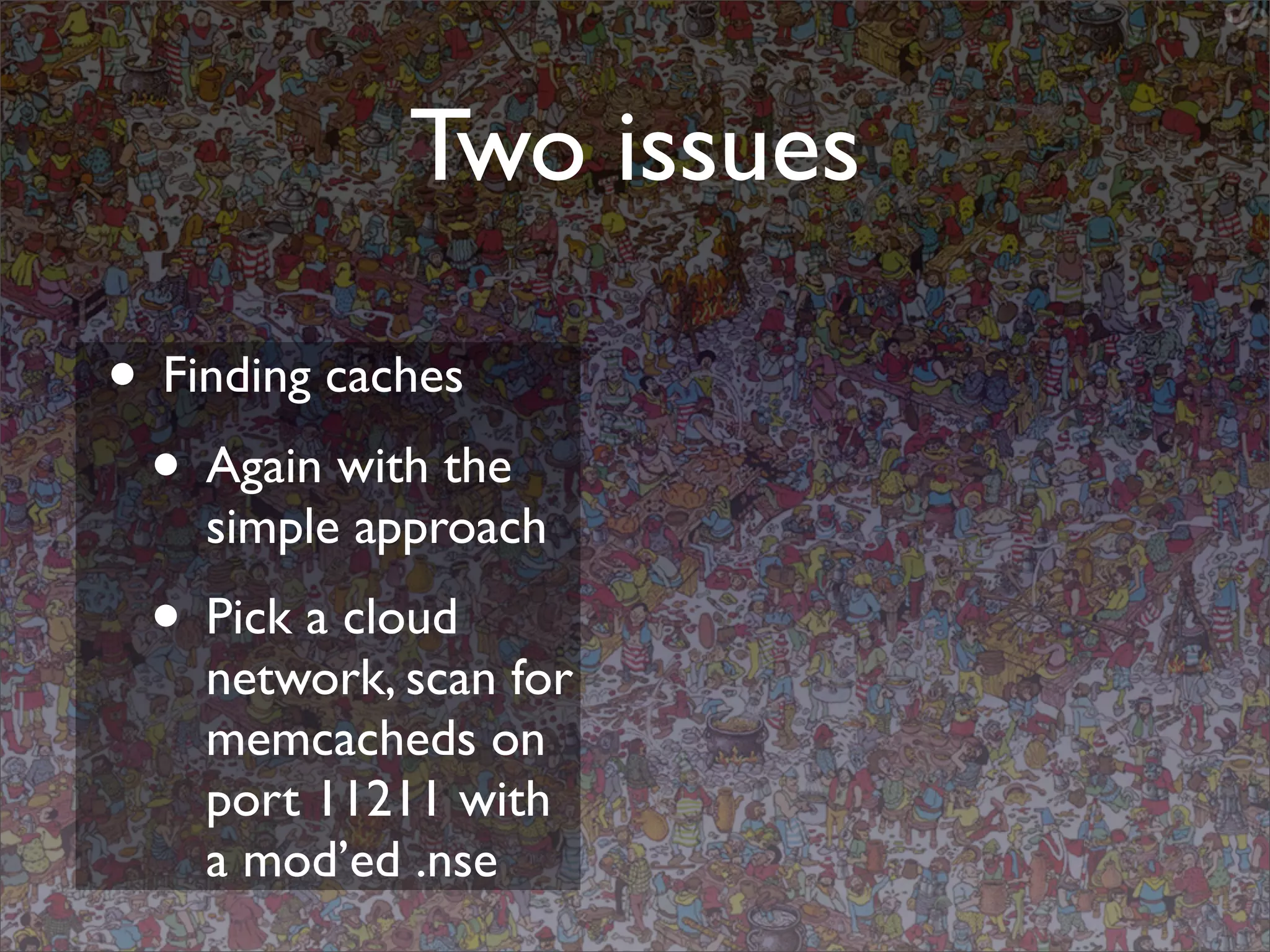
• Finding caches
 • Again with the
    simple approach
 • Pick a cloud
    network, scan for
    memcacheds on
    port 11211 with
    a mod’ed .nse
Two issues

                                                            •   Linking apps to
                                                                caches
                                                                •   Who’s %$!#ing
                                                                    cache is this?
                                                                •   Cached high scores
                                                                    suck. Where’s the
                                                                    good stuff?
                                                                •   Is it live?
http://www.rhythm.com/~keith/autoStereoGrams/vortexas.gif
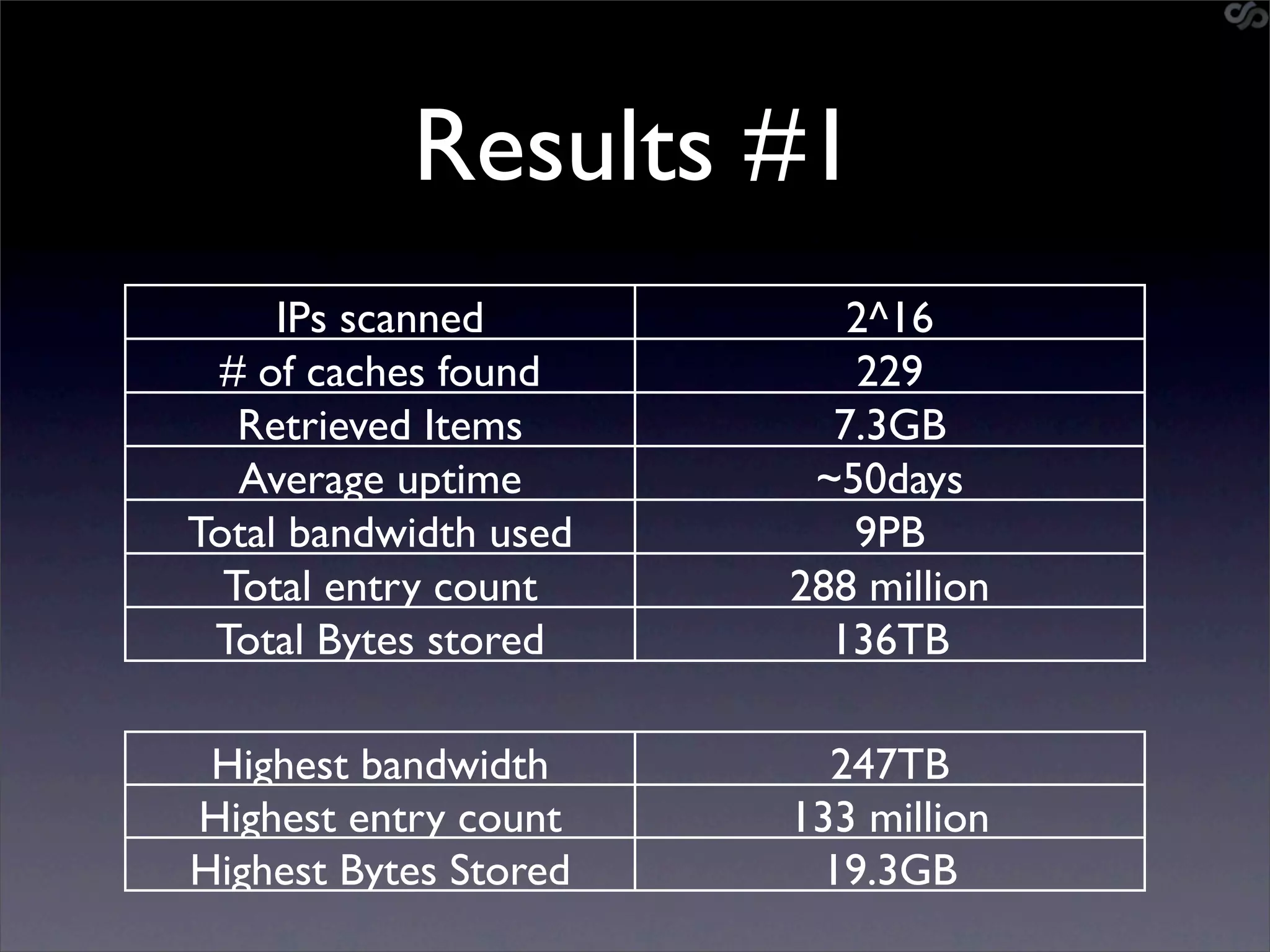
Results #1
     IPs scanned          2^16
 # of caches found        229
   Retrieved Items       7.3GB
   Average uptime       ~50days
Total bandwidth used      9PB
  Total entry count    288 million
 Total Bytes stored      136TB

 Highest bandwidth       247TB
Highest entry count    133 million
Highest Bytes Stored    19.3GB
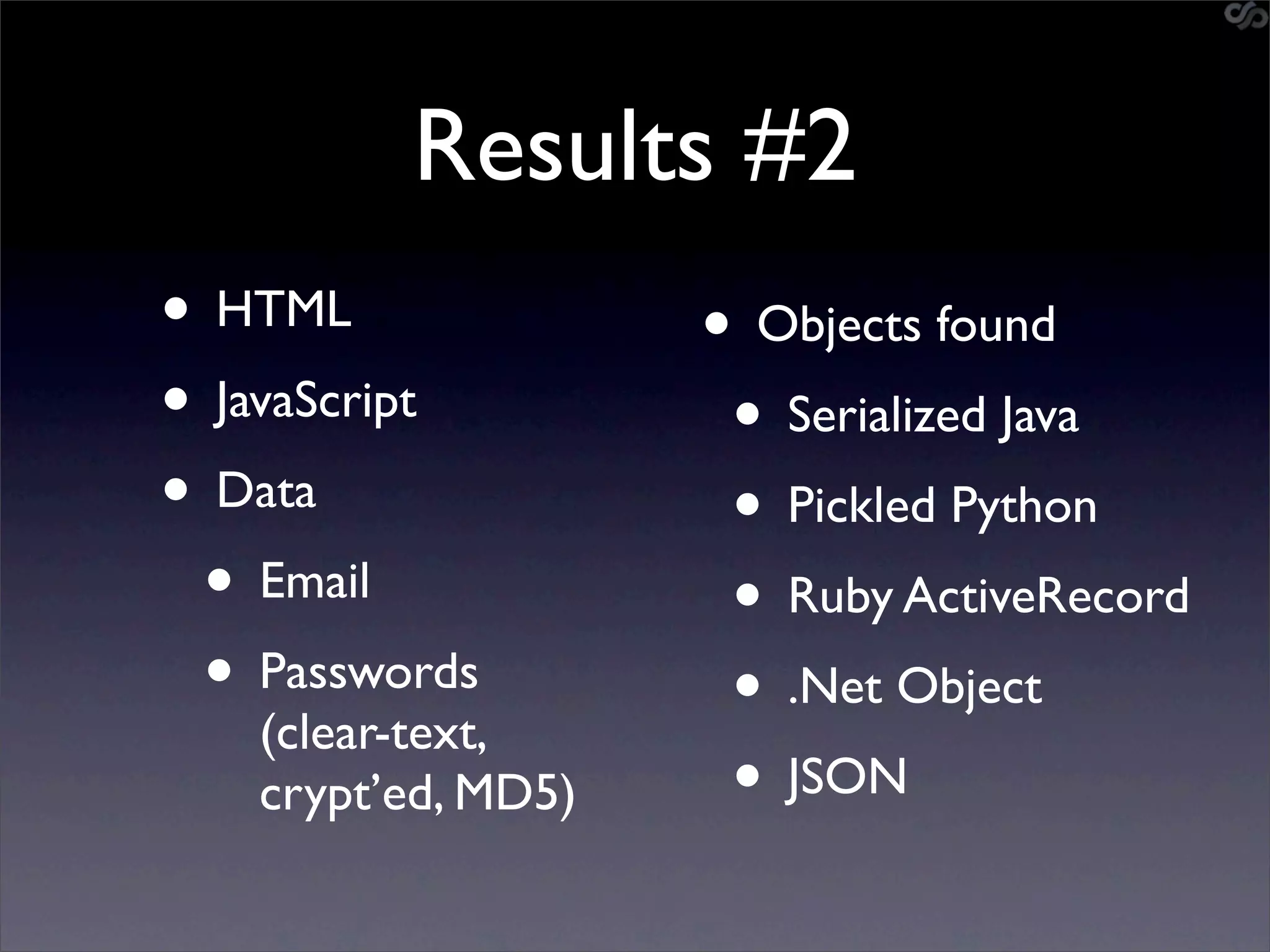
Results #2
• HTML              • Objects found
• JavaScript         • Serialized Java
• Data               • Pickled Python
 • Email             • Ruby ActiveRecord
 • Passwords         • .Net Object
   (clear-text,
   crypt’ed, MD5)    • JSON
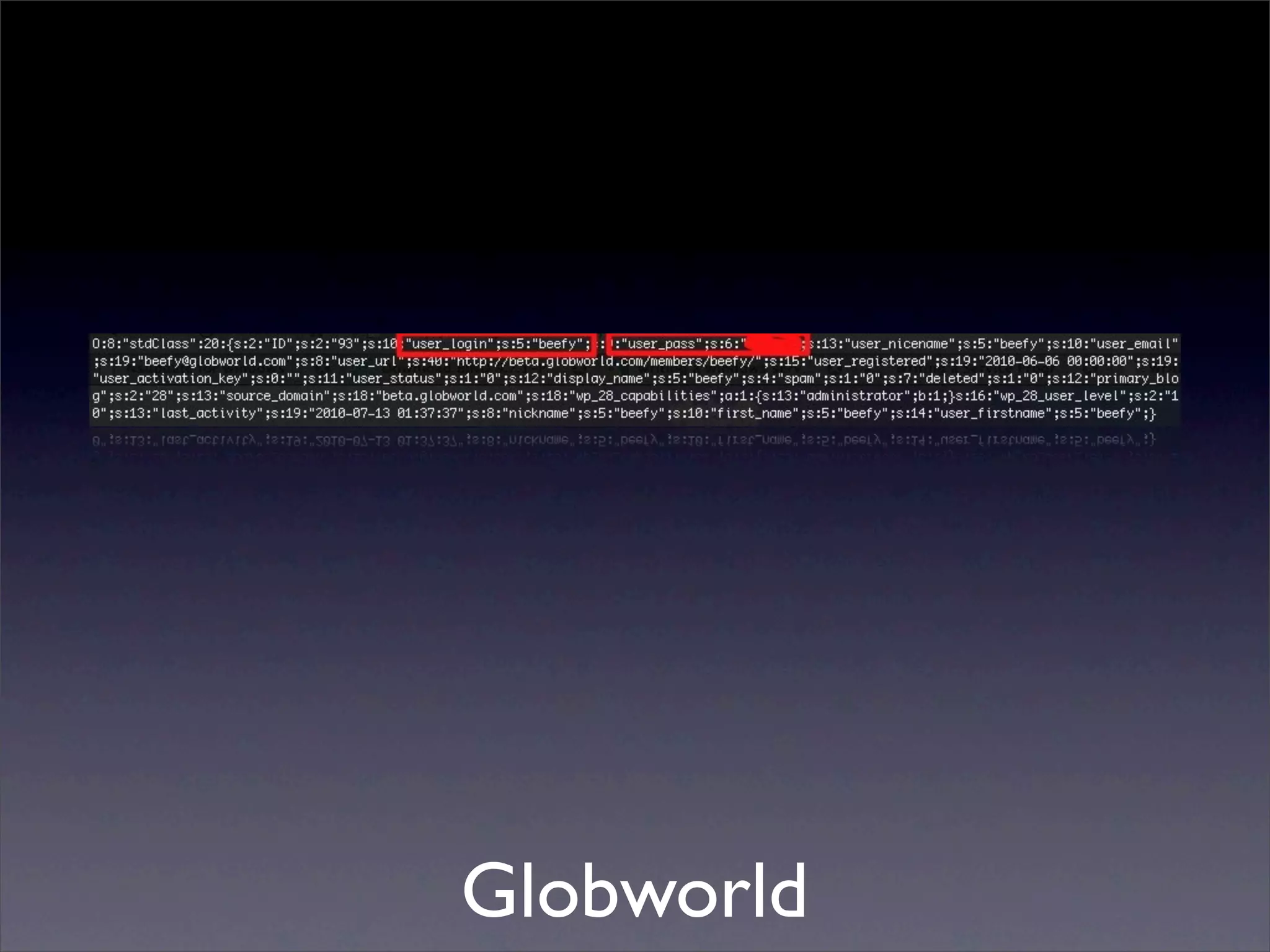
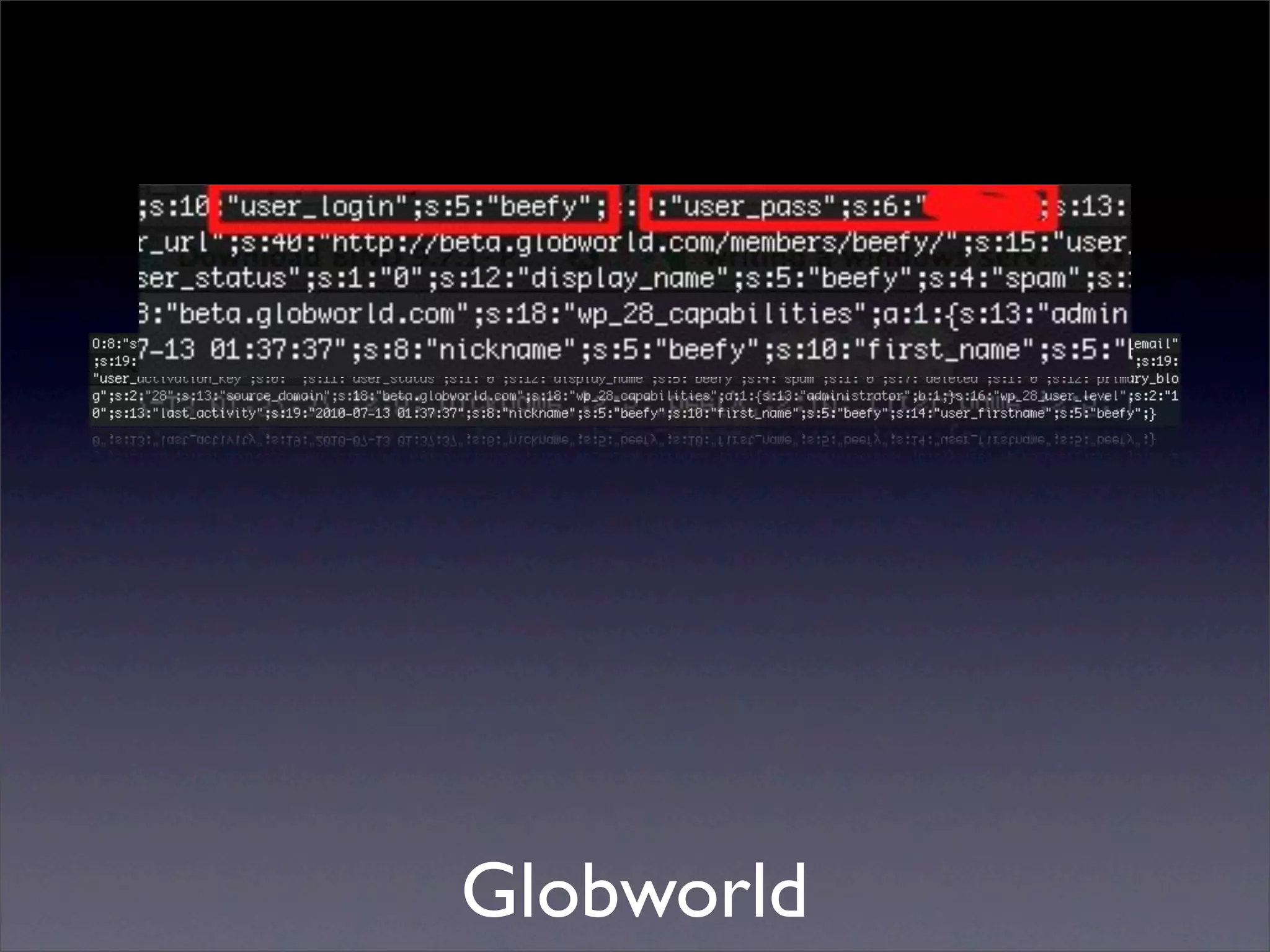
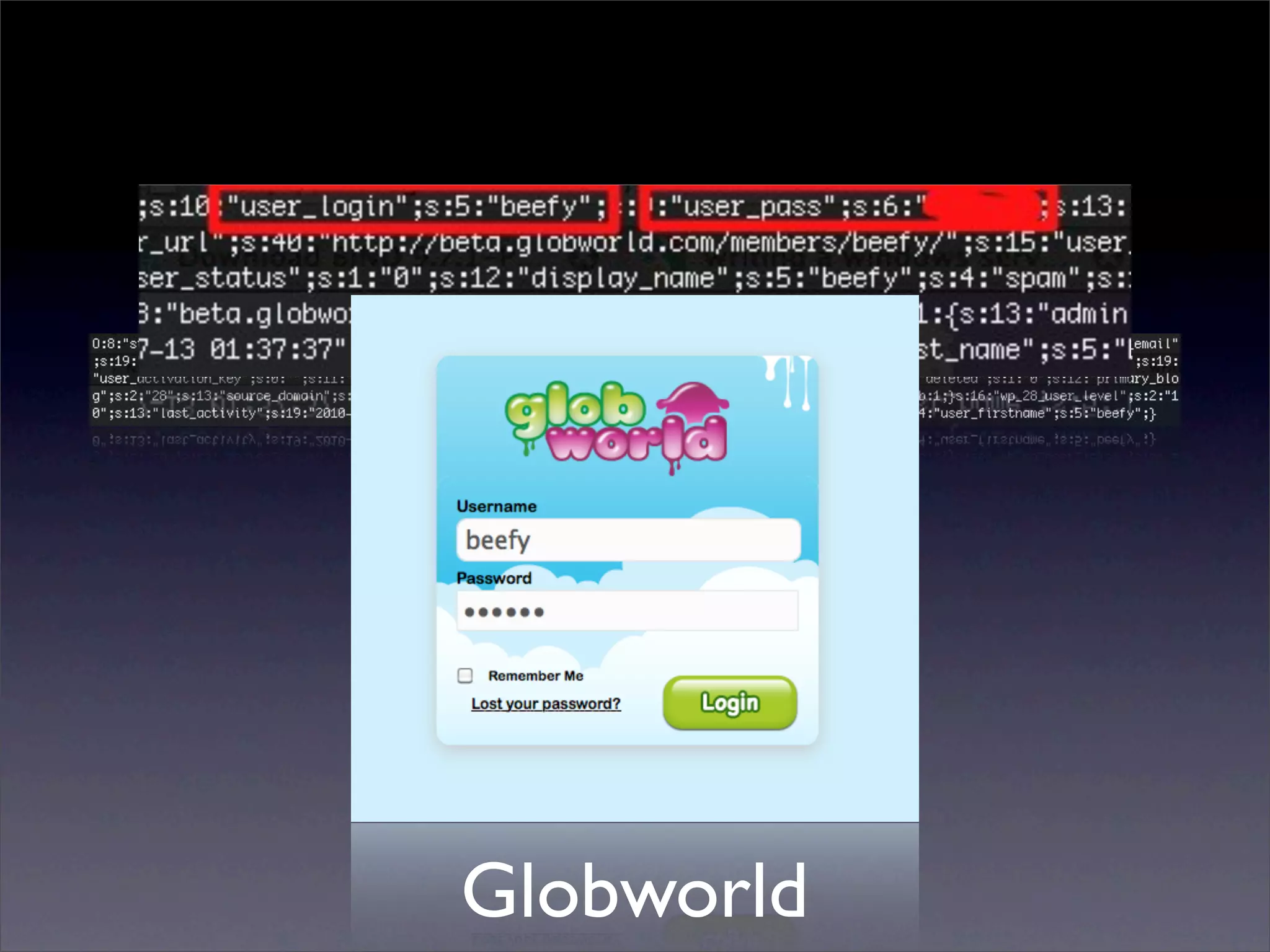
Globworld
Globworld
Globworld
Globworld
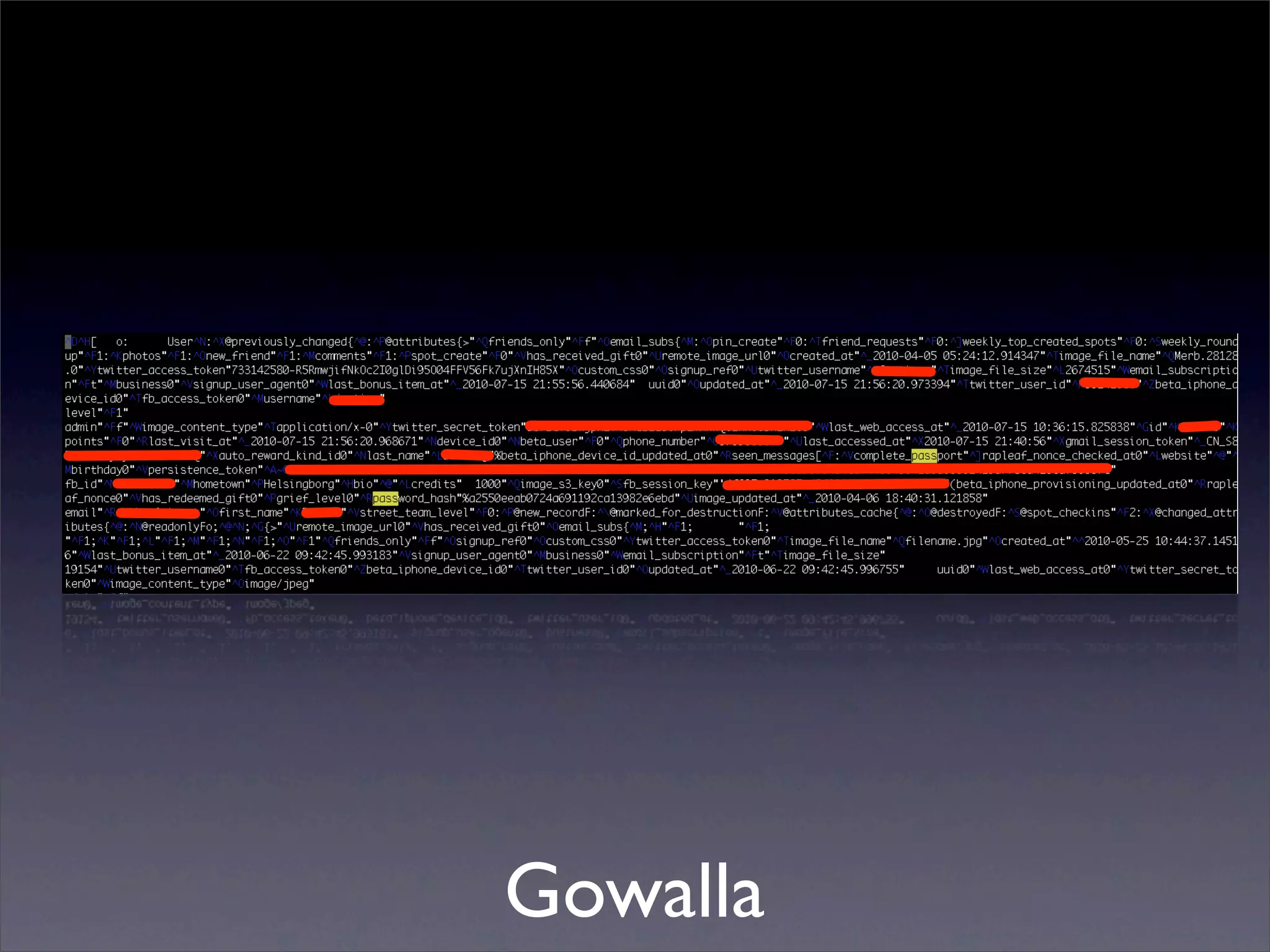
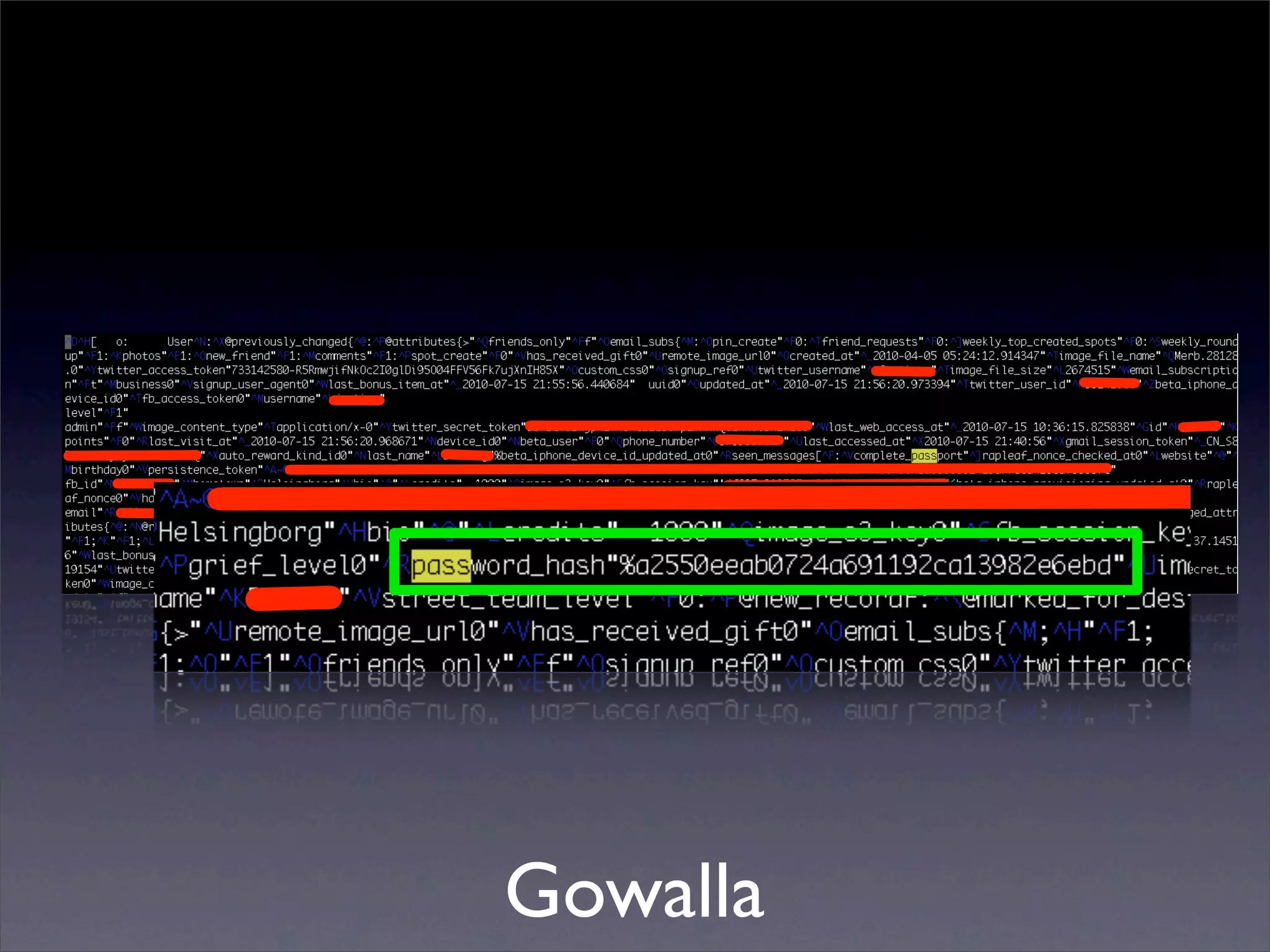
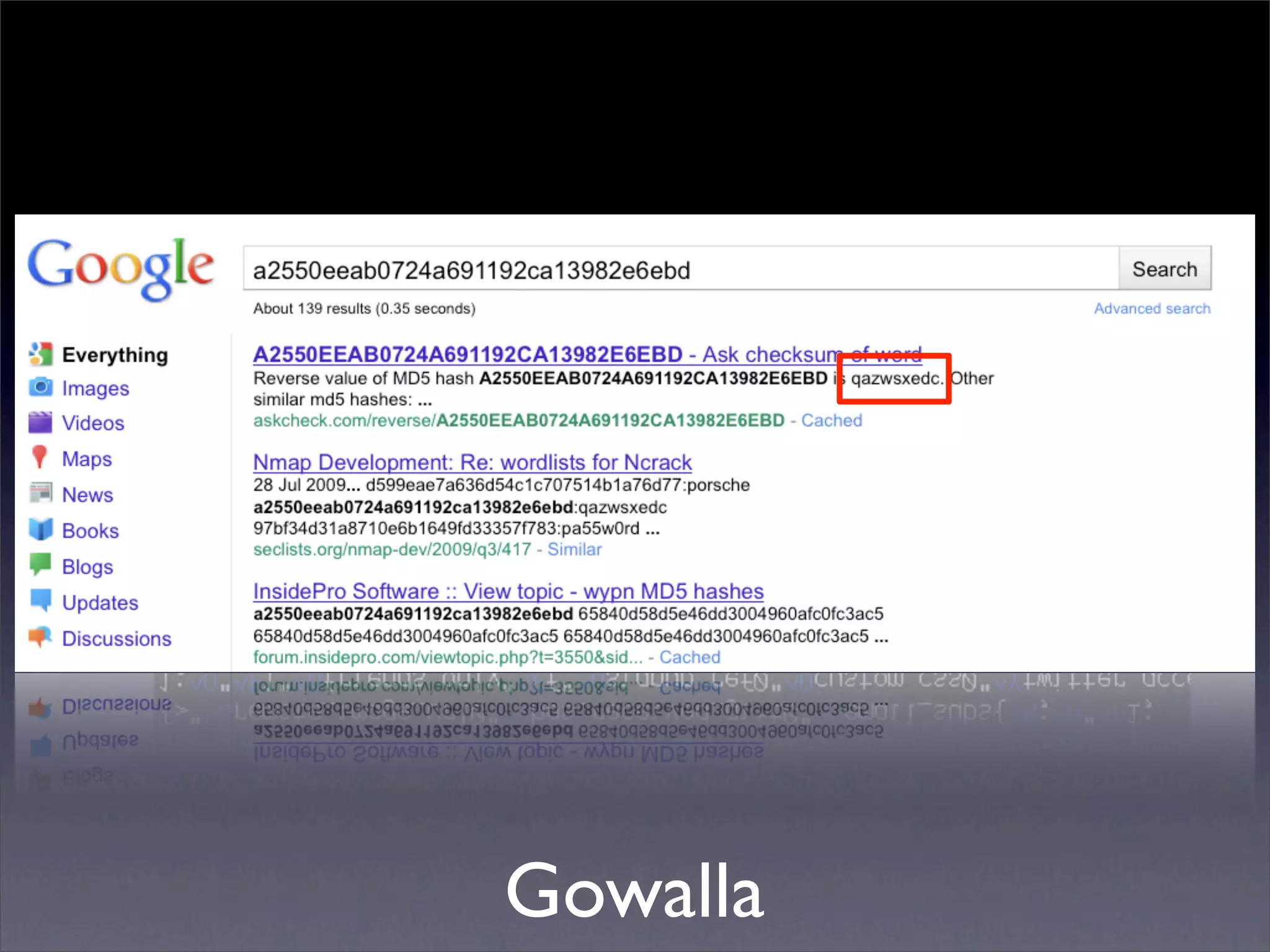
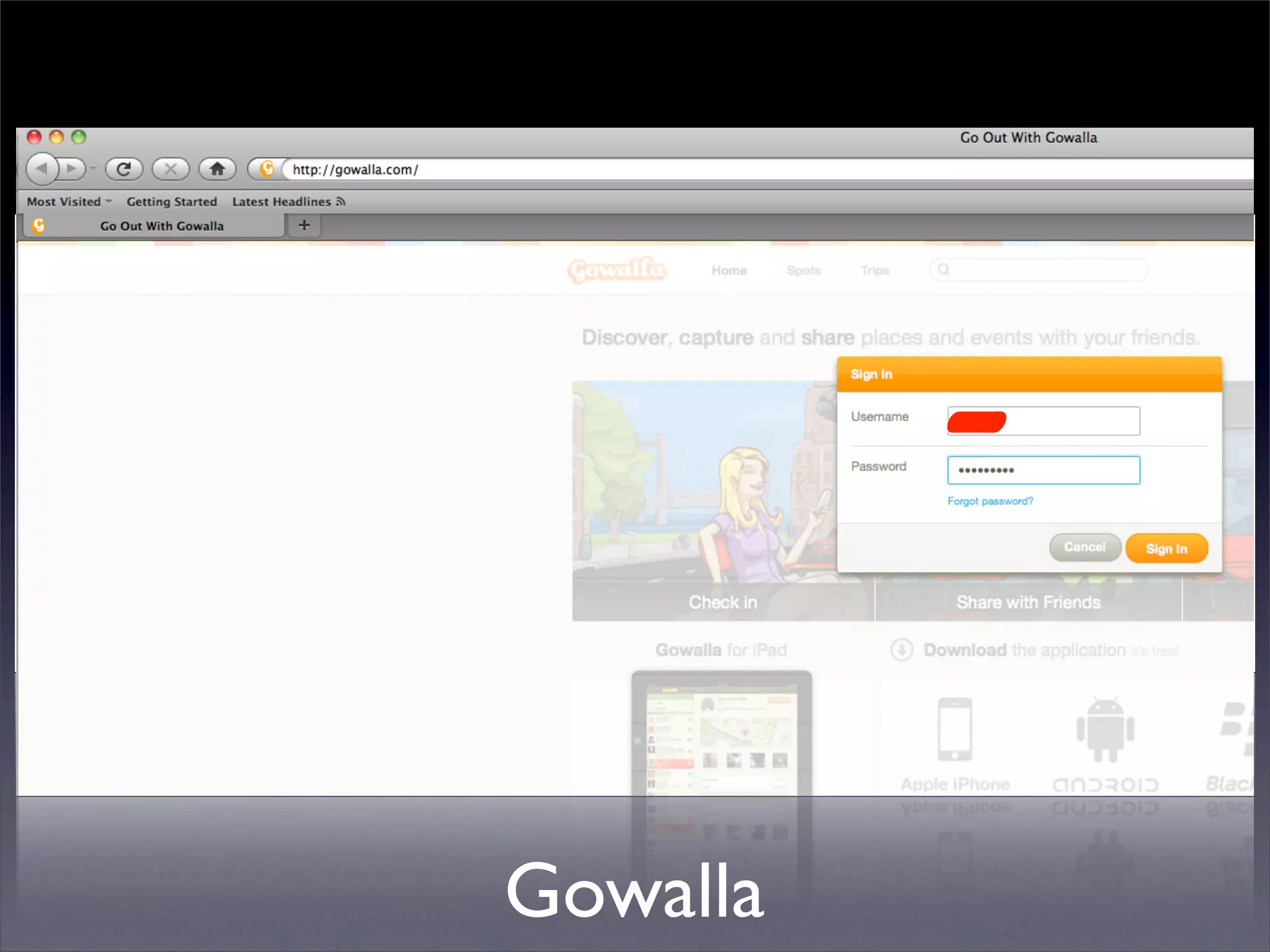
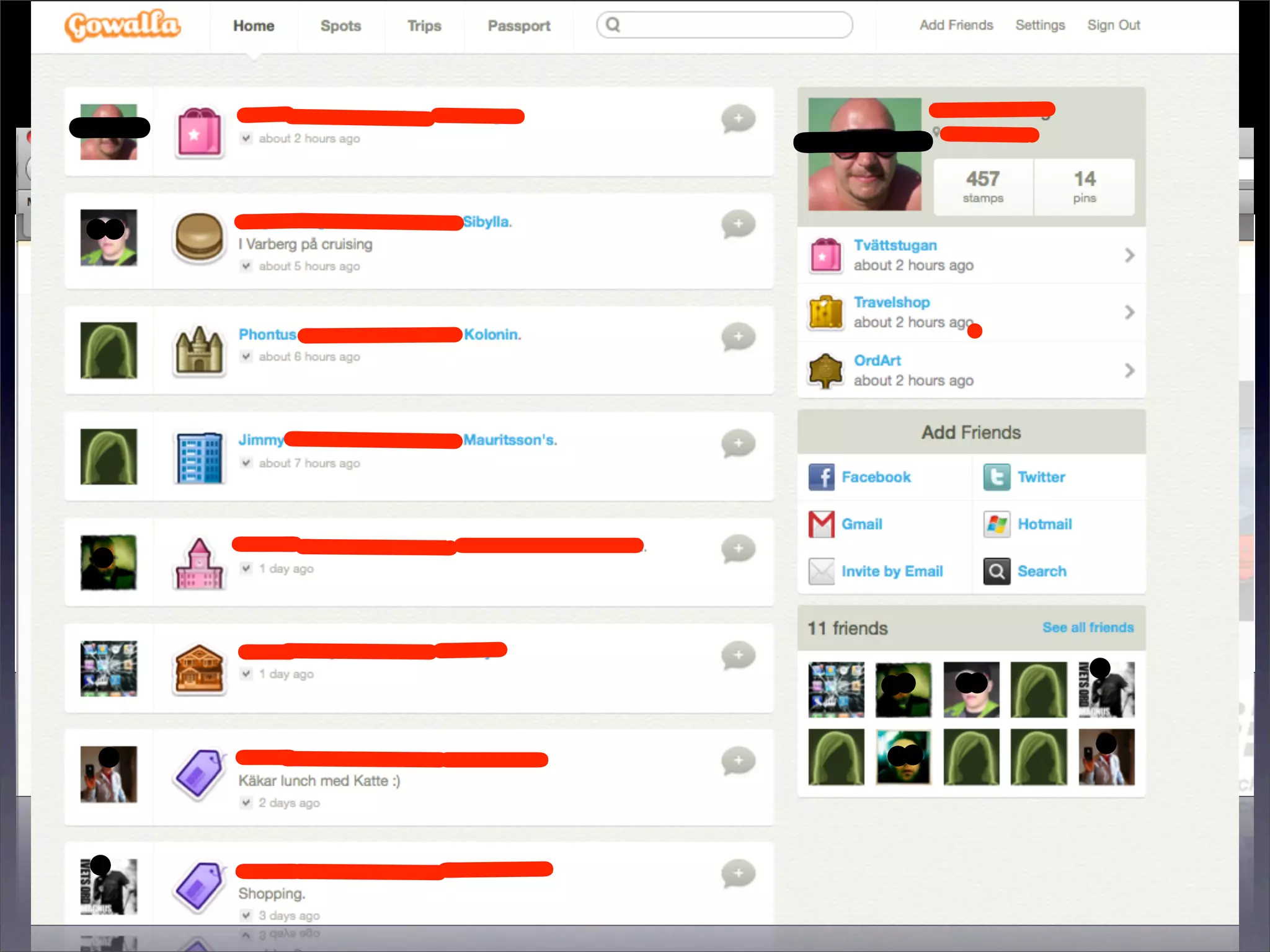
Gowalla
Gowalla
Gowalla
Gowalla
Gowalla
Gowalla
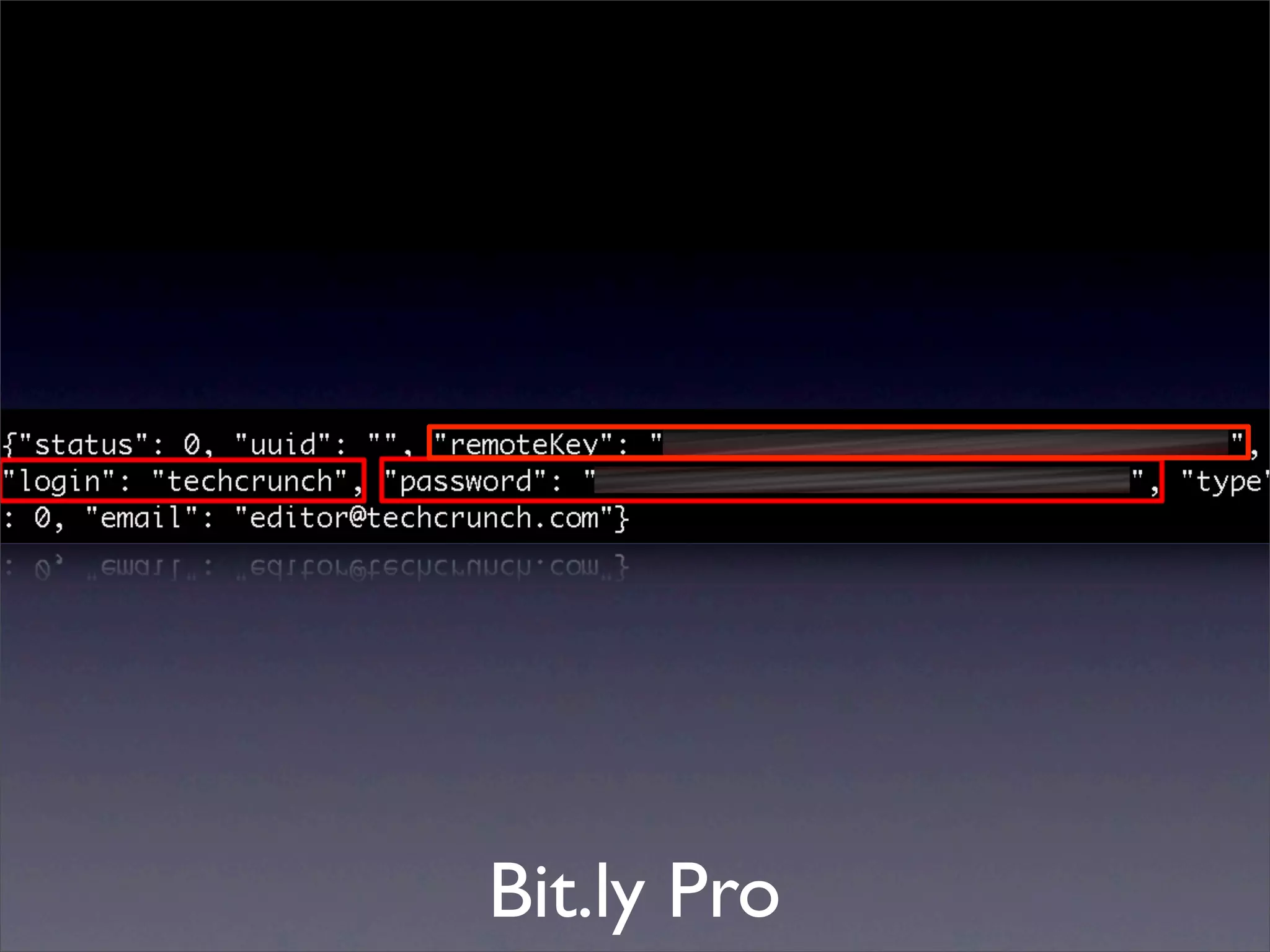
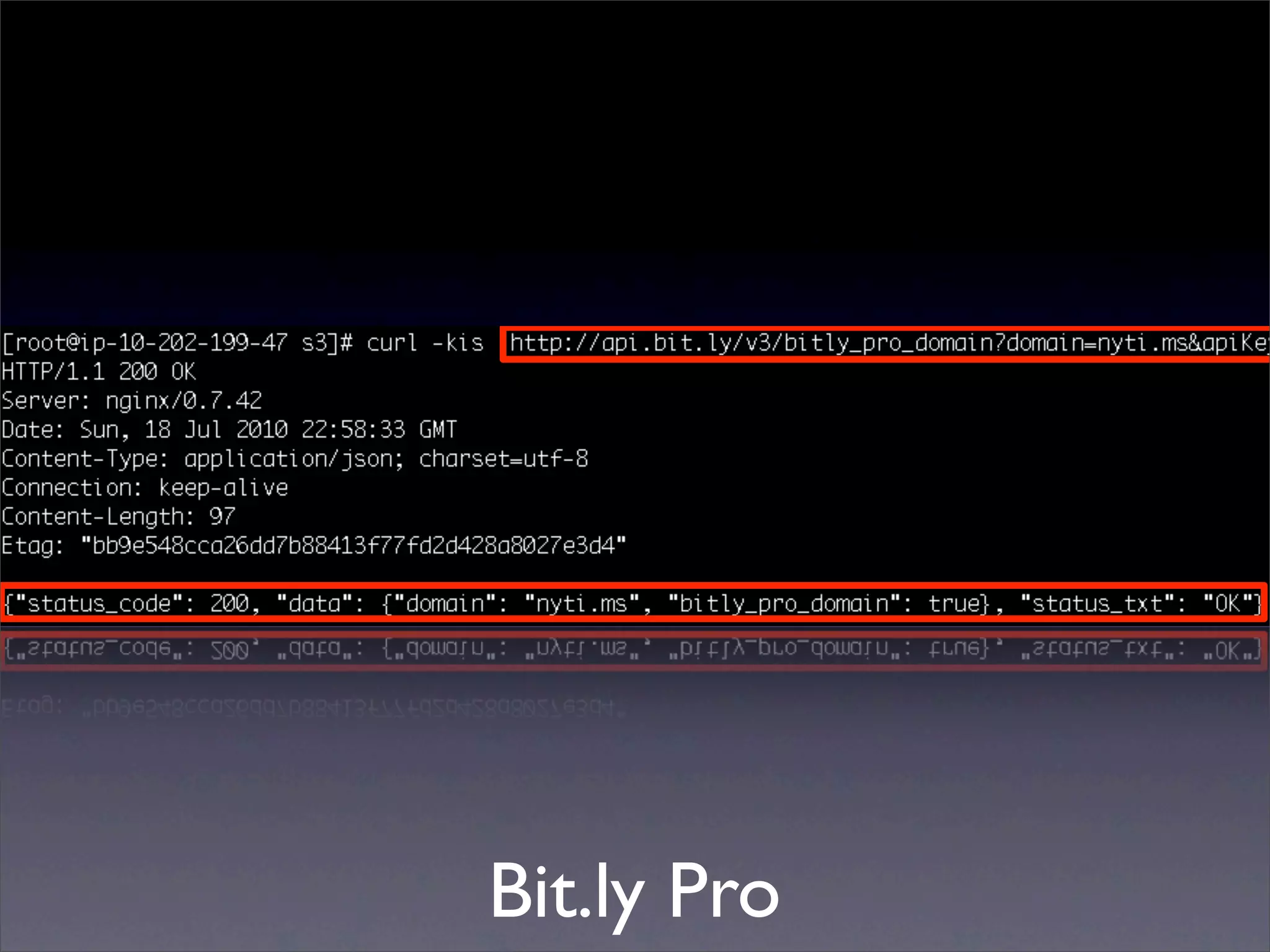
Bit.ly Pro
Bit.ly Pro
Bit.ly Pro
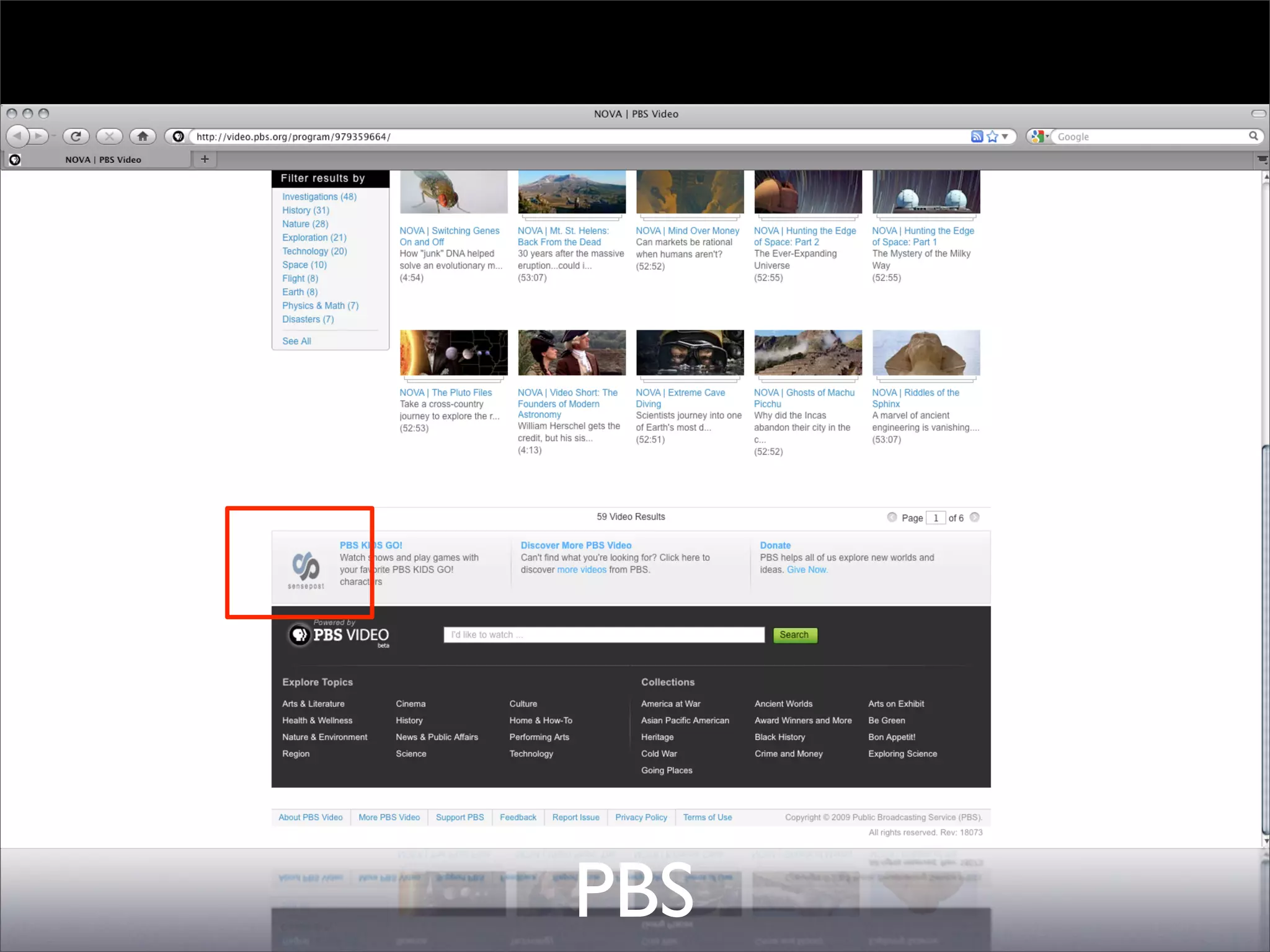
PBS
PBS
PBS
PBS
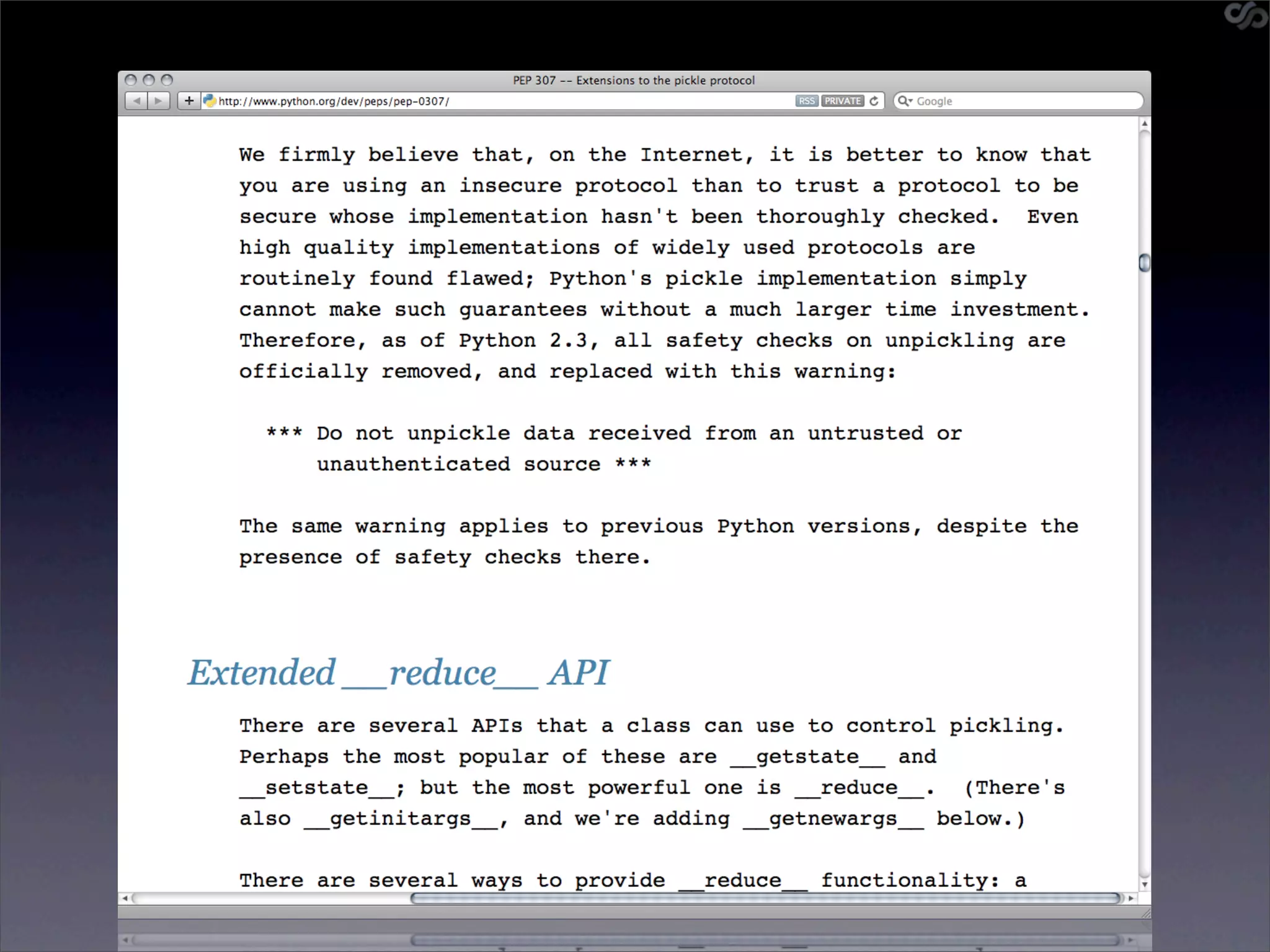
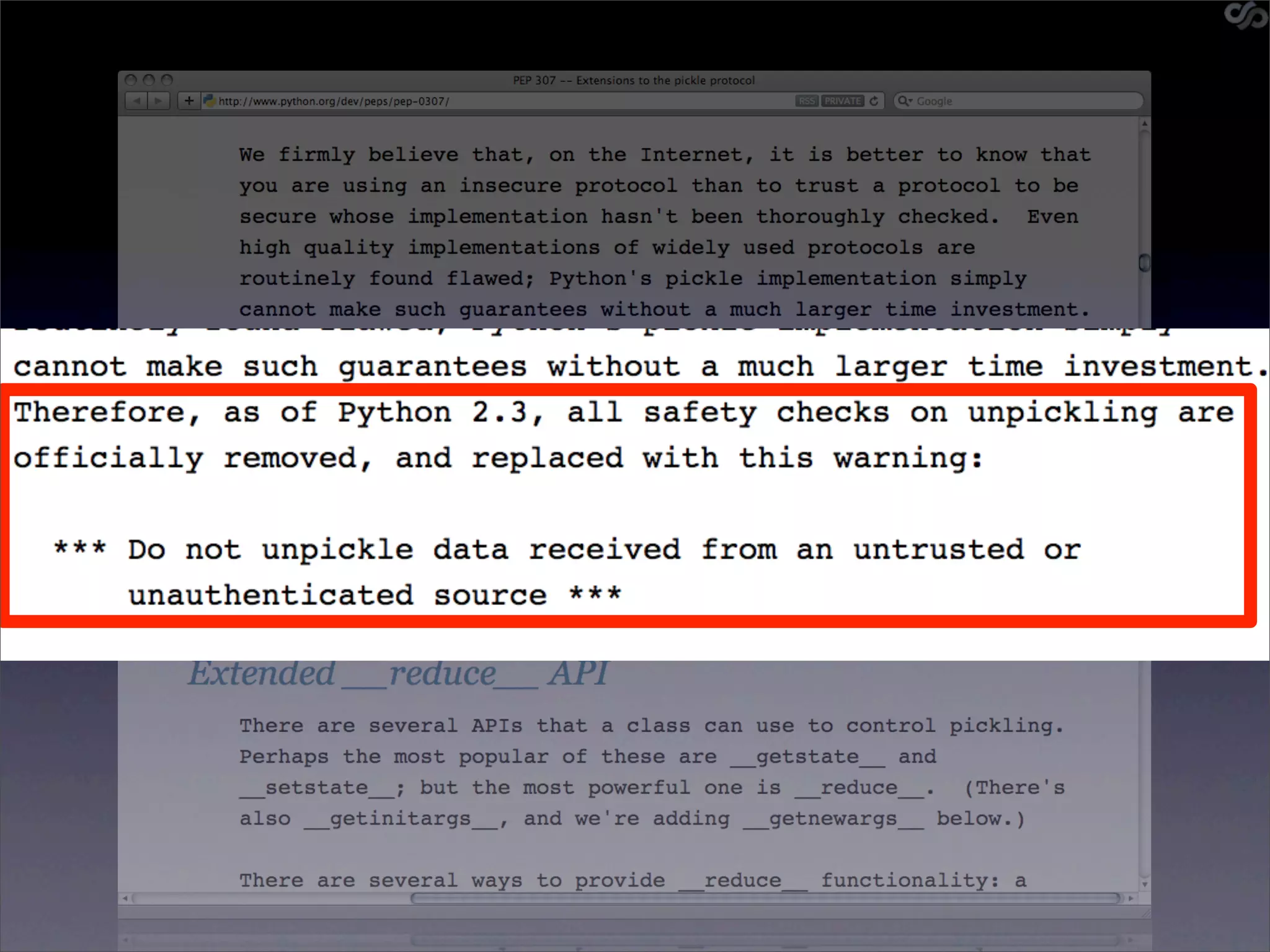
Sidebar: serialized objs
• Python’s pickle intentionally insecure
• But they’re exposed!
• Pickle shellcode
  cos
  system
  (S'echo hostname'
  tR.

• [demo]
Sidebar: serialized objs
• Python’s pickle intentionally insecure
• But they’re exposed!
• Pickle shellcode
  cos
  system
  (S'echo hostname'
  tR.

• [demo]
Fixes?
•   FW. FW. FW. FW. FW. FW. FW. FW. FW. FW. FW. FW.
    FW. FW. FW. FW. FW. FW. FW. FW. FW. FW. FW. FW.
    FW. FW. FW. FW. FW. FW. FW. FW. FW. FW. FW. FW.
    (VPC)
•   Hack code to disable stats facility (but doesn’t prevent
    key brute-force)
•   Hack code to disable remote enabling of debug features
•   Switch to SASL
    •  Requires binary protocol
    •  Not supported by a number of memcached libs
•   Salt your passwords with a proper scheme (PHK’s MD5
    or Bcrypt)
•   Also, FW.
Random thoughts
• This can’t be new
• Inject tracker images / strings
 • Trace Refers / hit Google
• Key guessing or prediction
• Your data ends up in places you never
  expected.
Places to keep looking

• Improve data detection/sifting/filtering
• Spread the search past a single provider
• Caching providers (?!?!)
• Other cache software
• Other infrastructure software
Questions?

www.sensepost.com/labs/tools/poc/go-derper

Cache on Delivery

  • 1.
    Cache on delivery mining memcached marco@sensepost.com
  • 3.
    The need forcaching • Large percentage of data remains relatively constant • Wikipedia page contents • Youtube video links • FB Profile data • Poorly designed solutions regenerate data on each request • Don’t regenerate, rather regurgitate
  • 4.
    The need forcaching • Large percentage of data remains relatively constant • Wikipedia page contents • Youtube video links • FB Profile data • Poorly designed solutions regenerate data on each request • Don’t regenerate, rather regurgitate
  • 5.
    Memcached • memcached.org • Writtenfor LJ (2003) by Brad Fitzpatrick • Non-persistent network-based KV store • Why do we care? Mom&pop don’t need the cache.
  • 6.
    Memcached • memcached.org • Writtenfor LJ (2003) by Brad Fitzpatrick • Non-persistent network-based KV store • Why do we care? Mom&pop don’t need the cache.
  • 7.
    Basic KV • Slabsare fixed size • Users don’t care about slabs • Dstvalue size by slab determined • Miners care about slabs
  • 8.
    Trivial protocol • ASCII-based • Long-lived • Tiny command set • set • get • stats • ... • ???? Binary and UDP protocols also exist, these were not touched.
  • 9.
    Trivial protocol • ASCII-based • Long-lived • Tiny command set • set • get • stats • ... • ???? Binary and UDP protocols also exist, these were not touched.
  • 10.
    Trivial protocol • ASCII-based • Long-lived • Tiny command set • set • get • stats • ... • ???? Binary and UDP protocols also exist, these were not touched.
  • 11.
    Trivial protocol • ASCII-based • Long-lived • Tiny command set • set • get • stats • ... • ???? Binary and UDP protocols also exist, these were not touched.
  • 12.
    Trivial protocol • ASCII-based • Long-lived • Tiny command set • set • get • stats • ... • ???? Binary and UDP protocols also exist, these were not touched.
  • 13.
    1998 • Blank ‘sa’ • Anonymous ftp • system/manager
  • 14.
    Goals • Connect to memcached • Find all slabs • Retrieve keynames from each slab • Retrieve each key
  • 15.
    Lies, damn lies,and stats stats slabs STAT 1:chunk_size 80 • <...> stats cmd has subcmds STAT 2:chunk_size 104 <...> STAT 3:chunk_size 136 • items <...> STAT 4:chunk_size <...> 176 • slabs STAT 6:chunk_size <...> STAT 8:chunk_size 280 440 • <...> ... STAT 9:chunk_size 552 <...> STAT 9:cas_badval 0 STAT active_slabs 7 This gets us the slabs_ids
  • 16.
    Retrieving key names Relyon two {poorly|un} documented features
  • 17.
    Retrieving key names Feature#1: Remote enabling of debug mode
  • 18.
    Retrieving key names Feature#2: “stats cachedump”
  • 19.
    Retrieving key names Feature#2: “stats cachedump”
  • 20.
    Retrieving key names Feature#2: “stats cachedump” Slabs ID
  • 21.
    Retrieving key names Feature#2: “stats cachedump” Key limit
  • 22.
    Retrieving key names Feature#2: “stats cachedump” Key list
  • 23.
    Retrieving key names Feature#2: “stats cachedump” This gets us key names
  • 24.
    And this getsus? • No need for complex hacks. Memcached serves up all its data for us. • What to do in an exposed cache? • Mine • SQLi is too hard for me • Overwrite • Client-side • Server-side
  • 25.
    Mining the cache •go-derper.rb – memcached miner • Retrieves up to k keys from each slab and their contents, store on disk • Applies regexes and filters matches in a hits file • Supports easy overwriting of cache entries • [demo]
  • 26.
  • 27.
    Two issues • Findingcaches • Again with the simple approach • Pick a cloud network, scan for memcacheds on port 11211 with a mod’ed .nse
  • 28.
    Two issues • Linking apps to caches • Who’s %$!#ing cache is this? • Cached high scores suck. Where’s the good stuff? • Is it live? http://www.rhythm.com/~keith/autoStereoGrams/vortexas.gif
  • 29.
    Results #1 IPs scanned 2^16 # of caches found 229 Retrieved Items 7.3GB Average uptime ~50days Total bandwidth used 9PB Total entry count 288 million Total Bytes stored 136TB Highest bandwidth 247TB Highest entry count 133 million Highest Bytes Stored 19.3GB
  • 30.
    Results #2 • HTML • Objects found • JavaScript • Serialized Java • Data • Pickled Python • Email • Ruby ActiveRecord • Passwords • .Net Object (clear-text, crypt’ed, MD5) • JSON
  • 31.
  • 32.
  • 33.
  • 34.
  • 35.
  • 36.
  • 37.
  • 38.
  • 39.
  • 40.
  • 41.
  • 42.
  • 43.
  • 44.
  • 45.
  • 46.
  • 47.
  • 48.
    Sidebar: serialized objs •Python’s pickle intentionally insecure • But they’re exposed! • Pickle shellcode cos system (S'echo hostname' tR. • [demo]
  • 51.
    Sidebar: serialized objs •Python’s pickle intentionally insecure • But they’re exposed! • Pickle shellcode cos system (S'echo hostname' tR. • [demo]
  • 52.
    Fixes? • FW. FW. FW. FW. FW. FW. FW. FW. FW. FW. FW. FW. FW. FW. FW. FW. FW. FW. FW. FW. FW. FW. FW. FW. FW. FW. FW. FW. FW. FW. FW. FW. FW. FW. FW. FW. (VPC) • Hack code to disable stats facility (but doesn’t prevent key brute-force) • Hack code to disable remote enabling of debug features • Switch to SASL • Requires binary protocol • Not supported by a number of memcached libs • Salt your passwords with a proper scheme (PHK’s MD5 or Bcrypt) • Also, FW.
  • 53.
    Random thoughts • Thiscan’t be new • Inject tracker images / strings • Trace Refers / hit Google • Key guessing or prediction • Your data ends up in places you never expected.
  • 54.
    Places to keeplooking • Improve data detection/sifting/filtering • Spread the search past a single provider • Caching providers (?!?!) • Other cache software • Other infrastructure software
  • 55.