Caching
Memcached vs. Redis
        San Francisco MySQL Meetup

                        Ryan Lowe
                       Erin O’Neill


                                      1
Databases

  WE LOVE THEM
         ...
Except when we don’t


                       2
When Databases Rule
• Many access patterns on the same set of
  data
• Transactions (both monetary and isolated
  units of work)
• Don’t know what the end state access
  patterns will be
• Always :)
                                             3
When Databases Suck

• Lots of concurrent users
• ORMs
• Big Data Sets
• Small Pockets of VERY hot data

                                   4
How Caching Works

• External vs. built-in caching
• MySQL Query Cache
• InnoDB Buffer Pool
• Rails SOMETHING

                                  5
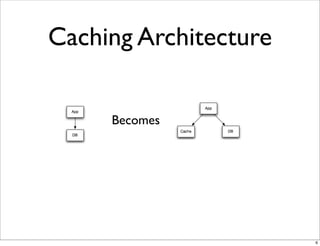
Caching Architecture


     Becomes


                       6
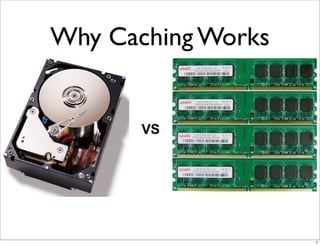
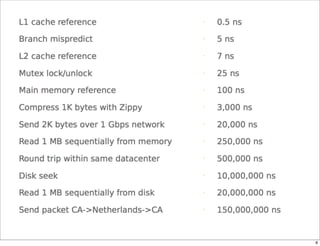
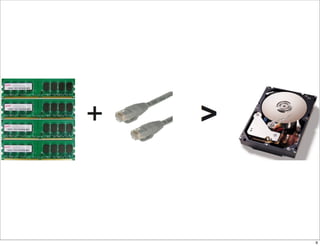
Why Caching Works


                    7
8
9
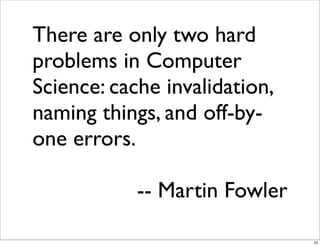
There are only two hard
problems in Computer
Science: cache invalidation,
naming things, and off-by-
one errors.

            -- Martin Fowler

                               10
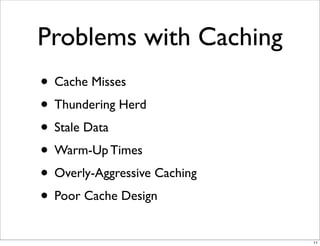
Problems with Caching
• Cache Misses
• Thundering Herd
• Stale Data
• Warm-Up Times
• Overly-Aggressive Caching
• Poor Cache Design
                              11
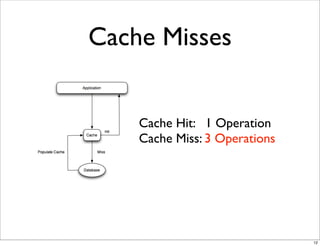
Cache Misses


    Cache Hit: 1 Operation
    Cache Miss: 3 Operations


                               12
Thundering Herd

• Key TOP_10_VIDEOS expires @ 9:00
• Generating the K/V takes three seconds
• Page gets 100 req/s = 100*3 = 300 threads!


                                               13
Stale Data

• Must maintain consistency between the
  database and the cache from within the
  application
• Extremely difficult to validate correctness


                                               14
Cache Warm-Up

• All attempts to read from the cache are
  CACHE MISSES, which require three
  operations.
• This can result in a significant degradation
  of response time.
• Usually accompanied by a Thundering Herd

                                                15
Use Cases
• Sessions           • Tag Clouds
• Popular Items      • Auto-suggest lists
• Full Page Cache    • Relationships
• Profile             • User Information
  Information
                     • Online Users
• User Preferences   • Statistics
                                            16
Memcached

Memcached is an in-memory key-
value store for small chunks of
arbitrary data (strings, objects) from
results of database calls, API calls,
or page rendering.


                                         17
Redis

Redis is an open source, advanced
key-value store. It is often referred
to as a “data structure server” since
keys can contain strings, hashes,
lists, sets and sorted sets.


                                        18
In-Memory Means
We’re Bound By RAM


                     19
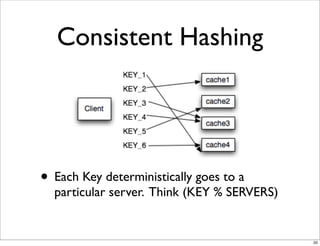
Consistent Hashing


• Each Key deterministically goes to a
  particular server. Think (KEY % SERVERS)


                                             20
Memcached

• Dead Simple & Battle Tested
• Fast
• Non-Blocking get()/set()
• Multi-Threaded
• Consistent Hashing

                                21
Memcached Example
employee_id = 1234
employee_json = {
   name => ‘Ryan Lowe’,
   title => ‘Production Engineer’ }
set(employee_id, employee_json)
get(employee_id) [Returns employee_json]


                                           22
But I don’t want all the
         data
• What if I just want the name?
• 64 Bytes for the object vs. 10 for just the
  name :-(
• 6x network traffic
• More work for the application
• Fatter applications
                                                23
Redis

• Advanced Data Types
• Replication
• Persistence
• Usually Fast
• Very Cool Atomic Operations

                                24
Redis: The Bad
• Single-Threaded
• Limited client support for consistent
  hashing
• Significant overhead for persistence (do be
  discussed later)
• Not widely deployed (compared to
  Memcached)


                                               25
Redis: Datatypes

• Strings (just like Memcached)
• Lists
• Sets
• Sorted Sets
• Hashes

                                  26
Redis: Lists

• Stored in sorted order
• Can push/pop
• Fast head/tail access
• Index access (yay)

                           27
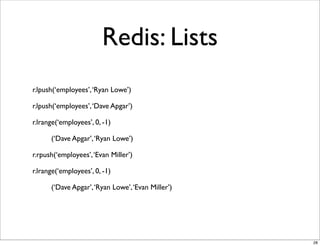
Redis: Lists
r.lpush(‘employees’, ‘Ryan Lowe’)

r.lpush(‘employees’, ‘Dave Apgar’)

r.lrange(‘employees’, 0, -1)

      (‘Dave Apgar’, ‘Ryan Lowe’)

r.rpush(‘employees’, ‘Evan Miller’)

r.lrange(‘employees’, 0, -1)

      (‘Dave Apgar’, ‘Ryan Lowe’, ‘Evan Miller’)


                                                   28
Redis: Sets

• Un-ordered collections of strings
• Unique (no repeated members)
• diff, intersect, merge


                                      29
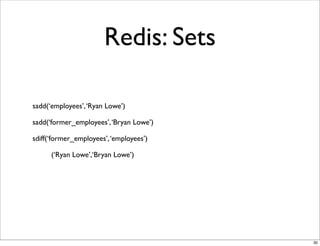
Redis: Sets

sadd(‘employees’, ‘Ryan Lowe’)

sadd(‘former_employees’, ‘Bryan Lowe’)

sdiff(‘former_employees’, ‘employees’)

      (‘Ryan Lowe’,‘Bryan Lowe’)


                                         30
Redis: Sorted Sets


• Same as Sets but ordered by a score


                                        31
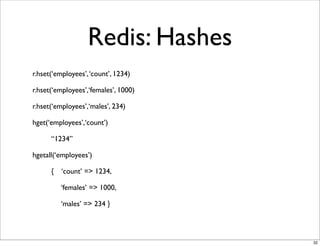
Redis: Hashes
r.hset(‘employees’, ‘count’, 1234)

r.hset(‘employees’,‘females’, 1000)

r.hset(‘employees’,‘males’, 234)

hget(‘employees’,‘count’)

      “1234”

hgetall(‘employees’)

      {   ‘count’ => 1234,

          ‘females’ => 1000,

          ‘males’ => 234 }


                                      32
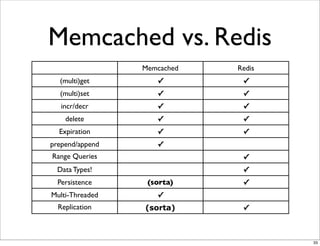
Memcached vs. Redis
                 Memcached   Redis
  (multi)get        ✓         ✓
  (multi)set        ✓         ✓
   incr/decr        ✓         ✓
    delete          ✓         ✓
  Expiration        ✓         ✓
prepend/append      ✓
Range Queries                 ✓
  Data Types!                 ✓
  Persistence     (sorta)     ✓
Multi-Threaded      ✓
  Replication    (sorta)      ✓


                                     33
Instrumentation
• Redis: info
• Memcached: stats

• Both give system information, connections,
  hits, misses, etc.
• Graphite most of the metrics!!!
                                               34
Benchmarks


             35
About the Benchmarks
• 1 Hour
• Redis 2.6 & Memcached 1.4.5
• 64,000,000 Keys
  "KEY_#{i.to_s}"


• 51-Character Values
  (0...50).map{ ('a'..'z').to_a[rand(26)] }.join


                                                   36
Redis Benchmarks


                   37
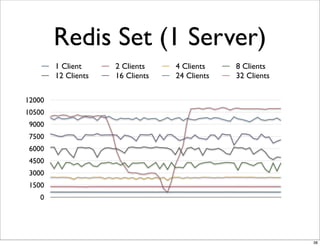
Redis Set (1 Server)
        1 Client     2 Clients    4 Clients    8 Clients
        12 Clients   16 Clients   24 Clients   32 Clients

12000
10500
 9000
 7500
 6000
 4500
 3000
 1500
    0


                                                            38
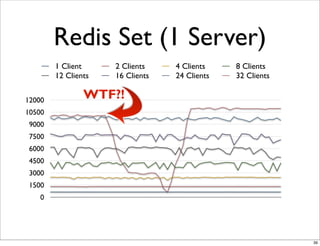
Redis Set (1 Server)
        1 Client     2 Clients    4 Clients    8 Clients
        12 Clients   16 Clients   24 Clients   32 Clients

12000
                WTF?!
10500
 9000
 7500
 6000
 4500
 3000
 1500
    0


                                                            39
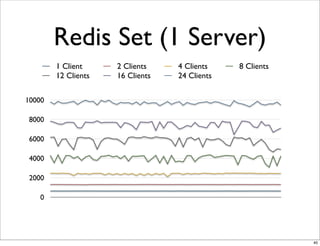
Redis Set (1 Server)
        1 Client     2 Clients    4 Clients    8 Clients
        12 Clients   16 Clients   24 Clients

10000

 8000

 6000

 4000

 2000

    0


                                                           40
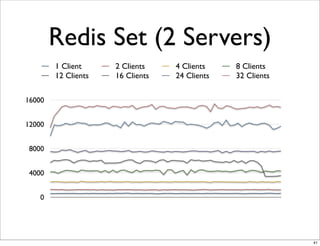
Redis Set (2 Servers)
        1 Client     2 Clients    4 Clients    8 Clients
        12 Clients   16 Clients   24 Clients   32 Clients

16000


12000


 8000


 4000


    0


                                                            41
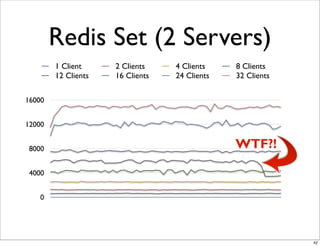
Redis Set (2 Servers)
        1 Client     2 Clients    4 Clients    8 Clients
        12 Clients   16 Clients   24 Clients   32 Clients

16000


12000


 8000                                          WTF?!

 4000


    0


                                                            42
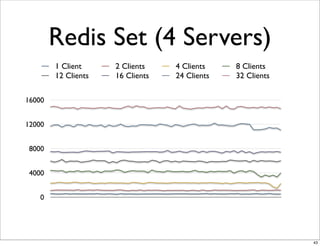
Redis Set (4 Servers)
        1 Client     2 Clients    4 Clients    8 Clients
        12 Clients   16 Clients   24 Clients   32 Clients

16000


12000


 8000


 4000


    0


                                                            43
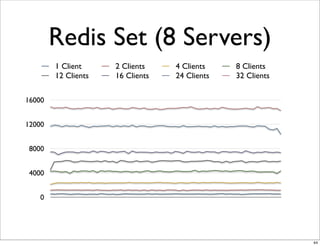
Redis Set (8 Servers)
        1 Client     2 Clients    4 Clients    8 Clients
        12 Clients   16 Clients   24 Clients   32 Clients

16000


12000


 8000


 4000


    0


                                                            44
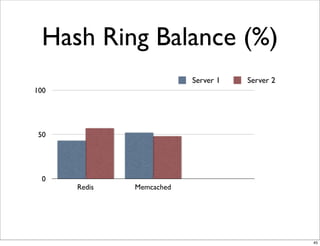
Hash Ring Balance (%)
                          Server 1   Server 2
100


 50


  0
      Redis   Memcached


                                                45
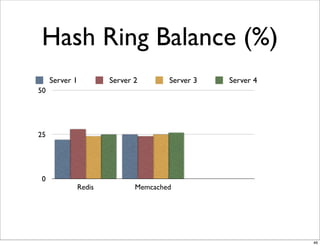
Hash Ring Balance (%)
     Server 1       Server 2       Server 3   Server 4
50


25


 0
            Redis          Memcached


                                                         46
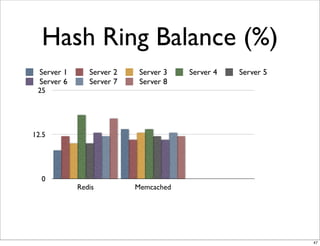
Hash Ring Balance (%)
  Server 1      Server 2    Server 3   Server 4   Server 5
  Server 6      Server 7    Server 8
 25


12.5


  0
             Redis         Memcached


                                                             47
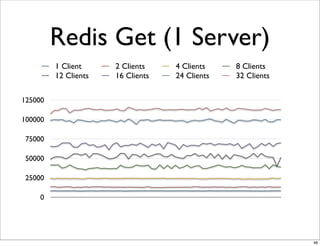
Redis Get (1 Server)
         1 Client     2 Clients    4 Clients    8 Clients
         12 Clients   16 Clients   24 Clients   32 Clients

125000

100000

 75000

 50000

 25000

     0


                                                             48
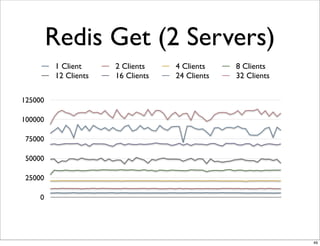
Redis Get (2 Servers)
         1 Client     2 Clients    4 Clients    8 Clients
         12 Clients   16 Clients   24 Clients   32 Clients

125000

100000

 75000

 50000

 25000

     0


                                                             49
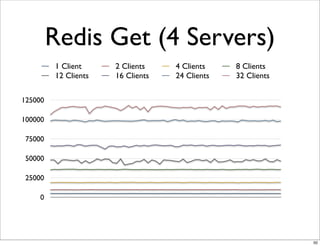
Redis Get (4 Servers)
         1 Client     2 Clients    4 Clients    8 Clients
         12 Clients   16 Clients   24 Clients   32 Clients

125000

100000

 75000

 50000

 25000

     0


                                                             50
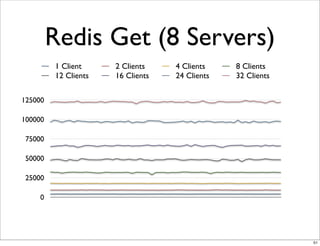
Redis Get (8 Servers)
         1 Client     2 Clients    4 Clients    8 Clients
         12 Clients   16 Clients   24 Clients   32 Clients

125000

100000

 75000

 50000

 25000

     0


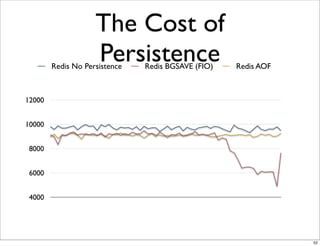
                                                             51
The Cost of
                    Persistence
        Redis No Persistence   Redis BGSAVE (FIO)   Redis AOF


12000


10000


 8000


 6000


 4000


                                                                52
Redis & Memcached
   Benchmarks


                    53
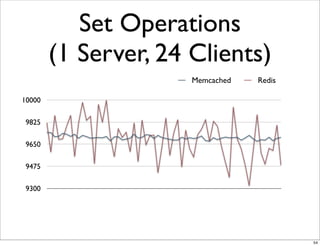
Set Operations
        (1 Server, 24 Clients)
                      Memcached   Redis

10000

 9825

 9650

 9475

 9300


                                          54
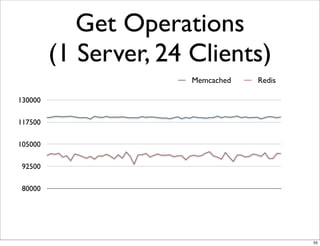
Get Operations
         (1 Server, 24 Clients)
                       Memcached   Redis

130000

117500

105000

 92500

 80000


                                           55
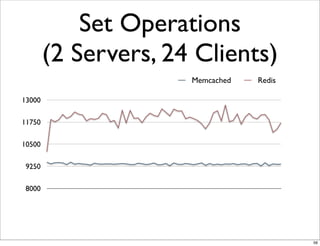
Set Operations
        (2 Servers, 24 Clients)
                      Memcached   Redis

13000

11750

10500

 9250

 8000


                                          56
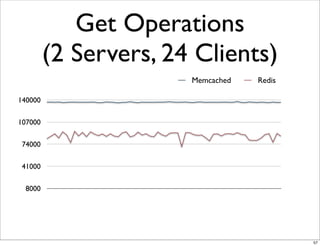
Get Operations
         (2 Servers, 24 Clients)
                       Memcached   Redis

140000

107000

 74000

 41000

  8000


                                           57
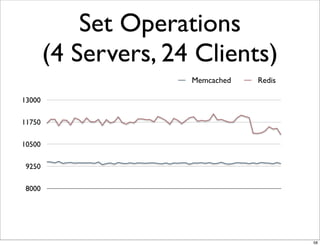
Set Operations
        (4 Servers, 24 Clients)
                      Memcached   Redis

13000

11750

10500

 9250

 8000


                                          58
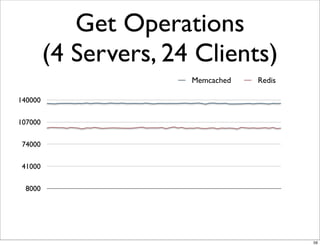
Get Operations
         (4 Servers, 24 Clients)
                       Memcached   Redis

140000

107000

 74000

 41000

  8000


                                           59
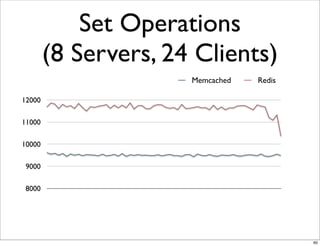
Set Operations
        (8 Servers, 24 Clients)
                      Memcached   Redis

12000

11000

10000

 9000

 8000


                                          60
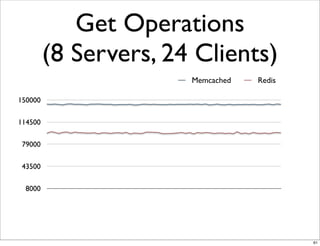
Get Operations
         (8 Servers, 24 Clients)
                       Memcached   Redis

150000

114500

 79000

 43500

  8000


                                           61
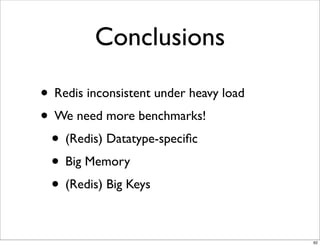
Conclusions

• Redis inconsistent under heavy load
• We need more benchmarks!
 • (Redis) Datatype-specific
 • Big Memory
 • (Redis) Big Keys

                                        62
Questions?


             63

Redis memcached pdf

  • 1.
    Caching Memcached vs. Redis San Francisco MySQL Meetup Ryan Lowe Erin O’Neill 1
  • 2.
    Databases WELOVE THEM ... Except when we don’t 2
  • 3.
    When Databases Rule •Many access patterns on the same set of data • Transactions (both monetary and isolated units of work) • Don’t know what the end state access patterns will be • Always :) 3
  • 4.
    When Databases Suck •Lots of concurrent users • ORMs • Big Data Sets • Small Pockets of VERY hot data 4
  • 5.
    How Caching Works •External vs. built-in caching • MySQL Query Cache • InnoDB Buffer Pool • Rails SOMETHING 5
  • 6.
  • 7.
  • 8.
  • 9.
  • 10.
    There are onlytwo hard problems in Computer Science: cache invalidation, naming things, and off-by- one errors. -- Martin Fowler 10
  • 11.
    Problems with Caching •Cache Misses • Thundering Herd • Stale Data • Warm-Up Times • Overly-Aggressive Caching • Poor Cache Design 11
  • 12.
    Cache Misses Cache Hit: 1 Operation Cache Miss: 3 Operations 12
  • 13.
    Thundering Herd • KeyTOP_10_VIDEOS expires @ 9:00 • Generating the K/V takes three seconds • Page gets 100 req/s = 100*3 = 300 threads! 13
  • 14.
    Stale Data • Mustmaintain consistency between the database and the cache from within the application • Extremely difficult to validate correctness 14
  • 15.
    Cache Warm-Up • Allattempts to read from the cache are CACHE MISSES, which require three operations. • This can result in a significant degradation of response time. • Usually accompanied by a Thundering Herd 15
  • 16.
    Use Cases • Sessions • Tag Clouds • Popular Items • Auto-suggest lists • Full Page Cache • Relationships • Profile • User Information Information • Online Users • User Preferences • Statistics 16
  • 17.
    Memcached Memcached is anin-memory key- value store for small chunks of arbitrary data (strings, objects) from results of database calls, API calls, or page rendering. 17
  • 18.
    Redis Redis is anopen source, advanced key-value store. It is often referred to as a “data structure server” since keys can contain strings, hashes, lists, sets and sorted sets. 18
  • 19.
  • 20.
    Consistent Hashing • EachKey deterministically goes to a particular server. Think (KEY % SERVERS) 20
  • 21.
    Memcached • Dead Simple& Battle Tested • Fast • Non-Blocking get()/set() • Multi-Threaded • Consistent Hashing 21
  • 22.
    Memcached Example employee_id =1234 employee_json = { name => ‘Ryan Lowe’, title => ‘Production Engineer’ } set(employee_id, employee_json) get(employee_id) [Returns employee_json] 22
  • 23.
    But I don’twant all the data • What if I just want the name? • 64 Bytes for the object vs. 10 for just the name :-( • 6x network traffic • More work for the application • Fatter applications 23
  • 24.
    Redis • Advanced DataTypes • Replication • Persistence • Usually Fast • Very Cool Atomic Operations 24
  • 25.
    Redis: The Bad •Single-Threaded • Limited client support for consistent hashing • Significant overhead for persistence (do be discussed later) • Not widely deployed (compared to Memcached) 25
  • 26.
    Redis: Datatypes • Strings(just like Memcached) • Lists • Sets • Sorted Sets • Hashes 26
  • 27.
    Redis: Lists • Storedin sorted order • Can push/pop • Fast head/tail access • Index access (yay) 27
  • 28.
    Redis: Lists r.lpush(‘employees’, ‘RyanLowe’) r.lpush(‘employees’, ‘Dave Apgar’) r.lrange(‘employees’, 0, -1) (‘Dave Apgar’, ‘Ryan Lowe’) r.rpush(‘employees’, ‘Evan Miller’) r.lrange(‘employees’, 0, -1) (‘Dave Apgar’, ‘Ryan Lowe’, ‘Evan Miller’) 28
  • 29.
    Redis: Sets • Un-orderedcollections of strings • Unique (no repeated members) • diff, intersect, merge 29
  • 30.
    Redis: Sets sadd(‘employees’, ‘RyanLowe’) sadd(‘former_employees’, ‘Bryan Lowe’) sdiff(‘former_employees’, ‘employees’) (‘Ryan Lowe’,‘Bryan Lowe’) 30
  • 31.
    Redis: Sorted Sets •Same as Sets but ordered by a score 31
  • 32.
    Redis: Hashes r.hset(‘employees’, ‘count’,1234) r.hset(‘employees’,‘females’, 1000) r.hset(‘employees’,‘males’, 234) hget(‘employees’,‘count’) “1234” hgetall(‘employees’) { ‘count’ => 1234, ‘females’ => 1000, ‘males’ => 234 } 32
  • 33.
    Memcached vs. Redis Memcached Redis (multi)get ✓ ✓ (multi)set ✓ ✓ incr/decr ✓ ✓ delete ✓ ✓ Expiration ✓ ✓ prepend/append ✓ Range Queries ✓ Data Types! ✓ Persistence (sorta) ✓ Multi-Threaded ✓ Replication (sorta) ✓ 33
  • 34.
    Instrumentation • Redis: info •Memcached: stats • Both give system information, connections, hits, misses, etc. • Graphite most of the metrics!!! 34
  • 35.
  • 36.
    About the Benchmarks •1 Hour • Redis 2.6 & Memcached 1.4.5 • 64,000,000 Keys "KEY_#{i.to_s}" • 51-Character Values (0...50).map{ ('a'..'z').to_a[rand(26)] }.join 36
  • 37.
  • 38.
    Redis Set (1Server) 1 Client 2 Clients 4 Clients 8 Clients 12 Clients 16 Clients 24 Clients 32 Clients 12000 10500 9000 7500 6000 4500 3000 1500 0 38
  • 39.
    Redis Set (1Server) 1 Client 2 Clients 4 Clients 8 Clients 12 Clients 16 Clients 24 Clients 32 Clients 12000 WTF?! 10500 9000 7500 6000 4500 3000 1500 0 39
  • 40.
    Redis Set (1Server) 1 Client 2 Clients 4 Clients 8 Clients 12 Clients 16 Clients 24 Clients 10000 8000 6000 4000 2000 0 40
  • 41.
    Redis Set (2Servers) 1 Client 2 Clients 4 Clients 8 Clients 12 Clients 16 Clients 24 Clients 32 Clients 16000 12000 8000 4000 0 41
  • 42.
    Redis Set (2Servers) 1 Client 2 Clients 4 Clients 8 Clients 12 Clients 16 Clients 24 Clients 32 Clients 16000 12000 8000 WTF?! 4000 0 42
  • 43.
    Redis Set (4Servers) 1 Client 2 Clients 4 Clients 8 Clients 12 Clients 16 Clients 24 Clients 32 Clients 16000 12000 8000 4000 0 43
  • 44.
    Redis Set (8Servers) 1 Client 2 Clients 4 Clients 8 Clients 12 Clients 16 Clients 24 Clients 32 Clients 16000 12000 8000 4000 0 44
  • 45.
    Hash Ring Balance(%) Server 1 Server 2 100 50 0 Redis Memcached 45
  • 46.
    Hash Ring Balance(%) Server 1 Server 2 Server 3 Server 4 50 25 0 Redis Memcached 46
  • 47.
    Hash Ring Balance(%) Server 1 Server 2 Server 3 Server 4 Server 5 Server 6 Server 7 Server 8 25 12.5 0 Redis Memcached 47
  • 48.
    Redis Get (1Server) 1 Client 2 Clients 4 Clients 8 Clients 12 Clients 16 Clients 24 Clients 32 Clients 125000 100000 75000 50000 25000 0 48
  • 49.
    Redis Get (2Servers) 1 Client 2 Clients 4 Clients 8 Clients 12 Clients 16 Clients 24 Clients 32 Clients 125000 100000 75000 50000 25000 0 49
  • 50.
    Redis Get (4Servers) 1 Client 2 Clients 4 Clients 8 Clients 12 Clients 16 Clients 24 Clients 32 Clients 125000 100000 75000 50000 25000 0 50
  • 51.
    Redis Get (8Servers) 1 Client 2 Clients 4 Clients 8 Clients 12 Clients 16 Clients 24 Clients 32 Clients 125000 100000 75000 50000 25000 0 51
  • 52.
    The Cost of Persistence Redis No Persistence Redis BGSAVE (FIO) Redis AOF 12000 10000 8000 6000 4000 52
  • 53.
    Redis & Memcached Benchmarks 53
  • 54.
    Set Operations (1 Server, 24 Clients) Memcached Redis 10000 9825 9650 9475 9300 54
  • 55.
    Get Operations (1 Server, 24 Clients) Memcached Redis 130000 117500 105000 92500 80000 55
  • 56.
    Set Operations (2 Servers, 24 Clients) Memcached Redis 13000 11750 10500 9250 8000 56
  • 57.
    Get Operations (2 Servers, 24 Clients) Memcached Redis 140000 107000 74000 41000 8000 57
  • 58.
    Set Operations (4 Servers, 24 Clients) Memcached Redis 13000 11750 10500 9250 8000 58
  • 59.
    Get Operations (4 Servers, 24 Clients) Memcached Redis 140000 107000 74000 41000 8000 59
  • 60.
    Set Operations (8 Servers, 24 Clients) Memcached Redis 12000 11000 10000 9000 8000 60
  • 61.
    Get Operations (8 Servers, 24 Clients) Memcached Redis 150000 114500 79000 43500 8000 61
  • 62.
    Conclusions • Redis inconsistentunder heavy load • We need more benchmarks! • (Redis) Datatype-specific • Big Memory • (Redis) Big Keys 62
  • 63.