Cable Preparation in CCTV
D R . R . H E P Z I P R A M I L A D E V A M A N I
A S S I S T A N T P R O F E S S O R O F P H Y S I C S
V . V . V A N N I A P E R U M A L C O L L E G E F O R W O M E N ,
V I R U D H U N A G A R
Bend Radius
Current coaxial standards do not specify bend radius; however, various manufacturers do provide
guidance. Check with manufacturers for specifics. Special care should be taken when pulling a
coaxial cable around bends. Using too much force or too tight of a bend can deform the dielectric
and cause a drop in transmission performance.
Transmission media is the most important part of an installation. It is estimated that over 65% of
failure in a CCTV system is associated with transmission media which includes the type of cable
used, connectors, connections and the installation methods.
Bend Radius
The second biggest area that account for nearly
27% of the problems are power and
environment related which includes either
excessive or inadequate input power,
ineffective or improper grounding or an
excessive temperature around the equipment.
Incorrect equipment setup, improper
equipment termination and improper camera
installation account for about 7% of the
problems directly associated with the
installation personnel. Only 1% of the failures
in a CCTV installation are actually caused by
device failures.
Connector Termination and Testing
The following steps will guide you through the
preparation and termination process for coaxial
cable with compression connectors.
Following these guidelines will help make sure
that you receive the optimum performance from
the coaxial cable.
Connector Termination and Testing
Step 1
The tools you will need:
Compression tool
Cable stripper
Compression Connectors
Connector Termination and Testing
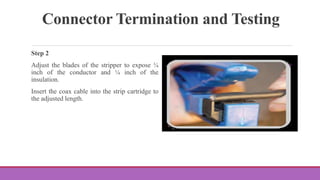
Step 2
Adjust the blades of the stripper to expose ¼
inch of the conductor and ¼ inch of the
insulation.
Insert the coax cable into the strip cartridge to
the adjusted length.
Connector Termination and Testing
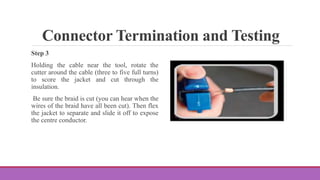
Step 3
Holding the cable near the tool, rotate the
cutter around the cable (three to five full turns)
to score the jacket and cut through the
insulation.
Be sure the braid is cut (you can hear when the
wires of the braid have all been cut). Then flex
the jacket to separate and slide it off to expose
the centre conductor.
Connector Termination and Testing
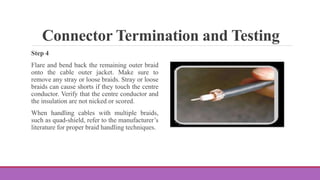
Step 4
Flare and bend back the remaining outer braid
onto the cable outer jacket. Make sure to
remove any stray or loose braids. Stray or loose
braids can cause shorts if they touch the centre
conductor. Verify that the centre conductor and
the insulation are not nicked or scored.
When handling cables with multiple braids,
such as quad-shield, refer to the manufacturer’s
literature for proper braid handling techniques.
Connector Termination and Testing
Step 5
Insert the sleeve ferrule and BNC body onto
the coaxial cable. Firmly push the cable as far
as possible or until 1⁄8 inch of the centre
conductor is protruding from the connector.
Make sure the connector is fully seated and the
white dielectric material is firmly pushed
against the inner stop of the connector. You can
see this by looking into the open end of some
connectors.
Connector Termination and Testing
Step 6
Insert the cable and connector into the
crimping device, making sure that it is
positioned firmly. Squeeze the crimper handle
tightly.
Use a ratcheting tool that does not release until
the proper crimping displacement has been
applied for the specific cabling and connector
type.
Once the tool releases after the final “click,”
the crimp should be complete.
Connector Termination and Testing
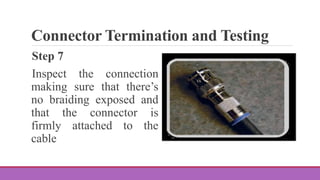
Step 7
Inspect the connection
making sure that there’s
no braiding exposed and
that the connector is
firmly attached to the
cable
Connector Termination and Testing
Step 8
Once the cable is pulled, the cable is to be tested for resistance and proper termination in order to
assure good video quality.
The following method is used to test the proper resistance in a single cable loop.
1. Remove the BNC connection from the output of the camera.
2. Short the centre conductor of the cable to the shield or ground of the connector.
3. Locate the other end of the cable under test and remove it from the DVR.
4. Connect a standard ohm meter to the circuit (black test lead to the shield of the connector, red
lead to the center pin of the connector).
Connector Termination and Testing
5. Check the DC resistance value on the meter.
The maximum DC resistance of the cable
assembly should be between 10 to 15 ohms.
This indicates the resistance loss of the cable,
resistance loss due to connector used or splice
points, and any breakdown of the copper
components of the coaxial cable. This is the
acceptable maximum resistance between the
camera and monitoring location (DVR side). A
lesser resistance value than stated above will
result in better video quality.
Connector Termination and Testing
Step 9
Check the cable length and the termination in a single cable loop.
Step 1: Make sure one end of the cable being tested is connected to the DVR.
Step 2: Remove the BNC connection from the output of the camera.
Step 3: Connect a standard ohm meter to the BNC connector at the camera end (black test lead to
the shield of the connector, red lead to the center pin of the connector).
Connector Termination and Testing
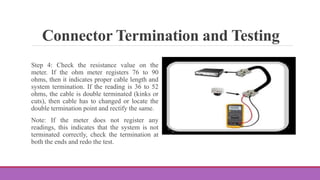
Step 4: Check the resistance value on the
meter. If the ohm meter registers 76 to 90
ohms, then it indicates proper cable length and
system termination. If the reading is 36 to 52
ohms, the cable is double terminated (kinks or
cuts), then cable has to changed or locate the
double termination point and rectify the same.
Note: If the meter does not register any
readings, this indicates that the system is not
terminated correctly, check the termination at
both the ends and redo the test.
Connector Termination and Testing
Step 10
Label the cables for easy troubleshooting
Step 1: Label both ends of the cable.
Step 2: Put the label about 2-3 inches away from the cable end as putting it close to the jack
makes it hard to read, especially on the back of a server in a rack.
Step 3: Consider labelling the cable in multiple places on the cable, for instance along the cable
run under the raised floor or overhead ladder.
REFERENCE
Material Prepared by Department of ECE, V.S.V.N Polytechnic College, Virudhunagar
THANK YOU

Cable preparation in CCTV

  • 1.
    Cable Preparation inCCTV D R . R . H E P Z I P R A M I L A D E V A M A N I A S S I S T A N T P R O F E S S O R O F P H Y S I C S V . V . V A N N I A P E R U M A L C O L L E G E F O R W O M E N , V I R U D H U N A G A R
  • 2.
    Bend Radius Current coaxialstandards do not specify bend radius; however, various manufacturers do provide guidance. Check with manufacturers for specifics. Special care should be taken when pulling a coaxial cable around bends. Using too much force or too tight of a bend can deform the dielectric and cause a drop in transmission performance. Transmission media is the most important part of an installation. It is estimated that over 65% of failure in a CCTV system is associated with transmission media which includes the type of cable used, connectors, connections and the installation methods.
  • 3.
    Bend Radius The secondbiggest area that account for nearly 27% of the problems are power and environment related which includes either excessive or inadequate input power, ineffective or improper grounding or an excessive temperature around the equipment. Incorrect equipment setup, improper equipment termination and improper camera installation account for about 7% of the problems directly associated with the installation personnel. Only 1% of the failures in a CCTV installation are actually caused by device failures.
  • 4.
    Connector Termination andTesting The following steps will guide you through the preparation and termination process for coaxial cable with compression connectors. Following these guidelines will help make sure that you receive the optimum performance from the coaxial cable.
  • 5.
    Connector Termination andTesting Step 1 The tools you will need: Compression tool Cable stripper Compression Connectors
  • 6.
    Connector Termination andTesting Step 2 Adjust the blades of the stripper to expose ¼ inch of the conductor and ¼ inch of the insulation. Insert the coax cable into the strip cartridge to the adjusted length.
  • 7.
    Connector Termination andTesting Step 3 Holding the cable near the tool, rotate the cutter around the cable (three to five full turns) to score the jacket and cut through the insulation. Be sure the braid is cut (you can hear when the wires of the braid have all been cut). Then flex the jacket to separate and slide it off to expose the centre conductor.
  • 8.
    Connector Termination andTesting Step 4 Flare and bend back the remaining outer braid onto the cable outer jacket. Make sure to remove any stray or loose braids. Stray or loose braids can cause shorts if they touch the centre conductor. Verify that the centre conductor and the insulation are not nicked or scored. When handling cables with multiple braids, such as quad-shield, refer to the manufacturer’s literature for proper braid handling techniques.
  • 9.
    Connector Termination andTesting Step 5 Insert the sleeve ferrule and BNC body onto the coaxial cable. Firmly push the cable as far as possible or until 1⁄8 inch of the centre conductor is protruding from the connector. Make sure the connector is fully seated and the white dielectric material is firmly pushed against the inner stop of the connector. You can see this by looking into the open end of some connectors.
  • 10.
    Connector Termination andTesting Step 6 Insert the cable and connector into the crimping device, making sure that it is positioned firmly. Squeeze the crimper handle tightly. Use a ratcheting tool that does not release until the proper crimping displacement has been applied for the specific cabling and connector type. Once the tool releases after the final “click,” the crimp should be complete.
  • 11.
    Connector Termination andTesting Step 7 Inspect the connection making sure that there’s no braiding exposed and that the connector is firmly attached to the cable
  • 12.
    Connector Termination andTesting Step 8 Once the cable is pulled, the cable is to be tested for resistance and proper termination in order to assure good video quality. The following method is used to test the proper resistance in a single cable loop. 1. Remove the BNC connection from the output of the camera. 2. Short the centre conductor of the cable to the shield or ground of the connector. 3. Locate the other end of the cable under test and remove it from the DVR. 4. Connect a standard ohm meter to the circuit (black test lead to the shield of the connector, red lead to the center pin of the connector).
  • 13.
    Connector Termination andTesting 5. Check the DC resistance value on the meter. The maximum DC resistance of the cable assembly should be between 10 to 15 ohms. This indicates the resistance loss of the cable, resistance loss due to connector used or splice points, and any breakdown of the copper components of the coaxial cable. This is the acceptable maximum resistance between the camera and monitoring location (DVR side). A lesser resistance value than stated above will result in better video quality.
  • 14.
    Connector Termination andTesting Step 9 Check the cable length and the termination in a single cable loop. Step 1: Make sure one end of the cable being tested is connected to the DVR. Step 2: Remove the BNC connection from the output of the camera. Step 3: Connect a standard ohm meter to the BNC connector at the camera end (black test lead to the shield of the connector, red lead to the center pin of the connector).
  • 15.
    Connector Termination andTesting Step 4: Check the resistance value on the meter. If the ohm meter registers 76 to 90 ohms, then it indicates proper cable length and system termination. If the reading is 36 to 52 ohms, the cable is double terminated (kinks or cuts), then cable has to changed or locate the double termination point and rectify the same. Note: If the meter does not register any readings, this indicates that the system is not terminated correctly, check the termination at both the ends and redo the test.
  • 16.
    Connector Termination andTesting Step 10 Label the cables for easy troubleshooting Step 1: Label both ends of the cable. Step 2: Put the label about 2-3 inches away from the cable end as putting it close to the jack makes it hard to read, especially on the back of a server in a rack. Step 3: Consider labelling the cable in multiple places on the cable, for instance along the cable run under the raised floor or overhead ladder.
  • 17.
    REFERENCE Material Prepared byDepartment of ECE, V.S.V.N Polytechnic College, Virudhunagar
  • 18.