LARYNGEAL CARCINOMA
RATHEESH R L
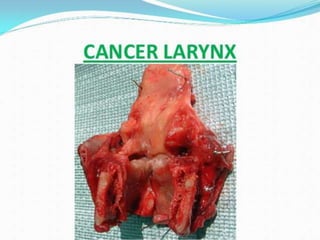
cancer of the larynx
• Laryngeal cancer, also known as cancer of the
larynx or laryngeal carcinoma, are
mostly squamous cell carcinomas, reflecting
their origin from the skin of the larynx.
• Cancer can develop in any part of the larynx, but
the cure rate is affected by the location of the
tumor.
• For the purposes of tumor staging, the larynx is
divided into three anatomical regions:
the glottis, supraglottis and the subglottis.
• Most laryngeal cancers originate in the glottis.
Supraglottic cancers are less common, and
subglottic tumours are least frequent.
• Cancer of larynx accounts for approximately
half of all head and neck cancers.
• Cancer of the larynx is most common in
people between the ages of 60 and 70 yrs and
it occurs 4 – 5 times frequently in men than in
women.
RISK FACTORS
• CARCINOGENS:
– Tobacco(smoke)
– Combined effects of alcohol & tobacco
– Asbetos
– Second hand smoke
– Paint fumes
– Wood dust
– Cement dust
– Chemicals
– Tar products
– Mustard gas
– Leather and metals
OTHER FACTORS:
– Straining the voice
– Chronic laryngitis
– Nutritional deficiencies
– History of alcohol abuse
– Familial predisposition
– Age (higher incidence after 60 yrs of age)
– Gender
– Race(african americans)
– Weakend immune system
• Hoarseness of more than 2 wks duration
occurs in the patient with cancer in the glottic
area because the tumor impedes the action of
vocal cords during speech.
• The voice may sound harsh,raspy and lower in
pitch.
Clinical manifestations:
• Patient may complain of a persistent cough or
sore throat and pain and burning in the
throat especially when consuming hot liquids
or citrus juices.
• A lump may be felt in the neck
• Later symptoms include dysphagia
,dyspnea,unilateral nasal obstruction or
discharge,persistent hoarseness,persistent
ulceration& foul breath.
• Cervical lymphadenopathy
• Unintentional weight loss, a general
debilitated state
• Pain radiating to the ear may occur with
metastasis.
• An initial assessment includes a complete
history and physical examination of the head
and neck
• This identification of risk factors ,family history
and underlying medical conditions.
• An indirect laryngoscopy using a flexible
endoscope,is initially performed in the
otolaryngologists office to visually evaluate
the pharynx,larynx and possible tumor.
Diagnostic findings:
• Mobility of the vocal cords is assessed ,if
normal movement is limited ,the growth may
affect muscle,other tissue,and even the
airway.
• The neck and thyroid gland are palpated for
enlarged lymphnodes & enlarged thyroid
gland.
• Diagnostic procedures that may be used
include endoscopy,including virtuaaal
endoscopy,optical imaging and CT.
• If the tumor is suspected on an initial
examination a direct laryngoscopic
examination is performed under local or
general anesathesia to evaluate all cases of
the larynx.
• In some cases intraoperative examination
obtained by direct microscopic visualization
and palpation of the vocal cords may yield a
more accurate diagnosis.
• CT and MRI are used to assess regional
adenopathy of soft tissues & to stage &
determine the extend of a tumor.
• PET scanning may also be used to detect
recurrence of a laryngeal tumor after
treatment.
TREATMENT
• Surgery:
There are many types of surgery for
throat cancer to allow more normal function in
swallowing and speech without a stoma (a
surgically made opening in the neck that allows
breathing).
CORDECTOMY
• Cordectomy is the surgical removal of a cord…
SUPRAGLOTTIC LARYNGECTOMY
• Supraglottic laryngectomy or horizontal
partial laryngectomy is an operation to
remove the epiglottis, false vocal cords, and
superior half of the thyroid cartilage.
HEMILARYNGECTOMY
• Hemilaryngectomy is an operation to remove
the anterior soft parts of the larynx in
continuity with the underlying thyroid
cartilage.
PARTIAL LARYNGECTOMY
• In this surgery the doctor removes part of the
voice box -- one vocal cord, part of a cord, or
the epiglottis
TOTAL LARYNGECTOMY
• A surgical procedure in which the whole voice
box is removed, and the stoma opening into
the larynx is permanent. The patient breathes
through the stoma.
• Chemotherapy:
These are drugs used to shrink
tumors and/or kill cancer cells after surgery
and/or radiation treatment. Chemotherapy is
often used in combination with other therapies.
• Radiation therapy:
it involves placement of
radioactive substance to remove tumor.
• Proton therapy:
This radiation doses using pencil
beam technology directed at the tumor while
preserving nearby healthy tissue
• Targeted therapies:
These drugs are used to stop
the growth of cancer cells by interfering with
proteins and/or other receptors on cancer cells.
• Cancer clinical trials:
This involves the use of
experimental drugs or other methods that may
show promise in survival and/or reduction in
clinical symptoms.
NURSING MANAGEMENT
• Assess respiratory status including rate, pattern,
lung sounds, and cough effectiveness at least
every 4 hours.
• Monitor quantity, color, and odor of secretions.
• Assess vital signs and pain at least every 4 hours.
Administer analgesics as ordered.
• Provide written information as requested.
• Monitor intake, output, and daily weight.
• Arrange dietary consultation to determine caloric
requirements.
• Maintain clear airways and lung sounds.
• Maintain oxygen saturation level greater than
92%.
• Demonstrate interest in providing incision and
stoma care.
• Accept information about potential
communication strategies.
• Communicate effective pain management.
• Maintain appropriate body weight, intake, and
output
NURSING DIAGNOSIS
• Risk for ineffective airway clearance related to
postoperative edema
• Risk for ineffective breathing pattern related
to pain and anxiety
• Disturbed body image related to total
laryngectomy and presence of tracheostomy
stoma
• Impaired verbal communication related to
total laryngectomy
• Pain related to surgical procedure
• Risk for imbalanced nutrition: Less than body
requirements related to difficulty eating after
surgery
Ca larynx

Ca larynx

  • 1.
  • 2.
    cancer of thelarynx • Laryngeal cancer, also known as cancer of the larynx or laryngeal carcinoma, are mostly squamous cell carcinomas, reflecting their origin from the skin of the larynx.
  • 4.
    • Cancer candevelop in any part of the larynx, but the cure rate is affected by the location of the tumor. • For the purposes of tumor staging, the larynx is divided into three anatomical regions: the glottis, supraglottis and the subglottis.
  • 5.
    • Most laryngealcancers originate in the glottis. Supraglottic cancers are less common, and subglottic tumours are least frequent.
  • 7.
    • Cancer oflarynx accounts for approximately half of all head and neck cancers. • Cancer of the larynx is most common in people between the ages of 60 and 70 yrs and it occurs 4 – 5 times frequently in men than in women.
  • 8.
    RISK FACTORS • CARCINOGENS: –Tobacco(smoke) – Combined effects of alcohol & tobacco – Asbetos – Second hand smoke – Paint fumes – Wood dust – Cement dust – Chemicals – Tar products
  • 9.
    – Mustard gas –Leather and metals OTHER FACTORS: – Straining the voice – Chronic laryngitis – Nutritional deficiencies – History of alcohol abuse – Familial predisposition – Age (higher incidence after 60 yrs of age)
  • 10.
    – Gender – Race(africanamericans) – Weakend immune system
  • 11.
    • Hoarseness ofmore than 2 wks duration occurs in the patient with cancer in the glottic area because the tumor impedes the action of vocal cords during speech. • The voice may sound harsh,raspy and lower in pitch. Clinical manifestations:
  • 12.
    • Patient maycomplain of a persistent cough or sore throat and pain and burning in the throat especially when consuming hot liquids or citrus juices. • A lump may be felt in the neck • Later symptoms include dysphagia ,dyspnea,unilateral nasal obstruction or discharge,persistent hoarseness,persistent ulceration& foul breath.
  • 13.
    • Cervical lymphadenopathy •Unintentional weight loss, a general debilitated state • Pain radiating to the ear may occur with metastasis.
  • 15.
    • An initialassessment includes a complete history and physical examination of the head and neck • This identification of risk factors ,family history and underlying medical conditions. • An indirect laryngoscopy using a flexible endoscope,is initially performed in the otolaryngologists office to visually evaluate the pharynx,larynx and possible tumor. Diagnostic findings:
  • 16.
    • Mobility ofthe vocal cords is assessed ,if normal movement is limited ,the growth may affect muscle,other tissue,and even the airway. • The neck and thyroid gland are palpated for enlarged lymphnodes & enlarged thyroid gland. • Diagnostic procedures that may be used include endoscopy,including virtuaaal endoscopy,optical imaging and CT.
  • 17.
    • If thetumor is suspected on an initial examination a direct laryngoscopic examination is performed under local or general anesathesia to evaluate all cases of the larynx. • In some cases intraoperative examination obtained by direct microscopic visualization and palpation of the vocal cords may yield a more accurate diagnosis. • CT and MRI are used to assess regional adenopathy of soft tissues & to stage & determine the extend of a tumor.
  • 18.
    • PET scanningmay also be used to detect recurrence of a laryngeal tumor after treatment.
  • 19.
    TREATMENT • Surgery: There aremany types of surgery for throat cancer to allow more normal function in swallowing and speech without a stoma (a surgically made opening in the neck that allows breathing).
  • 20.
    CORDECTOMY • Cordectomy isthe surgical removal of a cord…
  • 21.
    SUPRAGLOTTIC LARYNGECTOMY • Supraglotticlaryngectomy or horizontal partial laryngectomy is an operation to remove the epiglottis, false vocal cords, and superior half of the thyroid cartilage.
  • 22.
    HEMILARYNGECTOMY • Hemilaryngectomy isan operation to remove the anterior soft parts of the larynx in continuity with the underlying thyroid cartilage.
  • 23.
    PARTIAL LARYNGECTOMY • Inthis surgery the doctor removes part of the voice box -- one vocal cord, part of a cord, or the epiglottis
  • 24.
    TOTAL LARYNGECTOMY • Asurgical procedure in which the whole voice box is removed, and the stoma opening into the larynx is permanent. The patient breathes through the stoma.
  • 25.
    • Chemotherapy: These aredrugs used to shrink tumors and/or kill cancer cells after surgery and/or radiation treatment. Chemotherapy is often used in combination with other therapies.
  • 26.
    • Radiation therapy: itinvolves placement of radioactive substance to remove tumor.
  • 27.
    • Proton therapy: Thisradiation doses using pencil beam technology directed at the tumor while preserving nearby healthy tissue
  • 28.
    • Targeted therapies: Thesedrugs are used to stop the growth of cancer cells by interfering with proteins and/or other receptors on cancer cells.
  • 29.
    • Cancer clinicaltrials: This involves the use of experimental drugs or other methods that may show promise in survival and/or reduction in clinical symptoms.
  • 30.
    NURSING MANAGEMENT • Assessrespiratory status including rate, pattern, lung sounds, and cough effectiveness at least every 4 hours. • Monitor quantity, color, and odor of secretions. • Assess vital signs and pain at least every 4 hours. Administer analgesics as ordered. • Provide written information as requested. • Monitor intake, output, and daily weight. • Arrange dietary consultation to determine caloric requirements.
  • 31.
    • Maintain clearairways and lung sounds. • Maintain oxygen saturation level greater than 92%. • Demonstrate interest in providing incision and stoma care. • Accept information about potential communication strategies. • Communicate effective pain management. • Maintain appropriate body weight, intake, and output
  • 32.
    NURSING DIAGNOSIS • Riskfor ineffective airway clearance related to postoperative edema • Risk for ineffective breathing pattern related to pain and anxiety • Disturbed body image related to total laryngectomy and presence of tracheostomy stoma
  • 33.
    • Impaired verbalcommunication related to total laryngectomy • Pain related to surgical procedure • Risk for imbalanced nutrition: Less than body requirements related to difficulty eating after surgery