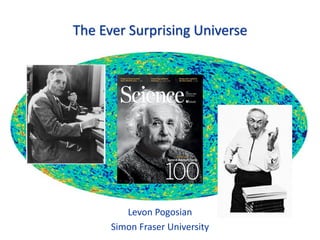
The Ever Surprising Universe
Levon Pogosian
Simon Fraser University
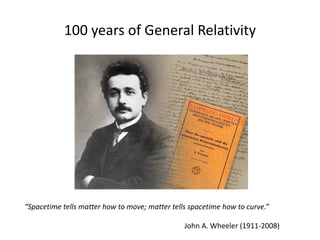
100 years of General Relativity
“Spacetime tells matter how to move; matter tells spacetime how to curve.”
John A. Wheeler (1911-2008)
einstein.stanford.edu
Einstein’s Perfect Universe of 1917
Same Everywhere
Ever the Same
no evidence for this in 1917,
but turned out to be correct
he tried,
turned out to be wrong
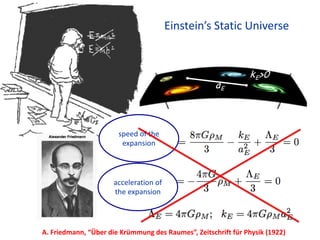
Einstein’s Static Universe
aE
kE>0
speed of the
expansion
acceleration of
the expansion
A. Friedmann, “Über die Krümmung des Raumes”, Zeitschrift für Physik (1922)
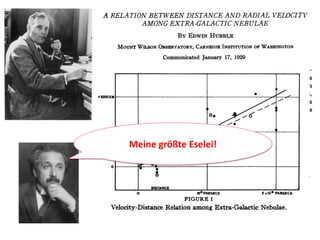
Meine größte Eselei!
Implication of the expansion:
the universe was denser and hotter in the past
We can see the evidence:
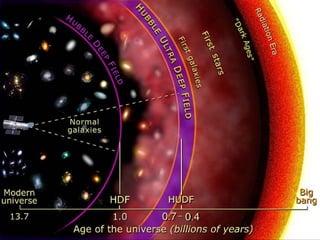
looking deep into space = looking back in time
Us in the center
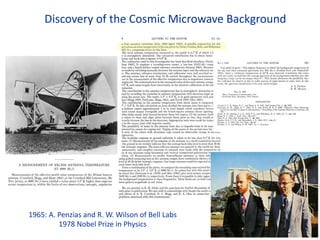
1965: A. Penzias and R. W. Wilson of Bell Labs
1978 Nobel Prize in Physics
Discovery of the Cosmic Microwave Background
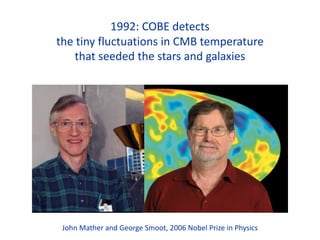
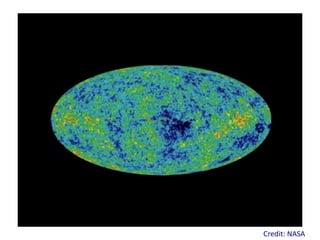
1992: COBE detects
the tiny fluctuations in CMB temperature
that seeded the stars and galaxies
John Mather and George Smoot, 2006 Nobel Prize in Physics
Credit: NASA
Need dark matter for this to work,
which by then was old news …
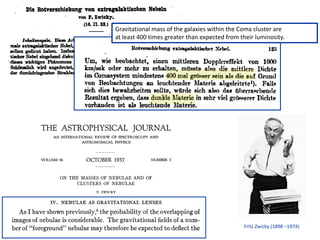
Fritz Zwicky (1898 –1974)
Gravitational mass of the galaxies within the Coma cluster are
at least 400 times greater than expected from their luminosity.
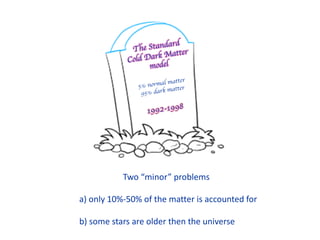
The Standard
Cold Dark Matter
model
5% normal matter
95% dark matter
1992-1998
Two “minor” problems
a) only 10%-50% of the matter is accounted for
b) some stars are older then the universe
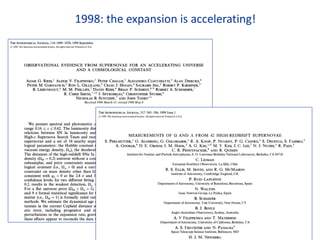
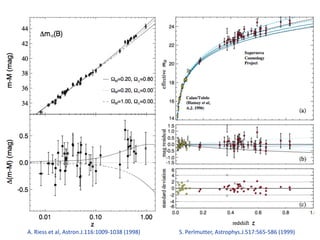
1998: the expansion is accelerating!
http://supernova.lbl.gov/video.html
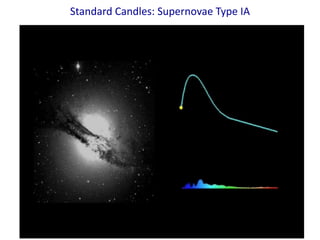
Standard Candles: Supernovae Type IA
Saul Perlmutter’s idea:
Look at thousands of galaxies for 2-3 nights every 2-3 weeks with
a wide-field imager. Follow up with spectroscopy, scheduled in advance
Saul Perlmutter starts the Supernovae Cosmology Project in 1988
Brian Schmidt starts the High-Z SN Search Team in 1994
Adam Riess leads the analysis for HZT
By 1998, SCP reported 42 reliable SNIa, HZT added another 16
Supernovae on Demand
A. Riess et al, Astron.J.116:1009-1038 (1998) S. Perlmutter, Astrophys.J.517:565-586 (1999)
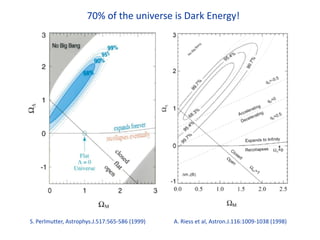
S. Perlmutter, Astrophys.J.517:565-586 (1999) A. Riess et al, Astron.J.116:1009-1038 (1998)
70% of the universe is Dark Energy!
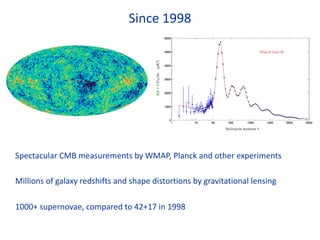
Since 1998
Spectacular CMB measurements by WMAP, Planck and other experiments
Millions of galaxy redshifts and shape distortions by gravitational lensing
1000+ supernovae, compared to 42+17 in 1998
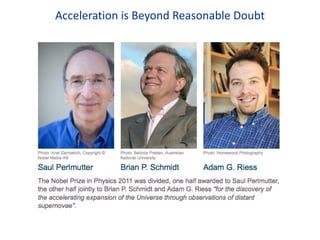
Acceleration is Beyond Reasonable Doubt
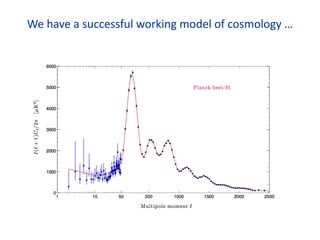
We have a successful working model of cosmology …
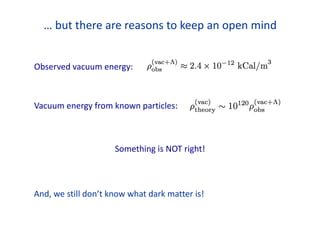
… but there are reasons to keep an open mind
Observed vacuum energy:
Vacuum energy from known particles:
Something is NOT right!
And, we still don’t know what dark matter is!
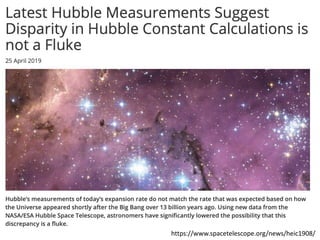
https://www.spacetelescope.org/news/heic1908/
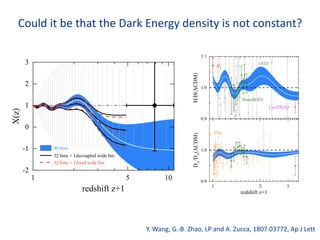
Could it be that the Dark Energy density is not constant?
Y. Wang, G.-B. Zhao, LP and A. Zucca, 1807.03772, Ap J Lett
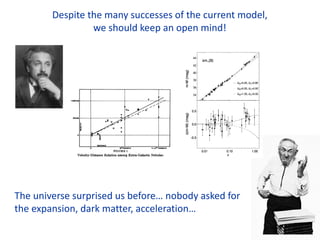
Despite the many successes of the current model,
we should keep an open mind!
The universe surprised us before… nobody asked for
the expansion, dark matter, acceleration…
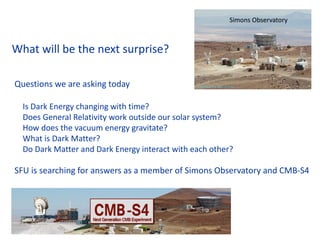
What will be the next surprise?
Questions we are asking today
Is Dark Energy changing with time?
Does General Relativity work outside our solar system?
How does the vacuum energy gravitate?
What is Dark Matter?
Do Dark Matter and Dark Energy interact with each other?
SFU is searching for answers as a member of Simons Observatory and CMB-S4
C O L L A B O R AT I O N C O U N C I L
SIMONS OBSERVATORY
Simons Observatory

The Ever Surprising Universe

  • 1.
    The Ever SurprisingUniverse Levon Pogosian Simon Fraser University
  • 2.
    100 years ofGeneral Relativity “Spacetime tells matter how to move; matter tells spacetime how to curve.” John A. Wheeler (1911-2008) einstein.stanford.edu
  • 3.
    Einstein’s Perfect Universeof 1917 Same Everywhere Ever the Same no evidence for this in 1917, but turned out to be correct he tried, turned out to be wrong
  • 4.
    Einstein’s Static Universe aE kE>0 speedof the expansion acceleration of the expansion A. Friedmann, “Über die Krümmung des Raumes”, Zeitschrift für Physik (1922)
  • 5.
  • 6.
    Implication of theexpansion: the universe was denser and hotter in the past We can see the evidence: looking deep into space = looking back in time
  • 7.
    Us in thecenter
  • 8.
    1965: A. Penziasand R. W. Wilson of Bell Labs 1978 Nobel Prize in Physics Discovery of the Cosmic Microwave Background
  • 9.
    1992: COBE detects thetiny fluctuations in CMB temperature that seeded the stars and galaxies John Mather and George Smoot, 2006 Nobel Prize in Physics
  • 10.
  • 11.
    Need dark matterfor this to work, which by then was old news …
  • 12.
    Fritz Zwicky (1898–1974) Gravitational mass of the galaxies within the Coma cluster are at least 400 times greater than expected from their luminosity.
  • 13.
    The Standard Cold DarkMatter model 5% normal matter 95% dark matter 1992-1998 Two “minor” problems a) only 10%-50% of the matter is accounted for b) some stars are older then the universe
  • 14.
    1998: the expansionis accelerating!
  • 15.
  • 16.
    Saul Perlmutter’s idea: Lookat thousands of galaxies for 2-3 nights every 2-3 weeks with a wide-field imager. Follow up with spectroscopy, scheduled in advance Saul Perlmutter starts the Supernovae Cosmology Project in 1988 Brian Schmidt starts the High-Z SN Search Team in 1994 Adam Riess leads the analysis for HZT By 1998, SCP reported 42 reliable SNIa, HZT added another 16 Supernovae on Demand
  • 17.
    A. Riess etal, Astron.J.116:1009-1038 (1998) S. Perlmutter, Astrophys.J.517:565-586 (1999)
  • 18.
    S. Perlmutter, Astrophys.J.517:565-586(1999) A. Riess et al, Astron.J.116:1009-1038 (1998) 70% of the universe is Dark Energy!
  • 19.
    Since 1998 Spectacular CMBmeasurements by WMAP, Planck and other experiments Millions of galaxy redshifts and shape distortions by gravitational lensing 1000+ supernovae, compared to 42+17 in 1998
  • 20.
    Acceleration is BeyondReasonable Doubt
  • 21.
    We have asuccessful working model of cosmology …
  • 22.
    … but thereare reasons to keep an open mind Observed vacuum energy: Vacuum energy from known particles: Something is NOT right! And, we still don’t know what dark matter is!
  • 23.
  • 24.
    Could it bethat the Dark Energy density is not constant? Y. Wang, G.-B. Zhao, LP and A. Zucca, 1807.03772, Ap J Lett
  • 25.
    Despite the manysuccesses of the current model, we should keep an open mind! The universe surprised us before… nobody asked for the expansion, dark matter, acceleration…
  • 26.
    What will bethe next surprise? Questions we are asking today Is Dark Energy changing with time? Does General Relativity work outside our solar system? How does the vacuum energy gravitate? What is Dark Matter? Do Dark Matter and Dark Energy interact with each other? SFU is searching for answers as a member of Simons Observatory and CMB-S4 C O L L A B O R AT I O N C O U N C I L SIMONS OBSERVATORY Simons Observatory