M Hom Choudhury et al Int. Journal of Engineering Research and Applications
ISSN : 2248-9622, Vol. 4, Issue 2( Version 5), February 2014, pp.09-18

RESEARCH ARTICLE

www.ijera.com

OPEN ACCESS

Thermal and Microstructural Property of Extruded Snack: An
Overview
Mahuya Hom Choudhury, Runu Chakraborty, Utpal Ray Chaudhuri*
Department of Food Technology & Biochemical Engineering, Jadavpur University, Kolkata-700 032

Abstract
Rice and Chapra (Fenneropenaeus indicus) mixture were extruded using a co rotating fully intermeshing twinscrew extruder to prepare carbohydrate protein based snack. The aim of the present work is to study the glass
transition temperature and microstructural behaviour of carbohydrate-protein extrudate snack. Parkin Elmer
Differential Scanning Calorimeter method was used for studying phase transition behaviour of complex
carbohydrate-protein extrudate at a heating rate of 5ºC/min and in the temperature range - 80ºC to 180ºC. On the
other hand, Scanning Electron Microscope (SEM) was used to study the microstructural behavior of
multicomponent extrudate at an accelerating voltage of 20 kV and at 1000 X magnification. State diagram
indicated phase separation of carbohydrate-protein complex food system at macromolecular level. The glass
transition temperature of protein dictated the texture of the mixed system. At room temperature, extrudate with
15% moisture is glassy while extrudates obtained <15% moisture shows rubbery texture and higher moisture
profile shows burnt texture. Microstructural analysis performed by SEM shows typical network like structure at
150C and 15% moisture.
Keyword: Shrimp, fish protein, extrusion, Differential Scanning Calorimeter

I. Introduction
The challenge in the field of food research is
to produce unique, innovative products based on
current market demands. Extrusion cooking is such a
common processing effort for converting starchy and
proteineous material into fabricated products at high
temperature short time duration to produce expanded
snacks. Starchy materials are generally used for
production of snacks. However, carbohydrate-fish
protein mixtures are rarely explored for production of
snack food by extrusion. Chapra (Fenneropenaeus
indicus ), a local variety of shrimp has been used as
food items in the coastal areas of West Bengal, India.
Chapra contains approximately 20% protein, 1% fat,
76% moisture, 1.5 % ash and a good amount of
minerals. (USDA National Nutrient Database for
Standard Reference, Release 15, 2002).A large
amount of Chapra is wasted every year due to lack of
proper
preservation
measures.
Considering
advantages of twin screw extrusion process, coastal
Chapra and rice flour mixture were extruded to
improve the nutritional quality of extruded product
and to study the related functionality of complex
carbohydrate and shrimp-protein mixture.
Glass transition temperature is critical
parameter, which control the extrudate processability,
properties, stability and safety for the amorphous
food matrices (Slade and Levine, 1993; Roos et al,
1995, D’Cruz and Bell, 2005). One of the major
factors that control the glass transition of food system
is the water content. (Roos and Karel 1991; Lillie and
www.ijera.com

Gosline,1993; Brent et al 1997). The phase behaviour
of simple food systems, particularly starchy food has
been extensively studied in the literature. However,
the majority of foods have a much more complex
composition, with a protein carbohydrate polymeric
matrix that entraps low mass molecular weight
components like fats, sugars and others. The
properties and storage stability of carbohydrateprotein mixtures can be controlled if the phase
behavior and the influence of intrinsic and external
factor on this behaviour are well understood.
(Matveev et al.2000). Microstructural analysis is
another important phenomena to identify the change
in molecular structural arrangement after high
temperature short time extrusion processing.
The objective of the present study is a) to analyse the
glass transition behavior of carbohydrate protein
comlex system to find out the system behavior for
food process design b) to examine the surface
morphology of the extrudates through Scanning
Electron microscopy.

II. Materials and Method
Materials: Rice (Oryza sativa L) procured from local
market and Chapra (Metapenaeopsis stridulans)
collected from coastal areas of West Bengal and
Table salt (2%) (Tata) procured from local market
was used for control formulation.
Preparation of Feed for extrusion: Chapra
collected from coastal area was washed thoroughly
9|P age
M Hom Choudhury et al Int. Journal of Engineering Research and Applications
ISSN : 2248-9622, Vol. 4, Issue 2( Version 5), February 2014, pp.09-18
with fresh water and the water was drained and then
it was dried in an oven (800 W grill oven Sanyo, JP)
at 60C for 2 hours. Rice collected from local market
was also washed and dried at the same condition.
After the water was completely removed, dried
shrimp and rice were finely ground into powder form
with a blender (Mixer Grinder, Bajaj,GM-550)
separately. Rice and Chapra powder thus prepared
was mixed (5:1) mixture. The flour was sealed in
polyethylene bags & stored at 4C in refrigerator for
48 hours prior to extrusion. The moisture was
adjusted to 11%, 13%, 15% and 17% adding the
required amount of water to the flour mixture and
conditioned

III. Extruder & Extrusion cooking
A co-rotating fully intermeshing twin screw
extruder was used (screw profile 12:1 barrel length
350 mm; barrel bore diameter 38 mm; screw
diameter 37.8 mm; conveying angle 30°;
intermeshing screws 24 mm apart) for extrusion of
the feed mixture using a 3 mm diameter die. The
screw speed of the extruder was set at 475 rpm, while
the feed rate was maintained constant at 28g/min.
The extruder started functioning properly with said
feed mixture at 110C and at 11% feed moisture
condition and totally stopped after 170C and at 19%
feed moisture condition. The temperature of the
extrudate at the time of product discharge was at
110°C, 130ºC, 150°C &165°C respectively and the
feeding
material
moisture
content
were
11%,13%15% and 17%. Phase behaviour of the
extrudate was studied.
Moisture content: Moisture content of control and
extruded products were measured using standard hot
air oven (Model No-06104, SC Dutta & Co, Kolkata)
according to AOAC, 2002.
Shear strength: A universal Texture Analyzer was
used in compression mode to record the required
force to break extruded products. The extruded
samples (5cm long) was placed on the platform
transversally over a metal sheet support (1cm. thick)
and operated in a compression mode with a sharp
testing blade (3mm. Thick, 6.93 mm wide). The
texturometer head moved the probe down at a rate of
15 mm/min until it broke the extrudates. Values
reported were averages of 30 measurements using
load of 50N.

IV. Microstructure Analysis
Scanning Electron Microscope (SEM):
Scanning electron microscope (Jeol, JSM
5200, Tokyo, Japan) was used at an accelerating
voltage of 15 kV to view extrudate in three
dimension and to determine the shape and surface
www.ijera.com

www.ijera.com

feature of extrudate. Extrudates from all the
treatments and the control sample were mounted
stubs with adhesive tape and sputters coated gold
approx 190 Aº thick for 2.5 min at 10 mA before
observation with SEM. One micrograph was taken
for at 1000 X magnification for the sample. All the
images for each sample showed representative result.

V. Differential Scanning Calorimeter:
A Perkin Elmer Instron Pyris Diamond
Differential Scanning Calorimeter (DSC) was used to
make Tg measurement. The calorimeter was
calibrated at a heating rate of 5ºC/min. Small discs of
15-20 mg of samples were inserted in medium
pressure, stainless steel crucible (which did not allow
any moisture loss during the measurement). The
samples were scanned at a heating rate of 10ºC/min
in the temperature range - 80ºC to 180ºC. The data
was processed with Pyris software in Microsoft
Windows 98 system.
Statistical Analysis
Experimental
data
were
analyzed
using
STATISTICA for Windows Release 9, Stat Soft Inc.
2009 and Microsoft Excel 2003 version.

VI. Result & Discussion
Microstructure analysis
Microstructure analysis performed by SEM
indicated heterogeneous, network like matrix with
voids at different temperature and moisture condition
(Figure 1A to Figure 1E). Figure 1A distinctly shows
two different size granules indicating two different
types granule of shrimp and carbohydrate. Some
disrupted nonsymmetrical structure and shear in the
granule was found in the extruded feed at 120 C in
Figure 1B. SEM picture at 135C shows better
symmetrical arrangement of carbohydrate and protein
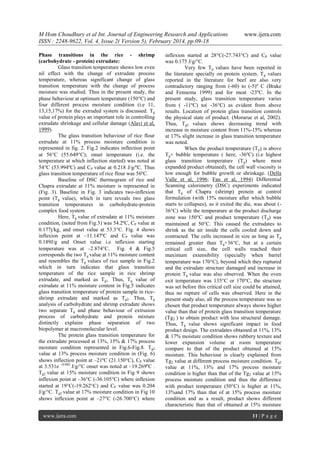
network than 120C (Figure 1C). SEM picture at
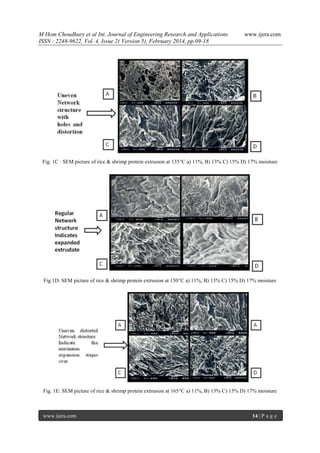
150ºC shows continuous network like structure in a
symmetrical fashion in (Figure 1D). SEM picture of
the extrudate at 165C (Figure 1E) temperature
indicated maximum shear in the granules i.e damage
and breaking in continuous symmetrical structure
was observed. SEM picture at 120C shows
unsymmetrical pattern and holes.SEM result shows
more symmetrical fashioned network like structure
extrudate produced at 150 C and 15% moisture
condition and after the limiting temperature crosses
the structure break down. Thus most expanded
product was observed at 150C. Absence of starch
granule in all SEM pictures of the extrudate indicated
gelatinization.

10 | P a g e
M Hom Choudhury et al Int. Journal of Engineering Research and Applications
ISSN : 2248-9622, Vol. 4, Issue 2( Version 5), February 2014, pp.09-18
Phase transitions in the rice - shrimp
(carbohydrate - protein) extrudate:
Glass transition temperature shows low even
nil effect with the change of extrudate process
temperature, whereas significant change of glass
transition temperature with the change of process
moisture was studied. Thus in the present study, the
phase behaviour at optimum temperature (150C) and
four different process moisture condition (i.e 11,
13,15,17%) for the extruded system is discussed. Tg
value of protein plays an important role in controlling
extrudate shrinkage and cellular damage (Alavi et al,
1999).
The glass transition behaviour of rice flour
extrudate at 11% process moisture condition is
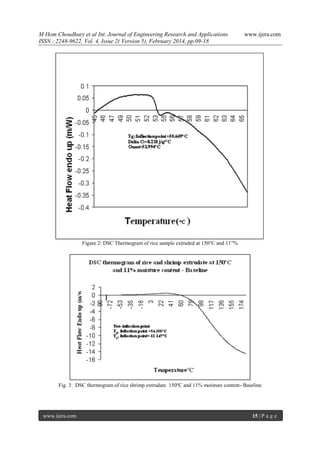
represented in fig. 2. Fig.2 indicates inflection point
at 56C (55.649C); onset temperature (i.e. the
temperature at which inflection started) was noted at
54C (53.994ºC) and CP value at 0.218 J/g/ºC. Thus
glass transition temperature of rice flour was 56ºC.
Baseline of DSC thermogram of rice and
Chapra extrudate at 11% moisture is represented in
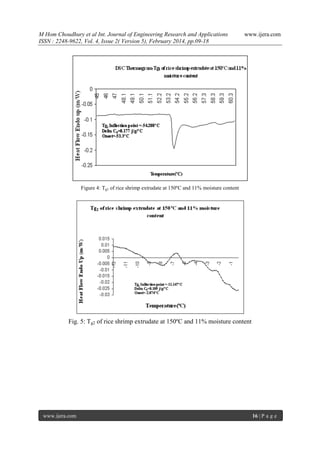
(Fig. 3). Baseline in Fig. 3 indicates two-inflexion
point (Tg value), which in turn reveals two glass
transition temperatures in carbohydrate-protein
complex food system.
Here, Tg value of extrudate at 11% moisture
condition, (noted from Fig.3) was 54.2ºC, CP value at
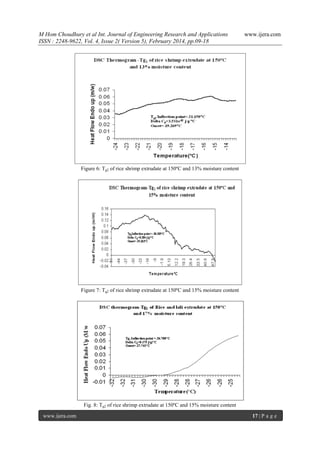
0.177j/kg, and onset value at 53.3C. Fig. 4 shows
inflexion point at –11.147ºC and CP value was
0.189J/g and Onset value i.e inflexion starting
temperature was at –2.874C. Fig. 4 & Fig.5
corresponds the two Tg value at 11% moisture content
and resembles the Tg values of rice sample in Fig.2
which in turn indicates that glass transition
temperature of the rice sample in rice shrimp
extrudate, and marked as Tg1. Thus, Tg value of
extrudate at 11% moisture content in Fig.5 indicates
glass transition temperature of protein sample in riceshrimp extrudate and marked as Tg2. Thus, Tg
analysis of carbohydrate and shrimp extrudate shows
two separate Tg and phase behaviour of extrusion
process of carbohydrate and protein mixture
distinctly explains phase separation of two
biopolymer at macromolecular level.
The protein glass transition temperature for
the extrudate processed at 13%, 15% & 17% process
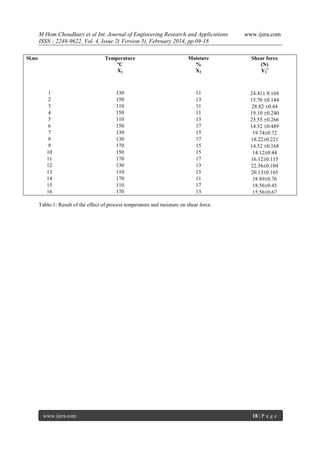
moisture condition represented in Fig.6-Fig.8. Tg2
value at 13% process moisture condition in (Fig. 6)
shows inflection point at –21ºC (21.150C), CP value
at 3.531e –0.002 J/g/°C onset was noted at –19.269ºC .
Tg2 value at 15% moisture condition in Fig 9 shows
inflexion point at –36C (-36.105C) where inflexion
started at 19C(-19.262C) and CP value was 0.204
J/g/°C. Tg2 value at 17% moisture condition in Fig 10
shows inflexion point at –27C (-26.700C) where
www.ijera.com

www.ijera.com

inflexion started at 28C(-27.743C) and CP value
was 0.175 J/g/°C.
Very few Tg values have been reported in
the literature specially on protein system. T g values
reported in the literature for beef are also very
contradictory ranging from (-60) to (-5)º C (Brake
and Fennema 1999) and for meat -23ºC. In the
present study, glass transition temperature varies
from ( -11ºC) to( -36C) as evident from above
results. Location of protein glass transition controls
the physical state of product. (Morarue et al, 2002).
Thus, Tg2 values shows decreasing trend with
increase in moisture content from 11%-15% whereas
at 17% slight increase in glass transition temperature
was noted.
When the product temperature (T p) is above
Tg+ bubble temperature ( here, -36ºC) (i.e highest
glass transition temperature (T g) where most
expanded product obtained), the cell wall viscosity is
low enough for bubble growth or shrinkage. (Della
Valle et al, 1996; Fan et al, 1994) Differential
Scanning calorimetry (DSC) experiments indicated
that Tg of Chapra (shrimp) protein at control
formulation (with 15% moisture after which bubble
starts to collapses), as it exited the die, was about (36C) while the temperature at the product discharge
zone was 150C and product temperature (T p) was
maintained at 50C. This caused the extrudates to
shrink as the air inside the cells cooled down and
contracted. The cells increased in size as long as T p
remained greater than Tg+36C, but at a certain
critical cell size, the cell walls reached their
maximum extensibility (specially when barrel
temperature was 170C), beyond which they ruptured
and the extrudate structure damaged and increase in
protein Tg value was also observed. When the oven
exit temperature was 135C or 170C, the structure
was set before this critical cell size could be attained,
thus no rupture of cells was observed. Here in the
present study also, all the process temperature was so
chosen that product temperature always shows higher
value than that of protein glass transition temperature
(Tg2 ) to obtain product with less structural damage.
Thus, Tg value shows significant impact in food
product design. The extrudates obtained at 11%, 13%
& 17% moisture condition shows rubbery texture and
lower expansion volume at room temperature
compare to that of the product obtained at 15%
moisture. This behaviour is clearly explained from
Tg2 value at different process moisture condition. Tg2
value at 11%, 13% and 17% process moisture
condition is higher than that of the Tg2 value at 15%
process moisture condition and thus the difference
with product temperature (50C) is higher at 11%,
13%and 17% than that of at 15% process moisture
condition and as a result, product shows different
characteristic than that of obtained at 15% moisture
11 | P a g e
M Hom Choudhury et al Int. Journal of Engineering Research and Applications
ISSN : 2248-9622, Vol. 4, Issue 2( Version 5), February 2014, pp.09-18
(i.e optimum process moisture condition). This is
clearly explained in the present study, where it was
estimated that Tg+36ºC values at 11%, 13% and 17%
moisture conditions are 25C, 15C & 9C (as Tg
value correspond to -11C, -21C & -27C
respectively at 11%, 13% and 17% moisture
condition) which is lower than product temperature
(50C) and higher than the T g+36ºC value obtained at
15% process moisture condition (0C) (as Tg value at
15% moisture condition was at -36C). Thus, at 15%
moisture condition, the difference of product
temperature (Tp-50C) with Tg+36ºC value (i.e 0C)
is highest and highest increase in cell size was
observed which in turn predict highest expansion
volume at that process moisture condition. Thus,
extrudates obtained at 15% moisture condition are
typical glassy polymers, while the extrudates
obtained at lower and higher moisture condition
become rubbery. Thus, the location of the protein
glass transition temperature (Tg2) controls the
physical state of the product. (Alavi et al, 1999).
Upon direct examination by texture analyzer, the
product obtained at optimum temperature condition
(at 150 C) and 15% moisture condition were found
brittle and glassy as also evident from lowest shear
force value (14.12 N) (Table 1), while the extrudate
obtained at 11, 13 & 17% moisture (Shear force
value of 19.12, 15.76, 14.52 N respectively as
recorded from Table1) was rubbery. In the present
study, the most expanded, greatest volume and lowest
stress were obtained at 150ºC barrel temperature and
15% moisture. The determined shear force value of
the extrudate varies between 14.12-28.82 N.
Thus Tg2 value of protein dictated the
physical state of the product. The same also validated
with the shear force value obtained by texture
analyser. Protein glass transition temperature has
significant impact on food product design and
process control.

Acknowledgements:
We gratefully acknowledge Central Research
Facility, Indian Institute of Technology, Kharagpur
and Subhas Mukherjee. Memorial research Institute,
Kolkata, Basic Technology Kolkata providing us
technical and instrumental support for carried out the
research work.

References
[1]

[2]

[3]

[4]

[5]

[6]

VII. Conclusion
In the carbohydrate –protein complex
extruded system, starch and proteins were immiscible
and retained their own glass transition. The
immiscibility of the system was clearly illustrated on
thermogram with two different glass transition
temperatures. Texture of matrix was dictated by the
location of the protein phase glass transition. Thus
the state diagram provides valuable information,
which can be used as predictive tools for food
product design. Microstructural analysis performed
by Scanning Electron microscopy revealed
symmetrical fashioned network like structure at
150C and 15% moisture.

[7]

[8]

[9]

www.ijera.com

www.ijera.com

Alavi, S.H., B.K. Gogoi, M. Khan, B.J.
Bowman and S.S.H. Rizvi, 1999. Structural
properties of protein-stabilized starch-based
supercritical fluid extrudates. Food Res. Int.,
32:
107-118.
http://www.ingentaconnect.com/content/els/
09639969/1999/00000032/00000002/art000
63
Brake NC. Fennema 1999. Glass transition
values of muscle tissue .J Food Sci 64
(1):10-15
Brent, J.L., S.J. Mulvaney, C. Cohen and
J.A. Bartsch, 1997. Thermomechanical glass
transition of extruded cereal melts. J. Cereal
Sci.,
26:
301-312.
http://www.sciencedirect.com/science/article
/pii/S0733521097901405
D’Cruz, N.M. and L.N. Bell, 2005. Thermal
unfolding of gelatin in solids as affected by
the glass transition. J. Food Sci., 70: E64E68.
Della Valle, G., P. Colonna, A. Patria and B.
Vergnes, 1996. Influence of amylose content
on the viscous behavior of low hydrated
molten starches. J. Rheol., 40: 347-362.
Fan, J., J.R. Mitchell and J.M.V. Blanshard,
1994. A computer simulation of the
dynamics of bubble growth and shrinkage
during extrudate expansion. J. Food Eng.,
23: 337-356.
Lillie, M.A. and J.M. Gosline, 1993. The
Effects of Swelling Solvents on the Glass
Transition in Elastin and other Proteins. In:
The Glassy State in Foods, Blanshard,
J.M.V. and P.J. Lillford (Eds.). Nottingham
University
Press,
Loughborrough,
Leicestershire, pp: 281-302.
Matveev, Y.I., V.Y. Grinberg and V.B.
Tolstoguzov, 2000. The plasticizing effect
of water on proteins, polysaccharides and
their mixtures. Glassy state of biopolymers
food and seeds. Food Hydrocolloids, 14:
425-437.
Moraru C.I., Kokini J.LNucleation and
Expansion During Extrusion and Microwave
12 | P a g e
M Hom Choudhury et al Int. Journal of Engineering Research and Applications
ISSN : 2248-9622, Vol. 4, Issue 2( Version 5), February 2014, pp.09-18

[10]

Heating of Cereal Foods, Comprehensive
Reviews In Food Science And Food Safety
2003—Vol. 2, 120-138
Roos, Y. and M. Karel, 1991. Water and
molecular weight effects on glass transitions
in
amorphous
carbohydrates
and

[11]

www.ijera.com

carbohydrate solutions. J. Food Sci., 56:
1676-1681.
Slade, L. and H. Levine, 1993. Water
relationships
in
starch
transitions.
Carbohydr.
Polym.,
21:
105131.http://www.sciencedirect.com/science/a
rticle/pii/014486179390006P

[12] USDA National Nutrient Database for Standard
Reference, Release 15 (August 2002)

Fig 1A: SEM picture of Rice & Shrimp Protein unextruded

Figure 1B: SEM picture of Rice & Shrimp protein Extrusion at 120 C B) 11% C) 13% D) 15% E) 17%
moisture

www.ijera.com

13 | P a g e
M Hom Choudhury et al Int. Journal of Engineering Research and Applications
ISSN : 2248-9622, Vol. 4, Issue 2( Version 5), February 2014, pp.09-18

www.ijera.com

Fig. 1C : SEM picture of rice & shrimp protein extrusion at 135C a) 11%, B) 13% C) 15% D) 17% moisture

Fig.1D: SEM picture of rice & shrimp protein extrusion at 150C a) 11%, B) 13% C) 15% D) 17% moisture

Fig. 1E: SEM picture of rice & shrimp protein extrusion at 165C a) 11%, B) 13% C) 15% D) 17% moisture

www.ijera.com

14 | P a g e
M Hom Choudhury et al Int. Journal of Engineering Research and Applications
ISSN : 2248-9622, Vol. 4, Issue 2( Version 5), February 2014, pp.09-18

www.ijera.com

Figure 2: DSC Thermogram of rice sample extruded at 150°C and 11”%

Fig. 3: DSC thermogram of rice shrimp extrudate 150ºC and 11% moisture content- Baseline

www.ijera.com

15 | P a g e
M Hom Choudhury et al Int. Journal of Engineering Research and Applications
ISSN : 2248-9622, Vol. 4, Issue 2( Version 5), February 2014, pp.09-18

www.ijera.com

Figure 4: Tg1 of rice shrimp extrudate at 150ºC and 11% moisture content

Fig. 5: Tg2 of rice shrimp extrudate at 150ºC and 11% moisture content

www.ijera.com

16 | P a g e
M Hom Choudhury et al Int. Journal of Engineering Research and Applications
ISSN : 2248-9622, Vol. 4, Issue 2( Version 5), February 2014, pp.09-18

www.ijera.com

Figure 6: Tg2 of rice shrimp extrudate at 150ºC and 13% moisture content

Figure 7: Tg2 of rice shrimp extrudate at 150ºC and 15% moisture content

Fig. 8: Tg2 of rice shrimp extrudate at 150ºC and 15% moisture content
www.ijera.com

17 | P a g e
M Hom Choudhury et al Int. Journal of Engineering Research and Applications
ISSN : 2248-9622, Vol. 4, Issue 2( Version 5), February 2014, pp.09-18
Sl.no

www.ijera.com

Temperature
ºC
X1

1
2
3
4
5
6
7
8
9
10
11
12
13
14
15
16

Moisture
%
X2

Shear force
(N)
Y2c

130
150
110
150
110
150
130
130
170
150
170
130
110
170
110
170

11
13
11
11
13
17
15
17
15
15
17
13
15
11
17
13

24.41 0.168
15.76 0.144
28.82 0.44
19.10 0.240
25.55 0.266
14.52 0.489
19.740.72
18.220.221
14.52 0.168
14.120.44
16.120.115
22.560.104
20.130.165
18.890.76
18.560.45
15.560.67

Table-1: Result of the effect of process temperature and moisture on shear force

www.ijera.com

18 | P a g e

C42050918

  • 1.
    M Hom Choudhuryet al Int. Journal of Engineering Research and Applications ISSN : 2248-9622, Vol. 4, Issue 2( Version 5), February 2014, pp.09-18 RESEARCH ARTICLE www.ijera.com OPEN ACCESS Thermal and Microstructural Property of Extruded Snack: An Overview Mahuya Hom Choudhury, Runu Chakraborty, Utpal Ray Chaudhuri* Department of Food Technology & Biochemical Engineering, Jadavpur University, Kolkata-700 032 Abstract Rice and Chapra (Fenneropenaeus indicus) mixture were extruded using a co rotating fully intermeshing twinscrew extruder to prepare carbohydrate protein based snack. The aim of the present work is to study the glass transition temperature and microstructural behaviour of carbohydrate-protein extrudate snack. Parkin Elmer Differential Scanning Calorimeter method was used for studying phase transition behaviour of complex carbohydrate-protein extrudate at a heating rate of 5ºC/min and in the temperature range - 80ºC to 180ºC. On the other hand, Scanning Electron Microscope (SEM) was used to study the microstructural behavior of multicomponent extrudate at an accelerating voltage of 20 kV and at 1000 X magnification. State diagram indicated phase separation of carbohydrate-protein complex food system at macromolecular level. The glass transition temperature of protein dictated the texture of the mixed system. At room temperature, extrudate with 15% moisture is glassy while extrudates obtained <15% moisture shows rubbery texture and higher moisture profile shows burnt texture. Microstructural analysis performed by SEM shows typical network like structure at 150C and 15% moisture. Keyword: Shrimp, fish protein, extrusion, Differential Scanning Calorimeter I. Introduction The challenge in the field of food research is to produce unique, innovative products based on current market demands. Extrusion cooking is such a common processing effort for converting starchy and proteineous material into fabricated products at high temperature short time duration to produce expanded snacks. Starchy materials are generally used for production of snacks. However, carbohydrate-fish protein mixtures are rarely explored for production of snack food by extrusion. Chapra (Fenneropenaeus indicus ), a local variety of shrimp has been used as food items in the coastal areas of West Bengal, India. Chapra contains approximately 20% protein, 1% fat, 76% moisture, 1.5 % ash and a good amount of minerals. (USDA National Nutrient Database for Standard Reference, Release 15, 2002).A large amount of Chapra is wasted every year due to lack of proper preservation measures. Considering advantages of twin screw extrusion process, coastal Chapra and rice flour mixture were extruded to improve the nutritional quality of extruded product and to study the related functionality of complex carbohydrate and shrimp-protein mixture. Glass transition temperature is critical parameter, which control the extrudate processability, properties, stability and safety for the amorphous food matrices (Slade and Levine, 1993; Roos et al, 1995, D’Cruz and Bell, 2005). One of the major factors that control the glass transition of food system is the water content. (Roos and Karel 1991; Lillie and www.ijera.com Gosline,1993; Brent et al 1997). The phase behaviour of simple food systems, particularly starchy food has been extensively studied in the literature. However, the majority of foods have a much more complex composition, with a protein carbohydrate polymeric matrix that entraps low mass molecular weight components like fats, sugars and others. The properties and storage stability of carbohydrateprotein mixtures can be controlled if the phase behavior and the influence of intrinsic and external factor on this behaviour are well understood. (Matveev et al.2000). Microstructural analysis is another important phenomena to identify the change in molecular structural arrangement after high temperature short time extrusion processing. The objective of the present study is a) to analyse the glass transition behavior of carbohydrate protein comlex system to find out the system behavior for food process design b) to examine the surface morphology of the extrudates through Scanning Electron microscopy. II. Materials and Method Materials: Rice (Oryza sativa L) procured from local market and Chapra (Metapenaeopsis stridulans) collected from coastal areas of West Bengal and Table salt (2%) (Tata) procured from local market was used for control formulation. Preparation of Feed for extrusion: Chapra collected from coastal area was washed thoroughly 9|P age
  • 2.
    M Hom Choudhuryet al Int. Journal of Engineering Research and Applications ISSN : 2248-9622, Vol. 4, Issue 2( Version 5), February 2014, pp.09-18 with fresh water and the water was drained and then it was dried in an oven (800 W grill oven Sanyo, JP) at 60C for 2 hours. Rice collected from local market was also washed and dried at the same condition. After the water was completely removed, dried shrimp and rice were finely ground into powder form with a blender (Mixer Grinder, Bajaj,GM-550) separately. Rice and Chapra powder thus prepared was mixed (5:1) mixture. The flour was sealed in polyethylene bags & stored at 4C in refrigerator for 48 hours prior to extrusion. The moisture was adjusted to 11%, 13%, 15% and 17% adding the required amount of water to the flour mixture and conditioned III. Extruder & Extrusion cooking A co-rotating fully intermeshing twin screw extruder was used (screw profile 12:1 barrel length 350 mm; barrel bore diameter 38 mm; screw diameter 37.8 mm; conveying angle 30°; intermeshing screws 24 mm apart) for extrusion of the feed mixture using a 3 mm diameter die. The screw speed of the extruder was set at 475 rpm, while the feed rate was maintained constant at 28g/min. The extruder started functioning properly with said feed mixture at 110C and at 11% feed moisture condition and totally stopped after 170C and at 19% feed moisture condition. The temperature of the extrudate at the time of product discharge was at 110°C, 130ºC, 150°C &165°C respectively and the feeding material moisture content were 11%,13%15% and 17%. Phase behaviour of the extrudate was studied. Moisture content: Moisture content of control and extruded products were measured using standard hot air oven (Model No-06104, SC Dutta & Co, Kolkata) according to AOAC, 2002. Shear strength: A universal Texture Analyzer was used in compression mode to record the required force to break extruded products. The extruded samples (5cm long) was placed on the platform transversally over a metal sheet support (1cm. thick) and operated in a compression mode with a sharp testing blade (3mm. Thick, 6.93 mm wide). The texturometer head moved the probe down at a rate of 15 mm/min until it broke the extrudates. Values reported were averages of 30 measurements using load of 50N. IV. Microstructure Analysis Scanning Electron Microscope (SEM): Scanning electron microscope (Jeol, JSM 5200, Tokyo, Japan) was used at an accelerating voltage of 15 kV to view extrudate in three dimension and to determine the shape and surface www.ijera.com www.ijera.com feature of extrudate. Extrudates from all the treatments and the control sample were mounted stubs with adhesive tape and sputters coated gold approx 190 Aº thick for 2.5 min at 10 mA before observation with SEM. One micrograph was taken for at 1000 X magnification for the sample. All the images for each sample showed representative result. V. Differential Scanning Calorimeter: A Perkin Elmer Instron Pyris Diamond Differential Scanning Calorimeter (DSC) was used to make Tg measurement. The calorimeter was calibrated at a heating rate of 5ºC/min. Small discs of 15-20 mg of samples were inserted in medium pressure, stainless steel crucible (which did not allow any moisture loss during the measurement). The samples were scanned at a heating rate of 10ºC/min in the temperature range - 80ºC to 180ºC. The data was processed with Pyris software in Microsoft Windows 98 system. Statistical Analysis Experimental data were analyzed using STATISTICA for Windows Release 9, Stat Soft Inc. 2009 and Microsoft Excel 2003 version. VI. Result & Discussion Microstructure analysis Microstructure analysis performed by SEM indicated heterogeneous, network like matrix with voids at different temperature and moisture condition (Figure 1A to Figure 1E). Figure 1A distinctly shows two different size granules indicating two different types granule of shrimp and carbohydrate. Some disrupted nonsymmetrical structure and shear in the granule was found in the extruded feed at 120 C in Figure 1B. SEM picture at 135C shows better symmetrical arrangement of carbohydrate and protein network than 120C (Figure 1C). SEM picture at 150ºC shows continuous network like structure in a symmetrical fashion in (Figure 1D). SEM picture of the extrudate at 165C (Figure 1E) temperature indicated maximum shear in the granules i.e damage and breaking in continuous symmetrical structure was observed. SEM picture at 120C shows unsymmetrical pattern and holes.SEM result shows more symmetrical fashioned network like structure extrudate produced at 150 C and 15% moisture condition and after the limiting temperature crosses the structure break down. Thus most expanded product was observed at 150C. Absence of starch granule in all SEM pictures of the extrudate indicated gelatinization. 10 | P a g e
  • 3.
    M Hom Choudhuryet al Int. Journal of Engineering Research and Applications ISSN : 2248-9622, Vol. 4, Issue 2( Version 5), February 2014, pp.09-18 Phase transitions in the rice - shrimp (carbohydrate - protein) extrudate: Glass transition temperature shows low even nil effect with the change of extrudate process temperature, whereas significant change of glass transition temperature with the change of process moisture was studied. Thus in the present study, the phase behaviour at optimum temperature (150C) and four different process moisture condition (i.e 11, 13,15,17%) for the extruded system is discussed. Tg value of protein plays an important role in controlling extrudate shrinkage and cellular damage (Alavi et al, 1999). The glass transition behaviour of rice flour extrudate at 11% process moisture condition is represented in fig. 2. Fig.2 indicates inflection point at 56C (55.649C); onset temperature (i.e. the temperature at which inflection started) was noted at 54C (53.994ºC) and CP value at 0.218 J/g/ºC. Thus glass transition temperature of rice flour was 56ºC. Baseline of DSC thermogram of rice and Chapra extrudate at 11% moisture is represented in (Fig. 3). Baseline in Fig. 3 indicates two-inflexion point (Tg value), which in turn reveals two glass transition temperatures in carbohydrate-protein complex food system. Here, Tg value of extrudate at 11% moisture condition, (noted from Fig.3) was 54.2ºC, CP value at 0.177j/kg, and onset value at 53.3C. Fig. 4 shows inflexion point at –11.147ºC and CP value was 0.189J/g and Onset value i.e inflexion starting temperature was at –2.874C. Fig. 4 & Fig.5 corresponds the two Tg value at 11% moisture content and resembles the Tg values of rice sample in Fig.2 which in turn indicates that glass transition temperature of the rice sample in rice shrimp extrudate, and marked as Tg1. Thus, Tg value of extrudate at 11% moisture content in Fig.5 indicates glass transition temperature of protein sample in riceshrimp extrudate and marked as Tg2. Thus, Tg analysis of carbohydrate and shrimp extrudate shows two separate Tg and phase behaviour of extrusion process of carbohydrate and protein mixture distinctly explains phase separation of two biopolymer at macromolecular level. The protein glass transition temperature for the extrudate processed at 13%, 15% & 17% process moisture condition represented in Fig.6-Fig.8. Tg2 value at 13% process moisture condition in (Fig. 6) shows inflection point at –21ºC (21.150C), CP value at 3.531e –0.002 J/g/°C onset was noted at –19.269ºC . Tg2 value at 15% moisture condition in Fig 9 shows inflexion point at –36C (-36.105C) where inflexion started at 19C(-19.262C) and CP value was 0.204 J/g/°C. Tg2 value at 17% moisture condition in Fig 10 shows inflexion point at –27C (-26.700C) where www.ijera.com www.ijera.com inflexion started at 28C(-27.743C) and CP value was 0.175 J/g/°C. Very few Tg values have been reported in the literature specially on protein system. T g values reported in the literature for beef are also very contradictory ranging from (-60) to (-5)º C (Brake and Fennema 1999) and for meat -23ºC. In the present study, glass transition temperature varies from ( -11ºC) to( -36C) as evident from above results. Location of protein glass transition controls the physical state of product. (Morarue et al, 2002). Thus, Tg2 values shows decreasing trend with increase in moisture content from 11%-15% whereas at 17% slight increase in glass transition temperature was noted. When the product temperature (T p) is above Tg+ bubble temperature ( here, -36ºC) (i.e highest glass transition temperature (T g) where most expanded product obtained), the cell wall viscosity is low enough for bubble growth or shrinkage. (Della Valle et al, 1996; Fan et al, 1994) Differential Scanning calorimetry (DSC) experiments indicated that Tg of Chapra (shrimp) protein at control formulation (with 15% moisture after which bubble starts to collapses), as it exited the die, was about (36C) while the temperature at the product discharge zone was 150C and product temperature (T p) was maintained at 50C. This caused the extrudates to shrink as the air inside the cells cooled down and contracted. The cells increased in size as long as T p remained greater than Tg+36C, but at a certain critical cell size, the cell walls reached their maximum extensibility (specially when barrel temperature was 170C), beyond which they ruptured and the extrudate structure damaged and increase in protein Tg value was also observed. When the oven exit temperature was 135C or 170C, the structure was set before this critical cell size could be attained, thus no rupture of cells was observed. Here in the present study also, all the process temperature was so chosen that product temperature always shows higher value than that of protein glass transition temperature (Tg2 ) to obtain product with less structural damage. Thus, Tg value shows significant impact in food product design. The extrudates obtained at 11%, 13% & 17% moisture condition shows rubbery texture and lower expansion volume at room temperature compare to that of the product obtained at 15% moisture. This behaviour is clearly explained from Tg2 value at different process moisture condition. Tg2 value at 11%, 13% and 17% process moisture condition is higher than that of the Tg2 value at 15% process moisture condition and thus the difference with product temperature (50C) is higher at 11%, 13%and 17% than that of at 15% process moisture condition and as a result, product shows different characteristic than that of obtained at 15% moisture 11 | P a g e
  • 4.
    M Hom Choudhuryet al Int. Journal of Engineering Research and Applications ISSN : 2248-9622, Vol. 4, Issue 2( Version 5), February 2014, pp.09-18 (i.e optimum process moisture condition). This is clearly explained in the present study, where it was estimated that Tg+36ºC values at 11%, 13% and 17% moisture conditions are 25C, 15C & 9C (as Tg value correspond to -11C, -21C & -27C respectively at 11%, 13% and 17% moisture condition) which is lower than product temperature (50C) and higher than the T g+36ºC value obtained at 15% process moisture condition (0C) (as Tg value at 15% moisture condition was at -36C). Thus, at 15% moisture condition, the difference of product temperature (Tp-50C) with Tg+36ºC value (i.e 0C) is highest and highest increase in cell size was observed which in turn predict highest expansion volume at that process moisture condition. Thus, extrudates obtained at 15% moisture condition are typical glassy polymers, while the extrudates obtained at lower and higher moisture condition become rubbery. Thus, the location of the protein glass transition temperature (Tg2) controls the physical state of the product. (Alavi et al, 1999). Upon direct examination by texture analyzer, the product obtained at optimum temperature condition (at 150 C) and 15% moisture condition were found brittle and glassy as also evident from lowest shear force value (14.12 N) (Table 1), while the extrudate obtained at 11, 13 & 17% moisture (Shear force value of 19.12, 15.76, 14.52 N respectively as recorded from Table1) was rubbery. In the present study, the most expanded, greatest volume and lowest stress were obtained at 150ºC barrel temperature and 15% moisture. The determined shear force value of the extrudate varies between 14.12-28.82 N. Thus Tg2 value of protein dictated the physical state of the product. The same also validated with the shear force value obtained by texture analyser. Protein glass transition temperature has significant impact on food product design and process control. Acknowledgements: We gratefully acknowledge Central Research Facility, Indian Institute of Technology, Kharagpur and Subhas Mukherjee. Memorial research Institute, Kolkata, Basic Technology Kolkata providing us technical and instrumental support for carried out the research work. References [1] [2] [3] [4] [5] [6] VII. Conclusion In the carbohydrate –protein complex extruded system, starch and proteins were immiscible and retained their own glass transition. The immiscibility of the system was clearly illustrated on thermogram with two different glass transition temperatures. Texture of matrix was dictated by the location of the protein phase glass transition. Thus the state diagram provides valuable information, which can be used as predictive tools for food product design. Microstructural analysis performed by Scanning Electron microscopy revealed symmetrical fashioned network like structure at 150C and 15% moisture. [7] [8] [9] www.ijera.com www.ijera.com Alavi, S.H., B.K. Gogoi, M. Khan, B.J. Bowman and S.S.H. Rizvi, 1999. Structural properties of protein-stabilized starch-based supercritical fluid extrudates. Food Res. Int., 32: 107-118. http://www.ingentaconnect.com/content/els/ 09639969/1999/00000032/00000002/art000 63 Brake NC. Fennema 1999. Glass transition values of muscle tissue .J Food Sci 64 (1):10-15 Brent, J.L., S.J. Mulvaney, C. Cohen and J.A. Bartsch, 1997. Thermomechanical glass transition of extruded cereal melts. J. Cereal Sci., 26: 301-312. http://www.sciencedirect.com/science/article /pii/S0733521097901405 D’Cruz, N.M. and L.N. Bell, 2005. Thermal unfolding of gelatin in solids as affected by the glass transition. J. Food Sci., 70: E64E68. Della Valle, G., P. Colonna, A. Patria and B. Vergnes, 1996. Influence of amylose content on the viscous behavior of low hydrated molten starches. J. Rheol., 40: 347-362. Fan, J., J.R. Mitchell and J.M.V. Blanshard, 1994. A computer simulation of the dynamics of bubble growth and shrinkage during extrudate expansion. J. Food Eng., 23: 337-356. Lillie, M.A. and J.M. Gosline, 1993. The Effects of Swelling Solvents on the Glass Transition in Elastin and other Proteins. In: The Glassy State in Foods, Blanshard, J.M.V. and P.J. Lillford (Eds.). Nottingham University Press, Loughborrough, Leicestershire, pp: 281-302. Matveev, Y.I., V.Y. Grinberg and V.B. Tolstoguzov, 2000. The plasticizing effect of water on proteins, polysaccharides and their mixtures. Glassy state of biopolymers food and seeds. Food Hydrocolloids, 14: 425-437. Moraru C.I., Kokini J.LNucleation and Expansion During Extrusion and Microwave 12 | P a g e
  • 5.
    M Hom Choudhuryet al Int. Journal of Engineering Research and Applications ISSN : 2248-9622, Vol. 4, Issue 2( Version 5), February 2014, pp.09-18 [10] Heating of Cereal Foods, Comprehensive Reviews In Food Science And Food Safety 2003—Vol. 2, 120-138 Roos, Y. and M. Karel, 1991. Water and molecular weight effects on glass transitions in amorphous carbohydrates and [11] www.ijera.com carbohydrate solutions. J. Food Sci., 56: 1676-1681. Slade, L. and H. Levine, 1993. Water relationships in starch transitions. Carbohydr. Polym., 21: 105131.http://www.sciencedirect.com/science/a rticle/pii/014486179390006P [12] USDA National Nutrient Database for Standard Reference, Release 15 (August 2002) Fig 1A: SEM picture of Rice & Shrimp Protein unextruded Figure 1B: SEM picture of Rice & Shrimp protein Extrusion at 120 C B) 11% C) 13% D) 15% E) 17% moisture www.ijera.com 13 | P a g e
  • 6.
    M Hom Choudhuryet al Int. Journal of Engineering Research and Applications ISSN : 2248-9622, Vol. 4, Issue 2( Version 5), February 2014, pp.09-18 www.ijera.com Fig. 1C : SEM picture of rice & shrimp protein extrusion at 135C a) 11%, B) 13% C) 15% D) 17% moisture Fig.1D: SEM picture of rice & shrimp protein extrusion at 150C a) 11%, B) 13% C) 15% D) 17% moisture Fig. 1E: SEM picture of rice & shrimp protein extrusion at 165C a) 11%, B) 13% C) 15% D) 17% moisture www.ijera.com 14 | P a g e
  • 7.
    M Hom Choudhuryet al Int. Journal of Engineering Research and Applications ISSN : 2248-9622, Vol. 4, Issue 2( Version 5), February 2014, pp.09-18 www.ijera.com Figure 2: DSC Thermogram of rice sample extruded at 150°C and 11”% Fig. 3: DSC thermogram of rice shrimp extrudate 150ºC and 11% moisture content- Baseline www.ijera.com 15 | P a g e
  • 8.
    M Hom Choudhuryet al Int. Journal of Engineering Research and Applications ISSN : 2248-9622, Vol. 4, Issue 2( Version 5), February 2014, pp.09-18 www.ijera.com Figure 4: Tg1 of rice shrimp extrudate at 150ºC and 11% moisture content Fig. 5: Tg2 of rice shrimp extrudate at 150ºC and 11% moisture content www.ijera.com 16 | P a g e
  • 9.
    M Hom Choudhuryet al Int. Journal of Engineering Research and Applications ISSN : 2248-9622, Vol. 4, Issue 2( Version 5), February 2014, pp.09-18 www.ijera.com Figure 6: Tg2 of rice shrimp extrudate at 150ºC and 13% moisture content Figure 7: Tg2 of rice shrimp extrudate at 150ºC and 15% moisture content Fig. 8: Tg2 of rice shrimp extrudate at 150ºC and 15% moisture content www.ijera.com 17 | P a g e
  • 10.
    M Hom Choudhuryet al Int. Journal of Engineering Research and Applications ISSN : 2248-9622, Vol. 4, Issue 2( Version 5), February 2014, pp.09-18 Sl.no www.ijera.com Temperature ºC X1 1 2 3 4 5 6 7 8 9 10 11 12 13 14 15 16 Moisture % X2 Shear force (N) Y2c 130 150 110 150 110 150 130 130 170 150 170 130 110 170 110 170 11 13 11 11 13 17 15 17 15 15 17 13 15 11 17 13 24.41 0.168 15.76 0.144 28.82 0.44 19.10 0.240 25.55 0.266 14.52 0.489 19.740.72 18.220.221 14.52 0.168 14.120.44 16.120.115 22.560.104 20.130.165 18.890.76 18.560.45 15.560.67 Table-1: Result of the effect of process temperature and moisture on shear force www.ijera.com 18 | P a g e