
Database as a Service
Alan Poon
Senior Sales Consultant
Oracle Systems Hong Kong
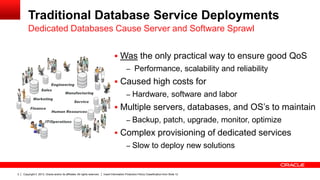
Traditional Database Service Deployments
Dedicated Databases Cause Server and Software Sprawl
 Was the only practical way to ensure good QoS
– Performance, scalability and reliability
Engineering
Sales

Manufacturing

Marketing
Finance

Service

Human Resources

IT/Operations

 Caused high costs for
‒ Hardware, software and labor

 Multiple servers, databases, and OS’s to maintain
‒ Backup, patch, upgrade, monitor, optimize

 Complex provisioning of dedicated services
‒ Slow to deploy new solutions

2

Copyright © 2013, Oracle and/or its affiliates. All rights reserved.

Insert Information Protection Policy Classification from Slide 12
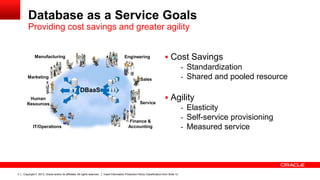
Database as a Service Goals
Providing cost savings and greater agility

Manufacturing

Engineering

Marketing

 Cost Savings
- Standardization
- Shared and pooled resource

Sales

DBaaS
Human
Resources

IT/Operations

3

Copyright © 2013, Oracle and/or its affiliates. All rights reserved.

Service

 Agility

Finance &
Accounting

Insert Information Protection Policy Classification from Slide 12

- Elasticity
- Self-service provisioning
- Measured service
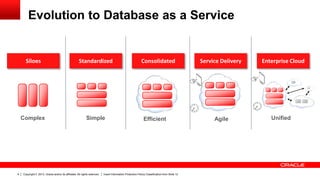
Evolution to Database as a Service

Siloes

Complex

4

Standardized

Simple

Copyright © 2013, Oracle and/or its affiliates. All rights reserved.

Consolidated

Efficient

Insert Information Protection Policy Classification from Slide 12

Service Delivery

Agile

Enterprise Cloud

Unified
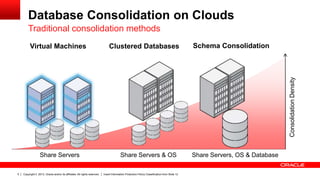
Database Consolidation on Clouds
Traditional consolidation methods
Clustered Databases

Schema Consolidation

Consolidation Density

Virtual Machines

Share Servers
5

Copyright © 2013, Oracle and/or its affiliates. All rights reserved.

Share Servers & OS
Insert Information Protection Policy Classification from Slide 12

Share Servers, OS & Database
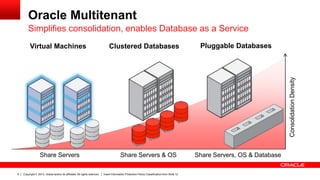
Oracle Multitenant
Simplifies consolidation, enables Database as a Service
Clustered Databases

Pluggable Databases

Consolidation Density

Virtual Machines

Share Servers
6

Copyright © 2013, Oracle and/or its affiliates. All rights reserved.

Share Servers & OS
Insert Information Protection Policy Classification from Slide 12

Share Servers, OS & Database
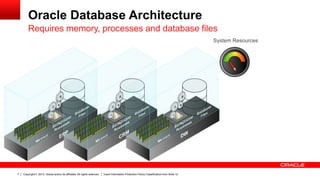
Oracle Database Architecture
Requires memory, processes and database files
System Resources

7

Copyright © 2013, Oracle and/or its affiliates. All rights reserved.

Insert Information Protection Policy Classification from Slide 12
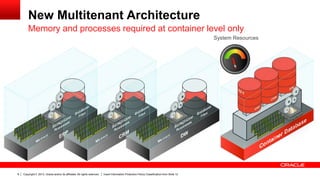
New Multitenant Architecture
Memory and processes required at container level only
System Resources

8

Copyright © 2013, Oracle and/or its affiliates. All rights reserved.

Insert Information Protection Policy Classification from Slide 12
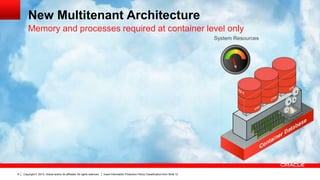
New Multitenant Architecture
Memory and processes required at container level only
System Resources

9

Copyright © 2013, Oracle and/or its affiliates. All rights reserved.

Insert Information Protection Policy Classification from Slide 12
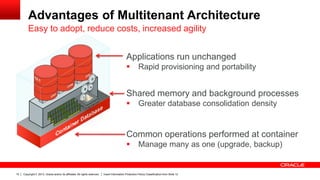
Advantages of Multitenant Architecture
Easy to adopt, reduce costs, increased agility
Applications run unchanged


Rapid provisioning and portability

Shared memory and background processes


Greater database consolidation density

Common operations performed at container


10

Copyright © 2013, Oracle and/or its affiliates. All rights reserved.

Manage many as one (upgrade, backup)

Insert Information Protection Policy Classification from Slide 12
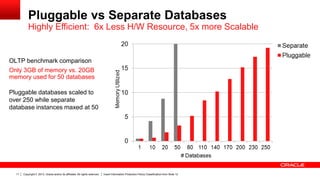
Pluggable vs Separate Databases
Highly Efficient: 6x Less H/W Resource, 5x more Scalable

OLTP benchmark comparison
Only 3GB of memory vs. 20GB
memory used for 50 databases
Pluggable databases scaled to
over 250 while separate
database instances maxed at 50

11

Copyright © 2013, Oracle and/or its affiliates. All rights reserved.

Insert Information Protection Policy Classification from Slide 12
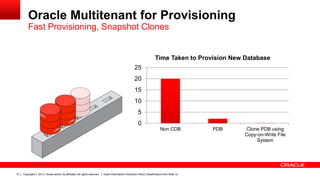
Oracle Multitenant for Provisioning
Fast Provisioning, Snapshot Clones

Time Taken to Provision New Database
25
20
15
10
5
0
Non CDB

12

Copyright © 2013, Oracle and/or its affiliates. All rights reserved.

Insert Information Protection Policy Classification from Slide 12

PDB

Clone PDB using
Copy-on-Write File
System
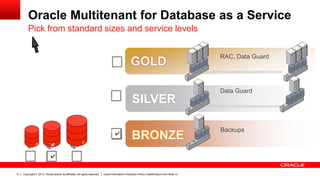
Oracle Multitenant for Database as a Service
Pick from standard sizes and service levels

GOLD
SILVER
✔

BRONZE

✔

13

Copyright © 2013, Oracle and/or its affiliates. All rights reserved.

Insert Information Protection Policy Classification from Slide 12

RAC, Data Guard

Data Guard

Backups
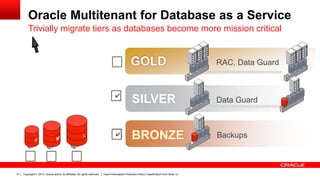
Oracle Multitenant for Database as a Service
Trivially migrate tiers as databases become more mission critical

GOLD
✔

Copyright © 2013, Oracle and/or its affiliates. All rights reserved.

SILVER

Data Guard

✔

14

RAC, Data Guard

BRONZE

Backups

Insert Information Protection Policy Classification from Slide 12
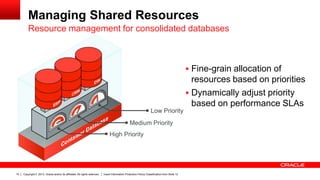
Managing Shared Resources
Resource management for consolidated databases

 Fine-grain allocation of

resources based on priorities
 Dynamically adjust priority
based on performance SLAs
Low Priority
Medium Priority
High Priority

15

Copyright © 2013, Oracle and/or its affiliates. All rights reserved.

Insert Information Protection Policy Classification from Slide 12
Database as a Service Platform Requirements
Support few to thousands of databases
 Mixed Simultaneous Workloads
– OLTP / Web commerce
– Reports / Ad hoc queries / Analytics
– Data Loads / Backups / Batch

– Development / Test

 Any SLA requirement
 Maximum Security

16

Copyright © 2013, Oracle and/or its affiliates. All rights reserved.

Insert Information Protection Policy Classification from Slide 12
Exadata Improves Consolidation Performance
Unique technology for accelerating all database workloads
 Smart Flash Cache
– Uses flash for physical I/O

 Smart Flash Log
– Uses flash to improve log I/O latency

 Smart Scan
– Runs portions of a database query in storage

 Hybrid Columnar Compression (HCC)
– Reduces the number of blocks and I/Os

17

Copyright © 2013, Oracle and/or its affiliates. All rights reserved.

Insert Information Protection Policy Classification from Slide 12
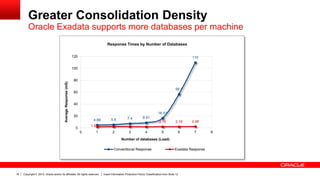
Greater Consolidation Density
Oracle Exadata supports more databases per machine
Response Times by Number of Databases
120

110

Average Response (mS)

100
80
56.7

60
40
16.51

20
4.89

5.5

7.4

8.91

2

3

4

2.16

2.16

2.48

5

6

7

1.89

0
0

1

Number of databases (Load)
Conventional Response

18

Copyright © 2013, Oracle and/or its affiliates. All rights reserved.

Exadata Response

Insert Information Protection Policy Classification from Slide 12

8
Mixed Workloads are Fundamental to DBaaS
Oracle Exadata enables safe consolidation of diverse workloads
 Database Resource Manager
– CPU resource management for conventional and pluggable databases

 Exadata I/O Resource Management
– By tenant pluggable database, job, SQL, user, service, etc.

 Exadata Network Resource Management
– Prioritizes critical messages through the entire fabric
– e.g. Web users prioritized over ad-hoc reporting

19

Copyright © 2013, Oracle and/or its affiliates. All rights reserved.

Insert Information Protection Policy Classification from Slide 12
Oracle Exadata
v

The Customer’s View

20

Copyright © 2013, Oracle and/or its affiliates. All rights reserved.

Insert Information Protection Policy Classification from Slide 12
21

Copyright © 2013, Oracle and/or its affiliates. All rights reserved.

Insert Information Protection Policy Classification from Slide 12
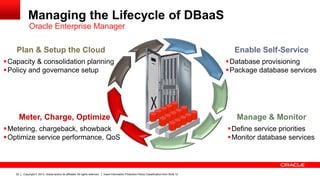
Managing the Lifecycle of DBaaS
Oracle Enterprise Manager
Plan & Setup the Cloud
Capacity & consolidation planning
Policy and governance setup

Meter, Charge, Optimize
Metering, chargeback, showback
Optimize service performance, QoS

22

Copyright © 2013, Oracle and/or its affiliates. All rights reserved.

Insert Information Protection Policy Classification from Slide 12

Enable Self-Service
Database provisioning
Package database services

Manage & Monitor
Define service priorities
Monitor database services
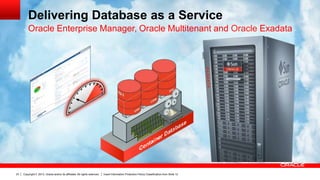
Delivering Database as a Service
Oracle Enterprise Manager, Oracle Multitenant and Oracle Exadata

23

Copyright © 2013, Oracle and/or its affiliates. All rights reserved.

Insert Information Protection Policy Classification from Slide 12
Oracle Database as a Service
Everybody wins…

Users Get:

IT Gets:

 Better performance & service

 Standardized deployments

 Self-service provisioning

 Less maintenance

 Pay per use

 Simplified support

24

Copyright © 2013, Oracle and/or its affiliates. All rights reserved.

Insert Information Protection Policy Classification from Slide 12
Graphic Section Divider

25

Copyright © 2013, Oracle and/or its affiliates. All rights reserved.

Insert Information Protection Policy Classification from Slide 12
26

Copyright © 2013, Oracle and/or its affiliates. All rights reserved.

Insert Information Protection Policy Classification from Slide 12

C4 delivering database as a service within your organization

  • 1.
    Database as aService Alan Poon Senior Sales Consultant Oracle Systems Hong Kong
  • 2.
    Traditional Database ServiceDeployments Dedicated Databases Cause Server and Software Sprawl  Was the only practical way to ensure good QoS – Performance, scalability and reliability Engineering Sales Manufacturing Marketing Finance Service Human Resources IT/Operations  Caused high costs for ‒ Hardware, software and labor  Multiple servers, databases, and OS’s to maintain ‒ Backup, patch, upgrade, monitor, optimize  Complex provisioning of dedicated services ‒ Slow to deploy new solutions 2 Copyright © 2013, Oracle and/or its affiliates. All rights reserved. Insert Information Protection Policy Classification from Slide 12
  • 3.
    Database as aService Goals Providing cost savings and greater agility Manufacturing Engineering Marketing  Cost Savings - Standardization - Shared and pooled resource Sales DBaaS Human Resources IT/Operations 3 Copyright © 2013, Oracle and/or its affiliates. All rights reserved. Service  Agility Finance & Accounting Insert Information Protection Policy Classification from Slide 12 - Elasticity - Self-service provisioning - Measured service
  • 4.
    Evolution to Databaseas a Service Siloes Complex 4 Standardized Simple Copyright © 2013, Oracle and/or its affiliates. All rights reserved. Consolidated Efficient Insert Information Protection Policy Classification from Slide 12 Service Delivery Agile Enterprise Cloud Unified
  • 5.
    Database Consolidation onClouds Traditional consolidation methods Clustered Databases Schema Consolidation Consolidation Density Virtual Machines Share Servers 5 Copyright © 2013, Oracle and/or its affiliates. All rights reserved. Share Servers & OS Insert Information Protection Policy Classification from Slide 12 Share Servers, OS & Database
  • 6.
    Oracle Multitenant Simplifies consolidation,enables Database as a Service Clustered Databases Pluggable Databases Consolidation Density Virtual Machines Share Servers 6 Copyright © 2013, Oracle and/or its affiliates. All rights reserved. Share Servers & OS Insert Information Protection Policy Classification from Slide 12 Share Servers, OS & Database
  • 7.
    Oracle Database Architecture Requiresmemory, processes and database files System Resources 7 Copyright © 2013, Oracle and/or its affiliates. All rights reserved. Insert Information Protection Policy Classification from Slide 12
  • 8.
    New Multitenant Architecture Memoryand processes required at container level only System Resources 8 Copyright © 2013, Oracle and/or its affiliates. All rights reserved. Insert Information Protection Policy Classification from Slide 12
  • 9.
    New Multitenant Architecture Memoryand processes required at container level only System Resources 9 Copyright © 2013, Oracle and/or its affiliates. All rights reserved. Insert Information Protection Policy Classification from Slide 12
  • 10.
    Advantages of MultitenantArchitecture Easy to adopt, reduce costs, increased agility Applications run unchanged  Rapid provisioning and portability Shared memory and background processes  Greater database consolidation density Common operations performed at container  10 Copyright © 2013, Oracle and/or its affiliates. All rights reserved. Manage many as one (upgrade, backup) Insert Information Protection Policy Classification from Slide 12
  • 11.
    Pluggable vs SeparateDatabases Highly Efficient: 6x Less H/W Resource, 5x more Scalable OLTP benchmark comparison Only 3GB of memory vs. 20GB memory used for 50 databases Pluggable databases scaled to over 250 while separate database instances maxed at 50 11 Copyright © 2013, Oracle and/or its affiliates. All rights reserved. Insert Information Protection Policy Classification from Slide 12
  • 12.
    Oracle Multitenant forProvisioning Fast Provisioning, Snapshot Clones Time Taken to Provision New Database 25 20 15 10 5 0 Non CDB 12 Copyright © 2013, Oracle and/or its affiliates. All rights reserved. Insert Information Protection Policy Classification from Slide 12 PDB Clone PDB using Copy-on-Write File System
  • 13.
    Oracle Multitenant forDatabase as a Service Pick from standard sizes and service levels GOLD SILVER ✔ BRONZE ✔ 13 Copyright © 2013, Oracle and/or its affiliates. All rights reserved. Insert Information Protection Policy Classification from Slide 12 RAC, Data Guard Data Guard Backups
  • 14.
    Oracle Multitenant forDatabase as a Service Trivially migrate tiers as databases become more mission critical GOLD ✔ Copyright © 2013, Oracle and/or its affiliates. All rights reserved. SILVER Data Guard ✔ 14 RAC, Data Guard BRONZE Backups Insert Information Protection Policy Classification from Slide 12
  • 15.
    Managing Shared Resources Resourcemanagement for consolidated databases  Fine-grain allocation of resources based on priorities  Dynamically adjust priority based on performance SLAs Low Priority Medium Priority High Priority 15 Copyright © 2013, Oracle and/or its affiliates. All rights reserved. Insert Information Protection Policy Classification from Slide 12
  • 16.
    Database as aService Platform Requirements Support few to thousands of databases  Mixed Simultaneous Workloads – OLTP / Web commerce – Reports / Ad hoc queries / Analytics – Data Loads / Backups / Batch – Development / Test  Any SLA requirement  Maximum Security 16 Copyright © 2013, Oracle and/or its affiliates. All rights reserved. Insert Information Protection Policy Classification from Slide 12
  • 17.
    Exadata Improves ConsolidationPerformance Unique technology for accelerating all database workloads  Smart Flash Cache – Uses flash for physical I/O  Smart Flash Log – Uses flash to improve log I/O latency  Smart Scan – Runs portions of a database query in storage  Hybrid Columnar Compression (HCC) – Reduces the number of blocks and I/Os 17 Copyright © 2013, Oracle and/or its affiliates. All rights reserved. Insert Information Protection Policy Classification from Slide 12
  • 18.
    Greater Consolidation Density OracleExadata supports more databases per machine Response Times by Number of Databases 120 110 Average Response (mS) 100 80 56.7 60 40 16.51 20 4.89 5.5 7.4 8.91 2 3 4 2.16 2.16 2.48 5 6 7 1.89 0 0 1 Number of databases (Load) Conventional Response 18 Copyright © 2013, Oracle and/or its affiliates. All rights reserved. Exadata Response Insert Information Protection Policy Classification from Slide 12 8
  • 19.
    Mixed Workloads areFundamental to DBaaS Oracle Exadata enables safe consolidation of diverse workloads  Database Resource Manager – CPU resource management for conventional and pluggable databases  Exadata I/O Resource Management – By tenant pluggable database, job, SQL, user, service, etc.  Exadata Network Resource Management – Prioritizes critical messages through the entire fabric – e.g. Web users prioritized over ad-hoc reporting 19 Copyright © 2013, Oracle and/or its affiliates. All rights reserved. Insert Information Protection Policy Classification from Slide 12
  • 20.
    Oracle Exadata v The Customer’sView 20 Copyright © 2013, Oracle and/or its affiliates. All rights reserved. Insert Information Protection Policy Classification from Slide 12
  • 21.
    21 Copyright © 2013,Oracle and/or its affiliates. All rights reserved. Insert Information Protection Policy Classification from Slide 12
  • 22.
    Managing the Lifecycleof DBaaS Oracle Enterprise Manager Plan & Setup the Cloud Capacity & consolidation planning Policy and governance setup Meter, Charge, Optimize Metering, chargeback, showback Optimize service performance, QoS 22 Copyright © 2013, Oracle and/or its affiliates. All rights reserved. Insert Information Protection Policy Classification from Slide 12 Enable Self-Service Database provisioning Package database services Manage & Monitor Define service priorities Monitor database services
  • 23.
    Delivering Database asa Service Oracle Enterprise Manager, Oracle Multitenant and Oracle Exadata 23 Copyright © 2013, Oracle and/or its affiliates. All rights reserved. Insert Information Protection Policy Classification from Slide 12
  • 24.
    Oracle Database asa Service Everybody wins… Users Get: IT Gets:  Better performance & service  Standardized deployments  Self-service provisioning  Less maintenance  Pay per use  Simplified support 24 Copyright © 2013, Oracle and/or its affiliates. All rights reserved. Insert Information Protection Policy Classification from Slide 12
  • 25.
    Graphic Section Divider 25 Copyright© 2013, Oracle and/or its affiliates. All rights reserved. Insert Information Protection Policy Classification from Slide 12
  • 26.
    26 Copyright © 2013,Oracle and/or its affiliates. All rights reserved. Insert Information Protection Policy Classification from Slide 12