CHAPTER 6:
CONSTITUTION
TOPICS TO BE COVERED:

Definition of Constitution
 Types of Constitution
 Written and Unwritten and their
advantages/disadvantages
 Rigid and flexible and their
advantages/disadvantages
 Characteristics of a good
constitution
 Concept of constitutionalism
1
INTRODUCTION
 A constitution is important to establish a stable &
orderly state
 All states creates rules/ principles with which to
guide the interaction between the rulers and the
ruled
 In short, constitution is the basic design of the
structure & powers of the government & the rights &
duties of its citizen
 It provides the highest set of principles/ laws in a
state
2
Roskin & Medeiros listed 3 purposes
of a constitution:
1) A statement of national ideals
 they provide the symbolic function of putting
in writing a statement of national ideals
2) Formalizes the structure of government
 A constitution is a blueprint, a written
description of who does what in gov., defining
the authority & limiting the powers of each
branch & providing for regularized channels
thought which conflict may be resolved
3) Establishes the legitimacy of government
 They attempt to justify the government’s right to
govern
3
DEFINITION
1) Roskin & Medeiros1) Roskin & Medeiros
 A written document that sets forth the
fundamental rules by which a political
system is governed
2) Woolsey2) Woolsey
 Collection of the principles according to
which the powers of gov & the rights of
the gov & the relationship between the 2
are adjusted
4
TYPES OF CONSTITUTION
1) WRITTEN CONSTITUTION
• Most of the fundamental principles of
governmental organization are written down in a
document/ a series of documents
• E.g the constitutions of Malaysia, Canada (are
written)
The fundamental principles concerning legislature,
the executive & judiciary & their powers,
the fundamental rights of the citizens &
the procedure for amending the constitution
are clearly written down in a document!!
5
2) UNWRITTEN CONSTITUTION
 The fundamental rules & regulations
regarding the structure of the government/
fundamental rights & liberties are not written
down in a document
 It may be scattered in various documents/It may be scattered in various documents/
found in usages, customs, traditions &found in usages, customs, traditions &
conventions of the countryconventions of the country
 E.g: the constitution of Britain (many people
are puzzled by the absence of a written
constitution in Great Britain)
6
ADVANTAGES &
DISADVANTAGES OF
UNWRITTEN & WRITTEN
CONSTITUTION???
1)it is not easy to violate a written const. by the
gov
2) The citizens can read & know the provisions of
the const.
3) const. limits the power of the gov. (that’s why the
distribution
of powers must be clearly written down in a
document)
4) An unwritten constitution is not certain & fails to
provide distinction between constitutional &
ordinary laws
A written constitution has
more advantages!!
Because it is:
1. Certain
2. Definite
3. distinct
7
3.) RIGID vs. FLEXIBLE
CONSTITUTION
 Can’t be changed easily ( there is distinct
method/ procedure for amending the const.
which is very complicated & rigorous & not
limited to the authority of legislature alone
 Eg: USA const. can’t be amended by
Congress alone (it needs the approval of the
people in a Referendum
 Eg: Canada const. can’t be changed just by
the Parliament (it needs the approval of the 7
provincial legislatures of 10 provinces having
50% of the total populations
RIGID
8
RIGID vs. FLEXIBLE
CONSTITUTION It can be changed easily by legislature like
passing an ordinary law
 There is no special procedure for
amending such const
 Eg: Bangladesh – the const. can be
changed by 2/3 majority voted of the
members of legislature
 The passing of ordinary law requires only a
simple majority
 So, in flexible const. the power of
parliament is supreme ( it is the final
authority in determining the changes in the
const.
 But, in a rigid const. the power of
legislatures is limited by the const. itself
FLEXIBLE
9
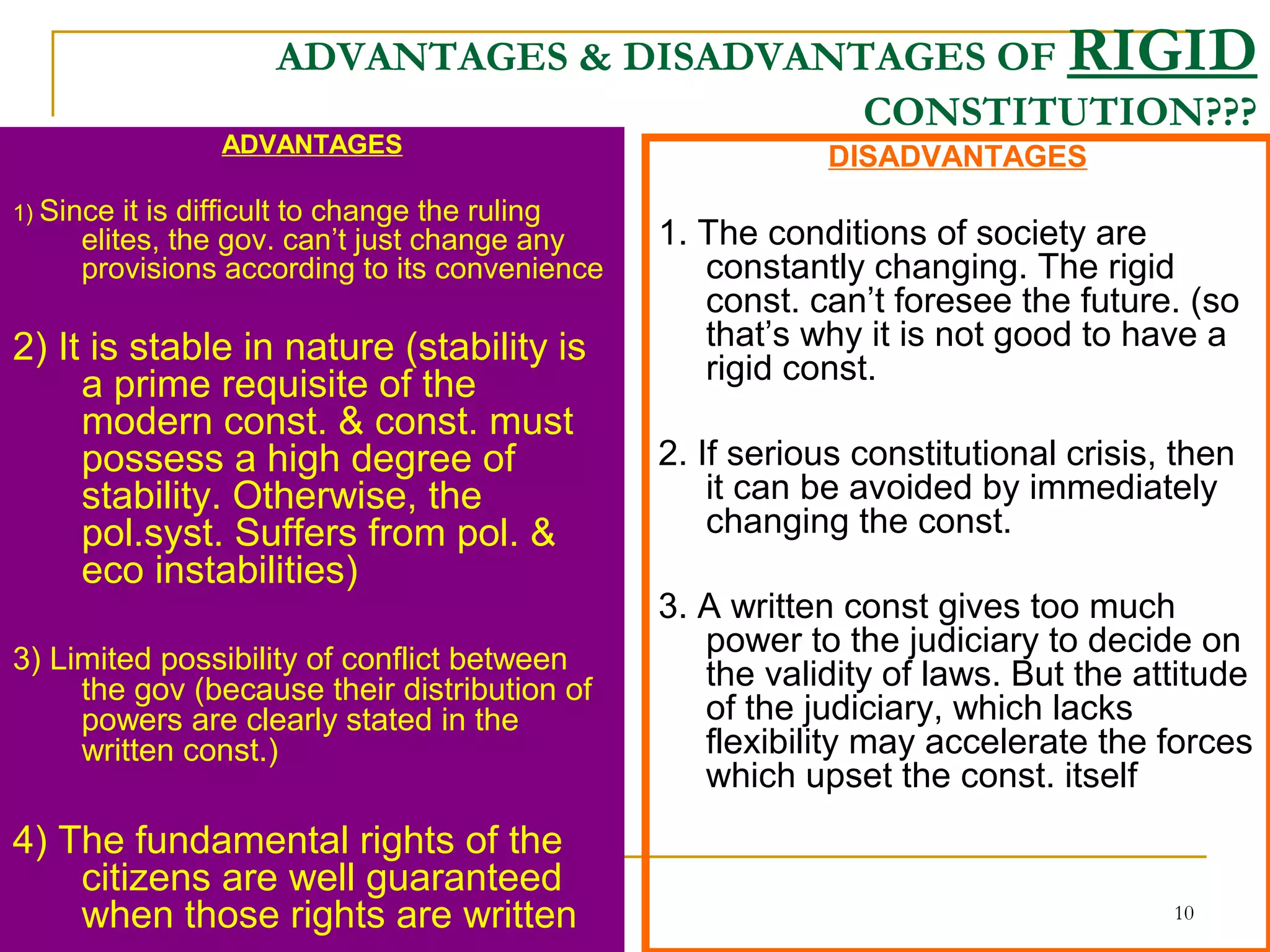
ADVANTAGES
1) Since it is difficult to change the ruling
elites, the gov. can’t just change any
provisions according to its convenience
2) It is stable in nature (stability is
a prime requisite of the
modern const. & const. must
possess a high degree of
stability. Otherwise, the
pol.syst. Suffers from pol. &
eco instabilities)
3) Limited possibility of conflict between
the gov (because their distribution of
powers are clearly stated in the
written const.)
4) The fundamental rights of the
citizens are well guaranteed
when those rights are written
DISADVANTAGES
1. The conditions of society are
constantly changing. The rigid
const. can’t foresee the future. (so
that’s why it is not good to have a
rigid const.
2. If serious constitutional crisis, then
it can be avoided by immediately
changing the const.
3. A written const gives too much
power to the judiciary to decide on
the validity of laws. But the attitude
of the judiciary, which lacks
flexibility may accelerate the forces
which upset the const. itself
ADVANTAGES & DISADVANTAGES OF RIGID
CONSTITUTION???
10
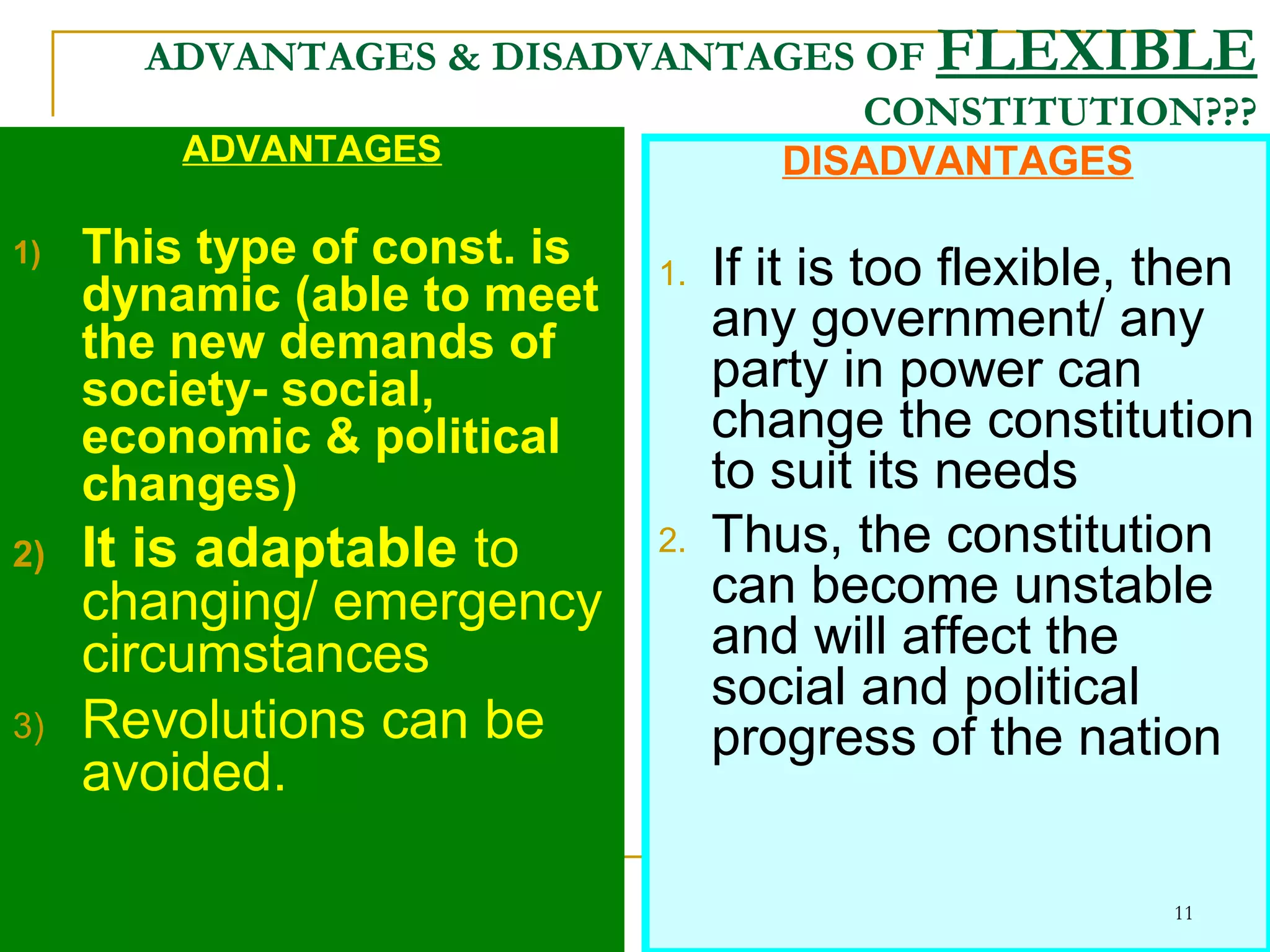
ADVANTAGES
1) This type of const. is
dynamic (able to meet
the new demands of
society- social,
economic & political
changes)
2) It is adaptable to
changing/ emergency
circumstances
3) Revolutions can be
avoided.
DISADVANTAGES
1. If it is too flexible, then
any government/ any
party in power can
change the constitution
to suit its needs
2. Thus, the constitution
can become unstable
and will affect the
social and political
progress of the nation
ADVANTAGES & DISADVANTAGES OF FLEXIBLE
CONSTITUTION???
11
RIGID vs FLEXIBLE???
 1 could easily say that the best constitution is 1 with
a mixture of both
 The const. should permitting changes to be made,
yet will ensure that the society will not be affected
 The procedure of amendment should not be so
complicated & delaying. The amending process
should meet the needs of the time.
 Progress and development can only be secured in
countries with rigid const. by a sufficiently easy
method of amendment.
12
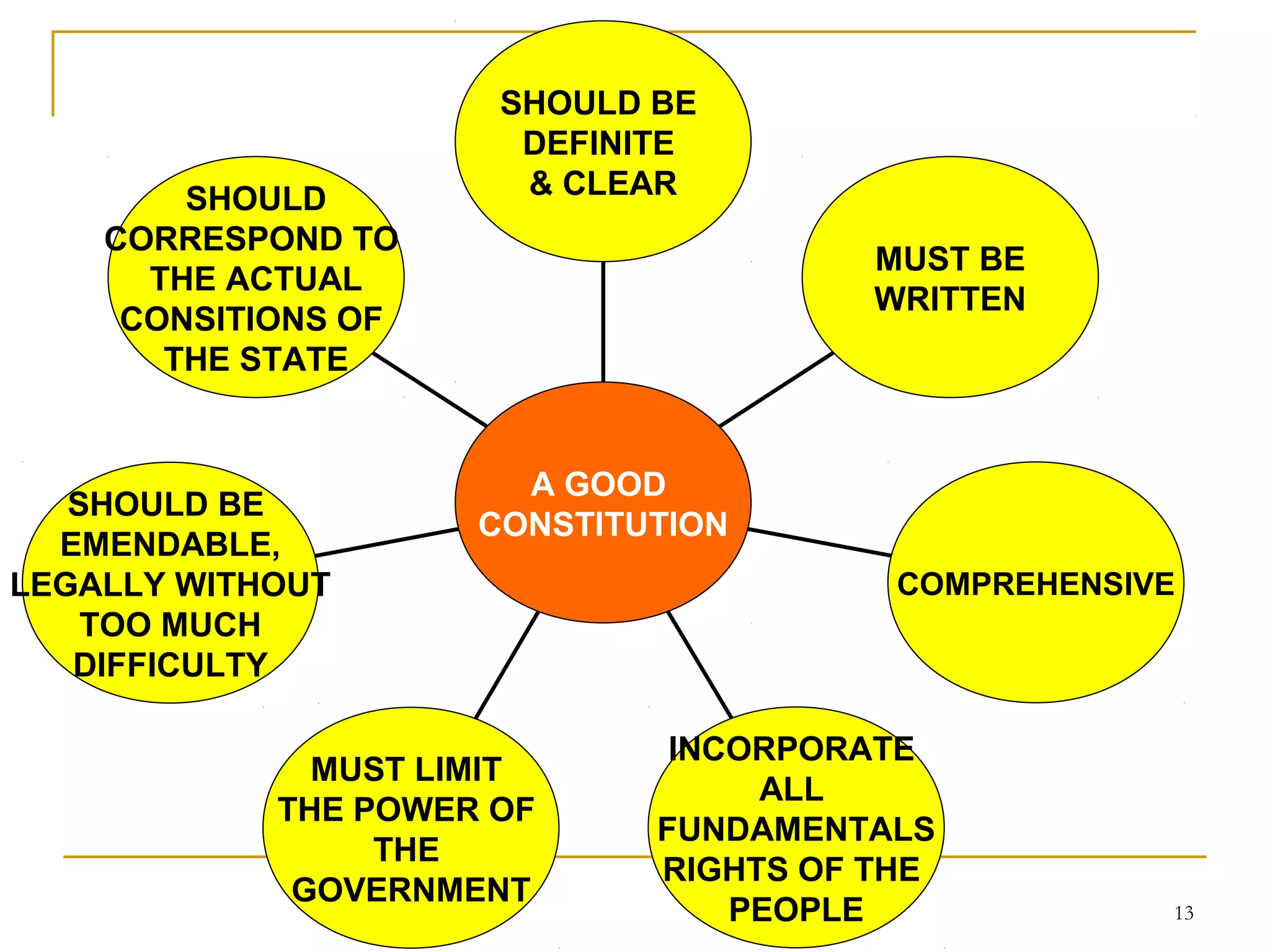
SHOULD
CORRESPOND TO
THE ACTUAL
CONSITIONS OF
THE STATE
SHOULD BE
EMENDABLE,
LEGALLY WITHOUT
TOO MUCH
DIFFICULTY
MUST LIMIT
THE POWER OF
THE
GOVERNMENT
INCORPORATE
ALL
FUNDAMENTALS
RIGHTS OF THE
PEOPLE
COMPREHENSIVE
MUST BE
WRITTEN
SHOULD BE
DEFINITE
& CLEAR
A GOOD
CONSTITUTION
13
-is a modern concept
that desires a political
order governed by laws
& regulations
CONSTITUTIONAL GOVERNMENT/
CONSTITUTIONALISM
 An existence of a constitution does not guarantee
that the political system is constitutional
 There is no guarantee of constitutionalism just
because a constitution exists
Constitutionalism?
14
Constitutionalism…
 Is only way through which people’s rights can
be protected
 It asserts that no public official should ever
exercise unlimited authority/ govern without
accountability to the people
 Very strong in some developed countries &
weak in some of them
 It is strong in Canada & Britain, but weak in
France
15
A Constitutional Government…
 Means a limited government
 In other words, the power of the government is
limited by the constitutional rules
 The powers of the government are curtailed &
procedures are defined in a constitution
 Therefore, a constitutional government is also called
as a limited government
 Eg: the Constitution of USA prohibits the President,
even during wartime, from seizing or nationalizing
industries without the approval of Congress
16
End of chapter 6
17

C6 constitution

  • 1.
    CHAPTER 6: CONSTITUTION TOPICS TOBE COVERED:  Definition of Constitution  Types of Constitution  Written and Unwritten and their advantages/disadvantages  Rigid and flexible and their advantages/disadvantages  Characteristics of a good constitution  Concept of constitutionalism 1
  • 2.
    INTRODUCTION  A constitutionis important to establish a stable & orderly state  All states creates rules/ principles with which to guide the interaction between the rulers and the ruled  In short, constitution is the basic design of the structure & powers of the government & the rights & duties of its citizen  It provides the highest set of principles/ laws in a state 2
  • 3.
    Roskin & Medeiroslisted 3 purposes of a constitution: 1) A statement of national ideals  they provide the symbolic function of putting in writing a statement of national ideals 2) Formalizes the structure of government  A constitution is a blueprint, a written description of who does what in gov., defining the authority & limiting the powers of each branch & providing for regularized channels thought which conflict may be resolved 3) Establishes the legitimacy of government  They attempt to justify the government’s right to govern 3
  • 4.
    DEFINITION 1) Roskin &Medeiros1) Roskin & Medeiros  A written document that sets forth the fundamental rules by which a political system is governed 2) Woolsey2) Woolsey  Collection of the principles according to which the powers of gov & the rights of the gov & the relationship between the 2 are adjusted 4
  • 5.
    TYPES OF CONSTITUTION 1)WRITTEN CONSTITUTION • Most of the fundamental principles of governmental organization are written down in a document/ a series of documents • E.g the constitutions of Malaysia, Canada (are written) The fundamental principles concerning legislature, the executive & judiciary & their powers, the fundamental rights of the citizens & the procedure for amending the constitution are clearly written down in a document!! 5
  • 6.
    2) UNWRITTEN CONSTITUTION The fundamental rules & regulations regarding the structure of the government/ fundamental rights & liberties are not written down in a document  It may be scattered in various documents/It may be scattered in various documents/ found in usages, customs, traditions &found in usages, customs, traditions & conventions of the countryconventions of the country  E.g: the constitution of Britain (many people are puzzled by the absence of a written constitution in Great Britain) 6
  • 7.
    ADVANTAGES & DISADVANTAGES OF UNWRITTEN& WRITTEN CONSTITUTION??? 1)it is not easy to violate a written const. by the gov 2) The citizens can read & know the provisions of the const. 3) const. limits the power of the gov. (that’s why the distribution of powers must be clearly written down in a document) 4) An unwritten constitution is not certain & fails to provide distinction between constitutional & ordinary laws A written constitution has more advantages!! Because it is: 1. Certain 2. Definite 3. distinct 7
  • 8.
    3.) RIGID vs.FLEXIBLE CONSTITUTION  Can’t be changed easily ( there is distinct method/ procedure for amending the const. which is very complicated & rigorous & not limited to the authority of legislature alone  Eg: USA const. can’t be amended by Congress alone (it needs the approval of the people in a Referendum  Eg: Canada const. can’t be changed just by the Parliament (it needs the approval of the 7 provincial legislatures of 10 provinces having 50% of the total populations RIGID 8
  • 9.
    RIGID vs. FLEXIBLE CONSTITUTIONIt can be changed easily by legislature like passing an ordinary law  There is no special procedure for amending such const  Eg: Bangladesh – the const. can be changed by 2/3 majority voted of the members of legislature  The passing of ordinary law requires only a simple majority  So, in flexible const. the power of parliament is supreme ( it is the final authority in determining the changes in the const.  But, in a rigid const. the power of legislatures is limited by the const. itself FLEXIBLE 9
  • 10.
    ADVANTAGES 1) Since itis difficult to change the ruling elites, the gov. can’t just change any provisions according to its convenience 2) It is stable in nature (stability is a prime requisite of the modern const. & const. must possess a high degree of stability. Otherwise, the pol.syst. Suffers from pol. & eco instabilities) 3) Limited possibility of conflict between the gov (because their distribution of powers are clearly stated in the written const.) 4) The fundamental rights of the citizens are well guaranteed when those rights are written DISADVANTAGES 1. The conditions of society are constantly changing. The rigid const. can’t foresee the future. (so that’s why it is not good to have a rigid const. 2. If serious constitutional crisis, then it can be avoided by immediately changing the const. 3. A written const gives too much power to the judiciary to decide on the validity of laws. But the attitude of the judiciary, which lacks flexibility may accelerate the forces which upset the const. itself ADVANTAGES & DISADVANTAGES OF RIGID CONSTITUTION??? 10
  • 11.
    ADVANTAGES 1) This typeof const. is dynamic (able to meet the new demands of society- social, economic & political changes) 2) It is adaptable to changing/ emergency circumstances 3) Revolutions can be avoided. DISADVANTAGES 1. If it is too flexible, then any government/ any party in power can change the constitution to suit its needs 2. Thus, the constitution can become unstable and will affect the social and political progress of the nation ADVANTAGES & DISADVANTAGES OF FLEXIBLE CONSTITUTION??? 11
  • 12.
    RIGID vs FLEXIBLE??? 1 could easily say that the best constitution is 1 with a mixture of both  The const. should permitting changes to be made, yet will ensure that the society will not be affected  The procedure of amendment should not be so complicated & delaying. The amending process should meet the needs of the time.  Progress and development can only be secured in countries with rigid const. by a sufficiently easy method of amendment. 12
  • 13.
    SHOULD CORRESPOND TO THE ACTUAL CONSITIONSOF THE STATE SHOULD BE EMENDABLE, LEGALLY WITHOUT TOO MUCH DIFFICULTY MUST LIMIT THE POWER OF THE GOVERNMENT INCORPORATE ALL FUNDAMENTALS RIGHTS OF THE PEOPLE COMPREHENSIVE MUST BE WRITTEN SHOULD BE DEFINITE & CLEAR A GOOD CONSTITUTION 13
  • 14.
    -is a modernconcept that desires a political order governed by laws & regulations CONSTITUTIONAL GOVERNMENT/ CONSTITUTIONALISM  An existence of a constitution does not guarantee that the political system is constitutional  There is no guarantee of constitutionalism just because a constitution exists Constitutionalism? 14
  • 15.
    Constitutionalism…  Is onlyway through which people’s rights can be protected  It asserts that no public official should ever exercise unlimited authority/ govern without accountability to the people  Very strong in some developed countries & weak in some of them  It is strong in Canada & Britain, but weak in France 15
  • 16.
    A Constitutional Government… Means a limited government  In other words, the power of the government is limited by the constitutional rules  The powers of the government are curtailed & procedures are defined in a constitution  Therefore, a constitutional government is also called as a limited government  Eg: the Constitution of USA prohibits the President, even during wartime, from seizing or nationalizing industries without the approval of Congress 16
  • 17.