INTRODUCTION
Most companies do a bad job of managing their inventory effectively. There are many reasons for this, but
it usually starts with bad submission of vendors recommended spare parts data, poor cataloguing and
selecting initial spares.
From our experience, this is not limited to any one industry, irrespective of the industry, e.g. Oil and Gas,
Mining, Power, Food & Drink, Electronics, Semi-Conductor plants all do a bad job of managing spares
leading to excess costs.
This practical 3-day workshop covers all aspects related to reducing inventory and costs of spare parts and
is supported by case studies, software and practical exercises to aid understanding.
This workshop focuses on reducing the inventory, an area often overlooked.
There are very few courses conducted that deal with the practical issues of spares cataloguing, optimising
spares and stock reduction.
After this course, delegates will leave the workshop with tools and techniques that they can
immediately apply in their own companies and start to reduce costs and improve procedures.
An MS Excel Analysis worksheet containing all formulae will be provided to conduct an audit of
current inventory parameters.
Two analysis techniques will be covered; first using probability for normal operating and consumable
spares and the second using simulation (modelling) techniques for high value spares with logistic issues.
The course is of particular benefit to companies who:
Want to audit their spares data quality or
Need to upgrade their CMMS system or
Want to reduce inventory levels and costs
The course will cover both new and existing spares, and many case studies will be shown including
reduction of 50-70% in the number of line items.
This course has been conducted very successfully over 20 times in Asia & Africa and THIS IS THE FIRST
COURSE to be run in the UK.
LEARNING OBJECTIVES
As a result of attending this workshop delegates will understand:
ISO5500 and what it means for inventory management
How to achieve consistent cataloguing
The different costs associated with spares management
The techniques to improve reliability resulting in less spares usage
How to select the right inventory policy for fast and slow moving parts
Good practices related to SPIR forms
How to evaluate safety stocks scientifically
How to determine how many to buy
The strategies to minimise stock
How to justify the financial case for high value spares
♦ How to measure inventory performance
♦ What can be done in-house and what can be done with specialist software
VENUE: Robinsons Brewery Conference Centre, Stockport. DATE: 15 – 17 March 2017
3 day Spares Optimisation & Inventory
Reduction (includes over 21 tactics to reduce inventory
& costs)
CONTENTS
Session 1: Introduction to Spares Management
Delegates’ Issues
Common issues in inventory management with real examples
Where we incur excess costs
Benefits of improved inventory management
Terms and definitions used in the workshop.
Topic 2: Recommended Spare Parts List (RSPL) from Vendors
RSPLs, their purpose and why they are submitted incorrectly, principles of good spares cataloguing
to ensure zero duplicates, and ease of searching
A critical review of a typical RSPL form and the associated procedures sent to vendors
Examples of good and bad RSPL
10 rules for effective use of RSPL
Proposed improved format for an electronic RSPL
Topic 3: Effective Cataloguing
Introduction and detailed examples of an 8 step cataloguing process, i.e.
Defining naming, formatting
Developing spare type guides to ensure consistent part naming
Developing rules for Mfg’s Part/Nos, dimensions, abbreviations
Define strategies i.e. who to buy from, OEMs, Vendors, specialist company
Develop a set of cataloguing best practice manuals
Create upload file and quality checks
Benefits of commercial cataloguing software
Many examples collected from our numerous studies will be shown
Session 4: Inventory Cost Reduction Programme
Introduction to a 21-step inventory reduction programme, tactics including, but not limited to:
Audit CMMS spares data quality
Challenge the decision, whether to stock and who pays
Establish spares criticality and service levels
Apply the 80-20 rule to AIV, Item Cost, Stock Holding Cost
Identify duplicates line items
Reduce internal lead times to reduce stock holding costs
Standardisation
Different strategies, min-max, reorder point control, constant vendor delivery
Replace OEM
List issues and make a plan
Session 5: Discussion on Spares Costs
Different costs used in the stock management process, e.g. buying, holding cost, item cost, issue
cost, penalty cost, average stock level costs, annual issue value
Session 6: Introduction to Reliability Theory
Normal & Poisson distribution,
Weibull parameters for high value spares
Explanation of service levels
Importance of the P-F
How to estimate annual usage using MTBFs or reliability data sources
Session 7: Challenge Vendors Recommended Quantities
How to calculate estimated annual demand rates based spare reliability
Case studies where actual consumption has exceeded initial estimates
Session 8: Setting of Re-Order Points, Safety Stock
Different approaches to set ROPs
Using the Poisson distribution to set re-order points based on lead time, annual usage and criticality
Session 9: How Many to Order? Determining the EOQ
How to determine the quantity to order
The effects of ordering too many or too few,
What to do, when the EOQ approach is not valid
Session 10 Auditing Current Inventory Parameters Effectiveness
Evaluate service levels; compare existing with those parameters in the Inventory Management
System
Different KPIs such as Turnover Ratios, Issue Rates, Annual Issue Value, Stock holding value
Using an MS Excel analysis worksheet with all formula
Session 11 Database Solutions
Demonstration of an MS Access Based Application to simplify the analysis
Session 12: Evaluate Policies for Insurance Spares
Introduction to Monte-Carlo simulation and penalty costs to evaluate policies for insurance spares
Session 13: Alternative Strategies
Sometimes the ROP/EOQ strategy is not appropriate, discussion on other options.
• Min-Max policy
• Constant Vendor Delivery
• EOQ related to evaluation discounts for higher order quantities
Session 14: Measuring Spare Management Effectiveness Using KPIs
Purchasing & Inventory KPIs
Performance management system
Course Review & Delegates Action Plans
WHO SHOULD ATTEND
Maintenance Managers, Engineers,
CMMS super users
Warehouse Managers & Supervisors
Project Engineers
Spares & Inventory Personnel
Purchasing & Logistics
Cost Controllers
TRAINING METHODOLOGY
PowerPoint slides; delegates will learn by active participation during the workshop and through the use of
case studies and conducting exercises.
Laptop required
YOUR INSTRUCTOR
David Thompson has over 40 years in the field of Maintenance, Reliability & Spares Optimisation.
As a consultant David has conducted 100s of different types of audits, developed maintenance strategies
and written management procedures, carried out CMMS builds and CMMS data cleansing. He has worked
in the oil and gas, petrochemical, mining, utility, food and beverage companies.
David was the UK representative for ReliaSoft Corp. one of the world’s leading providers of Reliability
Analysis software and has been a certified instructor for the taproot RCA/RCFA process
David has conducted numerous courses in reliability including public as well as in-house courses for a wide
range of companies including airports, semi-conductors, mining, oil and gas, etc.
David has also presented at Reliability Symposiums in Brazil, Europe and Asia and is an external online
instructor in Reliability for the Robert Gordon University for their Asset Integrity MSc.
Previous delegates for the 3 day Optimising spares course have been from:
Coca-Cola, Nestle, Del Monte
Power, Utilities, Mining, Aviation
Semi-Conductor, Forestry and finished Timber products
Etc.
More information is available on www.ramsoftuk.com
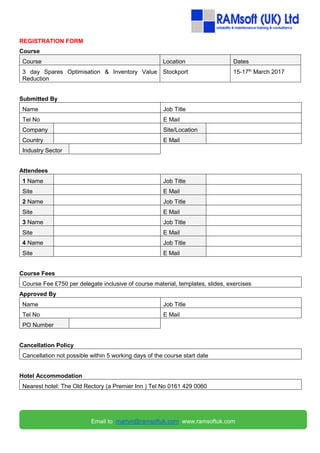
REGISTRATION FORM
Course
Course Location Dates
3 day Spares Optimisation & Inventory Value
Reduction
Stockport 15-17th
March 2017
Submitted By
Name Job Title
Tel No E Mail
Company Site/Location
Country E Mail
Industry Sector
Attendees
1 Name Job Title
Site E Mail
2 Name Job Title
Site E Mail
3 Name Job Title
Site E Mail
4 Name Job Title
Site E Mail
Course Fees
Course Fee £750 per delegate inclusive of course material, templates, slides, exercises
Approved By
Name Job Title
Tel No E Mail
PO Number
Cancellation Policy
Cancellation not possible within 5 working days of the course start date
Hotel Accommodation
Nearest hotel: The Old Rectory (a Premier Inn ) Tel No 0161 429 0060
Email to martyn@ramsoftuk.com www.ramsoftuk.com

C3 3 day spares optimisation rationalisation 2017 01

  • 1.
    INTRODUCTION Most companies doa bad job of managing their inventory effectively. There are many reasons for this, but it usually starts with bad submission of vendors recommended spare parts data, poor cataloguing and selecting initial spares. From our experience, this is not limited to any one industry, irrespective of the industry, e.g. Oil and Gas, Mining, Power, Food & Drink, Electronics, Semi-Conductor plants all do a bad job of managing spares leading to excess costs. This practical 3-day workshop covers all aspects related to reducing inventory and costs of spare parts and is supported by case studies, software and practical exercises to aid understanding. This workshop focuses on reducing the inventory, an area often overlooked. There are very few courses conducted that deal with the practical issues of spares cataloguing, optimising spares and stock reduction. After this course, delegates will leave the workshop with tools and techniques that they can immediately apply in their own companies and start to reduce costs and improve procedures. An MS Excel Analysis worksheet containing all formulae will be provided to conduct an audit of current inventory parameters. Two analysis techniques will be covered; first using probability for normal operating and consumable spares and the second using simulation (modelling) techniques for high value spares with logistic issues. The course is of particular benefit to companies who: Want to audit their spares data quality or Need to upgrade their CMMS system or Want to reduce inventory levels and costs The course will cover both new and existing spares, and many case studies will be shown including reduction of 50-70% in the number of line items. This course has been conducted very successfully over 20 times in Asia & Africa and THIS IS THE FIRST COURSE to be run in the UK. LEARNING OBJECTIVES As a result of attending this workshop delegates will understand: ISO5500 and what it means for inventory management How to achieve consistent cataloguing The different costs associated with spares management The techniques to improve reliability resulting in less spares usage How to select the right inventory policy for fast and slow moving parts Good practices related to SPIR forms How to evaluate safety stocks scientifically How to determine how many to buy The strategies to minimise stock How to justify the financial case for high value spares ♦ How to measure inventory performance ♦ What can be done in-house and what can be done with specialist software VENUE: Robinsons Brewery Conference Centre, Stockport. DATE: 15 – 17 March 2017 3 day Spares Optimisation & Inventory Reduction (includes over 21 tactics to reduce inventory & costs)
  • 2.
    CONTENTS Session 1: Introductionto Spares Management Delegates’ Issues Common issues in inventory management with real examples Where we incur excess costs Benefits of improved inventory management Terms and definitions used in the workshop. Topic 2: Recommended Spare Parts List (RSPL) from Vendors RSPLs, their purpose and why they are submitted incorrectly, principles of good spares cataloguing to ensure zero duplicates, and ease of searching A critical review of a typical RSPL form and the associated procedures sent to vendors Examples of good and bad RSPL 10 rules for effective use of RSPL Proposed improved format for an electronic RSPL Topic 3: Effective Cataloguing Introduction and detailed examples of an 8 step cataloguing process, i.e. Defining naming, formatting Developing spare type guides to ensure consistent part naming Developing rules for Mfg’s Part/Nos, dimensions, abbreviations Define strategies i.e. who to buy from, OEMs, Vendors, specialist company Develop a set of cataloguing best practice manuals Create upload file and quality checks Benefits of commercial cataloguing software Many examples collected from our numerous studies will be shown Session 4: Inventory Cost Reduction Programme Introduction to a 21-step inventory reduction programme, tactics including, but not limited to: Audit CMMS spares data quality Challenge the decision, whether to stock and who pays Establish spares criticality and service levels Apply the 80-20 rule to AIV, Item Cost, Stock Holding Cost Identify duplicates line items Reduce internal lead times to reduce stock holding costs Standardisation Different strategies, min-max, reorder point control, constant vendor delivery Replace OEM List issues and make a plan Session 5: Discussion on Spares Costs Different costs used in the stock management process, e.g. buying, holding cost, item cost, issue cost, penalty cost, average stock level costs, annual issue value Session 6: Introduction to Reliability Theory Normal & Poisson distribution, Weibull parameters for high value spares
  • 3.
    Explanation of servicelevels Importance of the P-F How to estimate annual usage using MTBFs or reliability data sources Session 7: Challenge Vendors Recommended Quantities How to calculate estimated annual demand rates based spare reliability Case studies where actual consumption has exceeded initial estimates Session 8: Setting of Re-Order Points, Safety Stock Different approaches to set ROPs Using the Poisson distribution to set re-order points based on lead time, annual usage and criticality Session 9: How Many to Order? Determining the EOQ How to determine the quantity to order The effects of ordering too many or too few, What to do, when the EOQ approach is not valid Session 10 Auditing Current Inventory Parameters Effectiveness Evaluate service levels; compare existing with those parameters in the Inventory Management System Different KPIs such as Turnover Ratios, Issue Rates, Annual Issue Value, Stock holding value Using an MS Excel analysis worksheet with all formula Session 11 Database Solutions Demonstration of an MS Access Based Application to simplify the analysis Session 12: Evaluate Policies for Insurance Spares Introduction to Monte-Carlo simulation and penalty costs to evaluate policies for insurance spares Session 13: Alternative Strategies Sometimes the ROP/EOQ strategy is not appropriate, discussion on other options. • Min-Max policy • Constant Vendor Delivery • EOQ related to evaluation discounts for higher order quantities Session 14: Measuring Spare Management Effectiveness Using KPIs Purchasing & Inventory KPIs Performance management system Course Review & Delegates Action Plans WHO SHOULD ATTEND Maintenance Managers, Engineers, CMMS super users Warehouse Managers & Supervisors Project Engineers Spares & Inventory Personnel Purchasing & Logistics Cost Controllers
  • 4.
    TRAINING METHODOLOGY PowerPoint slides;delegates will learn by active participation during the workshop and through the use of case studies and conducting exercises. Laptop required YOUR INSTRUCTOR David Thompson has over 40 years in the field of Maintenance, Reliability & Spares Optimisation. As a consultant David has conducted 100s of different types of audits, developed maintenance strategies and written management procedures, carried out CMMS builds and CMMS data cleansing. He has worked in the oil and gas, petrochemical, mining, utility, food and beverage companies. David was the UK representative for ReliaSoft Corp. one of the world’s leading providers of Reliability Analysis software and has been a certified instructor for the taproot RCA/RCFA process David has conducted numerous courses in reliability including public as well as in-house courses for a wide range of companies including airports, semi-conductors, mining, oil and gas, etc. David has also presented at Reliability Symposiums in Brazil, Europe and Asia and is an external online instructor in Reliability for the Robert Gordon University for their Asset Integrity MSc. Previous delegates for the 3 day Optimising spares course have been from: Coca-Cola, Nestle, Del Monte Power, Utilities, Mining, Aviation Semi-Conductor, Forestry and finished Timber products Etc. More information is available on www.ramsoftuk.com
  • 5.
    REGISTRATION FORM Course Course LocationDates 3 day Spares Optimisation & Inventory Value Reduction Stockport 15-17th March 2017 Submitted By Name Job Title Tel No E Mail Company Site/Location Country E Mail Industry Sector Attendees 1 Name Job Title Site E Mail 2 Name Job Title Site E Mail 3 Name Job Title Site E Mail 4 Name Job Title Site E Mail Course Fees Course Fee £750 per delegate inclusive of course material, templates, slides, exercises Approved By Name Job Title Tel No E Mail PO Number Cancellation Policy Cancellation not possible within 5 working days of the course start date Hotel Accommodation Nearest hotel: The Old Rectory (a Premier Inn ) Tel No 0161 429 0060 Email to martyn@ramsoftuk.com www.ramsoftuk.com