Location Planning
and Analysis
Dzanja J.L.
Location Theories
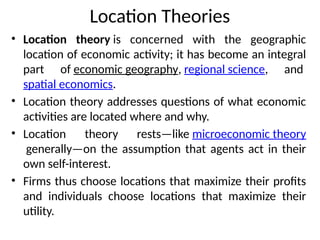
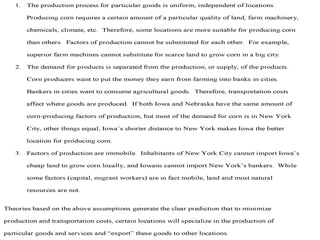
• Location theory is concerned with the geographic
location of economic activity; it has become an integral
part of economic geography, regional science, and
spatial economics.
• Location theory addresses questions of what economic
activities are located where and why.
• Location theory rests—like microeconomic theory
generally—on the assumption that agents act in their
own self-interest.
• Firms thus choose locations that maximize their profits
and individuals choose locations that maximize their
utility.
Continued
Need for Location Decisions
• Marketing Strategy
• Cost of Doing Business
• Growth
• Depletion of Resources
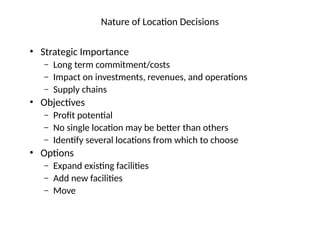
Nature of Location Decisions
• Strategic Importance
– Long term commitment/costs
– Impact on investments, revenues, and operations
– Supply chains
• Objectives
– Profit potential
– No single location may be better than others
– Identify several locations from which to choose
• Options
– Expand existing facilities
– Add new facilities
– Move
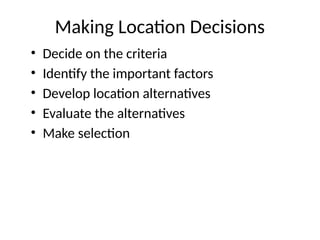
Making Location Decisions
• Decide on the criteria
• Identify the important factors
• Develop location alternatives
• Evaluate the alternatives
• Make selection
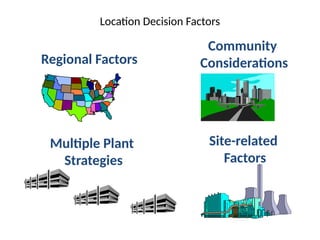
Location Decision Factors
Regional Factors
Site-related
Factors
Multiple Plant
Strategies
Community
Considerations
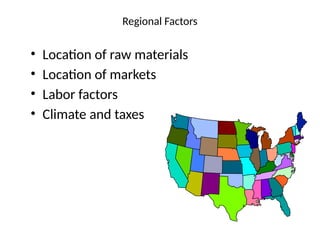
• Location of raw materials
• Location of markets
• Labor factors
• Climate and taxes
Regional Factors
• Quality of life
• Services
• Attitudes
• Taxes
• Environmental regulations
• Utilities
• Developer support
Community Considerations
• Land
• Transportation
• Environmental
• Legal
Site Related Factors
• Product plant strategy
• Market area plant strategy
• Process plant strategy
Multiple Plant Strategies
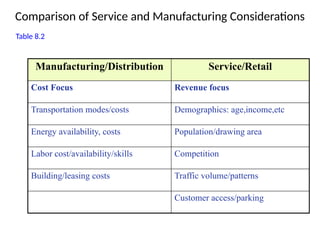
Comparison of Service and Manufacturing Considerations
Manufacturing/Distribution Service/Retail
Cost Focus Revenue focus
Transportation modes/costs Demographics: age,income,etc
Energy availability, costs Population/drawing area
Labor cost/availability/skills Competition
Building/leasing costs Traffic volume/patterns
Customer access/parking
Table 8.2
Trends in Locations
• Foreign producers locating in U.S.
– “Made in USA”
– Currency fluctuations
• Just-in-time manufacturing techniques
• Microfactories
• Information Technology
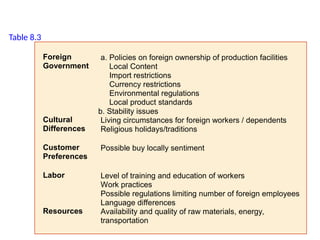
Foreign
Government
a. Policies on foreign ownership of production facilities
Local Content
Import restrictions
Currency restrictions
Environmental regulations
Local product standards
b. Stability issues
Cultural
Differences
Living circumstances for foreign workers / dependents
Religious holidays/traditions
Customer
Preferences
Possible buy locally sentiment
Labor Level of training and education of workers
Work practices
Possible regulations limiting number of foreign employees
Language differences
Resources Availability and quality of raw materials, energy,
transportation
Table 8.3
Evaluating Locations
• Cost-Profit-Volume Analysis
– Determine fixed and variable costs
– Plot total costs
– Determine lowest total costs
Location Cost-Volume Analysis
• Assumptions
– Fixed costs are constant
– Variable costs are linear
– Output can be closely estimated
– Only one product involved
Evaluating Locations
• Transportation Model
– Decision based on movement costs of raw
materials or finished goods
• Factor Rating
– Decision based on quantitative and qualitative
inputs
• Center of Gravity Method
– Decision based on minimum distribution costs
© Wiley 2010 20
Location Analysis
Three most important factors in real estate:
1. Location
2. Location
3. Location
Facility location is the process of identifying the
best geographic location for a service or
production facility
© Wiley 2010 21
Factors Affecting Location Decisions
• Proximity to source of supply:
– Reduce transportation costs of perishable or bulky
raw materials
• Proximity to customers:
– High population areas, close to JIT partners
• Proximity to labor:
– Local wage rates, attitude toward unions,
availability of special skills (silicon valley)
© Wiley 2010 22
More Location Factors
• Community considerations:
– Local community’s attitude toward the facility
(prisons, utility plants, etc.)
• Site considerations:
– Local zoning & taxes, access to utilities, etc.
• Quality-of-life issues:
– Climate, cultural attractions, commuting time, etc.
• Other considerations:
– Options for future expansion, local competition, etc.
© Wiley 2010 23
Globalization – Should Firm Go Global?
Globalization is the process of locating facilities around the
world
• Potential advantages:
– Inside track to foreign markets, avoid trade barriers, gain access to
cheaper labor
• Potential disadvantages:
– Political risks may increase, loss of control of proprietary technology,
local infrastructure (roads & utilities) may be inadequate, high inflation
• Other issues to consider:
– Language barriers, different laws & regulations, different business
cultures
© Wiley 2010 24
Making Location Decisions
Analysis should follow 3 step process:
1. Identify dominant location factors
2. Develop location alternatives
3. Evaluate locations alternatives
Procedures for evaluation location alternatives include
– Factor rating method
– Load-distance model
– Center of gravity approach
– Break-even analysis
– Transportation method

Location Planning and Analysis For managerial decisions

  • 1.
  • 2.
    Location Theories • Locationtheory is concerned with the geographic location of economic activity; it has become an integral part of economic geography, regional science, and spatial economics. • Location theory addresses questions of what economic activities are located where and why. • Location theory rests—like microeconomic theory generally—on the assumption that agents act in their own self-interest. • Firms thus choose locations that maximize their profits and individuals choose locations that maximize their utility.
  • 3.
  • 6.
    Need for LocationDecisions • Marketing Strategy • Cost of Doing Business • Growth • Depletion of Resources
  • 7.
    Nature of LocationDecisions • Strategic Importance – Long term commitment/costs – Impact on investments, revenues, and operations – Supply chains • Objectives – Profit potential – No single location may be better than others – Identify several locations from which to choose • Options – Expand existing facilities – Add new facilities – Move
  • 8.
    Making Location Decisions •Decide on the criteria • Identify the important factors • Develop location alternatives • Evaluate the alternatives • Make selection
  • 9.
    Location Decision Factors RegionalFactors Site-related Factors Multiple Plant Strategies Community Considerations
  • 10.
    • Location ofraw materials • Location of markets • Labor factors • Climate and taxes Regional Factors
  • 11.
    • Quality oflife • Services • Attitudes • Taxes • Environmental regulations • Utilities • Developer support Community Considerations
  • 12.
    • Land • Transportation •Environmental • Legal Site Related Factors
  • 13.
    • Product plantstrategy • Market area plant strategy • Process plant strategy Multiple Plant Strategies
  • 14.
    Comparison of Serviceand Manufacturing Considerations Manufacturing/Distribution Service/Retail Cost Focus Revenue focus Transportation modes/costs Demographics: age,income,etc Energy availability, costs Population/drawing area Labor cost/availability/skills Competition Building/leasing costs Traffic volume/patterns Customer access/parking Table 8.2
  • 15.
    Trends in Locations •Foreign producers locating in U.S. – “Made in USA” – Currency fluctuations • Just-in-time manufacturing techniques • Microfactories • Information Technology
  • 16.
    Foreign Government a. Policies onforeign ownership of production facilities Local Content Import restrictions Currency restrictions Environmental regulations Local product standards b. Stability issues Cultural Differences Living circumstances for foreign workers / dependents Religious holidays/traditions Customer Preferences Possible buy locally sentiment Labor Level of training and education of workers Work practices Possible regulations limiting number of foreign employees Language differences Resources Availability and quality of raw materials, energy, transportation Table 8.3
  • 17.
    Evaluating Locations • Cost-Profit-VolumeAnalysis – Determine fixed and variable costs – Plot total costs – Determine lowest total costs
  • 18.
    Location Cost-Volume Analysis •Assumptions – Fixed costs are constant – Variable costs are linear – Output can be closely estimated – Only one product involved
  • 19.
    Evaluating Locations • TransportationModel – Decision based on movement costs of raw materials or finished goods • Factor Rating – Decision based on quantitative and qualitative inputs • Center of Gravity Method – Decision based on minimum distribution costs
  • 20.
    © Wiley 201020 Location Analysis Three most important factors in real estate: 1. Location 2. Location 3. Location Facility location is the process of identifying the best geographic location for a service or production facility
  • 21.
    © Wiley 201021 Factors Affecting Location Decisions • Proximity to source of supply: – Reduce transportation costs of perishable or bulky raw materials • Proximity to customers: – High population areas, close to JIT partners • Proximity to labor: – Local wage rates, attitude toward unions, availability of special skills (silicon valley)
  • 22.
    © Wiley 201022 More Location Factors • Community considerations: – Local community’s attitude toward the facility (prisons, utility plants, etc.) • Site considerations: – Local zoning & taxes, access to utilities, etc. • Quality-of-life issues: – Climate, cultural attractions, commuting time, etc. • Other considerations: – Options for future expansion, local competition, etc.
  • 23.
    © Wiley 201023 Globalization – Should Firm Go Global? Globalization is the process of locating facilities around the world • Potential advantages: – Inside track to foreign markets, avoid trade barriers, gain access to cheaper labor • Potential disadvantages: – Political risks may increase, loss of control of proprietary technology, local infrastructure (roads & utilities) may be inadequate, high inflation • Other issues to consider: – Language barriers, different laws & regulations, different business cultures
  • 24.
    © Wiley 201024 Making Location Decisions Analysis should follow 3 step process: 1. Identify dominant location factors 2. Develop location alternatives 3. Evaluate locations alternatives Procedures for evaluation location alternatives include – Factor rating method – Load-distance model – Center of gravity approach – Break-even analysis – Transportation method