IOSR Journal of Engineering (IOSRJEN) www.iosrjen.org
ISSN (e): 2250-3021, ISSN (p): 2278-8719
Vol. 04, Issue 07 (July. 2014), ||V3|| PP 13-22
International organization of Scientific Research 13 | P a g e
Parametric Investigation of Foundation on Layered Soil under
Vertical Vibration
S. N. Swar , P. K. Pradhan **, B. P. Mishra ***
Assistant professor, Department of Civil Engineering, Hi-tech Institute of Technology, Bhubaneswar, INDIA-
752057,
**Professor & Head, Department of Civil Engineering, V. S. S. University of Technology, Burla, Sambalpur,
INDIA-768018
***Research Scholar, Department of Civil Engineering, National Institute of Technology, Rourkela, INDIA,
Abstract: - The paper presents the parametric investigation of foundation on layered soil underlain by a rigid base
subjected to vertical vibration are found out using one-dimensional wave propagation in cone,based on the
strength of material approach. The stiffness and damping co-efficient for a rigid massless circular foundation
resting on layered half-space and homogeneous half-space, under vertical vibration are evaluated using various
parameter such as, depth of the layer, material damping ratio, Poisson‟s ratio. The static stiffness predicted by the
model for different depth layer is evaluated using three value of Poisson‟s ratio. The resonant frequency-
amplitude and frequency-magnification are also studied varying the influencing parameter such as, mass ratio,
Poisson‟s ratio.
Keyword- Cone model, Dynamic impedance, Circular foundation, one-dimensional wave propagation,
Foundation vibration
I. INTRODUCTION
Foundation may be subjected to either static load (or) combination of static and dynamic loads; the latter
lead to motion in the soil and mutual dynamic interaction of the foundation and the soil. The design of machine
foundation involves a systematic application of the principles of soil engineering, soil dynamic and theory of
vibration. The source of dynamic force are numerous, so to determination of resonant frequency and resonant
amplitude of foundation has been subjected to considerable interest in the recent year, in relation to the design of
machine foundation , as well as the seismic design of important massive structure such as nuclear power plant.
The study of the dynamic response of foundations resting on soil subjected to various mode of vibration is an
important aspect in the design of machine foundations and dynamic soil-structure interaction problem.
The solution of the “dynamic Boussinesq” problem of Lamb(1904) formed the basis for the study of oscillation
of footings resting on a half-space (Reissner(1936) ; Sung(1953) ; Richart(1970) et al. ). Reissner(1936)
developed the first analytical solution for a vertically loaded cylindrical disk on elastic half-space assuming
uniform stress distribution under the footing. Later, extending Reissner‟s(1936)solution, many investigators
(Bycroft(1956), Lysmer (1972)and Richard(1970),Wolf(1994) ,Luco and Mita(1987) , Pradhan(2004,2008) to
name a few) studied different modes of vibrations with different contact stress distributions. Gazetas(1983,1991
)presented simple formulas for dynamic impedance co-efficient for both surface and embedded foundations for
various modes of vibration.
The cone model was originally developed by Ehlers (1942) to represent a surface disc under
translational motions and later for rotational motion (Meek and Veletsos, 1974; Veletsos and Nair, 1974). Meek
and Wolf presented a simplified methodology to evaluate the dynamic response of a base mat on the surface of a
homogeneous half-space. The cone model concept was extended to a layered cone to compute the dynamic
response of a footing or a base mat on a soil layer resting on a rigid rock. Meek and wolf (1994) performed
dynamic analysis of embedded footing by idealizing the soil as a translated cone instead of elastic half-space.
Wolf and Meek (1994) have found out the dynamic stiffness coefficients of foundations resting on or embedded
in a horizontally layered soil using cone frustums. Also, Jaya and Prasad (2002) studied the dynamic stiffness of
embedded foundations in layered soil using the same cone frustums. The major drawback of cone frustums
method as reported by Wolf and Meek (1994)is that the damping coefficient can become negative at lower
frequency, which is physically impossible. Pradhan et al(2003,2004)have computed dynamic impedance of
circular foundation resting on layered soil using wave propagation in cones, which overcomes the drawback of
the above cone frustum method.
Parametric Investigation of Foundation on Layered Soil under Vertical Vibration
International organization of Scientific Research 14 | P a g e
. Therefore a number of simplified approximate methods have been developed along with the exact
solutions. Cone model is one of such approximate analytical methods, where in elastic half-space is truncated
into a semi-infinite cone and the principle of one-dimensional wave propagation through this cone (Beam with
varying cross-section) is considered. In this paper studies the parametric investigation of foundation resting on
layer underlain by rigid base under vertical vibration is found out using wave propagation in cone , varying
widely the parameter like mass ratio, Poisson‟s ratio, depth of the layer, material damping ratio.
II. MATHMATICAL FORMULATION
To study the dynamic response of foundation resting on the surface of a soil layer underlain by rigid
base, a rigid mass less foundation of radius r0 is subjected to vertical vibration shown (Fig .1a).The l depth of the
layer „d‟ has the shear modulus „G‟, Poisson‟s ratio „𝜈‟,mass density „𝝆‟,hysteretic damping „𝝃‟.The interaction
force P0 and the corresponding displacement U0 are assumed to be harmonic . The dynamic impedance of the
massless foundation (disc) is expressed by:
)]()([)( 000
0
0
0 aciaakK
u
P
aK  (1)
)( 0aK Dynamic impedance, )( 0ak = spring coefficient, )( 0ac = damping coefficient, scra /00 
=dimensionless frequency, Gcs  shear wave velocity of the soil,
1
4 0Gr
=Static stiffness coefficient of
disc on homogeneous half space with material properties of the layer.
The effects of hysteretic material damping is isolated using an alternate expression to Eq. (1) for dynamic
impedance
)21)](()([)( 000
0
0
0 iaciaakK
u
P
aK  (2)
Using the equations of dynamic equilibrium, the dynamic displacement amplitude of the foundation with mass
m and subjected to a vertical harmonic force Q is expressed as
])()([ 2
0000
0
BaaciaakK
Q
u

 (3)
Where, 0u = dynamic displacement amplitude under the foundation resting on the homogeneous soil half-space.
Q force amplitude and 0
0
b
K
Gr
B  , with 3
0
0
r
m
b

 , the mass ratio.
Dynamic displacement amplitude given in Eq. (3) can be expressed in the non-dimensional form as given below,
12
0000
000
)()([

 BaaciaakK
K
Gr
Q
Gru (4)
Magnification factor i.e. the ratio of dynamic displacement to the static displacement is expressed by
Parametric Investigation of Foundation on Layered Soil under Vertical Vibration
International organization of Scientific Research 15 | P a g e
12
0000
0
])()([
/

 Baaciaak
KQ
u
M (5)
III. CONE MODEL FOR VERTICAL TRANSLATION
The theory of wave propagation in a semi-infinite truncated cone is presented based on strength of
material approach. Fig (2 a) shows wave propagation in cones beneath the disk of radius r0 resting on a layer
underlain by a rigid base under vertical harmonic excitation, P0. Let the displacement of the (truncated semi-
infinite) cone be denoted as u with the value u0 under the disk (fig 2 b), modeling a disk with same load P0 on a
homogeneous half space with the material properties of the layer. This displacement u0 is used to generate the
displacement of the layer u with its value at surface, u0.Thus, can also be called as the generating function. When
foundation subjected vertical vibration, wave is generated below base of the foundation and propagating down
ward to the soil in the shape of cone. The first wave generated below the base foundation and propagating
downward in a cone with apex 1is called as incident wave and its cone will be the same as that of the half-space,
as the wave generated beneath the disk does not know if at a specific depth a rigid interface is encountered or not.
Thus, the aspect ratio defined by the ratio of the height of cone from its apex to the radius is made equal for cone
of the half-space and first cone of the layer. Since the incident wave and subsequent reflected waves propagate in
the same medium in layer, the aspect ratio of the corresponding cones will be same. From the geometry, knowing
the height of the first cone, the heights of other cones corresponding to subsequent upward and downward
reflected waves are found as shown in Fig. 2 (a).
Parametric Investigation of Foundation on Layered Soil under Vertical Vibration
International organization of Scientific Research 16 | P a g e
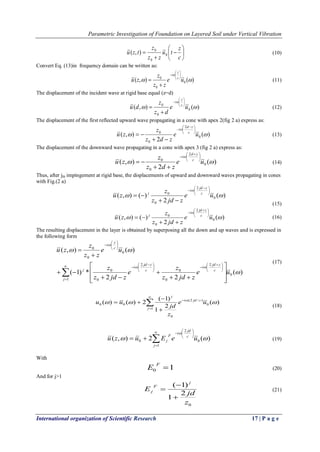
a) EQUATION OF MOTION 1ST
CONE
The translational truncated semi-infinite cone with the apex height 0z and radius 0r is shown for axial
distortion in Fig. 3, which is used to model the vertical degree of freedom. The area A at depth „z‟equals,
000 )/)(( AzzzA  with 2
00 rA  ,where „z‟ is measured from surface of disk. With c denoting the appropriate
wave velocity of compression-extension waves (dilatational waves) and ρ the mass density, ρc2
is equal to
corresponding elastic modulus (constrained modulus). Also, „u‟ represents the axial displacement and „N’ the
axial force. Radial effects are disregarded. the equilibrium equation of an infinite element strip (Fig.3) taking the
inertial loads into account,
0,  udzAdzNNN z
 (6)
Substituting the force-displacement relationship in Equ (6),
zAucN ,2
 (7)
The equation of motion in time domain of translational cone,
0,
2
, 2
0



c
u
u
zz
u zzz

(8)
Which may be written as one-dimensional wave equation in
u 0))((
1
),)(( 020  uzz
c
uzz zz (9) The
displacement amplitude of the incident wave propagating in a cone with apex 1in time domain given below:
z u0
u
P0
r0
z0
1
2(b) cone model for half
space
P0
A
0
r0
dz
N
Z0
z
Apex
1
N+ NZ
dz
A= A0
(Z0+Z)²/Z0²
0u
u
Fig 3 Wave propagation in semi-infinite truncated cone under vertical
harmonic excitation
Parametric Investigation of Foundation on Layered Soil under Vertical Vibration
International organization of Scientific Research 17 | P a g e









c
z
tu
zz
z
tzu 0
0
0
),( (10)
Convert Eq. (13)in frequency domain can be written as:
)(),( 0
0
0


ue
zz
z
zu c
z
i 







 (11)
The displacement of the incident wave at rigid base equal (z=d)
)(),( 0
0
0


ue
dz
z
du c
z
i 







 (12)
The displacement of the first reflected upward wave propagating in a cone with apex 2(fig 2 a) express as:
)(
2
),( 0
2
0
0


ue
zdz
z
zu c
zd
i 




 


 (13)
The displacement of the downward wave propagating in a cone with apex 3 (fig 2 a) express as:
)(
2
),( 0
2
0
0


ue
zdz
z
zu c
zd
i 




 


 (14)
Thus, after jth impingement at rigid base, the displacements of upward and downward waves propagating in cones
with Fig.(2 a)
)(
2
)(),( 0
2
0
0


ue
zjdz
z
zu c
zjd
i
j





 



(15)
)(
2
)(),( 0
2
0
0


ue
zjdz
z
zu c
zjd
i
j





 


 (16)
The resulting displacement in the layer is obtained by superposing all the down and up waves and is expressed in
the following form
)(
22
*)1(
)(),(
0
1
2
0
0
2
0
0
0
0
0




ue
zjdz
z
e
zjdz
z
ue
zz
z
zu
j
c
zjd
i
c
zjd
i
j
c
z
i








 





 






















(17)
(18)
)(2),( 0
2
1
0 

ueEuzu c
jd
i
j
F
j








 (19)
With
10 
F
E (20)
And for j>1
0
2
1
)1(
z
jd
E
j
F
j


 (21)







1
0
)/2(
0
00 )(
2
1
)1(
2)()(
j
cjdi
j
ue
z
jd
uu  
Parametric Investigation of Foundation on Layered Soil under Vertical Vibration
International organization of Scientific Research 18 | P a g e
EF
j can be called as echo constant, the inverse of sum of which gives the static stiffness of the layer normalized
by the static stiffness of the homogeneous half-space with material properties of the layer.
b) DYNAMIC IMPEDANCE
Enforcing boundary condition 00 )( uzzu  to Eq. (11) yields
)()(0 tftu 
(22)
Also, upward force equal downward force
zuAczzNP ,00
2
00 )(  (23)
Differentiating Eq. (11) with respect to „z‟ and substituting its value at 0zz  in Eq. (26), we get
)()()( 000
0
0
2
0 tucAtu
z
Ac
tP 

 (24)
The Eqs. (27) are valid for compressible soil i.e. 3/1 . For incompressible soil, the concept of introducing
trapped mass is enforced.
0
2
0 )()( uCiMKP   (25)
Where
3
0rM  with trapped mass coefficient µ; the values of which recommended by Wolf are given in
Table 1. The trapped mass M is introduced in order to match the stiffness coefficient of the cone model with
rigorous solutions in case of incompressible soil i.e )2/13/1(  . After simplification Eq. (28) reduces to
the form.
Cone Parameters
Parameter Expressions under
Vertical Vibration
Aspect Ratio
0
0
r
z 2
)1(
4 






sc
c


Static stiffness coefficient
K
0
2
0
2
)(
z
rc 
Normalized spring coefficient
)( 0ak
2
02
2
0
0
1 a
c
c
r
z s



Normalized damping coefficient
)( 0ac c
c
r
z s
0
0
Dimensionless frequency 0a
sc
r0
Appropriate wave velocity c pcc  for 3/1
scc 2 for 2/13/1 
where,


21
)1(2


 sp cc
Table 1The parameters of cone model under vertical vibration
Parametric Investigation of Foundation on Layered Soil under Vertical Vibration
International organization of Scientific Research 19 | P a g e
0
0
0
0
2
02
0
2
0
00 1)( u
cr
cz
iaa
cr
cz
KaP ss









(26)
Using Eq. (22) in Eq. (27), the interaction force displacement relationship for the layer-rigid base system reduces
to

















c
jd
i
j
F
j
ss
eE
cr
cz
iaa
cr
cz
K
u
p
aK 2
1
0
0
0
2
02
0
2
0
0
0
0
21
1
)(



(27)
Note: If d/r0 is ‘∞’, then the soil behave like homogeneous soil
In the expression of the dynamic impedance )( 0aK given by Eq. (30), the summation of series over „j‟
is worked out up to a finite term as the displacement amplitude of the waves vanish after a finite number of
impingement. Numerically j is terminated at a value, such that 01.01 
F
jj
F
EE
IV. RESULTS AND DISCUSSIONS
A parameter study is conducted widely varying the influencing parameter such as mass ratio, depth of
the top layer d/r0, material damping ratio and Poisson‟s ratio. The result are presented in the form of
dimensionless graph, which may prove to be useful in understanding the response of foundation resting on
layered and homogeneous soil subjected vertical vibration.
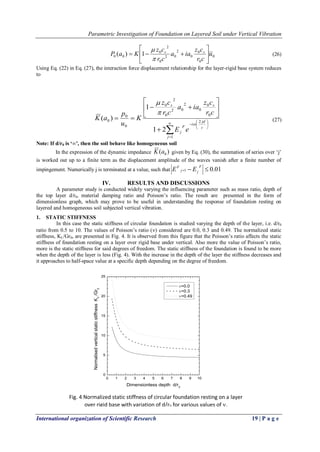
1. STATIC STIFFNESS
In this case the static stiffness of circular foundation is studied varying the depth of the layer, i.e. d/r0
ratio from 0.5 to 10. The values of Poisson‟s ratio () considered are 0.0, 0.3 and 0.49. The normalized static
stiffness, KL/Gr0, are presented in Fig. 4. It is observed from this figure that the Poisson‟s ratio affects the static
stiffness of foundation resting on a layer over rigid base under vertical. Also more the value of Poisson‟s ratio,
more is the static stiffness for said degrees of freedom. The static stiffness of the foundation is found to be more
when the depth of the layer is less (Fig. 4). With the increase in the depth of the layer the stiffness decreases and
it approaches to half-space value at a specific depth depending on the degree of freedom.
0 1 2 3 4 5 6 7 8 9 10
0
5
10
15
20
25
NormalisedverticalstaticstiffnessKV
/Gr0
Dimensionless depth d/r0
=0.0
=0.3
=0.49
Fig. 4 Normalized static stiffness of circular foundation resting on a layer
over rigid base with variation of d/r0 for various values of .
Parametric Investigation of Foundation on Layered Soil under Vertical Vibration
International organization of Scientific Research 20 | P a g e
2. DYNAMIC IMPEDANCE
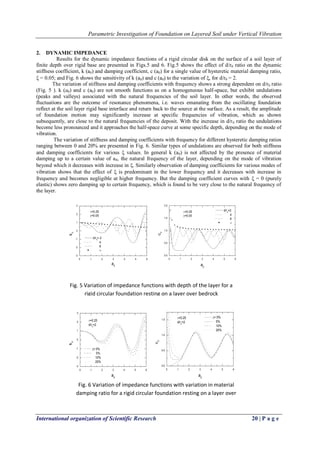
Results for the dynamic impedance functions of a rigid circular disk on the surface of a soil layer of
finite depth over rigid base are presented in Figs.5 and 6. Fig.5 shows the effect of d/r0 ratio on the dynamic
stiffness coefficient, k (a0) and damping coefficient, c (a0) for a single value of hysteretic material damping ratio,
 = 0.05; and Fig. 6 shows the sensitivity of k (a0) and c (a0) to the variation of , for d/r0 = 2.
The variation of stiffness and damping coefficients with frequency shows a strong dependent on d/r0 ratio
(Fig. 5 ). k (a0) and c (a0) are not smooth functions as on a homogeneous half-space, but exhibit undulations
(peaks and valleys) associated with the natural frequencies of the soil layer. In other words, the observed
fluctuations are the outcome of resonance phenomena, i.e. waves emanating from the oscillating foundation
reflect at the soil layer rigid base interface and return back to the source at the surface. As a result, the amplitude
of foundation motion may significantly increase at specific frequencies of vibration, which as shown
subsequently, are close to the natural frequencies of the deposit. With the increase in d/r0 ratio the undulations
become less pronounced and it approaches the half-space curve at some specific depth, depending on the mode of
vibration.
The variation of stiffness and damping coefficients with frequency for different hysteretic damping ratios
ranging between 0 and 20% are presented in Fig. 6. Similar types of undulations are observed for both stiffness
and damping coefficients for various  values. In general k (a0) is not affected by the presence of material
damping up to a certain value of a0, the natural frequency of the layer, depending on the mode of vibration
beyond which it decreases with increase in . Similarly observation of damping coefficients for various modes of
vibration shows that the effect of  is predominant in the lower frequency and it decreases with increase in
frequency and becomes negligible at higher frequency. But the damping coefficient curves with  = 0 (purely
elastic) shows zero damping up to certain frequency, which is found to be very close to the natural frequency of
the layer.
Fig. 5 Variation of impedance functions with depth of the layer for a
rigid circular foundation resting on a layer over bedrock
0 1 2 3 4 5 6
-3
-2
-1
0
1
2
3
=0.25
=0.05
d/r0
= 2
4
6

kV
a0
0 1 2 3 4 5 6
0.0
0.5
1.0
1.5
2.0
=0.25
=0.05
d/r0
=2
4
6

cV
a0
Fig. 6 Variation of impedance functions with variation in material
damping ratio for a rigid circular foundation resting on a layer over
bedrock.
0 1 2 3 4 5 6
0.0
0.5
1.0
1.5
=0.25
d/r0
=2
= 0%
5%
10%
20%
cV
a0
0 1 2 3 4 5 6
-3
-2
-1
0
1
2
3
=0.25
d/r0
=2
= 0%
5%
10%
20%
kV
a0
Parametric Investigation of Foundation on Layered Soil under Vertical Vibration
International organization of Scientific Research 21 | P a g e
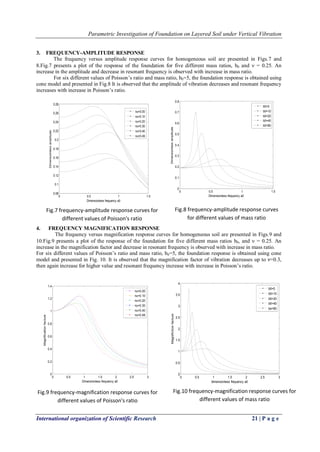
3. FREQUENCY-AMPLITUDE RESPONSE
The frequency versus amplitude response curves for homogeneous soil are presented in Figs.7 and
8.Fig.7 presents a plot of the response of the foundation for five different mass ratios, b0 and  = 0.25. An
increase in the amplitude and decrease in resonant frequency is observed with increase in mass ratio.
For six different values of Poisson‟s ratio and mass ratio, b0=5, the foundation response is obtained using
cone model and presented in Fig.8 It is observed that the amplitude of vibration decreases and resonant frequency
increases with increase in Poisson‟s ratio.
4. FREQUENCY MAGNIFICATION RESPONSE
The frequency versus magnification response curves for homogeneous soil are presented in Figs.9 and
10.Fig.9 presents a plot of the response of the foundation for five different mass ratios b0, and  = 0.25. An
increase in the magnification factor and decrease in resonant frequency is observed with increase in mass ratio.
For six different values of Poisson‟s ratio and mass ratio, b0=5, the foundation response is obtained using cone
model and presented in Fig. 10. It is observed that the magnification factor of vibration decreases up to 𝜈=0.3,
then again increase for higher value and resonant frequency increase with increase in Poisson‟s ratio.
0 0.5 1 1.5
0
0.1
0.2
0.3
0.4
0.5
0.6
0.7
0.8
Dimensionless frequency a0
Dimensionlessamplitude
b0=5
b0=10
b0=20
b0=40
b0=80
0 0.5 1 1.5 2 2.5 3
0
0.5
1
1.5
2
2.5
3
3.5
4
dimensionless frequency a0
Magnifictionfacture
b0=5
b0=10
b0=20
b0=40
bo=80
0 0.5 1 1.5
0.08
0.1
0.12
0.14
0.16
0.18
0.2
0.22
0.24
0.26
0.28
Dimensionless frequency a0
Dimensionlessamplitude
nu=0.00
nu=0.10
nu=0.20
nu=0.30
nu=0.40
nu=0.49
Fig.7 frequency-amplitude response curves for
different values of Poisson's ratio
Fig.8 frequency-amplitude response curves
for different values of mass ratio
0 0.5 1 1.5 2 2.5 3
0
0.2
0.4
0.6
0.8
1
1.2
1.4
Dimensionless frequency a0
Magnificationfacture
nu=0.00
nu=0.10
nu=0.20
nu=0.30
nu=0.40
nu=0.49
Fig.9 frequency-magnification response curves for
different values of Poisson's ratio
Fig.10 frequency-magnification response curves for
different values of mass ratio
Parametric Investigation of Foundation on Layered Soil under Vertical Vibration
International organization of Scientific Research 22 | P a g e
V. CONCLUSION
In contrast to rigorous methods, which address the very complicated wave pattern consisting of body
waves and generalized surface waves working in wave number domain, the proposed method based on wave
propagation in cones considers only one type of body wave depending on the mode of vibration i.e., dilatational
wave for the vertical degree of freedom. The sectional property of the cones increases in the direction of wave
propagation downwards as well as upwards. Based on the parametric studies, the following conclusions can be
drawn.
a. More the value of Poisson‟s ratio, more is the static stiffness.
b. With increase in the depth of the layer the static stiffness decreases.
c. With increase in Poisson‟s ratio, the resonant frequency decreases, but dynamic stiffness co-efficient remains
unchanged for homogeneous soil.
d. The resonant amplitude decreases and resonant frequency increases with increase in Poisson‟s ratio.
e. With increase in mass ratio, the resonant frequency decreases and resonant amplitude increases.
f. With increase in the mass ratio, magnification factor increases and resonant frequency decrease.
Result of parametric study presented in the form of dimensionless graph provide a clear understanding of the
vertical dynamic response of the foundation resting on soil layer underlain by rigid base.
REFERENCES
[1] Chen, S. and Shi, J.(2006). “Simplified Model for vertical vibrations of surface foundations.” Journal of
Geotechnical and Geoenvironmental Engineering, Vol.132, No. 5, 651- 655.
[2] Gazetas, G. (1983). “Analysis of machine foundation vibrations: state of the art.” J. Soil Dynamics and
Earthquake Engrg., 2, 2-42.
[3] Gazetas, G. (1991). “Formulae and charts for impedances of surface and embedded foundations.” J.
Geotech. Engrg., ASCE, 117(9), 1363-1381.
[4] Laing, V.C.(1974) “Dynamic response of structures in layered soils”, in R74-10. Department of Civil
Engineering, Massachusetts Institute of Technology, Cambridge MA.
[5] Lamb, H. (1904). “On the propagation of tremors over the surface of an elastic solid.” Philosophical
Transactions of the Royal Society of London, A203, 1-42.
[6] Luco, J. E. and Mita, A. (1987). “Response of a circular foundation on a uniform half-space to elastic
waves”, Earthquake Engng and Struct Dyn, 15, 105-118.
[7] Lysmer J, Wass G.(1972) “Shear waves in plane infinite structures”. Journal of Engineering Mechanics,
ASCE ;98:85–105.
[8] Lysmer J,(1975) et al. “Efficient finite element analysis of seismic soil structure interaction”, in Report:
EERC-75-34. Earthquake Engineering Research Cen- ter, University of California, Berkeley, C.A.
[9] Lysmer, J, Kuhlemeyer, R.L.(1969) “Finite dynamic model for infinite media”. Journal of Engineering
Mechanics Division, ASCE ;95(4):759–877.
[10] Meek J.W, Wolf J.P.(1992) “Cone models for soil layer on rigid rock”. J Geotech Engng Div ASCE
;118(5):686–703.
[11] Meek J.W, Wolf J.P.(1994) “Cone models for an embedded foundation”. J Geotech Engng Div ASCE
;120:60–80.
[12] Meek, J.W., and Wolf, J.P. (1992). “Cone models for homogeneous soil.” J. Geotech. Engrg. Div., ASCE,
118(5), 667-685.
[13] Pradhan, P. K., Baidya, D. K. and Ghosh D. P. (2004). “Dynamic response of foundations resting on
layered soil by cone model”, Journal of Soil Dynamics and Earthquake Engineering, Vol. 24 (6), 425-434
[14] Pradhan , p. k., Mandal, A. ,Baidya ,D. K., Ghosh, D. P. (2008) “Dynamic Response of Machine
Foundation On Layered Soil: Cone Model Versus Excremental” , Journal of Geotech Geoi Engineering ,
Vol 26,453-468.
[15] Quinlan P.M(1953) “The Elastic Theory of Soil Dynamic”ASTM Special Technical publication ,No 156
,Symposion on Soil Dynamic,3-34.
[16] Reissner, E (1936) “Stationary and axially symmetrical vibrations of a Homogeneous Elastic Half-Space
Caused by a Vibrating Mass,Ing, Archiv”, Band VII,281-396.
[17] Reissner. E and Sagoci H.F (1944) “Forced torsional Oscillation of an Elastic Half Space”J of APPL.Phys
,Vol.15,652-662
[18] Richart, F. E. Jr., Hall, J. R. Jr., and Woods, R. D. (1970). “Vibrations of soils and foundations.” Prentice-
Hall, Inc. Englewood Cliffs, New Jersey.
[19] Sung .T.Y (1953) “Vibration in Semi-infinite Solid due to Periodic Surface Loading”, ASTM Special
Technical Publication ,no 158 ,Symposion on Soil Dynamic ,July,35-64.
[20] Warburton GB. “Forced vibration of a body on an elastic stratum”. J Appl Mech, Trans ASME 1957;55–8

C04731328

  • 1.
    IOSR Journal ofEngineering (IOSRJEN) www.iosrjen.org ISSN (e): 2250-3021, ISSN (p): 2278-8719 Vol. 04, Issue 07 (July. 2014), ||V3|| PP 13-22 International organization of Scientific Research 13 | P a g e Parametric Investigation of Foundation on Layered Soil under Vertical Vibration S. N. Swar , P. K. Pradhan **, B. P. Mishra *** Assistant professor, Department of Civil Engineering, Hi-tech Institute of Technology, Bhubaneswar, INDIA- 752057, **Professor & Head, Department of Civil Engineering, V. S. S. University of Technology, Burla, Sambalpur, INDIA-768018 ***Research Scholar, Department of Civil Engineering, National Institute of Technology, Rourkela, INDIA, Abstract: - The paper presents the parametric investigation of foundation on layered soil underlain by a rigid base subjected to vertical vibration are found out using one-dimensional wave propagation in cone,based on the strength of material approach. The stiffness and damping co-efficient for a rigid massless circular foundation resting on layered half-space and homogeneous half-space, under vertical vibration are evaluated using various parameter such as, depth of the layer, material damping ratio, Poisson‟s ratio. The static stiffness predicted by the model for different depth layer is evaluated using three value of Poisson‟s ratio. The resonant frequency- amplitude and frequency-magnification are also studied varying the influencing parameter such as, mass ratio, Poisson‟s ratio. Keyword- Cone model, Dynamic impedance, Circular foundation, one-dimensional wave propagation, Foundation vibration I. INTRODUCTION Foundation may be subjected to either static load (or) combination of static and dynamic loads; the latter lead to motion in the soil and mutual dynamic interaction of the foundation and the soil. The design of machine foundation involves a systematic application of the principles of soil engineering, soil dynamic and theory of vibration. The source of dynamic force are numerous, so to determination of resonant frequency and resonant amplitude of foundation has been subjected to considerable interest in the recent year, in relation to the design of machine foundation , as well as the seismic design of important massive structure such as nuclear power plant. The study of the dynamic response of foundations resting on soil subjected to various mode of vibration is an important aspect in the design of machine foundations and dynamic soil-structure interaction problem. The solution of the “dynamic Boussinesq” problem of Lamb(1904) formed the basis for the study of oscillation of footings resting on a half-space (Reissner(1936) ; Sung(1953) ; Richart(1970) et al. ). Reissner(1936) developed the first analytical solution for a vertically loaded cylindrical disk on elastic half-space assuming uniform stress distribution under the footing. Later, extending Reissner‟s(1936)solution, many investigators (Bycroft(1956), Lysmer (1972)and Richard(1970),Wolf(1994) ,Luco and Mita(1987) , Pradhan(2004,2008) to name a few) studied different modes of vibrations with different contact stress distributions. Gazetas(1983,1991 )presented simple formulas for dynamic impedance co-efficient for both surface and embedded foundations for various modes of vibration. The cone model was originally developed by Ehlers (1942) to represent a surface disc under translational motions and later for rotational motion (Meek and Veletsos, 1974; Veletsos and Nair, 1974). Meek and Wolf presented a simplified methodology to evaluate the dynamic response of a base mat on the surface of a homogeneous half-space. The cone model concept was extended to a layered cone to compute the dynamic response of a footing or a base mat on a soil layer resting on a rigid rock. Meek and wolf (1994) performed dynamic analysis of embedded footing by idealizing the soil as a translated cone instead of elastic half-space. Wolf and Meek (1994) have found out the dynamic stiffness coefficients of foundations resting on or embedded in a horizontally layered soil using cone frustums. Also, Jaya and Prasad (2002) studied the dynamic stiffness of embedded foundations in layered soil using the same cone frustums. The major drawback of cone frustums method as reported by Wolf and Meek (1994)is that the damping coefficient can become negative at lower frequency, which is physically impossible. Pradhan et al(2003,2004)have computed dynamic impedance of circular foundation resting on layered soil using wave propagation in cones, which overcomes the drawback of the above cone frustum method.
  • 2.
    Parametric Investigation ofFoundation on Layered Soil under Vertical Vibration International organization of Scientific Research 14 | P a g e . Therefore a number of simplified approximate methods have been developed along with the exact solutions. Cone model is one of such approximate analytical methods, where in elastic half-space is truncated into a semi-infinite cone and the principle of one-dimensional wave propagation through this cone (Beam with varying cross-section) is considered. In this paper studies the parametric investigation of foundation resting on layer underlain by rigid base under vertical vibration is found out using wave propagation in cone , varying widely the parameter like mass ratio, Poisson‟s ratio, depth of the layer, material damping ratio. II. MATHMATICAL FORMULATION To study the dynamic response of foundation resting on the surface of a soil layer underlain by rigid base, a rigid mass less foundation of radius r0 is subjected to vertical vibration shown (Fig .1a).The l depth of the layer „d‟ has the shear modulus „G‟, Poisson‟s ratio „𝜈‟,mass density „𝝆‟,hysteretic damping „𝝃‟.The interaction force P0 and the corresponding displacement U0 are assumed to be harmonic . The dynamic impedance of the massless foundation (disc) is expressed by: )]()([)( 000 0 0 0 aciaakK u P aK  (1) )( 0aK Dynamic impedance, )( 0ak = spring coefficient, )( 0ac = damping coefficient, scra /00  =dimensionless frequency, Gcs  shear wave velocity of the soil, 1 4 0Gr =Static stiffness coefficient of disc on homogeneous half space with material properties of the layer. The effects of hysteretic material damping is isolated using an alternate expression to Eq. (1) for dynamic impedance )21)](()([)( 000 0 0 0 iaciaakK u P aK  (2) Using the equations of dynamic equilibrium, the dynamic displacement amplitude of the foundation with mass m and subjected to a vertical harmonic force Q is expressed as ])()([ 2 0000 0 BaaciaakK Q u   (3) Where, 0u = dynamic displacement amplitude under the foundation resting on the homogeneous soil half-space. Q force amplitude and 0 0 b K Gr B  , with 3 0 0 r m b   , the mass ratio. Dynamic displacement amplitude given in Eq. (3) can be expressed in the non-dimensional form as given below, 12 0000 000 )()([   BaaciaakK K Gr Q Gru (4) Magnification factor i.e. the ratio of dynamic displacement to the static displacement is expressed by
  • 3.
    Parametric Investigation ofFoundation on Layered Soil under Vertical Vibration International organization of Scientific Research 15 | P a g e 12 0000 0 ])()([ /   Baaciaak KQ u M (5) III. CONE MODEL FOR VERTICAL TRANSLATION The theory of wave propagation in a semi-infinite truncated cone is presented based on strength of material approach. Fig (2 a) shows wave propagation in cones beneath the disk of radius r0 resting on a layer underlain by a rigid base under vertical harmonic excitation, P0. Let the displacement of the (truncated semi- infinite) cone be denoted as u with the value u0 under the disk (fig 2 b), modeling a disk with same load P0 on a homogeneous half space with the material properties of the layer. This displacement u0 is used to generate the displacement of the layer u with its value at surface, u0.Thus, can also be called as the generating function. When foundation subjected vertical vibration, wave is generated below base of the foundation and propagating down ward to the soil in the shape of cone. The first wave generated below the base foundation and propagating downward in a cone with apex 1is called as incident wave and its cone will be the same as that of the half-space, as the wave generated beneath the disk does not know if at a specific depth a rigid interface is encountered or not. Thus, the aspect ratio defined by the ratio of the height of cone from its apex to the radius is made equal for cone of the half-space and first cone of the layer. Since the incident wave and subsequent reflected waves propagate in the same medium in layer, the aspect ratio of the corresponding cones will be same. From the geometry, knowing the height of the first cone, the heights of other cones corresponding to subsequent upward and downward reflected waves are found as shown in Fig. 2 (a).
  • 4.
    Parametric Investigation ofFoundation on Layered Soil under Vertical Vibration International organization of Scientific Research 16 | P a g e a) EQUATION OF MOTION 1ST CONE The translational truncated semi-infinite cone with the apex height 0z and radius 0r is shown for axial distortion in Fig. 3, which is used to model the vertical degree of freedom. The area A at depth „z‟equals, 000 )/)(( AzzzA  with 2 00 rA  ,where „z‟ is measured from surface of disk. With c denoting the appropriate wave velocity of compression-extension waves (dilatational waves) and ρ the mass density, ρc2 is equal to corresponding elastic modulus (constrained modulus). Also, „u‟ represents the axial displacement and „N’ the axial force. Radial effects are disregarded. the equilibrium equation of an infinite element strip (Fig.3) taking the inertial loads into account, 0,  udzAdzNNN z  (6) Substituting the force-displacement relationship in Equ (6), zAucN ,2  (7) The equation of motion in time domain of translational cone, 0, 2 , 2 0    c u u zz u zzz  (8) Which may be written as one-dimensional wave equation in u 0))(( 1 ),)(( 020  uzz c uzz zz (9) The displacement amplitude of the incident wave propagating in a cone with apex 1in time domain given below: z u0 u P0 r0 z0 1 2(b) cone model for half space P0 A 0 r0 dz N Z0 z Apex 1 N+ NZ dz A= A0 (Z0+Z)²/Z0² 0u u Fig 3 Wave propagation in semi-infinite truncated cone under vertical harmonic excitation
  • 5.
    Parametric Investigation ofFoundation on Layered Soil under Vertical Vibration International organization of Scientific Research 17 | P a g e          c z tu zz z tzu 0 0 0 ),( (10) Convert Eq. (13)in frequency domain can be written as: )(),( 0 0 0   ue zz z zu c z i          (11) The displacement of the incident wave at rigid base equal (z=d) )(),( 0 0 0   ue dz z du c z i          (12) The displacement of the first reflected upward wave propagating in a cone with apex 2(fig 2 a) express as: )( 2 ),( 0 2 0 0   ue zdz z zu c zd i           (13) The displacement of the downward wave propagating in a cone with apex 3 (fig 2 a) express as: )( 2 ),( 0 2 0 0   ue zdz z zu c zd i           (14) Thus, after jth impingement at rigid base, the displacements of upward and downward waves propagating in cones with Fig.(2 a) )( 2 )(),( 0 2 0 0   ue zjdz z zu c zjd i j           (15) )( 2 )(),( 0 2 0 0   ue zjdz z zu c zjd i j           (16) The resulting displacement in the layer is obtained by superposing all the down and up waves and is expressed in the following form )( 22 *)1( )(),( 0 1 2 0 0 2 0 0 0 0 0     ue zjdz z e zjdz z ue zz z zu j c zjd i c zjd i j c z i                                        (17) (18) )(2),( 0 2 1 0   ueEuzu c jd i j F j          (19) With 10  F E (20) And for j>1 0 2 1 )1( z jd E j F j    (21)        1 0 )/2( 0 00 )( 2 1 )1( 2)()( j cjdi j ue z jd uu  
  • 6.
    Parametric Investigation ofFoundation on Layered Soil under Vertical Vibration International organization of Scientific Research 18 | P a g e EF j can be called as echo constant, the inverse of sum of which gives the static stiffness of the layer normalized by the static stiffness of the homogeneous half-space with material properties of the layer. b) DYNAMIC IMPEDANCE Enforcing boundary condition 00 )( uzzu  to Eq. (11) yields )()(0 tftu  (22) Also, upward force equal downward force zuAczzNP ,00 2 00 )(  (23) Differentiating Eq. (11) with respect to „z‟ and substituting its value at 0zz  in Eq. (26), we get )()()( 000 0 0 2 0 tucAtu z Ac tP    (24) The Eqs. (27) are valid for compressible soil i.e. 3/1 . For incompressible soil, the concept of introducing trapped mass is enforced. 0 2 0 )()( uCiMKP   (25) Where 3 0rM  with trapped mass coefficient µ; the values of which recommended by Wolf are given in Table 1. The trapped mass M is introduced in order to match the stiffness coefficient of the cone model with rigorous solutions in case of incompressible soil i.e )2/13/1(  . After simplification Eq. (28) reduces to the form. Cone Parameters Parameter Expressions under Vertical Vibration Aspect Ratio 0 0 r z 2 )1( 4        sc c   Static stiffness coefficient K 0 2 0 2 )( z rc  Normalized spring coefficient )( 0ak 2 02 2 0 0 1 a c c r z s    Normalized damping coefficient )( 0ac c c r z s 0 0 Dimensionless frequency 0a sc r0 Appropriate wave velocity c pcc  for 3/1 scc 2 for 2/13/1  where,   21 )1(2    sp cc Table 1The parameters of cone model under vertical vibration
  • 7.
    Parametric Investigation ofFoundation on Layered Soil under Vertical Vibration International organization of Scientific Research 19 | P a g e 0 0 0 0 2 02 0 2 0 00 1)( u cr cz iaa cr cz KaP ss          (26) Using Eq. (22) in Eq. (27), the interaction force displacement relationship for the layer-rigid base system reduces to                  c jd i j F j ss eE cr cz iaa cr cz K u p aK 2 1 0 0 0 2 02 0 2 0 0 0 0 21 1 )(    (27) Note: If d/r0 is ‘∞’, then the soil behave like homogeneous soil In the expression of the dynamic impedance )( 0aK given by Eq. (30), the summation of series over „j‟ is worked out up to a finite term as the displacement amplitude of the waves vanish after a finite number of impingement. Numerically j is terminated at a value, such that 01.01  F jj F EE IV. RESULTS AND DISCUSSIONS A parameter study is conducted widely varying the influencing parameter such as mass ratio, depth of the top layer d/r0, material damping ratio and Poisson‟s ratio. The result are presented in the form of dimensionless graph, which may prove to be useful in understanding the response of foundation resting on layered and homogeneous soil subjected vertical vibration. 1. STATIC STIFFNESS In this case the static stiffness of circular foundation is studied varying the depth of the layer, i.e. d/r0 ratio from 0.5 to 10. The values of Poisson‟s ratio () considered are 0.0, 0.3 and 0.49. The normalized static stiffness, KL/Gr0, are presented in Fig. 4. It is observed from this figure that the Poisson‟s ratio affects the static stiffness of foundation resting on a layer over rigid base under vertical. Also more the value of Poisson‟s ratio, more is the static stiffness for said degrees of freedom. The static stiffness of the foundation is found to be more when the depth of the layer is less (Fig. 4). With the increase in the depth of the layer the stiffness decreases and it approaches to half-space value at a specific depth depending on the degree of freedom. 0 1 2 3 4 5 6 7 8 9 10 0 5 10 15 20 25 NormalisedverticalstaticstiffnessKV /Gr0 Dimensionless depth d/r0 =0.0 =0.3 =0.49 Fig. 4 Normalized static stiffness of circular foundation resting on a layer over rigid base with variation of d/r0 for various values of .
  • 8.
    Parametric Investigation ofFoundation on Layered Soil under Vertical Vibration International organization of Scientific Research 20 | P a g e 2. DYNAMIC IMPEDANCE Results for the dynamic impedance functions of a rigid circular disk on the surface of a soil layer of finite depth over rigid base are presented in Figs.5 and 6. Fig.5 shows the effect of d/r0 ratio on the dynamic stiffness coefficient, k (a0) and damping coefficient, c (a0) for a single value of hysteretic material damping ratio,  = 0.05; and Fig. 6 shows the sensitivity of k (a0) and c (a0) to the variation of , for d/r0 = 2. The variation of stiffness and damping coefficients with frequency shows a strong dependent on d/r0 ratio (Fig. 5 ). k (a0) and c (a0) are not smooth functions as on a homogeneous half-space, but exhibit undulations (peaks and valleys) associated with the natural frequencies of the soil layer. In other words, the observed fluctuations are the outcome of resonance phenomena, i.e. waves emanating from the oscillating foundation reflect at the soil layer rigid base interface and return back to the source at the surface. As a result, the amplitude of foundation motion may significantly increase at specific frequencies of vibration, which as shown subsequently, are close to the natural frequencies of the deposit. With the increase in d/r0 ratio the undulations become less pronounced and it approaches the half-space curve at some specific depth, depending on the mode of vibration. The variation of stiffness and damping coefficients with frequency for different hysteretic damping ratios ranging between 0 and 20% are presented in Fig. 6. Similar types of undulations are observed for both stiffness and damping coefficients for various  values. In general k (a0) is not affected by the presence of material damping up to a certain value of a0, the natural frequency of the layer, depending on the mode of vibration beyond which it decreases with increase in . Similarly observation of damping coefficients for various modes of vibration shows that the effect of  is predominant in the lower frequency and it decreases with increase in frequency and becomes negligible at higher frequency. But the damping coefficient curves with  = 0 (purely elastic) shows zero damping up to certain frequency, which is found to be very close to the natural frequency of the layer. Fig. 5 Variation of impedance functions with depth of the layer for a rigid circular foundation resting on a layer over bedrock 0 1 2 3 4 5 6 -3 -2 -1 0 1 2 3 =0.25 =0.05 d/r0 = 2 4 6  kV a0 0 1 2 3 4 5 6 0.0 0.5 1.0 1.5 2.0 =0.25 =0.05 d/r0 =2 4 6  cV a0 Fig. 6 Variation of impedance functions with variation in material damping ratio for a rigid circular foundation resting on a layer over bedrock. 0 1 2 3 4 5 6 0.0 0.5 1.0 1.5 =0.25 d/r0 =2 = 0% 5% 10% 20% cV a0 0 1 2 3 4 5 6 -3 -2 -1 0 1 2 3 =0.25 d/r0 =2 = 0% 5% 10% 20% kV a0
  • 9.
    Parametric Investigation ofFoundation on Layered Soil under Vertical Vibration International organization of Scientific Research 21 | P a g e 3. FREQUENCY-AMPLITUDE RESPONSE The frequency versus amplitude response curves for homogeneous soil are presented in Figs.7 and 8.Fig.7 presents a plot of the response of the foundation for five different mass ratios, b0 and  = 0.25. An increase in the amplitude and decrease in resonant frequency is observed with increase in mass ratio. For six different values of Poisson‟s ratio and mass ratio, b0=5, the foundation response is obtained using cone model and presented in Fig.8 It is observed that the amplitude of vibration decreases and resonant frequency increases with increase in Poisson‟s ratio. 4. FREQUENCY MAGNIFICATION RESPONSE The frequency versus magnification response curves for homogeneous soil are presented in Figs.9 and 10.Fig.9 presents a plot of the response of the foundation for five different mass ratios b0, and  = 0.25. An increase in the magnification factor and decrease in resonant frequency is observed with increase in mass ratio. For six different values of Poisson‟s ratio and mass ratio, b0=5, the foundation response is obtained using cone model and presented in Fig. 10. It is observed that the magnification factor of vibration decreases up to 𝜈=0.3, then again increase for higher value and resonant frequency increase with increase in Poisson‟s ratio. 0 0.5 1 1.5 0 0.1 0.2 0.3 0.4 0.5 0.6 0.7 0.8 Dimensionless frequency a0 Dimensionlessamplitude b0=5 b0=10 b0=20 b0=40 b0=80 0 0.5 1 1.5 2 2.5 3 0 0.5 1 1.5 2 2.5 3 3.5 4 dimensionless frequency a0 Magnifictionfacture b0=5 b0=10 b0=20 b0=40 bo=80 0 0.5 1 1.5 0.08 0.1 0.12 0.14 0.16 0.18 0.2 0.22 0.24 0.26 0.28 Dimensionless frequency a0 Dimensionlessamplitude nu=0.00 nu=0.10 nu=0.20 nu=0.30 nu=0.40 nu=0.49 Fig.7 frequency-amplitude response curves for different values of Poisson's ratio Fig.8 frequency-amplitude response curves for different values of mass ratio 0 0.5 1 1.5 2 2.5 3 0 0.2 0.4 0.6 0.8 1 1.2 1.4 Dimensionless frequency a0 Magnificationfacture nu=0.00 nu=0.10 nu=0.20 nu=0.30 nu=0.40 nu=0.49 Fig.9 frequency-magnification response curves for different values of Poisson's ratio Fig.10 frequency-magnification response curves for different values of mass ratio
  • 10.
    Parametric Investigation ofFoundation on Layered Soil under Vertical Vibration International organization of Scientific Research 22 | P a g e V. CONCLUSION In contrast to rigorous methods, which address the very complicated wave pattern consisting of body waves and generalized surface waves working in wave number domain, the proposed method based on wave propagation in cones considers only one type of body wave depending on the mode of vibration i.e., dilatational wave for the vertical degree of freedom. The sectional property of the cones increases in the direction of wave propagation downwards as well as upwards. Based on the parametric studies, the following conclusions can be drawn. a. More the value of Poisson‟s ratio, more is the static stiffness. b. With increase in the depth of the layer the static stiffness decreases. c. With increase in Poisson‟s ratio, the resonant frequency decreases, but dynamic stiffness co-efficient remains unchanged for homogeneous soil. d. The resonant amplitude decreases and resonant frequency increases with increase in Poisson‟s ratio. e. With increase in mass ratio, the resonant frequency decreases and resonant amplitude increases. f. With increase in the mass ratio, magnification factor increases and resonant frequency decrease. Result of parametric study presented in the form of dimensionless graph provide a clear understanding of the vertical dynamic response of the foundation resting on soil layer underlain by rigid base. REFERENCES [1] Chen, S. and Shi, J.(2006). “Simplified Model for vertical vibrations of surface foundations.” Journal of Geotechnical and Geoenvironmental Engineering, Vol.132, No. 5, 651- 655. [2] Gazetas, G. (1983). “Analysis of machine foundation vibrations: state of the art.” J. Soil Dynamics and Earthquake Engrg., 2, 2-42. [3] Gazetas, G. (1991). “Formulae and charts for impedances of surface and embedded foundations.” J. Geotech. Engrg., ASCE, 117(9), 1363-1381. [4] Laing, V.C.(1974) “Dynamic response of structures in layered soils”, in R74-10. Department of Civil Engineering, Massachusetts Institute of Technology, Cambridge MA. [5] Lamb, H. (1904). “On the propagation of tremors over the surface of an elastic solid.” Philosophical Transactions of the Royal Society of London, A203, 1-42. [6] Luco, J. E. and Mita, A. (1987). “Response of a circular foundation on a uniform half-space to elastic waves”, Earthquake Engng and Struct Dyn, 15, 105-118. [7] Lysmer J, Wass G.(1972) “Shear waves in plane infinite structures”. Journal of Engineering Mechanics, ASCE ;98:85–105. [8] Lysmer J,(1975) et al. “Efficient finite element analysis of seismic soil structure interaction”, in Report: EERC-75-34. Earthquake Engineering Research Cen- ter, University of California, Berkeley, C.A. [9] Lysmer, J, Kuhlemeyer, R.L.(1969) “Finite dynamic model for infinite media”. Journal of Engineering Mechanics Division, ASCE ;95(4):759–877. [10] Meek J.W, Wolf J.P.(1992) “Cone models for soil layer on rigid rock”. J Geotech Engng Div ASCE ;118(5):686–703. [11] Meek J.W, Wolf J.P.(1994) “Cone models for an embedded foundation”. J Geotech Engng Div ASCE ;120:60–80. [12] Meek, J.W., and Wolf, J.P. (1992). “Cone models for homogeneous soil.” J. Geotech. Engrg. Div., ASCE, 118(5), 667-685. [13] Pradhan, P. K., Baidya, D. K. and Ghosh D. P. (2004). “Dynamic response of foundations resting on layered soil by cone model”, Journal of Soil Dynamics and Earthquake Engineering, Vol. 24 (6), 425-434 [14] Pradhan , p. k., Mandal, A. ,Baidya ,D. K., Ghosh, D. P. (2008) “Dynamic Response of Machine Foundation On Layered Soil: Cone Model Versus Excremental” , Journal of Geotech Geoi Engineering , Vol 26,453-468. [15] Quinlan P.M(1953) “The Elastic Theory of Soil Dynamic”ASTM Special Technical publication ,No 156 ,Symposion on Soil Dynamic,3-34. [16] Reissner, E (1936) “Stationary and axially symmetrical vibrations of a Homogeneous Elastic Half-Space Caused by a Vibrating Mass,Ing, Archiv”, Band VII,281-396. [17] Reissner. E and Sagoci H.F (1944) “Forced torsional Oscillation of an Elastic Half Space”J of APPL.Phys ,Vol.15,652-662 [18] Richart, F. E. Jr., Hall, J. R. Jr., and Woods, R. D. (1970). “Vibrations of soils and foundations.” Prentice- Hall, Inc. Englewood Cliffs, New Jersey. [19] Sung .T.Y (1953) “Vibration in Semi-infinite Solid due to Periodic Surface Loading”, ASTM Special Technical Publication ,no 158 ,Symposion on Soil Dynamic ,July,35-64. [20] Warburton GB. “Forced vibration of a body on an elastic stratum”. J Appl Mech, Trans ASME 1957;55–8