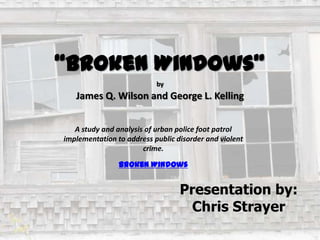
“Broken Windows”
by

James Q. Wilson and George L. Kelling
A study and analysis of urban police foot patrol
implementation to address public disorder and violent
crime.
Broken Windows

Presentation by:
Chris Strayer
Wilson & Kelling’s
Hypothesis heightened social
Concentrated community policing of perceived
disorder in impoverished urban areas would improve the residents’
perceptions of improved quality of life. As a consequence, by
maintaining order, more violent crimes would be prevented.

Wilson and Kelling seem to be responding to the idea of Durkheim’s
conception of anomie.
fixing broken windows + on-foot policing to prevent disorder=
maintenance of social norms

Durkheim’s work on anomie suggests that Wilson & Kelling should
expect that individuals’ behaviors and passions to be regulated by the
social norms provided in the environment, thereby prevent more
harmful crimes.
Methodology
 Philip Zombardo –experiments on vandalism
“vandalism can occur anywhere once communal barriers – the
sense of mutual regard and the obligation of civility – are
lowered by actions that seem to signal that ‘no one cares’” (p.31)
 Premise that one of people’s greatest fears is being “bothered
by disorderly people” (p. 30) + conceptual framework that
individuals will conform to societally established norms, if
these norms are signaled within the environment.
 Wilson & Kelling utilized first hand
observation, interviews, and surveys to collect data.
Key Concepts
• Fear stems from confrontation with incivility, which
leads to avoidance thereby weakening social controls
(p.33)
• Differentiation of “regulars” from “strangers”
 Regulars = “decent folk” or those “who knew their place
(p. 30)
 Strangers = foot patrolman’s jobs “to keep an eye on
strangers” to ensure widely understood rules were
observed (p.30)
 “Persons who broke the informal rules, especially those
who bothered people *…} were arrested for vagrancy.
Noisy teenagers were told to keep quiet.” (p.30)
Key Concepts (cont.)
• Social norms of the environment were defined and
enforced collaboratively – police & “regulars”

 “The people of Newark *…+ assign a high value to
public order, and feel relieved and reassured
when the police help them maintain that order”
(p. 31).
• Within the community – disorder is perceived to be
sequentially linked to crime

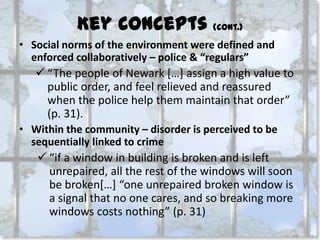
 “if a window in building is broken and is left
unrepaired, all the rest of the windows will soon
be broken*…+ “one unrepaired broken window is
a signal that no one cares, and so breaking more
windows costs nothing” (p. 31)
Conclusion: Police Central to
Maintaining Order

• “The essence of the police role is maintaining order is to reinforce the
informal control mechanisms of the community itself” (p. 34).
• “We must return to our long abandoned view that the police ought to
protect communities as well as individuals [and recognize] the
importance of maintaining, intact, communities without broken
windows” (p. 38).

Implications of Broken Window
Theory
• Extensive application by criminal justice departments in large urban
areas, such as New York City and Albuquerque
• Action research conducted in educational institutions and real estate
settings
• Criticisms: promotes overly aggressive policing (zero tolerance)
(Sridhar), racial and economic biases (Sampson &
Raudenbush, 2004), potentially fallacious relations between correlation
and causality (Thacher, 2004).
Additional Credits
Sampson, R. J., & Raudenbush, S. W. (2004). Seeing Disorder: Neighborhood Stigma and the
Social Construction of “Broken Windows”. Social Psychology Quarterly, 67(4), 319-342.

Sridhar, C.R. (13-19). "Broken Windows and Zero Tolerance: Policing Urban Crimes". Economic
and Political Weekly 41 (19): 1841–1843.
Thacher, David. (2004) "Order Maintenance Reconsidered”

Wilson & Kelling's "Broken Windows" Analysis - C Strayer

  • 1.
    “Broken Windows” by James Q.Wilson and George L. Kelling A study and analysis of urban police foot patrol implementation to address public disorder and violent crime. Broken Windows Presentation by: Chris Strayer
  • 2.
    Wilson & Kelling’s Hypothesisheightened social Concentrated community policing of perceived disorder in impoverished urban areas would improve the residents’ perceptions of improved quality of life. As a consequence, by maintaining order, more violent crimes would be prevented. Wilson and Kelling seem to be responding to the idea of Durkheim’s conception of anomie. fixing broken windows + on-foot policing to prevent disorder= maintenance of social norms Durkheim’s work on anomie suggests that Wilson & Kelling should expect that individuals’ behaviors and passions to be regulated by the social norms provided in the environment, thereby prevent more harmful crimes.
  • 3.
    Methodology  Philip Zombardo–experiments on vandalism “vandalism can occur anywhere once communal barriers – the sense of mutual regard and the obligation of civility – are lowered by actions that seem to signal that ‘no one cares’” (p.31)  Premise that one of people’s greatest fears is being “bothered by disorderly people” (p. 30) + conceptual framework that individuals will conform to societally established norms, if these norms are signaled within the environment.  Wilson & Kelling utilized first hand observation, interviews, and surveys to collect data.
  • 4.
    Key Concepts • Fearstems from confrontation with incivility, which leads to avoidance thereby weakening social controls (p.33) • Differentiation of “regulars” from “strangers”  Regulars = “decent folk” or those “who knew their place (p. 30)  Strangers = foot patrolman’s jobs “to keep an eye on strangers” to ensure widely understood rules were observed (p.30)  “Persons who broke the informal rules, especially those who bothered people *…} were arrested for vagrancy. Noisy teenagers were told to keep quiet.” (p.30)
  • 5.
    Key Concepts (cont.) •Social norms of the environment were defined and enforced collaboratively – police & “regulars”  “The people of Newark *…+ assign a high value to public order, and feel relieved and reassured when the police help them maintain that order” (p. 31). • Within the community – disorder is perceived to be sequentially linked to crime  “if a window in building is broken and is left unrepaired, all the rest of the windows will soon be broken*…+ “one unrepaired broken window is a signal that no one cares, and so breaking more windows costs nothing” (p. 31)
  • 6.
    Conclusion: Police Centralto Maintaining Order • “The essence of the police role is maintaining order is to reinforce the informal control mechanisms of the community itself” (p. 34). • “We must return to our long abandoned view that the police ought to protect communities as well as individuals [and recognize] the importance of maintaining, intact, communities without broken windows” (p. 38). Implications of Broken Window Theory • Extensive application by criminal justice departments in large urban areas, such as New York City and Albuquerque • Action research conducted in educational institutions and real estate settings • Criticisms: promotes overly aggressive policing (zero tolerance) (Sridhar), racial and economic biases (Sampson & Raudenbush, 2004), potentially fallacious relations between correlation and causality (Thacher, 2004).
  • 7.
    Additional Credits Sampson, R.J., & Raudenbush, S. W. (2004). Seeing Disorder: Neighborhood Stigma and the Social Construction of “Broken Windows”. Social Psychology Quarterly, 67(4), 319-342. Sridhar, C.R. (13-19). "Broken Windows and Zero Tolerance: Policing Urban Crimes". Economic and Political Weekly 41 (19): 1841–1843. Thacher, David. (2004) "Order Maintenance Reconsidered”