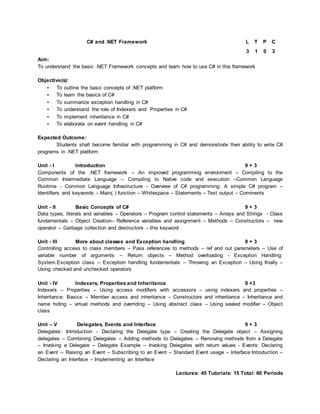
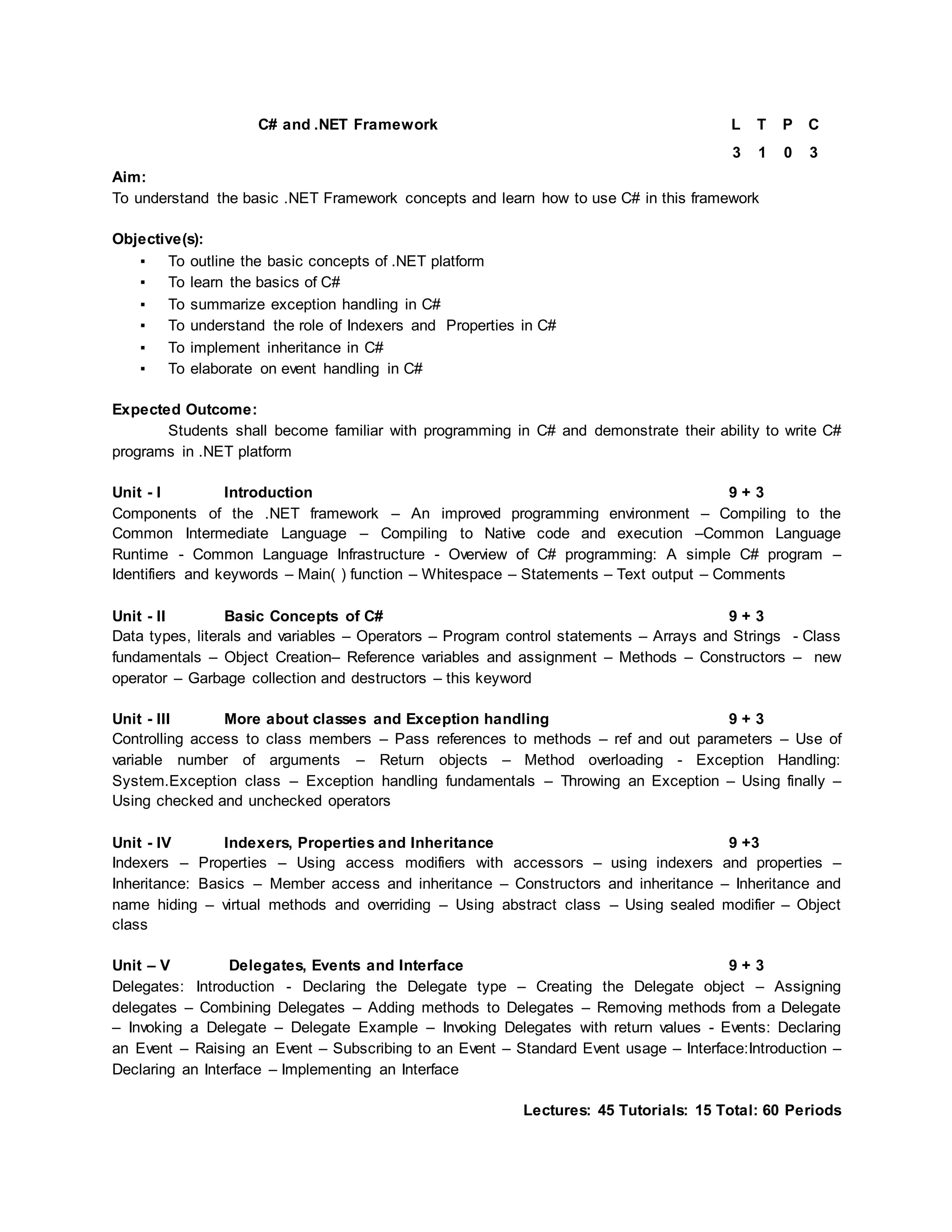
C# and .NET Framework L T P C
3 1 0 3
Aim:
To understand the basic .NET Framework concepts and learn how to use C# in this framework
Objective(s):
▪ To outline the basic concepts of .NET platform
▪ To learn the basics of C#
▪ To summarize exception handling in C#
▪ To understand the role of Indexers and Properties in C#
▪ To implement inheritance in C#
▪ To elaborate on event handling in C#
Expected Outcome:
Students shall become familiar with programming in C# and demonstrate their ability to write C#
programs in .NET platform
Unit - I Introduction 9 + 3
Components of the .NET framework – An improved programming environment – Compiling to the
Common Intermediate Language – Compiling to Native code and execution –Common Language
Runtime - Common Language Infrastructure - Overview of C# programming: A simple C# program –
Identifiers and keywords – Main( ) function – Whitespace – Statements – Text output – Comments
Unit - II Basic Concepts of C# 9 + 3
Data types, literals and variables – Operators – Program control statements – Arrays and Strings - Class
fundamentals – Object Creation– Reference variables and assignment – Methods – Constructors – new
operator – Garbage collection and destructors – this keyword
Unit - III More about classes and Exception handling 9 + 3
Controlling access to class members – Pass references to methods – ref and out parameters – Use of
variable number of arguments – Return objects – Method overloading - Exception Handling:
System.Exception class – Exception handling fundamentals – Throwing an Exception – Using finally –
Using checked and unchecked operators
Unit - IV Indexers, Properties and Inheritance 9 +3
Indexers – Properties – Using access modifiers with accessors – using indexers and properties –
Inheritance: Basics – Member access and inheritance – Constructors and inheritance – Inheritance and
name hiding – virtual methods and overriding – Using abstract class – Using sealed modifier – Object
class
Unit – V Delegates, Events and Interface 9 + 3
Delegates: Introduction - Declaring the Delegate type – Creating the Delegate object – Assigning
delegates – Combining Delegates – Adding methods to Delegates – Removing methods from a Delegate
– Invoking a Delegate – Delegate Example – Invoking Delegates with return values - Events: Declaring
an Event – Raising an Event – Subscribing to an Event – Standard Event usage – Interface:Introduction –
Declaring an Interface – Implementing an Interface
Lectures: 45 Tutorials: 15 Total: 60 Periods
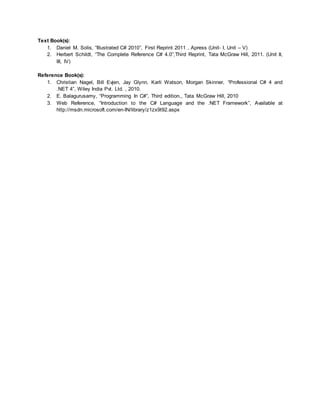
Text Book(s):
1. Daniel M. Solis, “Illustrated C# 2010”, First Reprint 2011 , Apress (Unit- I, Unit – V)
2. Herbert Schildt, “The Complete Reference C# 4.0”,Third Reprint, Tata McGraw Hill, 2011. (Unit II,
III, IV)
Reference Book(s):
1. Christian Nagel, Bill Evjen, Jay Glynn, Karli Watson, Morgan Skinner, “Professional C# 4 and
.NET 4”, Wiley India Pvt. Ltd. , 2010.
2. E. Balagurusamy, “Programming In C#”, Third edition,, Tata McGraw Hill, 2010
3. Web Reference, “Introduction to the C# Language and the .NET Framework”, Available at
http://msdn.microsoft.com/en-IN/library/z1zx9t92.aspx

C sharp syllabus

  • 1.
    C# and .NETFramework L T P C 3 1 0 3 Aim: To understand the basic .NET Framework concepts and learn how to use C# in this framework Objective(s): ▪ To outline the basic concepts of .NET platform ▪ To learn the basics of C# ▪ To summarize exception handling in C# ▪ To understand the role of Indexers and Properties in C# ▪ To implement inheritance in C# ▪ To elaborate on event handling in C# Expected Outcome: Students shall become familiar with programming in C# and demonstrate their ability to write C# programs in .NET platform Unit - I Introduction 9 + 3 Components of the .NET framework – An improved programming environment – Compiling to the Common Intermediate Language – Compiling to Native code and execution –Common Language Runtime - Common Language Infrastructure - Overview of C# programming: A simple C# program – Identifiers and keywords – Main( ) function – Whitespace – Statements – Text output – Comments Unit - II Basic Concepts of C# 9 + 3 Data types, literals and variables – Operators – Program control statements – Arrays and Strings - Class fundamentals – Object Creation– Reference variables and assignment – Methods – Constructors – new operator – Garbage collection and destructors – this keyword Unit - III More about classes and Exception handling 9 + 3 Controlling access to class members – Pass references to methods – ref and out parameters – Use of variable number of arguments – Return objects – Method overloading - Exception Handling: System.Exception class – Exception handling fundamentals – Throwing an Exception – Using finally – Using checked and unchecked operators Unit - IV Indexers, Properties and Inheritance 9 +3 Indexers – Properties – Using access modifiers with accessors – using indexers and properties – Inheritance: Basics – Member access and inheritance – Constructors and inheritance – Inheritance and name hiding – virtual methods and overriding – Using abstract class – Using sealed modifier – Object class Unit – V Delegates, Events and Interface 9 + 3 Delegates: Introduction - Declaring the Delegate type – Creating the Delegate object – Assigning delegates – Combining Delegates – Adding methods to Delegates – Removing methods from a Delegate – Invoking a Delegate – Delegate Example – Invoking Delegates with return values - Events: Declaring an Event – Raising an Event – Subscribing to an Event – Standard Event usage – Interface:Introduction – Declaring an Interface – Implementing an Interface Lectures: 45 Tutorials: 15 Total: 60 Periods
  • 2.
    Text Book(s): 1. DanielM. Solis, “Illustrated C# 2010”, First Reprint 2011 , Apress (Unit- I, Unit – V) 2. Herbert Schildt, “The Complete Reference C# 4.0”,Third Reprint, Tata McGraw Hill, 2011. (Unit II, III, IV) Reference Book(s): 1. Christian Nagel, Bill Evjen, Jay Glynn, Karli Watson, Morgan Skinner, “Professional C# 4 and .NET 4”, Wiley India Pvt. Ltd. , 2010. 2. E. Balagurusamy, “Programming In C#”, Third edition,, Tata McGraw Hill, 2010 3. Web Reference, “Introduction to the C# Language and the .NET Framework”, Available at http://msdn.microsoft.com/en-IN/library/z1zx9t92.aspx