C#.NET COURSE CONTENT 
Introduction to C#.NET 
 Object Oriented Programming 
 C#: The OOP Language 
 The NET Framework 
 CLR, MSIL, JIT and Managed Code 
 Metadata, Assemblies, The Manifest and Garbage Collection 
 Putting Things Together 
 ILASM and ILDASM 
 A First Look at the C# Code 
 The C# Code 
 The IL Code 
 Using the Library File 
 How to Get a Free C# Compiler 
 Compiling Programs in the Command Line Environment 
 Comparison of C# and C++ 
 Features of C# 
Building the Program Logic 
 UsingConditions 
 RelationalOperators 
 LogicalOperators 
 TheBitwiseOperators 
 The ifelseConstruct 
 ManipulatingCharacters 
 The switchConstruct 
 TheConditionalExpression 
 UsingLibraries 
 Repetition Loops 
 Nesting Loops 
 Branching Statements 
 Arrays 
 Multi Dimensional Arrays 
 Jagged Arrays 
 Using Program Arguments 
 Using .NET Properties and Methods with Arrays 
 The for each Loop 
----------------------------------------------------------------------------------------------------------------------------------------------------------------------------------------------- 
INDIA Trainingicon USA 
Phone: +91-966-690-0051 Email: info@trainingicon.com | www.trainingicon.com Phone: +1-408-791-8864
C# Programming 
 The “Hello,World!”C#Program 
 Compiling and Running the Program 
 Comments 
 Class Declaration 
 The Main Method 
 Using the NET Methods for Displaying Results 
 Using Directives 
 Using Local Variables 
 TheProgramArchitecture 
 Qualifying Names 
 Common Conventions for Writing Code 
 Code Documentation 
C# Data Types 
 Data Types 
 Builtin Data Types 
 ValueTypes 
 Variable Initialization 
 DefaultValues 
 ReferenceTypes 
 TheC#ReferenceTypes 
 Boxing and Unboxing 
 SimpleDataTypes 
 Creating and Manipulating Arithmetic Expressions 
 The Basic Arithmetic Operators (+,–,*, /) 
 The Modulus Operator (%) 
 The Assignment Operators 
 Increment and Decrement Operators (++,––) 
 Operator Associativity 
 HowtoGet theTypeName 
 Evaluating Expressions with Mixed Types 
 Adding a Suffixto Numeric Data 
 Real Types 
 Integral Types 
 Conversion between Types 
 The charType 
 Formatting Results (Currency, Decimal, Fixedpoint, Numeric, Scientific, 
Hexadecimal, NullableTypes 
----------------------------------------------------------------------------------------------------------------------------------------------------------------------------------------------- 
INDIA Trainingicon USA 
Phone: +91-966-690-0051 Email: info@trainingicon.com | www.trainingicon.com Phone: +1-408-791-8864
 Using the ??Operator 
 The string Type 
 StringExpressions 
 String Operators 
 The@Symbol 
 Reading the Keyboard Input 
 Class using the parse Method 
UsingClasses 
 ClassDeclaration 
 Class Instantiation 
 Namespaces 
 Nesting Namespaces 
 The Namespace Alias Qualifier 
 Access Levels 
 Properties and UsingProperties 
 ReadonlyProperties 
 Accessor Accessibility 
 StaticMembers and StaticClasses 
 Constants, Constructors, DeclaringConstructors, PrivateConstructors, 
StaticConstructors 
 Destructors, PartialClasses 
FunctionMembers 
 FunctionMembers 
 Polymorphism 
 Virtual and Override Methods 
 Calling Members of the Base Class 
 Method Overloading and Overriding Virtual Methods on the Base Class 
 Abstract Classes and Methods 
 Indexers 
 Structs, Enums and Attributes 
 Structs vs Classes 
 Passing Structs and Classes to Methods 
 Attributes 
 Calling Native Functions 
 Emulating Unions 
Generics 
----------------------------------------------------------------------------------------------------------------------------------------------------------------------------------------------- 
INDIA Trainingicon USA 
Phone: +91-966-690-0051 Email: info@trainingicon.com | www.trainingicon.com Phone: +1-408-791-8864
 What Are Generics? 
 Using Generic Collections 
 CreatingYourOwnGenericClasses 
 Generic Methods 
 Generic Methods inside Generic Classes 
 Overloading Generic Methods 
 GenericDelegates 
 Generic Interfaces 
 Limitations of Using Generics 
 ICollection, ICollectionMembers, IDictionary, IDictionary Members 
 Creating Your Own Generic Classes 
 Generic Methods, Generic Methods inside Generic Classes, Overloading Generic 
Methods 
 GenericDelegates, Generic Interfaces, BenefitsofUsingGenerics, 
LimitationsofUsingGenerics 
Interfaces 
 What Is an Interface 
 Declaring an Interface 
 Interface Implementation 
 Explicit Interface Implementation 
 Hiding Members of the Base Class, Versioning, Hiding Interface Members 
Exceptions 
 Errors and Exceptions 
 Throwing an Exception, Catching an Exception, Organizing the Handlers, 
Sequence of Events in Handling Exceptions, Expected Exceptions in File 
Processing 
 Reading Text Files, Writing and Appending Text Files 
 The finally Block, The try finally Statement, The try catch finally Statement, User 
defined Exceptions, Using the Stack Trace Property 
Delegatesand Events 
 What Is aDelegate?, DeclaringDelegates, CreatingaDelegate, Invoking the 
Delegate, Associating a Delegate with More Than One Method 
 Adding and Removing Delegates, Using NET Methods to Add and Remove 
Delegates, Anonymous Methods, OuterVariables, Restrictions on Using 
Anonymous Methods 
 Covariance, Contravariance, Events, Using Events in Applications 
----------------------------------------------------------------------------------------------------------------------------------------------------------------------------------------------- 
INDIA Trainingicon USA 
Phone: +91-966-690-0051 Email: info@trainingicon.com | www.trainingicon.com Phone: +1-408-791-8864
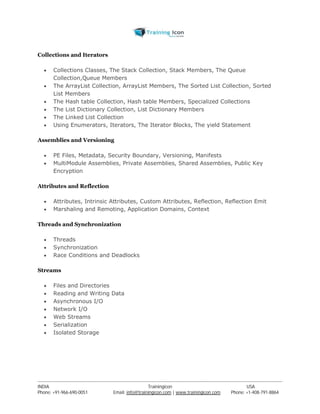
Collections and Iterators 
 Collections Classes, The Stack Collection, Stack Members, The Queue 
Collection,Queue Members 
 The ArrayList Collection, ArrayList Members, The Sorted List Collection, Sorted 
List Members 
 The Hash table Collection, Hash table Members, Specialized Collections 
 The List Dictionary Collection, List Dictionary Members 
 The Linked List Collection 
 Using Enumerators, Iterators, The Iterator Blocks, The yield Statement 
Assemblies and Versioning 
 PE Files, Metadata, Security Boundary, Versioning, Manifests 
 MultiModule Assemblies, Private Assemblies, Shared Assemblies, Public Key 
Encryption 
Attributes and Reflection 
 Attributes, Intrinsic Attributes, Custom Attributes, Reflection, Reflection Emit 
 Marshaling and Remoting, Application Domains, Context 
Threads and Synchronization 
 Threads 
 Synchronization 
 Race Conditions and Deadlocks 
Streams 
 Files and Directories 
 Reading and Writing Data 
 Asynchronous I/O 
 Network I/O 
 Web Streams 
 Serialization 
 Isolated Storage 
----------------------------------------------------------------------------------------------------------------------------------------------------------------------------------------------- 
INDIA Trainingicon USA 
Phone: +91-966-690-0051 Email: info@trainingicon.com | www.trainingicon.com Phone: +1-408-791-8864

C#.net online training

  • 1.
    C#.NET COURSE CONTENT Introduction to C#.NET  Object Oriented Programming  C#: The OOP Language  The NET Framework  CLR, MSIL, JIT and Managed Code  Metadata, Assemblies, The Manifest and Garbage Collection  Putting Things Together  ILASM and ILDASM  A First Look at the C# Code  The C# Code  The IL Code  Using the Library File  How to Get a Free C# Compiler  Compiling Programs in the Command Line Environment  Comparison of C# and C++  Features of C# Building the Program Logic  UsingConditions  RelationalOperators  LogicalOperators  TheBitwiseOperators  The ifelseConstruct  ManipulatingCharacters  The switchConstruct  TheConditionalExpression  UsingLibraries  Repetition Loops  Nesting Loops  Branching Statements  Arrays  Multi Dimensional Arrays  Jagged Arrays  Using Program Arguments  Using .NET Properties and Methods with Arrays  The for each Loop ----------------------------------------------------------------------------------------------------------------------------------------------------------------------------------------------- INDIA Trainingicon USA Phone: +91-966-690-0051 Email: info@trainingicon.com | www.trainingicon.com Phone: +1-408-791-8864
  • 2.
    C# Programming The “Hello,World!”C#Program  Compiling and Running the Program  Comments  Class Declaration  The Main Method  Using the NET Methods for Displaying Results  Using Directives  Using Local Variables  TheProgramArchitecture  Qualifying Names  Common Conventions for Writing Code  Code Documentation C# Data Types  Data Types  Builtin Data Types  ValueTypes  Variable Initialization  DefaultValues  ReferenceTypes  TheC#ReferenceTypes  Boxing and Unboxing  SimpleDataTypes  Creating and Manipulating Arithmetic Expressions  The Basic Arithmetic Operators (+,–,*, /)  The Modulus Operator (%)  The Assignment Operators  Increment and Decrement Operators (++,––)  Operator Associativity  HowtoGet theTypeName  Evaluating Expressions with Mixed Types  Adding a Suffixto Numeric Data  Real Types  Integral Types  Conversion between Types  The charType  Formatting Results (Currency, Decimal, Fixedpoint, Numeric, Scientific, Hexadecimal, NullableTypes ----------------------------------------------------------------------------------------------------------------------------------------------------------------------------------------------- INDIA Trainingicon USA Phone: +91-966-690-0051 Email: info@trainingicon.com | www.trainingicon.com Phone: +1-408-791-8864
  • 3.
     Using the??Operator  The string Type  StringExpressions  String Operators  The@Symbol  Reading the Keyboard Input  Class using the parse Method UsingClasses  ClassDeclaration  Class Instantiation  Namespaces  Nesting Namespaces  The Namespace Alias Qualifier  Access Levels  Properties and UsingProperties  ReadonlyProperties  Accessor Accessibility  StaticMembers and StaticClasses  Constants, Constructors, DeclaringConstructors, PrivateConstructors, StaticConstructors  Destructors, PartialClasses FunctionMembers  FunctionMembers  Polymorphism  Virtual and Override Methods  Calling Members of the Base Class  Method Overloading and Overriding Virtual Methods on the Base Class  Abstract Classes and Methods  Indexers  Structs, Enums and Attributes  Structs vs Classes  Passing Structs and Classes to Methods  Attributes  Calling Native Functions  Emulating Unions Generics ----------------------------------------------------------------------------------------------------------------------------------------------------------------------------------------------- INDIA Trainingicon USA Phone: +91-966-690-0051 Email: info@trainingicon.com | www.trainingicon.com Phone: +1-408-791-8864
  • 4.
     What AreGenerics?  Using Generic Collections  CreatingYourOwnGenericClasses  Generic Methods  Generic Methods inside Generic Classes  Overloading Generic Methods  GenericDelegates  Generic Interfaces  Limitations of Using Generics  ICollection, ICollectionMembers, IDictionary, IDictionary Members  Creating Your Own Generic Classes  Generic Methods, Generic Methods inside Generic Classes, Overloading Generic Methods  GenericDelegates, Generic Interfaces, BenefitsofUsingGenerics, LimitationsofUsingGenerics Interfaces  What Is an Interface  Declaring an Interface  Interface Implementation  Explicit Interface Implementation  Hiding Members of the Base Class, Versioning, Hiding Interface Members Exceptions  Errors and Exceptions  Throwing an Exception, Catching an Exception, Organizing the Handlers, Sequence of Events in Handling Exceptions, Expected Exceptions in File Processing  Reading Text Files, Writing and Appending Text Files  The finally Block, The try finally Statement, The try catch finally Statement, User defined Exceptions, Using the Stack Trace Property Delegatesand Events  What Is aDelegate?, DeclaringDelegates, CreatingaDelegate, Invoking the Delegate, Associating a Delegate with More Than One Method  Adding and Removing Delegates, Using NET Methods to Add and Remove Delegates, Anonymous Methods, OuterVariables, Restrictions on Using Anonymous Methods  Covariance, Contravariance, Events, Using Events in Applications ----------------------------------------------------------------------------------------------------------------------------------------------------------------------------------------------- INDIA Trainingicon USA Phone: +91-966-690-0051 Email: info@trainingicon.com | www.trainingicon.com Phone: +1-408-791-8864
  • 5.
    Collections and Iterators  Collections Classes, The Stack Collection, Stack Members, The Queue Collection,Queue Members  The ArrayList Collection, ArrayList Members, The Sorted List Collection, Sorted List Members  The Hash table Collection, Hash table Members, Specialized Collections  The List Dictionary Collection, List Dictionary Members  The Linked List Collection  Using Enumerators, Iterators, The Iterator Blocks, The yield Statement Assemblies and Versioning  PE Files, Metadata, Security Boundary, Versioning, Manifests  MultiModule Assemblies, Private Assemblies, Shared Assemblies, Public Key Encryption Attributes and Reflection  Attributes, Intrinsic Attributes, Custom Attributes, Reflection, Reflection Emit  Marshaling and Remoting, Application Domains, Context Threads and Synchronization  Threads  Synchronization  Race Conditions and Deadlocks Streams  Files and Directories  Reading and Writing Data  Asynchronous I/O  Network I/O  Web Streams  Serialization  Isolated Storage ----------------------------------------------------------------------------------------------------------------------------------------------------------------------------------------------- INDIA Trainingicon USA Phone: +91-966-690-0051 Email: info@trainingicon.com | www.trainingicon.com Phone: +1-408-791-8864