Website: www.batracomputercentre.comPh. No.: 8222066670, 4000670
Email: info.jatinbatra@gmail.com
BATRA COMPUTER CENTRE
ISO CERTIFIED 9001:2008
Website: www.batracomputercentre.comPh. No.: 8222066670, 4000670
Email: info.jatinbatra@gmail.com
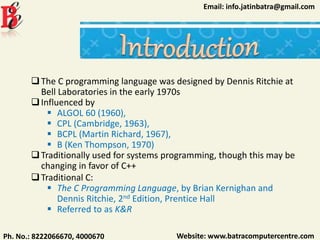
The C programming language was designed by Dennis Ritchie at
Bell Laboratories in the early 1970s
Influenced by
 ALGOL 60 (1960),
 CPL (Cambridge, 1963),
 BCPL (Martin Richard, 1967),
 B (Ken Thompson, 1970)
Traditionally used for systems programming, though this may be
changing in favor of C++
Traditional C:
 The C Programming Language, by Brian Kernighan and
Dennis Ritchie, 2nd Edition, Prentice Hall
 Referred to as K&R
Website: www.batracomputercentre.comPh. No.: 8222066670, 4000670
Email: info.jatinbatra@gmail.com
 Standardized in 1989 by ANSI (American National Standards Institute)
known as ANSI C
 International standard (ISO) in 1990 which was adopted by ANSI and is
known as C89
 As part of the normal evolution process the standard was updated in
1995 (C95) and 1999 (C99)
 C++ and C
 C++ extends C to include support for Object Oriented Programming
and other features that facilitate large software development
projects
 C is not strictly a subset of C++, but it is possible to write “Clean C”
that conforms to both the C++ and C standards.
Website: www.batracomputercentre.comPh. No.: 8222066670, 4000670
Email: info.jatinbatra@gmail.com
 A C development environment includes
 System libraries and headers: a set of standard libraries and their header files.
For example see /usr/include and glibc.
 Application Source: application source and header files
 Compiler: converts source to object code for a specific platform
 Linker: resolves external references and produces the executable module
 User program structure
 there must be one main function where execution begins when the program is
run. This function is called main
-int main (void) { ... },
-int main (int argc, char *argv[]) { ... }
-UNIX Systems have a 3rd way to define main(), though it is not POSIX.1
compliant
int main (int argc, char *argv[], char *envp[])
-additional local and external functions and variables
Website: www.batracomputercentre.comPh. No.: 8222066670, 4000670
Email: info.jatinbatra@gmail.com
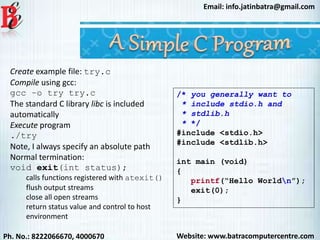
Create example file: try.c
Compile using gcc:
gcc –o try try.c
The standard C library libc is included
automatically
Execute program
./try
Note, I always specify an absolute path
Normal termination:
void exit(int status);
calls functions registered with atexit()
flush output streams
close all open streams
return status value and control to host
environment
/* you generally want to
* include stdio.h and
* stdlib.h
* */
#include <stdio.h>
#include <stdlib.h>
int main (void)
{
printf(“Hello Worldn”);
exit(0);
}
Website: www.batracomputercentre.comPh. No.: 8222066670, 4000670
Email: info.jatinbatra@gmail.com
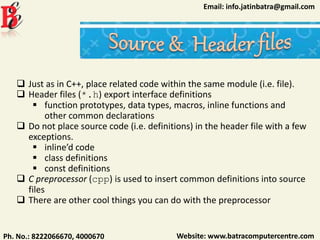
 Just as in C++, place related code within the same module (i.e. file).
 Header files (*.h) export interface definitions
 function prototypes, data types, macros, inline functions and
other common declarations
 Do not place source code (i.e. definitions) in the header file with a few
exceptions.
 inline’d code
 class definitions
 const definitions
 C preprocessor (cpp) is used to insert common definitions into source
files
 There are other cool things you can do with the preprocessor
Website: www.batracomputercentre.comPh. No.: 8222066670, 4000670
Email: info.jatinbatra@gmail.com
 When you execute a program you can
include arguments on the command line.
 The run time environment will create an
argument vector.
 argv is the argument vector
 argc is the number of arguments
 Argument vector is an array of pointers
to strings.
 a string is an array of characters
terminated by a binary 0 (NULL or ‘0’).
 argv[0] is always the program name, so
argc is at least 1.
./try –g 2 fred
argc = 4,
argv =
<address0>
‘t’‘r’‘y’‘0’
argv:
[0] <addres1>
[1] <addres2>
[2] <addres3>
[3] <addres4>
[4] NULL
‘-’‘g’‘0’
‘2’‘0’
‘f’‘r’‘e’‘d’‘0’
Website: www.batracomputercentre.comPh. No.: 8222066670, 4000670
Email: info.jatinbatra@gmail.com
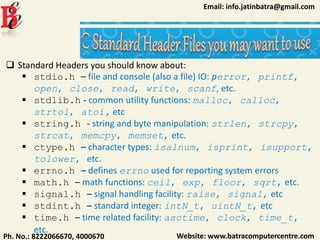
 Standard Headers you should know about:
 stdio.h – file and console (also a file) IO: perror, printf,
open, close, read, write, scanf, etc.
 stdlib.h - common utility functions: malloc, calloc,
strtol, atoi, etc
 string.h - string and byte manipulation: strlen, strcpy,
strcat, memcpy, memset, etc.
 ctype.h – character types: isalnum, isprint, isupport,
tolower, etc.
 errno.h – defines errno used for reporting system errors
 math.h – math functions: ceil, exp, floor, sqrt, etc.
 signal.h – signal handling facility: raise, signal, etc
 stdint.h – standard integer: intN_t, uintN_t, etc
 time.h – time related facility: asctime, clock, time_t,
etc.
Website: www.batracomputercentre.comPh. No.: 8222066670, 4000670
Email: info.jatinbatra@gmail.com
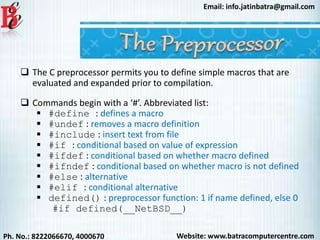
 The C preprocessor permits you to define simple macros that are
evaluated and expanded prior to compilation.
 Commands begin with a ‘#’. Abbreviated list:
 #define : defines a macro
 #undef : removes a macro definition
 #include : insert text from file
 #if : conditional based on value of expression
 #ifdef : conditional based on whether macro defined
 #ifndef : conditional based on whether macro is not defined
 #else : alternative
 #elif : conditional alternative
 defined() : preprocessor function: 1 if name defined, else 0
#if defined(__NetBSD__)
Website: www.batracomputercentre.comPh. No.: 8222066670, 4000670
Email: info.jatinbatra@gmail.com
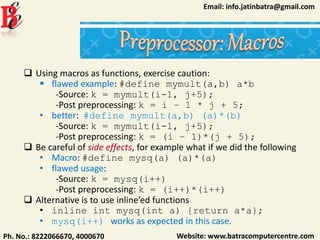
 Using macros as functions, exercise caution:
 flawed example: #define mymult(a,b) a*b
-Source: k = mymult(i-1, j+5);
-Post preprocessing: k = i – 1 * j + 5;
• better: #define mymult(a,b) (a)*(b)
-Source: k = mymult(i-1, j+5);
-Post preprocessing: k = (i – 1)*(j + 5);
 Be careful of side effects, for example what if we did the following
• Macro: #define mysq(a) (a)*(a)
• flawed usage:
-Source: k = mysq(i++)
-Post preprocessing: k = (i++)*(i++)
 Alternative is to use inline’ed functions
• inline int mysq(int a) {return a*a};
• mysq(i++) works as expected in this case.
Website: www.batracomputercentre.comPh. No.: 8222066670, 4000670
Email: info.jatinbatra@gmail.com
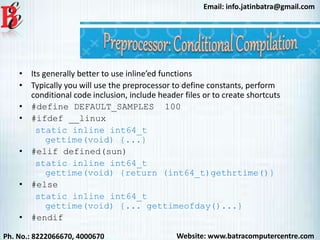
• Its generally better to use inline’ed functions
• Typically you will use the preprocessor to define constants, perform
conditional code inclusion, include header files or to create shortcuts
• #define DEFAULT_SAMPLES 100
• #ifdef __linux
static inline int64_t
gettime(void) {...}
• #elif defined(sun)
static inline int64_t
gettime(void) {return (int64_t)gethrtime()}
• #else
static inline int64_t
gettime(void) {... gettimeofday()...}
• #endif
Website: www.batracomputercentre.comPh. No.: 8222066670, 4000670
Email: info.jatinbatra@gmail.com
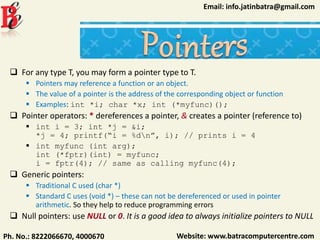
 For any type T, you may form a pointer type to T.
 Pointers may reference a function or an object.
 The value of a pointer is the address of the corresponding object or function
 Examples: int *i; char *x; int (*myfunc)();
 Pointer operators: * dereferences a pointer, & creates a pointer (reference to)
 int i = 3; int *j = &i;
*j = 4; printf(“i = %dn”, i); // prints i = 4
 int myfunc (int arg);
int (*fptr)(int) = myfunc;
i = fptr(4); // same as calling myfunc(4);
 Generic pointers:
 Traditional C used (char *)
 Standard C uses (void *) – these can not be dereferenced or used in pointer
arithmetic. So they help to reduce programming errors
 Null pointers: use NULL or 0. It is a good idea to always initialize pointers to NULL
Website: www.batracomputercentre.comPh. No.: 8222066670, 4000670
Email: info.jatinbatra@gmail.com
Address
0x3dc
0x3d8
Program Memory
0x3cc
0x3c8
0x3c4
0x3c0
Note: The compiler converts z[1] or *(z+1) to
Value at address (Address of z + sizeof(int));
In C you would write the byte address as:
(char *)z + sizeof(int);
or letting the compiler do the work for you
(int *)z + 1;
Step 1:
int main (int argc, argv) {
int x = 4;
int *y = &x;
int *z[4] = {NULL, NULL, NULL, NULL};
int a[4] = {1, 2, 3, 4};
...
0x3bc
0x3b8
0x3b4
0x3b0
0x3d4
0x3d0
z[3]
z[2]
z[1]
z[0]
a[3]
a[2]
a[1]
a[0]
4
0x3dc
0
0
0
0
4
3
2
1
NA
NA
x
y
Website: www.batracomputercentre.comPh. No.: 8222066670, 4000670
Email: info.jatinbatra@gmail.com
4
0x3dc
Address
0x3dc
0x3d8
Program Memory
0x3bc
0x3b8
0x3b4
0x3b0
0x3cc
0x3c8
0x3c4
0x3c0
Step 1:
int main (int argc, argv) {
int x = 4;
int *y = &x;
int *z[4] = {NULL, NULL, NULL, NULL};
int a[4] = {1, 2, 3, 4};
Step 2: Assign addresses to array Z
z[0] = a; // same as &a[0];
z[1] = a + 1; // same as &a[1];
z[2] = a + 2; // same as &a[2];
z[3] = a + 3; // same as &a[3];
0x3bc
0x3b8
0x3b4
0x3b0
4
3
2
1
NA 0x3d4
0x3d0
z[3]
z[2]
z[1]
z[0]
a[3]
a[2]
a[1]
a[0]
NA
x
y
Website: www.batracomputercentre.comPh. No.: 8222066670, 4000670
Email: info.jatinbatra@gmail.com
4
0x3dc
Address
0x3dc
0x3d8
Program Memory
0x3bc
0x3b8
0x3b4
0x3b0
0x3cc
0x3c8
0x3c4
0x3c0
Step 1:
int main (int argc, argv) {
int x = 4;
int *y = &x;
int *z[4] = {NULL, NULL, NULL, NULL};
int a[4] = {1, 2, 3, 4};
Step 2:
z[0] = a;
z[1] = a + 1;
z[2] = a + 2;
z[3] = a + 3;
Step 3: No change in z’s values
z[0] = (int *)((char *)a);
z[1] = (int *)((char *)a
+ sizeof(int));
z[2] = (int *)((char *)a
+ 2 * sizeof(int));
z[3] = (int *)((char *)a
+ 3 * sizeof(int));
0x3bc
0x3b8
0x3b4
0x3b0
4
3
2
1
NA 0x3d4
0x3d0
z[3]
z[2]
z[1]
z[0]
a[3]
a[2]
a[1]
a[0]
NA
x
y
Website: www.batracomputercentre.comPh. No.: 8222066670, 4000670
Email: info.jatinbatra@gmail.com
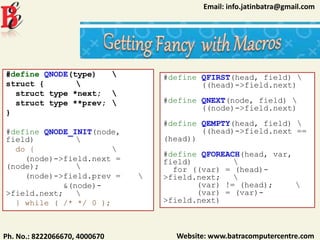
#define QNODE(type) 
struct { 
struct type *next; 
struct type **prev; 
}
#define QNODE_INIT(node,
field) 
do { 
(node)->field.next =
(node); 
(node)->field.prev = 
&(node)-
>field.next; 
} while ( /* */ 0 );
#define QFIRST(head, field) 
((head)->field.next)
#define QNEXT(node, field) 
((node)->field.next)
#define QEMPTY(head, field) 
((head)->field.next ==
(head))
#define QFOREACH(head, var,
field) 
for ((var) = (head)-
>field.next; 
(var) != (head); 
(var) = (var)-
>field.next)
Website: www.batracomputercentre.comPh. No.: 8222066670, 4000670
Email: info.jatinbatra@gmail.com
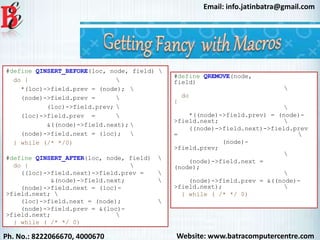
#define QINSERT_BEFORE(loc, node, field) 
do { 
*(loc)->field.prev = (node); 
(node)->field.prev = 
(loc)->field.prev; 
(loc)->field.prev = 
&((node)->field.next); 
(node)->field.next = (loc); 
} while (/* */0)
#define QINSERT_AFTER(loc, node, field) 
do { 
((loc)->field.next)->field.prev = 
&(node)->field.next; 
(node)->field.next = (loc)-
>field.next; 
(loc)->field.next = (node); 
(node)->field.prev = &(loc)-
>field.next; 
} while ( /* */ 0)
#define QREMOVE(node,
field)

do
{

*((node)->field.prev) = (node)-
>field.next; 
((node)->field.next)->field.prev
= 
(node)-
>field.prev;

(node)->field.next =
(node);

(node)->field.prev = &((node)-
>field.next); 
} while ( /* */ 0)
Website: www.batracomputercentre.comPh. No.: 8222066670, 4000670
Email: info.jatinbatra@gmail.com
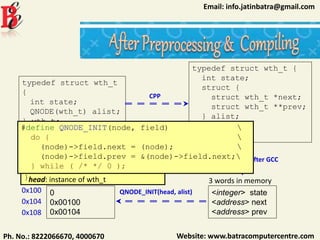
typedef struct wth_t
{
int state;
QNODE(wth_t) alist;
} wth_t;
#define QNODE(type) 
struct { 
struct type *next; 
struct type **prev; 
}
typedef struct wth_t {
int state;
struct {
struct wth_t *next;
struct wth_t **prev;
} alist;
} wth_t;
<integer> state
<address> next
<address> prev
3 words in memory
0
0x00100
0x00104
0x100
head: instance of wth_t
0x104
0x108
memory layout after GCC
CPP
QNODE_INIT(head, alist)
#define QNODE_INIT(node, field) 
do { 
(node)->field.next = (node); 
(node)->field.prev = &(node)->field.next;
} while ( /* */ 0 );
Website: www.batracomputercentre.comPh. No.: 8222066670, 4000670
Email: info.jatinbatra@gmail.com
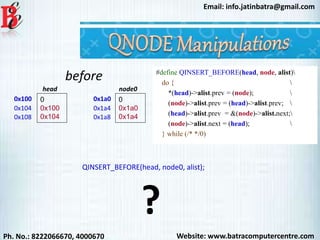
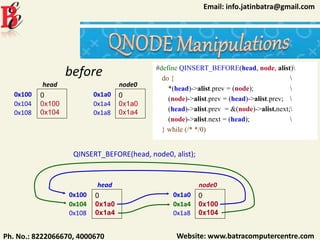
#define QINSERT_BEFORE(head, node, alist)
do { 
*(head)->alist.prev = (node); 
(node)->alist.prev = (head)->alist.prev; 
(head)->alist.prev = &(node)->alist.next;
(node)->alist.next = (head); 
} while (/* */0)
0x100 0
0x100
0x104
head
0x104
0x108
0x1a0 0
0x1a0
0x1a4
node0
0x1a4
0x1a8
QINSERT_BEFORE(head, node0, alist);
?
before
Website: www.batracomputercentre.comPh. No.: 8222066670, 4000670
Email: info.jatinbatra@gmail.com
#define QINSERT_BEFORE(head, node, alist)
do { 
*(head)->alist.prev = (node); 
(node)->alist.prev = (head)->alist.prev; 
(head)->alist.prev = &(node)->alist.next;
(node)->alist.next = (head); 
} while (/* */0)
0x100 0
0x100
0x104
head
0x104
0x108
0x1a0 0
0x1a0
0x1a4
node0
0x1a4
0x1a8
QINSERT_BEFORE(head, node0, alist);
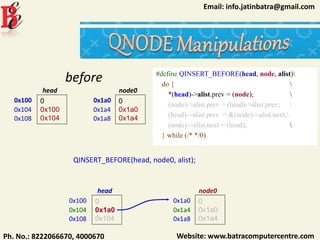
0x100 0
0x1a0
0x104
head
0x104
0x108
0x1a0 0
0x1a0
0x1a4
node0
0x1a4
0x1a8
before
Website: www.batracomputercentre.comPh. No.: 8222066670, 4000670
Email: info.jatinbatra@gmail.com
#define QINSERT_BEFORE(head, node, alist)
do { 
*(head)->alist.prev = (node); 
(node)->alist.prev = (head)->alist.prev; 
(head)->alist.prev = &(node)->alist.next;
(node)->alist.next = (head); 
} while (/* */0)
0x100 0
0x100
0x104
head
0x104
0x108
0x1a0 0
0x1a0
0x1a4
node0
0x1a4
0x1a8
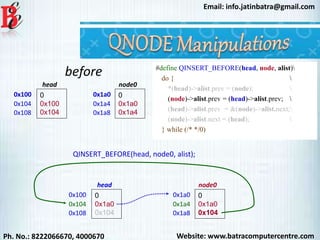
QINSERT_BEFORE(head, node0, alist);
0x100 0
0x1a0
0x104
head
0x104
0x108
0x1a0 0
0x1a0
0x104
node0
0x1a4
0x1a8
before
Website: www.batracomputercentre.comPh. No.: 8222066670, 4000670
Email: info.jatinbatra@gmail.com
#define QINSERT_BEFORE(head, node, alist)
do { 
*(head)->alist.prev = (node); 
(node)->alist.prev = (head)->alist.prev; 
(head)->alist.prev = &(node)->alist.next;
(node)->alist.next = (head); 
} while (/* */0)
0x100 0
0x100
0x104
head
0x104
0x108
0x1a0 0
0x1a0
0x1a4
node0
0x1a4
0x1a8
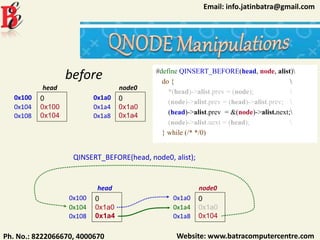
QINSERT_BEFORE(head, node0, alist);
0x100 0
0x1a0
0x1a4
head
0x104
0x108
0x1a0 0
0x1a0
0x104
node0
0x1a4
0x1a8
before
Website: www.batracomputercentre.comPh. No.: 8222066670, 4000670
Email: info.jatinbatra@gmail.com
#define QINSERT_BEFORE(head, node, alist)
do { 
*(head)->alist.prev = (node); 
(node)->alist.prev = (head)->alist.prev; 
(head)->alist.prev = &(node)->alist.next;
(node)->alist.next = (head); 
} while (/* */0)
0x100 0
0x100
0x104
head
0x104
0x108
0x1a0 0
0x1a0
0x1a4
node0
0x1a4
0x1a8
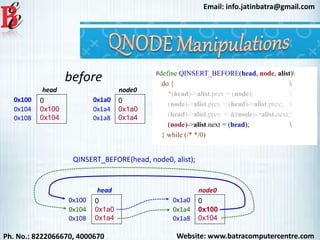
QINSERT_BEFORE(head, node0, alist);
0x100 0
0x1a0
0x1a4
head
0x104
0x108
0x1a0 0
0x100
0x104
node0
0x1a4
0x1a8
before
Website: www.batracomputercentre.comPh. No.: 8222066670, 4000670
Email: info.jatinbatra@gmail.com
#define QINSERT_BEFORE(head, node, alist)
do { 
*(head)->alist.prev = (node); 
(node)->alist.prev = (head)->alist.prev; 
(head)->alist.prev = &(node)->alist.next;
(node)->alist.next = (head); 
} while (/* */0)
0x100 0
0x100
0x104
head
0x104
0x108
0x1a0 0
0x1a0
0x1a4
node0
0x1a4
0x1a8
QINSERT_BEFORE(head, node0, alist);
0x100 0
0x1a0
0x1a4
head
0x104
0x108
0x1a0 0
0x100
0x104
node0
0x1a4
0x1a8
before
Website: www.batracomputercentre.comPh. No.: 8222066670, 4000670
Email: info.jatinbatra@gmail.com
0x100 0
0x1a0
0x1a4
head
0x104
0x108
0x1a0 0
0x100
0x104
node0
0x1a4
0x1a8
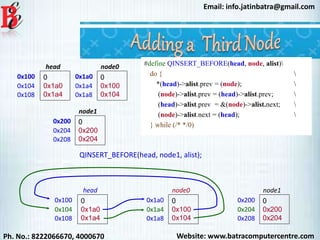
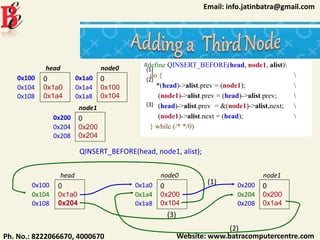
QINSERT_BEFORE(head, node1, alist);
0x200 0
0x200
0x204
node1
0x204
0x208
#define QINSERT_BEFORE(head, node, alist)
do { 
*(head)->alist.prev = (node); 
(node)->alist.prev = (head)->alist.prev; 
(head)->alist.prev = &(node)->alist.next; 
(node)->alist.next = (head); 
} while (/* */0)
0x200 0
0x200
0x204
node1
0x204
0x208
0x100 0
0x1a0
0x1a4
head
0x104
0x108
0x1a0 0
0x100
0x104
node0
0x1a4
0x1a8
Website: www.batracomputercentre.comPh. No.: 8222066670, 4000670
Email: info.jatinbatra@gmail.com
0x100 0
0x1a0
0x1a4
head
0x104
0x108
0x1a0 0
0x100
0x104
node0
0x1a4
0x1a8
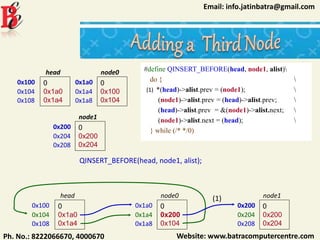
QINSERT_BEFORE(head, node1, alist);
0x100 0
0x1a0
0x1a4
head
0x104
0x108
0x1a0 0
0x200
0x104
node0
0x1a4
0x1a8
0x200 0
0x200
0x204
node1
0x204
0x208
#define QINSERT_BEFORE(head, node1, alist)
do { 
*(head)->alist.prev = (node1); 
(node1)->alist.prev = (head)->alist.prev; 
(head)->alist.prev = &(node1)->alist.next; 
(node1)->alist.next = (head); 
} while (/* */0)
0x200 0
0x200
0x204
node1
0x204
0x208
(1)
(1)
Website: www.batracomputercentre.comPh. No.: 8222066670, 4000670
Email: info.jatinbatra@gmail.com
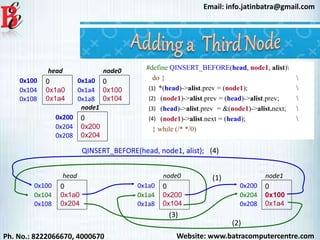
0x100 0
0x1a0
0x1a4
head
0x104
0x108
0x1a0 0
0x100
0x104
node0
0x1a4
0x1a8
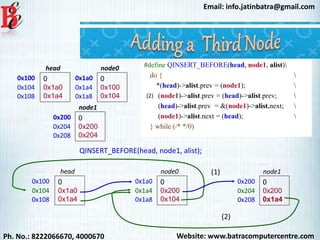
QINSERT_BEFORE(head, node1, alist);
0x100 0
0x1a0
0x1a4
head
0x104
0x108
0x1a0 0
0x200
0x104
node0
0x1a4
0x1a8
0x200 0
0x200
0x204
node1
0x204
0x208
#define QINSERT_BEFORE(head, node1, alist)
do { 
*(head)->alist.prev = (node1); 
(node1)->alist.prev = (head)->alist.prev; 
(head)->alist.prev = &(node1)->alist.next; 
(node1)->alist.next = (head); 
} while (/* */0)
0x200 0
0x200
0x1a4
node1
0x204
0x208
(1)
(2)
(2)
Website: www.batracomputercentre.comPh. No.: 8222066670, 4000670
Email: info.jatinbatra@gmail.com
0x100 0
0x1a0
0x1a4
head
0x104
0x108
0x1a0 0
0x100
0x104
node0
0x1a4
0x1a8
QINSERT_BEFORE(head, node1, alist);
0x100 0
0x1a0
0x204
head
0x104
0x108
0x1a0 0
0x200
0x104
node0
0x1a4
0x1a8
0x200 0
0x200
0x204
node1
0x204
0x208
#define QINSERT_BEFORE(head, node1, alist)
do { 
*(head)->alist.prev = (node1); 
(node1)->alist.prev = (head)->alist.prev; 
(head)->alist.prev = &(node1)->alist.next; 
(node1)->alist.next = (head); 
} while (/* */0)
0x200 0
0x200
0x1a4
node1
0x204
0x208
(1)
(1)
(2)
(2)
(3)
(3)
Website: www.batracomputercentre.comPh. No.: 8222066670, 4000670
Email: info.jatinbatra@gmail.com
0x100 0
0x1a0
0x1a4
head
0x104
0x108
0x1a0 0
0x100
0x104
node0
0x1a4
0x1a8
QINSERT_BEFORE(head, node1, alist);
0x100 0
0x1a0
0x204
head
0x104
0x108
0x1a0 0
0x200
0x104
node0
0x1a4
0x1a8
0x200 0
0x200
0x204
node1
0x204
0x208
#define QINSERT_BEFORE(head, node1, alist)
do { 
*(head)->alist.prev = (node1); 
(node1)->alist.prev = (head)->alist.prev; 
(head)->alist.prev = &(node1)->alist.next; 
(node1)->alist.next = (head); 
} while (/* */0)
0x200 0
0x100
0x1a4
node1
0x204
0x208
(1)
(1)
(2)
(2)
(3)
(3)
(4)
(4)
Website: www.batracomputercentre.comPh. No.: 8222066670, 4000670
Email: info.jatinbatra@gmail.com
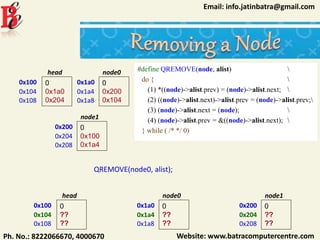
0x100 0
0x1a0
0x204
head
0x104
0x108
0x1a0 0
0x200
0x104
node0
0x1a4
0x1a8
0x200 0
0x100
0x1a4
node1
0x204
0x208
QREMOVE(node0, alist);
0x100 0
??
??
head
0x104
0x108
0x1a0 0
??
??
node0
0x1a4
0x1a8
0x200 0
??
??
node1
0x204
0x208
#define QREMOVE(node, alist) 
do { 
(1) *((node)->alist.prev) = (node)->alist.next; 
(2) ((node)->alist.next)->alist.prev = (node)->alist.prev;
(3) (node)->alist.next = (node); 
(4) (node)->alist.prev = &((node)->alist.next); 
} while ( /* */ 0)
Website: www.batracomputercentre.comPh. No.: 8222066670, 4000670
Email: info.jatinbatra@gmail.com
0x100 0
0x1a0
0x204
head
0x104
0x108
0x1a0 0
0x200
0x104
node0
0x1a4
0x1a8
0x200 0
0x100
0x1a4
node1
0x204
0x208
QREMOVE(node0, alist);
#define QREMOVE(node, alist) 
do { 
*((node)->alist.prev) = (node)->alist.next; 
((node)->alist.next)->alist.prev = (node)->alist.prev;
(node)->alist.next = (node); 
(node)->alist.prev = &((node)->alist.next); 
} while ( /* */ 0)
0x100 0
0x1a0
0x204
head
0x104
0x108
0x1a0 0
0x200
0x104
node0
0x1a4
0x1a8
0x200 0
0x100
0x1a4
node1
0x204
0x208
Website: www.batracomputercentre.comPh. No.: 8222066670, 4000670
Email: info.jatinbatra@gmail.com
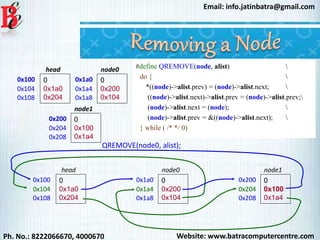
0x100 0
0x200
0x204
head
0x104
0x108
0x1a0 0
0x200
0x104
node0
0x1a4
0x1a8
0x200 0
0x100
0x1a4
node1
0x204
0x208
0x100 0
0x1a0
0x204
head
0x104
0x108
0x1a0 0
0x200
0x104
node0
0x1a4
0x1a8
0x200 0
0x100
0x1a4
node1
0x204
0x208
QREMOVE(node0, alist);
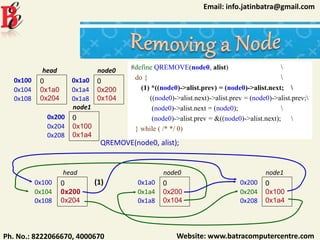
#define QREMOVE(node0, alist) 
do { 
(1) *((node0)->alist.prev) = (node0)->alist.next; 
((node0)->alist.next)->alist.prev = (node0)->alist.prev;
(node0)->alist.next = (node0); 
(node0)->alist.prev = &((node0)->alist.next); 
} while ( /* */ 0)
(1)
Website: www.batracomputercentre.comPh. No.: 8222066670, 4000670
Email: info.jatinbatra@gmail.com
0x100 0
0x200
0x204
head
0x104
0x108
0x1a0 0
0x200
0x104
node0
0x1a4
0x1a8
0x200 0
0x100
0x104
node1
0x204
0x208
0x100 0
0x1a0
0x204
head
0x104
0x108
0x1a0 0
0x200
0x104
node0
0x1a4
0x1a8
0x200 0
0x100
0x1a4
node1
0x204
0x208
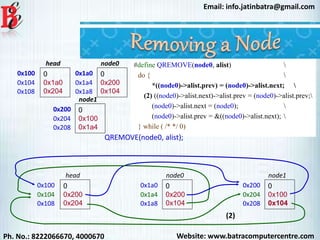
#define QREMOVE(node0, alist) 
do { 
*((node0)->alist.prev) = (node0)->alist.next; 
(2) ((node0)->alist.next)->alist.prev = (node0)->alist.prev;
(node0)->alist.next = (node0); 
(node0)->alist.prev = &((node0)->alist.next); 
} while ( /* */ 0)
(2)
QREMOVE(node0, alist);
Website: www.batracomputercentre.comPh. No.: 8222066670, 4000670
Email: info.jatinbatra@gmail.com
0x100 0
0x200
0x204
head
0x104
0x108
0x1a0 0
0x1a0
0x104
node0
0x1a4
0x1a8
0x200 0
0x100
0x104
node1
0x204
0x208
0x100 0
0x1a0
0x204
head
0x104
0x108
0x1a0 0
0x200
0x104
node0
0x1a4
0x1a8
0x200 0
0x100
0x1a4
node1
0x204
0x208
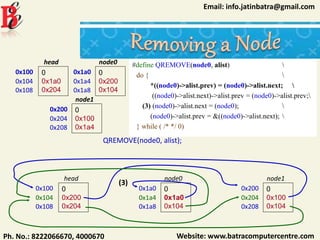
QREMOVE(node0, alist);
#define QREMOVE(node0, alist) 
do { 
*((node0)->alist.prev) = (node0)->alist.next; 
((node0)->alist.next)->alist.prev = (node0)->alist.prev;
(3) (node0)->alist.next = (node0); 
(node0)->alist.prev = &((node0)->alist.next); 
} while ( /* */ 0)
(3)
Website: www.batracomputercentre.comPh. No.: 8222066670, 4000670
Email: info.jatinbatra@gmail.com
0x100 0
0x200
0x204
head
0x104
0x108
0x1a0 0
0x1a0
0x1a4
node0
0x1a4
0x1a8
0x200 0
0x100
0x104
node1
0x204
0x208
0x100 0
0x1a0
0x204
head
0x104
0x108
0x1a0 0
0x200
0x104
node0
0x1a4
0x1a8
0x200 0
0x100
0x1a4
node1
0x204
0x208
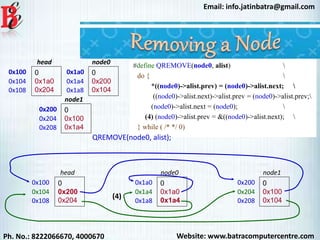
#define QREMOVE(node0, alist) 
do { 
*((node0)->alist.prev) = (node0)->alist.next; 
((node0)->alist.next)->alist.prev = (node0)->alist.prev;
(node0)->alist.next = (node0); 
(4) (node0)->alist.prev = &((node0)->alist.next); 
} while ( /* */ 0)
(4)
QREMOVE(node0, alist);
Website: www.batracomputercentre.comPh. No.: 8222066670, 4000670
Email: info.jatinbatra@gmail.com
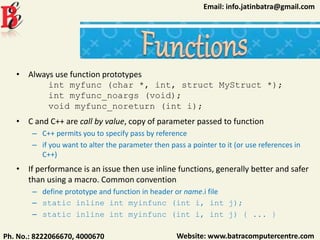
• Always use function prototypes
int myfunc (char *, int, struct MyStruct *);
int myfunc_noargs (void);
void myfunc_noreturn (int i);
• C and C++ are call by value, copy of parameter passed to function
– C++ permits you to specify pass by reference
– if you want to alter the parameter then pass a pointer to it (or use references in
C++)
• If performance is an issue then use inline functions, generally better and safer
than using a macro. Common convention
– define prototype and function in header or name.i file
– static inline int myinfunc (int i, int j);
– static inline int myinfunc (int i, int j) { ... }
Website: www.batracomputercentre.comPh. No.: 8222066670, 4000670
Email: info.jatinbatra@gmail.com
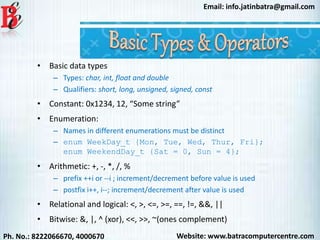
• Basic data types
– Types: char, int, float and double
– Qualifiers: short, long, unsigned, signed, const
• Constant: 0x1234, 12, “Some string”
• Enumeration:
– Names in different enumerations must be distinct
– enum WeekDay_t {Mon, Tue, Wed, Thur, Fri};
enum WeekendDay_t {Sat = 0, Sun = 4};
• Arithmetic: +, -, *, /, %
– prefix ++i or --i ; increment/decrement before value is used
– postfix i++, i--; increment/decrement after value is used
• Relational and logical: <, >, <=, >=, ==, !=, &&, ||
• Bitwise: &, |, ^ (xor), <<, >>, ~(ones complement)
Website: www.batracomputercentre.comPh. No.: 8222066670, 4000670
Email: info.jatinbatra@gmail.com
• structures
– struct MyPoint {int x, int y};
– typedef struct MyPoint MyPoint_t;
– MyPoint_t point, *ptr;
– point.x = 0;point.y = 10;
– ptr = &point; ptr->x = 12; ptr->y = 40;
• unions
– union MyUnion {int x; MyPoint_t pt; struct {int
3; char c[4]} S;};
– union MyUnion x;
– Can only use one of the elements. Memory will be allocated for the
largest element
Website: www.batracomputercentre.comPh. No.: 8222066670, 4000670
Email: info.jatinbatra@gmail.com
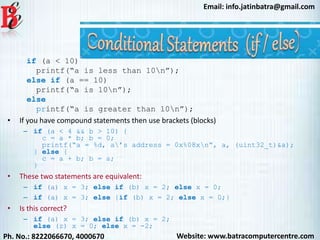
if (a < 10)
printf(“a is less than 10n”);
else if (a == 10)
printf(“a is 10n”);
else
printf(“a is greater than 10n”);
• If you have compound statements then use brackets (blocks)
– if (a < 4 && b > 10) {
c = a * b; b = 0;
printf(“a = %d, a’s address = 0x%08xn”, a, (uint32_t)&a);
} else {
c = a + b; b = a;
}
• These two statements are equivalent:
– if (a) x = 3; else if (b) x = 2; else x = 0;
– if (a) x = 3; else {if (b) x = 2; else x = 0;}
• Is this correct?
– if (a) x = 3; else if (b) x = 2;
else (z) x = 0; else x = -2;
Website: www.batracomputercentre.comPh. No.: 8222066670, 4000670
Email: info.jatinbatra@gmail.com
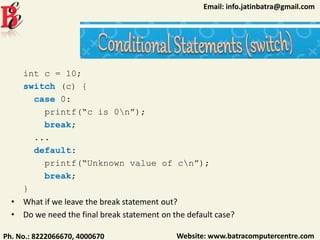
int c = 10;
switch (c) {
case 0:
printf(“c is 0n”);
break;
...
default:
printf(“Unknown value of cn”);
break;
}
• What if we leave the break statement out?
• Do we need the final break statement on the default case?
Website: www.batracomputercentre.comPh. No.: 8222066670, 4000670
Email: info.jatinbatra@gmail.com
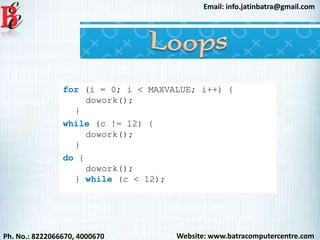
for (i = 0; i < MAXVALUE; i++) {
dowork();
}
while (c != 12) {
dowork();
}
do {
dowork();
} while (c < 12);
Website: www.batracomputercentre.comPh. No.: 8222066670, 4000670
Email: info.jatinbatra@gmail.com
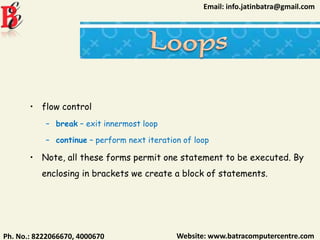
• flow control
– break – exit innermost loop
– continue – perform next iteration of loop
• Note, all these forms permit one statement to be executed. By
enclosing in brackets we create a block of statements.
Website: www.batracomputercentre.comPh. No.: 8222066670, 4000670
Email: info.jatinbatra@gmail.com
Website: www.batracomputercentre.comPh. No.: 8222066670, 4000670
Email: info.jatinbatra@gmail.com
ADDRESS:
SCO -15, Dayal Bagh,
Near Hanuman Mandir
Ambala Cantt-13300, Haryana
Ph. No.: 9729666670, 8222066670 &0171-4000670
Email ID: info.jatinbatra@gmail.com
Website: www.batracomputercentre.com
Website: www.batracomputercentre.comPh. No.: 8222066670, 4000670
Email: info.jatinbatra@gmail.com

C Programming Training in Ambala ! Batra Computer Centre

  • 1.
    Website: www.batracomputercentre.comPh. No.:8222066670, 4000670 Email: info.jatinbatra@gmail.com BATRA COMPUTER CENTRE ISO CERTIFIED 9001:2008
  • 2.
    Website: www.batracomputercentre.comPh. No.:8222066670, 4000670 Email: info.jatinbatra@gmail.com The C programming language was designed by Dennis Ritchie at Bell Laboratories in the early 1970s Influenced by  ALGOL 60 (1960),  CPL (Cambridge, 1963),  BCPL (Martin Richard, 1967),  B (Ken Thompson, 1970) Traditionally used for systems programming, though this may be changing in favor of C++ Traditional C:  The C Programming Language, by Brian Kernighan and Dennis Ritchie, 2nd Edition, Prentice Hall  Referred to as K&R
  • 3.
    Website: www.batracomputercentre.comPh. No.:8222066670, 4000670 Email: info.jatinbatra@gmail.com  Standardized in 1989 by ANSI (American National Standards Institute) known as ANSI C  International standard (ISO) in 1990 which was adopted by ANSI and is known as C89  As part of the normal evolution process the standard was updated in 1995 (C95) and 1999 (C99)  C++ and C  C++ extends C to include support for Object Oriented Programming and other features that facilitate large software development projects  C is not strictly a subset of C++, but it is possible to write “Clean C” that conforms to both the C++ and C standards.
  • 4.
    Website: www.batracomputercentre.comPh. No.:8222066670, 4000670 Email: info.jatinbatra@gmail.com  A C development environment includes  System libraries and headers: a set of standard libraries and their header files. For example see /usr/include and glibc.  Application Source: application source and header files  Compiler: converts source to object code for a specific platform  Linker: resolves external references and produces the executable module  User program structure  there must be one main function where execution begins when the program is run. This function is called main -int main (void) { ... }, -int main (int argc, char *argv[]) { ... } -UNIX Systems have a 3rd way to define main(), though it is not POSIX.1 compliant int main (int argc, char *argv[], char *envp[]) -additional local and external functions and variables
  • 5.
    Website: www.batracomputercentre.comPh. No.:8222066670, 4000670 Email: info.jatinbatra@gmail.com Create example file: try.c Compile using gcc: gcc –o try try.c The standard C library libc is included automatically Execute program ./try Note, I always specify an absolute path Normal termination: void exit(int status); calls functions registered with atexit() flush output streams close all open streams return status value and control to host environment /* you generally want to * include stdio.h and * stdlib.h * */ #include <stdio.h> #include <stdlib.h> int main (void) { printf(“Hello Worldn”); exit(0); }
  • 6.
    Website: www.batracomputercentre.comPh. No.:8222066670, 4000670 Email: info.jatinbatra@gmail.com  Just as in C++, place related code within the same module (i.e. file).  Header files (*.h) export interface definitions  function prototypes, data types, macros, inline functions and other common declarations  Do not place source code (i.e. definitions) in the header file with a few exceptions.  inline’d code  class definitions  const definitions  C preprocessor (cpp) is used to insert common definitions into source files  There are other cool things you can do with the preprocessor
  • 7.
    Website: www.batracomputercentre.comPh. No.:8222066670, 4000670 Email: info.jatinbatra@gmail.com  When you execute a program you can include arguments on the command line.  The run time environment will create an argument vector.  argv is the argument vector  argc is the number of arguments  Argument vector is an array of pointers to strings.  a string is an array of characters terminated by a binary 0 (NULL or ‘0’).  argv[0] is always the program name, so argc is at least 1. ./try –g 2 fred argc = 4, argv = <address0> ‘t’‘r’‘y’‘0’ argv: [0] <addres1> [1] <addres2> [2] <addres3> [3] <addres4> [4] NULL ‘-’‘g’‘0’ ‘2’‘0’ ‘f’‘r’‘e’‘d’‘0’
  • 8.
    Website: www.batracomputercentre.comPh. No.:8222066670, 4000670 Email: info.jatinbatra@gmail.com  Standard Headers you should know about:  stdio.h – file and console (also a file) IO: perror, printf, open, close, read, write, scanf, etc.  stdlib.h - common utility functions: malloc, calloc, strtol, atoi, etc  string.h - string and byte manipulation: strlen, strcpy, strcat, memcpy, memset, etc.  ctype.h – character types: isalnum, isprint, isupport, tolower, etc.  errno.h – defines errno used for reporting system errors  math.h – math functions: ceil, exp, floor, sqrt, etc.  signal.h – signal handling facility: raise, signal, etc  stdint.h – standard integer: intN_t, uintN_t, etc  time.h – time related facility: asctime, clock, time_t, etc.
  • 9.
    Website: www.batracomputercentre.comPh. No.:8222066670, 4000670 Email: info.jatinbatra@gmail.com  The C preprocessor permits you to define simple macros that are evaluated and expanded prior to compilation.  Commands begin with a ‘#’. Abbreviated list:  #define : defines a macro  #undef : removes a macro definition  #include : insert text from file  #if : conditional based on value of expression  #ifdef : conditional based on whether macro defined  #ifndef : conditional based on whether macro is not defined  #else : alternative  #elif : conditional alternative  defined() : preprocessor function: 1 if name defined, else 0 #if defined(__NetBSD__)
  • 10.
    Website: www.batracomputercentre.comPh. No.:8222066670, 4000670 Email: info.jatinbatra@gmail.com  Using macros as functions, exercise caution:  flawed example: #define mymult(a,b) a*b -Source: k = mymult(i-1, j+5); -Post preprocessing: k = i – 1 * j + 5; • better: #define mymult(a,b) (a)*(b) -Source: k = mymult(i-1, j+5); -Post preprocessing: k = (i – 1)*(j + 5);  Be careful of side effects, for example what if we did the following • Macro: #define mysq(a) (a)*(a) • flawed usage: -Source: k = mysq(i++) -Post preprocessing: k = (i++)*(i++)  Alternative is to use inline’ed functions • inline int mysq(int a) {return a*a}; • mysq(i++) works as expected in this case.
  • 11.
    Website: www.batracomputercentre.comPh. No.:8222066670, 4000670 Email: info.jatinbatra@gmail.com • Its generally better to use inline’ed functions • Typically you will use the preprocessor to define constants, perform conditional code inclusion, include header files or to create shortcuts • #define DEFAULT_SAMPLES 100 • #ifdef __linux static inline int64_t gettime(void) {...} • #elif defined(sun) static inline int64_t gettime(void) {return (int64_t)gethrtime()} • #else static inline int64_t gettime(void) {... gettimeofday()...} • #endif
  • 12.
    Website: www.batracomputercentre.comPh. No.:8222066670, 4000670 Email: info.jatinbatra@gmail.com  For any type T, you may form a pointer type to T.  Pointers may reference a function or an object.  The value of a pointer is the address of the corresponding object or function  Examples: int *i; char *x; int (*myfunc)();  Pointer operators: * dereferences a pointer, & creates a pointer (reference to)  int i = 3; int *j = &i; *j = 4; printf(“i = %dn”, i); // prints i = 4  int myfunc (int arg); int (*fptr)(int) = myfunc; i = fptr(4); // same as calling myfunc(4);  Generic pointers:  Traditional C used (char *)  Standard C uses (void *) – these can not be dereferenced or used in pointer arithmetic. So they help to reduce programming errors  Null pointers: use NULL or 0. It is a good idea to always initialize pointers to NULL
  • 13.
    Website: www.batracomputercentre.comPh. No.:8222066670, 4000670 Email: info.jatinbatra@gmail.com Address 0x3dc 0x3d8 Program Memory 0x3cc 0x3c8 0x3c4 0x3c0 Note: The compiler converts z[1] or *(z+1) to Value at address (Address of z + sizeof(int)); In C you would write the byte address as: (char *)z + sizeof(int); or letting the compiler do the work for you (int *)z + 1; Step 1: int main (int argc, argv) { int x = 4; int *y = &x; int *z[4] = {NULL, NULL, NULL, NULL}; int a[4] = {1, 2, 3, 4}; ... 0x3bc 0x3b8 0x3b4 0x3b0 0x3d4 0x3d0 z[3] z[2] z[1] z[0] a[3] a[2] a[1] a[0] 4 0x3dc 0 0 0 0 4 3 2 1 NA NA x y
  • 14.
    Website: www.batracomputercentre.comPh. No.:8222066670, 4000670 Email: info.jatinbatra@gmail.com 4 0x3dc Address 0x3dc 0x3d8 Program Memory 0x3bc 0x3b8 0x3b4 0x3b0 0x3cc 0x3c8 0x3c4 0x3c0 Step 1: int main (int argc, argv) { int x = 4; int *y = &x; int *z[4] = {NULL, NULL, NULL, NULL}; int a[4] = {1, 2, 3, 4}; Step 2: Assign addresses to array Z z[0] = a; // same as &a[0]; z[1] = a + 1; // same as &a[1]; z[2] = a + 2; // same as &a[2]; z[3] = a + 3; // same as &a[3]; 0x3bc 0x3b8 0x3b4 0x3b0 4 3 2 1 NA 0x3d4 0x3d0 z[3] z[2] z[1] z[0] a[3] a[2] a[1] a[0] NA x y
  • 15.
    Website: www.batracomputercentre.comPh. No.:8222066670, 4000670 Email: info.jatinbatra@gmail.com 4 0x3dc Address 0x3dc 0x3d8 Program Memory 0x3bc 0x3b8 0x3b4 0x3b0 0x3cc 0x3c8 0x3c4 0x3c0 Step 1: int main (int argc, argv) { int x = 4; int *y = &x; int *z[4] = {NULL, NULL, NULL, NULL}; int a[4] = {1, 2, 3, 4}; Step 2: z[0] = a; z[1] = a + 1; z[2] = a + 2; z[3] = a + 3; Step 3: No change in z’s values z[0] = (int *)((char *)a); z[1] = (int *)((char *)a + sizeof(int)); z[2] = (int *)((char *)a + 2 * sizeof(int)); z[3] = (int *)((char *)a + 3 * sizeof(int)); 0x3bc 0x3b8 0x3b4 0x3b0 4 3 2 1 NA 0x3d4 0x3d0 z[3] z[2] z[1] z[0] a[3] a[2] a[1] a[0] NA x y
  • 16.
    Website: www.batracomputercentre.comPh. No.:8222066670, 4000670 Email: info.jatinbatra@gmail.com #define QNODE(type) struct { struct type *next; struct type **prev; } #define QNODE_INIT(node, field) do { (node)->field.next = (node); (node)->field.prev = &(node)- >field.next; } while ( /* */ 0 ); #define QFIRST(head, field) ((head)->field.next) #define QNEXT(node, field) ((node)->field.next) #define QEMPTY(head, field) ((head)->field.next == (head)) #define QFOREACH(head, var, field) for ((var) = (head)- >field.next; (var) != (head); (var) = (var)- >field.next)
  • 17.
    Website: www.batracomputercentre.comPh. No.:8222066670, 4000670 Email: info.jatinbatra@gmail.com #define QINSERT_BEFORE(loc, node, field) do { *(loc)->field.prev = (node); (node)->field.prev = (loc)->field.prev; (loc)->field.prev = &((node)->field.next); (node)->field.next = (loc); } while (/* */0) #define QINSERT_AFTER(loc, node, field) do { ((loc)->field.next)->field.prev = &(node)->field.next; (node)->field.next = (loc)- >field.next; (loc)->field.next = (node); (node)->field.prev = &(loc)- >field.next; } while ( /* */ 0) #define QREMOVE(node, field) do { *((node)->field.prev) = (node)- >field.next; ((node)->field.next)->field.prev = (node)- >field.prev; (node)->field.next = (node); (node)->field.prev = &((node)- >field.next); } while ( /* */ 0)
  • 18.
    Website: www.batracomputercentre.comPh. No.:8222066670, 4000670 Email: info.jatinbatra@gmail.com typedef struct wth_t { int state; QNODE(wth_t) alist; } wth_t; #define QNODE(type) struct { struct type *next; struct type **prev; } typedef struct wth_t { int state; struct { struct wth_t *next; struct wth_t **prev; } alist; } wth_t; <integer> state <address> next <address> prev 3 words in memory 0 0x00100 0x00104 0x100 head: instance of wth_t 0x104 0x108 memory layout after GCC CPP QNODE_INIT(head, alist) #define QNODE_INIT(node, field) do { (node)->field.next = (node); (node)->field.prev = &(node)->field.next; } while ( /* */ 0 );
  • 19.
    Website: www.batracomputercentre.comPh. No.:8222066670, 4000670 Email: info.jatinbatra@gmail.com #define QINSERT_BEFORE(head, node, alist) do { *(head)->alist.prev = (node); (node)->alist.prev = (head)->alist.prev; (head)->alist.prev = &(node)->alist.next; (node)->alist.next = (head); } while (/* */0) 0x100 0 0x100 0x104 head 0x104 0x108 0x1a0 0 0x1a0 0x1a4 node0 0x1a4 0x1a8 QINSERT_BEFORE(head, node0, alist); ? before
  • 20.
    Website: www.batracomputercentre.comPh. No.:8222066670, 4000670 Email: info.jatinbatra@gmail.com #define QINSERT_BEFORE(head, node, alist) do { *(head)->alist.prev = (node); (node)->alist.prev = (head)->alist.prev; (head)->alist.prev = &(node)->alist.next; (node)->alist.next = (head); } while (/* */0) 0x100 0 0x100 0x104 head 0x104 0x108 0x1a0 0 0x1a0 0x1a4 node0 0x1a4 0x1a8 QINSERT_BEFORE(head, node0, alist); 0x100 0 0x1a0 0x104 head 0x104 0x108 0x1a0 0 0x1a0 0x1a4 node0 0x1a4 0x1a8 before
  • 21.
    Website: www.batracomputercentre.comPh. No.:8222066670, 4000670 Email: info.jatinbatra@gmail.com #define QINSERT_BEFORE(head, node, alist) do { *(head)->alist.prev = (node); (node)->alist.prev = (head)->alist.prev; (head)->alist.prev = &(node)->alist.next; (node)->alist.next = (head); } while (/* */0) 0x100 0 0x100 0x104 head 0x104 0x108 0x1a0 0 0x1a0 0x1a4 node0 0x1a4 0x1a8 QINSERT_BEFORE(head, node0, alist); 0x100 0 0x1a0 0x104 head 0x104 0x108 0x1a0 0 0x1a0 0x104 node0 0x1a4 0x1a8 before
  • 22.
    Website: www.batracomputercentre.comPh. No.:8222066670, 4000670 Email: info.jatinbatra@gmail.com #define QINSERT_BEFORE(head, node, alist) do { *(head)->alist.prev = (node); (node)->alist.prev = (head)->alist.prev; (head)->alist.prev = &(node)->alist.next; (node)->alist.next = (head); } while (/* */0) 0x100 0 0x100 0x104 head 0x104 0x108 0x1a0 0 0x1a0 0x1a4 node0 0x1a4 0x1a8 QINSERT_BEFORE(head, node0, alist); 0x100 0 0x1a0 0x1a4 head 0x104 0x108 0x1a0 0 0x1a0 0x104 node0 0x1a4 0x1a8 before
  • 23.
    Website: www.batracomputercentre.comPh. No.:8222066670, 4000670 Email: info.jatinbatra@gmail.com #define QINSERT_BEFORE(head, node, alist) do { *(head)->alist.prev = (node); (node)->alist.prev = (head)->alist.prev; (head)->alist.prev = &(node)->alist.next; (node)->alist.next = (head); } while (/* */0) 0x100 0 0x100 0x104 head 0x104 0x108 0x1a0 0 0x1a0 0x1a4 node0 0x1a4 0x1a8 QINSERT_BEFORE(head, node0, alist); 0x100 0 0x1a0 0x1a4 head 0x104 0x108 0x1a0 0 0x100 0x104 node0 0x1a4 0x1a8 before
  • 24.
    Website: www.batracomputercentre.comPh. No.:8222066670, 4000670 Email: info.jatinbatra@gmail.com #define QINSERT_BEFORE(head, node, alist) do { *(head)->alist.prev = (node); (node)->alist.prev = (head)->alist.prev; (head)->alist.prev = &(node)->alist.next; (node)->alist.next = (head); } while (/* */0) 0x100 0 0x100 0x104 head 0x104 0x108 0x1a0 0 0x1a0 0x1a4 node0 0x1a4 0x1a8 QINSERT_BEFORE(head, node0, alist); 0x100 0 0x1a0 0x1a4 head 0x104 0x108 0x1a0 0 0x100 0x104 node0 0x1a4 0x1a8 before
  • 25.
    Website: www.batracomputercentre.comPh. No.:8222066670, 4000670 Email: info.jatinbatra@gmail.com 0x100 0 0x1a0 0x1a4 head 0x104 0x108 0x1a0 0 0x100 0x104 node0 0x1a4 0x1a8 QINSERT_BEFORE(head, node1, alist); 0x200 0 0x200 0x204 node1 0x204 0x208 #define QINSERT_BEFORE(head, node, alist) do { *(head)->alist.prev = (node); (node)->alist.prev = (head)->alist.prev; (head)->alist.prev = &(node)->alist.next; (node)->alist.next = (head); } while (/* */0) 0x200 0 0x200 0x204 node1 0x204 0x208 0x100 0 0x1a0 0x1a4 head 0x104 0x108 0x1a0 0 0x100 0x104 node0 0x1a4 0x1a8
  • 26.
    Website: www.batracomputercentre.comPh. No.:8222066670, 4000670 Email: info.jatinbatra@gmail.com 0x100 0 0x1a0 0x1a4 head 0x104 0x108 0x1a0 0 0x100 0x104 node0 0x1a4 0x1a8 QINSERT_BEFORE(head, node1, alist); 0x100 0 0x1a0 0x1a4 head 0x104 0x108 0x1a0 0 0x200 0x104 node0 0x1a4 0x1a8 0x200 0 0x200 0x204 node1 0x204 0x208 #define QINSERT_BEFORE(head, node1, alist) do { *(head)->alist.prev = (node1); (node1)->alist.prev = (head)->alist.prev; (head)->alist.prev = &(node1)->alist.next; (node1)->alist.next = (head); } while (/* */0) 0x200 0 0x200 0x204 node1 0x204 0x208 (1) (1)
  • 27.
    Website: www.batracomputercentre.comPh. No.:8222066670, 4000670 Email: info.jatinbatra@gmail.com 0x100 0 0x1a0 0x1a4 head 0x104 0x108 0x1a0 0 0x100 0x104 node0 0x1a4 0x1a8 QINSERT_BEFORE(head, node1, alist); 0x100 0 0x1a0 0x1a4 head 0x104 0x108 0x1a0 0 0x200 0x104 node0 0x1a4 0x1a8 0x200 0 0x200 0x204 node1 0x204 0x208 #define QINSERT_BEFORE(head, node1, alist) do { *(head)->alist.prev = (node1); (node1)->alist.prev = (head)->alist.prev; (head)->alist.prev = &(node1)->alist.next; (node1)->alist.next = (head); } while (/* */0) 0x200 0 0x200 0x1a4 node1 0x204 0x208 (1) (2) (2)
  • 28.
    Website: www.batracomputercentre.comPh. No.:8222066670, 4000670 Email: info.jatinbatra@gmail.com 0x100 0 0x1a0 0x1a4 head 0x104 0x108 0x1a0 0 0x100 0x104 node0 0x1a4 0x1a8 QINSERT_BEFORE(head, node1, alist); 0x100 0 0x1a0 0x204 head 0x104 0x108 0x1a0 0 0x200 0x104 node0 0x1a4 0x1a8 0x200 0 0x200 0x204 node1 0x204 0x208 #define QINSERT_BEFORE(head, node1, alist) do { *(head)->alist.prev = (node1); (node1)->alist.prev = (head)->alist.prev; (head)->alist.prev = &(node1)->alist.next; (node1)->alist.next = (head); } while (/* */0) 0x200 0 0x200 0x1a4 node1 0x204 0x208 (1) (1) (2) (2) (3) (3)
  • 29.
    Website: www.batracomputercentre.comPh. No.:8222066670, 4000670 Email: info.jatinbatra@gmail.com 0x100 0 0x1a0 0x1a4 head 0x104 0x108 0x1a0 0 0x100 0x104 node0 0x1a4 0x1a8 QINSERT_BEFORE(head, node1, alist); 0x100 0 0x1a0 0x204 head 0x104 0x108 0x1a0 0 0x200 0x104 node0 0x1a4 0x1a8 0x200 0 0x200 0x204 node1 0x204 0x208 #define QINSERT_BEFORE(head, node1, alist) do { *(head)->alist.prev = (node1); (node1)->alist.prev = (head)->alist.prev; (head)->alist.prev = &(node1)->alist.next; (node1)->alist.next = (head); } while (/* */0) 0x200 0 0x100 0x1a4 node1 0x204 0x208 (1) (1) (2) (2) (3) (3) (4) (4)
  • 30.
    Website: www.batracomputercentre.comPh. No.:8222066670, 4000670 Email: info.jatinbatra@gmail.com 0x100 0 0x1a0 0x204 head 0x104 0x108 0x1a0 0 0x200 0x104 node0 0x1a4 0x1a8 0x200 0 0x100 0x1a4 node1 0x204 0x208 QREMOVE(node0, alist); 0x100 0 ?? ?? head 0x104 0x108 0x1a0 0 ?? ?? node0 0x1a4 0x1a8 0x200 0 ?? ?? node1 0x204 0x208 #define QREMOVE(node, alist) do { (1) *((node)->alist.prev) = (node)->alist.next; (2) ((node)->alist.next)->alist.prev = (node)->alist.prev; (3) (node)->alist.next = (node); (4) (node)->alist.prev = &((node)->alist.next); } while ( /* */ 0)
  • 31.
    Website: www.batracomputercentre.comPh. No.:8222066670, 4000670 Email: info.jatinbatra@gmail.com 0x100 0 0x1a0 0x204 head 0x104 0x108 0x1a0 0 0x200 0x104 node0 0x1a4 0x1a8 0x200 0 0x100 0x1a4 node1 0x204 0x208 QREMOVE(node0, alist); #define QREMOVE(node, alist) do { *((node)->alist.prev) = (node)->alist.next; ((node)->alist.next)->alist.prev = (node)->alist.prev; (node)->alist.next = (node); (node)->alist.prev = &((node)->alist.next); } while ( /* */ 0) 0x100 0 0x1a0 0x204 head 0x104 0x108 0x1a0 0 0x200 0x104 node0 0x1a4 0x1a8 0x200 0 0x100 0x1a4 node1 0x204 0x208
  • 32.
    Website: www.batracomputercentre.comPh. No.:8222066670, 4000670 Email: info.jatinbatra@gmail.com 0x100 0 0x200 0x204 head 0x104 0x108 0x1a0 0 0x200 0x104 node0 0x1a4 0x1a8 0x200 0 0x100 0x1a4 node1 0x204 0x208 0x100 0 0x1a0 0x204 head 0x104 0x108 0x1a0 0 0x200 0x104 node0 0x1a4 0x1a8 0x200 0 0x100 0x1a4 node1 0x204 0x208 QREMOVE(node0, alist); #define QREMOVE(node0, alist) do { (1) *((node0)->alist.prev) = (node0)->alist.next; ((node0)->alist.next)->alist.prev = (node0)->alist.prev; (node0)->alist.next = (node0); (node0)->alist.prev = &((node0)->alist.next); } while ( /* */ 0) (1)
  • 33.
    Website: www.batracomputercentre.comPh. No.:8222066670, 4000670 Email: info.jatinbatra@gmail.com 0x100 0 0x200 0x204 head 0x104 0x108 0x1a0 0 0x200 0x104 node0 0x1a4 0x1a8 0x200 0 0x100 0x104 node1 0x204 0x208 0x100 0 0x1a0 0x204 head 0x104 0x108 0x1a0 0 0x200 0x104 node0 0x1a4 0x1a8 0x200 0 0x100 0x1a4 node1 0x204 0x208 #define QREMOVE(node0, alist) do { *((node0)->alist.prev) = (node0)->alist.next; (2) ((node0)->alist.next)->alist.prev = (node0)->alist.prev; (node0)->alist.next = (node0); (node0)->alist.prev = &((node0)->alist.next); } while ( /* */ 0) (2) QREMOVE(node0, alist);
  • 34.
    Website: www.batracomputercentre.comPh. No.:8222066670, 4000670 Email: info.jatinbatra@gmail.com 0x100 0 0x200 0x204 head 0x104 0x108 0x1a0 0 0x1a0 0x104 node0 0x1a4 0x1a8 0x200 0 0x100 0x104 node1 0x204 0x208 0x100 0 0x1a0 0x204 head 0x104 0x108 0x1a0 0 0x200 0x104 node0 0x1a4 0x1a8 0x200 0 0x100 0x1a4 node1 0x204 0x208 QREMOVE(node0, alist); #define QREMOVE(node0, alist) do { *((node0)->alist.prev) = (node0)->alist.next; ((node0)->alist.next)->alist.prev = (node0)->alist.prev; (3) (node0)->alist.next = (node0); (node0)->alist.prev = &((node0)->alist.next); } while ( /* */ 0) (3)
  • 35.
    Website: www.batracomputercentre.comPh. No.:8222066670, 4000670 Email: info.jatinbatra@gmail.com 0x100 0 0x200 0x204 head 0x104 0x108 0x1a0 0 0x1a0 0x1a4 node0 0x1a4 0x1a8 0x200 0 0x100 0x104 node1 0x204 0x208 0x100 0 0x1a0 0x204 head 0x104 0x108 0x1a0 0 0x200 0x104 node0 0x1a4 0x1a8 0x200 0 0x100 0x1a4 node1 0x204 0x208 #define QREMOVE(node0, alist) do { *((node0)->alist.prev) = (node0)->alist.next; ((node0)->alist.next)->alist.prev = (node0)->alist.prev; (node0)->alist.next = (node0); (4) (node0)->alist.prev = &((node0)->alist.next); } while ( /* */ 0) (4) QREMOVE(node0, alist);
  • 36.
    Website: www.batracomputercentre.comPh. No.:8222066670, 4000670 Email: info.jatinbatra@gmail.com • Always use function prototypes int myfunc (char *, int, struct MyStruct *); int myfunc_noargs (void); void myfunc_noreturn (int i); • C and C++ are call by value, copy of parameter passed to function – C++ permits you to specify pass by reference – if you want to alter the parameter then pass a pointer to it (or use references in C++) • If performance is an issue then use inline functions, generally better and safer than using a macro. Common convention – define prototype and function in header or name.i file – static inline int myinfunc (int i, int j); – static inline int myinfunc (int i, int j) { ... }
  • 37.
    Website: www.batracomputercentre.comPh. No.:8222066670, 4000670 Email: info.jatinbatra@gmail.com • Basic data types – Types: char, int, float and double – Qualifiers: short, long, unsigned, signed, const • Constant: 0x1234, 12, “Some string” • Enumeration: – Names in different enumerations must be distinct – enum WeekDay_t {Mon, Tue, Wed, Thur, Fri}; enum WeekendDay_t {Sat = 0, Sun = 4}; • Arithmetic: +, -, *, /, % – prefix ++i or --i ; increment/decrement before value is used – postfix i++, i--; increment/decrement after value is used • Relational and logical: <, >, <=, >=, ==, !=, &&, || • Bitwise: &, |, ^ (xor), <<, >>, ~(ones complement)
  • 38.
    Website: www.batracomputercentre.comPh. No.:8222066670, 4000670 Email: info.jatinbatra@gmail.com • structures – struct MyPoint {int x, int y}; – typedef struct MyPoint MyPoint_t; – MyPoint_t point, *ptr; – point.x = 0;point.y = 10; – ptr = &point; ptr->x = 12; ptr->y = 40; • unions – union MyUnion {int x; MyPoint_t pt; struct {int 3; char c[4]} S;}; – union MyUnion x; – Can only use one of the elements. Memory will be allocated for the largest element
  • 39.
    Website: www.batracomputercentre.comPh. No.:8222066670, 4000670 Email: info.jatinbatra@gmail.com if (a < 10) printf(“a is less than 10n”); else if (a == 10) printf(“a is 10n”); else printf(“a is greater than 10n”); • If you have compound statements then use brackets (blocks) – if (a < 4 && b > 10) { c = a * b; b = 0; printf(“a = %d, a’s address = 0x%08xn”, a, (uint32_t)&a); } else { c = a + b; b = a; } • These two statements are equivalent: – if (a) x = 3; else if (b) x = 2; else x = 0; – if (a) x = 3; else {if (b) x = 2; else x = 0;} • Is this correct? – if (a) x = 3; else if (b) x = 2; else (z) x = 0; else x = -2;
  • 40.
    Website: www.batracomputercentre.comPh. No.:8222066670, 4000670 Email: info.jatinbatra@gmail.com int c = 10; switch (c) { case 0: printf(“c is 0n”); break; ... default: printf(“Unknown value of cn”); break; } • What if we leave the break statement out? • Do we need the final break statement on the default case?
  • 41.
    Website: www.batracomputercentre.comPh. No.:8222066670, 4000670 Email: info.jatinbatra@gmail.com for (i = 0; i < MAXVALUE; i++) { dowork(); } while (c != 12) { dowork(); } do { dowork(); } while (c < 12);
  • 42.
    Website: www.batracomputercentre.comPh. No.:8222066670, 4000670 Email: info.jatinbatra@gmail.com • flow control – break – exit innermost loop – continue – perform next iteration of loop • Note, all these forms permit one statement to be executed. By enclosing in brackets we create a block of statements.
  • 43.
    Website: www.batracomputercentre.comPh. No.:8222066670, 4000670 Email: info.jatinbatra@gmail.com
  • 44.
    Website: www.batracomputercentre.comPh. No.:8222066670, 4000670 Email: info.jatinbatra@gmail.com ADDRESS: SCO -15, Dayal Bagh, Near Hanuman Mandir Ambala Cantt-13300, Haryana Ph. No.: 9729666670, 8222066670 &0171-4000670 Email ID: info.jatinbatra@gmail.com Website: www.batracomputercentre.com
  • 45.
    Website: www.batracomputercentre.comPh. No.:8222066670, 4000670 Email: info.jatinbatra@gmail.com