Group member
• Manash Kumar Mondal
• Shariar Niloy
Types of if statement
What is if statement?
The if statement either selects an action, if a condition is
true or skips the action if the condition is false.
“If it is not raining, we will go to school.”
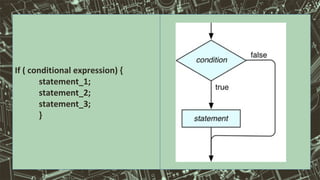
If ( conditional expression) {
statement_1;
statement_2;
statement_3;
}
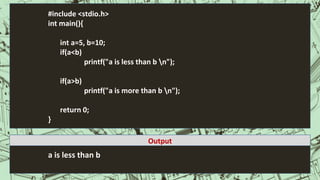
#include <stdio.h>
int main(){
int a=5, b=10;
if(a<b)
printf("a is less than b n");
if(a>b)
printf("a is more than b n");
return 0;
}
a is less than b
Output
It allows you to specify that
different actions are to be
performed when the condition is
true and when it’s false.
If else
statement
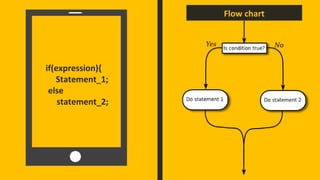
Flow chart
if(expression){
Statement_1;
else
statement_2;
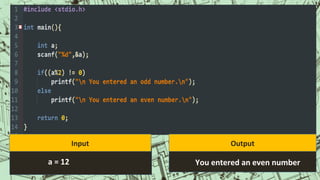
You entered an even numbera = 12
OutputInput
Nested loop?
If we use if else as a compound statement in another if else,
then it is called nested loop.
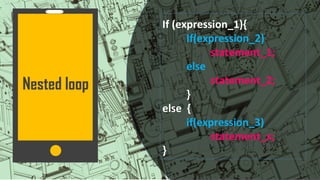
Nested loop
If (expression_1){
If(expression_2)
statement_1;
else
statement_2;
}
else {
if(expression_3)
statement_x;
}
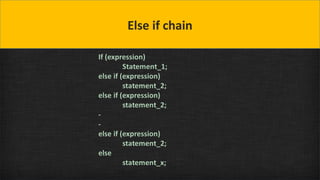
Else if chain
A switch statement is a type of selection control
mechanism used to allow the value of a variable or
expression to change the control flow of program
execution via a multiway branch.
Switch
statement
Flow diagram
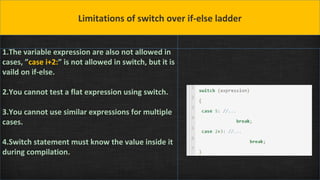
Limitations of switch over if-else ladder
1.The variable expression are also not allowed in
cases, ”case i+2:” is not allowed in switch, but it is
vaild on if-else.
2.You cannot test a flat expression using switch.
3.You cannot use similar expressions for multiple
cases.
4.Switch statement must know the value inside it
during compilation.
Advantages of switch over if-else ladder
1.A switch statement works much faster than equivalent if-else
ladder.
2.It is more readable and in compare to if-else statements.
3.It is more manageable for having higher level of indentation than if.
4. Here multiple statements need not to be enclosed within a pair of
braces.
Where to use
switch over if-
else ladder
1.If there are large number of
compares for a condition in your
program, use switch over if-else
ladder.
2.For more complex comparisons.
}
Where to use if-
else ladder over
switch
In case of simple and few
compares, if-else executes faster
and easy write. Thus as per
program’s requirement, a
programmer should decide
himself where to use which one
condition control.
Thank you….

If-else and switch-case

  • 2.
    Group member • ManashKumar Mondal • Shariar Niloy
  • 3.
    Types of ifstatement
  • 4.
    What is ifstatement? The if statement either selects an action, if a condition is true or skips the action if the condition is false. “If it is not raining, we will go to school.”
  • 5.
    If ( conditionalexpression) { statement_1; statement_2; statement_3; }
  • 6.
    #include <stdio.h> int main(){ inta=5, b=10; if(a<b) printf("a is less than b n"); if(a>b) printf("a is more than b n"); return 0; } a is less than b Output
  • 7.
    It allows youto specify that different actions are to be performed when the condition is true and when it’s false. If else statement
  • 8.
  • 9.
    You entered aneven numbera = 12 OutputInput
  • 10.
    Nested loop? If weuse if else as a compound statement in another if else, then it is called nested loop.
  • 11.
  • 12.
  • 13.
    A switch statementis a type of selection control mechanism used to allow the value of a variable or expression to change the control flow of program execution via a multiway branch. Switch statement
  • 15.
  • 16.
    Limitations of switchover if-else ladder 1.The variable expression are also not allowed in cases, ”case i+2:” is not allowed in switch, but it is vaild on if-else. 2.You cannot test a flat expression using switch. 3.You cannot use similar expressions for multiple cases. 4.Switch statement must know the value inside it during compilation.
  • 17.
    Advantages of switchover if-else ladder 1.A switch statement works much faster than equivalent if-else ladder. 2.It is more readable and in compare to if-else statements. 3.It is more manageable for having higher level of indentation than if. 4. Here multiple statements need not to be enclosed within a pair of braces.
  • 18.
    Where to use switchover if- else ladder 1.If there are large number of compares for a condition in your program, use switch over if-else ladder. 2.For more complex comparisons. }
  • 19.
    Where to useif- else ladder over switch In case of simple and few compares, if-else executes faster and easy write. Thus as per program’s requirement, a programmer should decide himself where to use which one condition control.
  • 20.