Generators,Coroutines
andOtherBrain
UnrollingSweetness
ADI S HAVI T
Corehard.by :: 2019
Generators,Coroutines
andOtherBrain
UnrollingSweetness
ADI S HAVI T
Corehard.by :: 2019
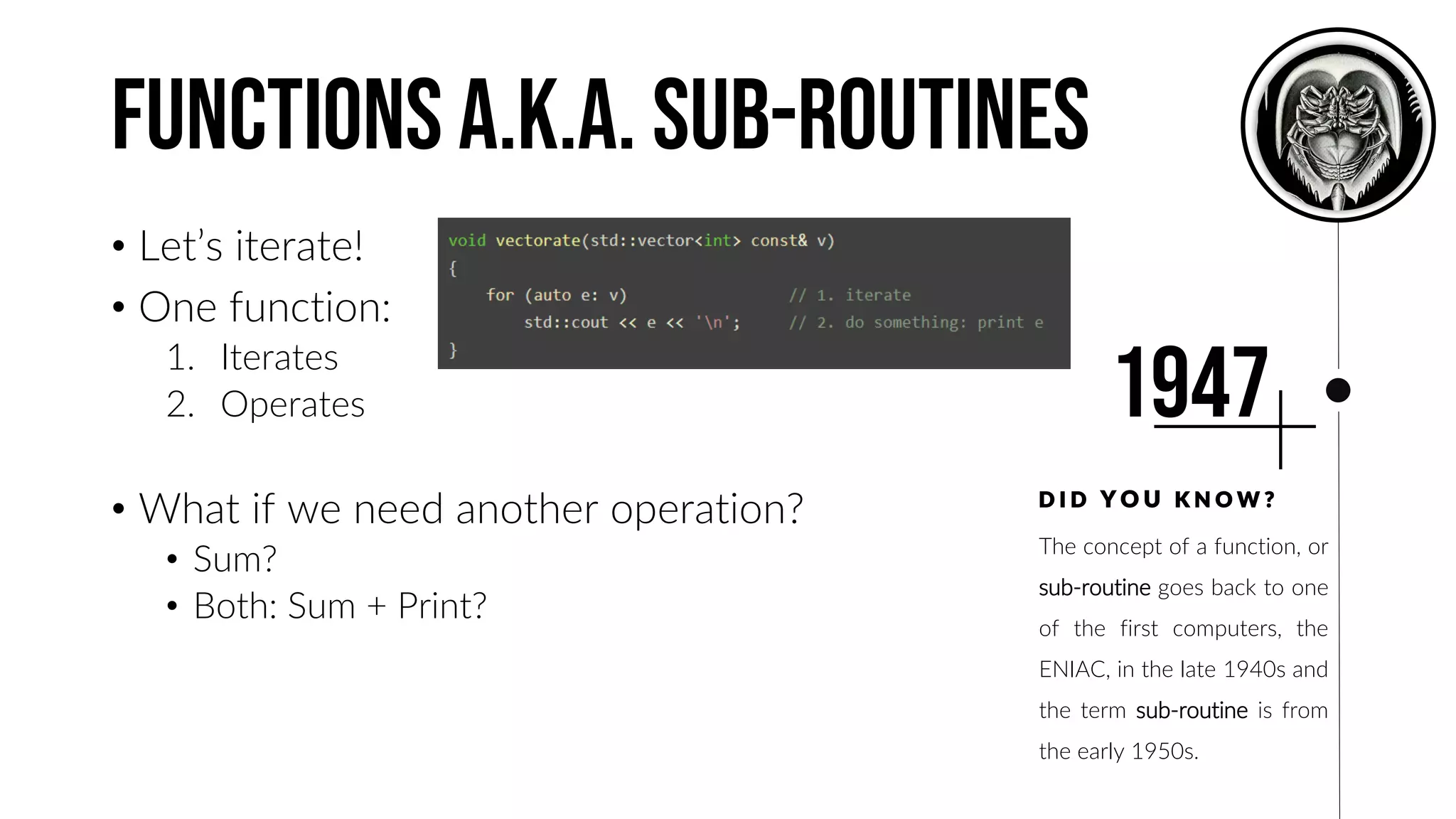
Functions A.K.A. Sub-Routines
• Let’s iterate!
• One function:
1. Iterates
2. Operates
• What if we need another operation?
• Sum?
• Both: Sum + Print?
The concept of a function, or
sub-routine goes back to one
of the first computers, the
ENIAC, in the late 1940s and
the term sub-routine is from
the early 1950s.
D I D Y O U K N O W ?
1947
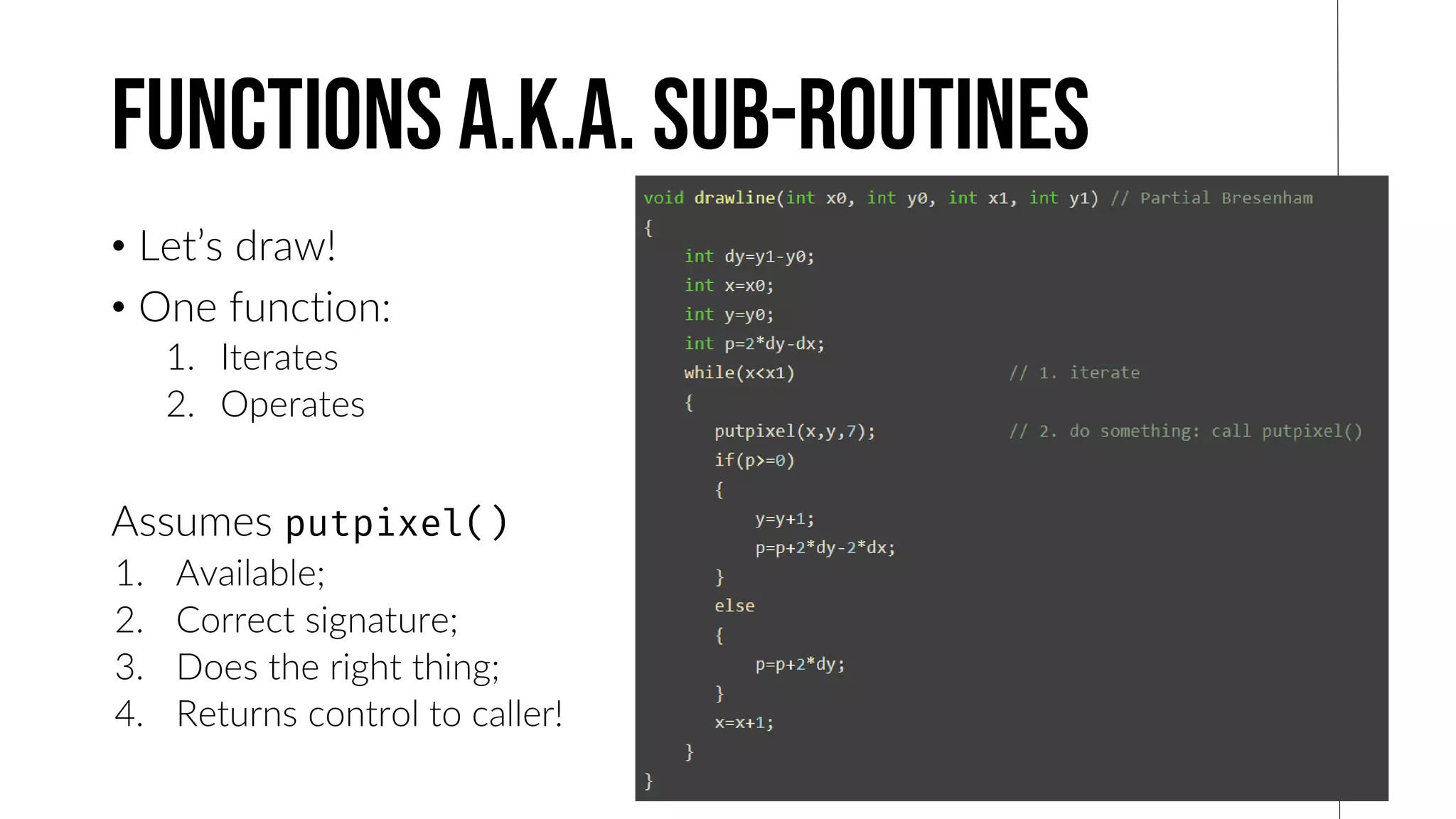
Functions A.K.A. Sub-Routines
• Let’s draw!
• One function:
1. Iterates
2. Operates
Assumes
1. Available;
2. Correct signature;
3. Does the right thing;
4. Returns control to caller!
Subroutines
are eager
and closed
E A G E R P R O C E S S I N G
“Closed” in the sense that
they only return after
they have iterated over
the whole sequence.
They eagerly process a
whole sequence.
▪Inversion-of-Control
▪Callback Hell
▪still eager
▪ Function pointers
▪ Lambdas
▪ Callable template parameters or Concepts
E XTE RNAL C A L L A B L E S
CALLBACKS
C a n w e B r e a k t h e m o p e n ?
If only there was a way to “flip” these
iterating functions “inside-out” and iterate
over a sequence without pre-committing to
a specific operation.
Iterators
• Iterator Objects and Iterator Adaptors
• “Stand-alone” types;
• Often indirectly or implicitly coupled to a sequence
• Examples from the C++ standard:
•
•
•
The concept of Iterators has
been with C++ since the STL
was designed by Alex
Stepanov and together with
the rest of the STL became
part of C++98.
D I D Y O U K N O W ?
1998
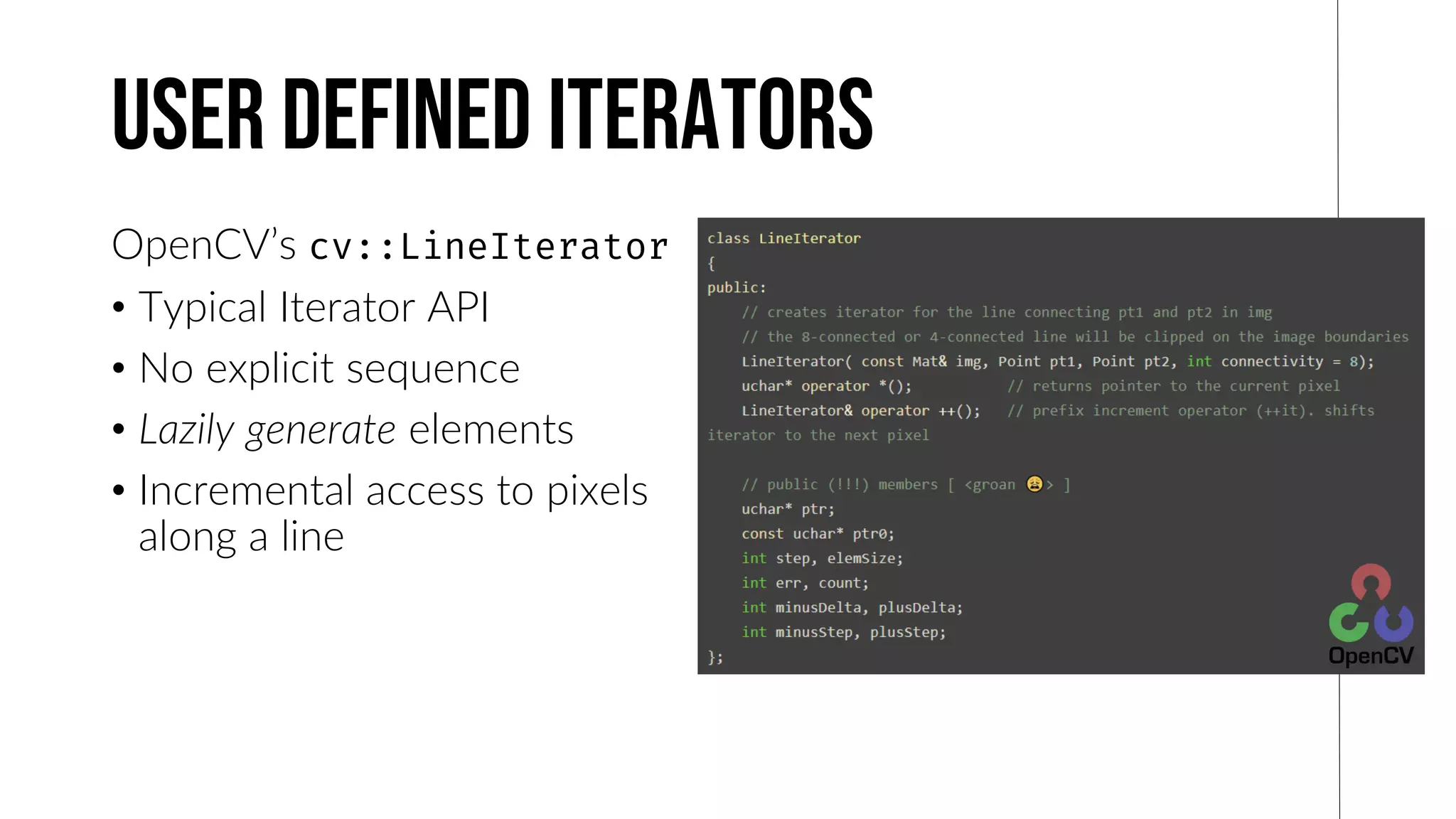
User defined iterators
OpenCV’s
• Typical Iterator API
• No explicit sequence
• Lazily generate elements
• Incremental access to pixels
along a line
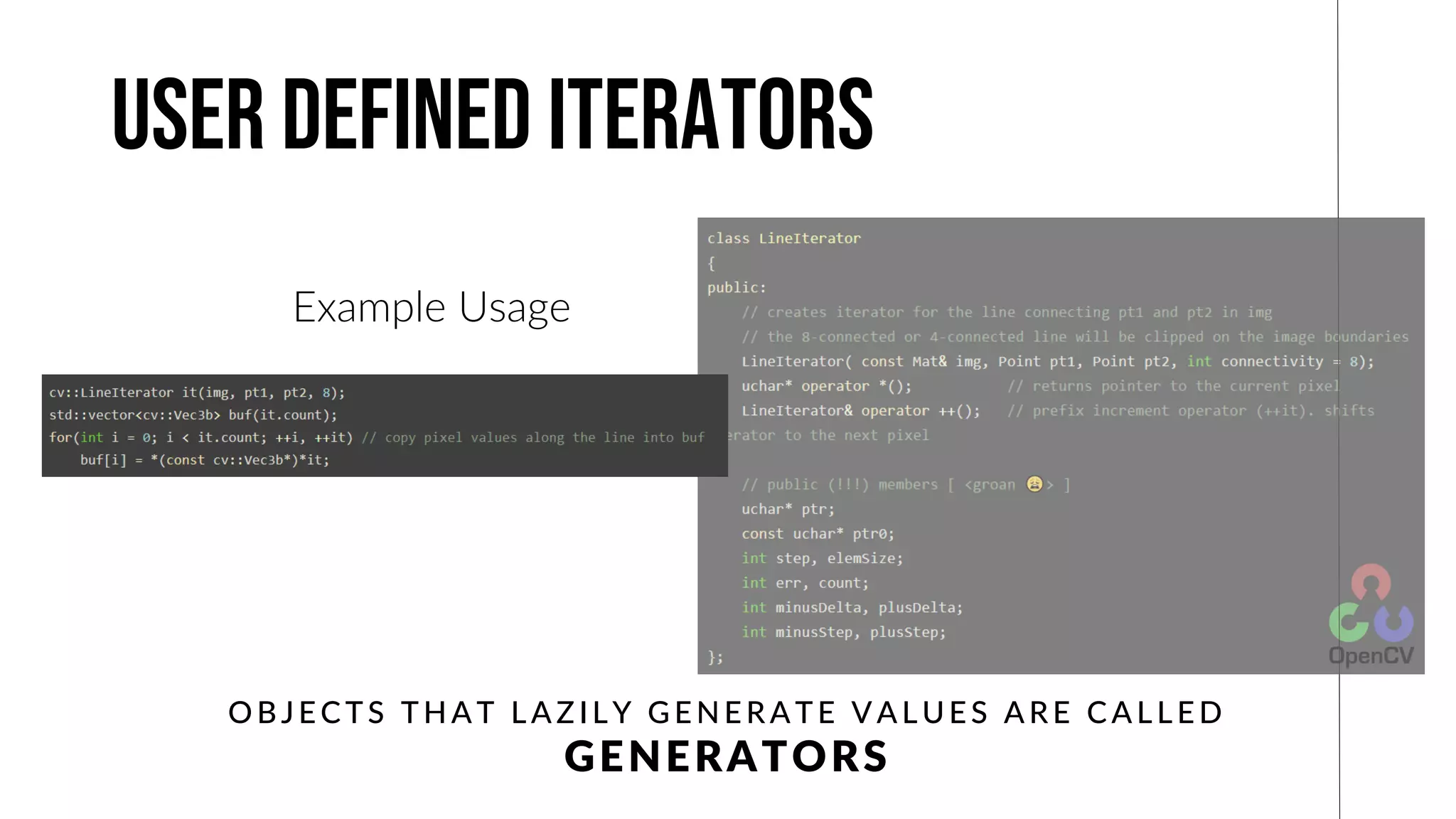
User defined iterators
Example Usage
OBJECTS THAT LAZILY GENERATE VALUES ARE CALLED
GENERATORS
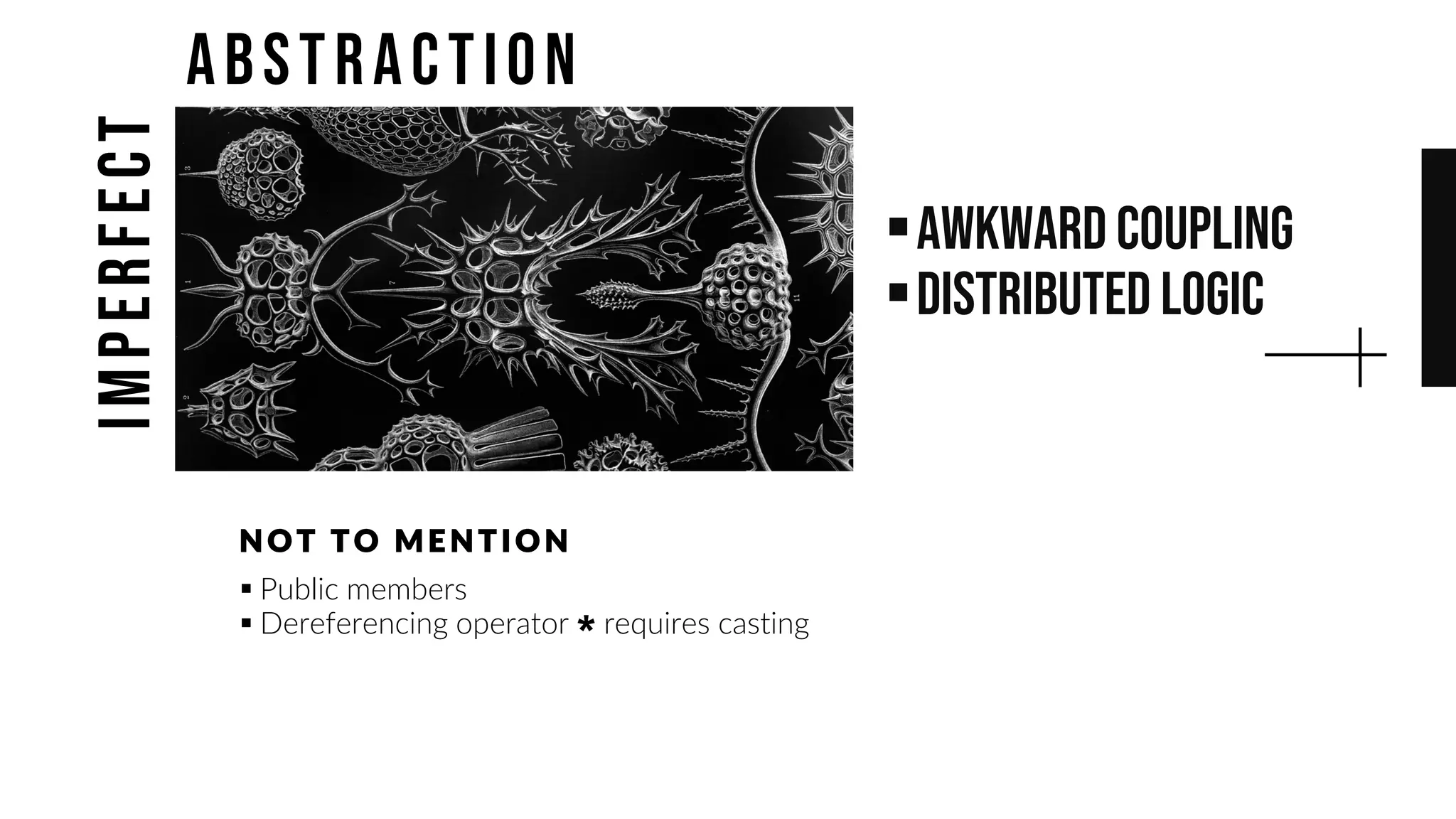
▪awkward Coupling
▪Distributed Logic
▪ Public members
▪ Dereferencing operator requires casting
NOT TO ME NTION
imperfect
abstraction
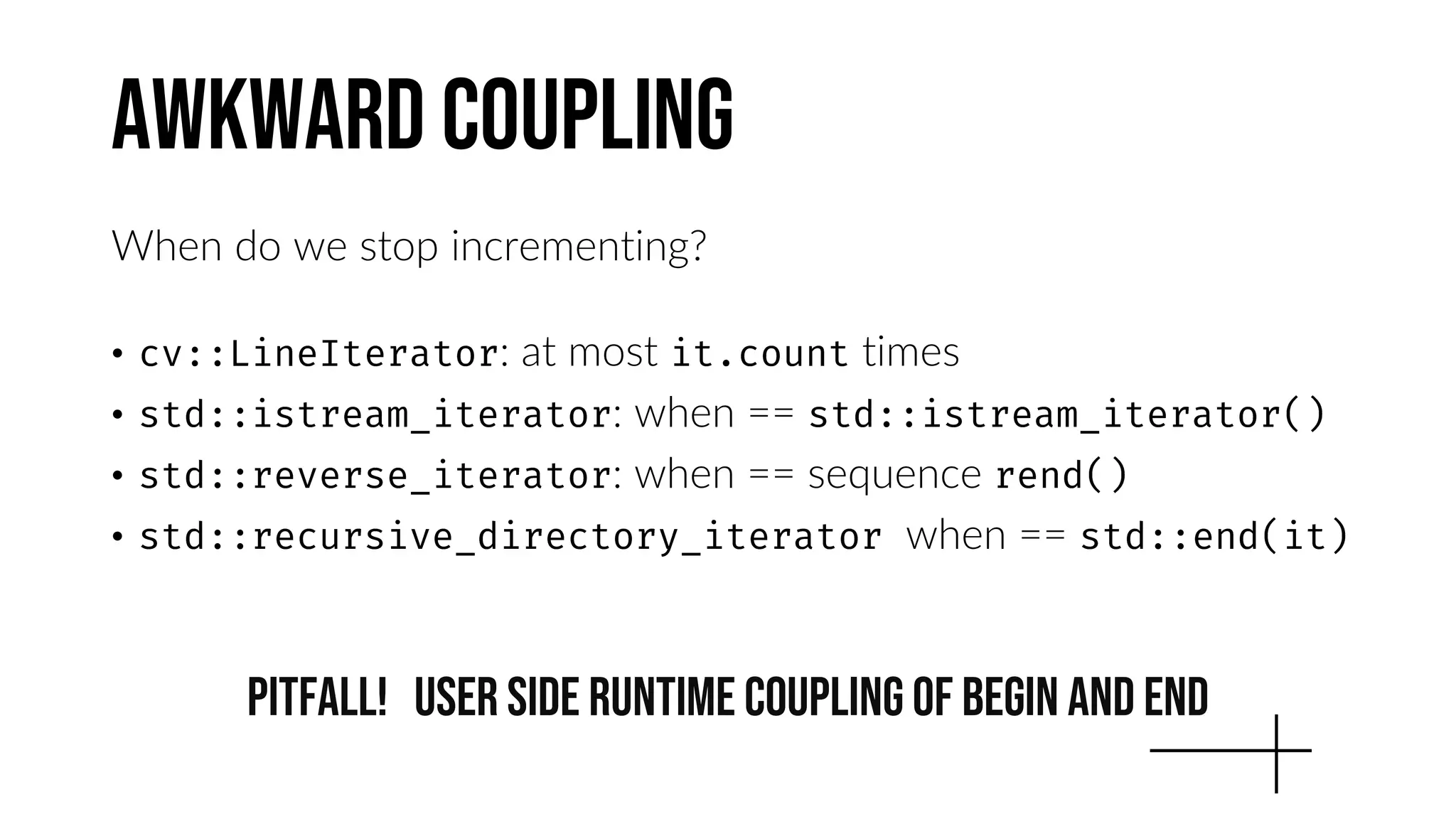
awkward Coupling
When do we stop incrementing?
• : at most times
• : when ==
• : when == sequence
• when ==
PITFALL! User side runtime coupling of begin and end
ranges
• Abstraction layer on top of iterators
• The answer to The Awkward Coupling
• C++20 Ranges encapsulate:
• A begin and end iterator-pair;
• An iterator + size;
• An iterator and stopping condition
• A single object makes STL algorithms more
powerful by making them composable.
• Create pipelines to transform values
Ranges are coming to
C++20 and are an amazing
new addition to the
standard library! Three
pillars: Views, Actions, and
Algorithms.
D I D Y O U K N O W ?
2020
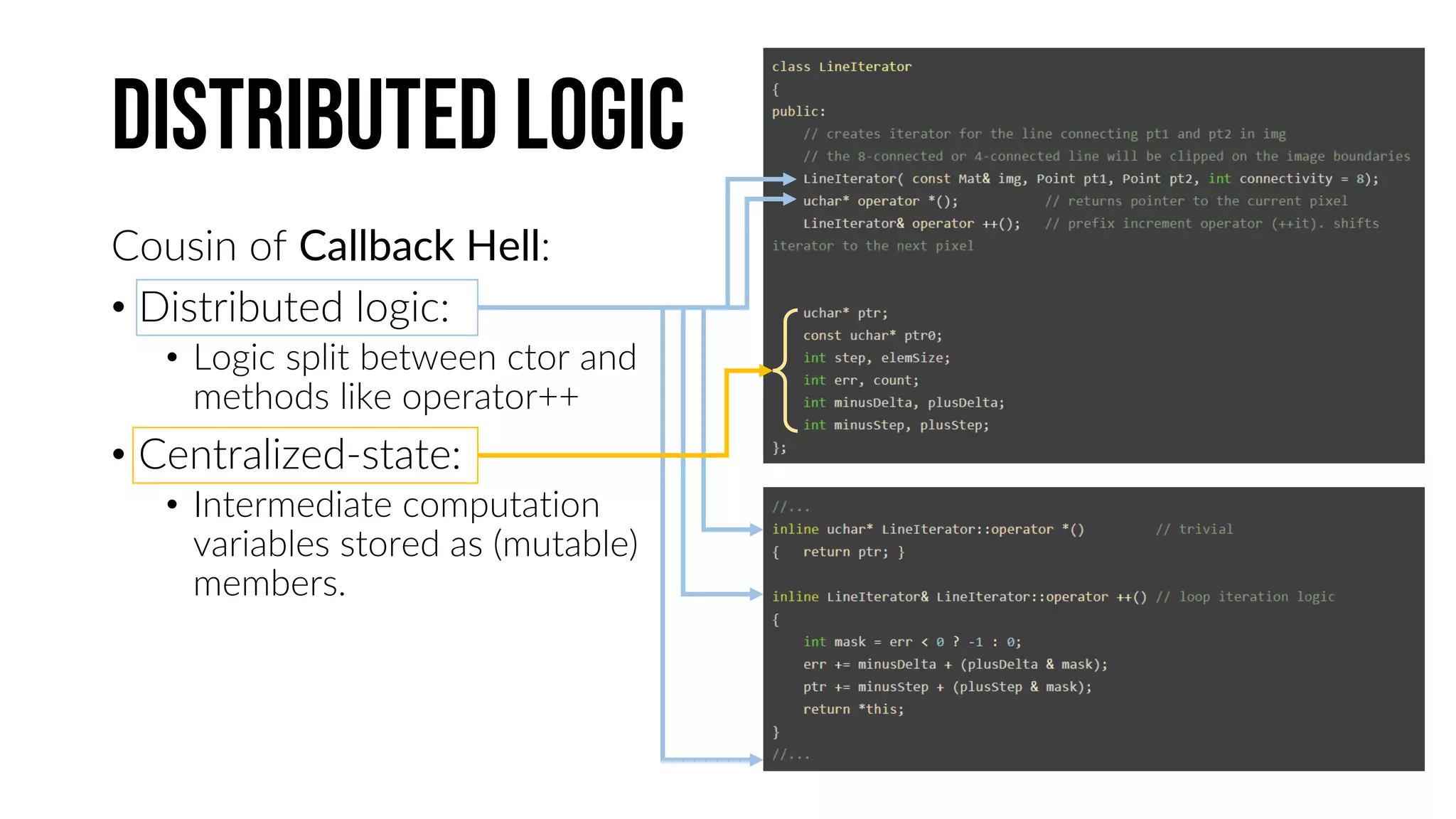
Distributed logic
Cousin of Callback Hell:
• Distributed logic:
• Logic split between ctor and
methods like operator++
• Centralized-state:
• Intermediate computation
variables stored as (mutable)
members.
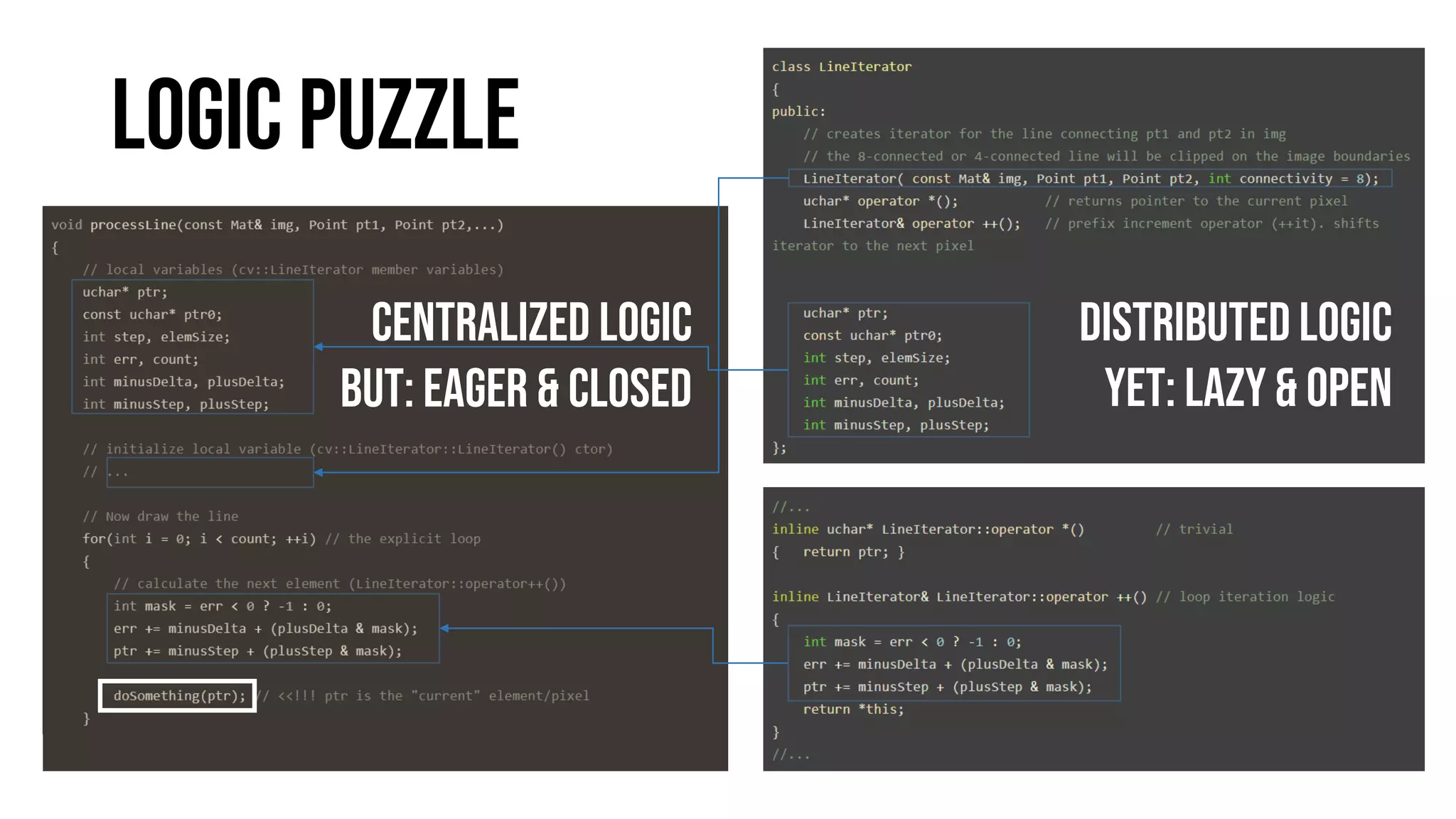
Logic Puzzle
Centralized logic
BUT: eager & Closed
Distributed logic
YET: lazy & Open
C a n w e h a v e n i c e t h i n g s ?
If only there was a way to write easy to
reason about, serial algorithms with local
scoped variables while still abstracting way
the iteration…
coroutines
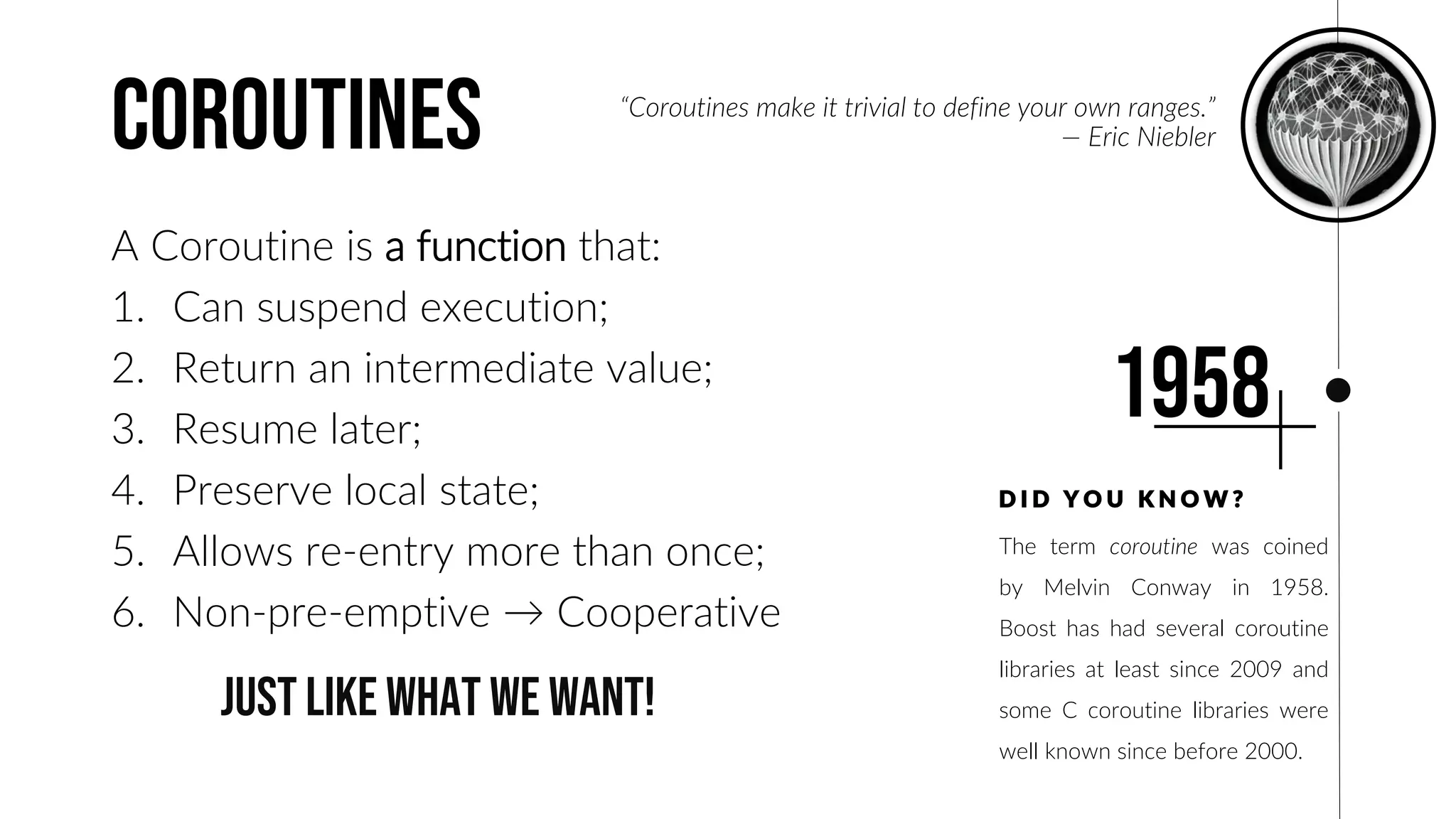
A Coroutine is a function that:
1. Can suspend execution;
2. Return an intermediate value;
3. Resume later;
4. Preserve local state;
5. Allows re-entry more than once;
6. Non-pre-emptive → Cooperative
The term coroutine was coined
by Melvin Conway in 1958.
Boost has had several coroutine
libraries at least since 2009 and
some C coroutine libraries were
well known since before 2000.
D I D Y O U K N O W ?
1958
“Coroutines make it trivial to define your own ranges.”
— Eric Niebler
just like what we want!
coroutines
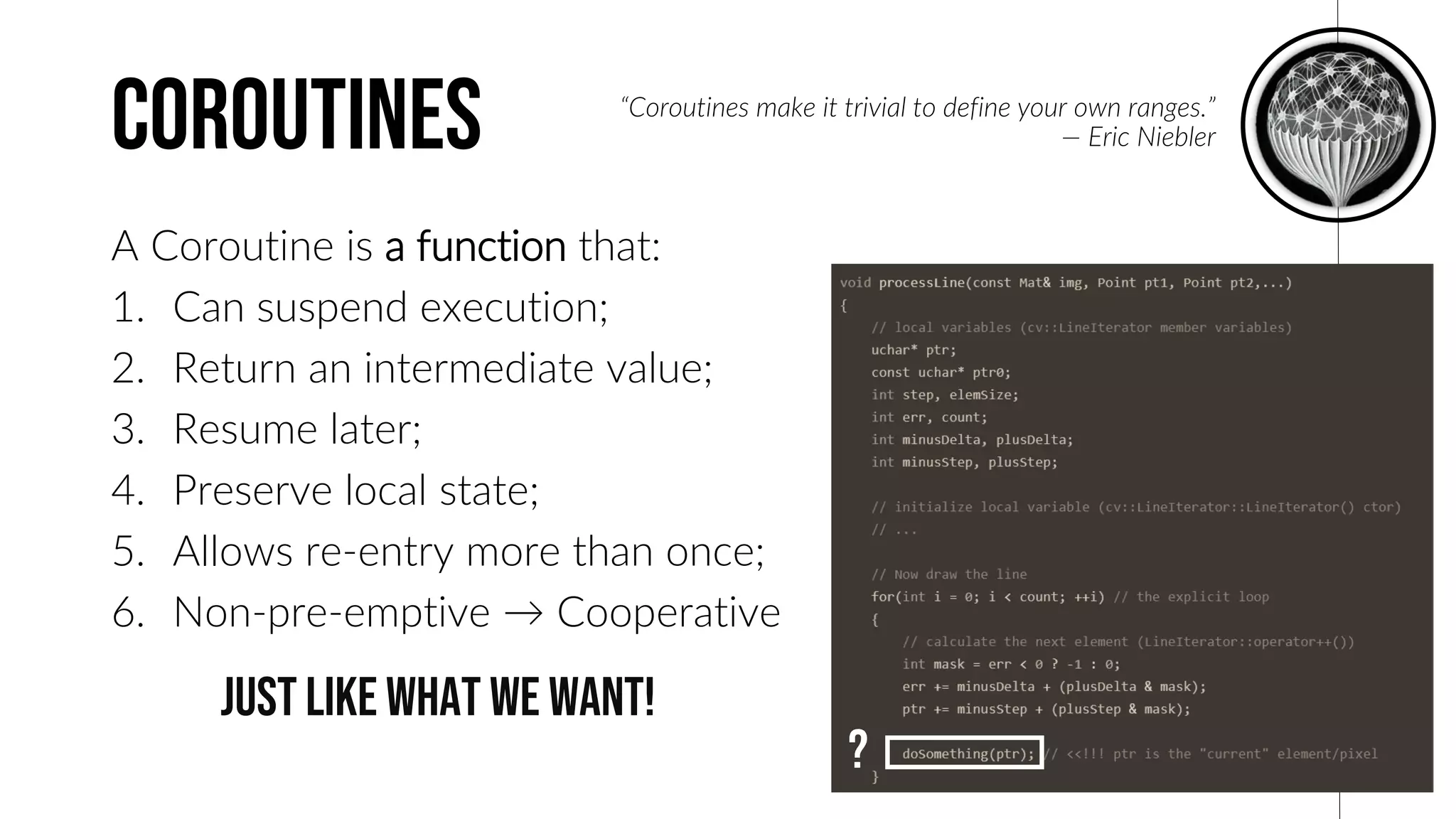
A Coroutine is a function that:
1. Can suspend execution;
2. Return an intermediate value;
3. Resume later;
4. Preserve local state;
5. Allows re-entry more than once;
6. Non-pre-emptive → Cooperative
The term A coroutine was coined
by Melvin Conway in 1958. Boost
has had several coroutine libraries
at least since 2009 and some C
coroutine libraries were well
known since before 2000.
D I D Y O U K N O W ?
1958
“Coroutines make it trivial to define your own ranges.”
— Eric Niebler
?
just like what we want!
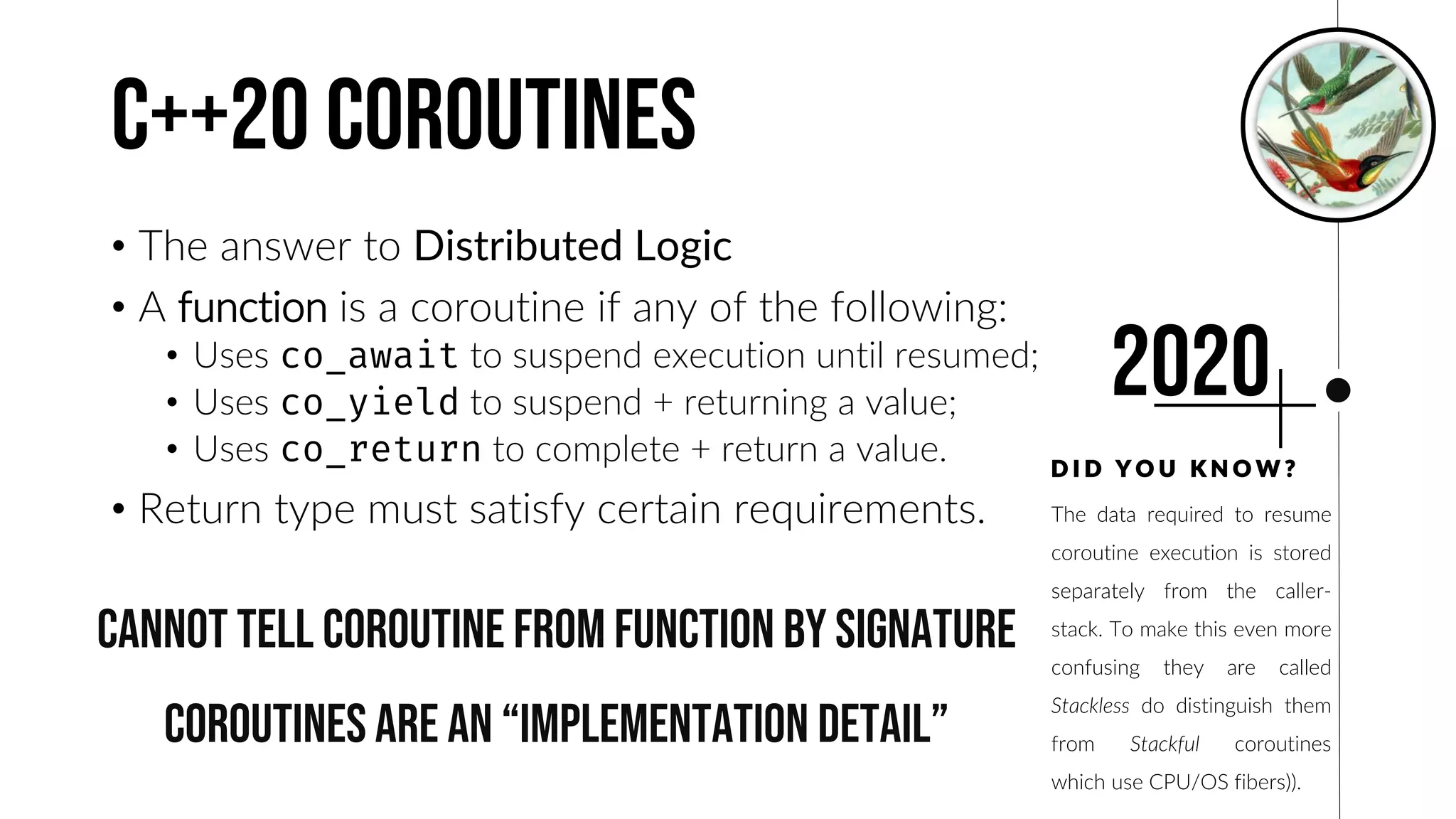
The data required to resume
coroutine execution is stored
separately from the caller-
stack. To make this even more
confusing they are called
Stackless do distinguish them
from Stackful coroutines
which use CPU/OS fibers)).
C++20 coroutines
• The answer to Distributed Logic
• A function is a coroutine if any of the following:
• Uses to suspend execution until resumed;
• Uses to suspend + returning a value;
• Uses to complete + return a value.
• Return type must satisfy certain requirements.
D I D Y O U K N O W ?
2020
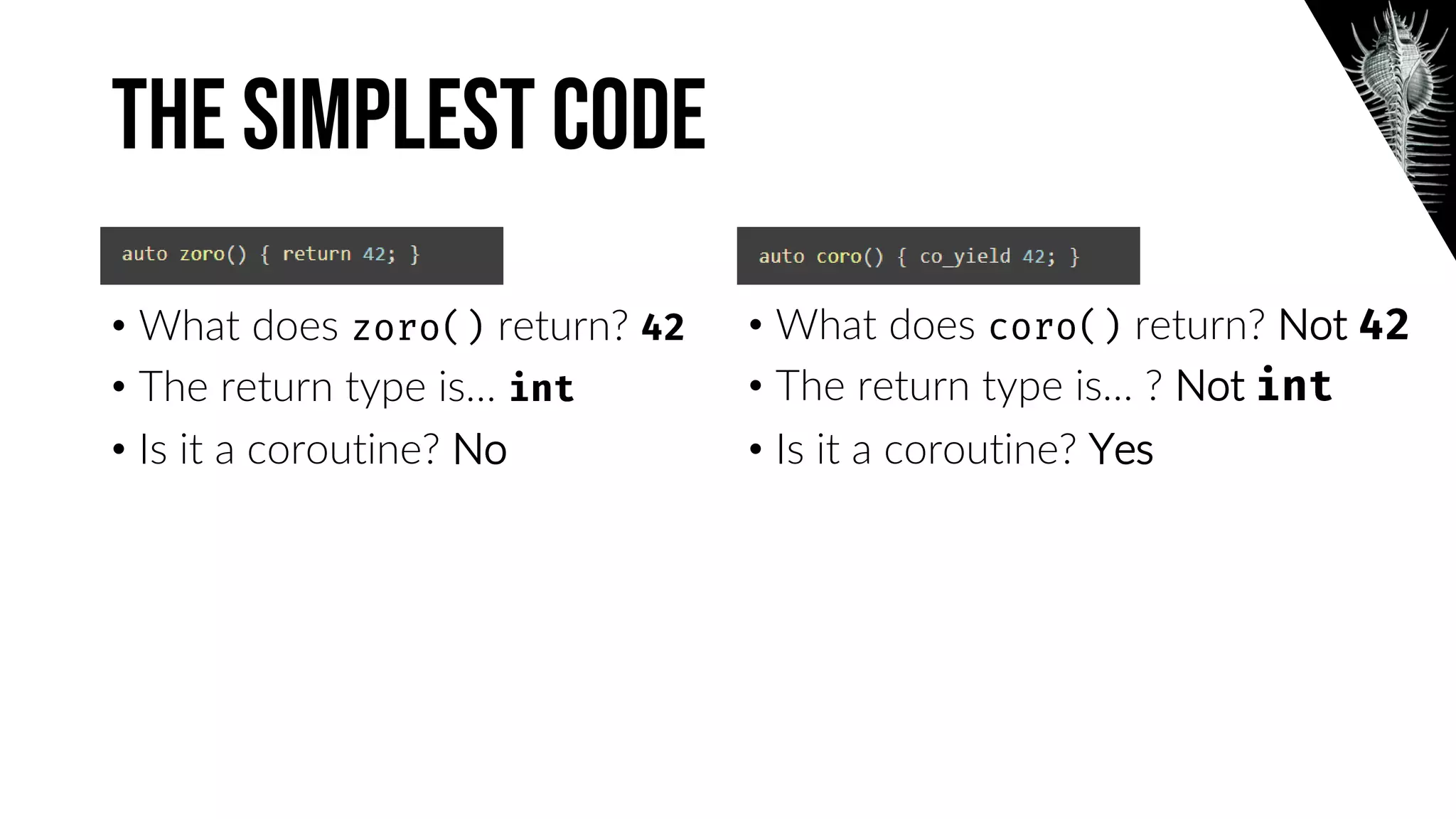
Cannot tell coroutine from function by signature
Coroutines are an “implementation detail”
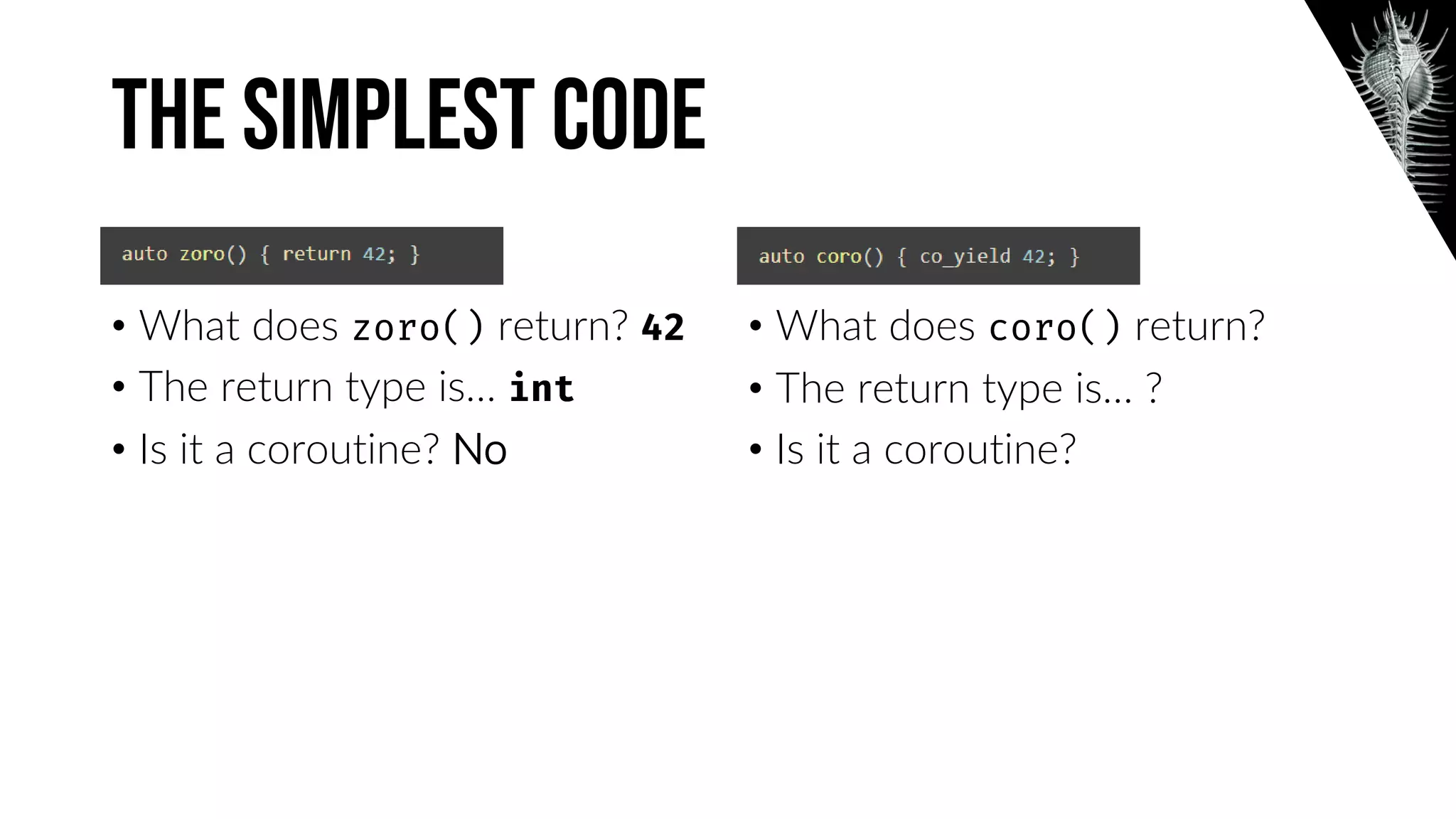
The Simplest code
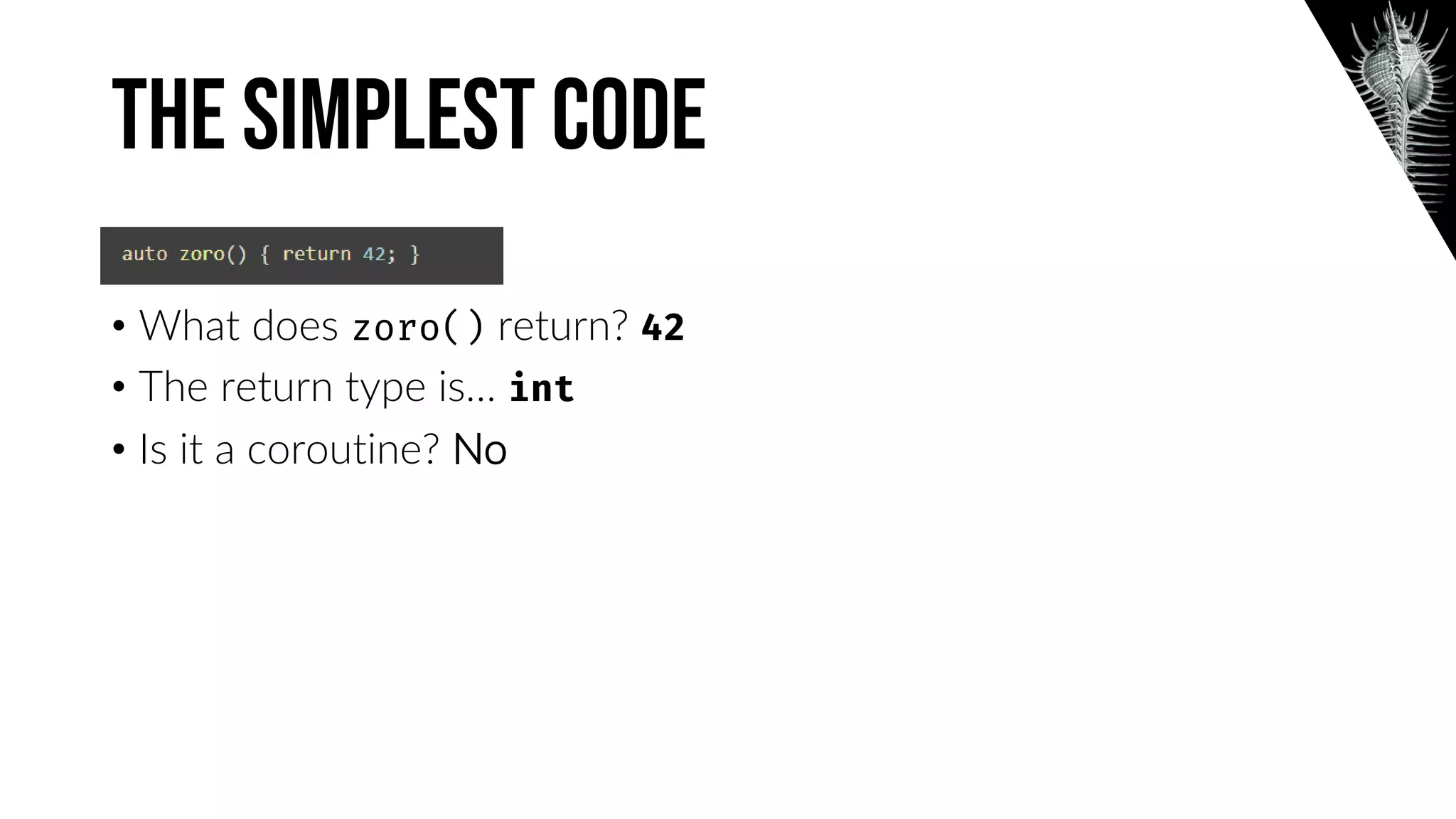
• What does return?
• The return type is…
• Is it a coroutine? No
The Simplest code
• What does return?
• The return type is…
• Is it a coroutine? No
• What does return?
• The return type is… ?
• Is it a coroutine?
The Simplest code
• What does return?
• The return type is…
• Is it a coroutine? No
• What does return? Not
• The return type is… ? Not
• Is it a coroutine? Yes
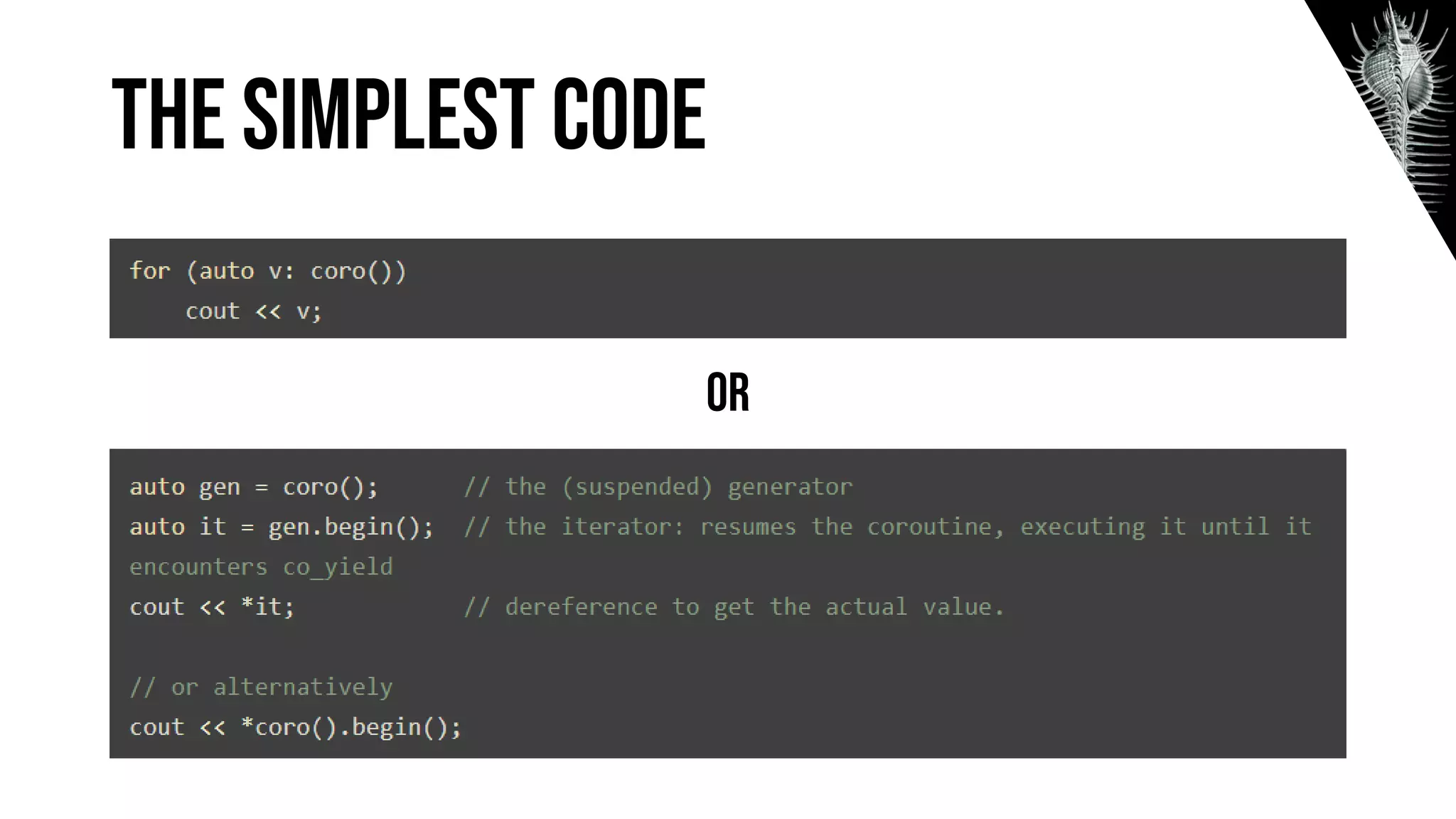
The Simplest code
Or
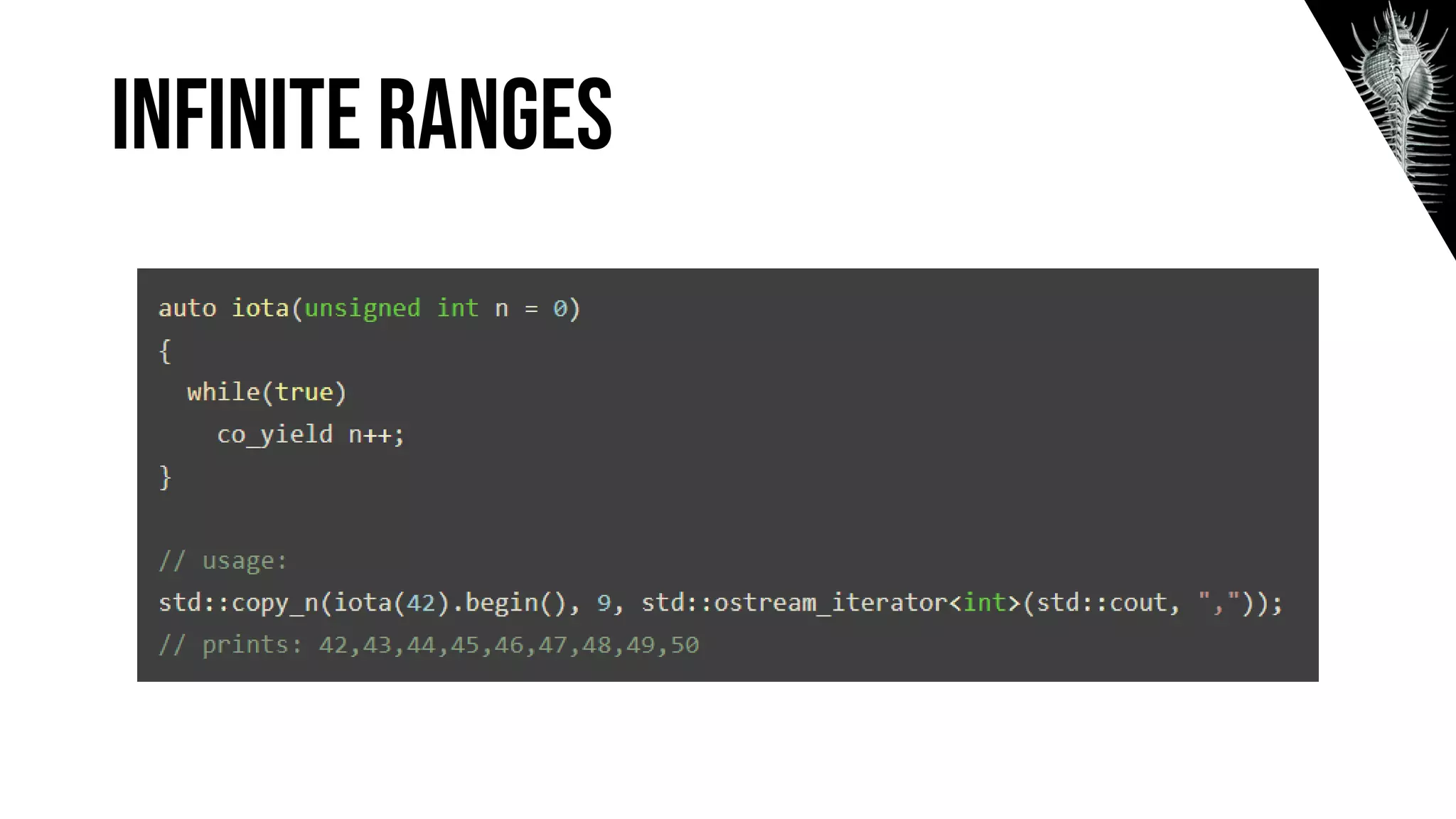
Infinite Ranges
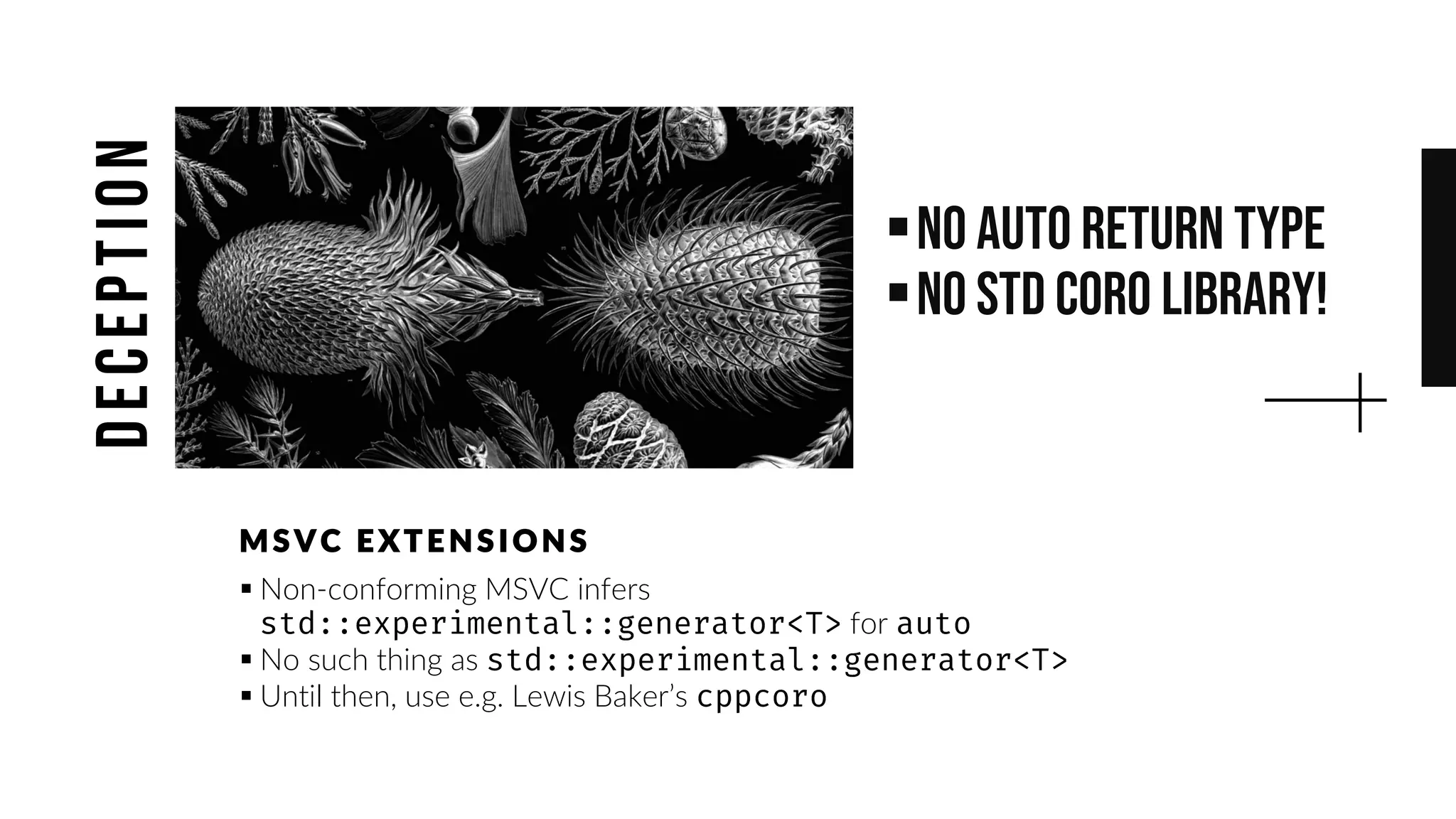
▪No auto return type
▪No std coro library!
▪ Non-conforming MSVC infers
for
▪ No such thing as
▪ Until then, use e.g. Lewis Baker’s
MS VC E XTE NS IONS
deception
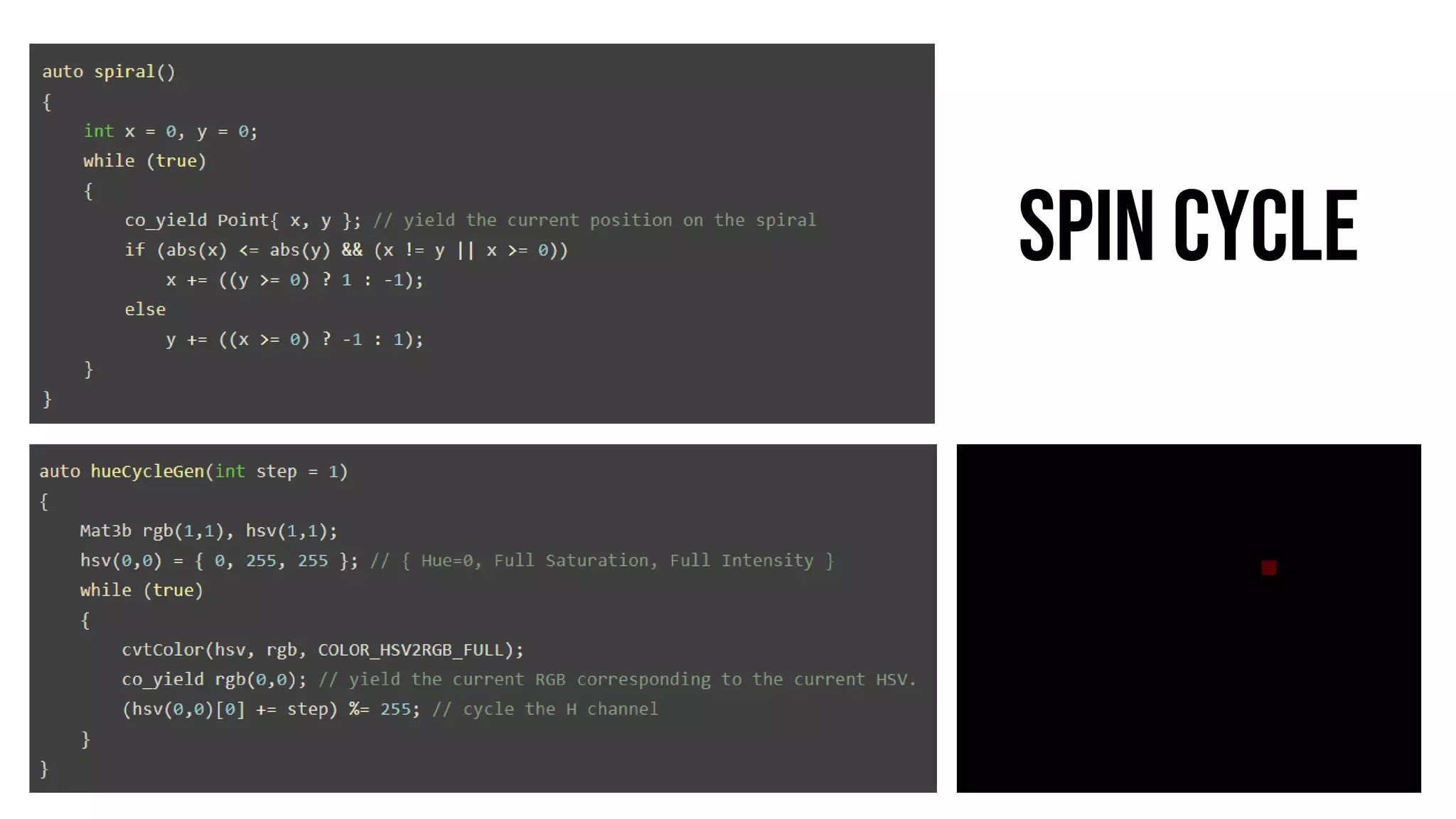
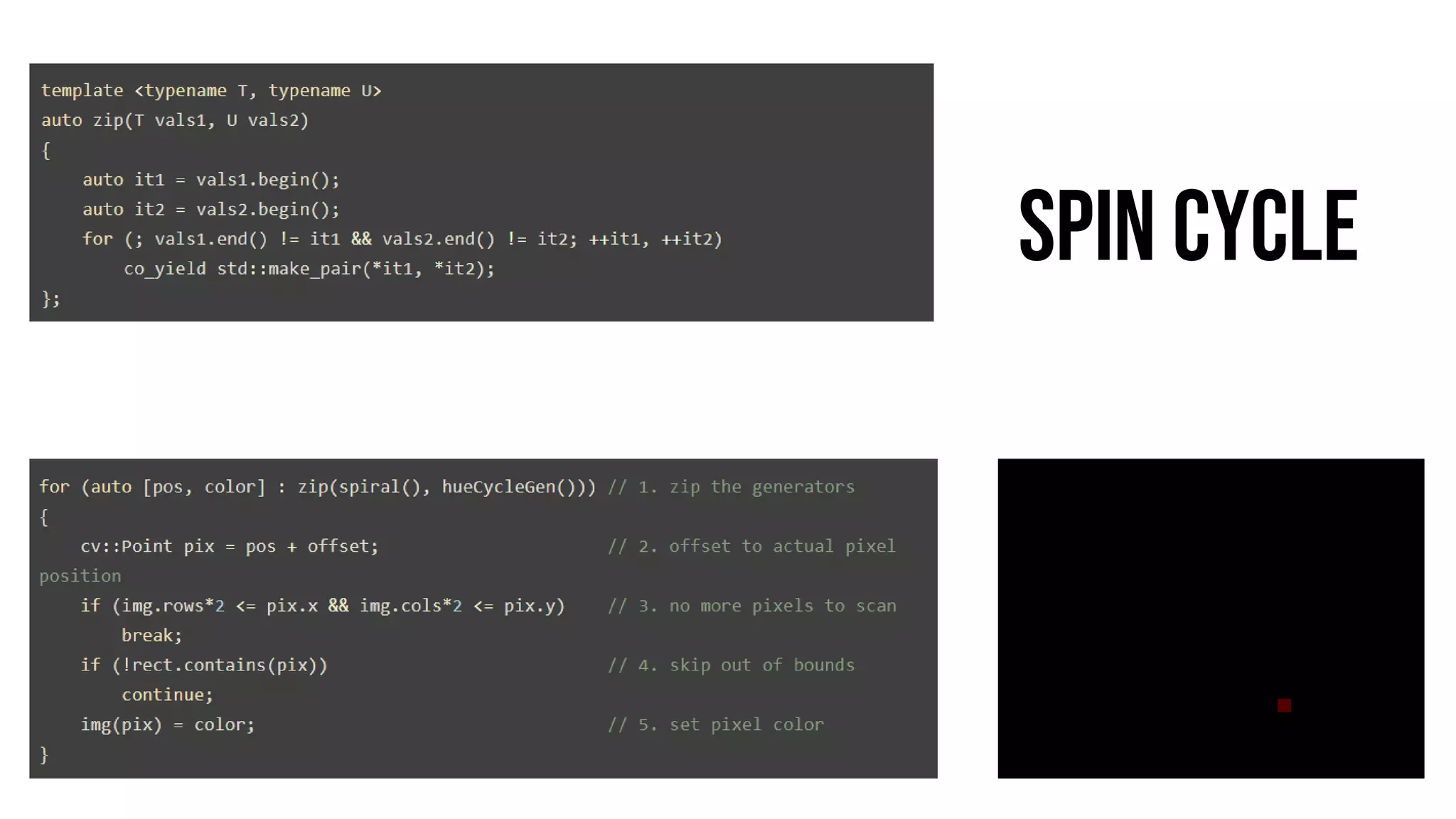
Spin Cycle
Spin Cycle
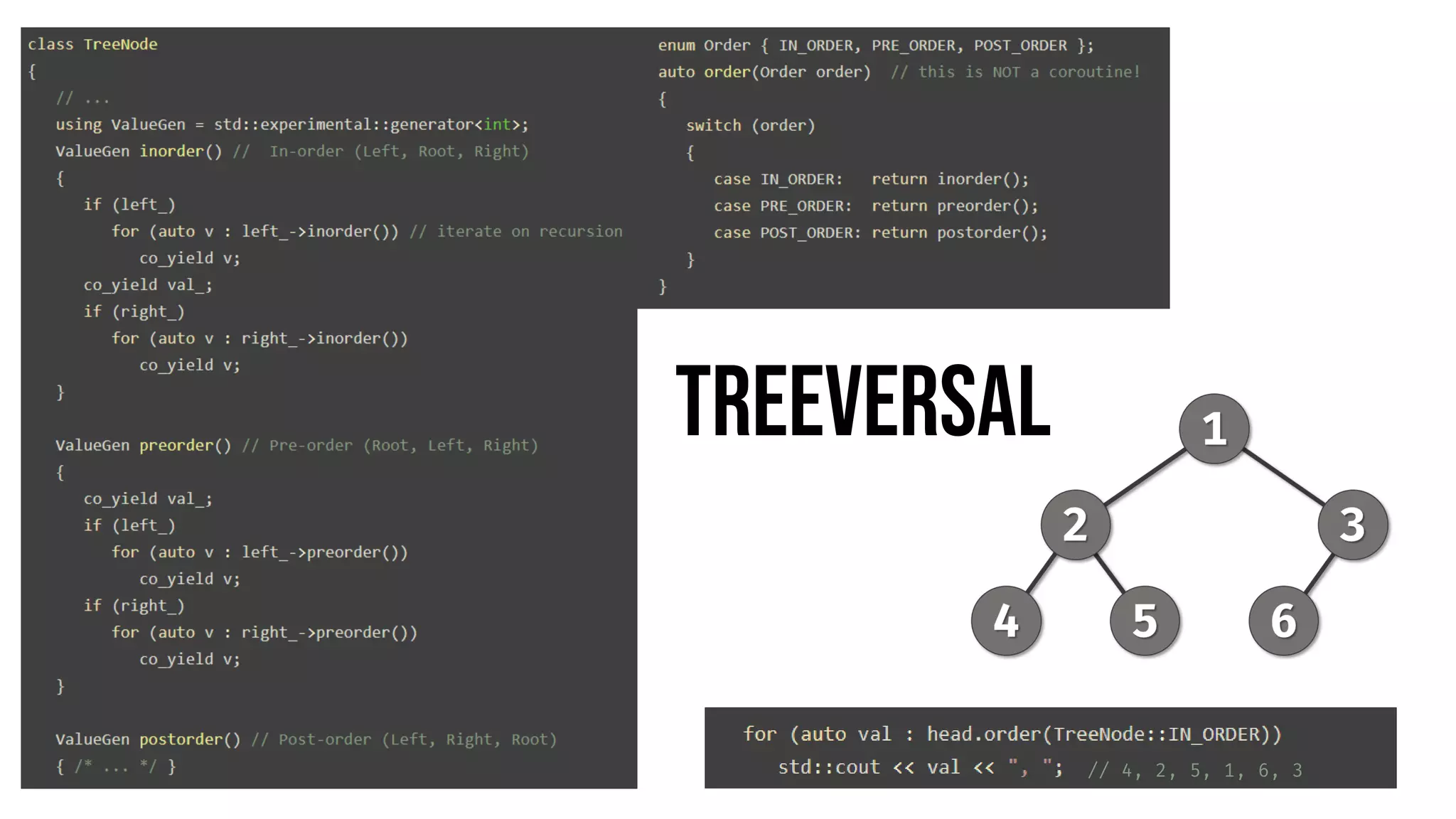
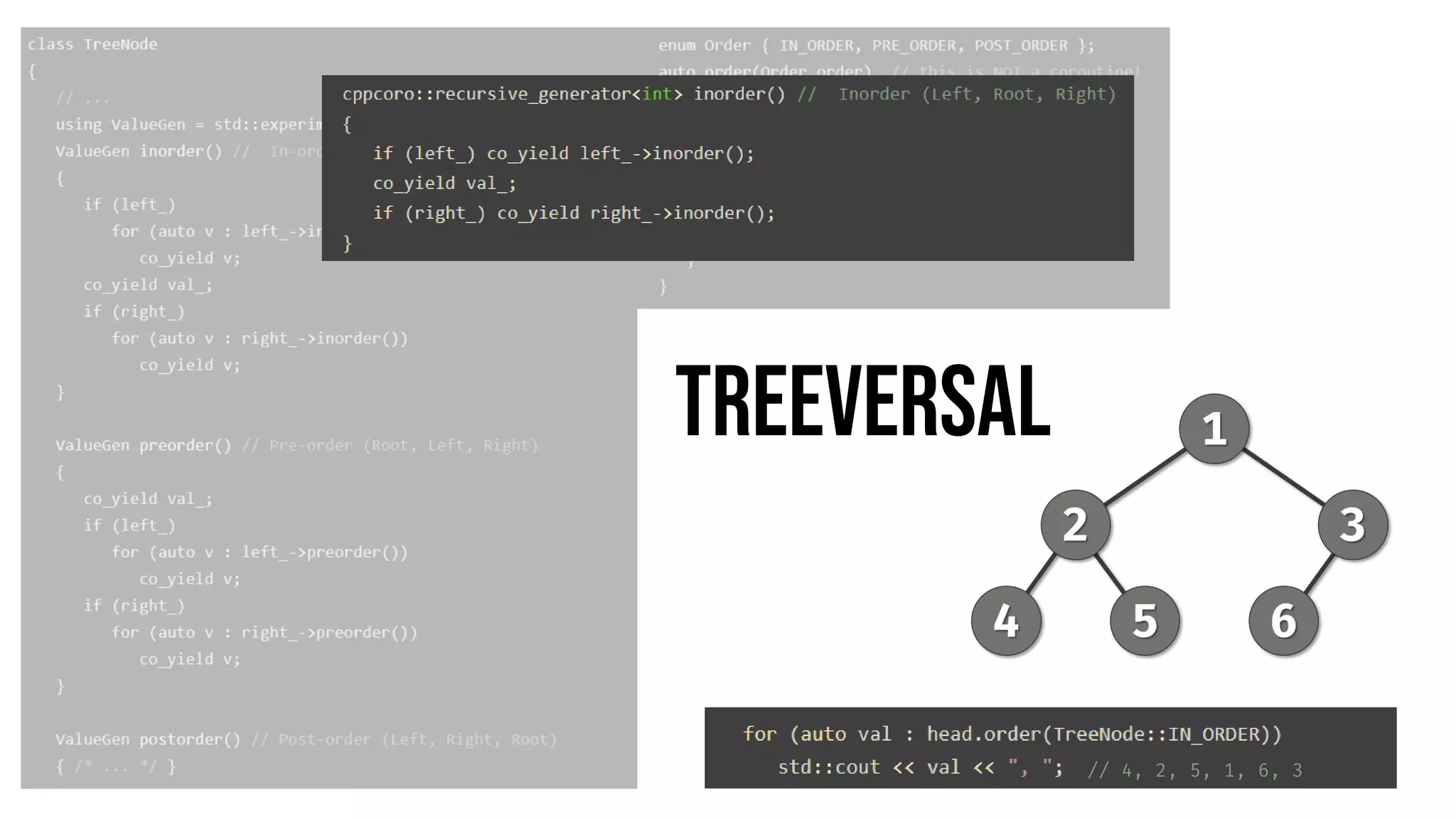
Treeversal
Treeversal
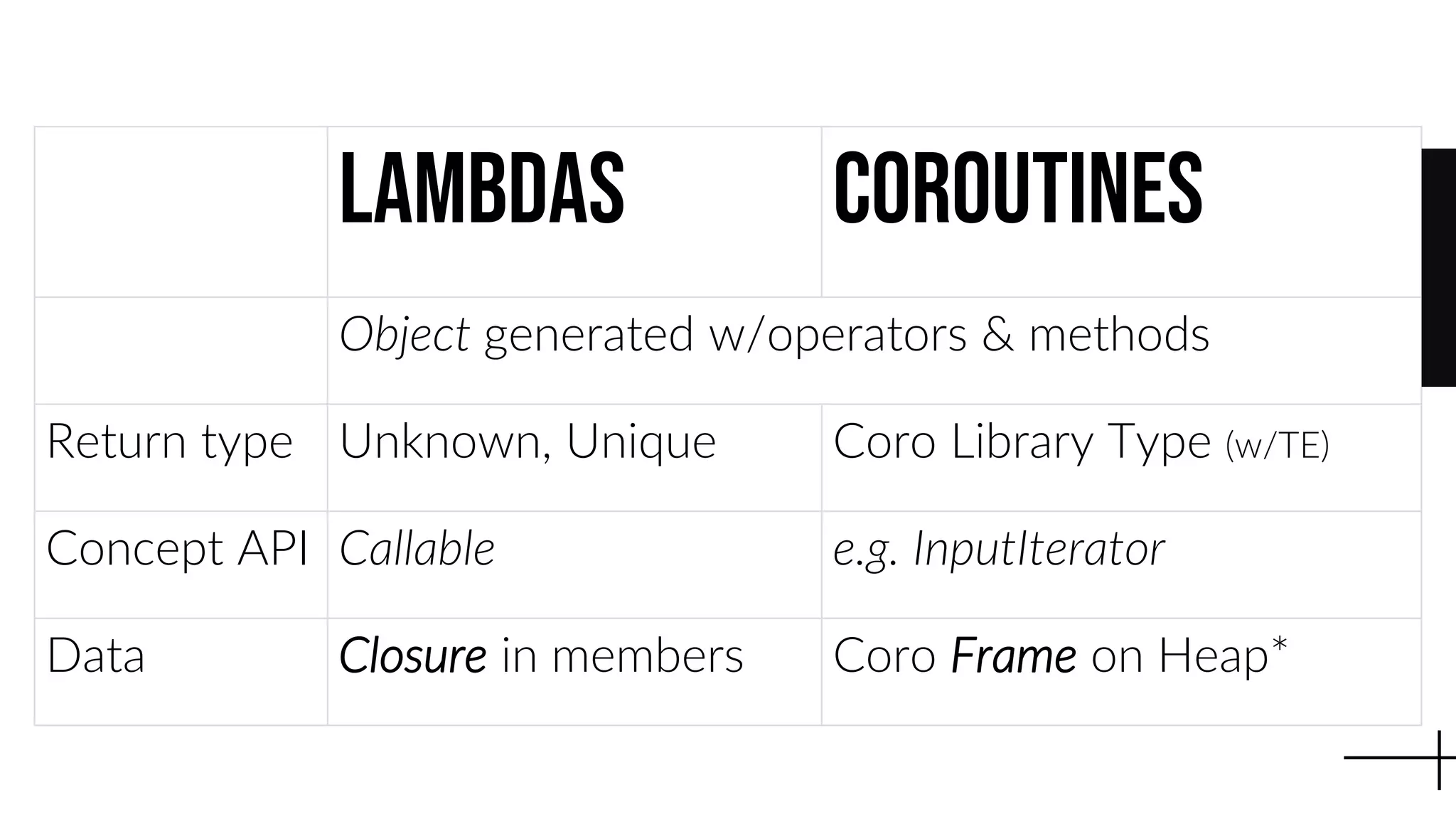
LAMbdas Coroutines
Object generated w/operators & methods
Return type Unknown, Unique Coro Library Type (w/TE)
Concept API Callable e.g. InputIterator
Data Closure in members Coro Frame on Heap*
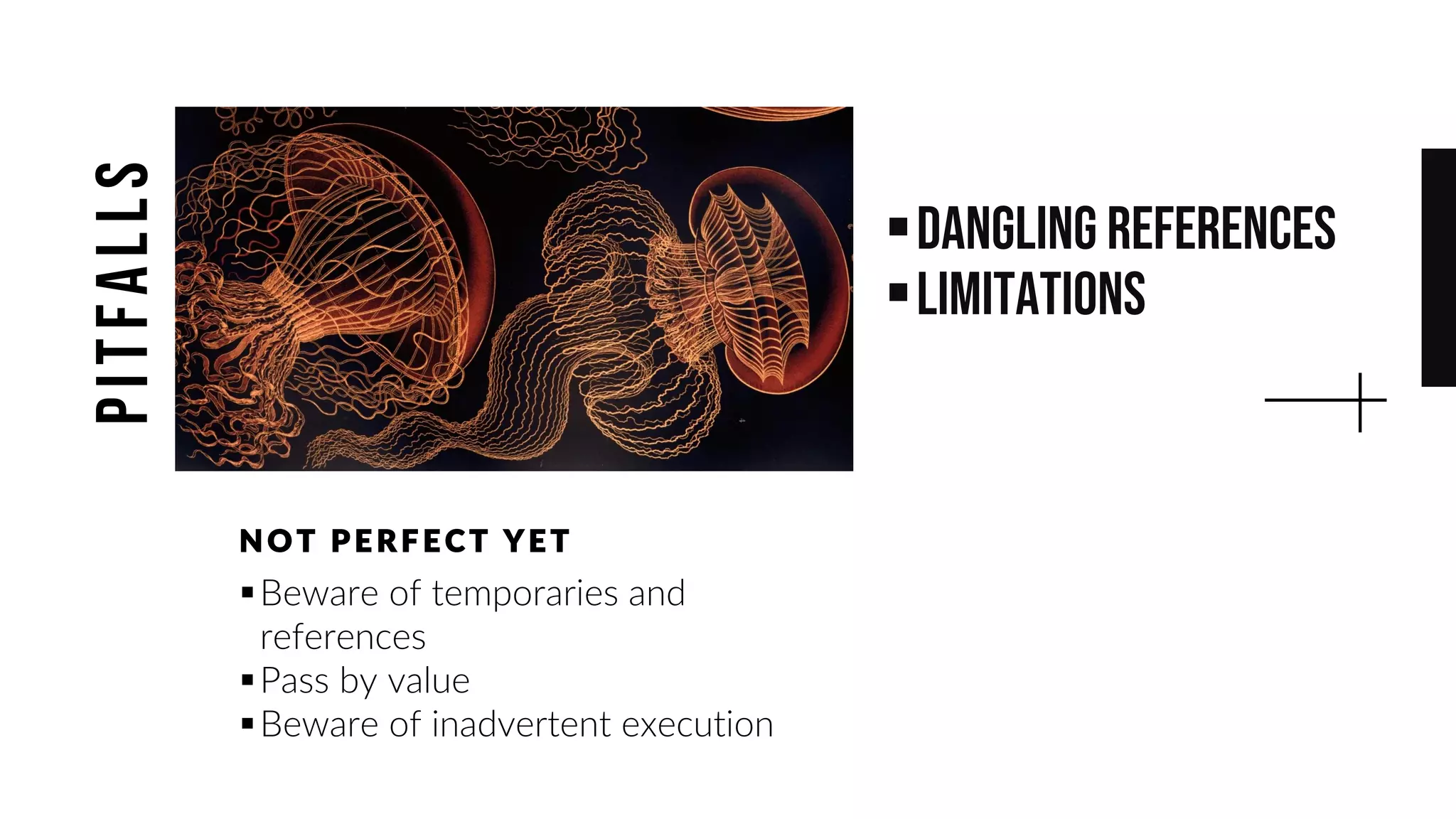
▪Dangling references
▪Limitations
▪Beware of temporaries and
references
▪Pass by value
▪Beware of inadvertent execution
NOT PE RF E CT YE T
pitfalls
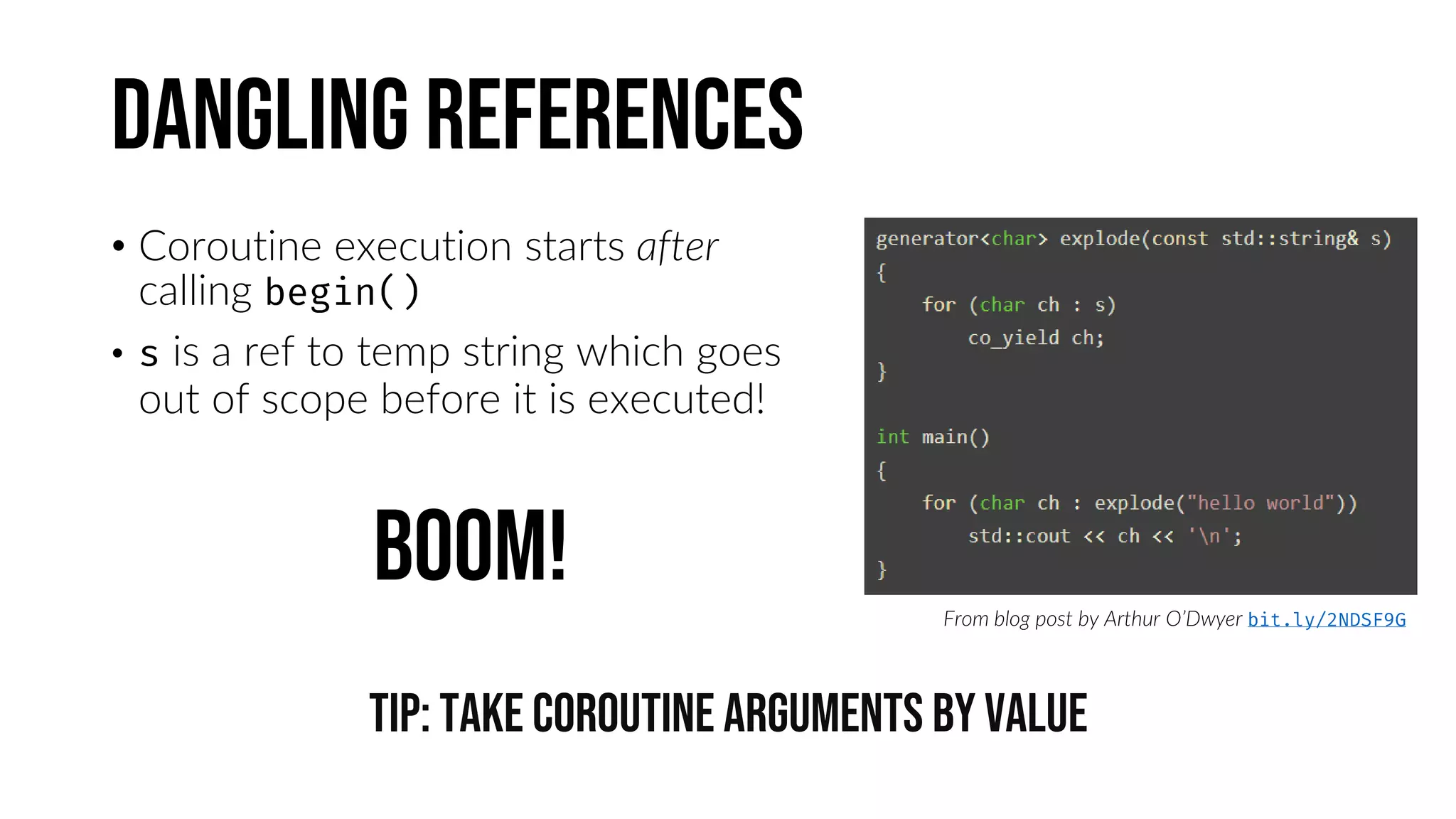
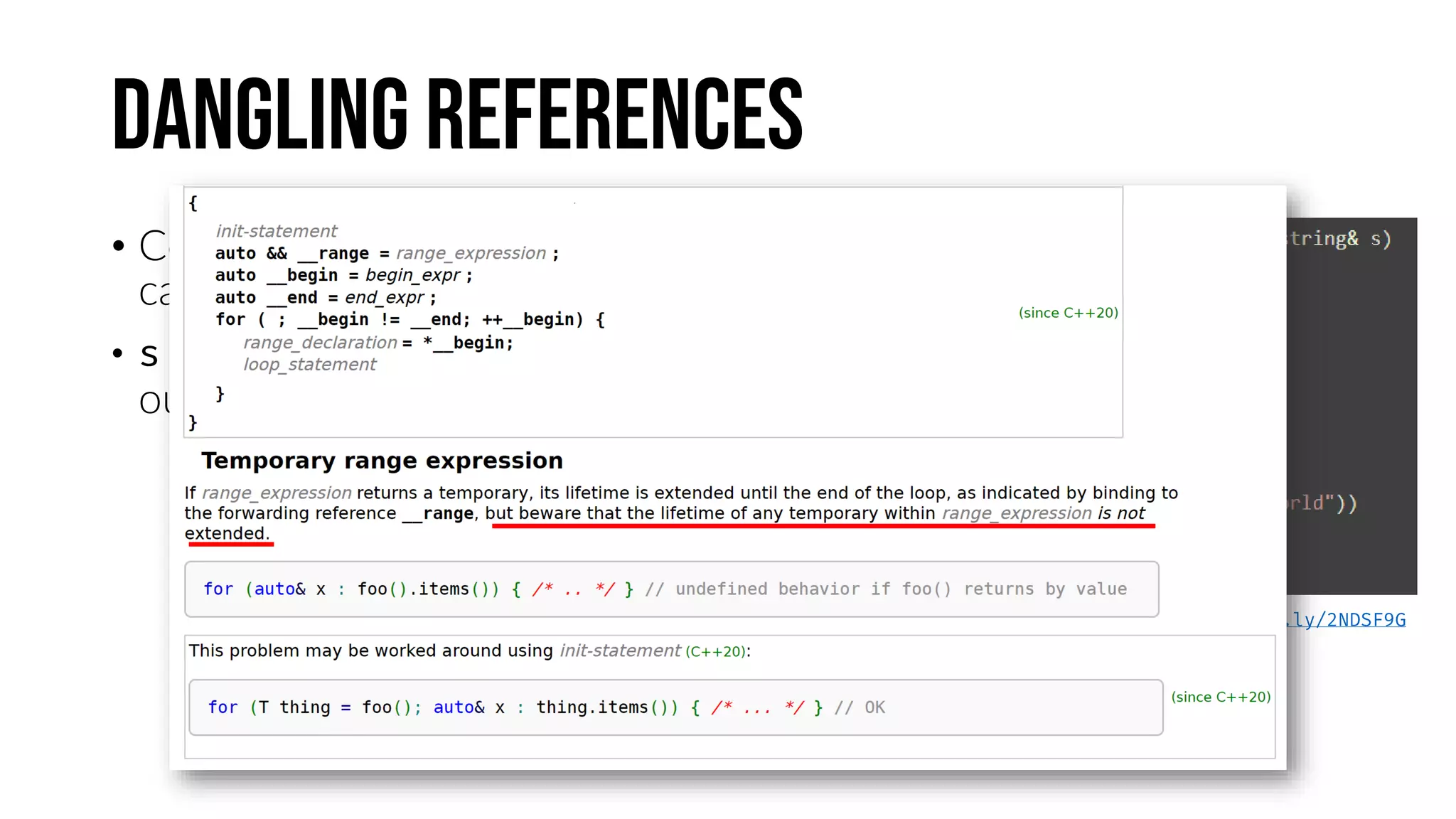
Dangling References
• Coroutine execution starts after
calling
• is a ref to temp string which goes
out of scope before it is executed!
BOOM! From blog post by Arthur O’Dwyer
Tip: Take coroutine arguments by value
Dangling References
• Coroutine execution starts after
calling
• is a ref to temp string which goes
out of scope before it is executed!
BOOM! From blog post by Arthur O’Dwyer
Tip: Take coroutine arguments by value
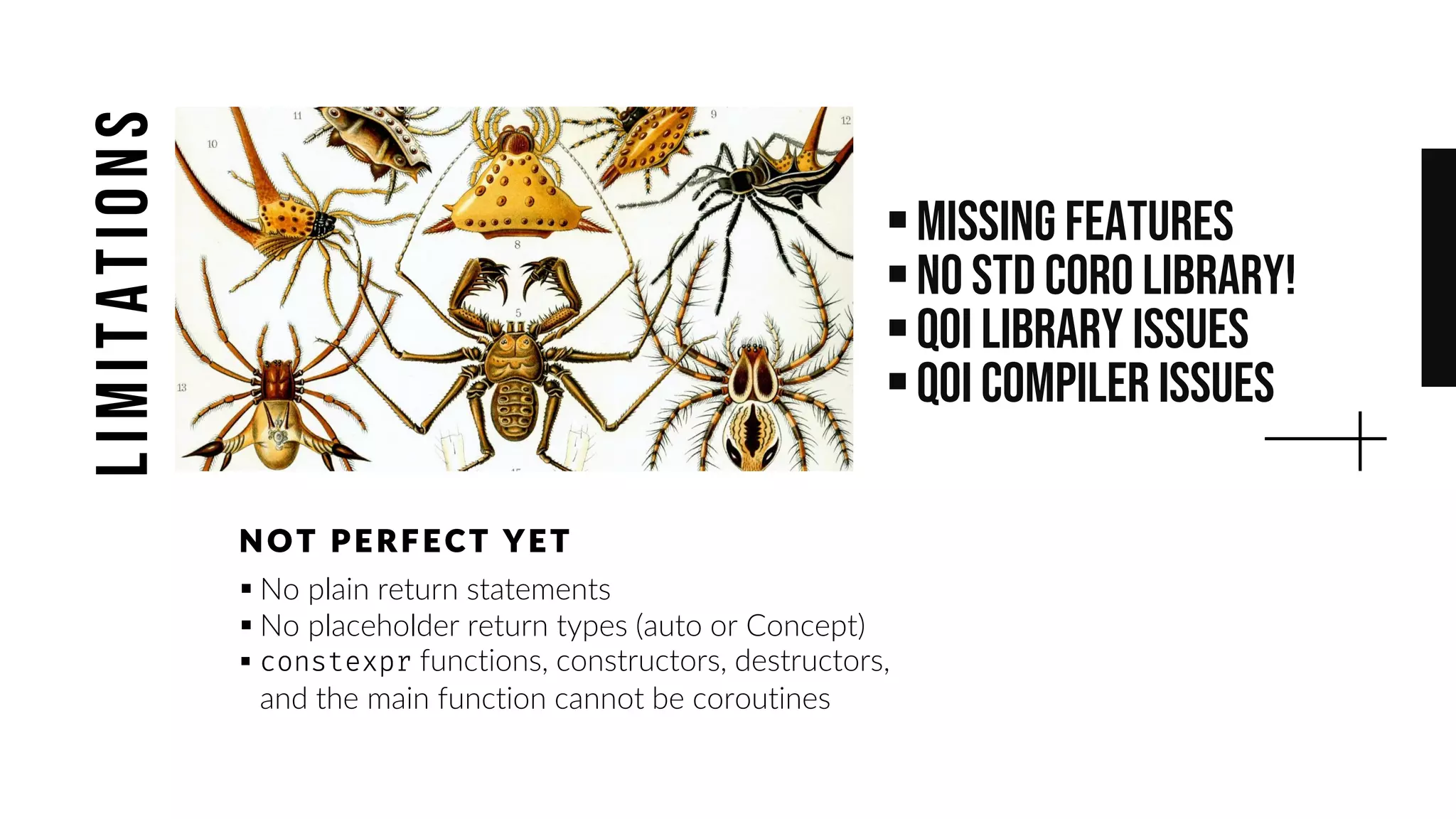
▪Missing features
▪No std coro library!
▪QOI Library Issues
▪QoI Compiler issues
▪ No plain return statements
▪ No placeholder return types (auto or Concept)
▪ functions, constructors, destructors,
and the main function cannot be coroutines
NOT PE RF E CT YE T
limitations
Resources
• A massive list of coroutine resources, MattPD
•
• The channel on the C++ Slack
• More details on my blog
Thank you!
Kunstformen der Natur, Ernst Haeckel :: Hypebeast Presentation Template

Generators, Coroutines and Other Brain Unrolling Sweetness. Adi Shavit ➠ CoreHard Autumn 2019

  • 1.
  • 2.
  • 3.
    Functions A.K.A. Sub-Routines •Let’s iterate! • One function: 1. Iterates 2. Operates • What if we need another operation? • Sum? • Both: Sum + Print? The concept of a function, or sub-routine goes back to one of the first computers, the ENIAC, in the late 1940s and the term sub-routine is from the early 1950s. D I D Y O U K N O W ? 1947
  • 4.
    Functions A.K.A. Sub-Routines •Let’s draw! • One function: 1. Iterates 2. Operates Assumes 1. Available; 2. Correct signature; 3. Does the right thing; 4. Returns control to caller!
  • 5.
    Subroutines are eager and closed EA G E R P R O C E S S I N G “Closed” in the sense that they only return after they have iterated over the whole sequence. They eagerly process a whole sequence.
  • 6.
    ▪Inversion-of-Control ▪Callback Hell ▪still eager ▪Function pointers ▪ Lambdas ▪ Callable template parameters or Concepts E XTE RNAL C A L L A B L E S CALLBACKS
  • 7.
    C a nw e B r e a k t h e m o p e n ? If only there was a way to “flip” these iterating functions “inside-out” and iterate over a sequence without pre-committing to a specific operation.
  • 8.
    Iterators • Iterator Objectsand Iterator Adaptors • “Stand-alone” types; • Often indirectly or implicitly coupled to a sequence • Examples from the C++ standard: • • • The concept of Iterators has been with C++ since the STL was designed by Alex Stepanov and together with the rest of the STL became part of C++98. D I D Y O U K N O W ? 1998
  • 9.
    User defined iterators OpenCV’s •Typical Iterator API • No explicit sequence • Lazily generate elements • Incremental access to pixels along a line
  • 10.
    User defined iterators ExampleUsage OBJECTS THAT LAZILY GENERATE VALUES ARE CALLED GENERATORS
  • 11.
    ▪awkward Coupling ▪Distributed Logic ▪Public members ▪ Dereferencing operator requires casting NOT TO ME NTION imperfect abstraction
  • 12.
    awkward Coupling When dowe stop incrementing? • : at most times • : when == • : when == sequence • when == PITFALL! User side runtime coupling of begin and end
  • 13.
    ranges • Abstraction layeron top of iterators • The answer to The Awkward Coupling • C++20 Ranges encapsulate: • A begin and end iterator-pair; • An iterator + size; • An iterator and stopping condition • A single object makes STL algorithms more powerful by making them composable. • Create pipelines to transform values Ranges are coming to C++20 and are an amazing new addition to the standard library! Three pillars: Views, Actions, and Algorithms. D I D Y O U K N O W ? 2020
  • 14.
    Distributed logic Cousin ofCallback Hell: • Distributed logic: • Logic split between ctor and methods like operator++ • Centralized-state: • Intermediate computation variables stored as (mutable) members.
  • 15.
    Logic Puzzle Centralized logic BUT:eager & Closed Distributed logic YET: lazy & Open
  • 16.
    C a nw e h a v e n i c e t h i n g s ? If only there was a way to write easy to reason about, serial algorithms with local scoped variables while still abstracting way the iteration…
  • 17.
    coroutines A Coroutine isa function that: 1. Can suspend execution; 2. Return an intermediate value; 3. Resume later; 4. Preserve local state; 5. Allows re-entry more than once; 6. Non-pre-emptive → Cooperative The term coroutine was coined by Melvin Conway in 1958. Boost has had several coroutine libraries at least since 2009 and some C coroutine libraries were well known since before 2000. D I D Y O U K N O W ? 1958 “Coroutines make it trivial to define your own ranges.” — Eric Niebler just like what we want!
  • 18.
    coroutines A Coroutine isa function that: 1. Can suspend execution; 2. Return an intermediate value; 3. Resume later; 4. Preserve local state; 5. Allows re-entry more than once; 6. Non-pre-emptive → Cooperative The term A coroutine was coined by Melvin Conway in 1958. Boost has had several coroutine libraries at least since 2009 and some C coroutine libraries were well known since before 2000. D I D Y O U K N O W ? 1958 “Coroutines make it trivial to define your own ranges.” — Eric Niebler ? just like what we want!
  • 19.
    The data requiredto resume coroutine execution is stored separately from the caller- stack. To make this even more confusing they are called Stackless do distinguish them from Stackful coroutines which use CPU/OS fibers)). C++20 coroutines • The answer to Distributed Logic • A function is a coroutine if any of the following: • Uses to suspend execution until resumed; • Uses to suspend + returning a value; • Uses to complete + return a value. • Return type must satisfy certain requirements. D I D Y O U K N O W ? 2020 Cannot tell coroutine from function by signature Coroutines are an “implementation detail”
  • 20.
    The Simplest code •What does return? • The return type is… • Is it a coroutine? No
  • 21.
    The Simplest code •What does return? • The return type is… • Is it a coroutine? No • What does return? • The return type is… ? • Is it a coroutine?
  • 22.
    The Simplest code •What does return? • The return type is… • Is it a coroutine? No • What does return? Not • The return type is… ? Not • Is it a coroutine? Yes
  • 23.
  • 24.
  • 25.
    ▪No auto returntype ▪No std coro library! ▪ Non-conforming MSVC infers for ▪ No such thing as ▪ Until then, use e.g. Lewis Baker’s MS VC E XTE NS IONS deception
  • 26.
  • 27.
  • 28.
  • 29.
  • 30.
    LAMbdas Coroutines Object generatedw/operators & methods Return type Unknown, Unique Coro Library Type (w/TE) Concept API Callable e.g. InputIterator Data Closure in members Coro Frame on Heap*
  • 31.
    ▪Dangling references ▪Limitations ▪Beware oftemporaries and references ▪Pass by value ▪Beware of inadvertent execution NOT PE RF E CT YE T pitfalls
  • 32.
    Dangling References • Coroutineexecution starts after calling • is a ref to temp string which goes out of scope before it is executed! BOOM! From blog post by Arthur O’Dwyer Tip: Take coroutine arguments by value
  • 33.
    Dangling References • Coroutineexecution starts after calling • is a ref to temp string which goes out of scope before it is executed! BOOM! From blog post by Arthur O’Dwyer Tip: Take coroutine arguments by value
  • 34.
    ▪Missing features ▪No stdcoro library! ▪QOI Library Issues ▪QoI Compiler issues ▪ No plain return statements ▪ No placeholder return types (auto or Concept) ▪ functions, constructors, destructors, and the main function cannot be coroutines NOT PE RF E CT YE T limitations
  • 35.
    Resources • A massivelist of coroutine resources, MattPD • • The channel on the C++ Slack • More details on my blog Thank you! Kunstformen der Natur, Ernst Haeckel :: Hypebeast Presentation Template