GPU
Programming
on CPUs
Using C++AMP
Miller Lee
Outline
1. Introduction to C++AMP
2. Introduction to Tiling
3. tile_static
4. barrier.wait and solutions
a. C++11 thread
b. setjmp/longjmp
c. ucontext
2
(Homogeneous coordinates)
(0, 0) (0, 1) (0, 2) (0, 3)
(1, 0) (1, 1) (1, 2) (1, 3)
(2, 0) (2, 1) (2, 2) (2, 3)
(3, 0) (3, 1) (3, 2) (3, 3)
X
0
1
2
3
Matrix A b
=
0
1
2
3
result
Computing example
● Simple matrix multiplication
3
C++ Version
1. int A[4][4];
2. int b[4];
3. int result[4];
4. for (int i = 0; i < 4; i++) {
5. result[i] = 0;
6. for (int j = 0; j < 4; j++)
7. result[i] += A[i][j] * b[j];
8. } 4
C++AMP Version
1. array_view<float, 2> A(4, 4);
2. array_view<float, 1> b(4);
3. array_view<float, 1> result(4);
4. extent<1> ext(4);
5. parallel_for_each(ext, [&](index<1> idx) restrict(amp)
6. {
7. result[idx[0]] = 0;
8. for (int i = 0; i < 4; i++)
9. result[idx[0]] += A(idx[0], i) * b(i);
10. });
5
memory access
0 1 2 3
P0 P1 P2 P3
global memory
b
100t
Total access time = 400t 6
shared memory
0 1 2 3
shared memory
10t
100t
Total access time = 130t
b
7
1. array_view<float, 2> A(4, 4);
2. array_view<float, 1> b(4);
3. array_view<float, 1> result(4);
4. extent<1> ext(4);
5. parallel_for_each(ext.tile<4>(), [&](tiled_index<4> tidx)
restrict(amp)
6. {
7. int local = tidx.local[0];
8. int global = tidx.global[0];
9. tile_statc int buf[4];
10. buf[local] = b[global];
11. tidx.barrier.wait();
12. result[idx[0]] = 0;
13. for (int i = 0; i < 4; i++)
14. result[idx[0]] += A[idx[0]][i] * buf[i];
15. }); 8
barrier
9
Architecture
source: NVIDIA TESLA:AUNIFIED GRAPHICS AND COMPUTING ARCHITECTURE
shared memory
accessible to all SPs
10
Goal
● Implement all the C++AMP function on CPU
instead of GPU without any compiler
modification.
11
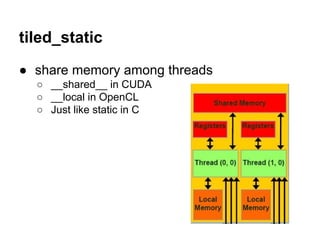
tiled_static
● The limitation of C++ syntax leads to the
following choices
○ const, volatile
○ __attribute__(...)
○ static
● Choose static
○ static memory can be shared among all the threads
○ side effect: At most one thread group can be
executed at the same time.
#define tile_static static
12
Barrier.wait
● Threads in the same thread group will be
waited at the point where “wait” is called.
● Program can
a. perform real barrier action
b. jump out of current execution context
13
● True threading
○ C++11 thread
● Fake threading(Coroutines)
○ setjmp/longjmp
○ makecontext/getcontext/swapcontext/setcontext
Approaches
14
C++11 thread
● launch hundreds of threads at a time.
● implemente my own barrier by using C++11
mutex library.
→ extremely slow.
→ The data on static memory will be corrupted
15
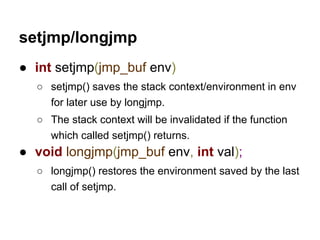
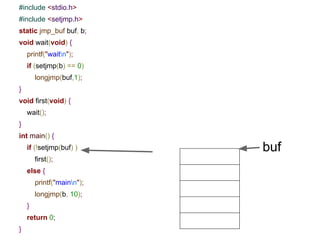
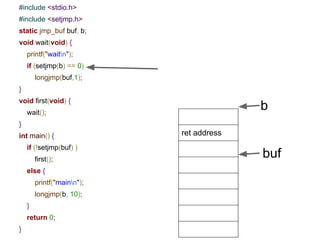
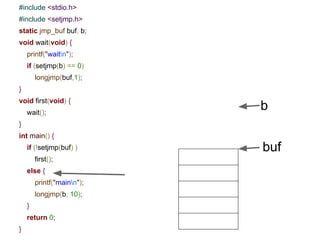
setjmp/longjmp
● int setjmp(jmp_buf env)
○ setjmp() saves the stack context/environment in env
for later use by longjmp.
○ The stack context will be invalidated if the function
which called setjmp() returns.
● void longjmp(jmp_buf env, int val);
○ longjmp() restores the environment saved by the last
call of setjmp.
16
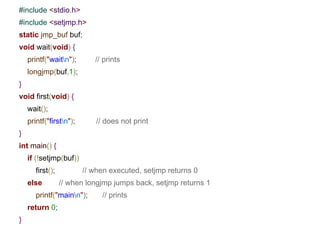
1. #include <stdio.h>
2. #include <setjmp.h>
3. jmp_buf buf;
4. void wait(void) {
5. printf("waitn"); // prints
6. longjmp(buf,1);
7. }
8. void first(void) {
9. wait();
10. printf("firstn"); // does not print
11. }
12. int main() {
13. if (!setjmp(buf))
14. first(); // when executed, setjmp returns 0
15. else // when longjmp jumps back, setjmp returns 1
16. printf("mainn"); // prints
17. return 0;
18. }
17
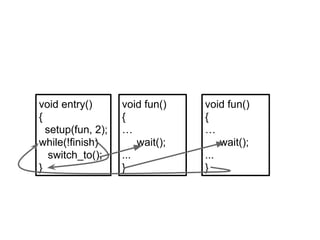
Pseudo code (1)
void entry()
{
while(!finish)
for(t : tasks)
run(t)
}
void fun()
{
…
wait();
...
}
void fun()
{
…
wait();
...
}
void entry()
{
while(!finish)
for(t : tasks)
run(t)
}
void fun()
{
…
wait();
...
}
void fun()
{
…
wait();
...
}
18
Pseudo code (2)
void entry()
{
while(!finish)
for(t : tasks)
run(t)
}
void fun()
{
…
wait();
...
}
void fun()
{
…
wait();
...
}
void entry()
{
while(!finish)
for(t : tasks)
run(t)
}
void fun()
{
…
wait();
...
}
void fun()
{
…
wait();
...
}
19
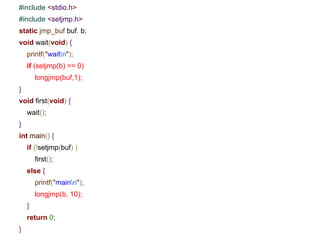
1. #include <stdio.h>
2. #include <setjmp.h>
3. jmp_buf buf, b;
4. void wait(void) {
5. printf("waitn");
6. if (setjmp(b) == 0)
7. longjmp(buf,1);
8. }
9. void first(void) {
10. wait();
11. }
12. int main() {
13. if (!setjmp(buf) )
14. first();
15. else {
16. printf("mainn");
17. longjmp(b, 10);
18. }
19. return 0;
20. } 20
1. #include <stdio.h>
2. #include <setjmp.h>
3. jmp_buf buf, b;
4. void wait(void) {
5. printf("waitn");
6. if (setjmp(b) == 0)
7. longjmp(buf,1);
8. }
9. void first(void) {
10. wait();
11. }
12. int main() {
13. if (!setjmp(buf) )
14. first();
15. else {
16. printf("mainn");
17. longjmp(b, 10);
18. }
19. return 0;
20. }
buf
21
1. #include <stdio.h>
2. #include <setjmp.h>
3. jmp_buf buf, b;
4. void wait(void) {
5. printf("waitn");
6. if (setjmp(b) == 0)
7. longjmp(buf,1);
8. }
9. void first(void) {
10. wait();
11. }
12. int main() {
13. if (!setjmp(buf) )
14. first();
15. else {
16. printf("mainn");
17. longjmp(b, 10);
18. }
19. return 0;
20. }
ret address
buf
b
22
1. #include <stdio.h>
2. #include <setjmp.h>
3. jmp_buf buf, b;
4. void wait(void) {
5. printf("waitn");
6. if (setjmp(b) == 0)
7. longjmp(buf,1);
8. }
9. void first(void) {
10. wait();
11. }
12. int main() {
13. if (!setjmp(buf) )
14. first();
15. else {
16. printf("mainn");
17. longjmp(b, 10);
18. }
19. return 0;
20. }
buf
b
23
1. #include <stdio.h>
2. #include <setjmp.h>
3. jmp_buf buf, b;
4. void wait(void) {
5. printf("waitn");
6. if (setjmp(b) == 0)
7. longjmp(buf,1);
8. }
9. void first(void) {
10. wait();
11. }
12. int main() {
13. if (!setjmp(buf) )
14. first();
15. else {
16. printf("mainn");
17. longjmp(b, 10);
18. }
19. return 0;
20. }
Cannot return
???
???
???
buf
b
24
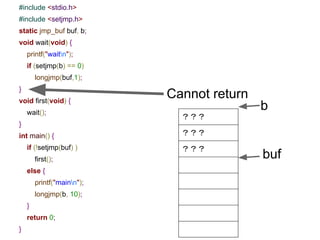
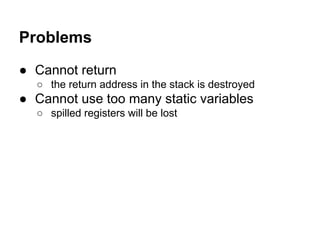
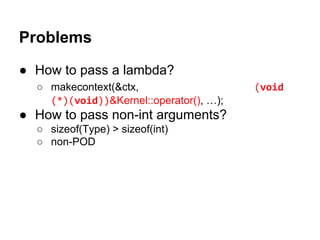
Problems
● Cannot return
○ return address in the stack is destroyed
● Cannot use too many static variables
○ will lost spilled registers
→ can be solved by using “alloca”
http://www.codemud.net/~thinker/GinGin_CGI.
py/show_id_doc/489
25
ucontext.h
● ucontext_t
● getcontext
● makecontest
● swapcontext
● setcontext
26
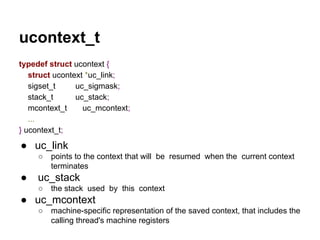
ucontext_t
typedef struct ucontext {
struct ucontext *uc_link;
sigset_t uc_sigmask;
stack_t uc_stack;
mcontext_t uc_mcontext;
...
} ucontext_t;
● uc_link
○ points to the context that will be resumed when the current context
terminates
● uc_stack
○ the stack used by this context
● uc_mcontext
○ machine-specific representation of the saved context, that includes the
calling thread's machine registers
27
Functions
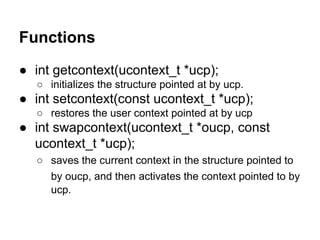
● int getcontext(ucontext_t *ucp);
○ initializes the structure pointed at by ucp.
● int setcontext(const ucontext_t *ucp);
○ restores the user context pointed at by ucp
● int swapcontext(ucontext_t *oucp, const
ucontext_t *ucp);
○ saves the current context in the structure pointed to
by oucp, and then activates the context pointed to by
ucp.
28
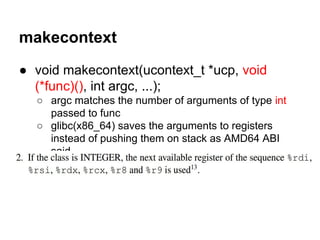
makecontext
● void makecontext(ucontext_t *ucp, void
(*func)(), int argc, ...);
○ glibc(x86_64) saves the arguments to registers
instead of pushing them on stack as AMD64 ABI
said
○ The size of the arguments that passed to
makecontext should be no less than sizeof(register)
29
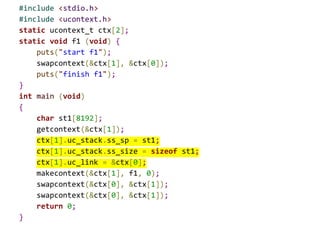
1. #include <stdio.h>
2. #include <ucontext.h>
3. static ucontext_t ctx[2];
4. static void f1 (void) {
5. puts("start f1");
6. swapcontext(&ctx[1], &ctx[0]);
7. puts("finish f1");
8. }
9. int main (void)
10. {
11. char st1[8192];
12. getcontext(&ctx[1]);
13. ctx[1].uc_stack.ss_sp = st1;
14. ctx[1].uc_stack.ss_size = sizeof st1;
15. ctx[1].uc_link = &ctx[0];
16. makecontext(&ctx[1], f1, 0);
17. swapcontext(&ctx[0], &ctx[1]);
18. swapcontext(&ctx[0], &ctx[1]);
19. return 0;
20. } 30
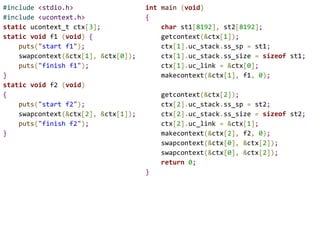
1. #include <stdio.h>
2. #include <ucontext.h>
3. static ucontext_t ctx[3];
4. static void f1 (void) {
5. puts("start f1");
6. swapcontext(&ctx[1], &ctx
[0]);
7. puts("finish f1");
8. }
9. static void f2 (void)
10. {
11. puts("start f2");
12. swapcontext(&ctx[2], &ctx
[1]);
13. puts("finish f2");
14. }
1. int main (void)
2. {
3. char st1[8192], st2[8192];
4. getcontext(&ctx[1]);
5. ctx[1].uc_stack.ss_sp = st1;
6. ctx[1].uc_stack.ss_size = sizeof
st1;
7. ctx[1].uc_link = &ctx[0];
8. makecontext(&ctx[1], f1, 0);
9.
10. getcontext(&ctx[2]);
11. ctx[2].uc_stack.ss_sp = st2;
12. ctx[2].uc_stack.ss_size = sizeof
st2;
13. ctx[2].uc_link = &ctx[1];
14. makecontext(&ctx[2], f2, 0);
15. swapcontext(&ctx[0], &ctx[2]);
16. swapcontext(&ctx[0], &ctx[2]);
17. return 0;
18. }
31
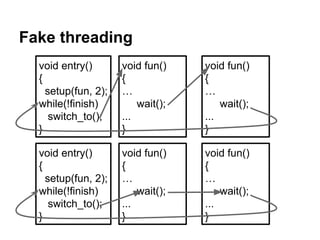
Fake threading (yield)
void entry()
{
setup(fun, 2);
while(!finish)
switch_to();
}
void fun()
{
…
wait();
...
}
void fun()
{
…
wait();
...
}
32
void entry()
{
setup(fun, 2);
while(!finish)
switch_to();
}
void fun()
{
…
wait();
...
}
void fun()
{
…
wait();
...
}
Problems
1. How to pass a lambda?
○ makecontext(&ctx,
(void (*)(void))&Kernel::operator(), …);
2. How to pass non-int arguments?
○ What if sizeof(Type) > sizeof(int)
○ How about complex structure and class
33
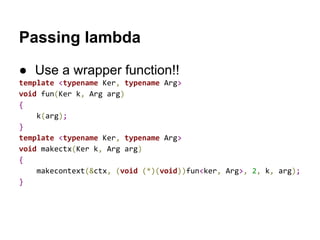
Pass lambda
1. Use a wrapper function!!
template <typename Ker, typename Arg>
void fun(Ker k, Arg arg)
{
k(arg);
}
template <typename Ker, typename Arg>
void makectx(Ker k, Arg arg)
{
makecontext(&ctx, (void (*)(void))fun<ker, Arg>, 2, k, arg);
}
34
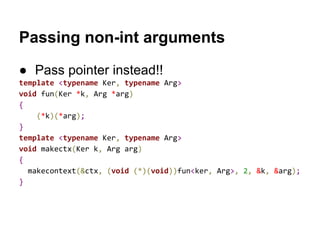
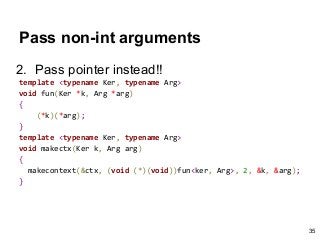
Pass non-int arguments
2. Pass pointer instead!!
template <typename Ker, typename Arg>
void fun(Ker *k, Arg *arg)
{
(*k)(*arg);
}
template <typename Ker, typename Arg>
void makectx(Ker k, Arg arg)
{
makecontext(&ctx, (void (*)(void))fun<ker, Arg>, 2, &k, &arg);
}
35
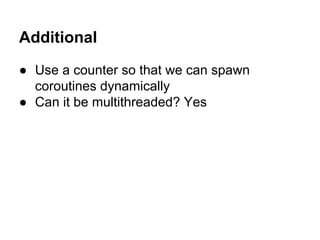
Additional
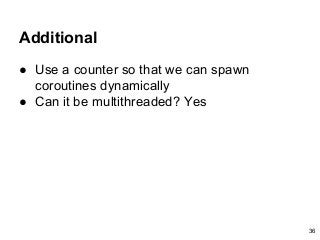
● Use a counter so that we can spawn
coroutines dynamically
● Can it be multithreaded? Yes
36
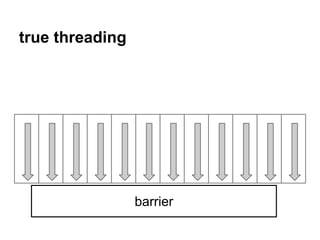
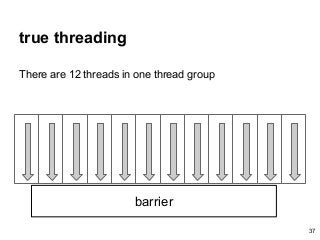
true threading
barrier
There are 12 threads in one thread group
37
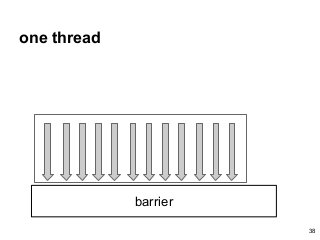
one thread
barrier
38
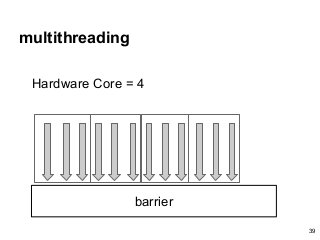
multithreading
barrier
Hardware Core = 4
39
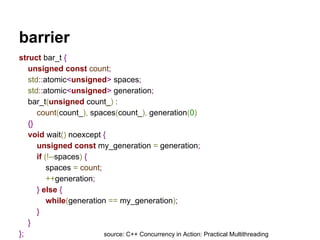
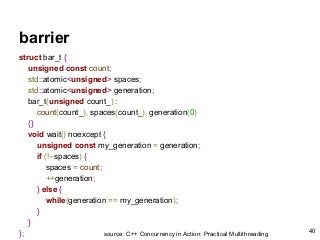
barrier
struct bar_t {
unsigned const count;
std::atomic<unsigned> spaces;
std::atomic<unsigned> generation;
bar_t(unsigned count_) :
count(count_), spaces(count_), generation(0)
{}
void wait() noexcept {
unsigned const my_generation = generation;
if (!--spaces) {
spaces = count;
++generation;
} else {
while(generation == my_generation);
}
}
}; source: C++ Concurrency in Action: Practical Multithreading
40
Summary
● It works fine on AMP right now
● The importance of low level knowledge
41
42

GPU Programming on CPU - Using C++AMP

  • 1.
  • 2.
    Outline 1. Introduction toC++AMP 2. Introduction to Tiling 3. tile_static 4. barrier.wait and solutions a. C++11 thread b. setjmp/longjmp c. ucontext 2
  • 3.
    (Homogeneous coordinates) (0, 0)(0, 1) (0, 2) (0, 3) (1, 0) (1, 1) (1, 2) (1, 3) (2, 0) (2, 1) (2, 2) (2, 3) (3, 0) (3, 1) (3, 2) (3, 3) X 0 1 2 3 Matrix A b = 0 1 2 3 result Computing example ● Simple matrix multiplication 3
  • 4.
    C++ Version 1. intA[4][4]; 2. int b[4]; 3. int result[4]; 4. for (int i = 0; i < 4; i++) { 5. result[i] = 0; 6. for (int j = 0; j < 4; j++) 7. result[i] += A[i][j] * b[j]; 8. } 4
  • 5.
    C++AMP Version 1. array_view<float,2> A(4, 4); 2. array_view<float, 1> b(4); 3. array_view<float, 1> result(4); 4. extent<1> ext(4); 5. parallel_for_each(ext, [&](index<1> idx) restrict(amp) 6. { 7. result[idx[0]] = 0; 8. for (int i = 0; i < 4; i++) 9. result[idx[0]] += A(idx[0], i) * b(i); 10. }); 5
  • 6.
    memory access 0 12 3 P0 P1 P2 P3 global memory b 100t Total access time = 400t 6
  • 7.
    shared memory 0 12 3 shared memory 10t 100t Total access time = 130t b 7
  • 8.
    1. array_view<float, 2>A(4, 4); 2. array_view<float, 1> b(4); 3. array_view<float, 1> result(4); 4. extent<1> ext(4); 5. parallel_for_each(ext.tile<4>(), [&](tiled_index<4> tidx) restrict(amp) 6. { 7. int local = tidx.local[0]; 8. int global = tidx.global[0]; 9. tile_statc int buf[4]; 10. buf[local] = b[global]; 11. tidx.barrier.wait(); 12. result[idx[0]] = 0; 13. for (int i = 0; i < 4; i++) 14. result[idx[0]] += A[idx[0]][i] * buf[i]; 15. }); 8
  • 9.
  • 10.
    Architecture source: NVIDIA TESLA:AUNIFIEDGRAPHICS AND COMPUTING ARCHITECTURE shared memory accessible to all SPs 10
  • 11.
    Goal ● Implement allthe C++AMP function on CPU instead of GPU without any compiler modification. 11
  • 12.
    tiled_static ● The limitationof C++ syntax leads to the following choices ○ const, volatile ○ __attribute__(...) ○ static ● Choose static ○ static memory can be shared among all the threads ○ side effect: At most one thread group can be executed at the same time. #define tile_static static 12
  • 13.
    Barrier.wait ● Threads inthe same thread group will be waited at the point where “wait” is called. ● Program can a. perform real barrier action b. jump out of current execution context 13
  • 14.
    ● True threading ○C++11 thread ● Fake threading(Coroutines) ○ setjmp/longjmp ○ makecontext/getcontext/swapcontext/setcontext Approaches 14
  • 15.
    C++11 thread ● launchhundreds of threads at a time. ● implemente my own barrier by using C++11 mutex library. → extremely slow. → The data on static memory will be corrupted 15
  • 16.
    setjmp/longjmp ● int setjmp(jmp_bufenv) ○ setjmp() saves the stack context/environment in env for later use by longjmp. ○ The stack context will be invalidated if the function which called setjmp() returns. ● void longjmp(jmp_buf env, int val); ○ longjmp() restores the environment saved by the last call of setjmp. 16
  • 17.
    1. #include <stdio.h> 2.#include <setjmp.h> 3. jmp_buf buf; 4. void wait(void) { 5. printf("waitn"); // prints 6. longjmp(buf,1); 7. } 8. void first(void) { 9. wait(); 10. printf("firstn"); // does not print 11. } 12. int main() { 13. if (!setjmp(buf)) 14. first(); // when executed, setjmp returns 0 15. else // when longjmp jumps back, setjmp returns 1 16. printf("mainn"); // prints 17. return 0; 18. } 17
  • 18.
    Pseudo code (1) voidentry() { while(!finish) for(t : tasks) run(t) } void fun() { … wait(); ... } void fun() { … wait(); ... } void entry() { while(!finish) for(t : tasks) run(t) } void fun() { … wait(); ... } void fun() { … wait(); ... } 18
  • 19.
    Pseudo code (2) voidentry() { while(!finish) for(t : tasks) run(t) } void fun() { … wait(); ... } void fun() { … wait(); ... } void entry() { while(!finish) for(t : tasks) run(t) } void fun() { … wait(); ... } void fun() { … wait(); ... } 19
  • 20.
    1. #include <stdio.h> 2.#include <setjmp.h> 3. jmp_buf buf, b; 4. void wait(void) { 5. printf("waitn"); 6. if (setjmp(b) == 0) 7. longjmp(buf,1); 8. } 9. void first(void) { 10. wait(); 11. } 12. int main() { 13. if (!setjmp(buf) ) 14. first(); 15. else { 16. printf("mainn"); 17. longjmp(b, 10); 18. } 19. return 0; 20. } 20
  • 21.
    1. #include <stdio.h> 2.#include <setjmp.h> 3. jmp_buf buf, b; 4. void wait(void) { 5. printf("waitn"); 6. if (setjmp(b) == 0) 7. longjmp(buf,1); 8. } 9. void first(void) { 10. wait(); 11. } 12. int main() { 13. if (!setjmp(buf) ) 14. first(); 15. else { 16. printf("mainn"); 17. longjmp(b, 10); 18. } 19. return 0; 20. } buf 21
  • 22.
    1. #include <stdio.h> 2.#include <setjmp.h> 3. jmp_buf buf, b; 4. void wait(void) { 5. printf("waitn"); 6. if (setjmp(b) == 0) 7. longjmp(buf,1); 8. } 9. void first(void) { 10. wait(); 11. } 12. int main() { 13. if (!setjmp(buf) ) 14. first(); 15. else { 16. printf("mainn"); 17. longjmp(b, 10); 18. } 19. return 0; 20. } ret address buf b 22
  • 23.
    1. #include <stdio.h> 2.#include <setjmp.h> 3. jmp_buf buf, b; 4. void wait(void) { 5. printf("waitn"); 6. if (setjmp(b) == 0) 7. longjmp(buf,1); 8. } 9. void first(void) { 10. wait(); 11. } 12. int main() { 13. if (!setjmp(buf) ) 14. first(); 15. else { 16. printf("mainn"); 17. longjmp(b, 10); 18. } 19. return 0; 20. } buf b 23
  • 24.
    1. #include <stdio.h> 2.#include <setjmp.h> 3. jmp_buf buf, b; 4. void wait(void) { 5. printf("waitn"); 6. if (setjmp(b) == 0) 7. longjmp(buf,1); 8. } 9. void first(void) { 10. wait(); 11. } 12. int main() { 13. if (!setjmp(buf) ) 14. first(); 15. else { 16. printf("mainn"); 17. longjmp(b, 10); 18. } 19. return 0; 20. } Cannot return ??? ??? ??? buf b 24
  • 25.
    Problems ● Cannot return ○return address in the stack is destroyed ● Cannot use too many static variables ○ will lost spilled registers → can be solved by using “alloca” http://www.codemud.net/~thinker/GinGin_CGI. py/show_id_doc/489 25
  • 26.
    ucontext.h ● ucontext_t ● getcontext ●makecontest ● swapcontext ● setcontext 26
  • 27.
    ucontext_t typedef struct ucontext{ struct ucontext *uc_link; sigset_t uc_sigmask; stack_t uc_stack; mcontext_t uc_mcontext; ... } ucontext_t; ● uc_link ○ points to the context that will be resumed when the current context terminates ● uc_stack ○ the stack used by this context ● uc_mcontext ○ machine-specific representation of the saved context, that includes the calling thread's machine registers 27
  • 28.
    Functions ● int getcontext(ucontext_t*ucp); ○ initializes the structure pointed at by ucp. ● int setcontext(const ucontext_t *ucp); ○ restores the user context pointed at by ucp ● int swapcontext(ucontext_t *oucp, const ucontext_t *ucp); ○ saves the current context in the structure pointed to by oucp, and then activates the context pointed to by ucp. 28
  • 29.
    makecontext ● void makecontext(ucontext_t*ucp, void (*func)(), int argc, ...); ○ glibc(x86_64) saves the arguments to registers instead of pushing them on stack as AMD64 ABI said ○ The size of the arguments that passed to makecontext should be no less than sizeof(register) 29
  • 30.
    1. #include <stdio.h> 2.#include <ucontext.h> 3. static ucontext_t ctx[2]; 4. static void f1 (void) { 5. puts("start f1"); 6. swapcontext(&ctx[1], &ctx[0]); 7. puts("finish f1"); 8. } 9. int main (void) 10. { 11. char st1[8192]; 12. getcontext(&ctx[1]); 13. ctx[1].uc_stack.ss_sp = st1; 14. ctx[1].uc_stack.ss_size = sizeof st1; 15. ctx[1].uc_link = &ctx[0]; 16. makecontext(&ctx[1], f1, 0); 17. swapcontext(&ctx[0], &ctx[1]); 18. swapcontext(&ctx[0], &ctx[1]); 19. return 0; 20. } 30
  • 31.
    1. #include <stdio.h> 2.#include <ucontext.h> 3. static ucontext_t ctx[3]; 4. static void f1 (void) { 5. puts("start f1"); 6. swapcontext(&ctx[1], &ctx [0]); 7. puts("finish f1"); 8. } 9. static void f2 (void) 10. { 11. puts("start f2"); 12. swapcontext(&ctx[2], &ctx [1]); 13. puts("finish f2"); 14. } 1. int main (void) 2. { 3. char st1[8192], st2[8192]; 4. getcontext(&ctx[1]); 5. ctx[1].uc_stack.ss_sp = st1; 6. ctx[1].uc_stack.ss_size = sizeof st1; 7. ctx[1].uc_link = &ctx[0]; 8. makecontext(&ctx[1], f1, 0); 9. 10. getcontext(&ctx[2]); 11. ctx[2].uc_stack.ss_sp = st2; 12. ctx[2].uc_stack.ss_size = sizeof st2; 13. ctx[2].uc_link = &ctx[1]; 14. makecontext(&ctx[2], f2, 0); 15. swapcontext(&ctx[0], &ctx[2]); 16. swapcontext(&ctx[0], &ctx[2]); 17. return 0; 18. } 31
  • 32.
    Fake threading (yield) voidentry() { setup(fun, 2); while(!finish) switch_to(); } void fun() { … wait(); ... } void fun() { … wait(); ... } 32 void entry() { setup(fun, 2); while(!finish) switch_to(); } void fun() { … wait(); ... } void fun() { … wait(); ... }
  • 33.
    Problems 1. How topass a lambda? ○ makecontext(&ctx, (void (*)(void))&Kernel::operator(), …); 2. How to pass non-int arguments? ○ What if sizeof(Type) > sizeof(int) ○ How about complex structure and class 33
  • 34.
    Pass lambda 1. Usea wrapper function!! template <typename Ker, typename Arg> void fun(Ker k, Arg arg) { k(arg); } template <typename Ker, typename Arg> void makectx(Ker k, Arg arg) { makecontext(&ctx, (void (*)(void))fun<ker, Arg>, 2, k, arg); } 34
  • 35.
    Pass non-int arguments 2.Pass pointer instead!! template <typename Ker, typename Arg> void fun(Ker *k, Arg *arg) { (*k)(*arg); } template <typename Ker, typename Arg> void makectx(Ker k, Arg arg) { makecontext(&ctx, (void (*)(void))fun<ker, Arg>, 2, &k, &arg); } 35
  • 36.
    Additional ● Use acounter so that we can spawn coroutines dynamically ● Can it be multithreaded? Yes 36
  • 37.
    true threading barrier There are12 threads in one thread group 37
  • 38.
  • 39.
  • 40.
    barrier struct bar_t { unsignedconst count; std::atomic<unsigned> spaces; std::atomic<unsigned> generation; bar_t(unsigned count_) : count(count_), spaces(count_), generation(0) {} void wait() noexcept { unsigned const my_generation = generation; if (!--spaces) { spaces = count; ++generation; } else { while(generation == my_generation); } } }; source: C++ Concurrency in Action: Practical Multithreading 40
  • 41.
    Summary ● It worksfine on AMP right now ● The importance of low level knowledge 41
  • 42.