The Butterfly System
BowmanSJ, Carano A. The Butterfly System. J Clin Orthod. 2004;38(5):274–87.
Journal Club Presentation - 6
2.
Dr. S. JAYBOWMAN,
DMD, MSD
Dr. ALDO CARANO, DO,
MS
Bowman SJ, Carano A. The Butterfly System. J Clin Orthod. 2004;38(5):274–87.
3.
Creekmore and Kunikdescribed five reasons why current preadjusted
appliances do not achieve ideal tooth positions with the use of “straight” wires:
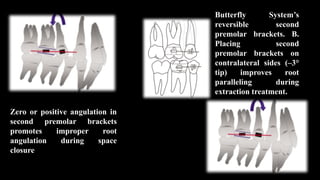
1. Inaccurate bracket placement.
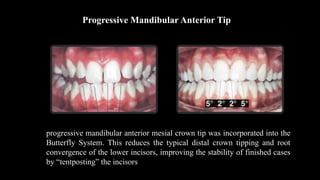
2. Variations in tooth structure.
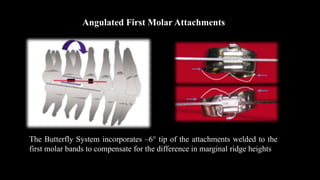
3. Variations in anteroposterior jaw relationships affecting incisor position.
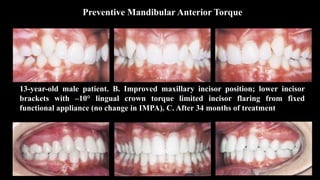
4. Lack of overcorrection built into treatment mechanics (i.e., tissue rebound).
5. Mechanical deficiencies of the orthodontic appliance—force not applied at
the center of re-sistance, play between wire and slot, or force diminution
4.
The Butterfly System
Hybrid, Third-generation appliance
low-profile
twin-wing bracket
rounded tie wings
the elimination of standard hooks
results in an appliance that is more
comfortable, esthetic, and hygienic.
Trademark of American Orthodontics, Inc., 1714 Cambridge Ave., Sheboygan, MI 53082.
5.
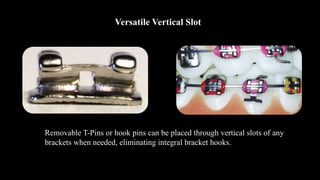
Versatile Vertical Slot
RemovableT-Pins or hook pins can be placed through vertical slots of any
brackets when needed, eliminating integral bracket hooks.
6.
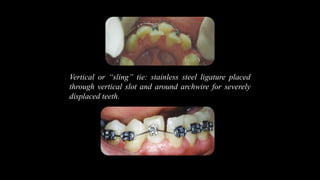
Vertical or “sling”tie: stainless steel ligature placed
through vertical slot and around archwire for severely
displaced teeth.
7.
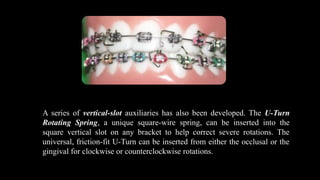
A series ofvertical-slot auxiliaries has also been developed. The U-Turn
Rotating Spring, a unique square-wire spring, can be inserted into the
square vertical slot on any bracket to help correct severe rotations. The
universal, friction-fit U-Turn can be inserted from either the occlusal or the
gingival for clockwise or counterclockwise rotations.
8.
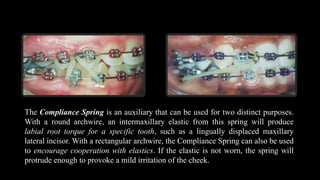
The Compliance Springis an auxiliary that can be used for two distinct purposes.
With a round archwire, an intermaxillary elastic from this spring will produce
labial root torque for a specific tooth, such as a lingually displaced maxillary
lateral incisor. With a rectangular archwire, the Compliance Spring can also be used
to encourage cooperation with elastics. If the elastic is not worn, the spring will
protrude enough to provoke a mild irritation of the cheek.
9.
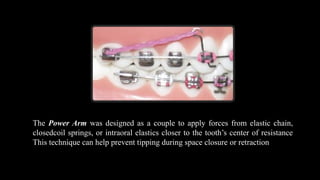
The Power Armwas designed as a couple to apply forces from elastic chain,
closedcoil springs, or intraoral elastics closer to the tooth’s center of resistance
This technique can help prevent tipping during space closure or retraction
10.
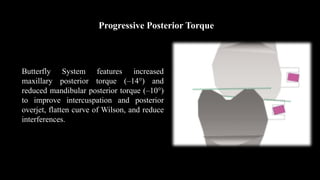
Progressive Posterior Torque
ButterflySystem features increased
maxillary posterior torque (–14°) and
reduced mandibular posterior torque (–10°)
to improve intercuspation and posterior
overjet, flatten curve of Wilson, and reduce
interferences.
11.
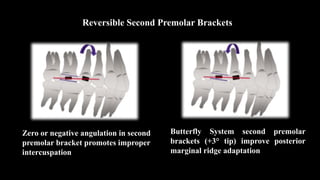
Reversible Second PremolarBrackets
Zero or negative angulation in second
premolar bracket promotes improper
intercuspation
Butterfly System second premolar
brackets (+3° tip) improve posterior
marginal ridge adaptation
12.
Zero or positiveangulation in
second premolar brackets
promotes improper root
angulation during space
closure
Butterfly System’s
reversible second
premolar brackets. B.
Placing second
premolar brackets on
contralateral sides (–3°
tip) improves root
paralleling during
extraction treatment.
13.
Progressive Mandibular AnteriorTip
progressive mandibular anterior mesial crown tip was incorporated into the
Butterfly System. This reduces the typical distal crown tipping and root
convergence of the lower incisors, improving the stability of finished cases
by “tentposting” the incisors
14.
Angulated First MolarAttachments
The Butterfly System incorporates –6° tip of the attachments welded to the
first molar bands to compensate for the difference in marginal ridge heights
15.
Preventive Mandibular AnteriorTorque
13-year-old male patient. B. Improved maxillary incisor position; lower incisor
brackets with –10° lingual crown torque limited incisor flaring from fixed
functional appliance (no change in IMPA). C. After 34 months of treatment
16.
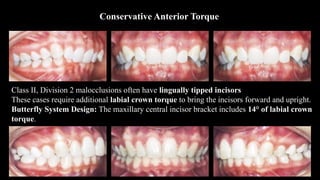
Conservative Anterior Torque
ClassII, Division 2 malocclusions often have lingually tipped incisors
These cases require additional labial crown torque to bring the incisors forward and upright.
Butterfly System Design: The maxillary central incisor bracket includes 14° of labial crown
torque.
17.
Improvements in Overjet
Use of overexpanded commercial arch blanks in conjunction with
bimaxillary expansion therapies often leads to Anterior and posterior
overjet discrepancies.
Flared molars
Distally tipped incisors
18.
Reduced mandibulartorque: Prevents the mandibular posterior teeth from
"rolling in"
Increased maxillary torque: Helps avoid flared maxillary molars
This progressive torque balances the alignment of upper and lower posterior teeth,
ensuring proper overjet.
Archform Selection:
•The patient’s pretreatment anatomical archform is used as a guide for archwire
selection, avoiding over-expansion or narrowing of the arches.
•Maintaining the pretreatment intercanine width helps preserve natural arch
symmetry and prevent distortions.
Coordinated Archforms
19.
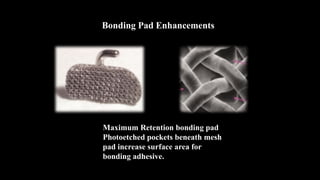
Bonding Pad Enhancements
MaximumRetention bonding pad
Photoetched pockets beneath mesh
pad increase surface area for
bonding adhesive.
20.
The articledoes not provide clinical trials or long-term studies to validate
the claims of improved outcomes compared to existing systems like MBT.
Evidence is largely anecdotal or based on theoretical improvements rather
than statistically significant results
CRITICAL APPRAISAL
21.
Conclusion
The design ofthe Butterfly System prioritizes aesthetics, comfort, versatility, and
personalization. The miniature twin Butterfly bracket is crafted with a low profile and
rounded tie-wing corners for enhanced comfort. Its multipurpose vertical slot eliminates
the need for hooks, and the system supports colorful elastomeric ligatures, which many
patients now prefer for personalizing their braces.
By incorporating the strengths of previous designs while resolving common issues, this
system aims to deliver more efficient treatments and improved outcomes for patients.
#3 If teeth were moved through air or the “virtual reality” of a computer simulation,11 the preadjusted prescription would always work. In reality, however, a straight wire never becomes entirely straight. Consequently, it is not enough simply to plan for ideal tooth positions; some overcompensation or overcorrection is needed in the prescription.
#4 The twin-wing configuration of the brackets resembles a butterfly's wings.
Orthodontic treatment is about transforming a patient's smile, much like a butterfly's metamorphosis. The name underscores the system's role in achieving beautiful, functional, and esthetic transformations
#5 The incorporation of a simple vertical slot
the elimination of ball hooks on the brackets significantly reduces the likelihood of tissue impingement, trapped food, and plaque, while making archwires easier to tie.
a simple hook pin or T-Pin can be inserted into the vertical slot of any bracket— virtually eliminating the need for soldered hooks, and crimpable surgical hooks.
One of the simplest uses of the vertical slot
is for teeth that are blocked out, lingually displaced,
or ectopically erupted. In these instances,
it is nearly impossible to tie an archwire into the bracket during early alignment, but a stainless steel ligature or elastic thread can be placed through the vertical slot to form a vertical or “sling” tie around the archwire (Fig. 3). A loose stainless steel tie, especially a single vertical tie,produces even less friction than a self-ligating bracket.
#7 A series of vertical-slot auxiliaries has also been developed. The U-Turn Rotating Spring,a unique square-wire spring, can be inserted into the square vertical slot on any bracket to help correct severe rotations (Fig. 4). The universal, friction-fit U-Turn can be inserted from either the occlusal or the gingival for clockwise or counterclockwise rotations.
#8 The Compliance Spring** is an auxiliary that can be used for two distinct purposes. With a round archwire, an intermaxillary elastic from this spring will produce labial root torque for a specific tooth, such as a lingually displaced maxillary lateral incisor (Fig. 5A). With a rectangular archwire, the Compliance Spring can also be used to encourage cooperation with elastics (Fig. 5B). If the elastic is not worn, the spring will protrude enough to provoke a mild irritation of the cheek.
#10 The most common deficiency of finished cases presented by either orthodontic residents or successful ABO candidates is improper buccolingual inclinations.1,15 Torque is not efficiently expressed with preadjusted appliances, because the area of torque application, which depends on the twisting effect of a thin wire, is quite small compared with the bulk of the tooth.5,12 In addition, most practitioners do not use full-size archwires of sufficient stiffness to express torque; for example, an .019" × .025" wire in an .022" ×.028" system has about 10° of play
mandibular posterior teeth have significant lingual crown torque (-20°), and maxillary posterior teeth have minimal torque (-14°).
This combination tends to tip the upper posterior teeth to the buccal and “roll in” the lower posterior teeth to the lingual, resulting in overly prominent maxillary palatal cusps, inappropriate interdigitation of the maxillary buccal cusps, increased occlusal interference, and an accentuated curve of Wilson1
#13 "Tentposting" refers to maintaining appropriate spacing and alignment of the incisor roots, creating a stable and upright position like the poles of a tent.This ensures the teeth are better positioned to withstand functional forces and reduces the likelihood of post-treatment relapse.
#14 When Butterfly System first molar bands are fitted to marginal ridges, tube angulation keeps buccal cusps parallel to occlusal plane.
Another contributing
factor is the difference in height
between the mesial and distal marginal ridges of
the maxillary first molar. Standard molar bands,
fitted to the marginal ridge heights, are often
positioned too far gingivally on the distal side,
thus tipping the buccal molar tube distally. The
results are excessive prominence of the first
molar’s distobuccal cusps, marginal ridge discrepancies,
and occlusal interferences (Fig. 17).
Bennett and McLaughlin recommended that the
attachments, not the margins of the band, be
placed parallel to the buccal cusps,5 but this
makes it difficult to achieve an ideal fit of the
band to the molar.
The Butterfly System incorporates –6° tip of the attachments welded to the first molar bands to compensate for the difference in marginal ridge heights, as in the Ricketts and Alexander prescriptions. When the bands are fitted evenly at the mesial and distal ridges, the bracket slot will be level
#16 This torque is sufficient to correct lingually tipped incisors (e.g., changing the incisal angle from 98° to 104°).










![Alexander_Discipline_(PART_2)[1] complete.pptx](https://cdn.slidesharecdn.com/ss_thumbnails/alexanderdisciplinepart21-251118184023-04d0c3b3-thumbnail.jpg?width=640&height=640&fit=bounds)


![ONFH[AVN HIP] -TRIPLE REGIME -A NOVAL SURGICAL CONCEPT .pptx](https://cdn.slidesharecdn.com/ss_thumbnails/onfhavnhip2026koaconcalicutdrgokuldevdrmashraf-260210064517-213ec005-thumbnail.jpg?width=640&height=640&fit=bounds)
![CTEV [ clubfoot] DR ARUN LAL ,DR MOHAMED ASHRAF travancore medical college k...](https://cdn.slidesharecdn.com/ss_thumbnails/ctevclubfootdrarunlaldrmohamedashraftravancoremedicalcollegekollamkeralaindia-260208063247-18fc466c-thumbnail.jpg?width=640&height=640&fit=bounds)


