Fixed a ppliances
Nay Aung, BDS PhD
24.12.2022
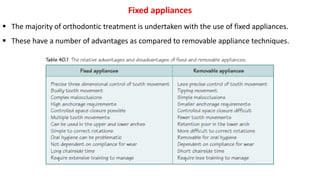
 The majority of orthodontic treatment is undertaken with the use of fixed appliances.
 These have a number of advantages as compared to removable appliance techniques.
Fixed appliances
 There are many fixed appliance systems with the most commonly used being the ‘pre-
adjusted’ edgewise appliance.
 This appliance was developed from the standard edgewise appliance that was originally
introduced by Edward Angle.
 The pre-adjusted Edgewise appliance benefits by each tooth having its own individual bracket,
with the slot at a specific angle and a base of varying thickness, which positions the tooth at
its correct tip/inclination/rotation once a full size archwire has been allowed to fully express
itself.
 This circumvents the requirement for complex archwire bending, which was common practice
with the standard Edgewise technique.
Fixed appliances
 The successful use of fixed appliances requires extensive training which is beyond the scope of
undergraduate training programmes.
 General practitioners should, however, have a basic understanding of what these appliances
can achieve and the commonly encountered problems.
Fixed appliances
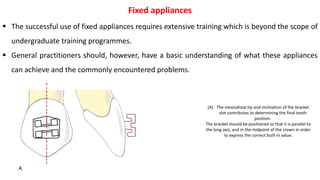
(A) The mesiodistal tip and inclination of the bracket
slot contributes to determining the final tooth
position.
The bracket should be positioned so that it is parallel to
the long axis, and in the midpoint of the crown in order
to express the correct built-in value.
 Brackets are bonded to the teeth, using the acid-etch technique, or welded onto bands which
can then be cemented using glass ionomer cement.
 Some clinicians will band the molars for the application of headgear or because of the
reduced risk of bond failure and bond all other teeth.
 Separators are often placed 5-7 days before band placement to create space between the
interproximal contacts to allow band placement.
Components of a fixed appliance
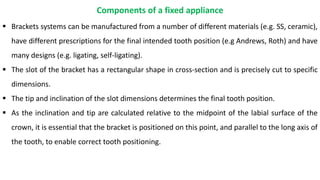
 Brackets systems can be manufactured from a number of different materials (e.g. SS, ceramic),
have different prescriptions for the final intended tooth position (e.g Andrews, Roth) and have
many designs (e.g. ligating, self-ligating).
 The slot of the bracket has a rectangular shape in cross-section and is precisely cut to specific
dimensions.
 The tip and inclination of the slot dimensions determines the final tooth position.
 As the inclination and tip are calculated relative to the midpoint of the labial surface of the
crown, it is essential that the bracket is positioned on this point, and parallel to the long axis of
the tooth, to enable correct tooth positioning.
Components of a fixed appliance
 Archwires apply the active force to move teeth to their desired position.
 They are constructed from various materials (e.g. SS, NiTi), have different cross-sectional
shapes (round or rectangular) and have a large range of diameters.
 As the archwire is formed into a pre-determined archform, it will tend to move the teeth to
this position unless the proportional limit of the wire is exceeded.
Components of a fixed appliance
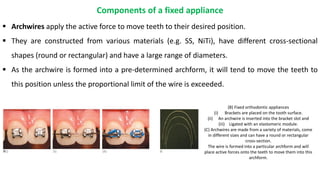
(B) Fixed orthodontic appliances
(i) Brackets are placed on the tooth surface.
(ii) An archwire is inserted into the bracket slot and
(iii) Ligated with an elastomeric module.
(C) Archwires are made from a variety of materials, come
in different sizes and can have a round or rectangular
cross-section.
The wire is formed into a particular archform and will
place active forces onto the teeth to move them into this
archform.
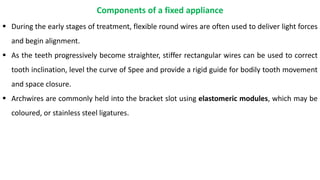
 During the early stages of treatment, flexible round wires are often used to deliver light forces
and begin alignment.
 As the teeth progressively become straighter, stiffer rectangular wires can be used to correct
tooth inclination, level the curve of Spee and provide a rigid guide for bodily tooth movement
and space closure.
 Archwires are commonly held into the bracket slot using elastomeric modules, which may be
coloured, or stainless steel ligatures.
Components of a fixed appliance
 During treatment, archwires may protrude excessively from the most distal bracket and cause
soft tissue trauma.
 These long ‘distal ends’ can be easily cut using specially designed pliers (distal-end cutters)
that securely hold the excess wire to allow safe retrieval from the mouth.
 Auxillaries are used to apply active forces for space opening or closure.
 Elastic materials can be used for intra-arch (intra-maxillary) space closure, and springs
constructed from SS or NiTi can be used for space opening.
Components of a fixed appliance
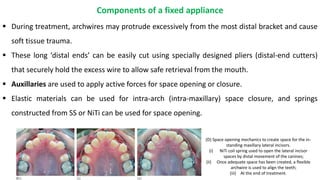
(D) Space opening mechanics to create space for the in-
standing maxillary lateral incisors.
(i) NiTi coil spring used to open the lateral incisor
spaces by distal movement of the canines;
(ii) Once adequate space has been created, a flexible
archwire is used to align the teeth;
(iii) At the end of treatment.
 For the purpose of learning, fixed appliance treatment can be subdivided into a number of
stages.
 It is important to note that in a number of cases, the mechanical stages may overlap:
 Diagnosis and treatment planning
 Anchorage control
 Levelling and aligning
 Overbite reduction
 Overjet correction and space closure
 Finishing
 Retention
Stages of orthodontic treatment
 Alignment refers to the correction of rotations, tip and inclination whereas levelling refers to
the alignment of the bracket slots in the vertical plane.
 Levelling and alignment commences with the use of flexible aligning wires, which can be fully
engaged into the bracket slot, and is complete when a large rectangular SS wire (usually of
0.019 x 0.025 inch dimensions) lies passively within the bracket slot.
Stages of orthodontic treatment
 A deep overbite must be reduced before the incisors can be placed into a Class I relationship.
 For example, in a Class II case with a deep overbite, if the incisors are retracted without
reducing the overbite, the lower incisal edges will clash with the cingulum of the upper
incisors and prevent their retraction.
Stages of orthodontic treatment
 Overjet correction and space closure is undertaken in large rectangular wires which control
the inclination of teeth.
 Space closing forces can be applied with intramaxillary and intermaxillary traction.
 It is important to reassess anchorage requirements before commencing space closure.
Stages of orthodontic treatment
 Common finishing procedures include adjustments to inclination and tip, centerline correction
and occlusal settling.
 Final tip and inclination adjustments can be made by placing bends into the archwire or by
repositioning incorrectly placed brackets.
 Centerline correction and settling is often undertaken using intermaxillary elastics.
Stages of orthodontic treatment
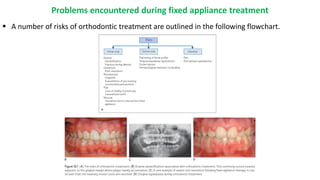
 A number of risks of orthodontic treatment are outlined in the following flowchart.
Problems encountered during fixed appliance treatment
 The following slides will concentrate on problems that may be encountered during fixed
appliance treatment.
 There is large individual variation in the intensity of pain experienced by patients during fixed
appliance treatment.
 Most will experience some pain that is caused by a localized inflammatory reaction around the
tooth socket.
 Pain is commonly encountered following the placement of separators and after fixed
appliance adjustments.
 It usually starts within a few hours of such a procedure, increases over the next 24 hours and
decreases to baseline levels within 5-7 days.
 It may show diurnal variation with greatest intensity in the evening and night.
 NSAIDs can be used in low doses, if necessary, to improve patient comfort.
Problems encountered during fixed appliance treatment
 Tooth mobility is a normal phenomenon during tooth movement caused by disruption and an
increased width of the periodontal ligament.
 Teeth with premature contacts may experience greater mobility, as can teeth on which
excessive orthodontic forces are placed.
 In the majority of cases, the patient will just require reassurance if they are concerned about
increased mobility, however, if the mobility is severe it may be worth taking a periapical
radiograph to rule out severe root resorption or alveolar bone loss.
Problems encountered during fixed appliance treatment
 Mucosal trauma is a common phenomenon during fixed appliance treatment.
 In the majority of cases, a protruding wire is often the cause and is easy to deal with.
 Some patients may have exaggerated hyperplastic mucosal reactions to mild irritation caused
by appliances rubbing on the mucosa.
 Orthodontic wax can be used to cushion the effects of appliance components.
Problems encountered during fixed appliance treatment
 Brackets may often debond during a course of fixed appliance treatment.
 Patients should be advised to immediately see their orthodontist as a loss of control of
debonded teeth and unwanted tooth movement may prolong treatment.
 Teeth with poorly developed enamel and a diet consisting of hard food predispose to multiple
bracket failures.
Problems encountered during fixed appliance treatment
Thank you so much for your kind attention.

Fixed appliances.pdf

  • 1.
    Fixed a ppliances NayAung, BDS PhD 24.12.2022
  • 2.
     The majorityof orthodontic treatment is undertaken with the use of fixed appliances.  These have a number of advantages as compared to removable appliance techniques. Fixed appliances
  • 3.
     There aremany fixed appliance systems with the most commonly used being the ‘pre- adjusted’ edgewise appliance.  This appliance was developed from the standard edgewise appliance that was originally introduced by Edward Angle.  The pre-adjusted Edgewise appliance benefits by each tooth having its own individual bracket, with the slot at a specific angle and a base of varying thickness, which positions the tooth at its correct tip/inclination/rotation once a full size archwire has been allowed to fully express itself.  This circumvents the requirement for complex archwire bending, which was common practice with the standard Edgewise technique. Fixed appliances
  • 4.
     The successfuluse of fixed appliances requires extensive training which is beyond the scope of undergraduate training programmes.  General practitioners should, however, have a basic understanding of what these appliances can achieve and the commonly encountered problems. Fixed appliances (A) The mesiodistal tip and inclination of the bracket slot contributes to determining the final tooth position. The bracket should be positioned so that it is parallel to the long axis, and in the midpoint of the crown in order to express the correct built-in value.
  • 5.
     Brackets arebonded to the teeth, using the acid-etch technique, or welded onto bands which can then be cemented using glass ionomer cement.  Some clinicians will band the molars for the application of headgear or because of the reduced risk of bond failure and bond all other teeth.  Separators are often placed 5-7 days before band placement to create space between the interproximal contacts to allow band placement. Components of a fixed appliance
  • 6.
     Brackets systemscan be manufactured from a number of different materials (e.g. SS, ceramic), have different prescriptions for the final intended tooth position (e.g Andrews, Roth) and have many designs (e.g. ligating, self-ligating).  The slot of the bracket has a rectangular shape in cross-section and is precisely cut to specific dimensions.  The tip and inclination of the slot dimensions determines the final tooth position.  As the inclination and tip are calculated relative to the midpoint of the labial surface of the crown, it is essential that the bracket is positioned on this point, and parallel to the long axis of the tooth, to enable correct tooth positioning. Components of a fixed appliance
  • 7.
     Archwires applythe active force to move teeth to their desired position.  They are constructed from various materials (e.g. SS, NiTi), have different cross-sectional shapes (round or rectangular) and have a large range of diameters.  As the archwire is formed into a pre-determined archform, it will tend to move the teeth to this position unless the proportional limit of the wire is exceeded. Components of a fixed appliance (B) Fixed orthodontic appliances (i) Brackets are placed on the tooth surface. (ii) An archwire is inserted into the bracket slot and (iii) Ligated with an elastomeric module. (C) Archwires are made from a variety of materials, come in different sizes and can have a round or rectangular cross-section. The wire is formed into a particular archform and will place active forces onto the teeth to move them into this archform.
  • 8.
     During theearly stages of treatment, flexible round wires are often used to deliver light forces and begin alignment.  As the teeth progressively become straighter, stiffer rectangular wires can be used to correct tooth inclination, level the curve of Spee and provide a rigid guide for bodily tooth movement and space closure.  Archwires are commonly held into the bracket slot using elastomeric modules, which may be coloured, or stainless steel ligatures. Components of a fixed appliance
  • 9.
     During treatment,archwires may protrude excessively from the most distal bracket and cause soft tissue trauma.  These long ‘distal ends’ can be easily cut using specially designed pliers (distal-end cutters) that securely hold the excess wire to allow safe retrieval from the mouth.  Auxillaries are used to apply active forces for space opening or closure.  Elastic materials can be used for intra-arch (intra-maxillary) space closure, and springs constructed from SS or NiTi can be used for space opening. Components of a fixed appliance (D) Space opening mechanics to create space for the in- standing maxillary lateral incisors. (i) NiTi coil spring used to open the lateral incisor spaces by distal movement of the canines; (ii) Once adequate space has been created, a flexible archwire is used to align the teeth; (iii) At the end of treatment.
  • 10.
     For thepurpose of learning, fixed appliance treatment can be subdivided into a number of stages.  It is important to note that in a number of cases, the mechanical stages may overlap:  Diagnosis and treatment planning  Anchorage control  Levelling and aligning  Overbite reduction  Overjet correction and space closure  Finishing  Retention Stages of orthodontic treatment
  • 11.
     Alignment refersto the correction of rotations, tip and inclination whereas levelling refers to the alignment of the bracket slots in the vertical plane.  Levelling and alignment commences with the use of flexible aligning wires, which can be fully engaged into the bracket slot, and is complete when a large rectangular SS wire (usually of 0.019 x 0.025 inch dimensions) lies passively within the bracket slot. Stages of orthodontic treatment
  • 12.
     A deepoverbite must be reduced before the incisors can be placed into a Class I relationship.  For example, in a Class II case with a deep overbite, if the incisors are retracted without reducing the overbite, the lower incisal edges will clash with the cingulum of the upper incisors and prevent their retraction. Stages of orthodontic treatment
  • 13.
     Overjet correctionand space closure is undertaken in large rectangular wires which control the inclination of teeth.  Space closing forces can be applied with intramaxillary and intermaxillary traction.  It is important to reassess anchorage requirements before commencing space closure. Stages of orthodontic treatment
  • 14.
     Common finishingprocedures include adjustments to inclination and tip, centerline correction and occlusal settling.  Final tip and inclination adjustments can be made by placing bends into the archwire or by repositioning incorrectly placed brackets.  Centerline correction and settling is often undertaken using intermaxillary elastics. Stages of orthodontic treatment
  • 15.
     A numberof risks of orthodontic treatment are outlined in the following flowchart. Problems encountered during fixed appliance treatment
  • 16.
     The followingslides will concentrate on problems that may be encountered during fixed appliance treatment.  There is large individual variation in the intensity of pain experienced by patients during fixed appliance treatment.  Most will experience some pain that is caused by a localized inflammatory reaction around the tooth socket.  Pain is commonly encountered following the placement of separators and after fixed appliance adjustments.  It usually starts within a few hours of such a procedure, increases over the next 24 hours and decreases to baseline levels within 5-7 days.  It may show diurnal variation with greatest intensity in the evening and night.  NSAIDs can be used in low doses, if necessary, to improve patient comfort. Problems encountered during fixed appliance treatment
  • 17.
     Tooth mobilityis a normal phenomenon during tooth movement caused by disruption and an increased width of the periodontal ligament.  Teeth with premature contacts may experience greater mobility, as can teeth on which excessive orthodontic forces are placed.  In the majority of cases, the patient will just require reassurance if they are concerned about increased mobility, however, if the mobility is severe it may be worth taking a periapical radiograph to rule out severe root resorption or alveolar bone loss. Problems encountered during fixed appliance treatment
  • 18.
     Mucosal traumais a common phenomenon during fixed appliance treatment.  In the majority of cases, a protruding wire is often the cause and is easy to deal with.  Some patients may have exaggerated hyperplastic mucosal reactions to mild irritation caused by appliances rubbing on the mucosa.  Orthodontic wax can be used to cushion the effects of appliance components. Problems encountered during fixed appliance treatment
  • 19.
     Brackets mayoften debond during a course of fixed appliance treatment.  Patients should be advised to immediately see their orthodontist as a loss of control of debonded teeth and unwanted tooth movement may prolong treatment.  Teeth with poorly developed enamel and a diet consisting of hard food predispose to multiple bracket failures. Problems encountered during fixed appliance treatment
  • 20.
    Thank you somuch for your kind attention.