Business Research
Design
Plan for a study
Blue print to carry out the study
Types of Research design
•Exploratory
•Descriptive
•Causal research
Exploratory Research
• Converting broad, vague problem statements into
small, precise problem statements
• Early stages of research
• To formulate hypothesis
Characteristics of Exploratory Research
• It is flexible and versatile
• Data collection structured forms are not used
• Experimentation is not a requirement
• Cost is low
• Possibility of exploration of views
What circumstances is exploratory study ideal?
• To gain insight into the problem
• To generate new product ideas
• To assess the various alternatives
• To develop hypothesis
• To clarify concepts and formulating precise problems
• To pretest a draft questionnaire
Exploratory Research Methods
•Literature search
•Experience survey
•Focus group
•Analysis of selected cases
Literature Review
• It is a comprehensive survey of a previous research
• The literature review surveys scholarly articles, books,
Journals and other sources relevant to your study
• The main aim is to find out problems that are already
investigated and those that need further investigation
• It gives us knowledge about what others have found out in
the related field of study and how they have done so
Literature Review – Why it is needed
• Provide background information
• Identify the focus of research
• Introduce the topic to readers
• Address the trend
• Provide a framework of method
• Analyze the published
6/25/2024
RVIM, Bangalore 8
Literature Review – Where to start
• Where are the major databases/ sources that have been
recommended by your supervisor/mentor?
• Focus on the central research problem and bring out the key
words
• Prepare a list of journals in your area of research
• Give it a title focused towards your objectives
6/25/2024
RVIM, Bangalore 9
Literature review: Key points
• Read relevant(up-to-date) literature
• Refer original works
• Read with comprehension
• Index the literature
• State what others have said/done, and what not
• Discuss what others have said/done towards developing a theme out
of other studies, to end up with identifying research gaps.
6/25/2024
RVIM, Bangalore 10
Literature review in 5 steps
1. Search for a literature relevant for your study
• Develop a list of keywords
• Develop a list of synonyms for these key words
• Open a scholarly database(Google scholar, EBSCO, Science direct, Scopus etc)
• Use Boolean Operators(AND, OR, NOT etc.)
Boolean Operators are simple words (AND, OR, NOT etc.) used as conjunctions to
combine or exclude keywords in a search, resulting in more focused and productive
results. This should save time and effort by eliminating inappropriate hits that must be
scanned before discarding.
• Identify the most important publication
6/25/2024
RVIM, Bangalore 11
Literature review in 5 steps
2. Evaluate and select source
• Do not read the full research , read the abstract
• Look at the bibliography of the publication for other relevant
sources
• Observe the number of high citation count
6/25/2024
RVIM, Bangalore 12
Example…
Impact of Intrinsic Motivation and Institutional
Support on Faculty Research Productivity
RV Institute of
Management
Go, change the world
6/25/2024
RVIM, Bangalore 13
Literature review in 5 steps
3. Identify themes, debates and gaps
• Take not of the connections of different sources to easily
organise your literature review
• Observe for the trends, patterns and themes
• Debates and contradictions
• Influential studies
• Gaps
RV Institute of
Management
Go, change the world
6/25/2024
RVIM, Bangalore 14
Literature review in 5 steps
4. Organise by outlining
• Chronological
• From older to new publication
• Thematic
• Organised around several key themes
• Methodological
• Compare the different research methods being used across studies
• Theoretical
• Used to discuss opposing theories or models
6/25/2024
RVIM, Bangalore 15
Literature
Author, Year &
Area
Title Methodology Sampling Variables Findings
Sohail Khan
(1996)
KURDISTAN,
IRAQ*
The impact of
staff training
and
development on
teachers’
research
productivity
Structured
Questionnaire 58 teachers
Expertise, Morale, Skill,
competency of
supervisors, trust
T&D to have profound
influence on teachers’
productivity, therefore
teachers need to be regularly
motivated for training
programs in to enhance their
productivity.
Morgan, Clauset
(1999)
USA*
Research
Productivity,
prominence,
and the effects
of academic
environment
Matched-pairs
experimental design
using a Survey
2,453 early-
career faculty at
all 205 PhD-
granting CSE
departments.
Work environment,
training, scholarly
impact,
Characteristics of a work
environment are more
predictive of faculty
productivity than preferential
selection or retention
Shaker, Plater
(GEORGIA
UNIVERSITY*
(2001)
The Public
Good,
Productivity
and Faculty
Work:
Individual
Effort and
Social Value
Delphi technique Secondary data
analysis
Rubrics, Service, ISR,
Societal Impact,
community service,
positive attitude.
Credentials without quality
and teaching without public
purpose lead inevitably to
the decline of American
higher education
Michael M.
Rawls (2002)
TEXAS* PUBLIC
INSTITUTES
Assessing
Research
Productivity
from an
Institutional
Effectiveness
Perspective.
Quantitative &
Qualitative Designs
–Questionnaire
62 Institutions
Priority for research,
research assistants,
collective research
goals of department,
peer productivity
Core facilities appear to be
insufficient in terms of
capacity to meet demand
and are operated without an
adequate staffing model to
provide the expertise
needed
Mariom,
McMorther
(2012)
VIRGINIA*
Understanding
the productivity
of faculty
members in
higher
education
Descriptive case
study design
293 full time
employees
[department of
biomedical
engineering]
Time, self
advancement,
reporting, workloads,
financial inducements
Administrators must look at
workload expectations for
faculty and create policies to
help manage their time
6/25/2024
RVIM, Bangalore 16
Literature review in 5 steps
5. Start writing the literature review
• Introduction
• Cite and present the study
• Main body
• Summarises and synthesis the sources to your study
• Conclusion
• The function of your paper’s conclusion is to restate the main argument.
It reminds the reader of the strengths of your main arguments and
reiterates the most important evidence supporting those arguments.
6/25/2024
RVIM, Bangalore 17
Literature review - Funnel approach – 80:20 rule
So you start with the broader aspects of your topic (the contextual background, for instance)
and then gradually narrow your focus until you reach the specific aspect of the topic that you
will be addressing.
Ex: Marketing strategies of two wheelers manufacturers with special reference to Karnataka
• Review of research studies on Marketing strategies in general
• Review of research studies on Marketing strategies in manufacturing
• Review of research studies on Marketing strategies in Automobile manufacturing
• Review of closely related research studies on MS -TWM in India
6/25/2024
RVIM, Bangalore 18
Experience survey
• It is desirable to talk to persons who are well informed in the
areas being investigated
• No questionnaire is required
• The approach adopted should be highly unstructured
• Non probability sampling can be used
Ex: Group of housewives may be approached for their choice for a
“ready to cook product”
Focus group
• A small number of individuals are brought together to study and
talk about some topic of interest
• The discussion is coordinated by a moderator
• The group usually consists of 8 – 12 persons and they should
have a common background and experience.
• The typical focus group lasts for one to two hours
Ex: Reva car
Analysis of selected cases
• Gives an insight into the problem which is being researched
• The result of investigation of case histories are always considered
suggestive, rather than conclusive
Ex: Ready to eat food
Conclusive Research
•Descriptive Research
•Experimental Research or causal research
Descriptive research
• Describe the characteristics of the population
• Provides association between two variables
• Clear specification on Who, What, When, Where,
Why and How.
When to use Descriptive research?
• Size of the market
• Buying power of the consumer
• Product usage pattern
• To track the performance of the brand
• To determine the association of the two variables such as
Advertisement and sales
• To make prediction
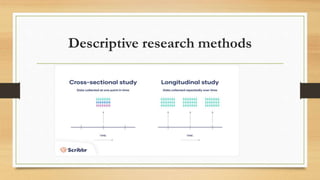
Descriptive research methods
Longitudinal
study
Cross –
sectional
study
Descriptive research methods
Longitudinal study
• An event or occurrence measured again and again over a period
of time
• This is also known as “Time series study”
• Can determine how the market changes over time
• It involve panels
• The panel or sample remains constant throughout the period
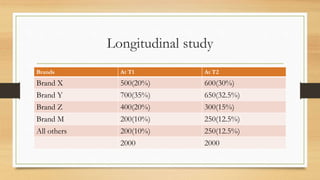
Longitudinal study
Brands At T1 At T2
Brand X 500(20%) 600(30%)
Brand Y 700(35%) 650(32.5%)
Brand Z 400(20%) 300(15%)
Brand M 200(10%) 250(12.5%)
All others 200(10%) 250(12.5%)
2000 2000
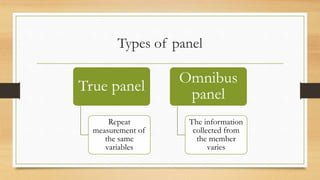
Types of panel
True panel
Repeat
measurement of
the same
variables
Omnibus
panel
The information
collected from
the member
varies
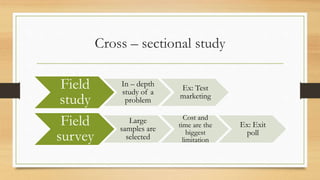
Cross – sectional study
Field
study
In – depth
study of a
problem
Ex: Test
marketing
Field
survey
Large
samples are
selected
Cost and
time are the
biggest
limitation
Ex: Exit
poll
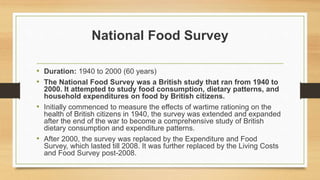
National Food Survey
• Duration: 1940 to 2000 (60 years)
• The National Food Survey was a British study that ran from 1940 to
2000. It attempted to study food consumption, dietary patterns, and
household expenditures on food by British citizens.
• Initially commenced to measure the effects of wartime rationing on the
health of British citizens in 1940, the survey was extended and expanded
after the end of the war to become a comprehensive study of British
dietary consumption and expenditure patterns.
• After 2000, the survey was replaced by the Expenditure and Food
Survey, which lasted till 2008. It was further replaced by the Living Costs
and Food Survey post-2008.
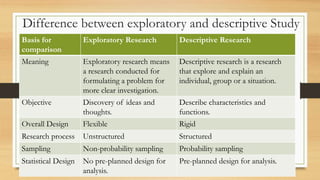
Difference between exploratory and descriptive Study
Basis for
comparison
Exploratory Research Descriptive Research
Meaning Exploratory research means
a research conducted for
formulating a problem for
more clear investigation.
Descriptive research is a research
that explore and explain an
individual, group or a situation.
Objective Discovery of ideas and
thoughts.
Describe characteristics and
functions.
Overall Design Flexible Rigid
Research process Unstructured Structured
Sampling Non-probability sampling Probability sampling
Statistical Design No pre-planned design for
analysis.
Pre-planned design for analysis.
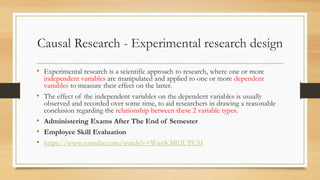
Causal Research - Experimental research design
• Experimental research is a scientific approach to research, where one or more
independent variables are manipulated and applied to one or more dependent
variables to measure their effect on the latter.
• The effect of the independent variables on the dependent variables is usually
observed and recorded over some time, to aid researchers in drawing a reasonable
conclusion regarding the relationship between these 2 variable types.
• Administering Exams After The End of Semester
• Employee Skill Evaluation
• https://www.youtube.com/watch?v=WwtKM02UPUM
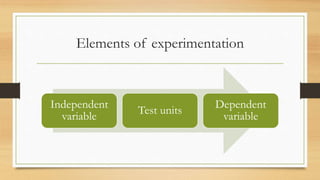
Elements of experimentation
Independent
variable
Test units
Dependent
variable
Formal/Informal experimental designs
Informal experimental designs are those designs that
normally use a less sophisticated form of analysis
based on differences in magnitudes, whereas formal
experimental designs offer relatively more control and
use precise statistical procedures for analysis.
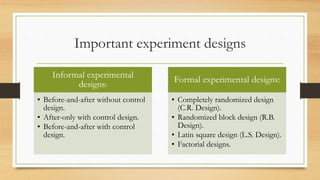
Important experiment designs
Informal experimental
designs:
• Before-and-after without control
design.
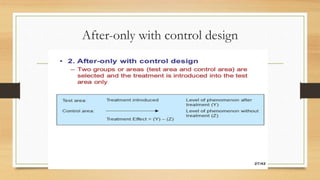
• After-only with control design.
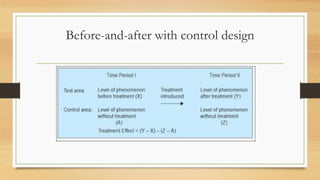
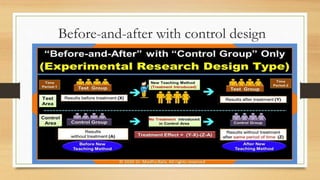
• Before-and-after with control
design.
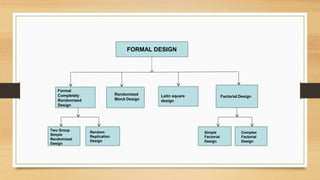
Formal experimental designs:
• Completely randomized design
(C.R. Design).
• Randomized block design (R.B.
Design).
• Latin square design (L.S. Design).
• Factorial designs.
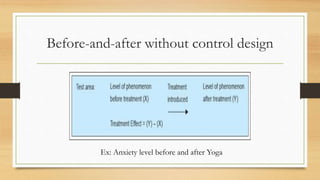
Before-and-after without control design
Ex: Anxiety level before and after Yoga
After-only with control design
Before-and-after with control design
FORMAL DESIGN
Formal
Completely
Randomized
Design
Randomized
Block Design
Latin square
design
Factorial Design
Two Group
Simple
Randomized
Design
Random
Replication
Design
Simple
Factorial
Design
Complex
Factorial
Design
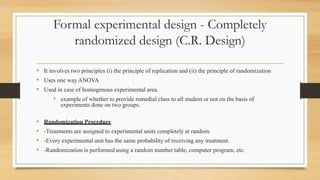
Formal experimental design - Completely
randomized design (C.R. Design)
• It involves two principles (i) the principle of replication and (ii) the principle of randomization
• Uses one way ANOVA
• Used in case of homogenous experimental area.
• example of whether to provide remedial class to all student or not on the basis of
experiments done on two groups.
• Randomization Procedure
• -Treatments are assigned to experimental units completely at random.
• -Every experimental unit has the same probability of receiving any treatment.
• -Randomization is performed using a random number table, computer program, etc.
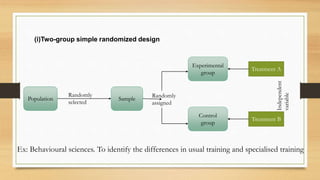
Population Sample
Experimental
group
Control
group
Treatment A
Treatment B
Randomly
selected
Randomly
assigned
Independent
variable
(i)Two-group simple randomized design
Ex: Behavioural sciences. To identify the differences in usual training and specialised training
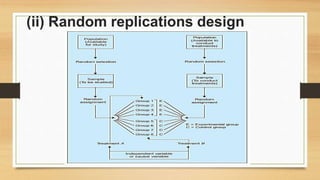
(ii) Random replications design
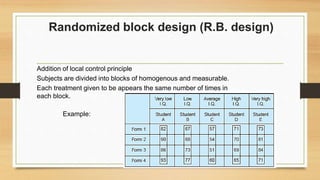
Randomized block design (R.B. design)
Addition of local control principle
Subjects are divided into blocks of homogenous and measurable.
Each treatment given to be appears the same number of times in
each block.
Example:
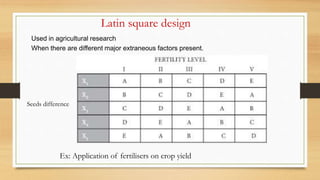
Seeds difference
Latin square design
Used in agricultural research
When there are different major extraneous factors present.
Ex: Application of fertilisers on crop yield
Factorial design
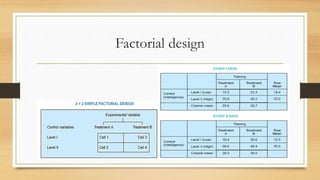
• A factorial design allows the effect of several factors and even interactions
between them to be determined with the same number of trials as are
necessary to determine any one of the effects by itself with the same
degree of accuracy.
Factorial design
Factorial design
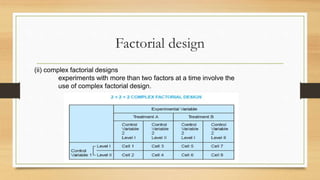
(ii) complex factorial designs
experiments with more than two factors at a time involve the
use of complex factorial design.
Hypothesis Development
• A Proposition that is empirically testable. It is an
empirical statement concerned with the relationship
among variables.
• Is a logical relationship between two or more variables
expressed in the form of a testable statement.
Hypothesis
• A hypothesis helps to translate the research problem and objective
into a clear explanation or prediction of the expected results or
outcomes of the study.
• Hypothesis is derived from the research problems, literature review
and conceptual framework.
• Hypothesis in a research project logically follow literature review and
conceptual framework.
Hypothesis Development
• Good hypothesis:
• Must be adequate for its purpose
• Must be testable
• Can be:
• Directional
• Non-directional
Purpose of hypothesis
• To explain the relationship
• If advertising is increased, then sales will also go up.
• To establish the differences among groups
• More men than women are whistleblowers,
• To find the interdependence of two or more factors
• Working the night shift (as opposed to the day shift) is related to whether or not
one is married.
Directional and Non directional Hypotheses
• Directional hypotheses: the direction of the relationship between the variables
(positive/negative) is indicated.
• The greater the stress experienced in the job, the lower the job
satisfaction of employees. Or
• Women are more motivated than men are.
• Nondirectional hypotheses: there are no indication of the direction of the
relationships between variables.
• There is a relationship between age and Job satisfaction.
Null and Alternate Hypotheses
• The null hypothesis is a proposition that states a definitive, exact
relationship between two variables.
• That is, it states that the population correlation between two variables is
equal to zero or that the difference in the means of two groups in the
population is equal to zero (or some definite number).
• In general, the null statement is expressed as no (significant)
relationship between two variables or no (significant) difference
between two groups.
Null and Alternate Hypotheses
• The alternate hypotheses is the opposite of the null hypotheses, is
a statement expressing a relationship between two variables or
indicating differences between groups.
• The alternative statement is expressed as a (significant) relationship
between two variables or a (significant) difference between two
groups.
Difference between groups or means
• Independent sample T test
• Paired sample T test
• One way ANOVA
• Two way ANOVA
Difference between groups or means
Independent sample T test
• Compares the means between two unrelated groups on the
dependent variable(continuous)
• Your independent variable should consist of two categorical, independent
groups.
• Ex: Gender (2 groups: male or female), employment status (2 groups: employed
or unemployed)
• Ex: Salaries based on gender
Difference between groups or means
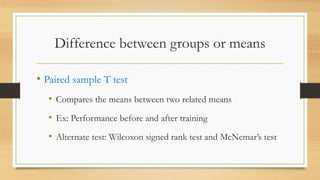
• Paired sample T test
• Compares the means between two related means
• Ex: Performance before and after training
• Alternate test: Wilcoxon signed rank test and McNemar’s test
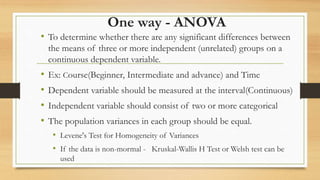
One way - ANOVA
• To determine whether there are any significant differences between
the means of three or more independent (unrelated) groups on a
continuous dependent variable.
• Ex: Course(Beginner, Intermediate and advance) and Time
• Dependent variable should be measured at the interval(Continuous)
• Independent variable should consist of two or more categorical
• The population variances in each group should be equal.
• Levene's Test for Homogeneity of Variances
• If the data is non-mormal - Kruskal-Wallis H Test or Welsh test can be
used
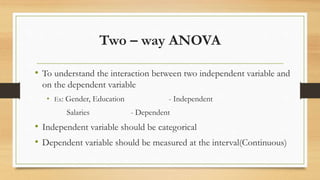
Two – way ANOVA
• To understand the interaction between two independent variable and
on the dependent variable
• Ex: Gender, Education - Independent
Salaries - Dependent
• Independent variable should be categorical
• Dependent variable should be measured at the interval(Continuous)
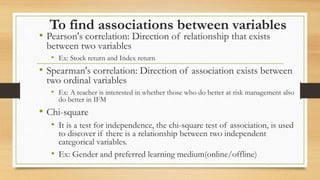
To find associations between variables
• Pearson's correlation: Direction of relationship that exists
between two variables
• Ex: Stock return and Index return
• Spearman's correlation: Direction of association exists between
two ordinal variables
• Ex: A teacher is interested in whether those who do better at risk management also
do better in IFM
• Chi-square
• It is a test for independence, the chi-square test of association, is used
to discover if there is a relationship between two independent
categorical variables.
• Ex: Gender and preferred learning medium(online/offline)
Predicting scores
• Linear regression
• To predict the value of a variable based on the value of another variable
• The variable we want to predict is called the dependent variable or outcome variable
• The variable we are using to predict the other variable's value is called the independent variable
or the predictor variable)
• There needs to be a linear relationship between two variables
• Ex: Exam performance and revision time
Stock return and index return
• Multiple regression
• Two or more independent variables, rather than just one, you need to use multiple regression.
• Ex:Exam performance can be predicted based on revision time, attendance, lecture, and gender
Business research methods and sampling method

Business research methods and sampling method

  • 1.
    Business Research Design Plan fora study Blue print to carry out the study
  • 2.
    Types of Researchdesign •Exploratory •Descriptive •Causal research
  • 3.
    Exploratory Research • Convertingbroad, vague problem statements into small, precise problem statements • Early stages of research • To formulate hypothesis
  • 4.
    Characteristics of ExploratoryResearch • It is flexible and versatile • Data collection structured forms are not used • Experimentation is not a requirement • Cost is low • Possibility of exploration of views
  • 5.
    What circumstances isexploratory study ideal? • To gain insight into the problem • To generate new product ideas • To assess the various alternatives • To develop hypothesis • To clarify concepts and formulating precise problems • To pretest a draft questionnaire
  • 6.
    Exploratory Research Methods •Literaturesearch •Experience survey •Focus group •Analysis of selected cases
  • 7.
    Literature Review • Itis a comprehensive survey of a previous research • The literature review surveys scholarly articles, books, Journals and other sources relevant to your study • The main aim is to find out problems that are already investigated and those that need further investigation • It gives us knowledge about what others have found out in the related field of study and how they have done so
  • 8.
    Literature Review –Why it is needed • Provide background information • Identify the focus of research • Introduce the topic to readers • Address the trend • Provide a framework of method • Analyze the published 6/25/2024 RVIM, Bangalore 8
  • 9.
    Literature Review –Where to start • Where are the major databases/ sources that have been recommended by your supervisor/mentor? • Focus on the central research problem and bring out the key words • Prepare a list of journals in your area of research • Give it a title focused towards your objectives 6/25/2024 RVIM, Bangalore 9
  • 10.
    Literature review: Keypoints • Read relevant(up-to-date) literature • Refer original works • Read with comprehension • Index the literature • State what others have said/done, and what not • Discuss what others have said/done towards developing a theme out of other studies, to end up with identifying research gaps. 6/25/2024 RVIM, Bangalore 10
  • 11.
    Literature review in5 steps 1. Search for a literature relevant for your study • Develop a list of keywords • Develop a list of synonyms for these key words • Open a scholarly database(Google scholar, EBSCO, Science direct, Scopus etc) • Use Boolean Operators(AND, OR, NOT etc.) Boolean Operators are simple words (AND, OR, NOT etc.) used as conjunctions to combine or exclude keywords in a search, resulting in more focused and productive results. This should save time and effort by eliminating inappropriate hits that must be scanned before discarding. • Identify the most important publication 6/25/2024 RVIM, Bangalore 11
  • 12.
    Literature review in5 steps 2. Evaluate and select source • Do not read the full research , read the abstract • Look at the bibliography of the publication for other relevant sources • Observe the number of high citation count 6/25/2024 RVIM, Bangalore 12
  • 13.
    Example… Impact of IntrinsicMotivation and Institutional Support on Faculty Research Productivity RV Institute of Management Go, change the world 6/25/2024 RVIM, Bangalore 13
  • 14.
    Literature review in5 steps 3. Identify themes, debates and gaps • Take not of the connections of different sources to easily organise your literature review • Observe for the trends, patterns and themes • Debates and contradictions • Influential studies • Gaps RV Institute of Management Go, change the world 6/25/2024 RVIM, Bangalore 14
  • 15.
    Literature review in5 steps 4. Organise by outlining • Chronological • From older to new publication • Thematic • Organised around several key themes • Methodological • Compare the different research methods being used across studies • Theoretical • Used to discuss opposing theories or models 6/25/2024 RVIM, Bangalore 15
  • 16.
    Literature Author, Year & Area TitleMethodology Sampling Variables Findings Sohail Khan (1996) KURDISTAN, IRAQ* The impact of staff training and development on teachers’ research productivity Structured Questionnaire 58 teachers Expertise, Morale, Skill, competency of supervisors, trust T&D to have profound influence on teachers’ productivity, therefore teachers need to be regularly motivated for training programs in to enhance their productivity. Morgan, Clauset (1999) USA* Research Productivity, prominence, and the effects of academic environment Matched-pairs experimental design using a Survey 2,453 early- career faculty at all 205 PhD- granting CSE departments. Work environment, training, scholarly impact, Characteristics of a work environment are more predictive of faculty productivity than preferential selection or retention Shaker, Plater (GEORGIA UNIVERSITY* (2001) The Public Good, Productivity and Faculty Work: Individual Effort and Social Value Delphi technique Secondary data analysis Rubrics, Service, ISR, Societal Impact, community service, positive attitude. Credentials without quality and teaching without public purpose lead inevitably to the decline of American higher education Michael M. Rawls (2002) TEXAS* PUBLIC INSTITUTES Assessing Research Productivity from an Institutional Effectiveness Perspective. Quantitative & Qualitative Designs –Questionnaire 62 Institutions Priority for research, research assistants, collective research goals of department, peer productivity Core facilities appear to be insufficient in terms of capacity to meet demand and are operated without an adequate staffing model to provide the expertise needed Mariom, McMorther (2012) VIRGINIA* Understanding the productivity of faculty members in higher education Descriptive case study design 293 full time employees [department of biomedical engineering] Time, self advancement, reporting, workloads, financial inducements Administrators must look at workload expectations for faculty and create policies to help manage their time 6/25/2024 RVIM, Bangalore 16
  • 17.
    Literature review in5 steps 5. Start writing the literature review • Introduction • Cite and present the study • Main body • Summarises and synthesis the sources to your study • Conclusion • The function of your paper’s conclusion is to restate the main argument. It reminds the reader of the strengths of your main arguments and reiterates the most important evidence supporting those arguments. 6/25/2024 RVIM, Bangalore 17
  • 18.
    Literature review -Funnel approach – 80:20 rule So you start with the broader aspects of your topic (the contextual background, for instance) and then gradually narrow your focus until you reach the specific aspect of the topic that you will be addressing. Ex: Marketing strategies of two wheelers manufacturers with special reference to Karnataka • Review of research studies on Marketing strategies in general • Review of research studies on Marketing strategies in manufacturing • Review of research studies on Marketing strategies in Automobile manufacturing • Review of closely related research studies on MS -TWM in India 6/25/2024 RVIM, Bangalore 18
  • 19.
    Experience survey • Itis desirable to talk to persons who are well informed in the areas being investigated • No questionnaire is required • The approach adopted should be highly unstructured • Non probability sampling can be used Ex: Group of housewives may be approached for their choice for a “ready to cook product”
  • 20.
    Focus group • Asmall number of individuals are brought together to study and talk about some topic of interest • The discussion is coordinated by a moderator • The group usually consists of 8 – 12 persons and they should have a common background and experience. • The typical focus group lasts for one to two hours Ex: Reva car
  • 21.
    Analysis of selectedcases • Gives an insight into the problem which is being researched • The result of investigation of case histories are always considered suggestive, rather than conclusive Ex: Ready to eat food
  • 22.
  • 23.
    Descriptive research • Describethe characteristics of the population • Provides association between two variables • Clear specification on Who, What, When, Where, Why and How.
  • 24.
    When to useDescriptive research? • Size of the market • Buying power of the consumer • Product usage pattern • To track the performance of the brand • To determine the association of the two variables such as Advertisement and sales • To make prediction
  • 25.
  • 26.
  • 27.
    Longitudinal study • Anevent or occurrence measured again and again over a period of time • This is also known as “Time series study” • Can determine how the market changes over time • It involve panels • The panel or sample remains constant throughout the period
  • 28.
    Longitudinal study Brands AtT1 At T2 Brand X 500(20%) 600(30%) Brand Y 700(35%) 650(32.5%) Brand Z 400(20%) 300(15%) Brand M 200(10%) 250(12.5%) All others 200(10%) 250(12.5%) 2000 2000
  • 29.
    Types of panel Truepanel Repeat measurement of the same variables Omnibus panel The information collected from the member varies
  • 30.
    Cross – sectionalstudy Field study In – depth study of a problem Ex: Test marketing Field survey Large samples are selected Cost and time are the biggest limitation Ex: Exit poll
  • 31.
    National Food Survey •Duration: 1940 to 2000 (60 years) • The National Food Survey was a British study that ran from 1940 to 2000. It attempted to study food consumption, dietary patterns, and household expenditures on food by British citizens. • Initially commenced to measure the effects of wartime rationing on the health of British citizens in 1940, the survey was extended and expanded after the end of the war to become a comprehensive study of British dietary consumption and expenditure patterns. • After 2000, the survey was replaced by the Expenditure and Food Survey, which lasted till 2008. It was further replaced by the Living Costs and Food Survey post-2008.
  • 32.
    Difference between exploratoryand descriptive Study Basis for comparison Exploratory Research Descriptive Research Meaning Exploratory research means a research conducted for formulating a problem for more clear investigation. Descriptive research is a research that explore and explain an individual, group or a situation. Objective Discovery of ideas and thoughts. Describe characteristics and functions. Overall Design Flexible Rigid Research process Unstructured Structured Sampling Non-probability sampling Probability sampling Statistical Design No pre-planned design for analysis. Pre-planned design for analysis.
  • 33.
    Causal Research -Experimental research design • Experimental research is a scientific approach to research, where one or more independent variables are manipulated and applied to one or more dependent variables to measure their effect on the latter. • The effect of the independent variables on the dependent variables is usually observed and recorded over some time, to aid researchers in drawing a reasonable conclusion regarding the relationship between these 2 variable types. • Administering Exams After The End of Semester • Employee Skill Evaluation • https://www.youtube.com/watch?v=WwtKM02UPUM
  • 34.
  • 35.
    Formal/Informal experimental designs Informalexperimental designs are those designs that normally use a less sophisticated form of analysis based on differences in magnitudes, whereas formal experimental designs offer relatively more control and use precise statistical procedures for analysis.
  • 36.
    Important experiment designs Informalexperimental designs: • Before-and-after without control design. • After-only with control design. • Before-and-after with control design. Formal experimental designs: • Completely randomized design (C.R. Design). • Randomized block design (R.B. Design). • Latin square design (L.S. Design). • Factorial designs.
  • 37.
    Before-and-after without controldesign Ex: Anxiety level before and after Yoga
  • 38.
  • 39.
  • 40.
  • 41.
    FORMAL DESIGN Formal Completely Randomized Design Randomized Block Design Latinsquare design Factorial Design Two Group Simple Randomized Design Random Replication Design Simple Factorial Design Complex Factorial Design
  • 42.
    Formal experimental design- Completely randomized design (C.R. Design) • It involves two principles (i) the principle of replication and (ii) the principle of randomization • Uses one way ANOVA • Used in case of homogenous experimental area. • example of whether to provide remedial class to all student or not on the basis of experiments done on two groups. • Randomization Procedure • -Treatments are assigned to experimental units completely at random. • -Every experimental unit has the same probability of receiving any treatment. • -Randomization is performed using a random number table, computer program, etc.
  • 43.
    Population Sample Experimental group Control group Treatment A TreatmentB Randomly selected Randomly assigned Independent variable (i)Two-group simple randomized design Ex: Behavioural sciences. To identify the differences in usual training and specialised training
  • 44.
  • 45.
    Randomized block design(R.B. design) Addition of local control principle Subjects are divided into blocks of homogenous and measurable. Each treatment given to be appears the same number of times in each block. Example:
  • 46.
    Seeds difference Latin squaredesign Used in agricultural research When there are different major extraneous factors present. Ex: Application of fertilisers on crop yield
  • 47.
    Factorial design • Afactorial design allows the effect of several factors and even interactions between them to be determined with the same number of trials as are necessary to determine any one of the effects by itself with the same degree of accuracy.
  • 48.
  • 49.
    Factorial design (ii) complexfactorial designs experiments with more than two factors at a time involve the use of complex factorial design.
  • 50.
    Hypothesis Development • AProposition that is empirically testable. It is an empirical statement concerned with the relationship among variables. • Is a logical relationship between two or more variables expressed in the form of a testable statement.
  • 51.
    Hypothesis • A hypothesishelps to translate the research problem and objective into a clear explanation or prediction of the expected results or outcomes of the study. • Hypothesis is derived from the research problems, literature review and conceptual framework. • Hypothesis in a research project logically follow literature review and conceptual framework.
  • 52.
    Hypothesis Development • Goodhypothesis: • Must be adequate for its purpose • Must be testable • Can be: • Directional • Non-directional
  • 53.
    Purpose of hypothesis •To explain the relationship • If advertising is increased, then sales will also go up. • To establish the differences among groups • More men than women are whistleblowers, • To find the interdependence of two or more factors • Working the night shift (as opposed to the day shift) is related to whether or not one is married.
  • 54.
    Directional and Nondirectional Hypotheses • Directional hypotheses: the direction of the relationship between the variables (positive/negative) is indicated. • The greater the stress experienced in the job, the lower the job satisfaction of employees. Or • Women are more motivated than men are. • Nondirectional hypotheses: there are no indication of the direction of the relationships between variables. • There is a relationship between age and Job satisfaction.
  • 55.
    Null and AlternateHypotheses • The null hypothesis is a proposition that states a definitive, exact relationship between two variables. • That is, it states that the population correlation between two variables is equal to zero or that the difference in the means of two groups in the population is equal to zero (or some definite number). • In general, the null statement is expressed as no (significant) relationship between two variables or no (significant) difference between two groups.
  • 56.
    Null and AlternateHypotheses • The alternate hypotheses is the opposite of the null hypotheses, is a statement expressing a relationship between two variables or indicating differences between groups. • The alternative statement is expressed as a (significant) relationship between two variables or a (significant) difference between two groups.
  • 57.
    Difference between groupsor means • Independent sample T test • Paired sample T test • One way ANOVA • Two way ANOVA
  • 58.
    Difference between groupsor means Independent sample T test • Compares the means between two unrelated groups on the dependent variable(continuous) • Your independent variable should consist of two categorical, independent groups. • Ex: Gender (2 groups: male or female), employment status (2 groups: employed or unemployed) • Ex: Salaries based on gender
  • 59.
    Difference between groupsor means • Paired sample T test • Compares the means between two related means • Ex: Performance before and after training • Alternate test: Wilcoxon signed rank test and McNemar’s test
  • 60.
    One way -ANOVA • To determine whether there are any significant differences between the means of three or more independent (unrelated) groups on a continuous dependent variable. • Ex: Course(Beginner, Intermediate and advance) and Time • Dependent variable should be measured at the interval(Continuous) • Independent variable should consist of two or more categorical • The population variances in each group should be equal. • Levene's Test for Homogeneity of Variances • If the data is non-mormal - Kruskal-Wallis H Test or Welsh test can be used
  • 61.
    Two – wayANOVA • To understand the interaction between two independent variable and on the dependent variable • Ex: Gender, Education - Independent Salaries - Dependent • Independent variable should be categorical • Dependent variable should be measured at the interval(Continuous)
  • 62.
    To find associationsbetween variables • Pearson's correlation: Direction of relationship that exists between two variables • Ex: Stock return and Index return • Spearman's correlation: Direction of association exists between two ordinal variables • Ex: A teacher is interested in whether those who do better at risk management also do better in IFM • Chi-square • It is a test for independence, the chi-square test of association, is used to discover if there is a relationship between two independent categorical variables. • Ex: Gender and preferred learning medium(online/offline)
  • 63.
    Predicting scores • Linearregression • To predict the value of a variable based on the value of another variable • The variable we want to predict is called the dependent variable or outcome variable • The variable we are using to predict the other variable's value is called the independent variable or the predictor variable) • There needs to be a linear relationship between two variables • Ex: Exam performance and revision time Stock return and index return • Multiple regression • Two or more independent variables, rather than just one, you need to use multiple regression. • Ex:Exam performance can be predicted based on revision time, attendance, lecture, and gender