www.derby.ac.uk
Writing a Business Report
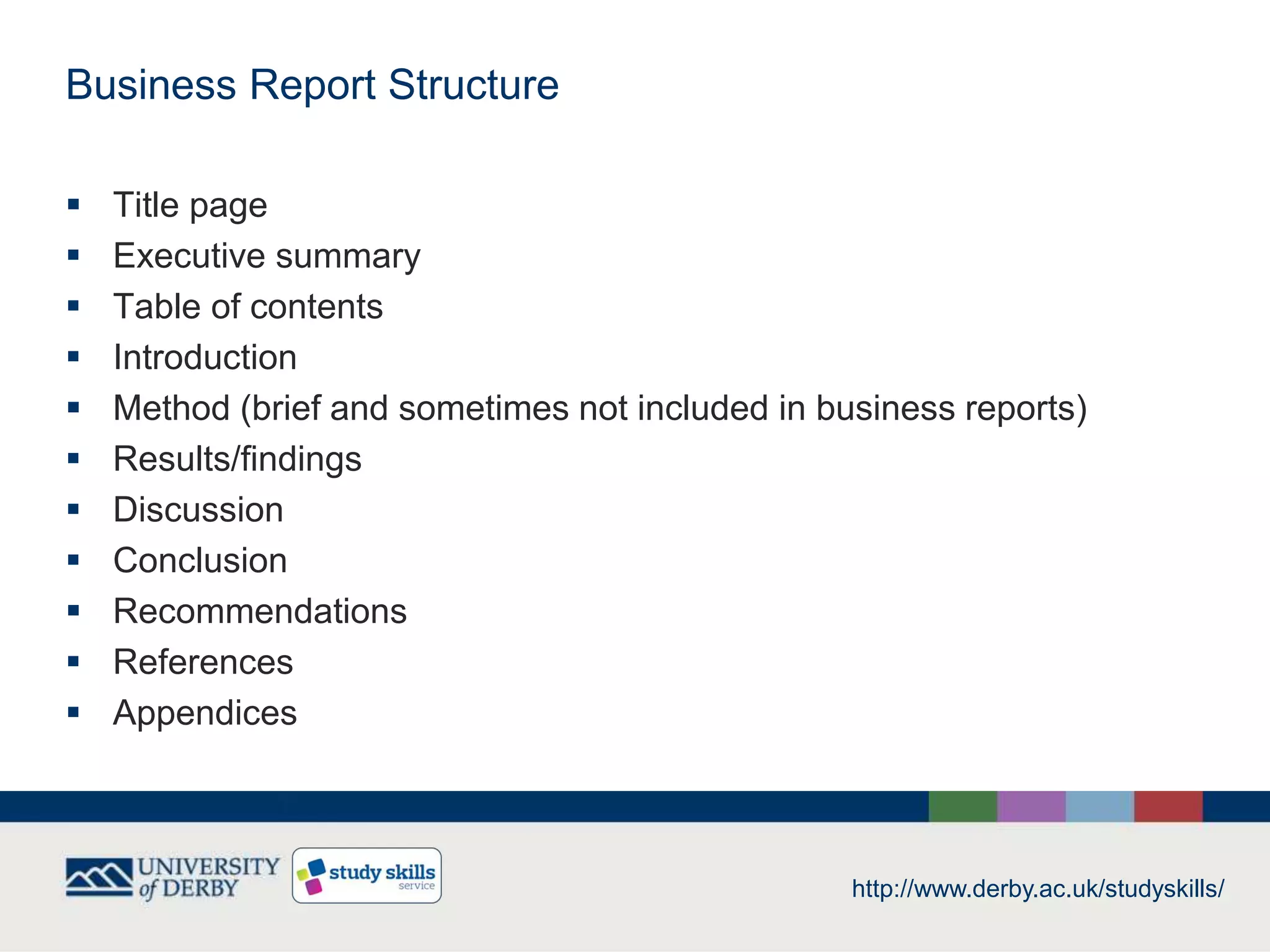
Business Report Structure
 Title page
 Executive summary
 Table of contents
 Introduction
 Method (brief and sometimes not included in business reports)
 Results/findings
 Discussion
 Conclusion
 Recommendations
 References
 Appendices
http://www.derby.ac.uk/studyskills/
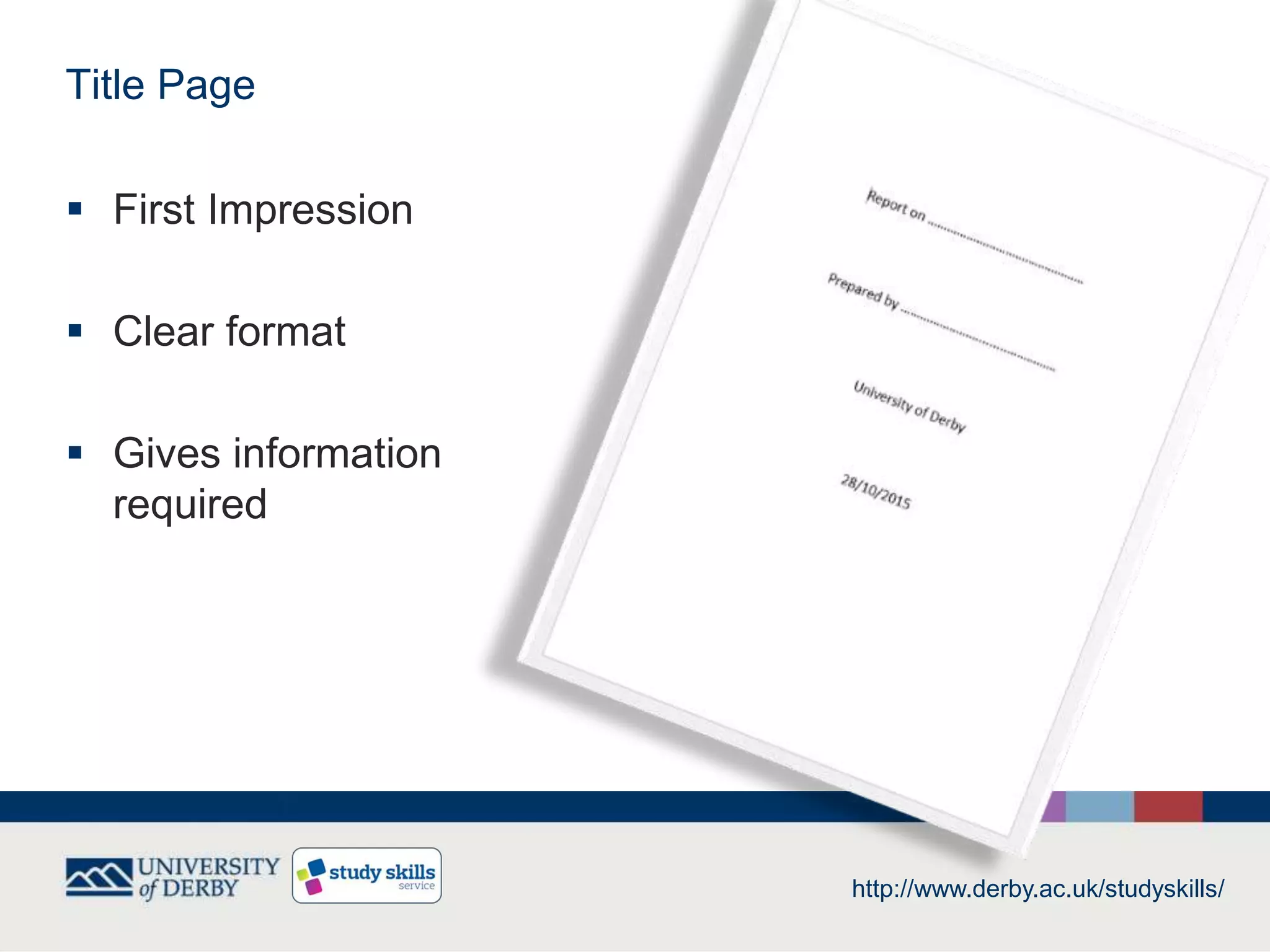
Title Page
 First Impression
 Clear format
 Gives information
required
http://www.derby.ac.uk/studyskills/
Executive summary
 Key problem
 Objective of the report
 Main findings and conclusions
 Crucial recommendations
http://www.derby.ac.uk/studyskills/
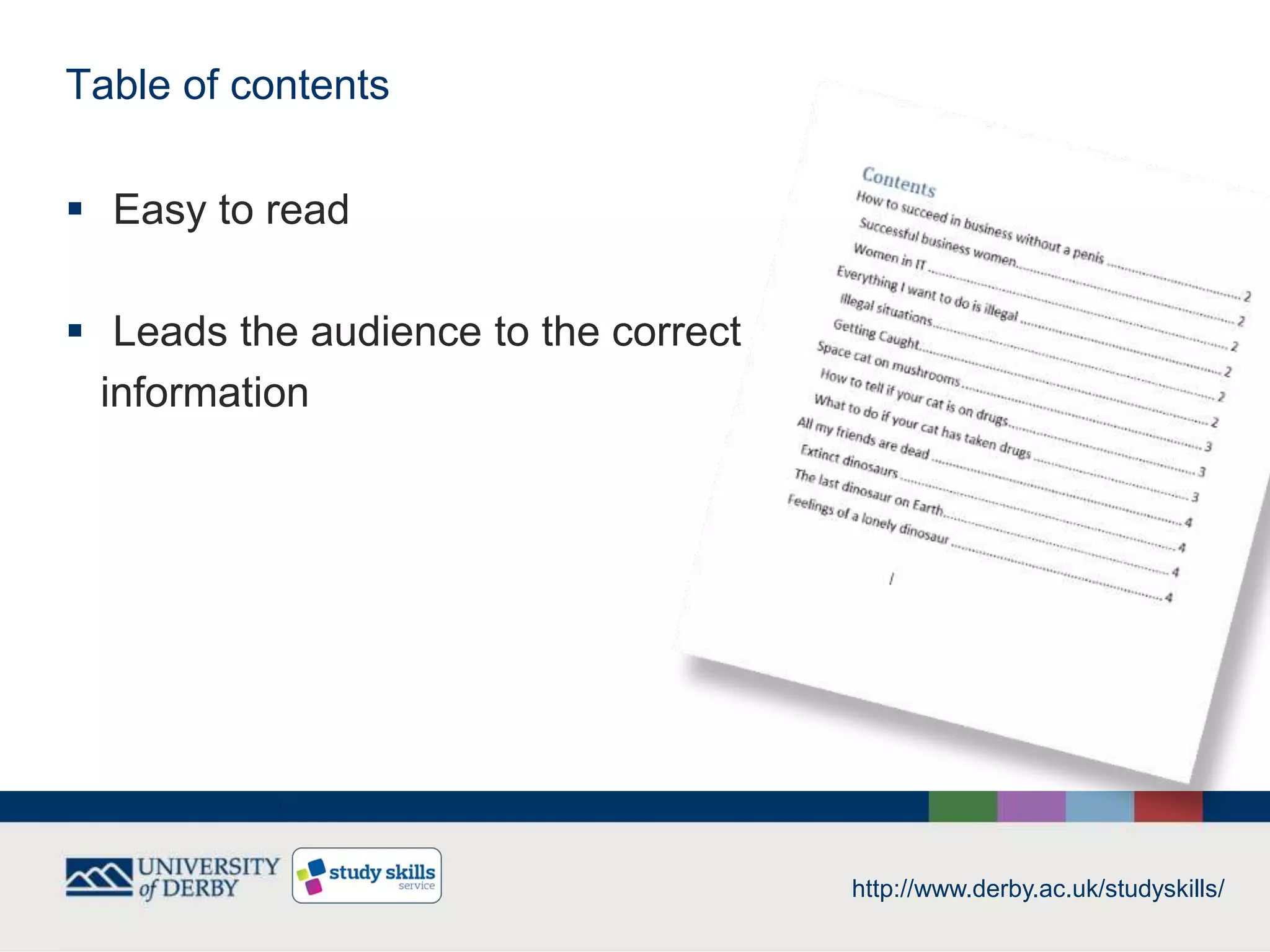
Table of contents
 Easy to read
 Leads the audience to the correct
information
http://www.derby.ac.uk/studyskills/
Introduction
 Describe what you have been asked to investigate
 Why is it important?
 Who is your audience?
 What is the purpose?
 What research is out there already?
 How are you going to carry out your investigation?
 What are you going to write in your report?
http://www.derby.ac.uk/studyskills/
Method
 How did you collect your data?
 Qualitative or quantitative?
 Describe your method
 Refer to appendices (for example with a questionnaire)
http://www.derby.ac.uk/studyskills/
Results
 Present your results in the same order collected
 Not all data can be presented – what is most relevant to
your brief?
 Describe in words
 Present in one format e.g. graphs, tables or diagrams
http://www.derby.ac.uk/studyskills/
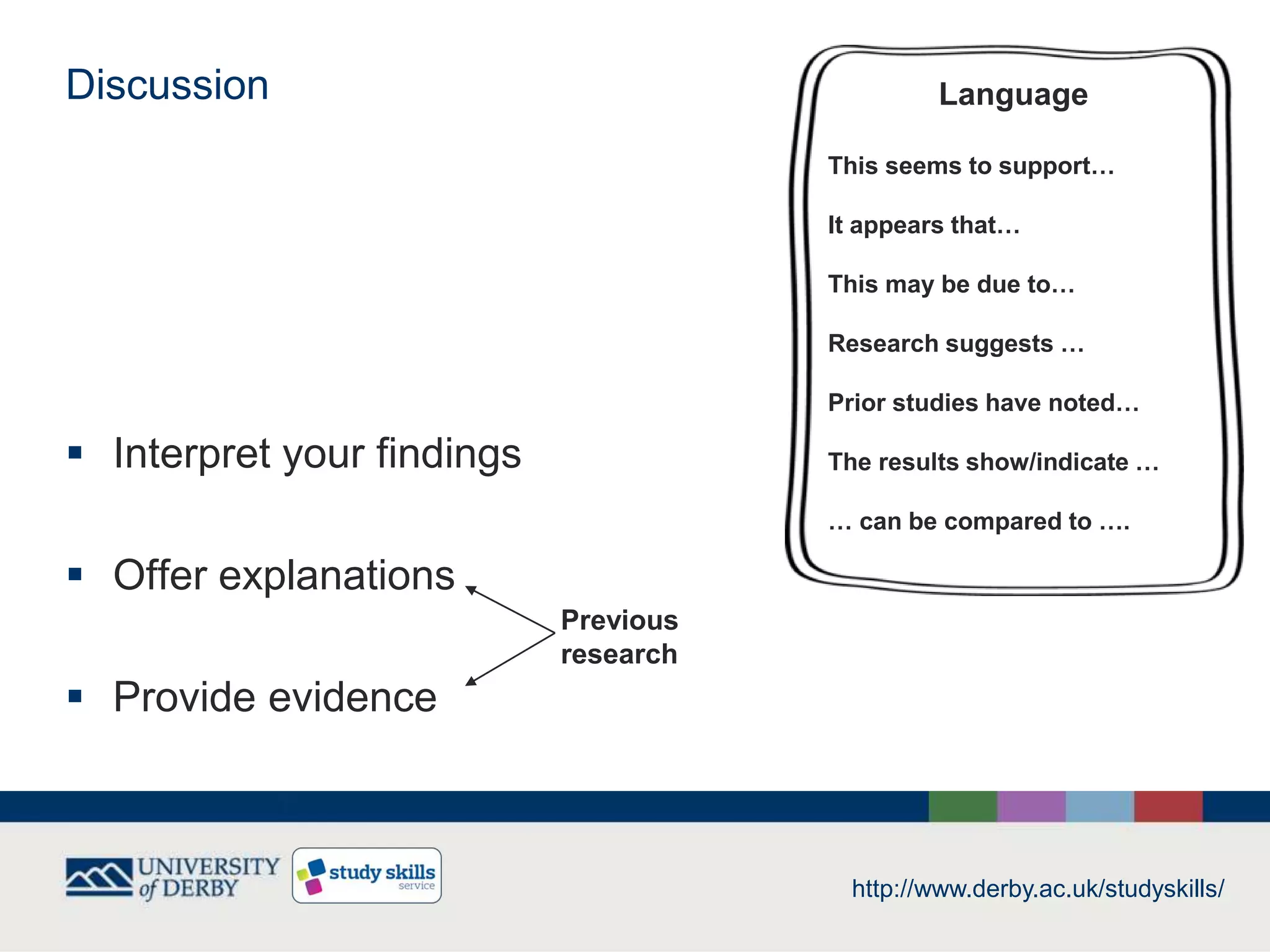
Discussion
 Interpret your findings
 Offer explanations
 Provide evidence
http://www.derby.ac.uk/studyskills/
Language
This seems to support…
It appears that…
This may be due to…
Research suggests …
Prior studies have noted…
The results show/indicate …
… can be compared to ….
Previous
research
Conclusion – so what? Recommendations
 What do my findings show?
 Are there any limitations in
the research?
 What does this mean for my
readers?
http://www.derby.ac.uk/studyskills/
 Suggest actions that should
be taken as a result of your
investigation
 What can be done with the
findings?
References
 In text
According to Bell (2010, p. 23), the most important part of the research
process is ...
Burton (2012) provided information for…
 Reference page
Bell, J. (2010). Doing your research project, 5th ed. Maidenhead: Open
University Press.
Burton, P.A. (2012). Castles of Spain. Available at:
http://www.castlesofspain.co.uk, [Accessed 14 October 2012].
http://www.derby.ac.uk/studyskills/
Appendices
Additional information that would disrupt the reader if included
in the main report, but is useful to understand context
 Questionnaires
 Data
 Interview transcripts
 Observation notes
http://www.derby.ac.uk/studyskills/
Where can I get further help?
Course Resources
Sections on each area students ask for support in
Study Skills webpages
www.derby.ac.uk/studyskills
Study Advisor Scheme
Study Skills Office, Kedleston Road Library
01332 591369
studyadvisors@derby.ac.uk
http://www.derby.ac.uk/studyskills/

Business report writing

  • 1.
  • 2.
    Business Report Structure Title page  Executive summary  Table of contents  Introduction  Method (brief and sometimes not included in business reports)  Results/findings  Discussion  Conclusion  Recommendations  References  Appendices http://www.derby.ac.uk/studyskills/
  • 3.
    Title Page  FirstImpression  Clear format  Gives information required http://www.derby.ac.uk/studyskills/
  • 4.
    Executive summary  Keyproblem  Objective of the report  Main findings and conclusions  Crucial recommendations http://www.derby.ac.uk/studyskills/
  • 5.
    Table of contents Easy to read  Leads the audience to the correct information http://www.derby.ac.uk/studyskills/
  • 6.
    Introduction  Describe whatyou have been asked to investigate  Why is it important?  Who is your audience?  What is the purpose?  What research is out there already?  How are you going to carry out your investigation?  What are you going to write in your report? http://www.derby.ac.uk/studyskills/
  • 7.
    Method  How didyou collect your data?  Qualitative or quantitative?  Describe your method  Refer to appendices (for example with a questionnaire) http://www.derby.ac.uk/studyskills/
  • 8.
    Results  Present yourresults in the same order collected  Not all data can be presented – what is most relevant to your brief?  Describe in words  Present in one format e.g. graphs, tables or diagrams http://www.derby.ac.uk/studyskills/
  • 9.
    Discussion  Interpret yourfindings  Offer explanations  Provide evidence http://www.derby.ac.uk/studyskills/ Language This seems to support… It appears that… This may be due to… Research suggests … Prior studies have noted… The results show/indicate … … can be compared to …. Previous research
  • 10.
    Conclusion – sowhat? Recommendations  What do my findings show?  Are there any limitations in the research?  What does this mean for my readers? http://www.derby.ac.uk/studyskills/  Suggest actions that should be taken as a result of your investigation  What can be done with the findings?
  • 11.
    References  In text Accordingto Bell (2010, p. 23), the most important part of the research process is ... Burton (2012) provided information for…  Reference page Bell, J. (2010). Doing your research project, 5th ed. Maidenhead: Open University Press. Burton, P.A. (2012). Castles of Spain. Available at: http://www.castlesofspain.co.uk, [Accessed 14 October 2012]. http://www.derby.ac.uk/studyskills/
  • 12.
    Appendices Additional information thatwould disrupt the reader if included in the main report, but is useful to understand context  Questionnaires  Data  Interview transcripts  Observation notes http://www.derby.ac.uk/studyskills/
  • 13.
    Where can Iget further help? Course Resources Sections on each area students ask for support in Study Skills webpages www.derby.ac.uk/studyskills Study Advisor Scheme Study Skills Office, Kedleston Road Library 01332 591369 studyadvisors@derby.ac.uk http://www.derby.ac.uk/studyskills/