Phoenix-English
Communications 2014
instructor@phoenix-english.com
The Scientific Report
How-to-do
In English
http://tutor2u.net/blog/index.php/business-studies/comments/buss4-exam-technique-big-mac-or-hamburger-fries/
2
The Scientific Report islike a Big Mac
It has layers and is built into something enjoyable that
is easy to digest;
Some of its components are standardized, some
changeable;
If done well, it will stay with you awhile and you‘ll think
about it.
This powerpoint has lots of text because
I‘m not present to explain every detail…
3
1. The Scientific Report usually poses a problem or recognizes a
challenge involving your theme, (“Problem Definition”). You have to state a
clear problem or challenge and then the whole paper is structured around that
problem.
2. Your research takes a hard look at that problem (the "Main Body" of the
Paper).
3. The end of the paper summarizes what you have found and reminds us of
your points. (This is "Results").
4. Based on what your research found, a solution - (something new!) is
offered, (The "Conclusion"). If you have no solution or more research is needed
beyond the scope of your paper, you say so in the Conclusion.
The Conclusion refers to the Problem already stated and offers a
SOLUTION.
First: Choose a theme that interests you,
Second: Develop a problem or a challenge, (it only needs to be 3-4
sentences), make sure it has a clear definition which will define the
direction of the paper.
Third: Then you can begin your research.
What‘s a Scientific Report?
GO!
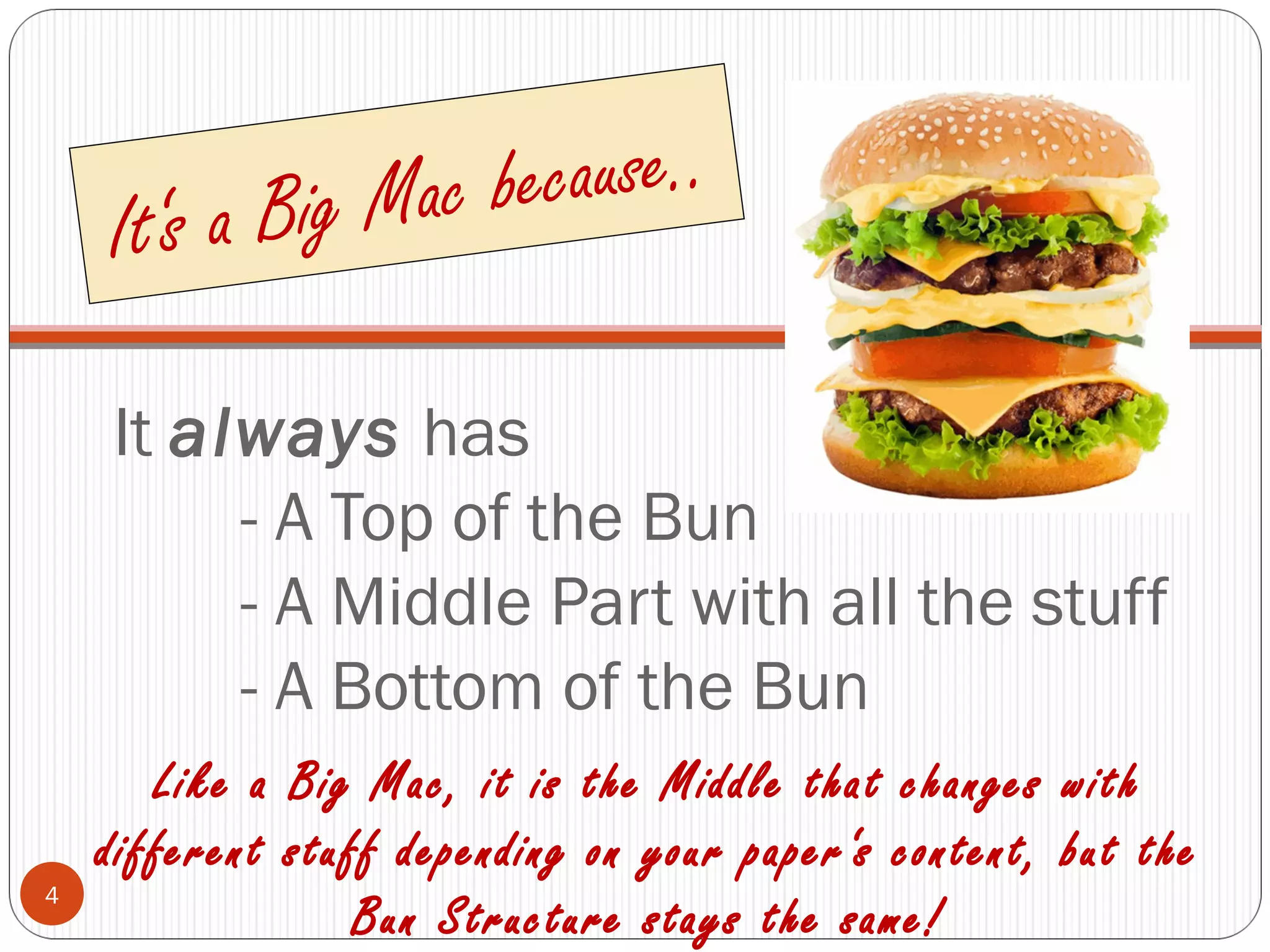
It always has
- A Top of the Bun
- A Middle Part with all the stuff
- A Bottom of the Bun
It‘s a Big Mac because..
4
Like a Big Mac, it is the Middle that changes with
different stuff depending on your paper‘s content, but the
Bun Structure stays the same!
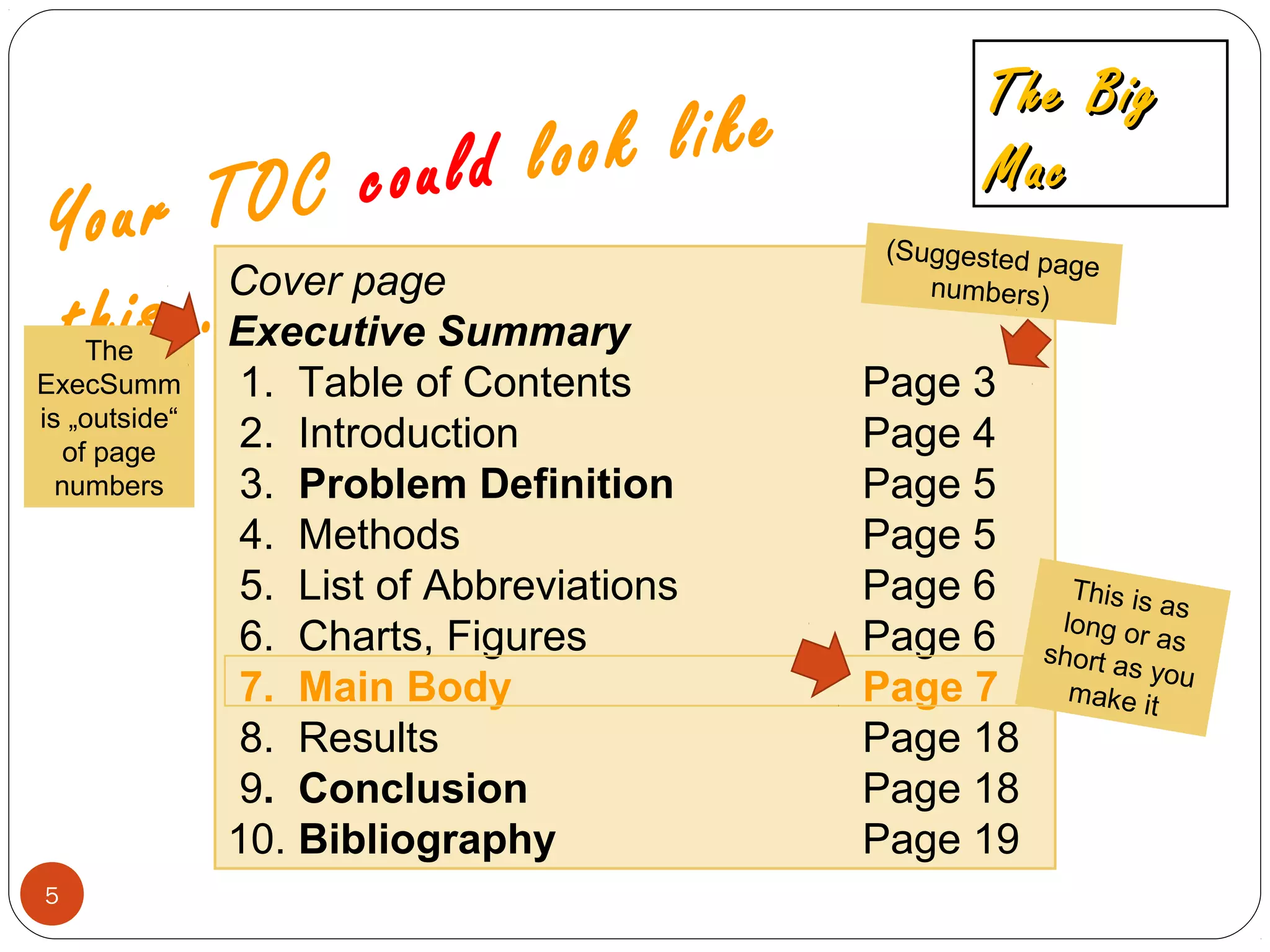
Cover page
Executive Summary
1. Table of Contents Page 3
2. Introduction Page 4
3. Problem Definition Page 5
4. Methods Page 5
5. List of Abbreviations Page 6
6. Charts, Figures Page 6
7. Main Body Page 7
8. Results Page 18
9. Conclusion Page 18
10. Bibliography Page 19
Your TOC could look like
this…
5
The BigThe Big
MacMac
(Suggested page
numbers)
This is as
long or asshort as you
make it
The
ExecSumm
is „outside“
of page
numbers
The Executive
“Summary”
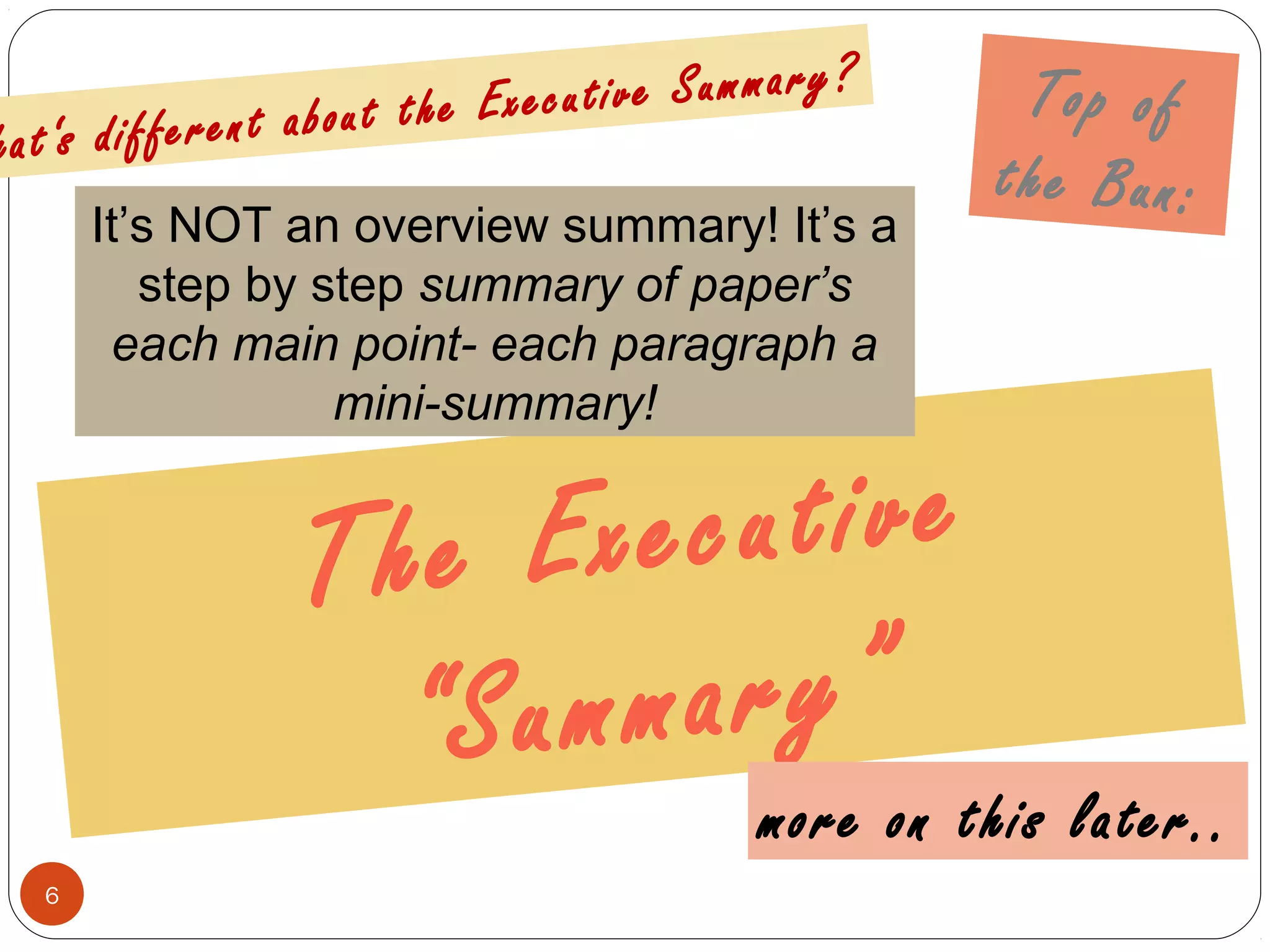
It’s NOT an overview summary! It’s a
step by step summary of paper’s
each main point- each paragraph a
mini-summary!
6
Top of
the Bun:
more on this later..
hat‘s different about the Executive Summary?
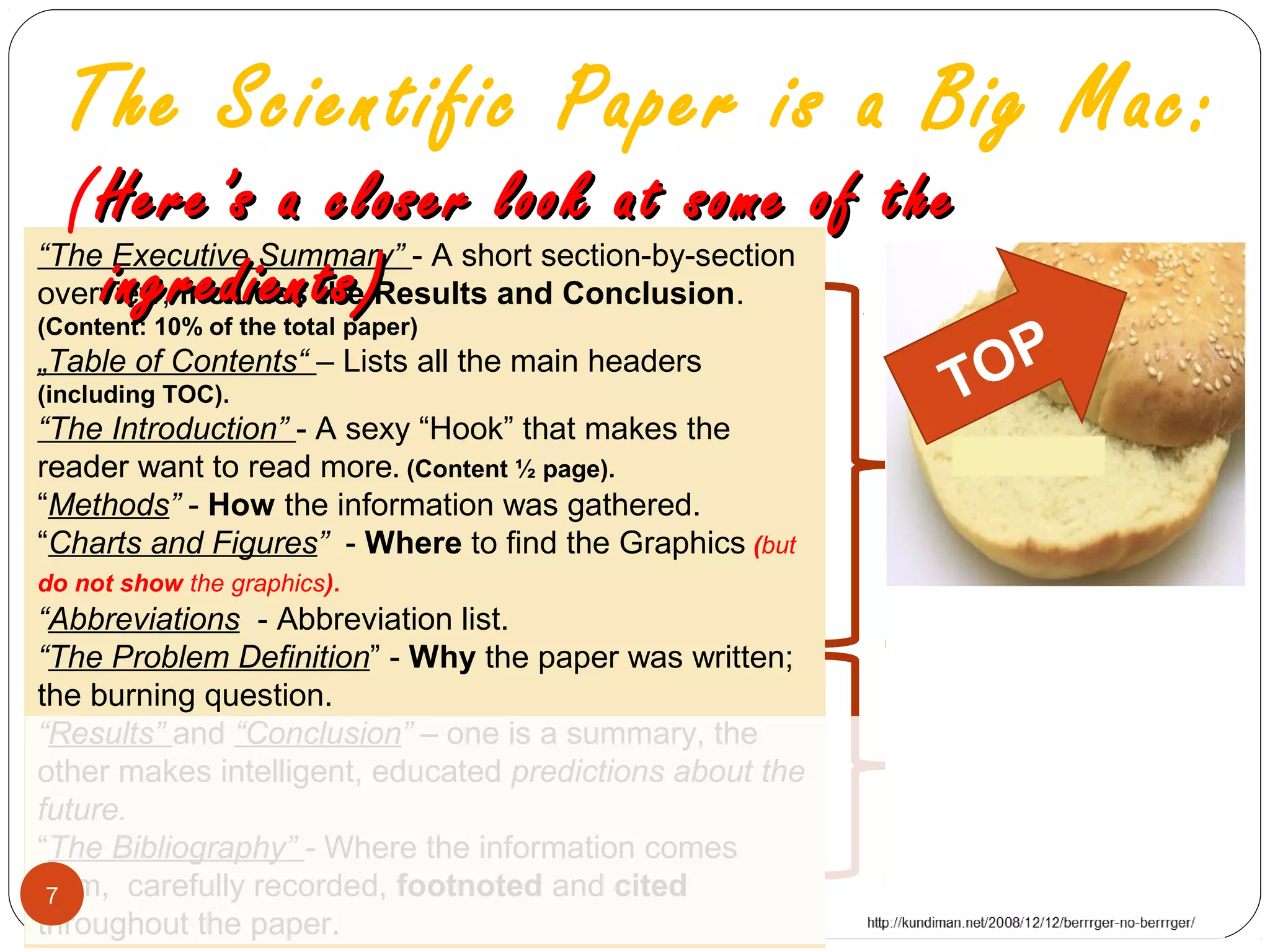
“The Executive Summary” - A short section-by-section
overview, includes the Results and Conclusion.
(Content: 10% of the total paper)
„Table of Contents“ – Lists all the main headers
(including TOC).
“The Introduction” - A sexy “Hook” that makes the
reader want to read more. (Content ½ page).
“Methods” - How the information was gathered.
“Charts and Figures” - Where to find the Graphics (but
do not show the graphics).
“Abbreviations - Abbreviation list.
“The Problem Definition” - Why the paper was written;
the burning question.
“Results” and “Conclusion” – one is a summary, the
other makes intelligent, educated predictions about the
future.
“The Bibliography” - Where the information comes
from, carefully recorded, footnoted and cited
throughout the paper.
The Scientific Paper is a Big Mac:
(Here’s a closer look at some of theHere’s a closer look at some of the
ingredients)ingredients)
7
TOP
8
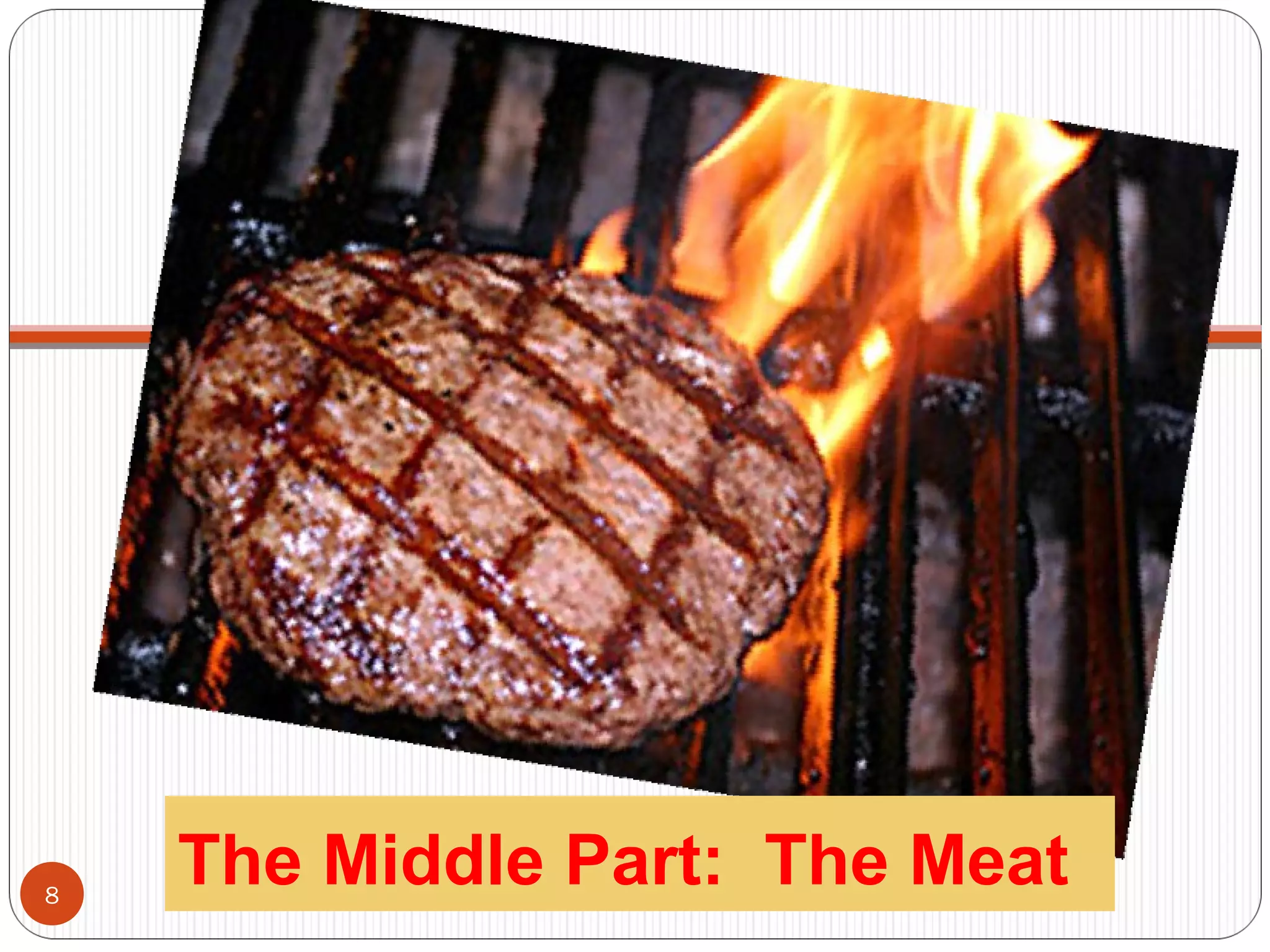
The Middle Part: The Meat
http://www.gotbuffalo. com/Buffalo-5lb-Patty-Burger.htm
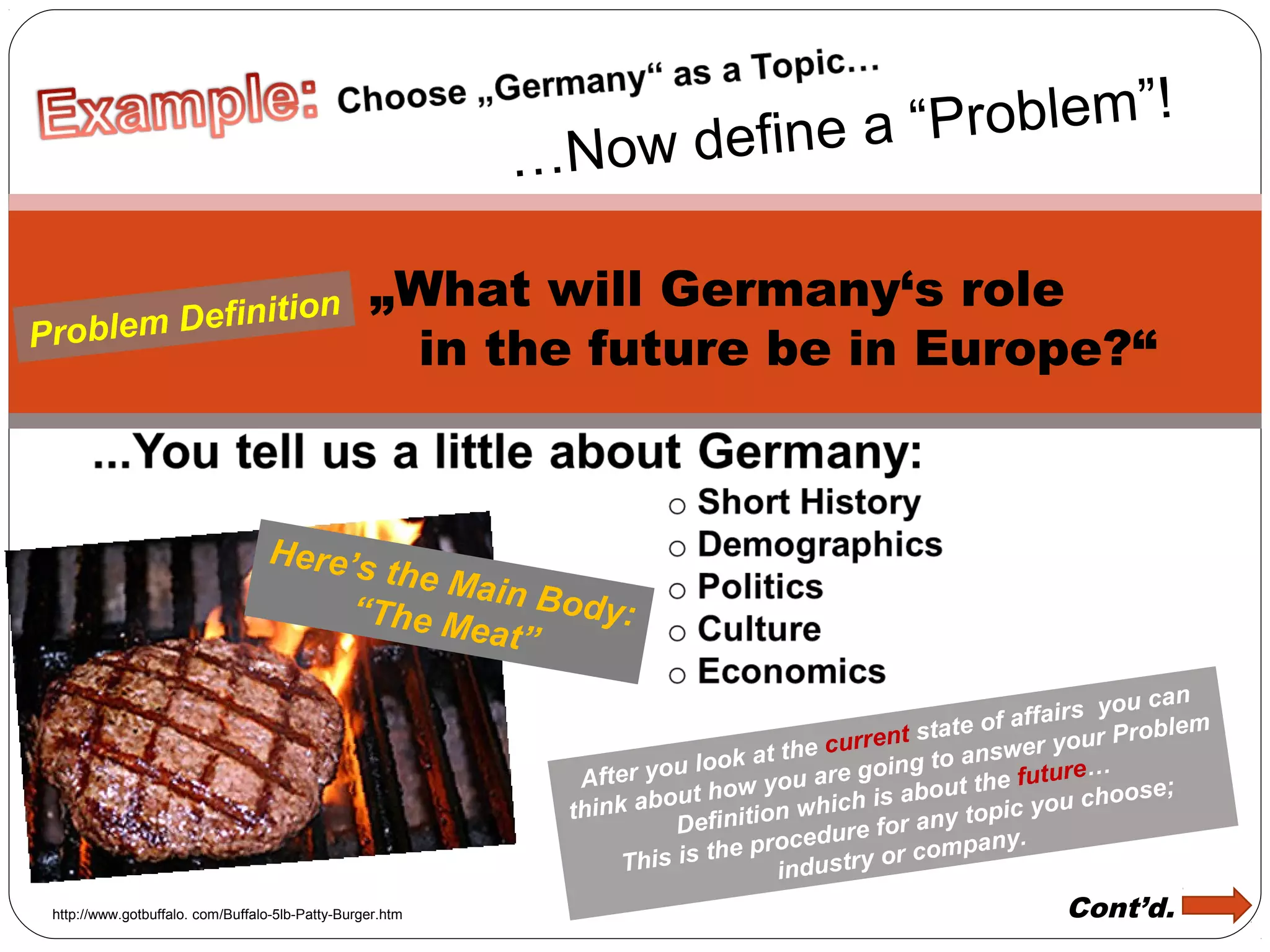
Here’s the Main Body:“The Meat”
…Now define a “Problem”!
After you look at the current state of affairs you can
think about how you are going to answer your Problem
Definition which is about the future…
This is the procedure for any topic you choose;
industry or company.
Problem Definition „What will Germany‘s role
in the future be in Europe?“
Cont’d.
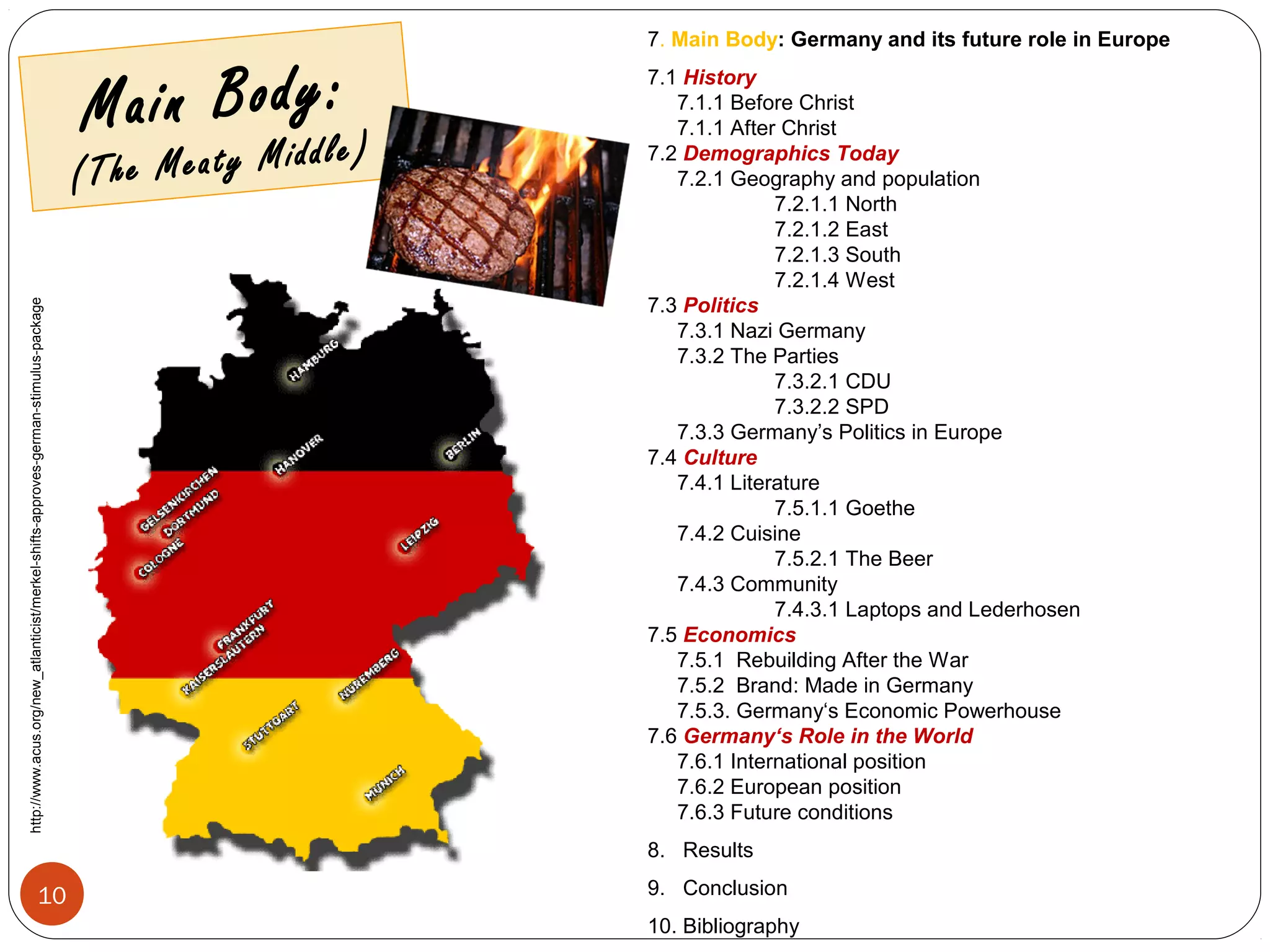
Main Body:
(The Meaty Middle)
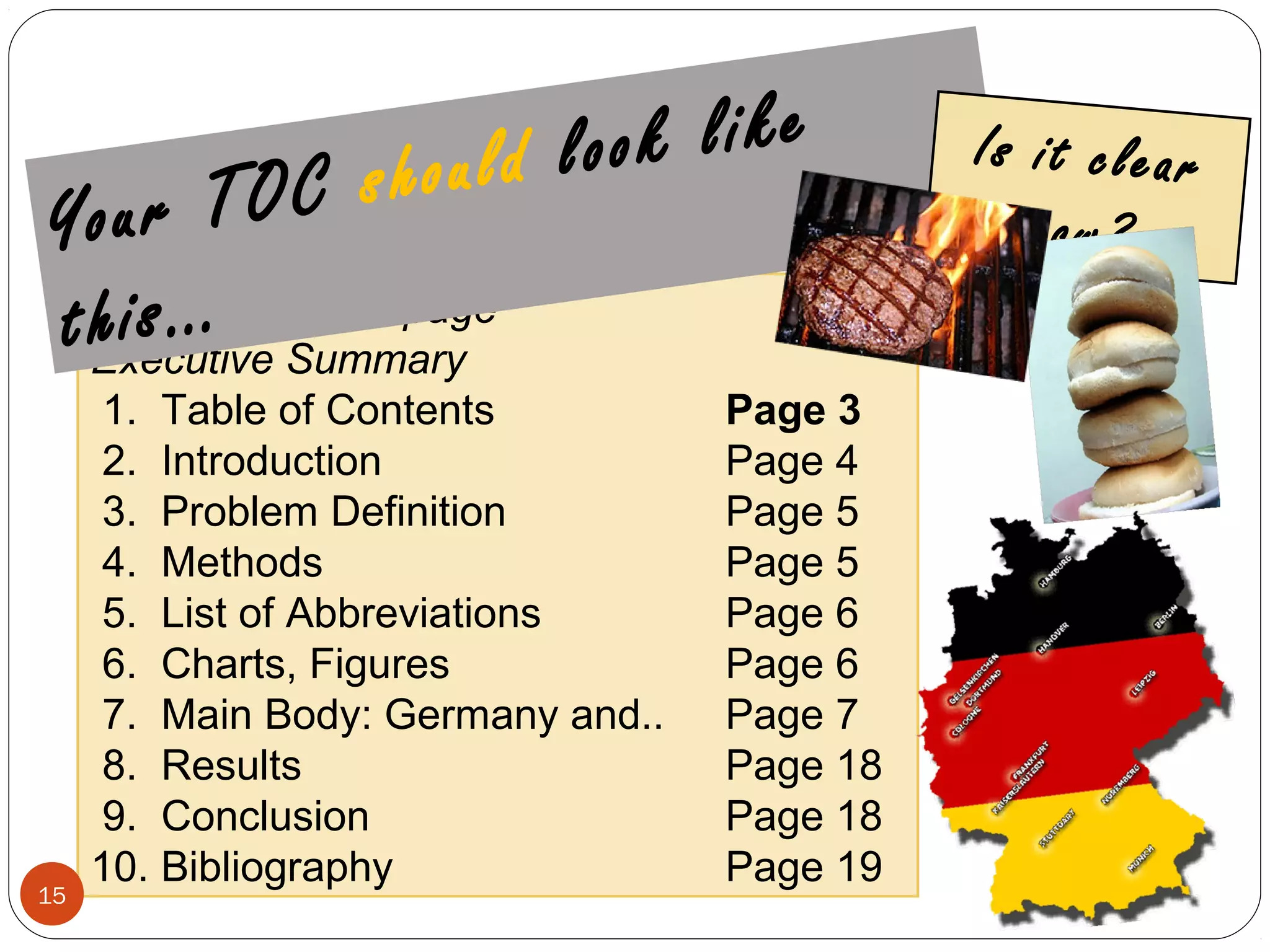
7. Main Body: Germany and its future role in Europe
7.1 History
7.1.1 Before Christ
7.1.1 After Christ
7.2 Demographics Today
7.2.1 Geography and population
7.2.1.1 North
7.2.1.2 East
7.2.1.3 South
7.2.1.4 West
7.3 Politics
7.3.1 Nazi Germany
7.3.2 The Parties
7.3.2.1 CDU
7.3.2.2 SPD
7.3.3 Germany’s Politics in Europe
7.4 Culture
7.4.1 Literature
7.5.1.1 Goethe
7.4.2 Cuisine
7.5.2.1 The Beer
7.4.3 Community
7.4.3.1 Laptops and Lederhosen
7.5 Economics
7.5.1 Rebuilding After the War
7.5.2 Brand: Made in Germany
7.5.3. Germany‘s Economic Powerhouse
7.6 Germany‘s Role in the World
7.6.1 International position
7.6.2 European position
7.6.3 Future conditions
8. Results
9. Conclusion
10. Bibliography
http://www.acus.org/new_atlanticist/merkel-shifts-approves-german-stimulus-package
10
“Methods” - How the information was gathered.
“The Problem Definition” - Why the paper was written.
“Charts and Figures” - Where to find the Graphics.
“Abbreviations - Abbreviation list
“The Introduction” - A sexy “Hook” that makes the
reader want more.
“The Executive Summary” - A short section-by-section
overview, includes the Results and Conclusion.
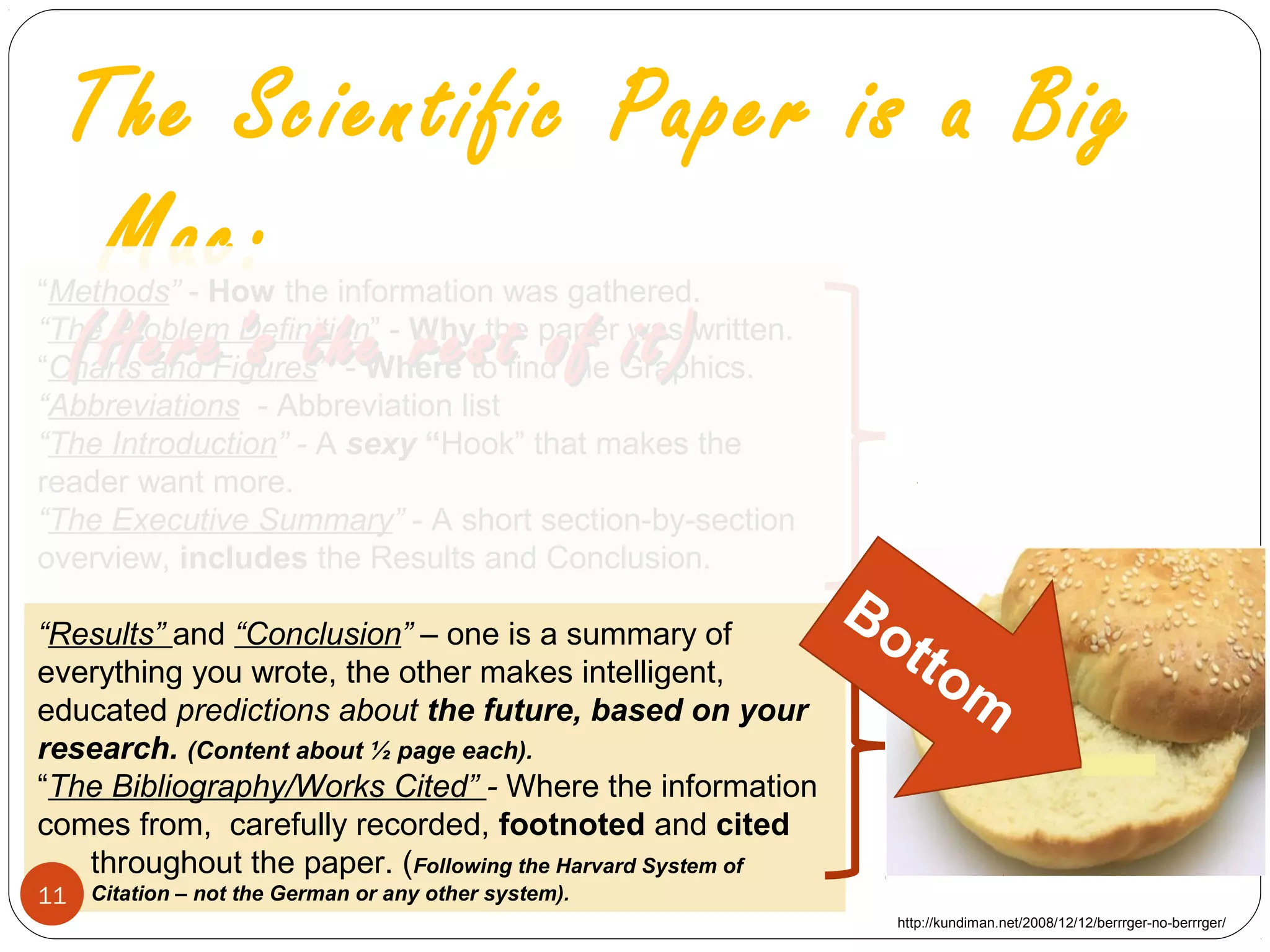
“Results” and “Conclusion” – one is a summary of
everything you wrote, the other makes intelligent,
educated predictions about the future, based on your
research. (Content about ½ page each).
“The Bibliography/Works Cited” - Where the information
comes from, carefully recorded, footnoted and cited
throughout the paper. (Following the Harvard System of
Citation – not the German or any other system).
The Scientific Paper is a Big
Mac:
(Here’s the rest of it)(Here’s the rest of it)
http://kundiman.net/2008/12/12/berrrger-no-berrrger/
11
BottomBottom
Bottom
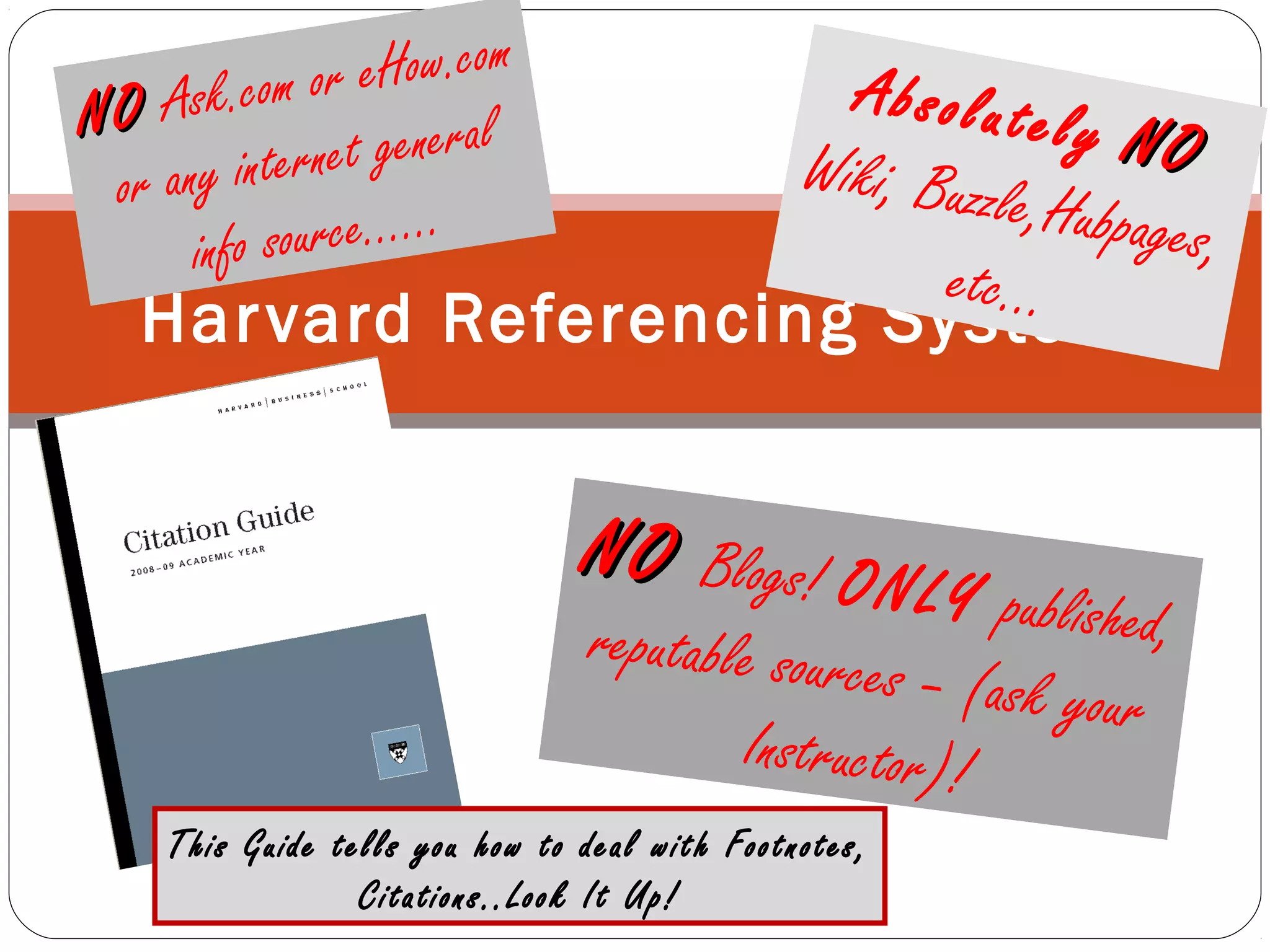
Harvard Referencing System
Absolutely NONOWiki, Buzzle,Hubpages,
etc…
NONO Ask.com or eHow.com
or any internet general
info source……
NONO Blogs! ONLY published,reputable sources – (ask your
Instructor)!
This Guide tells you how to deal with Footnotes,
Citations..Look It Up!
13
A reference/citation looks likeA reference/citation looks like
this:this:
“..Although most scholars accept the blabla theory, a few
have criticized its main points (e.g. Blust 1999, Tsuchida &
Yamada 1991, Peiros 2004)…”
• Tsuchida, S. & Yamada, Y. (1991). "Ogawa’s
Siraya/Makatao/Taivoan comparative vocabulary" in S. Tsuchida,
Y. Yamada & T. Moriguchi (Ed.) Linguistic Materials of the Formosan
Sinicized Populations I: Siraya and Basai. Tokyo: The University of
Tokyo.
In the body of the text
Then this on the Bibliography/
Works Cited page
The Executive “Summary”
A blow by blow description of each
main point: 7.1, 7.2, 7.3, 7.4, etc.
History, Demographics, Politics,
Culture, Economics etc…
14
Write it after you have finished writing therest of the paper – andand..it includes theconclusion!!
It is written in
this way for
busy people whocan’t or don’twant to read thewhole report!
It is the first page of your
Scientific Report after the
cover page.
Attractive Cover page
Executive Summary
1. Table of Contents Page 3
2. Introduction Page 4
3. Problem Definition Page 5
4. Methods Page 5
5. List of Abbreviations Page 6
6. Charts, Figures Page 6
7. Main Body: Germany and.. Page 7
8. Results Page 18
9. Conclusion Page 18
10. Bibliography Page 19
Your TOC should look like
this…
15
Is it clear
now?
The Presentation
Put numbers
on your
slides!
WeWe have to read ALL THE
ALL THETEXTTEXT while sitting faraway; can we see your graphsand all the text?
http://www.telegraph.co.uk/health/healthnews/7797323/Children-who-eat-three-or-more-burgers-a-week-more-likely-to-develop-asthma.html
We want to Enjoy what
we are seeing! 1. Choose one ideaone idea only,only, for each
slide –Get away from BulletGet away from Bullet
Points-use graphics/visuals,Points-use graphics/visuals,
VISUALSVISUALS!!!!
2. Answer this: Why have you
chosen to tell us thisthis piece of
17
in a presentation. Ask your
Instructor.Instructor.
18 practice meets theory meets experience

How to write a Scientific Report/Presentation tips, pre-Bachelor level, non-native English speakers.

  • 1.
    Phoenix-English Communications 2014 instructor@phoenix-english.com The ScientificReport How-to-do In English http://tutor2u.net/blog/index.php/business-studies/comments/buss4-exam-technique-big-mac-or-hamburger-fries/
  • 2.
    2 The Scientific Reportislike a Big Mac It has layers and is built into something enjoyable that is easy to digest; Some of its components are standardized, some changeable; If done well, it will stay with you awhile and you‘ll think about it. This powerpoint has lots of text because I‘m not present to explain every detail…
  • 3.
    3 1. The ScientificReport usually poses a problem or recognizes a challenge involving your theme, (“Problem Definition”). You have to state a clear problem or challenge and then the whole paper is structured around that problem. 2. Your research takes a hard look at that problem (the "Main Body" of the Paper). 3. The end of the paper summarizes what you have found and reminds us of your points. (This is "Results"). 4. Based on what your research found, a solution - (something new!) is offered, (The "Conclusion"). If you have no solution or more research is needed beyond the scope of your paper, you say so in the Conclusion. The Conclusion refers to the Problem already stated and offers a SOLUTION. First: Choose a theme that interests you, Second: Develop a problem or a challenge, (it only needs to be 3-4 sentences), make sure it has a clear definition which will define the direction of the paper. Third: Then you can begin your research. What‘s a Scientific Report? GO!
  • 4.
    It always has -A Top of the Bun - A Middle Part with all the stuff - A Bottom of the Bun It‘s a Big Mac because.. 4 Like a Big Mac, it is the Middle that changes with different stuff depending on your paper‘s content, but the Bun Structure stays the same!
  • 5.
    Cover page Executive Summary 1.Table of Contents Page 3 2. Introduction Page 4 3. Problem Definition Page 5 4. Methods Page 5 5. List of Abbreviations Page 6 6. Charts, Figures Page 6 7. Main Body Page 7 8. Results Page 18 9. Conclusion Page 18 10. Bibliography Page 19 Your TOC could look like this… 5 The BigThe Big MacMac (Suggested page numbers) This is as long or asshort as you make it The ExecSumm is „outside“ of page numbers
  • 6.
    The Executive “Summary” It’s NOTan overview summary! It’s a step by step summary of paper’s each main point- each paragraph a mini-summary! 6 Top of the Bun: more on this later.. hat‘s different about the Executive Summary?
  • 7.
    “The Executive Summary”- A short section-by-section overview, includes the Results and Conclusion. (Content: 10% of the total paper) „Table of Contents“ – Lists all the main headers (including TOC). “The Introduction” - A sexy “Hook” that makes the reader want to read more. (Content ½ page). “Methods” - How the information was gathered. “Charts and Figures” - Where to find the Graphics (but do not show the graphics). “Abbreviations - Abbreviation list. “The Problem Definition” - Why the paper was written; the burning question. “Results” and “Conclusion” – one is a summary, the other makes intelligent, educated predictions about the future. “The Bibliography” - Where the information comes from, carefully recorded, footnoted and cited throughout the paper. The Scientific Paper is a Big Mac: (Here’s a closer look at some of theHere’s a closer look at some of the ingredients)ingredients) 7 TOP
  • 8.
  • 9.
    http://www.gotbuffalo. com/Buffalo-5lb-Patty-Burger.htm Here’s theMain Body:“The Meat” …Now define a “Problem”! After you look at the current state of affairs you can think about how you are going to answer your Problem Definition which is about the future… This is the procedure for any topic you choose; industry or company. Problem Definition „What will Germany‘s role in the future be in Europe?“ Cont’d.
  • 10.
    Main Body: (The MeatyMiddle) 7. Main Body: Germany and its future role in Europe 7.1 History 7.1.1 Before Christ 7.1.1 After Christ 7.2 Demographics Today 7.2.1 Geography and population 7.2.1.1 North 7.2.1.2 East 7.2.1.3 South 7.2.1.4 West 7.3 Politics 7.3.1 Nazi Germany 7.3.2 The Parties 7.3.2.1 CDU 7.3.2.2 SPD 7.3.3 Germany’s Politics in Europe 7.4 Culture 7.4.1 Literature 7.5.1.1 Goethe 7.4.2 Cuisine 7.5.2.1 The Beer 7.4.3 Community 7.4.3.1 Laptops and Lederhosen 7.5 Economics 7.5.1 Rebuilding After the War 7.5.2 Brand: Made in Germany 7.5.3. Germany‘s Economic Powerhouse 7.6 Germany‘s Role in the World 7.6.1 International position 7.6.2 European position 7.6.3 Future conditions 8. Results 9. Conclusion 10. Bibliography http://www.acus.org/new_atlanticist/merkel-shifts-approves-german-stimulus-package 10
  • 11.
    “Methods” - Howthe information was gathered. “The Problem Definition” - Why the paper was written. “Charts and Figures” - Where to find the Graphics. “Abbreviations - Abbreviation list “The Introduction” - A sexy “Hook” that makes the reader want more. “The Executive Summary” - A short section-by-section overview, includes the Results and Conclusion. “Results” and “Conclusion” – one is a summary of everything you wrote, the other makes intelligent, educated predictions about the future, based on your research. (Content about ½ page each). “The Bibliography/Works Cited” - Where the information comes from, carefully recorded, footnoted and cited throughout the paper. (Following the Harvard System of Citation – not the German or any other system). The Scientific Paper is a Big Mac: (Here’s the rest of it)(Here’s the rest of it) http://kundiman.net/2008/12/12/berrrger-no-berrrger/ 11 BottomBottom Bottom
  • 12.
    Harvard Referencing System AbsolutelyNONOWiki, Buzzle,Hubpages, etc… NONO Ask.com or eHow.com or any internet general info source…… NONO Blogs! ONLY published,reputable sources – (ask your Instructor)! This Guide tells you how to deal with Footnotes, Citations..Look It Up!
  • 13.
    13 A reference/citation lookslikeA reference/citation looks like this:this: “..Although most scholars accept the blabla theory, a few have criticized its main points (e.g. Blust 1999, Tsuchida & Yamada 1991, Peiros 2004)…” • Tsuchida, S. & Yamada, Y. (1991). "Ogawa’s Siraya/Makatao/Taivoan comparative vocabulary" in S. Tsuchida, Y. Yamada & T. Moriguchi (Ed.) Linguistic Materials of the Formosan Sinicized Populations I: Siraya and Basai. Tokyo: The University of Tokyo. In the body of the text Then this on the Bibliography/ Works Cited page
  • 14.
    The Executive “Summary” Ablow by blow description of each main point: 7.1, 7.2, 7.3, 7.4, etc. History, Demographics, Politics, Culture, Economics etc… 14 Write it after you have finished writing therest of the paper – andand..it includes theconclusion!! It is written in this way for busy people whocan’t or don’twant to read thewhole report! It is the first page of your Scientific Report after the cover page.
  • 15.
    Attractive Cover page ExecutiveSummary 1. Table of Contents Page 3 2. Introduction Page 4 3. Problem Definition Page 5 4. Methods Page 5 5. List of Abbreviations Page 6 6. Charts, Figures Page 6 7. Main Body: Germany and.. Page 7 8. Results Page 18 9. Conclusion Page 18 10. Bibliography Page 19 Your TOC should look like this… 15 Is it clear now?
  • 16.
    The Presentation Put numbers onyour slides! WeWe have to read ALL THE ALL THETEXTTEXT while sitting faraway; can we see your graphsand all the text? http://www.telegraph.co.uk/health/healthnews/7797323/Children-who-eat-three-or-more-burgers-a-week-more-likely-to-develop-asthma.html We want to Enjoy what we are seeing! 1. Choose one ideaone idea only,only, for each slide –Get away from BulletGet away from Bullet Points-use graphics/visuals,Points-use graphics/visuals, VISUALSVISUALS!!!! 2. Answer this: Why have you chosen to tell us thisthis piece of
  • 17.
    17 in a presentation.Ask your in a presentation. Ask your Instructor.Instructor.
  • 18.
    18 practice meetstheory meets experience