Business Plan IT Productivity Office
                               sector Lighting
                                   Draft 1.0 - April 2012


         Eddy Dekkers
         IT Productivity Office Sector Lighting
Confidential                         IT Productivity Office Sector Lighting
Content

      1. Introduction
      2. Department Vision & Mission
      3. Situation analysis section
      4. Main scope IT Productivity
      5. Main goals IT Productivity
      6. Tactical steps
      7. Key performance indicators
      8. Productivity process and Tooling
      9. Cost and funding
      10. Long-term outlook
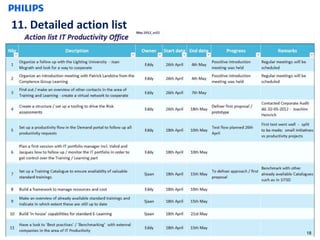
      11. Detailed action list
Confidential               IT Productivity Office Sector Lighting   2
1. Introduction
Philips has invested over a period a significant amount of money in all kind of
global IT solutions to support the business processes, such as ERP/SAP – CRM –
Vendavo and APO.

It’s obvious that training and capturing the knowledge are essential for such IT /
Business investments, however this is not always the case.
Just a short summarize of things that might can go wrong;
• “Projects do not always deliver what has been promised …”
• “Training material was not properly delivered or old dated on Go live of a
     project …”
• “End users left for another job and the job / IT knowledge was not properly
     transferred …”
• “New / reviewed business solutions have been implemented however no
     sufficient training was given …”


Confidential                      IT Productivity Office Sector Lighting             3
1. Introduction
There is also alternative need by the business for retrieving and experience
training such E-learning and standard catalogue solutions.

The new IT productivity role needs to anticipate and act on these IT / Business
environmental changes and safeguard the valuable asset: “Knowledge”!

This document describes the way for the right approach , scope, goals and the
way to realize the achievements.
It’s meant as an internal overview / structure to set the foundation for this new
IT productivity role.
The period for review is 3-5 months.


Confidential                      IT Productivity Office Sector Lighting            4
2. Department Vision & Mission

 Vision:
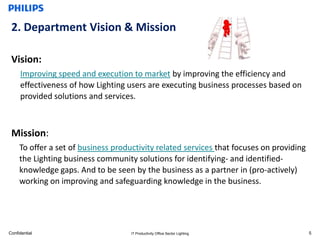
     Improving speed and execution to market by improving the efficiency and
     effectiveness of how Lighting users are executing business processes based on
     provided solutions and services.


 Mission:
     To offer a set of business productivity related services that focuses on providing
     the Lighting business community solutions for identifying- and identified-
     knowledge gaps. And to be seen by the business as a partner in (pro-actively)
     working on improving and safeguarding knowledge in the business.


Confidential                         IT Productivity Office Sector Lighting               5
3. Situation analysis section

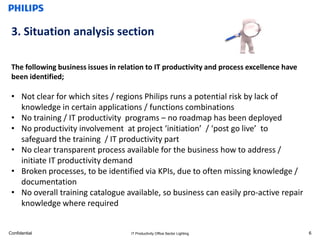
 The following business issues in relation to IT productivity and process excellence have
 been identified;

 • Not clear for which sites / regions Philips runs a potential risk by lack of
   knowledge in certain applications / functions combinations
 • No training / IT productivity programs – no roadmap has been deployed
 • No productivity involvement at project ‘initiation’ / ‘post go live’ to
   safeguard the training / IT productivity part
 • No clear transparent process available for the business how to address /
   initiate IT productivity demand
 • Broken processes, to be identified via KPIs, due to often missing knowledge /
   documentation
 • No overall training catalogue available, so business can easily pro-active repair
   knowledge where required


Confidential                         IT Productivity Office Sector Lighting                 6
4. Main scope IT Productivity

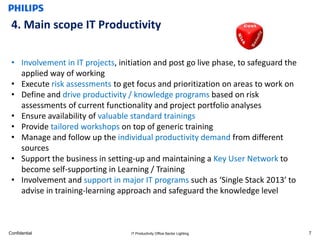
 • Involvement in IT projects, initiation and post go live phase, to safeguard the
   applied way of working
 • Execute risk assessments to get focus and prioritization on areas to work on
 • Define and drive productivity / knowledge programs based on risk
   assessments of current functionality and project portfolio analyses
 • Ensure availability of valuable standard trainings
 • Provide tailored workshops on top of generic training
 • Manage and follow up the individual productivity demand from different
   sources
 • Support the business in setting-up and maintaining a Key User Network to
   become self-supporting in Learning / Training
 • Involvement and support in major IT programs such as ‘Single Stack 2013’ to
   advise in training-learning approach and safeguard the knowledge level


Confidential                       IT Productivity Office Sector Lighting            7
4. Scope IT Productivity


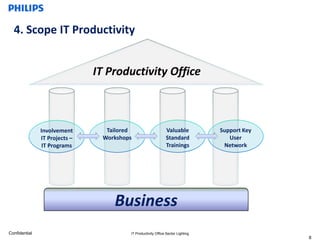
                               IT Productivity Office


               Involvement       Tailored                     Valuable           Support Key
               IT Projects –    Workshops                     Standard              User
                IT Programs                                   Trainings           Network


                                   Business
Confidential                            IT Productivity Office Sector Lighting
                                                                                               8
5. Main goals IT Productivity


 • Collaboration between Business and IT to achieve increased productivity

 • Satisfaction of Key business stake holders and end users

 • Increase the business value created

 • Minimize the business risks

 • Safeguard business continuity


Confidential                       IT Productivity Office Sector Lighting    9
6. Tactical steps

 1. Reach out to others involved in training / learning and look for opportunities to
    cooperate. (Lighting University / Competence group Learning etc.)
 2. Build on virtual teams with key users / ITBPs / BPOs / BPMs / BPEs
 3. Create a structure and tooling method to drive the Risk assessments / Surveys
 4. Set up a productivity flow in the demand tool to be able to follow up the productivity
    requests
 5. Define a way to get involved in the IT portfolio process in order to safeguard the
    knowledge / training part – Define a checklist
 6. Set up a training catalogue to ensure availability of valuable standard trainings
 7. Build a framework to manage resources and cost
 8. Pro-active develop and launch training initiatives as an outcome of Risk assessments,
    Pulse checks and Problem management
 9. Organize Best practices / Benchmarking with external companies in the area of IT
    productivity


Confidential                          IT Productivity Office Sector Lighting                 10
7. Key performance indicators


 Proposed KPIs

 •    Satisfaction of Key business stake holders
 •    Business value created through IT (realized projects in portfolio)
 •    Cost within agreed framework
 •    Operational Excellence measured with E2E KPIs
 •    Satisfaction of end users
 •    Follow up completion for past projects


Confidential                            IT Productivity Office Sector Lighting   11
8. The Productivity process and Tooling

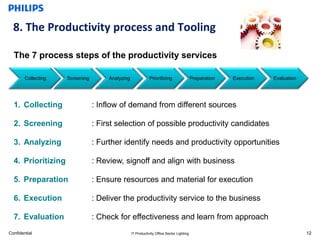
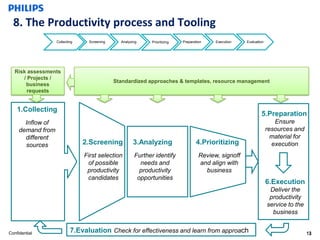
  The 7 process steps of the productivity services

        Collecting   Screening        Analyzing               Prioritizing                 Preparation   Execution   Evaluation


  1. Collecting                  : Inflow of demand from different sources

  2. Screening                   : First selection of possible productivity candidates

  3. Analyzing                   : Further identify needs and productivity opportunities

  4. Prioritizing                : Review, signoff and align with business

  5. Preparation                 : Ensure resources and material for execution

  6. Execution                   : Deliver the productivity service to the business

  7. Evaluation                  : Check for effectiveness and learn from approach
Confidential                                      IT Productivity Office Sector Lighting                                          12
8. The Productivity process and Tooling
                   Collecting    Screening     Analyzing    Prioritizing   Preparation    Execution   Evaluation


   Risk assessments
      / Projects /
                                             Standardized approaches & templates, resource management
       business
        requests


    1.Collecting
                                                                                                              5.Preparation
       Inflow of                                                                                                      Ensure
     demand from                                                                                                   resources and
       different                                                                                                     material for
       sources                  2.Screening          3.Analyzing                  4.Prioritizing                     execution
                                First selection       Further identify              Review, signoff
                                 of possible            needs and                   and align with
                                 productivity           productivity                  business
                                 candidates            opportunities
                                                                                                                   6.Execution
                                                                                                                    Deliver the
                                                                                                                    productivity
                                                                                                                   service to the
                                                                                                                     business


Confidential               7.Evaluation CheckITfor effectiveness and learn from approach
                                                Productivity Office Sector Lighting                                                 13
8. The Productivity process and Tooling
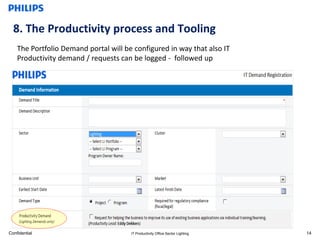
    The Portfolio Demand portal will be configured in way that also IT
    Productivity demand / requests can be logged - followed up


Confidential                           IT Productivity Office Sector Lighting   14
8. The Productivity process and Tooling
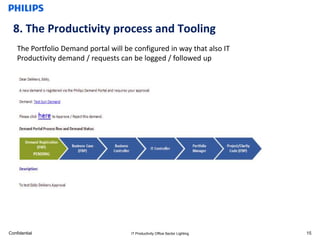
    The Portfolio Demand portal will be configured in way that also IT
    Productivity demand / requests can be logged / followed up


Confidential                           IT Productivity Office Sector Lighting   15
9. Cost and funding

 The main principles for the coming period agreed are;

 • Any demand needs to be registered with typical information (description, timing,
   value, costs, readiness, risk, contacts…) in the demand portal.
 • The IT productivity lead will organize for regular or ad hoc reviews to take related
   decisions on what to execute
 • Very small effort will be covered by a dedicated small bucket (PR number tbd), owned
   by lead ITBP, any single activity registering time there requires lead ITBP approval
 • Targeted efforts towards commercial organisations will need to be covered by QMR
   budgets (competing with ‘normal’ projects), decision per MG/BG with available budget
 • Larger scale efforts and such related to BGs / Factories / Innovation etc need to go
   through normal project request and budget competition on total Lighting scale
 • Lead IT productivity will act as a kind of project manager with relation to keeping costs
   within agreed limits in all levels


Confidential                          IT Productivity Office Sector Lighting                   16
10. Long-term outlook


 Tbd


Confidential             IT Productivity Office Sector Lighting   17
11. Detailed action list


Confidential                IT Productivity Office Sector Lighting   18
Business plan it productivity office draft 10

Business plan it productivity office draft 10

  • 1.
    Business Plan ITProductivity Office sector Lighting Draft 1.0 - April 2012 Eddy Dekkers IT Productivity Office Sector Lighting Confidential IT Productivity Office Sector Lighting
  • 2.
    Content 1. Introduction 2. Department Vision & Mission 3. Situation analysis section 4. Main scope IT Productivity 5. Main goals IT Productivity 6. Tactical steps 7. Key performance indicators 8. Productivity process and Tooling 9. Cost and funding 10. Long-term outlook 11. Detailed action list Confidential IT Productivity Office Sector Lighting 2
  • 3.
    1. Introduction Philips hasinvested over a period a significant amount of money in all kind of global IT solutions to support the business processes, such as ERP/SAP – CRM – Vendavo and APO. It’s obvious that training and capturing the knowledge are essential for such IT / Business investments, however this is not always the case. Just a short summarize of things that might can go wrong; • “Projects do not always deliver what has been promised …” • “Training material was not properly delivered or old dated on Go live of a project …” • “End users left for another job and the job / IT knowledge was not properly transferred …” • “New / reviewed business solutions have been implemented however no sufficient training was given …” Confidential IT Productivity Office Sector Lighting 3
  • 4.
    1. Introduction There isalso alternative need by the business for retrieving and experience training such E-learning and standard catalogue solutions. The new IT productivity role needs to anticipate and act on these IT / Business environmental changes and safeguard the valuable asset: “Knowledge”! This document describes the way for the right approach , scope, goals and the way to realize the achievements. It’s meant as an internal overview / structure to set the foundation for this new IT productivity role. The period for review is 3-5 months. Confidential IT Productivity Office Sector Lighting 4
  • 5.
    2. Department Vision& Mission Vision: Improving speed and execution to market by improving the efficiency and effectiveness of how Lighting users are executing business processes based on provided solutions and services. Mission: To offer a set of business productivity related services that focuses on providing the Lighting business community solutions for identifying- and identified- knowledge gaps. And to be seen by the business as a partner in (pro-actively) working on improving and safeguarding knowledge in the business. Confidential IT Productivity Office Sector Lighting 5
  • 6.
    3. Situation analysissection The following business issues in relation to IT productivity and process excellence have been identified; • Not clear for which sites / regions Philips runs a potential risk by lack of knowledge in certain applications / functions combinations • No training / IT productivity programs – no roadmap has been deployed • No productivity involvement at project ‘initiation’ / ‘post go live’ to safeguard the training / IT productivity part • No clear transparent process available for the business how to address / initiate IT productivity demand • Broken processes, to be identified via KPIs, due to often missing knowledge / documentation • No overall training catalogue available, so business can easily pro-active repair knowledge where required Confidential IT Productivity Office Sector Lighting 6
  • 7.
    4. Main scopeIT Productivity • Involvement in IT projects, initiation and post go live phase, to safeguard the applied way of working • Execute risk assessments to get focus and prioritization on areas to work on • Define and drive productivity / knowledge programs based on risk assessments of current functionality and project portfolio analyses • Ensure availability of valuable standard trainings • Provide tailored workshops on top of generic training • Manage and follow up the individual productivity demand from different sources • Support the business in setting-up and maintaining a Key User Network to become self-supporting in Learning / Training • Involvement and support in major IT programs such as ‘Single Stack 2013’ to advise in training-learning approach and safeguard the knowledge level Confidential IT Productivity Office Sector Lighting 7
  • 8.
    4. Scope ITProductivity IT Productivity Office Involvement Tailored Valuable Support Key IT Projects – Workshops Standard User IT Programs Trainings Network Business Confidential IT Productivity Office Sector Lighting 8
  • 9.
    5. Main goalsIT Productivity • Collaboration between Business and IT to achieve increased productivity • Satisfaction of Key business stake holders and end users • Increase the business value created • Minimize the business risks • Safeguard business continuity Confidential IT Productivity Office Sector Lighting 9
  • 10.
    6. Tactical steps 1. Reach out to others involved in training / learning and look for opportunities to cooperate. (Lighting University / Competence group Learning etc.) 2. Build on virtual teams with key users / ITBPs / BPOs / BPMs / BPEs 3. Create a structure and tooling method to drive the Risk assessments / Surveys 4. Set up a productivity flow in the demand tool to be able to follow up the productivity requests 5. Define a way to get involved in the IT portfolio process in order to safeguard the knowledge / training part – Define a checklist 6. Set up a training catalogue to ensure availability of valuable standard trainings 7. Build a framework to manage resources and cost 8. Pro-active develop and launch training initiatives as an outcome of Risk assessments, Pulse checks and Problem management 9. Organize Best practices / Benchmarking with external companies in the area of IT productivity Confidential IT Productivity Office Sector Lighting 10
  • 11.
    7. Key performanceindicators Proposed KPIs • Satisfaction of Key business stake holders • Business value created through IT (realized projects in portfolio) • Cost within agreed framework • Operational Excellence measured with E2E KPIs • Satisfaction of end users • Follow up completion for past projects Confidential IT Productivity Office Sector Lighting 11
  • 12.
    8. The Productivityprocess and Tooling The 7 process steps of the productivity services Collecting Screening Analyzing Prioritizing Preparation Execution Evaluation 1. Collecting : Inflow of demand from different sources 2. Screening : First selection of possible productivity candidates 3. Analyzing : Further identify needs and productivity opportunities 4. Prioritizing : Review, signoff and align with business 5. Preparation : Ensure resources and material for execution 6. Execution : Deliver the productivity service to the business 7. Evaluation : Check for effectiveness and learn from approach Confidential IT Productivity Office Sector Lighting 12
  • 13.
    8. The Productivityprocess and Tooling Collecting Screening Analyzing Prioritizing Preparation Execution Evaluation Risk assessments / Projects / Standardized approaches & templates, resource management business requests 1.Collecting 5.Preparation Inflow of Ensure demand from resources and different material for sources 2.Screening 3.Analyzing 4.Prioritizing execution First selection Further identify Review, signoff of possible needs and and align with productivity productivity business candidates opportunities 6.Execution Deliver the productivity service to the business Confidential 7.Evaluation CheckITfor effectiveness and learn from approach Productivity Office Sector Lighting 13
  • 14.
    8. The Productivityprocess and Tooling The Portfolio Demand portal will be configured in way that also IT Productivity demand / requests can be logged - followed up Confidential IT Productivity Office Sector Lighting 14
  • 15.
    8. The Productivityprocess and Tooling The Portfolio Demand portal will be configured in way that also IT Productivity demand / requests can be logged / followed up Confidential IT Productivity Office Sector Lighting 15
  • 16.
    9. Cost andfunding The main principles for the coming period agreed are; • Any demand needs to be registered with typical information (description, timing, value, costs, readiness, risk, contacts…) in the demand portal. • The IT productivity lead will organize for regular or ad hoc reviews to take related decisions on what to execute • Very small effort will be covered by a dedicated small bucket (PR number tbd), owned by lead ITBP, any single activity registering time there requires lead ITBP approval • Targeted efforts towards commercial organisations will need to be covered by QMR budgets (competing with ‘normal’ projects), decision per MG/BG with available budget • Larger scale efforts and such related to BGs / Factories / Innovation etc need to go through normal project request and budget competition on total Lighting scale • Lead IT productivity will act as a kind of project manager with relation to keeping costs within agreed limits in all levels Confidential IT Productivity Office Sector Lighting 16
  • 17.
    10. Long-term outlook Tbd Confidential IT Productivity Office Sector Lighting 17
  • 18.
    11. Detailed actionlist Confidential IT Productivity Office Sector Lighting 18