The Promotional
Strategies
Promotional Strategies
The promotional mix for industrial products &
services is different from the promotional mix for
consumer goods.
This is due to the fact of technical nature of
industrial product and relatively smaller in
industrial buyers and complex nature of
organizational buying process.
Developing the Industrial Communication
The major steps involved in developing effective
communication or promotional programme are:
•
•
•
•
•
•
•

Determine communication objectives
Identify the target audiences
Determine the promotional budget
Develop the message strategy
Select the media
Evaluate the promotion’s results
Integrate the promotional programme
Determining the communication objectives
Promotional objectives are formulated based on the
firm’s overall corporate and marketing objectives.
Once the objectives are established, an industrial
firm choose the strategies and actions required to
achieve the set objectives.
Before determining communication objectives, the industrial
marketer should find out the communication problems. This
can be done by collecting the data ( Through marketing
research) on the existing levels of awareness and attitudes of
the existing & prospective customers.

Data would help in setting specific communication goal.
• Data collections permits measurement of the quantified
communication objectives.
• The purpose of the communication programme is to move the
potential buyer from unawareness to buying action.
3 stages of Buying behavior
• Buyer’s awareness levels
• Changes in buyer’s attitudes
• Buying actions
Identifying the target Audience
• BM must be clear about the target audience. In Industrial
Marketing the target market is clearly classified at 2 levels
and they are
Firstly, identify the buying organization based on the target
segments.
Secondly, identify the attitudes & buying factors used by
buying centre (committee) in the organizations
It is importance to assess the target audience’s current image of
the company, its products, and its competitors. This
information can be obtained by conducting a market
research study to understand the awareness levels and
attitudes of the buying centre members. The data will also
be useful in developing message strategy and media plan.
Determine the Promotional Budget
• This is most difficult decisions the companies are
facing is the questions as to “how much to spend
on promotional or what should be the promotional
or communications budget”
The promotional budget consist of advertising, sales
promotion, direct marketing, and publicity.
• There are four common methods used to set a
promotional budget, they are
Affordable budget
Percentage of sales method
Competitive-parity method
Objective-task method
Affordable Budget Method
• Many companies set this type of method on what they think
the company can afford.
• This method ignores the role of promotional as an
investment and its impact on sales volume

Percentage of Sales Method
• This is most common method used in Industrial Marketing
to set the expenditure budget for promotion is a specified %
of sales, either sales in the previous year or in the current
year/ Forecasted sales.
• At times a % of sales , an “what are the other competing
firms doing” and what can we afford”, thus using all the 3
methods.
The promotional budget is decided in two steps,
Firstly, total marketing budget
Secondly, the advertising or promotional budget
Advantages:
• The finance managers are satisfied that the
promotional expenses have a close relationship to
the sales.
• The method considers affordability
• The parity with competitors is maintained.
Disadvantages:
It does not encourage building up promotional
budget by determining what each product and
territory deserves.
Competitive- Parity Method
Fewer companies set their promotional budget by spending the same
percentage of the sales on promotion as that of competitors. There
are two arguments in this method.
1. Average expenditure of the companies would represent a
collective wisdom of the industry.
2. Maintaining the parity with the competitors, it would help to
prevent promotional wars.

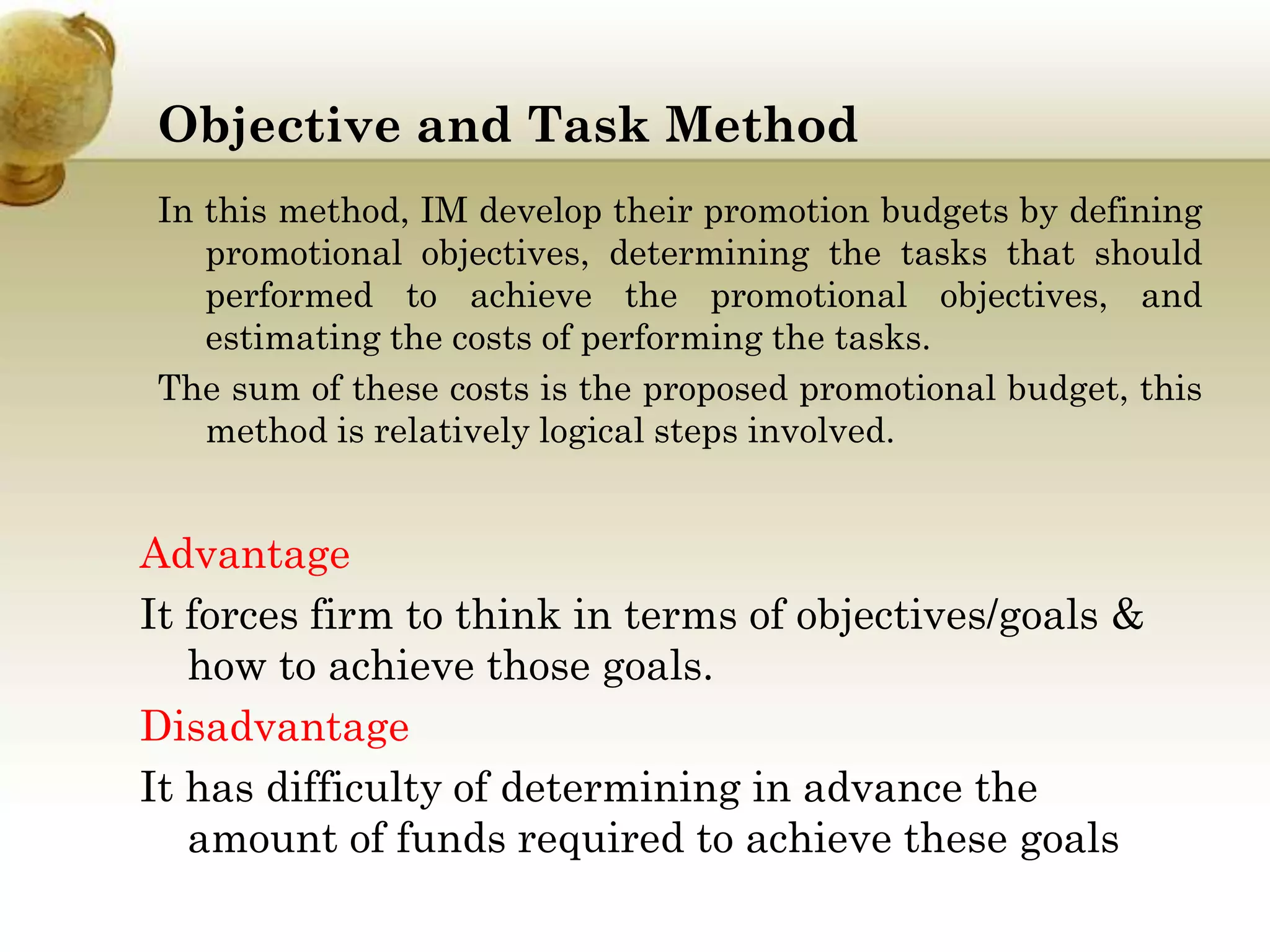
Objective and Task Method
In this method, IM develop their promotion budgets by defining
promotional objectives, determining the tasks that should
performed to achieve the promotional objectives, and estimating the
costs of performing the tasks.
The sum of these costs is the proposed promotional budget, this
method is relatively logical steps involved.
Objective and Task Method
In this method, IM develop their promotion budgets by defining
promotional objectives, determining the tasks that should
performed to achieve the promotional objectives, and
estimating the costs of performing the tasks.
The sum of these costs is the proposed promotional budget, this
method is relatively logical steps involved.

Advantage
It forces firm to think in terms of objectives/goals &
how to achieve those goals.
Disadvantage
It has difficulty of determining in advance the
amount of funds required to achieve these goals
Developing the Message Strategy
This indicates how to achieve the communication
objectives. The message/ Theme/Appeal is
developed to determine “what to say” to the target
audience so as achieve the desired results.
In BM, the message should be more rational. The
rational appeals are developed either from position
strategy or by conducting MR studies.
BM should remember two important points while
developing communication messages.
Firstly, Any Industrial Buyers are fairly well
informed or knowledgeable.
Secondly, Instead of the message discussing product
features, the message should focus on customer
benefits
Selecting the Media
This criteria depends on the target audience to be reached,
the statement of the communication objectives, and the
promotional budget.
The selection depends on whether the advertiser wishes to
penetrate a particular industry or various industries
The selection depends on the circulation & cost of
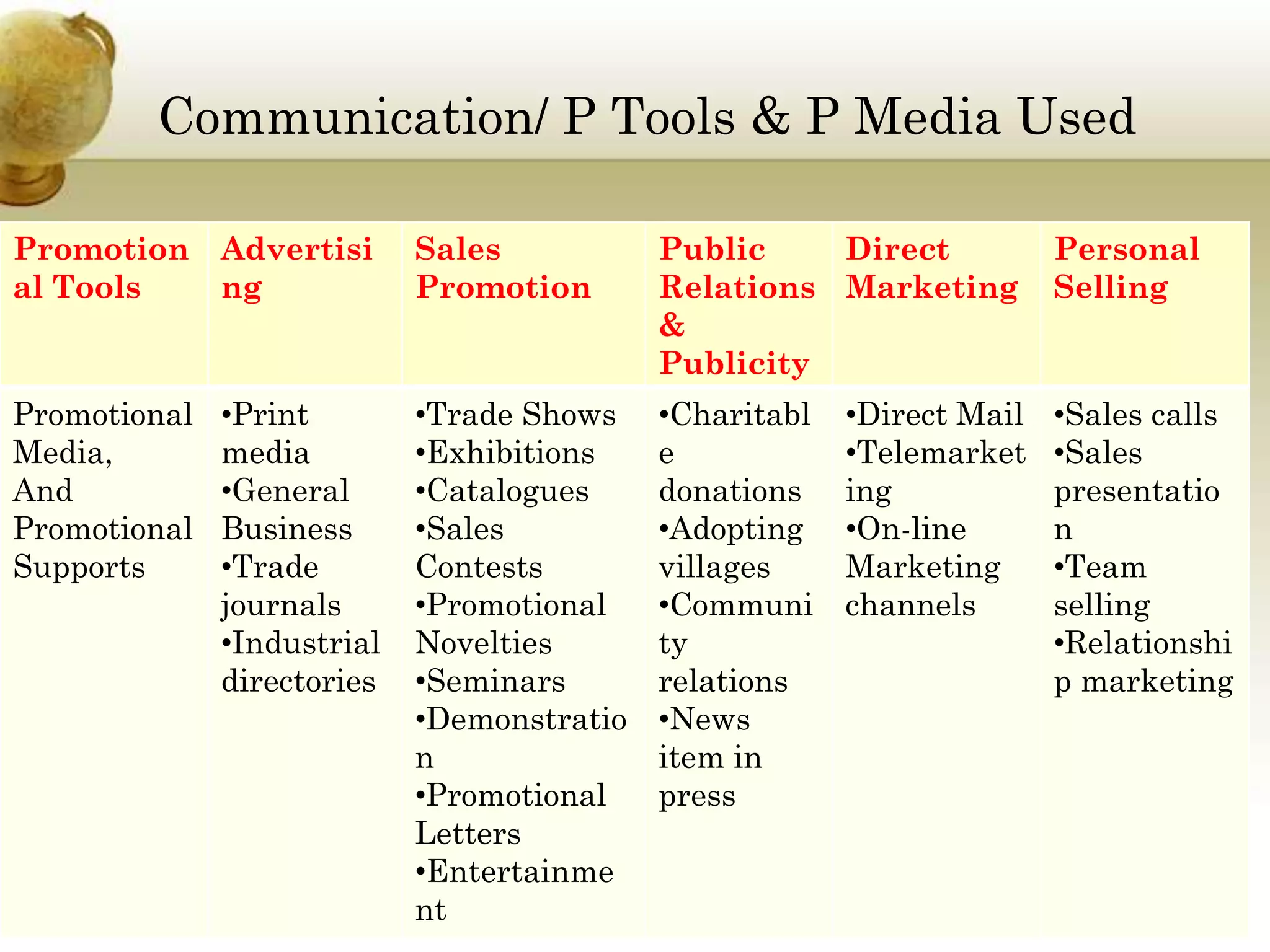
advertising space. The different communication/
Promotional tools/ P Media that used in BM are…
Communication/ P Tools & P Media Used
Promotion Advertisi
al Tools
ng

Sales
Promotion

Public
Direct
Relations Marketing
&
Publicity

Promotional
Media,
And
Promotional
Supports

•Trade Shows
•Exhibitions
•Catalogues
•Sales
Contests
•Promotional
Novelties
•Seminars
•Demonstratio
n
•Promotional
Letters
•Entertainme
nt

•Charitabl
e
donations
•Adopting
villages
•Communi
ty
relations
•News
item in
press

•Print
media
•General
Business
•Trade
journals
•Industrial
directories

•Direct Mail
•Telemarket
ing
•On-line
Marketing
channels

Personal
Selling

•Sales calls
•Sales
presentatio
n
•Team
selling
•Relationshi
p marketing
Effectiveness of P Media
Ranking

Promotional Media

Index of
Effectiveness

1

Personal Selling

100

2

Catalogues, Specifications Sheets

46

3

Direct Mail

39

4

Advertising

38

5

Trade Shows and Exhibitions

35

6

Samples, demonstrations

34

7

Publicity & Public relations

31

8

Customer entertainment

26

9

Promotional gift ( Novelties)

24
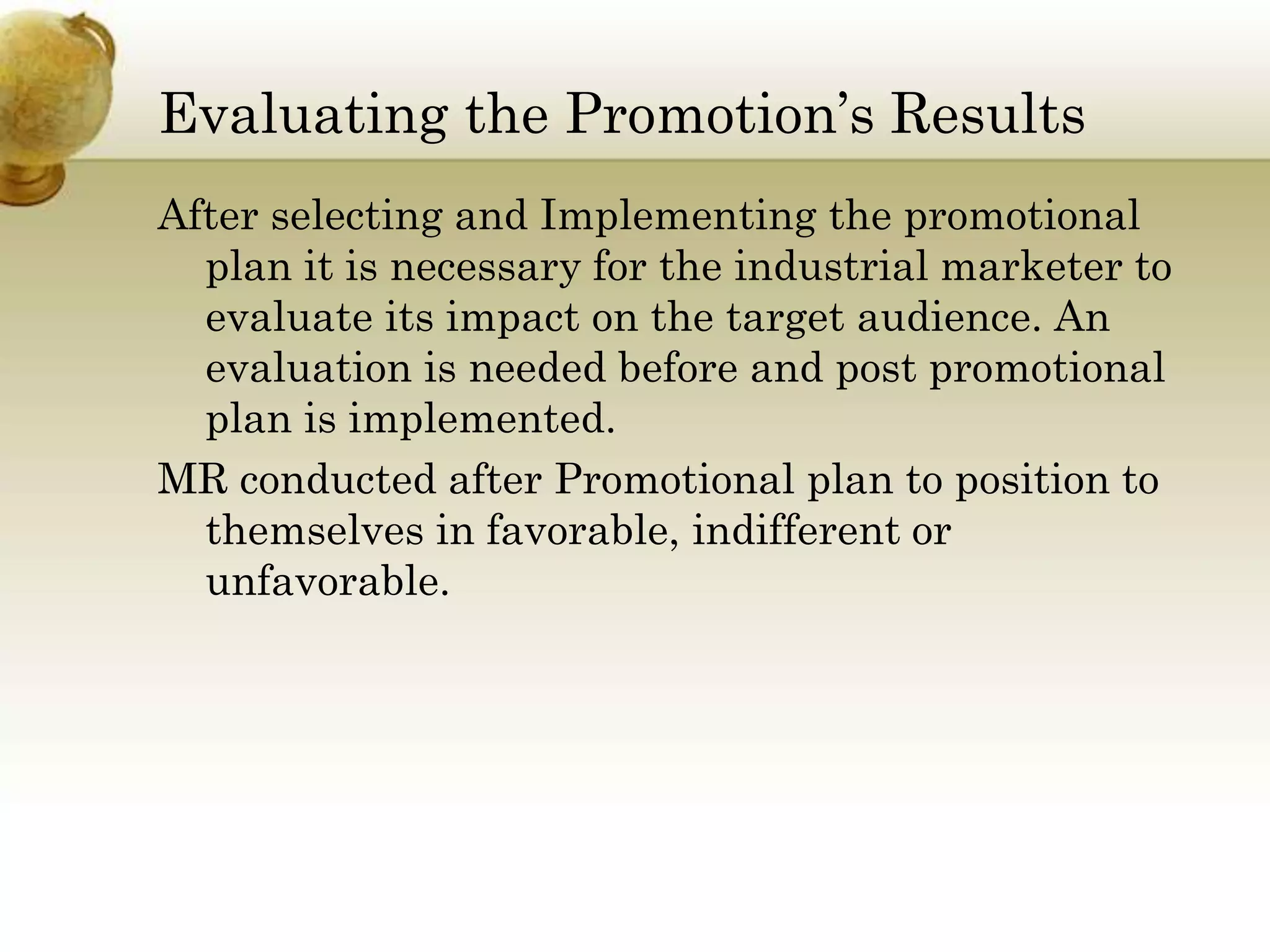
Evaluating the Promotion’s Results
After selecting and Implementing the promotional
plan it is necessary for the industrial marketer to
evaluate its impact on the target audience. An
evaluation is needed before and post promotional
plan is implemented.
MR conducted after Promotional plan to position to
themselves in favorable, indifferent or
unfavorable.
The major mistakes in practice are
1. Failure to quantify the promotional objectives
into measurable goals
2. Not to plan evaluation.
Integrating the Promotional Programme
Many Companies have recognized the importance of integrating
the promotional plan and are adopting the concept of
Integrating marketing communications (IMC)
The basic objective is to provide clarity, consistency, maximum
impact,
and
cost-effectiveness
to
the
company's
communication plan. To achieve this objective the following
are suggested…

• The company should appoint the head of communication
• The company should build a database by measuring the
results 0f the promotional plan in relation to the
communication goals, cost effectiveness of P Media, and
message consistency.
• Conduct the training for all the persons handling various
tools so that they think of integrating.
Role of Advertizing in IM
R
e
l
a
t
i
v
e

Advertrizing
Sales Promotion

S
p
e
n
d
i
n
g

Personnal Selling
Direct Selling
Publicity & PR

Promotional Tools
Consumer Markets

Promotional Tools
Industrial Markets
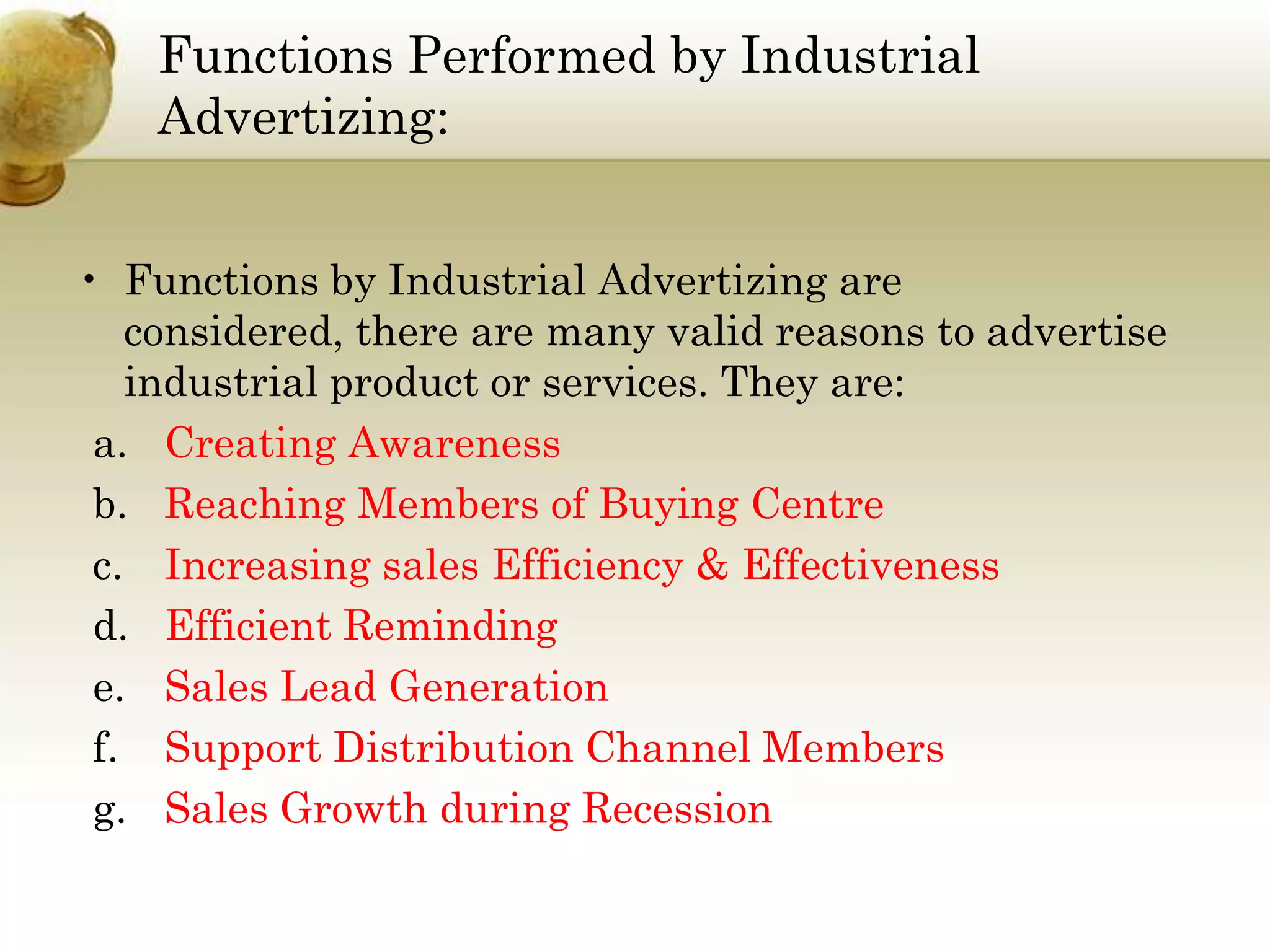
Functions Performed by Industrial
Advertizing:
• Functions by Industrial Advertizing are
considered, there are many valid reasons to advertise
industrial product or services. They are:
a. Creating Awareness
b. Reaching Members of Buying Centre
c. Increasing sales Efficiency & Effectiveness
d. Efficient Reminding
e. Sales Lead Generation
f. Support Distribution Channel Members
g. Sales Growth during Recession
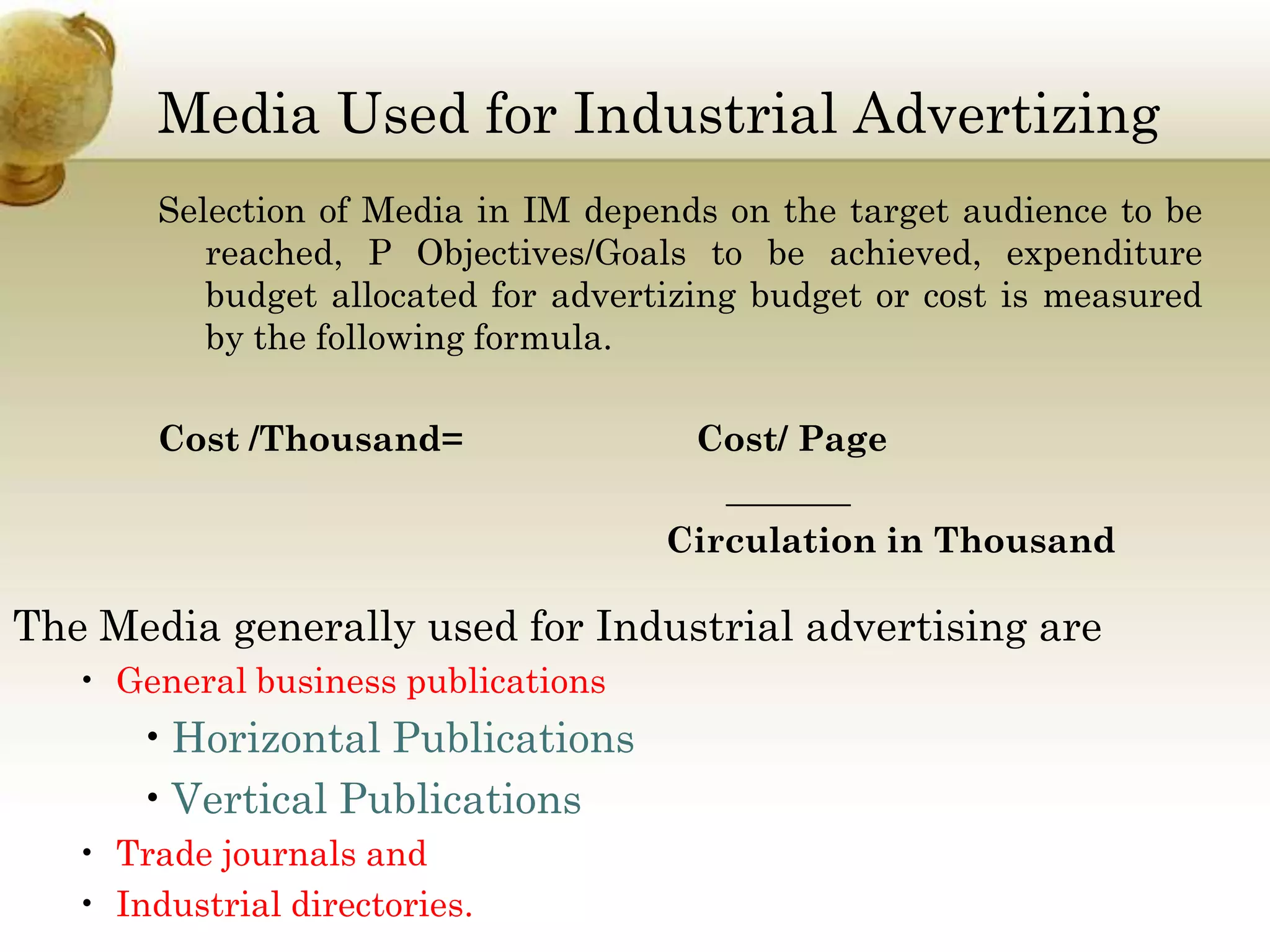
Media Used for Industrial Advertizing
Selection of Media in IM depends on the target audience to be
reached, P Objectives/Goals to be achieved, expenditure
budget allocated for advertizing budget or cost is measured
by the following formula.
Cost /Thousand=

Cost/ Page
_______
Circulation in Thousand

The Media generally used for Industrial advertising are
• General business publications

• Horizontal Publications
• Vertical Publications
• Trade journals and
• Industrial directories.
The Role of Sales Promotion, Public Relations, Publicity
& Direct Marketing In BM

Sales Promotion: the objectives in BM are to gather
leads, impressing, rewarding customers &
stimulating the sales force to greater effort. The
methods used in IM for Sales Promotion.
• Trade Shows
• Sales Contests
• Seminars
• Demonstration
• Catalogues
• Promotional Letters
• Entertainment
• Promotional Novelties
Role of Direct Marketing:
• Direct Mail
• Telemarketing
• Online Marketing Channels
Role of Publicity & Public Relations
They typically located at head Quarters deals
various categories of people.
Publicity is more credible and low cost compare to
advertising.
Organizing
the Sales Force
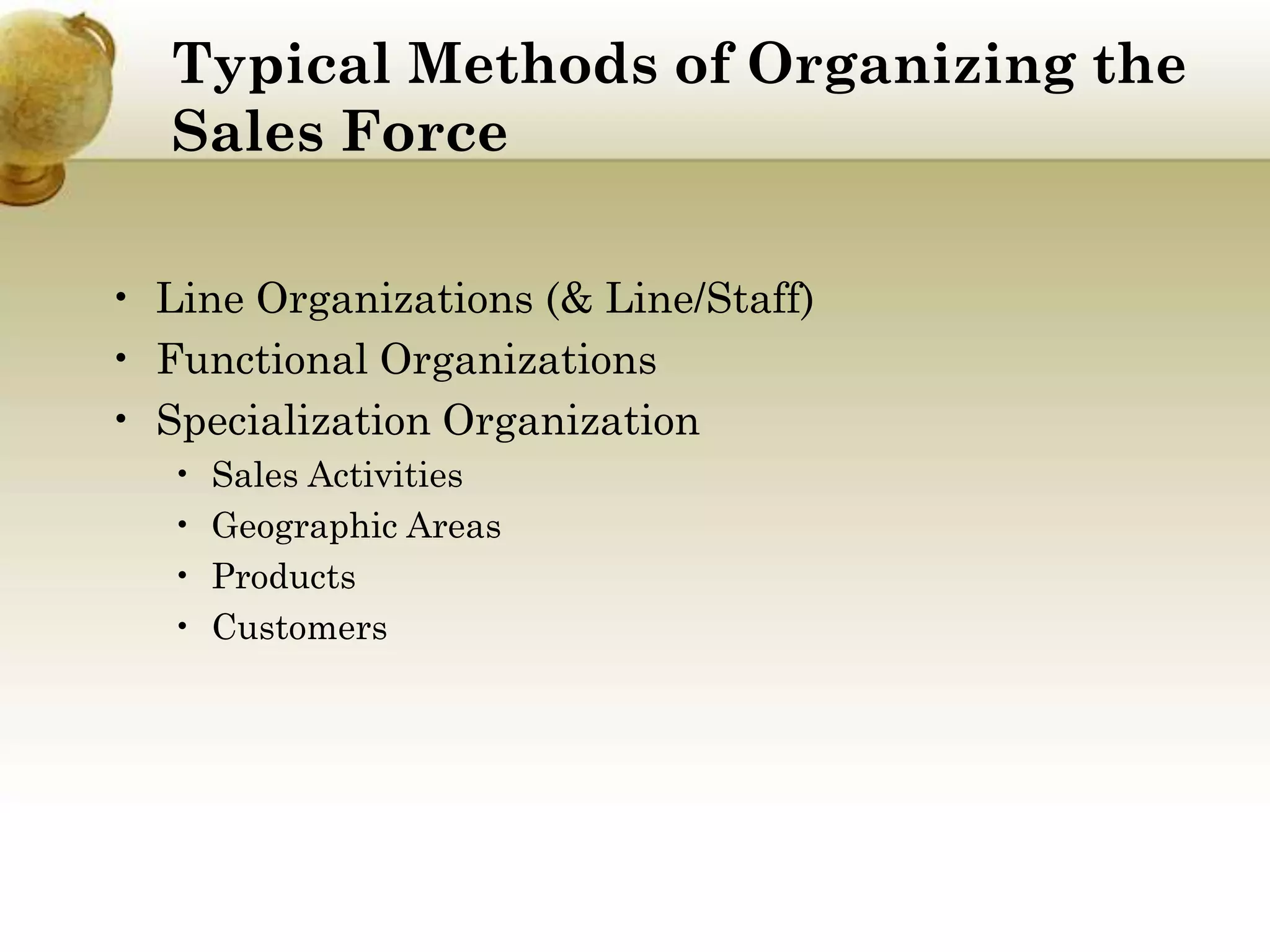
Typical Methods of Organizing the
Sales Force
• Line Organizations (& Line/Staff)
• Functional Organizations
• Specialization Organization
•
•
•
•

Sales Activities
Geographic Areas
Products
Customers
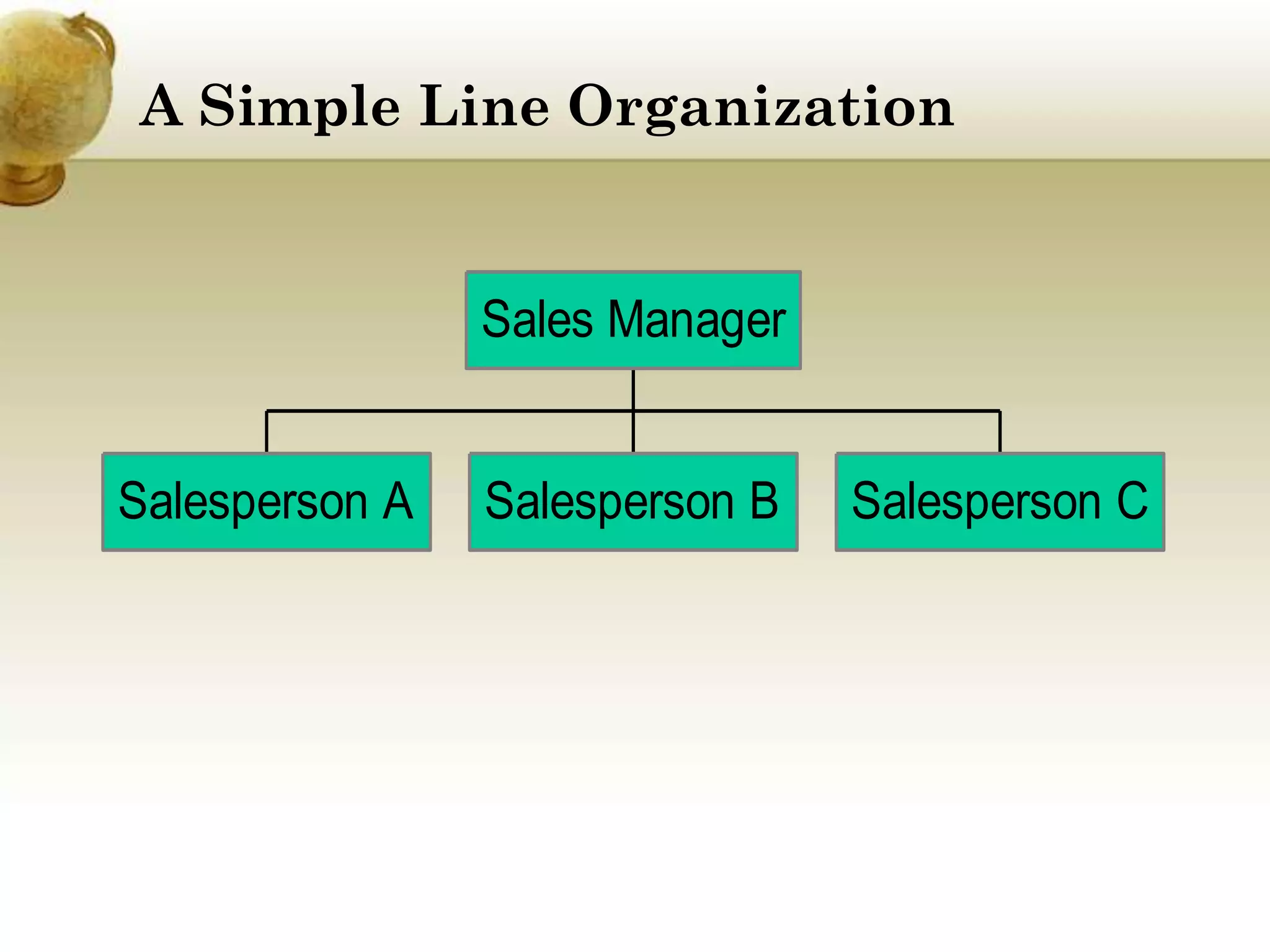
A Simple Line Organization

Sales Manager

Salesperson A

Salesperson B

Salesperson C
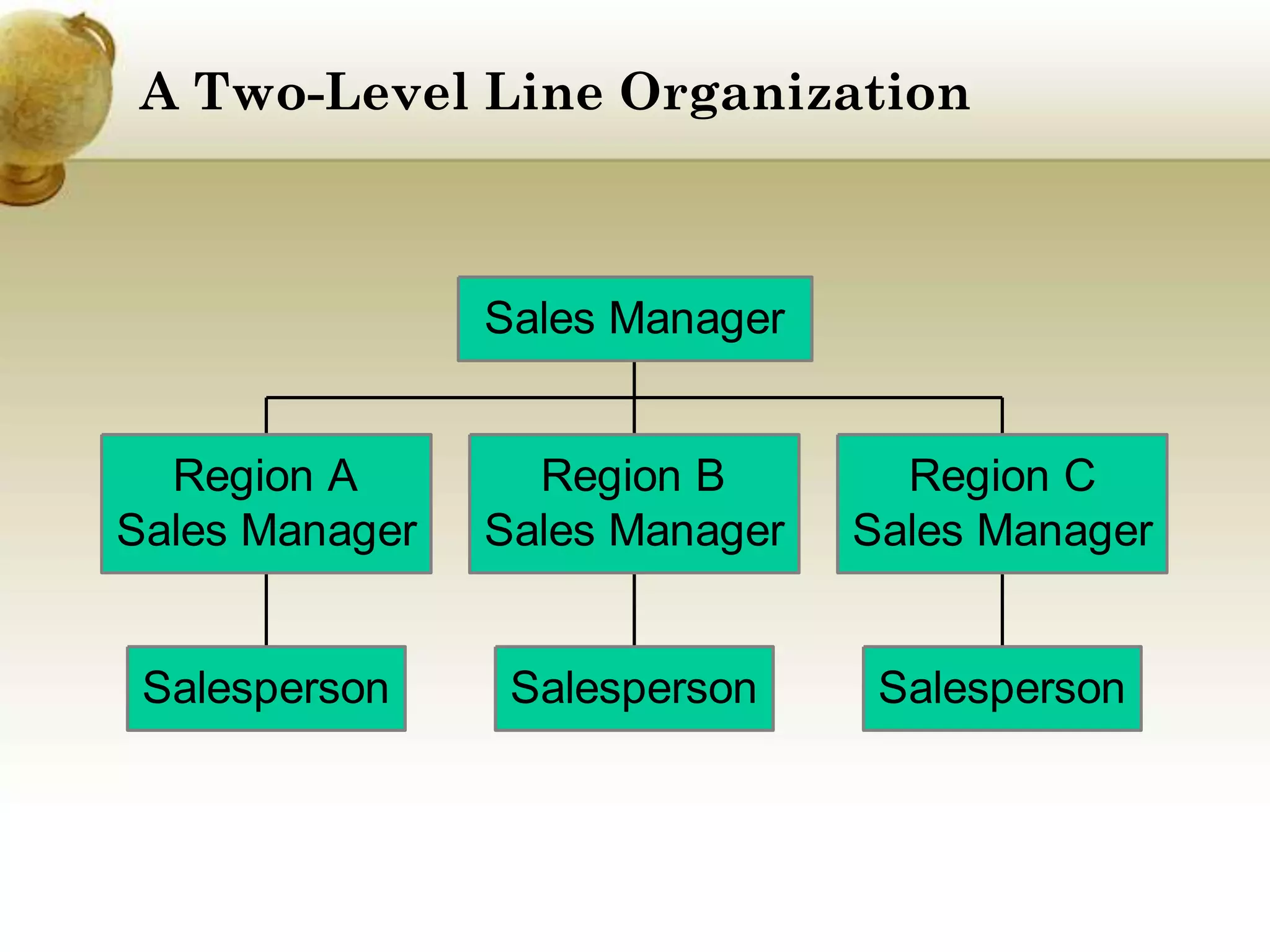
A Two-Level Line Organization

Sales Manager

Region A
Sales Manager

Region B
Sales Manager

Region C
Sales Manager

Salesperson

Salesperson

Salesperson
Line Organizations
• Advantages
• Very simple to understand and use.
• Easy to trace accountability.
• Relatively inexpensive (only a few highly-paid
executives are necessary)
• Quick action possible since decision-making is in
hands of relatively few people.
• Disadvantages
– As organization size increases, problems become
more complex.
– Specialized skills often needed.
– Many sales managers cannot keep on top of all
functions that relate to sales.
– Lack of trained replacements.
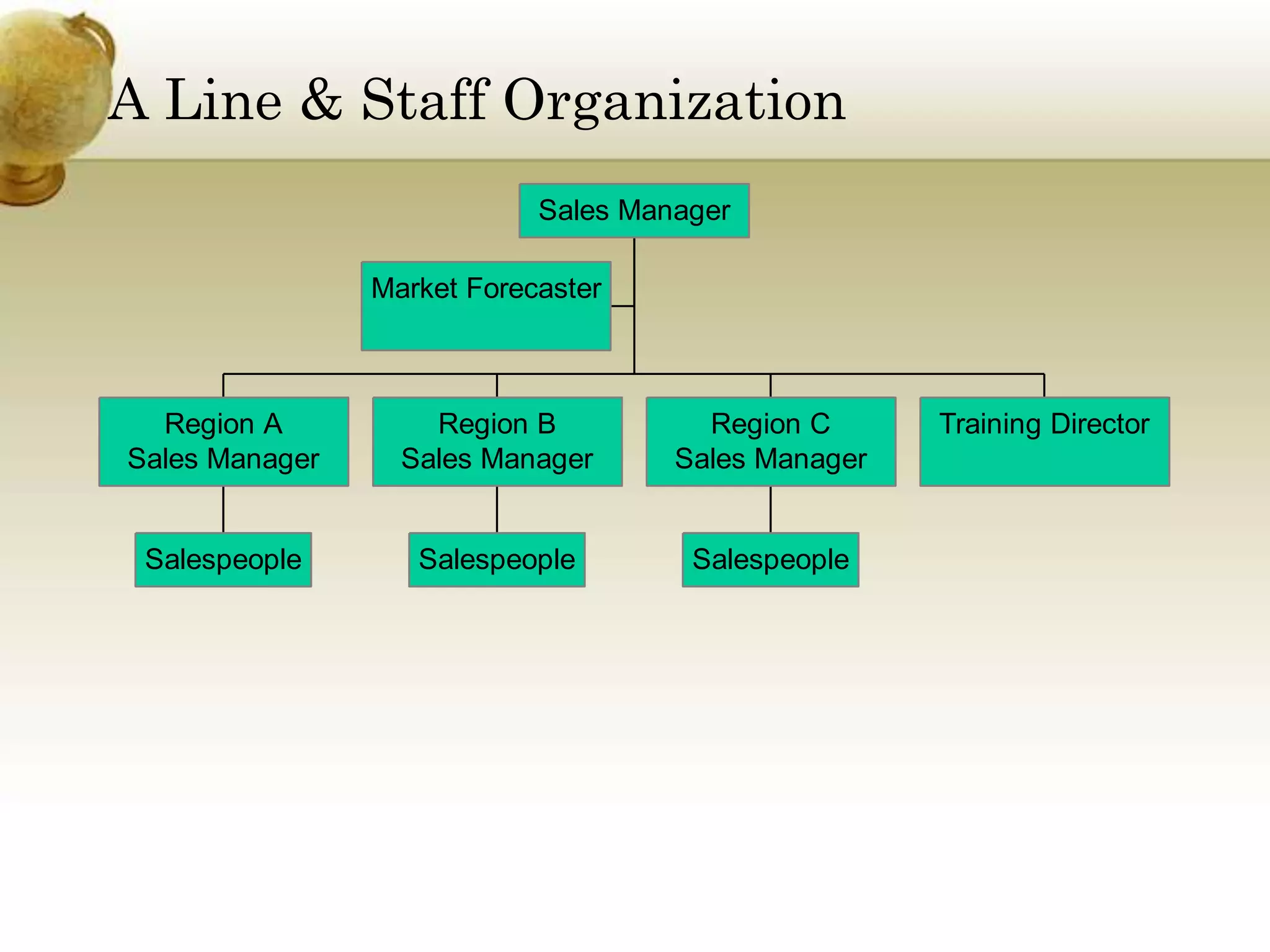
A Line & Staff Organization
Sales Manager

Market Forecaster

Region A
Sales Manager

Region B
Sales Manager

Region C
Sales Manager

Salespeople

Salespeople

Salespeople

Training Director
Line and Staff Organizations
• Characteristics
• Same as line organization except staff positions added
• Staff positions don’t have authority over line positions

• Advantages
• Staff provide sales manager with specialized skills
• Allows sales manager to be more efficient/ effective.
• Doesn’t dilute his/her authority/contact w/salespeople.
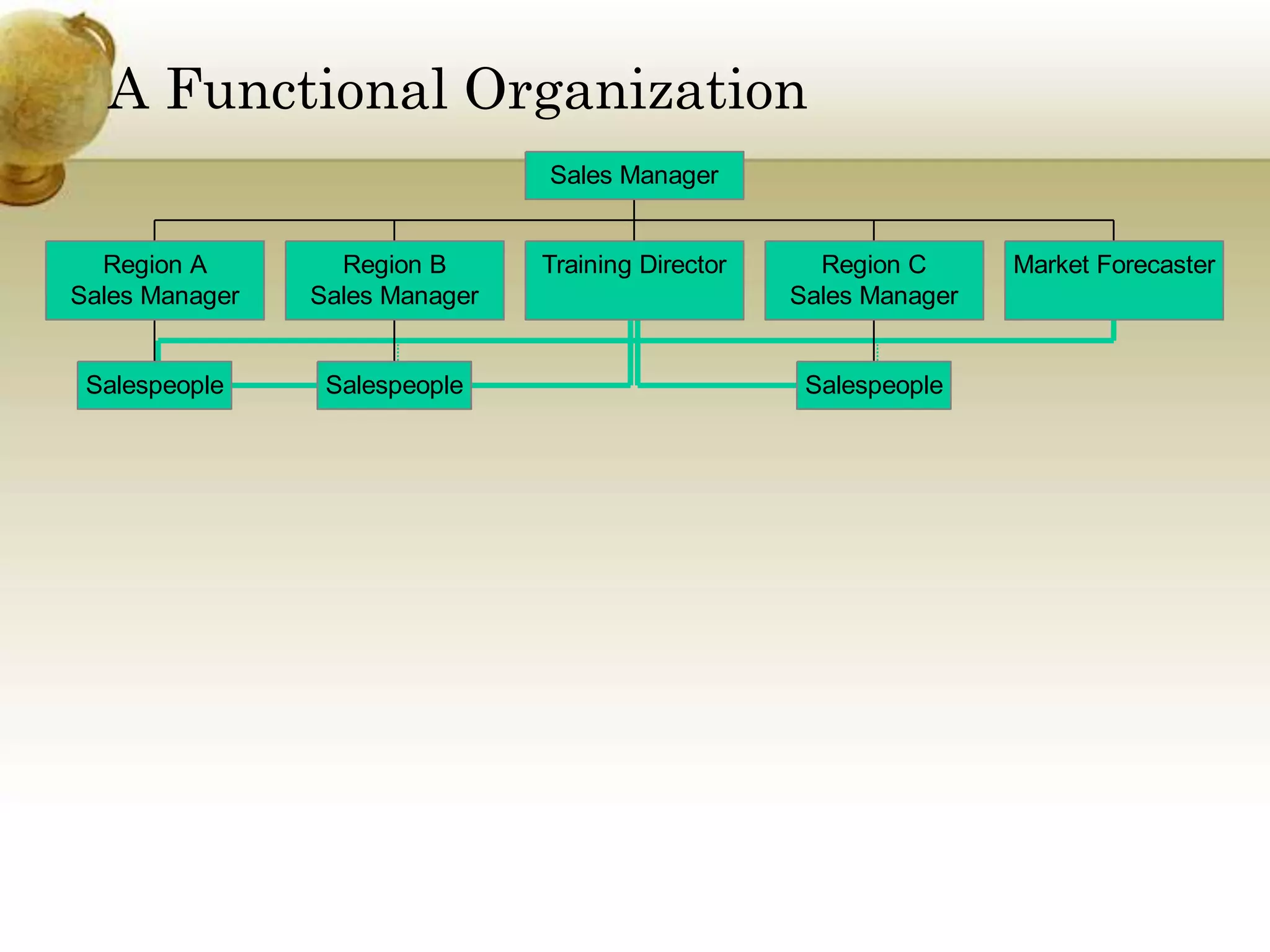
A Functional Organization
Sales Manager

Region A
Sales Manager

Region B
Sales Manager

Salespeople

Salespeople

Training Director

Region C
Sales Manager

Salespeople

Market Forecaster
Functional Organizations
• Characteristics
• Organization divided by function.
• Functional specialists have line authority.
• Salespeople report to multiple bosses.

• Advantages
• Specialist ensure their functions are carried out.
• Should improve performance in each functional area due to the
specialization.

• Disadvantages
• Can be more expensive than a line organization.
• Conflicts may arise between line & staff executives.
• Staff executives may attempt to exert authority over line
personnel.
• Line executives may ignore the counsel of the staff
Centralized vs. Decentralized?
Factors That Influence
• Size of Sales Force
•
•
•
•

As sales force size increases, the need to decentralize increases.
Span-of-control problems emerge
More field managers will be necessary
Decentralization more feasible
Sales Organizations
•
•
•
•

Geographical Organization
Product Organization
Combination of Product and Geographical
Market Organization

1-34
Sales Force Administration
 Recruitment and Selection

 Training
 Supervision and Motivation
 Evaluation and Control
Managing the Sales Force
• Recruitment and selection begins with Selection
criteria:
• Human relation skills, communication
skills, Technical background, job knowledge etc
• Personal interviews
Training Industrial sales force
• Aims
• Contents(Company product and Market
information)
• Methods
• Execution
• Evaluation

1-37
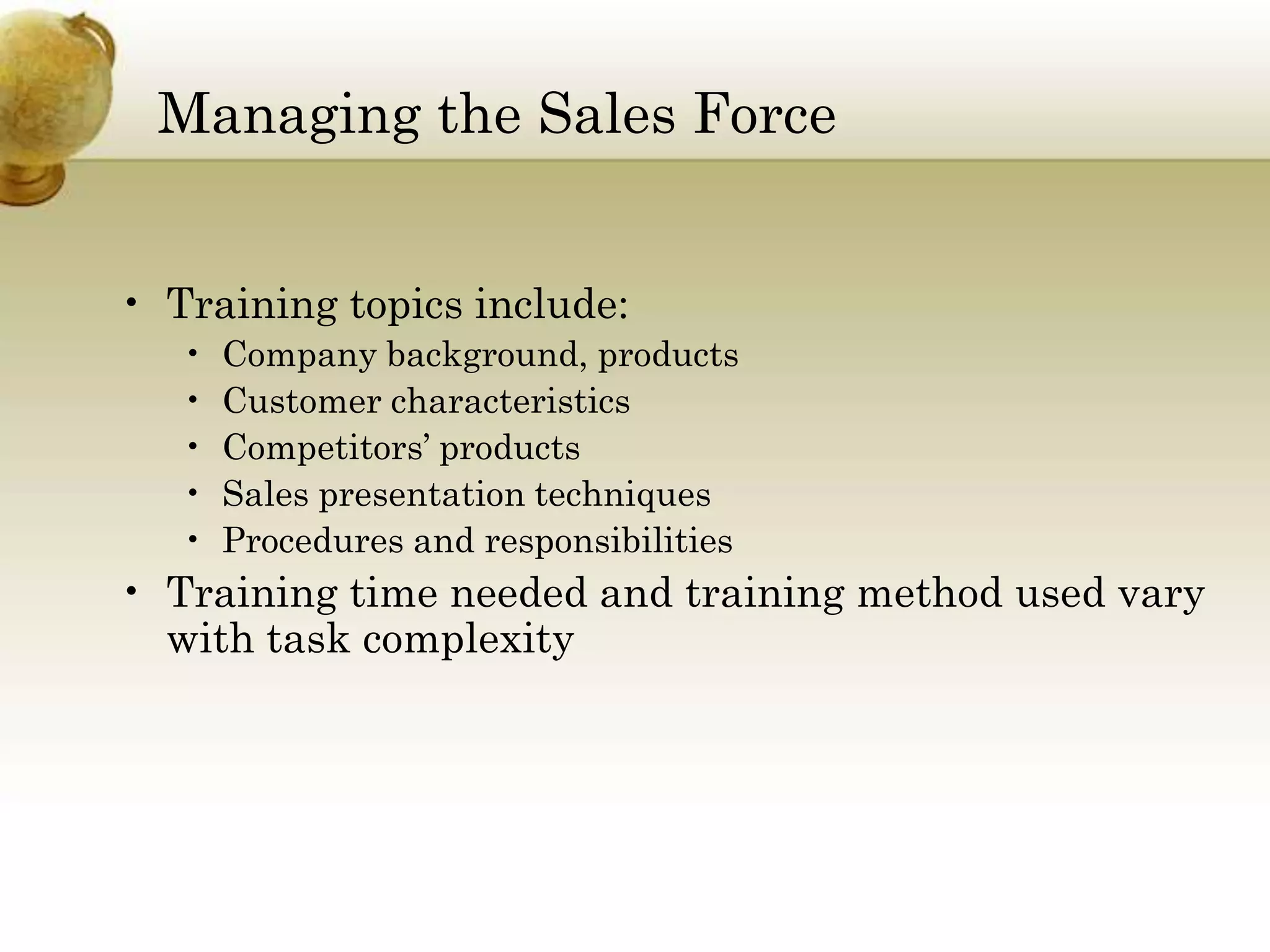
Managing the Sales Force
• Training topics include:
•
•
•
•
•

Company background, products
Customer characteristics
Competitors’ products
Sales presentation techniques
Procedures and responsibilities

• Training time needed and training method used vary
with task complexity
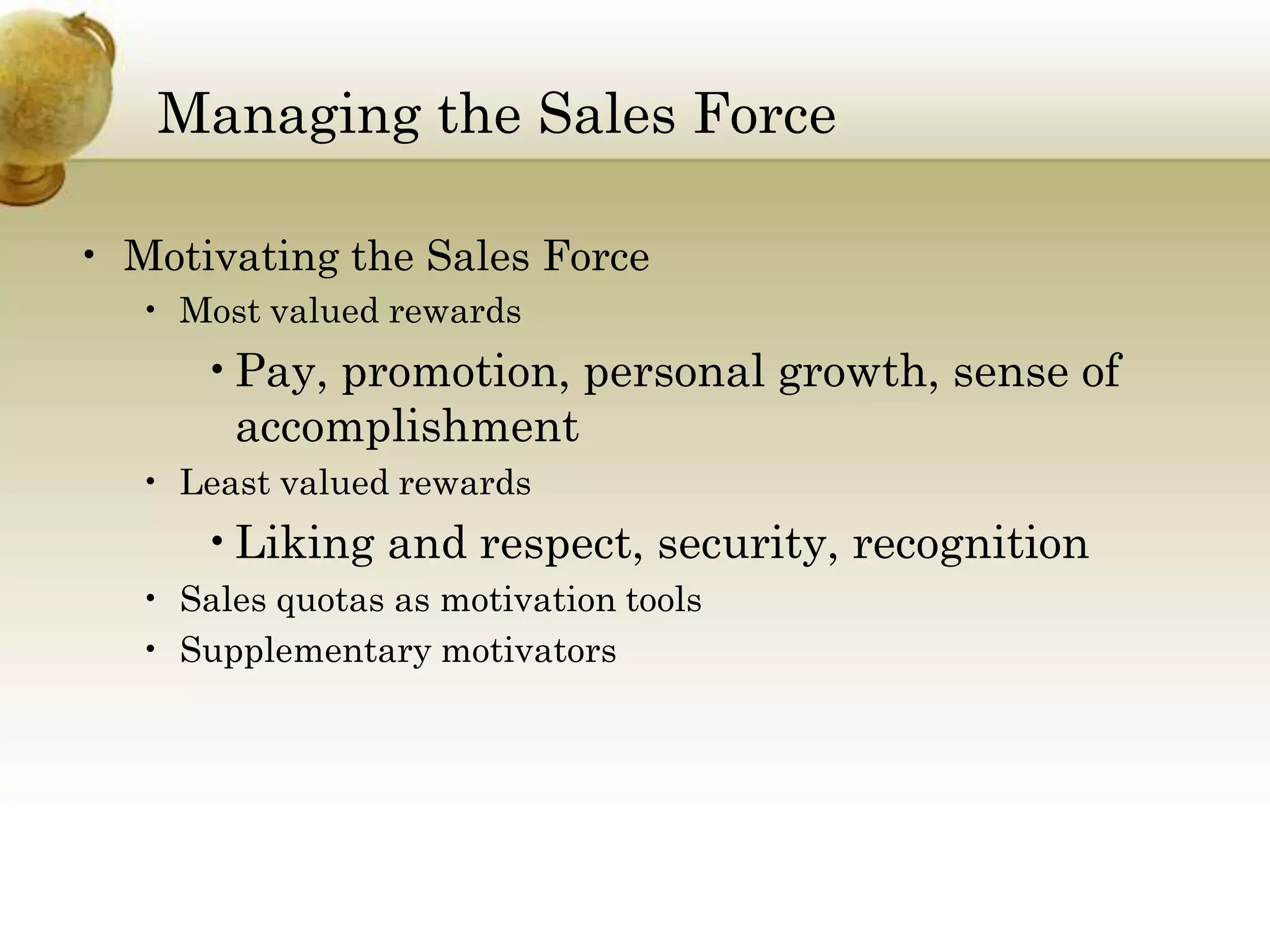
Managing the Sales Force
• Motivating the Sales Force
• Most valued rewards

•Pay, promotion, personal growth, sense of
accomplishment
• Least valued rewards

•Liking and respect, security, recognition
• Sales quotas as motivation tools
• Supplementary motivators
Orville Walker Jr., Gilbert Churchill Jr., and Neil Ford define
motivation as:
The amount of effort the salesperson “desires to expend on each of
the activities or tasks associated with his (her) job, such as calling
on potential new accounts, planning sales presentations, and filling
out reports.”

Determinan
ts of a
Salesperso
n’s
Performanc
e
Two Types of Rewards
1. Internally mediated rewards
2. Externally mediated rewards
Developing the sales force
• BLAKE AND MOUTON MANAGERIAL GRID

1-42
BLAKE AND MOUTON MANAGERIAL GRID

1-43
Evaluating the Sales Force
• Sources of information

•Sales or call reports, personal
observation, customer letters and
complaints, customer surveys, other
representatives
• Formal evaluation

•Performance comparisons
•Knowledge assessments
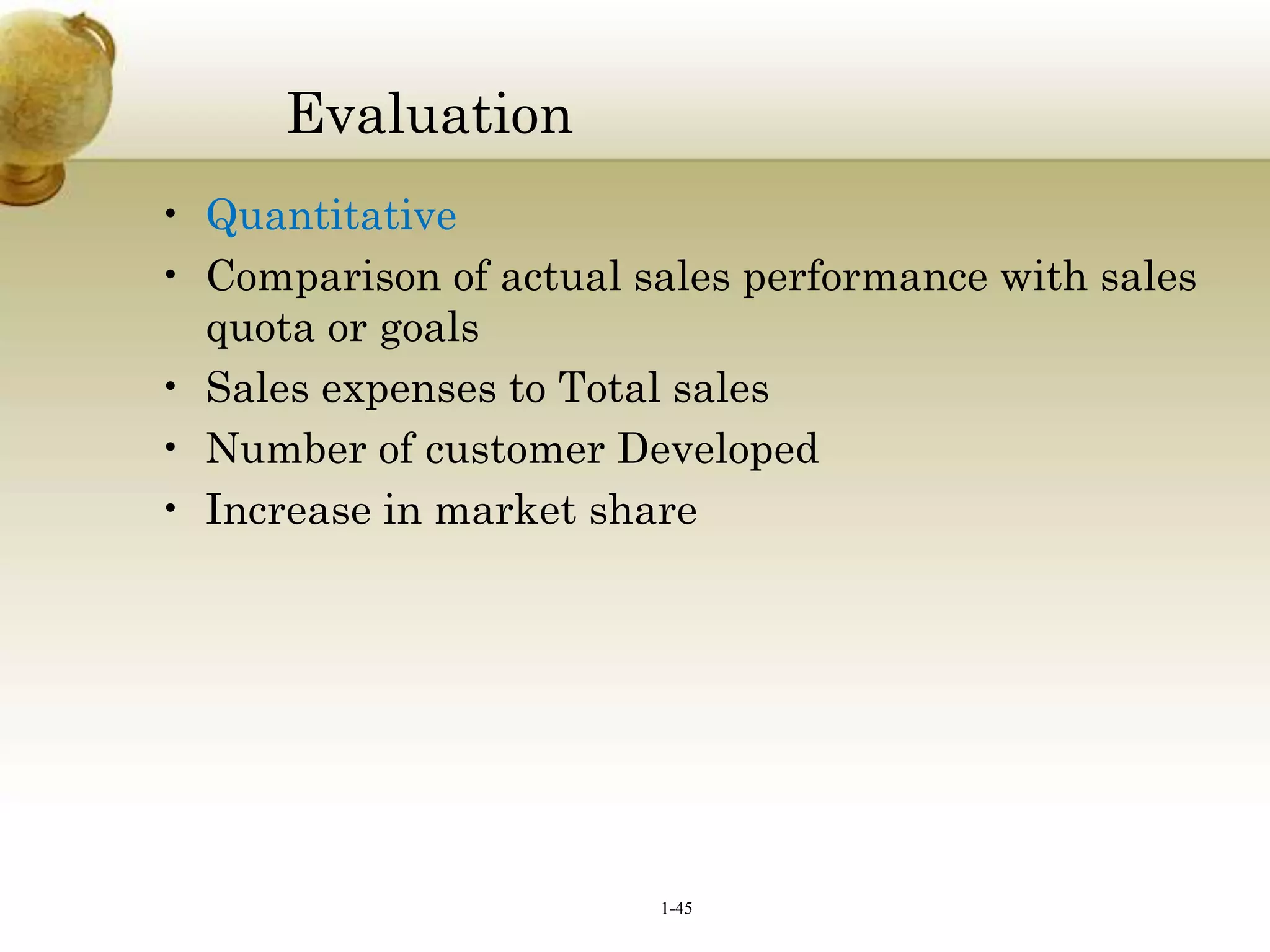
Evaluation
• Quantitative
• Comparison of actual sales performance with sales
quota or goals
• Sales expenses to Total sales
• Number of customer Developed
• Increase in market share

1-45
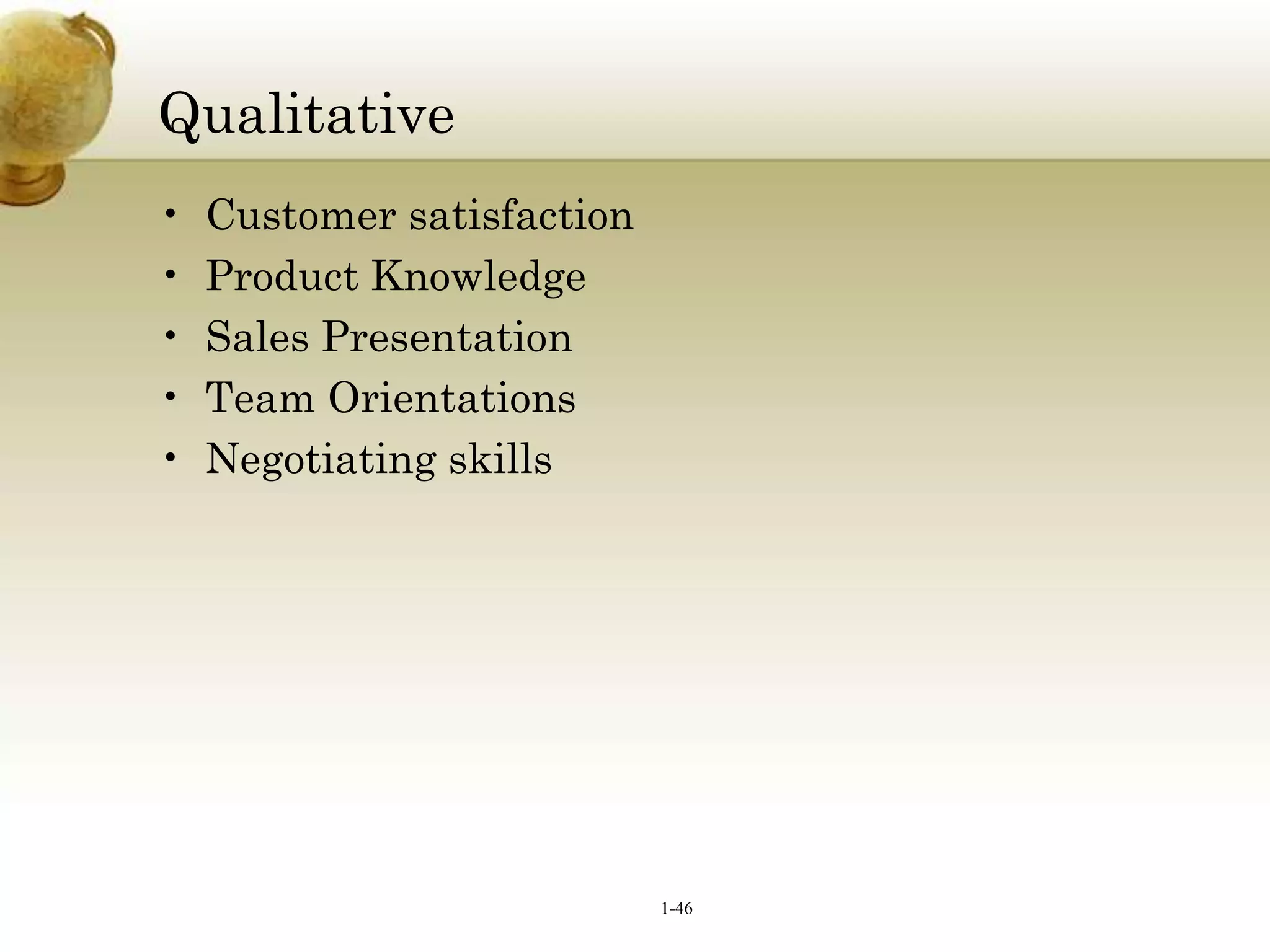
Qualitative
•
•
•
•
•

Customer satisfaction
Product Knowledge
Sales Presentation
Team Orientations
Negotiating skills

1-46
Management By Objectives(MBO)
(Effective control tool)
• Joint Goal setting
• Review actual performance periodically
• Identify reasons for deviations
• Corrective actions

1-47
Deployment of sales force
• Setting up of sales territories
• Determining size of sales force
• Allocating sales force to the sales territories

1-48
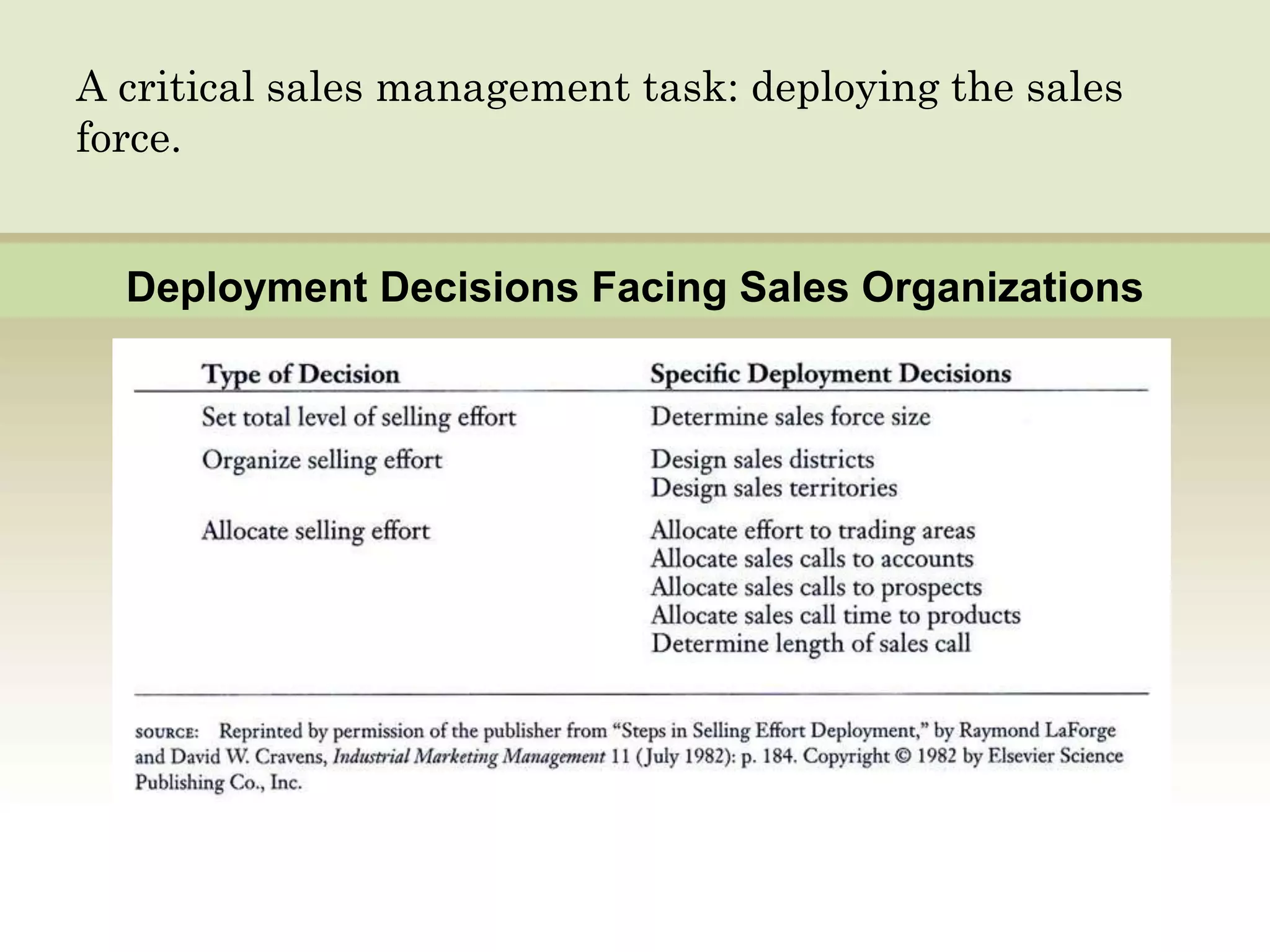
A critical sales management task: deploying the sales
force.

Deployment Decisions Facing Sales Organizations
• Deployment analysis
matches sales resources to
market opportunities.
• A sales resource
opportunity grid can be
used to classify the
industrial firm’s portfolio of
PCU’s.
• PCU opportunity is the
total potential that the
PCU represents for all
sellers.
• Sales organization strength
includes the competitive
advantages or distinctive
competencies that the firm
enjoys within the PCU.

Sales Resource
Opportunity Grid

Business marketing -module_4

  • 1.
  • 2.
    Promotional Strategies The promotionalmix for industrial products & services is different from the promotional mix for consumer goods. This is due to the fact of technical nature of industrial product and relatively smaller in industrial buyers and complex nature of organizational buying process.
  • 3.
    Developing the IndustrialCommunication The major steps involved in developing effective communication or promotional programme are: • • • • • • • Determine communication objectives Identify the target audiences Determine the promotional budget Develop the message strategy Select the media Evaluate the promotion’s results Integrate the promotional programme
  • 4.
    Determining the communicationobjectives Promotional objectives are formulated based on the firm’s overall corporate and marketing objectives. Once the objectives are established, an industrial firm choose the strategies and actions required to achieve the set objectives.
  • 5.
    Before determining communicationobjectives, the industrial marketer should find out the communication problems. This can be done by collecting the data ( Through marketing research) on the existing levels of awareness and attitudes of the existing & prospective customers. Data would help in setting specific communication goal. • Data collections permits measurement of the quantified communication objectives. • The purpose of the communication programme is to move the potential buyer from unawareness to buying action. 3 stages of Buying behavior • Buyer’s awareness levels • Changes in buyer’s attitudes • Buying actions
  • 6.
    Identifying the targetAudience • BM must be clear about the target audience. In Industrial Marketing the target market is clearly classified at 2 levels and they are Firstly, identify the buying organization based on the target segments. Secondly, identify the attitudes & buying factors used by buying centre (committee) in the organizations It is importance to assess the target audience’s current image of the company, its products, and its competitors. This information can be obtained by conducting a market research study to understand the awareness levels and attitudes of the buying centre members. The data will also be useful in developing message strategy and media plan.
  • 7.
    Determine the PromotionalBudget • This is most difficult decisions the companies are facing is the questions as to “how much to spend on promotional or what should be the promotional or communications budget” The promotional budget consist of advertising, sales promotion, direct marketing, and publicity. • There are four common methods used to set a promotional budget, they are Affordable budget Percentage of sales method Competitive-parity method Objective-task method
  • 8.
    Affordable Budget Method •Many companies set this type of method on what they think the company can afford. • This method ignores the role of promotional as an investment and its impact on sales volume Percentage of Sales Method • This is most common method used in Industrial Marketing to set the expenditure budget for promotion is a specified % of sales, either sales in the previous year or in the current year/ Forecasted sales. • At times a % of sales , an “what are the other competing firms doing” and what can we afford”, thus using all the 3 methods.
  • 9.
    The promotional budgetis decided in two steps, Firstly, total marketing budget Secondly, the advertising or promotional budget Advantages: • The finance managers are satisfied that the promotional expenses have a close relationship to the sales. • The method considers affordability • The parity with competitors is maintained. Disadvantages: It does not encourage building up promotional budget by determining what each product and territory deserves.
  • 10.
    Competitive- Parity Method Fewercompanies set their promotional budget by spending the same percentage of the sales on promotion as that of competitors. There are two arguments in this method. 1. Average expenditure of the companies would represent a collective wisdom of the industry. 2. Maintaining the parity with the competitors, it would help to prevent promotional wars. Objective and Task Method In this method, IM develop their promotion budgets by defining promotional objectives, determining the tasks that should performed to achieve the promotional objectives, and estimating the costs of performing the tasks. The sum of these costs is the proposed promotional budget, this method is relatively logical steps involved.
  • 11.
    Objective and TaskMethod In this method, IM develop their promotion budgets by defining promotional objectives, determining the tasks that should performed to achieve the promotional objectives, and estimating the costs of performing the tasks. The sum of these costs is the proposed promotional budget, this method is relatively logical steps involved. Advantage It forces firm to think in terms of objectives/goals & how to achieve those goals. Disadvantage It has difficulty of determining in advance the amount of funds required to achieve these goals
  • 12.
    Developing the MessageStrategy This indicates how to achieve the communication objectives. The message/ Theme/Appeal is developed to determine “what to say” to the target audience so as achieve the desired results. In BM, the message should be more rational. The rational appeals are developed either from position strategy or by conducting MR studies. BM should remember two important points while developing communication messages. Firstly, Any Industrial Buyers are fairly well informed or knowledgeable. Secondly, Instead of the message discussing product features, the message should focus on customer benefits
  • 13.
    Selecting the Media Thiscriteria depends on the target audience to be reached, the statement of the communication objectives, and the promotional budget. The selection depends on whether the advertiser wishes to penetrate a particular industry or various industries The selection depends on the circulation & cost of advertising space. The different communication/ Promotional tools/ P Media that used in BM are…
  • 14.
    Communication/ P Tools& P Media Used Promotion Advertisi al Tools ng Sales Promotion Public Direct Relations Marketing & Publicity Promotional Media, And Promotional Supports •Trade Shows •Exhibitions •Catalogues •Sales Contests •Promotional Novelties •Seminars •Demonstratio n •Promotional Letters •Entertainme nt •Charitabl e donations •Adopting villages •Communi ty relations •News item in press •Print media •General Business •Trade journals •Industrial directories •Direct Mail •Telemarket ing •On-line Marketing channels Personal Selling •Sales calls •Sales presentatio n •Team selling •Relationshi p marketing
  • 15.
    Effectiveness of PMedia Ranking Promotional Media Index of Effectiveness 1 Personal Selling 100 2 Catalogues, Specifications Sheets 46 3 Direct Mail 39 4 Advertising 38 5 Trade Shows and Exhibitions 35 6 Samples, demonstrations 34 7 Publicity & Public relations 31 8 Customer entertainment 26 9 Promotional gift ( Novelties) 24
  • 16.
    Evaluating the Promotion’sResults After selecting and Implementing the promotional plan it is necessary for the industrial marketer to evaluate its impact on the target audience. An evaluation is needed before and post promotional plan is implemented. MR conducted after Promotional plan to position to themselves in favorable, indifferent or unfavorable.
  • 17.
    The major mistakesin practice are 1. Failure to quantify the promotional objectives into measurable goals 2. Not to plan evaluation.
  • 18.
    Integrating the PromotionalProgramme Many Companies have recognized the importance of integrating the promotional plan and are adopting the concept of Integrating marketing communications (IMC) The basic objective is to provide clarity, consistency, maximum impact, and cost-effectiveness to the company's communication plan. To achieve this objective the following are suggested… • The company should appoint the head of communication • The company should build a database by measuring the results 0f the promotional plan in relation to the communication goals, cost effectiveness of P Media, and message consistency. • Conduct the training for all the persons handling various tools so that they think of integrating.
  • 19.
    Role of Advertizingin IM R e l a t i v e Advertrizing Sales Promotion S p e n d i n g Personnal Selling Direct Selling Publicity & PR Promotional Tools Consumer Markets Promotional Tools Industrial Markets
  • 20.
    Functions Performed byIndustrial Advertizing: • Functions by Industrial Advertizing are considered, there are many valid reasons to advertise industrial product or services. They are: a. Creating Awareness b. Reaching Members of Buying Centre c. Increasing sales Efficiency & Effectiveness d. Efficient Reminding e. Sales Lead Generation f. Support Distribution Channel Members g. Sales Growth during Recession
  • 21.
    Media Used forIndustrial Advertizing Selection of Media in IM depends on the target audience to be reached, P Objectives/Goals to be achieved, expenditure budget allocated for advertizing budget or cost is measured by the following formula. Cost /Thousand= Cost/ Page _______ Circulation in Thousand The Media generally used for Industrial advertising are • General business publications • Horizontal Publications • Vertical Publications • Trade journals and • Industrial directories.
  • 22.
    The Role ofSales Promotion, Public Relations, Publicity & Direct Marketing In BM Sales Promotion: the objectives in BM are to gather leads, impressing, rewarding customers & stimulating the sales force to greater effort. The methods used in IM for Sales Promotion. • Trade Shows • Sales Contests • Seminars • Demonstration • Catalogues • Promotional Letters • Entertainment • Promotional Novelties
  • 23.
    Role of DirectMarketing: • Direct Mail • Telemarketing • Online Marketing Channels Role of Publicity & Public Relations They typically located at head Quarters deals various categories of people. Publicity is more credible and low cost compare to advertising.
  • 24.
  • 25.
    Typical Methods ofOrganizing the Sales Force • Line Organizations (& Line/Staff) • Functional Organizations • Specialization Organization • • • • Sales Activities Geographic Areas Products Customers
  • 26.
    A Simple LineOrganization Sales Manager Salesperson A Salesperson B Salesperson C
  • 27.
    A Two-Level LineOrganization Sales Manager Region A Sales Manager Region B Sales Manager Region C Sales Manager Salesperson Salesperson Salesperson
  • 28.
    Line Organizations • Advantages •Very simple to understand and use. • Easy to trace accountability. • Relatively inexpensive (only a few highly-paid executives are necessary) • Quick action possible since decision-making is in hands of relatively few people. • Disadvantages – As organization size increases, problems become more complex. – Specialized skills often needed. – Many sales managers cannot keep on top of all functions that relate to sales. – Lack of trained replacements.
  • 29.
    A Line &Staff Organization Sales Manager Market Forecaster Region A Sales Manager Region B Sales Manager Region C Sales Manager Salespeople Salespeople Salespeople Training Director
  • 30.
    Line and StaffOrganizations • Characteristics • Same as line organization except staff positions added • Staff positions don’t have authority over line positions • Advantages • Staff provide sales manager with specialized skills • Allows sales manager to be more efficient/ effective. • Doesn’t dilute his/her authority/contact w/salespeople.
  • 31.
    A Functional Organization SalesManager Region A Sales Manager Region B Sales Manager Salespeople Salespeople Training Director Region C Sales Manager Salespeople Market Forecaster
  • 32.
    Functional Organizations • Characteristics •Organization divided by function. • Functional specialists have line authority. • Salespeople report to multiple bosses. • Advantages • Specialist ensure their functions are carried out. • Should improve performance in each functional area due to the specialization. • Disadvantages • Can be more expensive than a line organization. • Conflicts may arise between line & staff executives. • Staff executives may attempt to exert authority over line personnel. • Line executives may ignore the counsel of the staff
  • 33.
    Centralized vs. Decentralized? FactorsThat Influence • Size of Sales Force • • • • As sales force size increases, the need to decentralize increases. Span-of-control problems emerge More field managers will be necessary Decentralization more feasible
  • 34.
    Sales Organizations • • • • Geographical Organization ProductOrganization Combination of Product and Geographical Market Organization 1-34
  • 35.
    Sales Force Administration Recruitment and Selection  Training  Supervision and Motivation  Evaluation and Control
  • 36.
    Managing the SalesForce • Recruitment and selection begins with Selection criteria: • Human relation skills, communication skills, Technical background, job knowledge etc • Personal interviews
  • 37.
    Training Industrial salesforce • Aims • Contents(Company product and Market information) • Methods • Execution • Evaluation 1-37
  • 38.
    Managing the SalesForce • Training topics include: • • • • • Company background, products Customer characteristics Competitors’ products Sales presentation techniques Procedures and responsibilities • Training time needed and training method used vary with task complexity
  • 39.
    Managing the SalesForce • Motivating the Sales Force • Most valued rewards •Pay, promotion, personal growth, sense of accomplishment • Least valued rewards •Liking and respect, security, recognition • Sales quotas as motivation tools • Supplementary motivators
  • 40.
    Orville Walker Jr.,Gilbert Churchill Jr., and Neil Ford define motivation as: The amount of effort the salesperson “desires to expend on each of the activities or tasks associated with his (her) job, such as calling on potential new accounts, planning sales presentations, and filling out reports.” Determinan ts of a Salesperso n’s Performanc e
  • 41.
    Two Types ofRewards 1. Internally mediated rewards 2. Externally mediated rewards
  • 42.
    Developing the salesforce • BLAKE AND MOUTON MANAGERIAL GRID 1-42
  • 43.
    BLAKE AND MOUTONMANAGERIAL GRID 1-43
  • 44.
    Evaluating the SalesForce • Sources of information •Sales or call reports, personal observation, customer letters and complaints, customer surveys, other representatives • Formal evaluation •Performance comparisons •Knowledge assessments
  • 45.
    Evaluation • Quantitative • Comparisonof actual sales performance with sales quota or goals • Sales expenses to Total sales • Number of customer Developed • Increase in market share 1-45
  • 46.
    Qualitative • • • • • Customer satisfaction Product Knowledge SalesPresentation Team Orientations Negotiating skills 1-46
  • 47.
    Management By Objectives(MBO) (Effectivecontrol tool) • Joint Goal setting • Review actual performance periodically • Identify reasons for deviations • Corrective actions 1-47
  • 48.
    Deployment of salesforce • Setting up of sales territories • Determining size of sales force • Allocating sales force to the sales territories 1-48
  • 49.
    A critical salesmanagement task: deploying the sales force. Deployment Decisions Facing Sales Organizations
  • 50.
    • Deployment analysis matchessales resources to market opportunities. • A sales resource opportunity grid can be used to classify the industrial firm’s portfolio of PCU’s. • PCU opportunity is the total potential that the PCU represents for all sellers. • Sales organization strength includes the competitive advantages or distinctive competencies that the firm enjoys within the PCU. Sales Resource Opportunity Grid