Performance Management
 Performance Management is a systematic process by an
Organisation to improve and evaluate the performance of its
employees as individuals as well as groups.”
 Performance management is a strategic and integrated approach to
delivering sustained success to organizations by improving the
performance of the people who work in them and by developing the
capabilities of teams and individual contributors‟ (Armstrong and
Baron, ).
10/21/2022 21
A successful performance management is
 Where the employee’s interests are understood by the
employer and renders his helping hand to develop
employee’s career as well as his performance and
 The employee understanding the requirements of the
organisation, cooperating and accepting the helping hand
of employer to increase his performance levels and thus
also his self.
 Performance Management is conducted and understood
on two classifications
1. Performance of the employees in the organisation, which
we are studying in detail in this course
2. Performance of the organisation, which is often the net
result of the total performance of all the employees put
together.
Principles of Performance Management
 Transparency
The system should be transparent, free from partiality, bias and
discrimination among the employees.
 Employee Empowerment
Participative and empowered employees take the responsibility well.
They develop the belongingness towards the organisation.
Recognizing and rewarding the employees brings them together to
work and achieve.
 Organisational Values and Culture
A fair treatment and ensuring due satisfaction to the employees,
empathy and trust, respect and treating people equally – are all the
foundations for the development of the Culture and values of the
organisation
 Amicable Workplace /friendly
A work environment which attracts the employee rather than
expecting the week end to be away from the workplace is the
principle
The scope of the performance management includes the following:
 Providing employees a better understanding of their role and
responsibilities
 Increase the confidence of the employees through recognizing their
strengths
 Identifying training needs to overcome the weak areas
 Improve the relationships in the working areas
 Improve communication between superior and subordinates
 Improve teams and team spirit
 Improve commitment
 Succession planning through grooming subordinates to future managers
 Providing space for personal reflections
 Providing a platform for personal development
 Providing assistance to achieve personal career goals
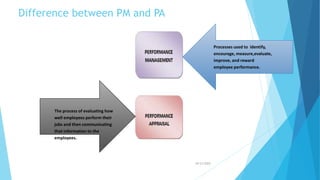
Difference between PM and PA
10/21/2022
Processes used to identify,
encourage, measure,evaluate,
improve, and reward
employee performance.
The process of evaluating how
well employees perform their
jobs and then communicating
that information to the
employees.
Performance management

Performance management

  • 19.
    Performance Management  PerformanceManagement is a systematic process by an Organisation to improve and evaluate the performance of its employees as individuals as well as groups.”  Performance management is a strategic and integrated approach to delivering sustained success to organizations by improving the performance of the people who work in them and by developing the capabilities of teams and individual contributors‟ (Armstrong and Baron, ).
  • 21.
    10/21/2022 21 A successfulperformance management is  Where the employee’s interests are understood by the employer and renders his helping hand to develop employee’s career as well as his performance and  The employee understanding the requirements of the organisation, cooperating and accepting the helping hand of employer to increase his performance levels and thus also his self.
  • 22.
     Performance Managementis conducted and understood on two classifications 1. Performance of the employees in the organisation, which we are studying in detail in this course 2. Performance of the organisation, which is often the net result of the total performance of all the employees put together.
  • 23.
    Principles of PerformanceManagement  Transparency The system should be transparent, free from partiality, bias and discrimination among the employees.  Employee Empowerment Participative and empowered employees take the responsibility well. They develop the belongingness towards the organisation. Recognizing and rewarding the employees brings them together to work and achieve.  Organisational Values and Culture A fair treatment and ensuring due satisfaction to the employees, empathy and trust, respect and treating people equally – are all the foundations for the development of the Culture and values of the organisation
  • 24.
     Amicable Workplace/friendly A work environment which attracts the employee rather than expecting the week end to be away from the workplace is the principle
  • 25.
    The scope ofthe performance management includes the following:  Providing employees a better understanding of their role and responsibilities  Increase the confidence of the employees through recognizing their strengths  Identifying training needs to overcome the weak areas  Improve the relationships in the working areas  Improve communication between superior and subordinates  Improve teams and team spirit  Improve commitment  Succession planning through grooming subordinates to future managers  Providing space for personal reflections  Providing a platform for personal development  Providing assistance to achieve personal career goals
  • 26.
    Difference between PMand PA 10/21/2022 Processes used to identify, encourage, measure,evaluate, improve, and reward employee performance. The process of evaluating how well employees perform their jobs and then communicating that information to the employees.